
MCOM 207 Essay 2 Question and Answer + Instructor Comments, Fall 2012
American University of Beirut · Digital Media Literacy · 11 pages · Ms. Sarah Mallat · with solution
Showing the first 10 of 11 pages. Download the PDF to see all of it.
More MCOM 207 files
Show the text of this file
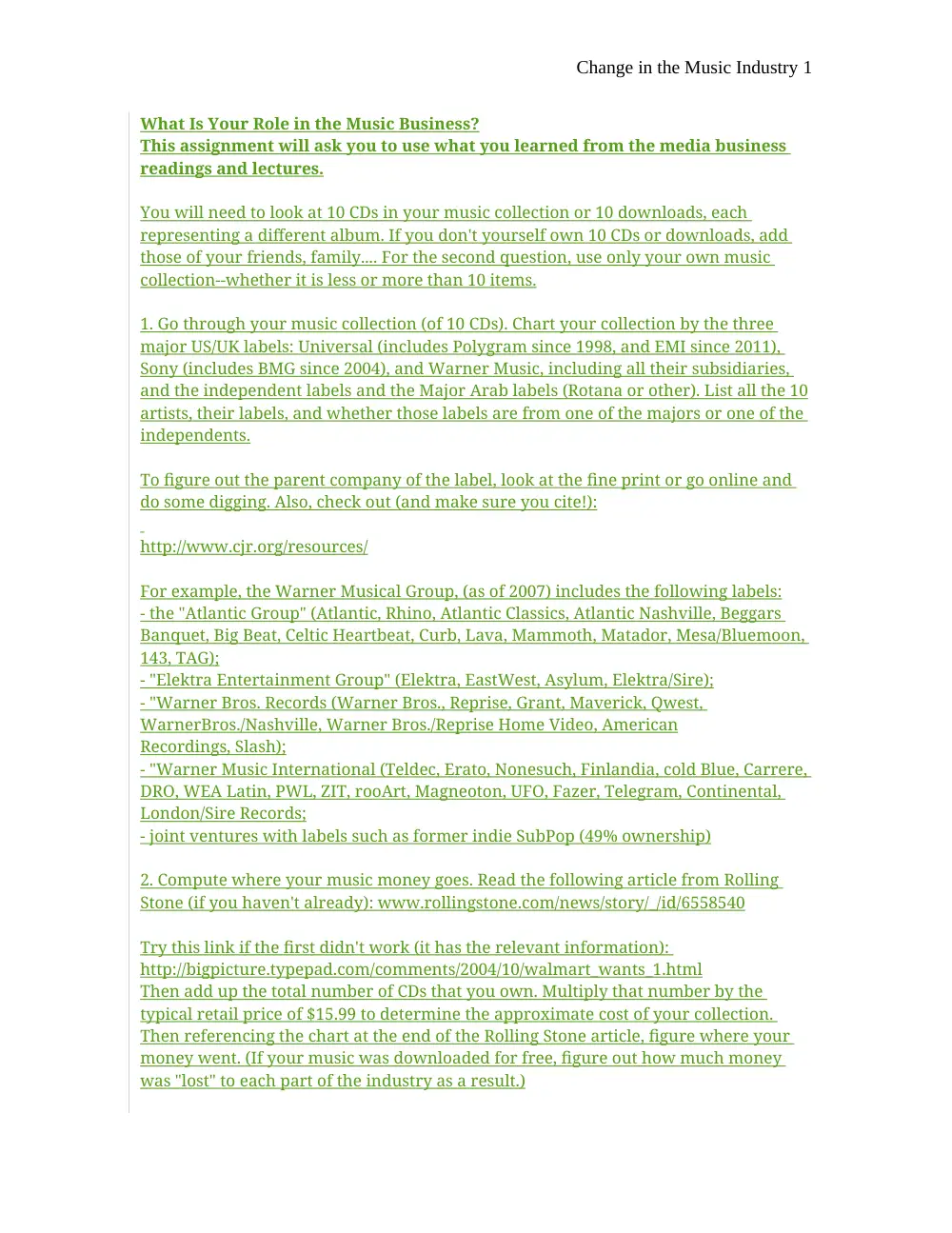
Change in the Music Industry 1
What Is Your Role in the Music Business?
This assignment will ask you to use what you learned from the media business
readings and lectures.
You will need to look at 10 CDs in your music collection or 10 downloads, each
representing a different album. If you don't yourself own 10 CDs or downloads, add
those of your friends, family.... For the second question, use only your own music
collection--whether it is less or more than 10 items.
1. Go through your music collection (of 10 CDs). Chart your collection by the three
major US/UK labels: Universal (includes Polygram since 1998, and EMI since 2011),
Sony (includes BMG since 2004), and Warner Music, including all their subsidiaries,
and the independent labels and the Major Arab labels (Rotana or other). List all the 10
artists, their labels, and whether those labels are from one of the majors or one of the
independents.
To figure out the parent company of the label, look at the fine print or go online and
do some digging. Also, check out (and make sure you cite!):
http://www.cjr.org/resources/
For example, the Warner Musical Group, (as of 2007) includes the following labels:
- the "Atlantic Group" (Atlantic, Rhino, Atlantic Classics, Atlantic Nashville, Beggars
Banquet, Big Beat, Celtic Heartbeat, Curb, Lava, Mammoth, Matador, Mesa/Bluemoon,
143, TAG);
- "Elektra Entertainment Group" (Elektra, EastWest, Asylum, Elektra/Sire);
- "Warner Bros. Records (Warner Bros., Reprise, Grant, Maverick, Qwest,
WarnerBros./Nashville, Warner Bros./Reprise Home Video, American
Recordings, Slash);
- "Warner Music International (Teldec, Erato, Nonesuch, Finlandia, cold Blue, Carrere,
DRO, WEA Latin, PWL, ZIT, rooArt, Magneoton, UFO, Fazer, Telegram, Continental,
London/Sire Records;
- joint ventures with labels such as former indie SubPop (49% ownership)
2. Compute where your music money goes. Read the following article from Rolling
Stone (if you haven't already): www.rollingstone.com/news/story/_/id/6558540
Try this link if the first didn't work (it has the relevant information):
http://bigpicture.typepad.com/comments/2004/10/walmart_wants_1.html
Then add up the total number of CDs that you own. Multiply that number by the
typical retail price of $15.99 to determine the approximate cost of your collection.
Then referencing the chart at the end of the Rolling Stone article, figure where your
money went. (If your music was downloaded for free, figure out how much money
was "lost" to each part of the industry as a result.)
Change in the Music Industry 2
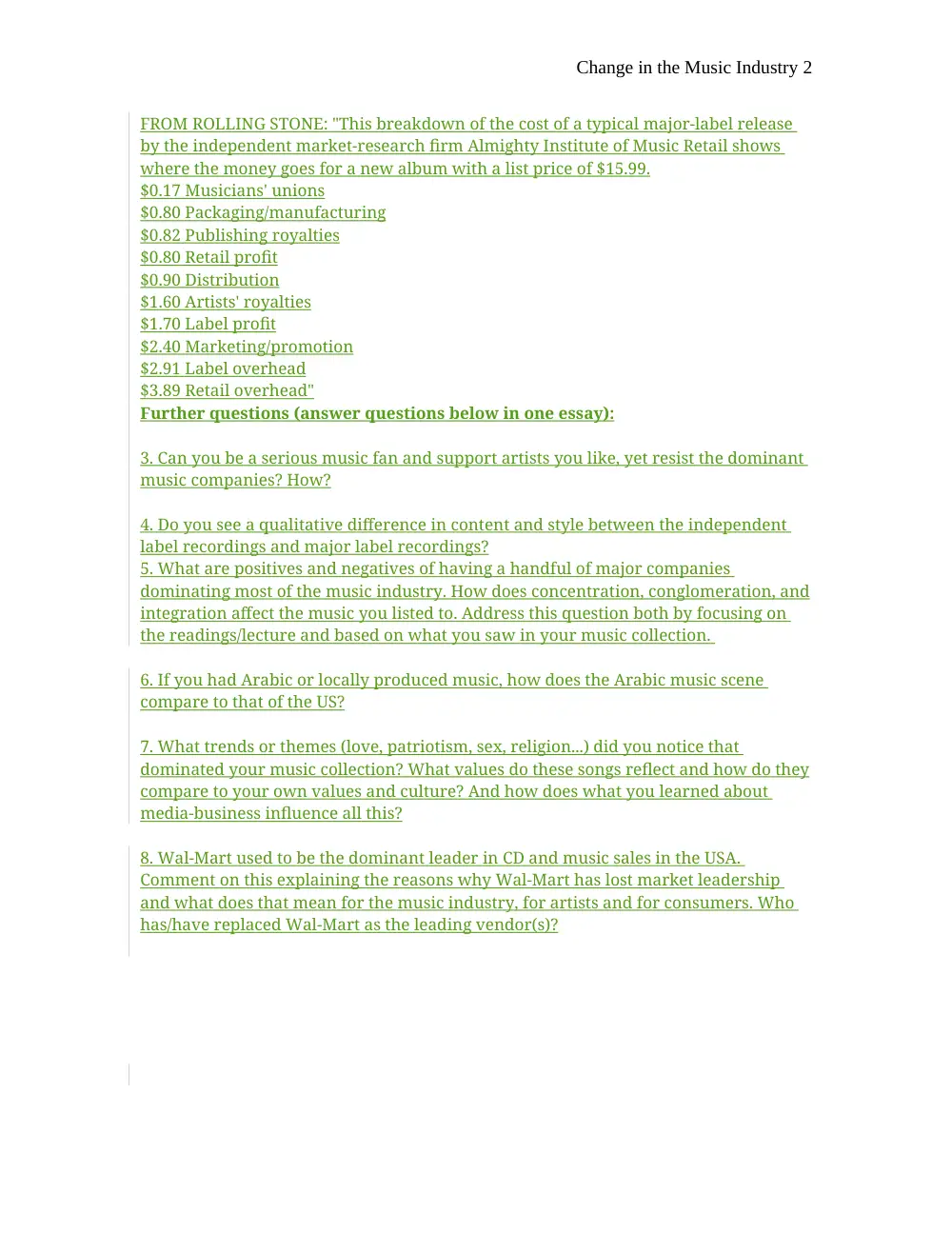
FROM ROLLING STONE: "This breakdown of the cost of a typical major-label release
by the independent market-research firm Almighty Institute of Music Retail shows
where the money goes for a new album with a list price of $15.99.
$0.17 Musicians' unions
$0.80 Packaging/manufacturing
$0.82 Publishing royalties
$0.80 Retail profit
$0.90 Distribution
$1.60 Artists' royalties
$1.70 Label profit
$2.40 Marketing/promotion
$2.91 Label overhead
$3.89 Retail overhead"
Further questions (answer questions below in one essay):
3. Can you be a serious music fan and support artists you like, yet resist the dominant
music companies? How?
4. Do you see a qualitative difference in content and style between the independent
label recordings and major label recordings?
5. What are positives and negatives of having a handful of major companies
dominating most of the music industry. How does concentration, conglomeration, and
integration affect the music you listed to. Address this question both by focusing on
the readings/lecture and based on what you saw in your music collection.
6. If you had Arabic or locally produced music, how does the Arabic music scene
compare to that of the US?
7. What trends or themes (love, patriotism, sex, religion...) did you notice that
dominated your music collection? What values do these songs reflect and how do they
compare to your own values and culture? And how does what you learned about
media-business influence all this?
8. Wal-Mart used to be the dominant leader in CD and music sales in the USA.
Comment on this explaining the reasons why Wal-Mart has lost market leadership
and what does that mean for the music industry, for artists and for consumers. Who
has/have replaced Wal-Mart as the leading vendor(s)?
Change in the Music Industry 3
The Change in the Music Industry
Maya Chami
American University of Beirut
Maya Chami
October 21, 2012
Change in the Music Industry 4
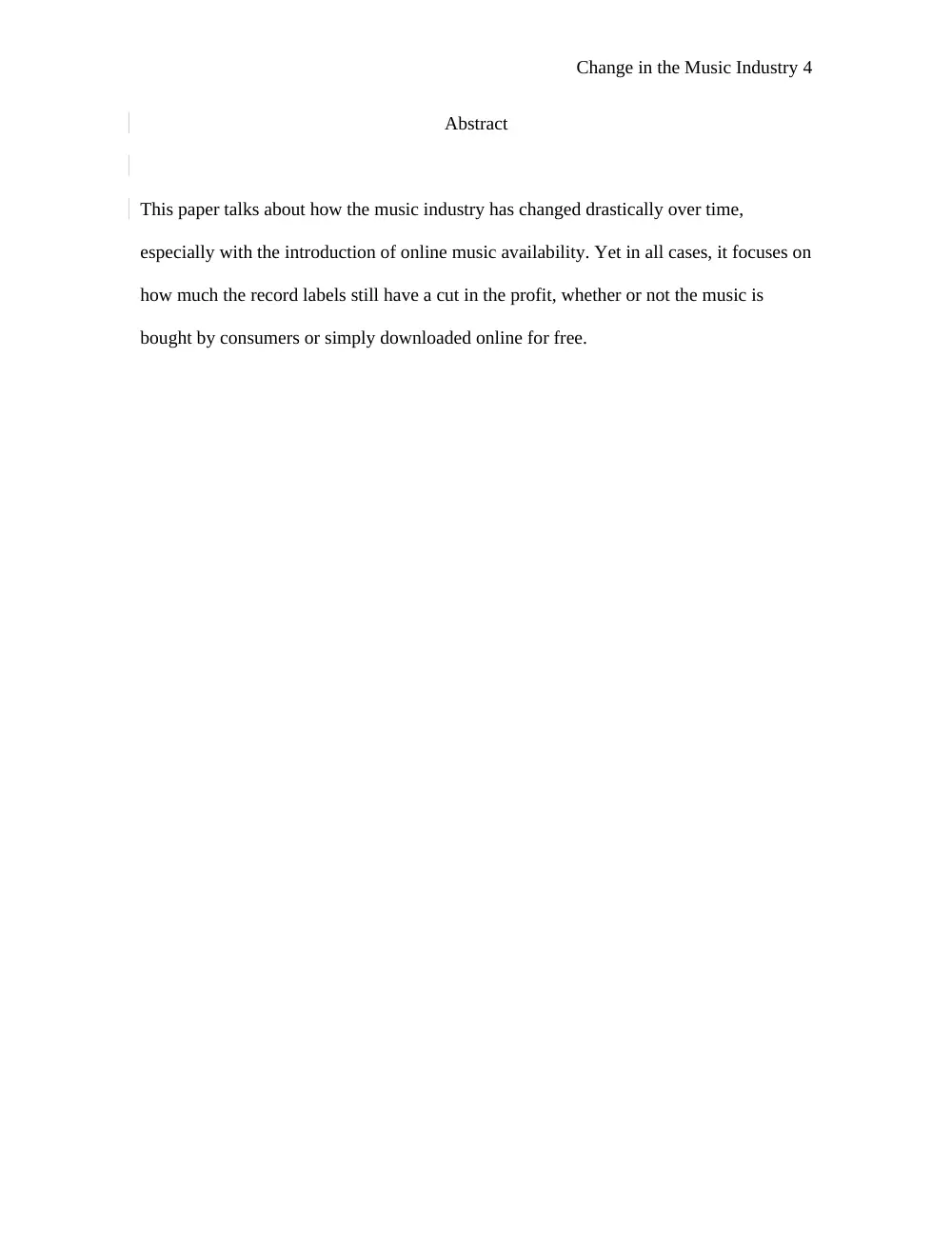
Abstract
This paper talks about how the music industry has changed drastically over time,
especially with the introduction of online music availability. Yet in all cases, it focuses on
how much the record labels still have a cut in the profit, whether or not the music is
bought by consumers or simply downloaded online for free.
Change in the Music Industry 5
The Change in the Music Industry
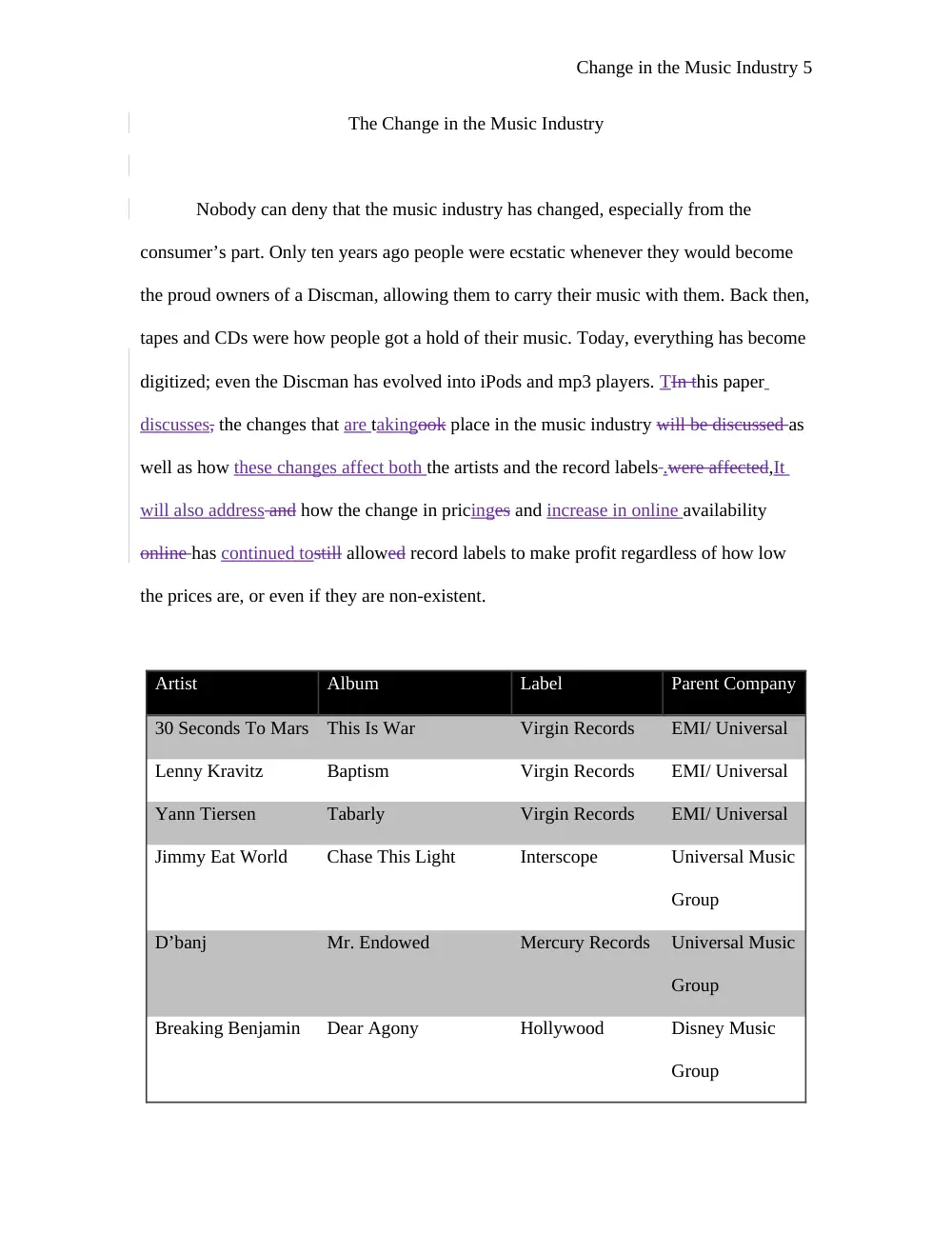
Nobody can deny that the music industry has changed, especially from the
consumer’s part. Only ten years ago people were ecstatic whenever they would become
the proud owners of a Discman, allowing them to carry their music with them. Back then,
tapes and CDs were how people got a hold of their music. Today, everything has become
digitized; even the Discman has evolved into iPods and mp3 players. TIn this paper
discusses, the changes that are takingook place in the music industry will be discussed as
well as how these changes affect both the artists and the record labels .were affected,It
will also address and how the change in pricinges and increase in online availability
online has continued tostill allowed record labels to make profit regardless of how low
the prices are, or even if they are non-existent.
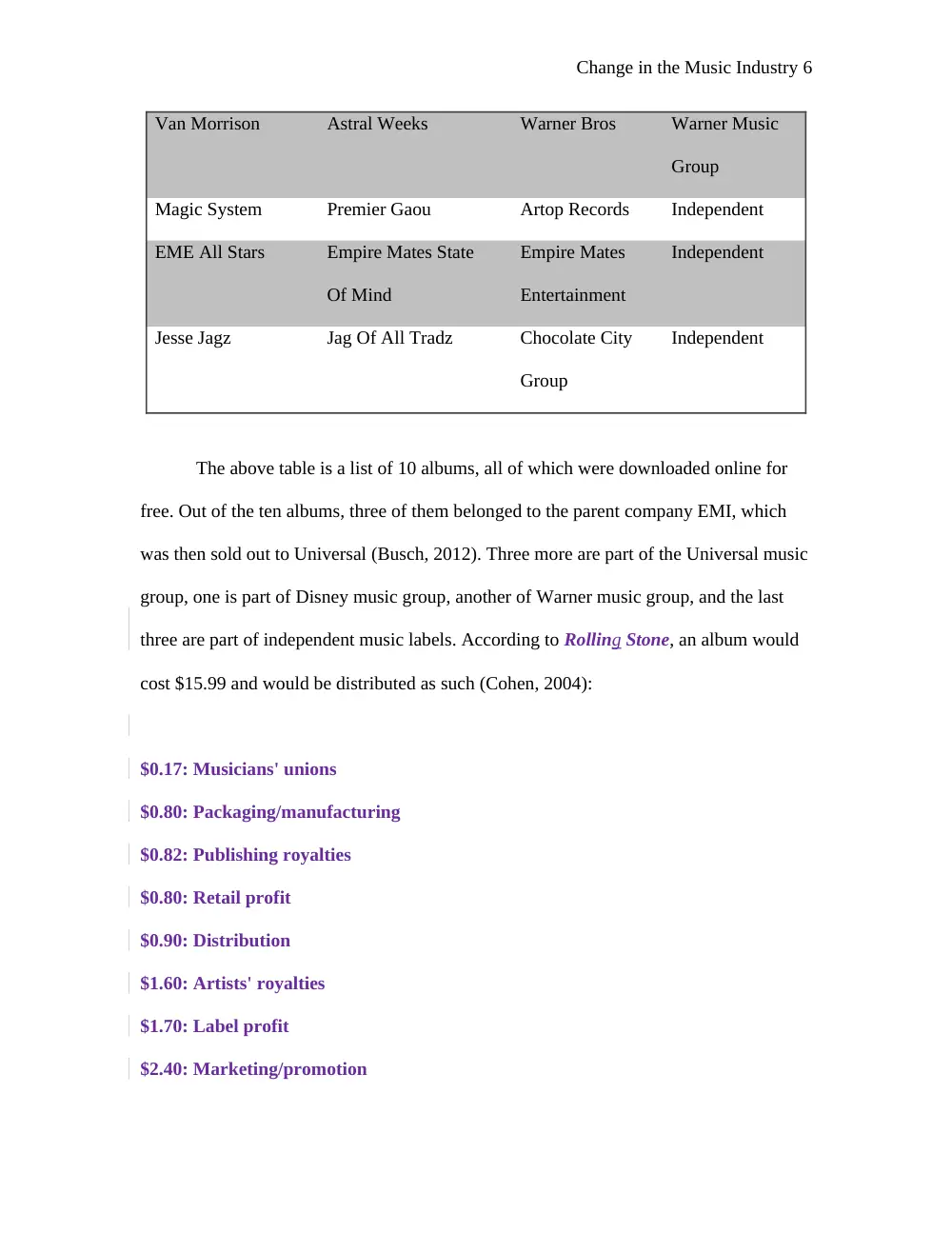
Artist
Album
Label
Parent Company
30 Seconds To Mars
This Is War
Virgin Records
EMI/ Universal
Lenny Kravitz
Baptism
Virgin Records
EMI/ Universal
Yann Tiersen
Tabarly
Virgin Records
EMI/ Universal
Jimmy Eat World
Chase This Light
Interscope
Universal Music
Group
D’banj
Mr. Endowed
Mercury Records
Universal Music
Group
Breaking Benjamin
Dear Agony
Hollywood
Disney Music
Group
Change in the Music Industry 6
Van Morrison
Astral Weeks
Warner Bros
Warner Music
Group
Magic System
Premier Gaou
Artop Records
Independent
EME All Stars
Empire Mates State
Of Mind
Empire Mates
Entertainment
Independent
Jesse Jagz
Jag Of All Tradz
Chocolate City
Group
Independent
The above table is a list of 10 albums, all of which were downloaded online for
free. Out of the ten albums, three of them belonged to the parent company EMI, which
was then sold out to Universal (Busch, 2012). Three more are part of the Universal music
group, one is part of Disney music group, another of Warner music group, and the last
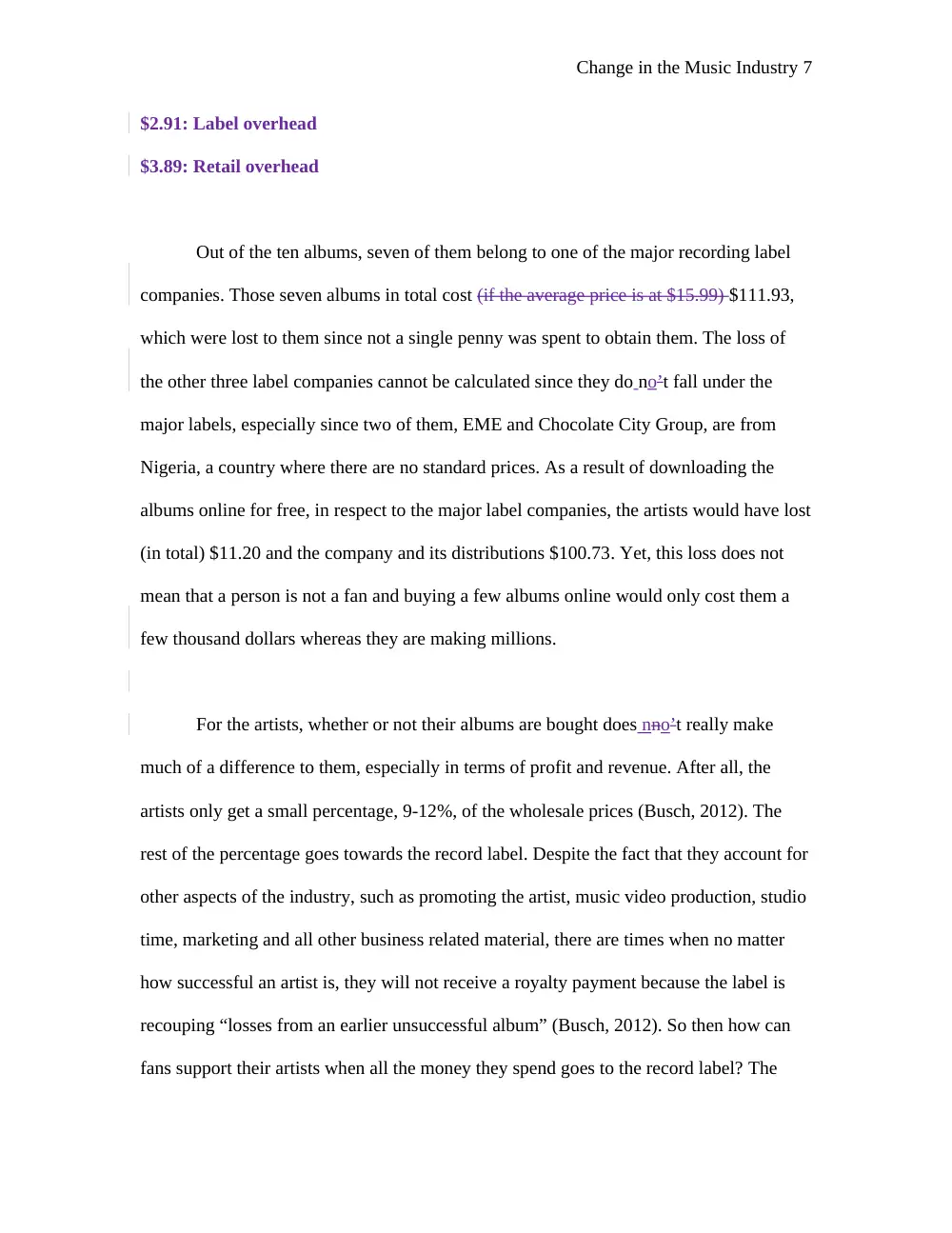
three are part of independent music labels. According to Rolling Stone, an album would
cost $15.99 and would be distributed as such (Cohen, 2004):
$0.17: Musicians' unions
$0.80: Packaging/manufacturing
$0.82: Publishing royalties
$0.80: Retail profit
$0.90: Distribution
$1.60: Artists' royalties
$1.70: Label profit
$2.40: Marketing/promotion
Change in the Music Industry 7
$2.91: Label overhead
$3.89: Retail overhead
Out of the ten albums, seven of them belong to one of the major recording label
companies. Those seven albums in total cost (if the average price is at $15.99) $111.93,
which were lost to them since not a single penny was spent to obtain them. The loss of
the other three label companies cannot be calculated since they do no’t fall under the
major labels, especially since two of them, EME and Chocolate City Group, are from
Nigeria, a country where there are no standard prices. As a result of downloading the
albums online for free, in respect to the major label companies, the artists would have lost
(in total) $11.20 and the company and its distributions $100.73. Yet, this loss does not
mean that a person is not a fan and buying a few albums online would only cost them a
few thousand dollars whereas they are making millions.
For the artists, whether or not their albums are bought does nno’t really make
much of a difference to them, especially in terms of profit and revenue. After all, the
artists only get a small percentage, 9-12%, of the wholesale prices (Busch, 2012). The
rest of the percentage goes towards the record label. Despite the fact that they account for
other aspects of the industry, such as promoting the artist, music video production, studio
time, marketing and all other business related material, there are times when no matter
how successful an artist is, they will not receive a royalty payment because the label is
recouping “losses from an earlier unsuccessful album” (Busch, 2012). So then how can
fans support their artists when all the money they spend goes to the record label? The
Change in the Music Industry 8
answer is simple. There are other ways to support them through buying concert tickets,
showing up to the concert, buying their signatures online, or buying any merchandise that
is promoted, marketed and sold by the artist, not through the record label.
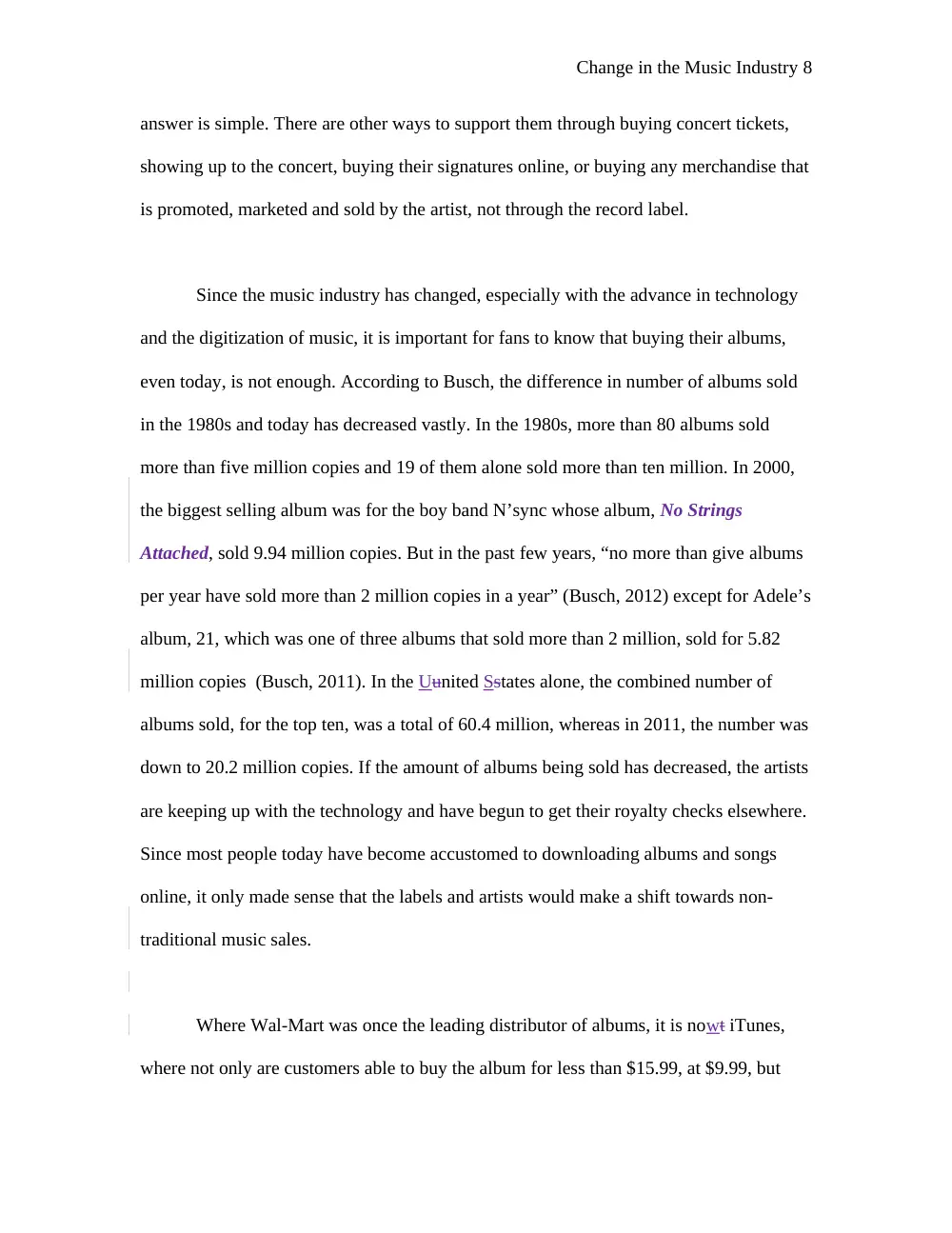
Since the music industry has changed, especially with the advance in technology
and the digitization of music, it is important for fans to know that buying their albums,
even today, is not enough. According to Busch, the difference in number of albums sold
in the 1980s and today has decreased vastly. In the 1980s, more than 80 albums sold
more than five million copies and 19 of them alone sold more than ten million. In 2000,
the biggest selling album was for the boy band N’sync whose album, No Strings
Attached, sold 9.94 million copies. But in the past few years, “no more than give albums
per year have sold more than 2 million copies in a year” (Busch, 2012) except for Adele’s
album, 21, which was one of three albums that sold more than 2 million, sold for 5.82
million copies (Busch, 2011). In the Uunited Sstates alone, the combined number of
albums sold, for the top ten, was a total of 60.4 million, whereas in 2011, the number was
down to 20.2 million copies. If the amount of albums being sold has decreased, the artists
are keeping up with the technology and have begun to get their royalty checks elsewhere.
Since most people today have become accustomed to downloading albums and songs
online, it only made sense that the labels and artists would make a shift towards non-
traditional music sales.
Where Wal-Mart was once the leading distributor of albums, it is nowt iTunes,
where not only are customers able to buy the album for less than $15.99, at $9.99, but
Change in the Music Industry 9
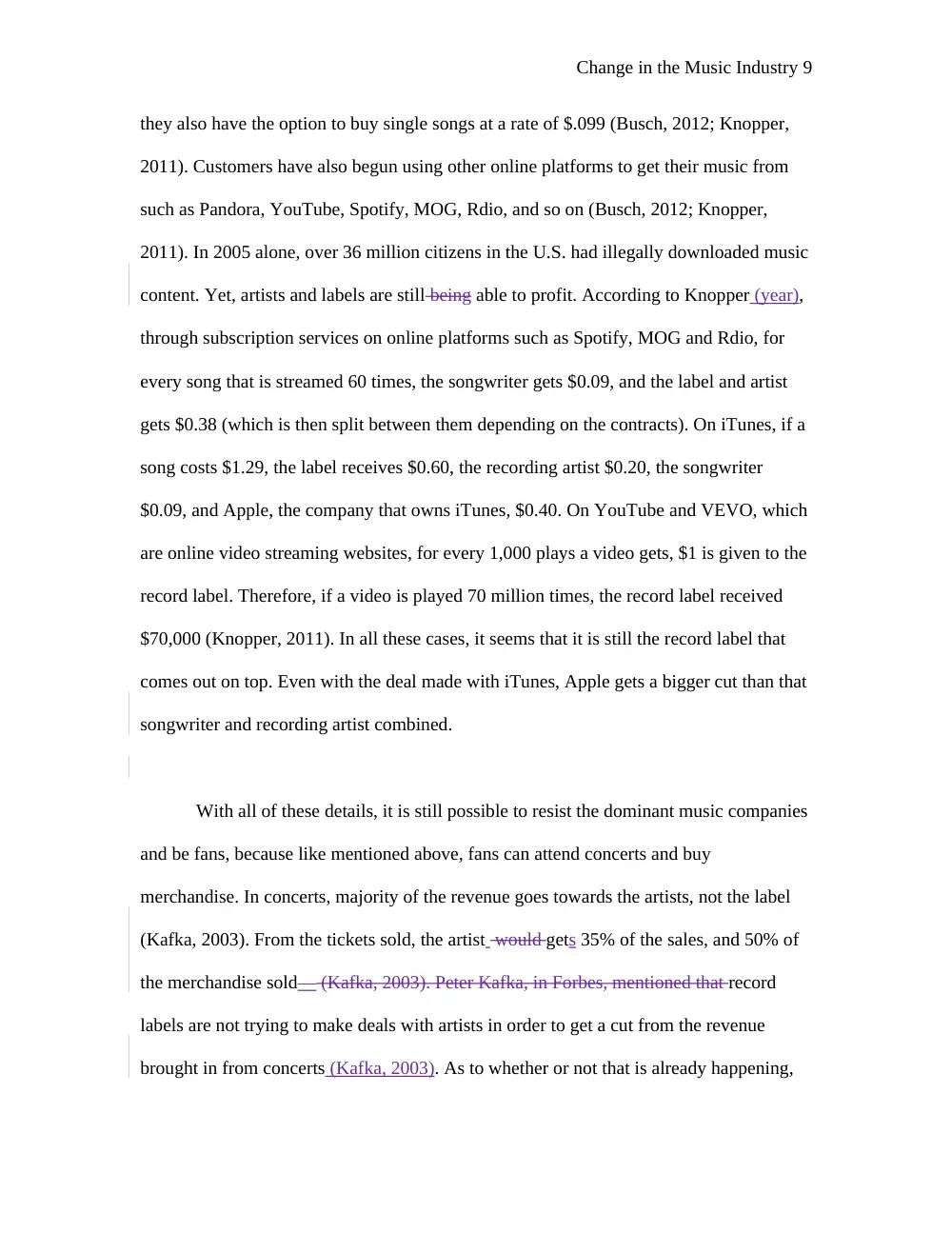
they also have the option to buy single songs at a rate of $.099 (Busch, 2012; Knopper,
2011). Customers have also begun using other online platforms to get their music from
such as Pandora, YouTube, Spotify, MOG, Rdio, and so on (Busch, 2012; Knopper,
2011). In 2005 alone, over 36 million citizens in the U.S. had illegally downloaded music
content. Yet, artists and labels are still being able to profit. According to Knopper (year),
through subscription services on online platforms such as Spotify, MOG and Rdio, for
every song that is streamed 60 times, the songwriter gets $0.09, and the label and artist
gets $0.38 (which is then split between them depending on the contracts). On iTunes, if a
song costs $1.29, the label receives $0.60, the recording artist $0.20, the songwriter
$0.09, and Apple, the company that owns iTunes, $0.40. On YouTube and VEVO, which
are online video streaming websites, for every 1,000 plays a video gets, $1 is given to the
record label. Therefore, if a video is played 70 million times, the record label received
$70,000 (Knopper, 2011). In all these cases, it seems that it is still the record label that
comes out on top. Even with the deal made with iTunes, Apple gets a bigger cut than that
songwriter and recording artist combined.
With all of these details, it is still possible to resist the dominant music companies
and be fans, because like mentioned above, fans can attend concerts and buy
merchandise. In concerts, majority of the revenue goes towards the artists, not the label
(Kafka, 2003). From the tickets sold, the artist would gets 35% of the sales, and 50% of
the merchandise sold— (Kafka, 2003). Peter Kafka, in Forbes, mentioned that record
labels are not trying to make deals with artists in order to get a cut from the revenue
brought in from concerts (Kafka, 2003). As to whether or not that is already happening,
Change in the Music Industry 10
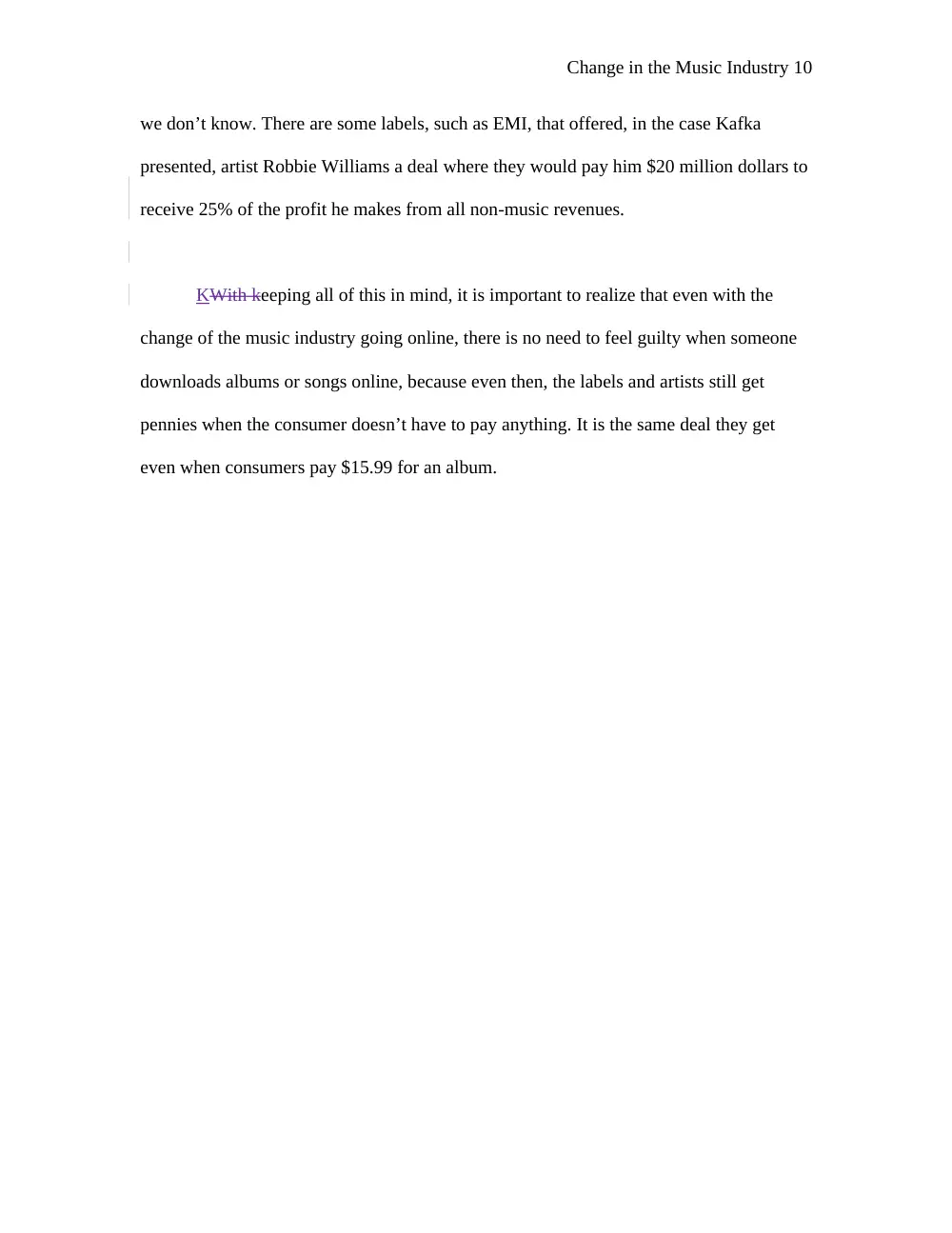
we don’t know. There are some labels, such as EMI, that offered, in the case Kafka
presented, artist Robbie Williams a deal where they would pay him $20 million dollars to
receive 25% of the profit he makes from all non-music revenues.
KWith keeping all of this in mind, it is important to realize that even with the
change of the music industry going online, there is no need to feel guilty when someone
downloads albums or songs online, because even then, the labels and artists still get
pennies when the consumer doesn’t have to pay anything. It is the same deal they get
even when consumers pay $15.99 for an album.
Change in the Music Industry 11
References
Busch, R. (2012). Major Record Labels As Dinosours? Forbes. Retrieved from
http://www.forbes.com/sites/richardbusch/2012/03/27/major-record-labels-as
dinosaurs/
Cohen, W. (2004). Wal-Mart wants $10 CDs. Rolling Stones. Retrieved from
http://bigpicture.typepad.com/comments/2004/10/walmart-wants-1.html
Kafka, P. (2003). The Road to Riches. Forbes. Retrieved from
http://www.forbes.com/forbes/2003/0707/078_print.html
Knopper, S. (2011). The New Economics of the Music Industry. Rolling Stone.
Retrieved from http://www.rollingstone.com/music/news/the-new-economics
of-the-music-industry-20111025