
MECH 340 Lecture, Fall 2002
American University of Beirut · Engineering Materials · 49 pages
Showing the first 10 of 49 pages. Download the PDF to see all of it.
More MECH 340 files
Show the text of this lab
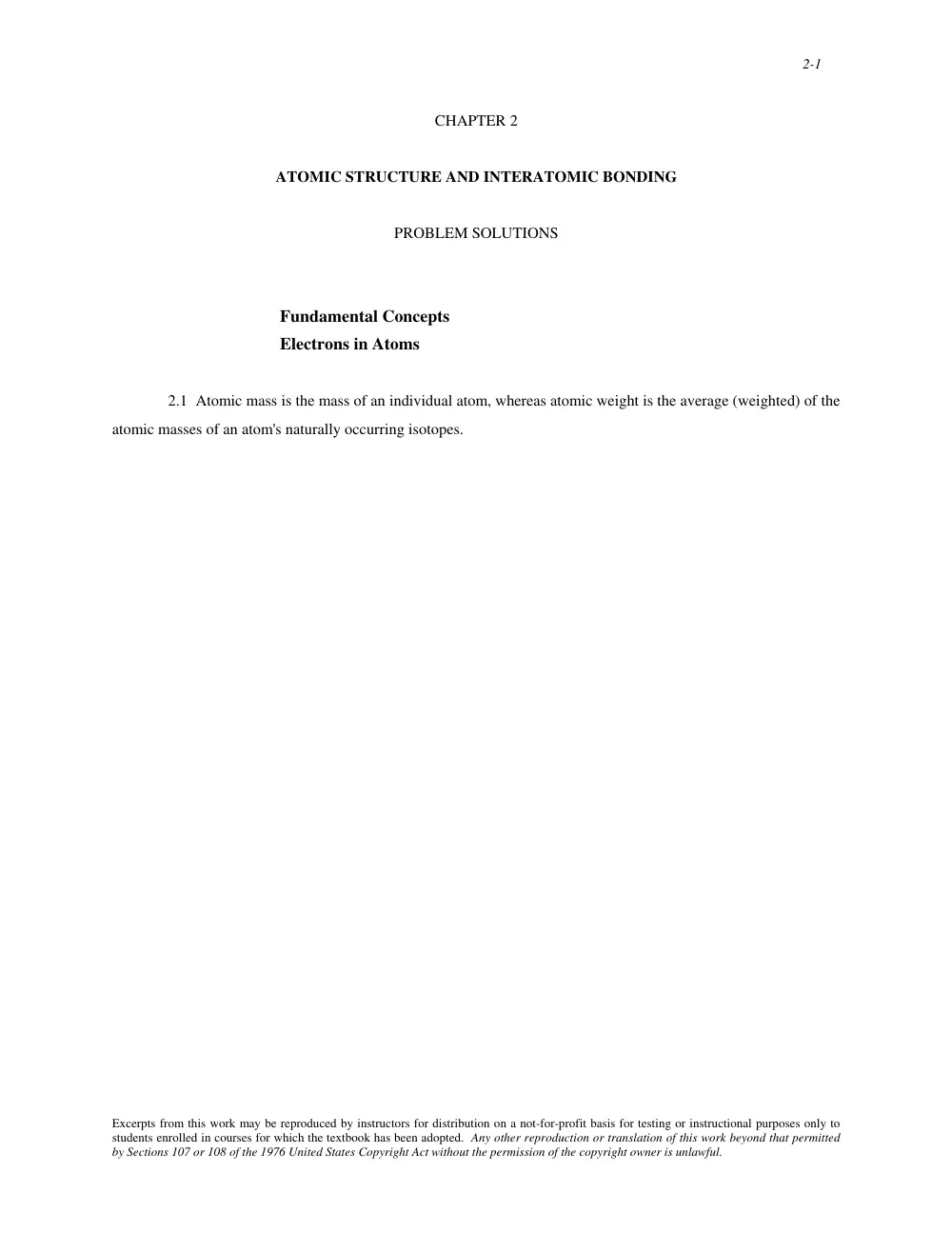
2-1
CHAPTER 2
ATOMIC STRUCTURE AND INTERATOMIC BONDING
PROBLEM SOLUTIONS
Fundamental Concepts
Electrons in Atoms
2.1 Atomic mass is the mass of an individual atom, whereas atomic weight is the average (weighted) of the
atomic masses of an atom's naturally occurring isotopes.
Excerpts from this work may be reproduced by instructors for distribution on a not-for-profit basis for testing or instructional purposes only to
students enrolled in courses for which the textbook has been adopted. Any other reproduction or translation of this work beyond that permitted
by Sections 107 or 108 of the 1976 United States Copyright Act without the permission of the copyright owner is unlawful.
2-2
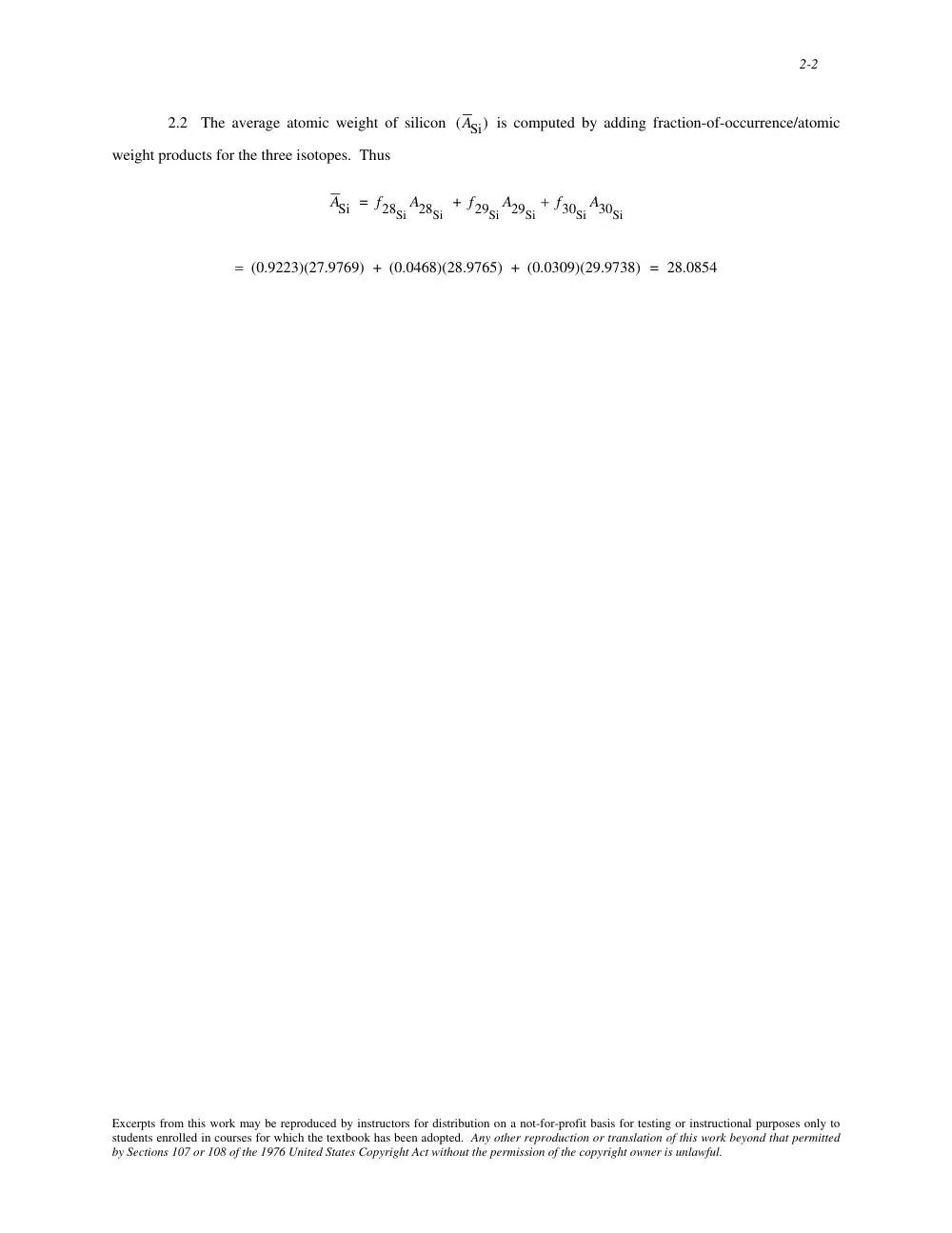
2.2 The average atomic weight of silicon (A Si) is computed by adding fraction-of-occurrence/atomic
weight products for the three isotopes. Thus
A Si = f28Si A28Si + f29Si A29Si + f30Si A30Si
= (0.9223)(27.9769) + (0.0468)(28.9765) + (0.0309)(29.9738) = 28.0854
Excerpts from this work may be reproduced by instructors for distribution on a not-for-profit basis for testing or instructional purposes only to
students enrolled in courses for which the textbook has been adopted. Any other reproduction or translation of this work beyond that permitted
by Sections 107 or 108 of the 1976 United States Copyright Act without the permission of the copyright owner is unlawful.
2-3
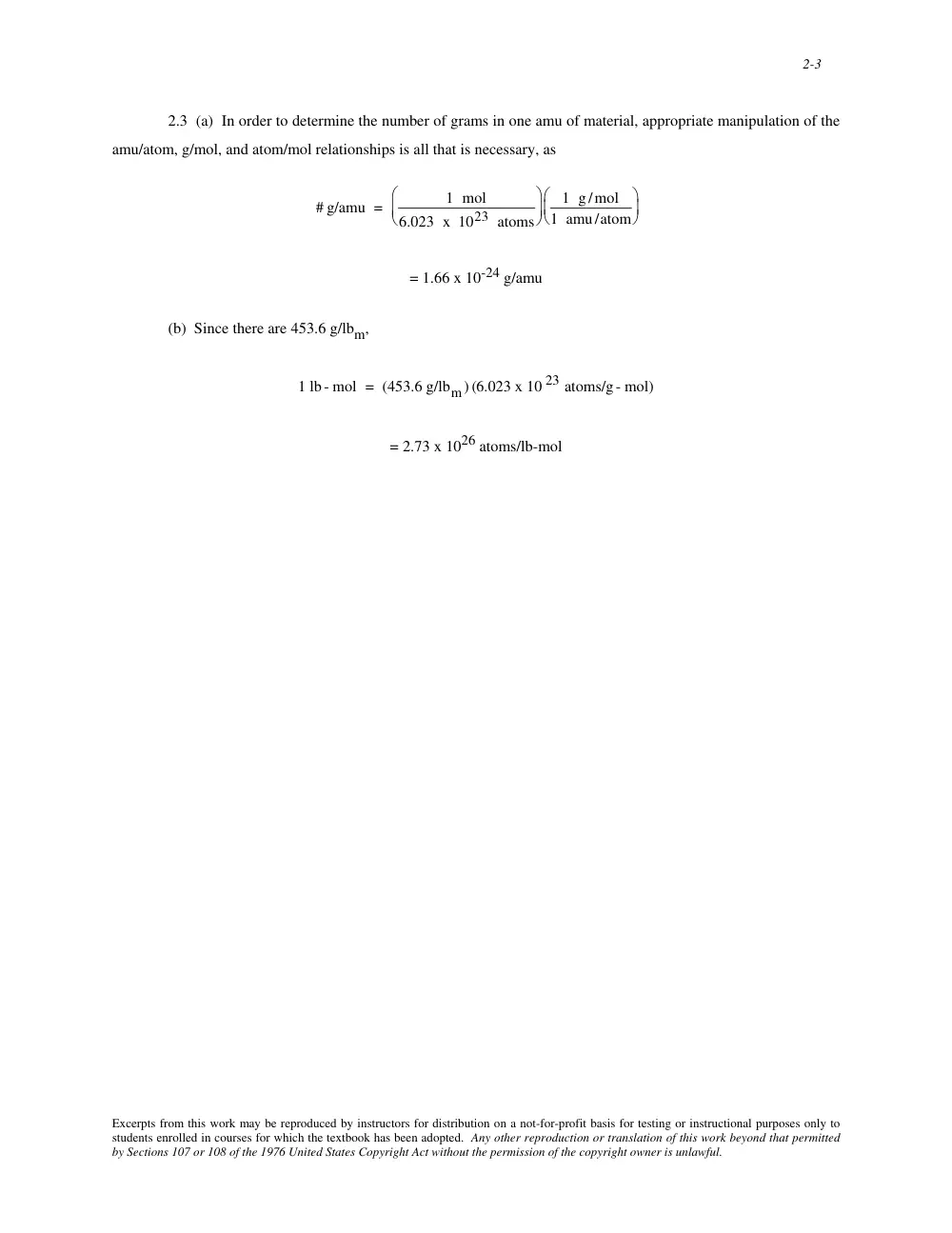
2.3 (a) In order to determine the number of grams in one amu of material, appropriate manipulation of the
amu/atom, g/mol, and atom/mol relationships is all that is necessary, as
# g/amu =
1 mol
6.023 x 10²³ atoms
⎛
⎝ ⎜
⎞
⎠ ⎟
1 g/mol
1 amu/atom
⎛
⎝ ⎜
⎞
⎠ ⎟
= 1.66 x 10⁻²⁴ g/amu
(b) Since there are 453.6 g/lbm,
1 lb - mol = (453.6 g/lbm) (6.023 x 10 23 atoms/g - mol)
= 2.73 x 1026 atoms/lb-mol
Excerpts from this work may be reproduced by instructors for distribution on a not-for-profit basis for testing or instructional purposes only to
students enrolled in courses for which the textbook has been adopted. Any other reproduction or translation of this work beyond that permitted
by Sections 107 or 108 of the 1976 United States Copyright Act without the permission of the copyright owner is unlawful.
2-4
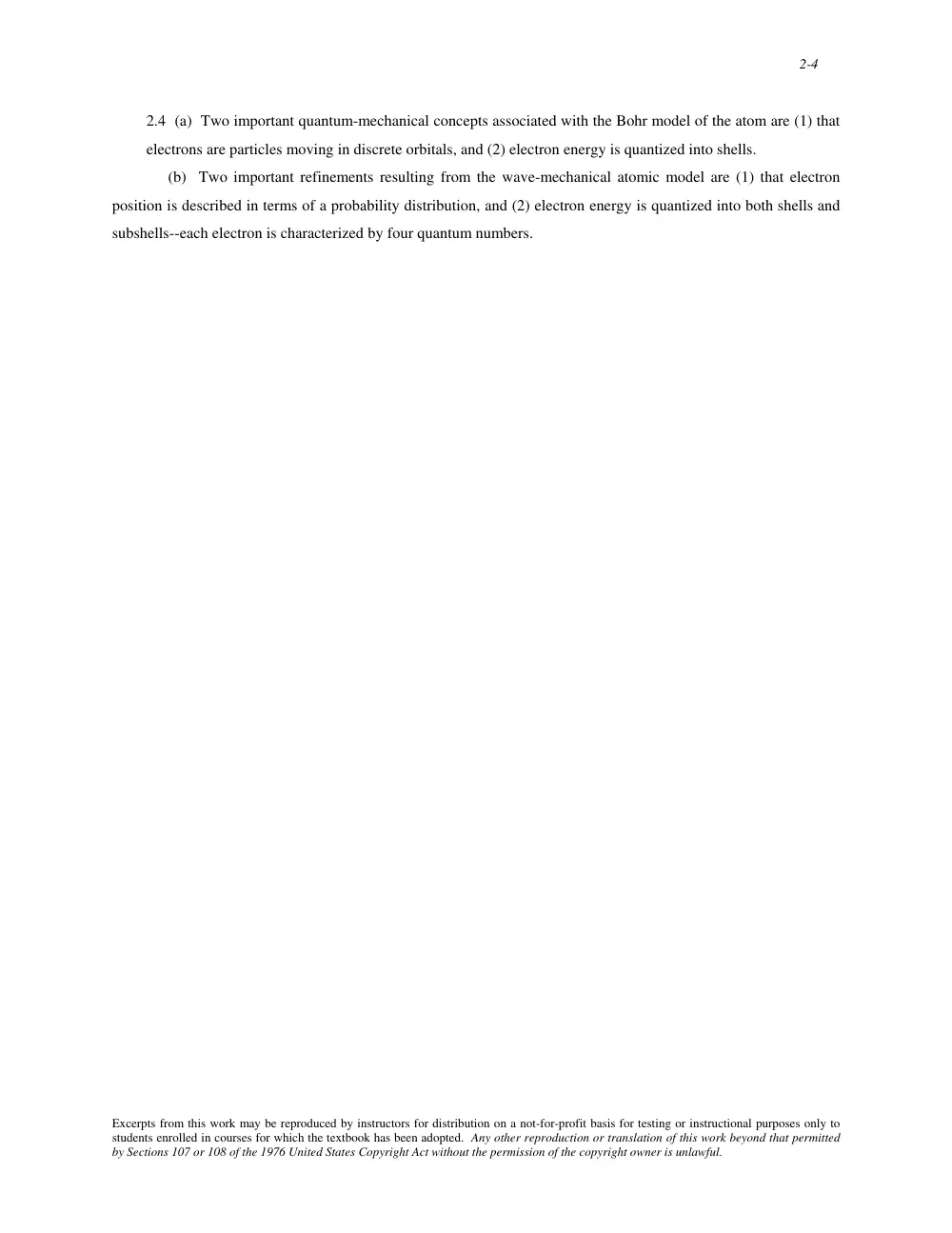
2.4 (a) Two important quantum-mechanical concepts associated with the Bohr model of the atom are (1) that
electrons are particles moving in discrete orbitals, and (2) electron energy is quantized into shells.
(b) Two important refinements resulting from the wave-mechanical atomic model are (1) that electron
position is described in terms of a probability distribution, and (2) electron energy is quantized into both shells and
subshells--each electron is characterized by four quantum numbers.
Excerpts from this work may be reproduced by instructors for distribution on a not-for-profit basis for testing or instructional purposes only to
students enrolled in courses for which the textbook has been adopted. Any other reproduction or translation of this work beyond that permitted
by Sections 107 or 108 of the 1976 United States Copyright Act without the permission of the copyright owner is unlawful.
2-5
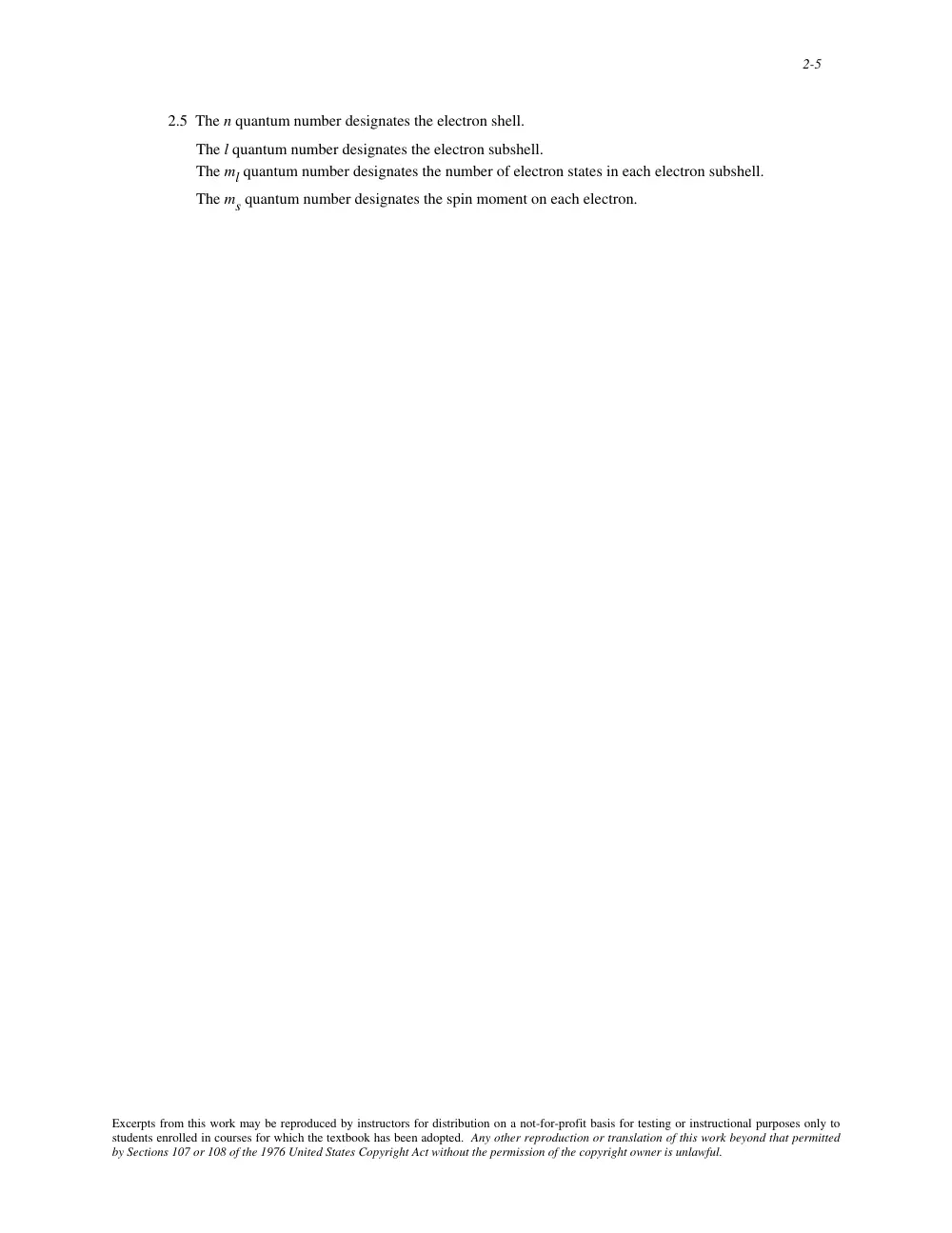
2.5 The n quantum number designates the electron shell.
The l quantum number designates the electron subshell.
The ml quantum number designates the number of electron states in each electron subshell.
The ms quantum number designates the spin moment on each electron.
Excerpts from this work may be reproduced by instructors for distribution on a not-for-profit basis for testing or instructional purposes only to
students enrolled in courses for which the textbook has been adopted. Any other reproduction or translation of this work beyond that permitted
by Sections 107 or 108 of the 1976 United States Copyright Act without the permission of the copyright owner is unlawful.
2-6
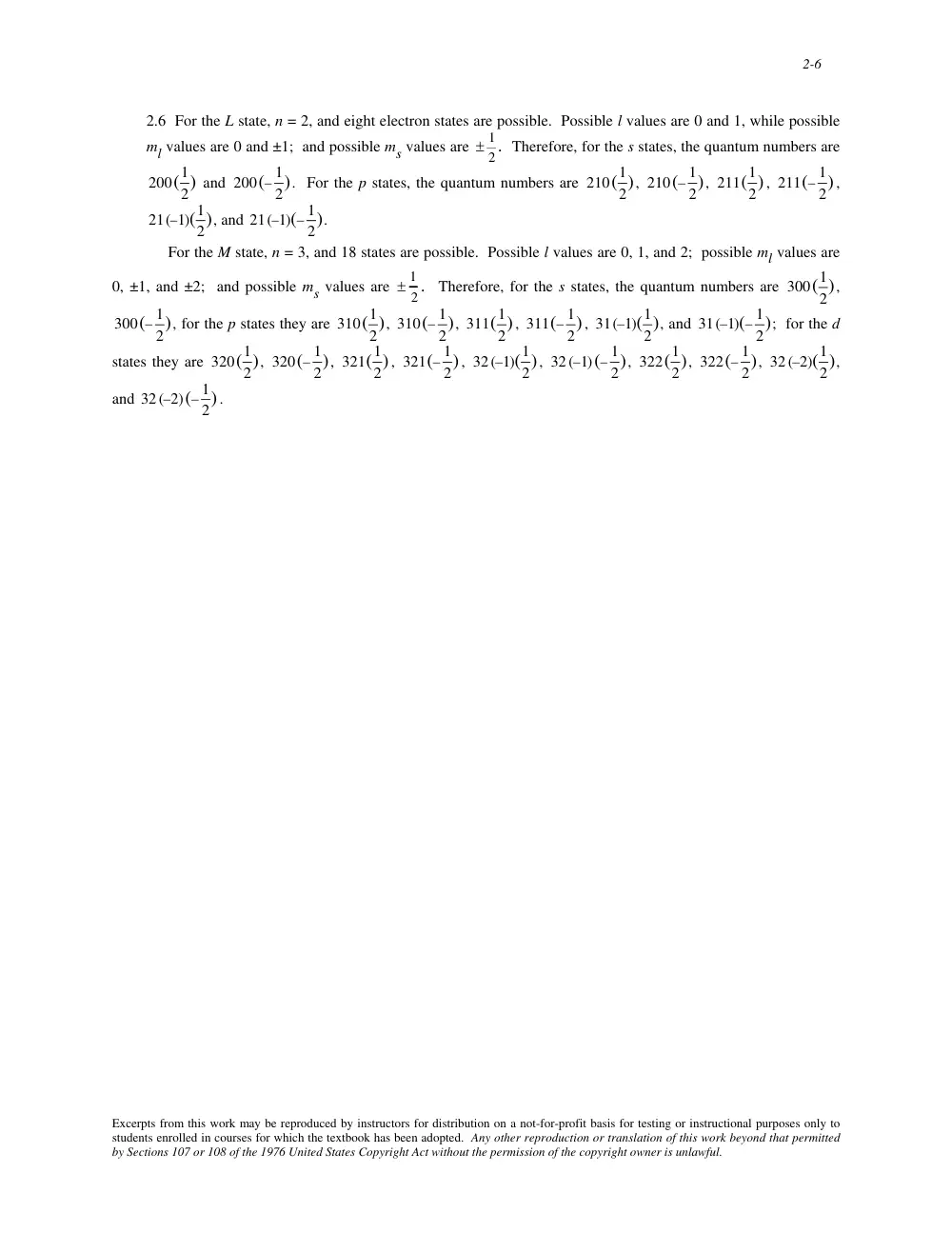
2.6 For the L state, n = 2, and eight electron states are possible. Possible l values are 0 and 1, while possible
ml values are 0 and ±1; and possible ms values are ± 1
2. Therefore, for the s states, the quantum numbers are
200(1
2) and
200(− 1
2). For the p states, the quantum numbers are
210(1
2),
210(− 1
2),
211(1
2) ,
211(− 1
2) ,
21(−1)(1
2), and
21(−1)(− 1
2).
For the M state, n = 3, and 18 states are possible. Possible l values are 0, 1, and 2; possible ml values are
0, ±1, and ±2; and possible ms values are ± 1
2. Therefore, for the s states, the quantum numbers are
300(1
2),
300(− 1
2), for the p states they are
310(1
2),
310(− 1
2),
311(1
2) ,
311(− 1
2) ,
31(−1)(1
2), and
31(−1)(− 1
2); for the d
states they are
320(1
2),
320(− 1
2),
321(1
2) ,
321(− 1
2) ,
32 (−1)(1
2),
32 (−1)(− 1
2),
322(1
2),
322(− 1
2),
32 (−2)(1
2),
and
32 (−2)(− 1
2) .
Excerpts from this work may be reproduced by instructors for distribution on a not-for-profit basis for testing or instructional purposes only to
students enrolled in courses for which the textbook has been adopted. Any other reproduction or translation of this work beyond that permitted
by Sections 107 or 108 of the 1976 United States Copyright Act without the permission of the copyright owner is unlawful.
2-7
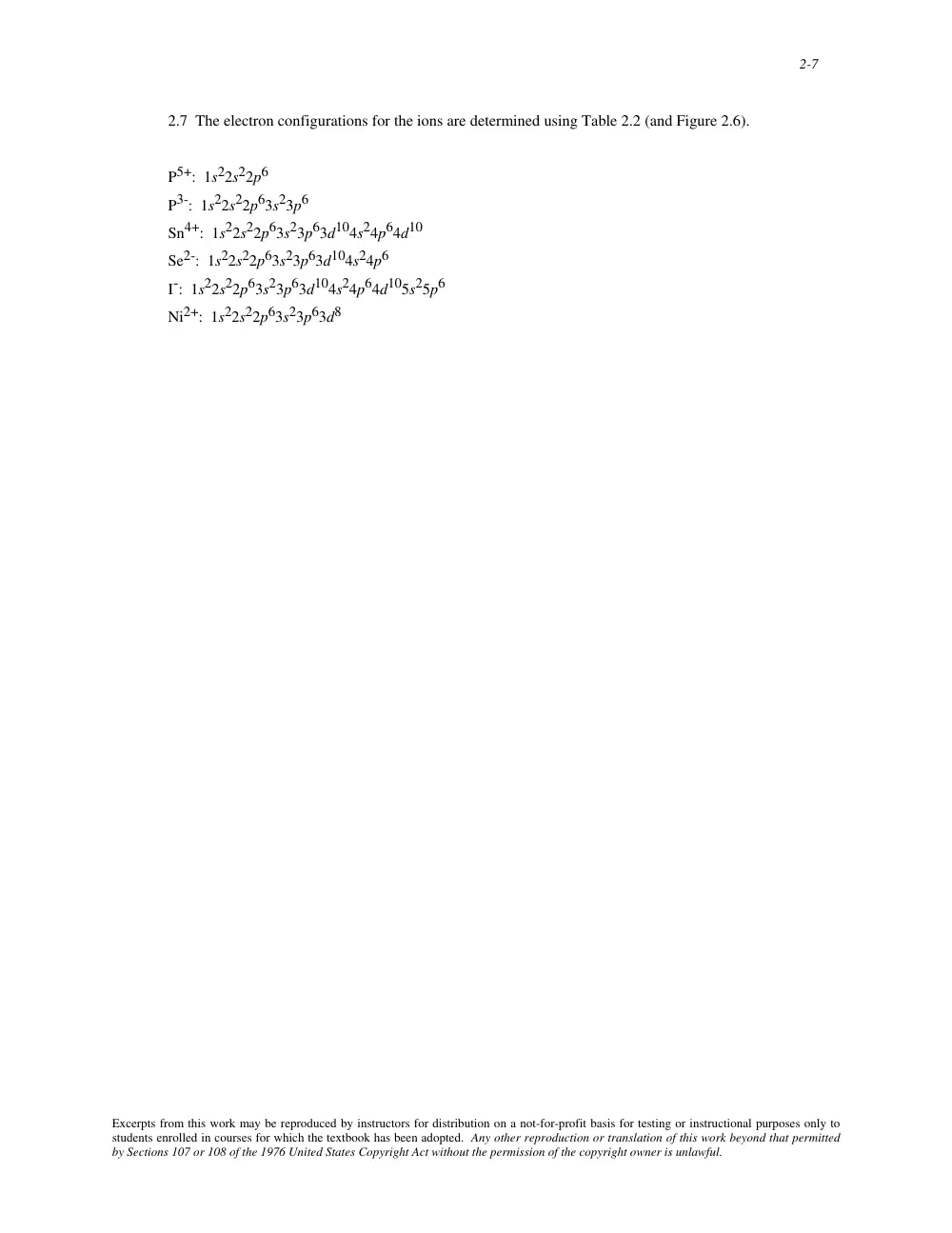
2.7 The electron configurations for the ions are determined using Table 2.2 (and Figure 2.6).
P5+: 1s22s22p6
P3-: 1s22s22p63s23p6
Sn4+: 1s22s22p63s23p63d104s24p64d10
Se2-: 1s22s22p63s23p63d104s24p6
I-: 1s22s22p63s23p63d104s24p64d105s25p6
Ni2+: 1s22s22p63s23p63d8
Excerpts from this work may be reproduced by instructors for distribution on a not-for-profit basis for testing or instructional purposes only to
students enrolled in courses for which the textbook has been adopted. Any other reproduction or translation of this work beyond that permitted
by Sections 107 or 108 of the 1976 United States Copyright Act without the permission of the copyright owner is unlawful.
2-8
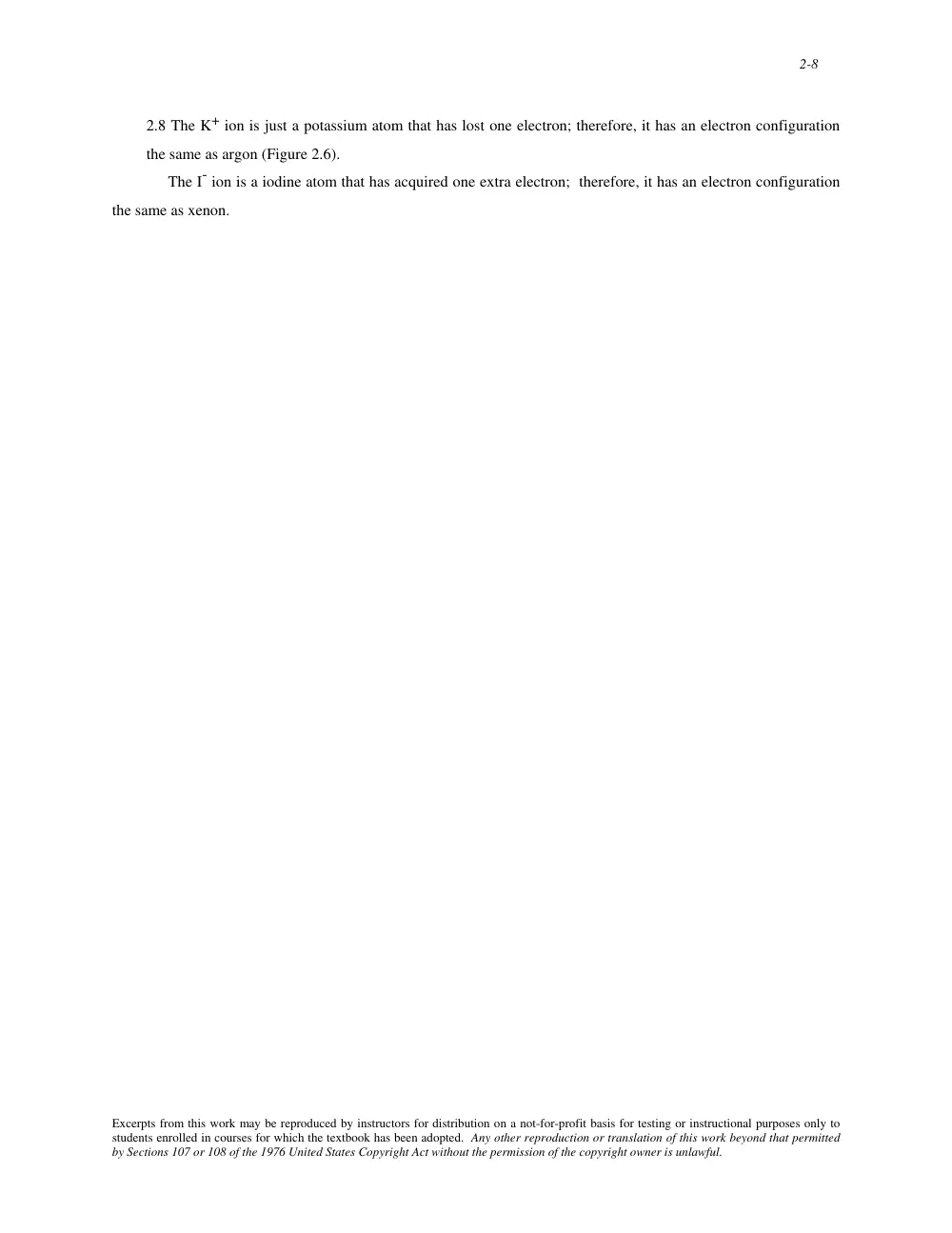
2.8 The K+ ion is just a potassium atom that has lost one electron; therefore, it has an electron configuration
the same as argon (Figure 2.6).
The I- ion is a iodine atom that has acquired one extra electron; therefore, it has an electron configuration
the same as xenon.
Excerpts from this work may be reproduced by instructors for distribution on a not-for-profit basis for testing or instructional purposes only to
students enrolled in courses for which the textbook has been adopted. Any other reproduction or translation of this work beyond that permitted
by Sections 107 or 108 of the 1976 United States Copyright Act without the permission of the copyright owner is unlawful.
2-9
The Periodic Table
2.9 Each of the elements in Group IIA has two s electrons.
Excerpts from this work may be reproduced by instructors for distribution on a not-for-profit basis for testing or instructional purposes only to
students enrolled in courses for which the textbook has been adopted. Any other reproduction or translation of this work beyond that permitted
by Sections 107 or 108 of the 1976 United States Copyright Act without the permission of the copyright owner is unlawful.
2-10
2.10 From the periodic table (Figure 2.6) the element having atomic number 112 would belong to group
IIB. According to Figure 2.6, Ds, having an atomic number of 110 lies below Pt in the periodic table and in the
right-most column of group VIII. Moving two columns to the right puts element 112 under Hg and in group IIB.
Excerpts from this work may be reproduced by instructors for distribution on a not-for-profit basis for testing or instructional purposes only to
students enrolled in courses for which the textbook has been adopted. Any other reproduction or translation of this work beyond that permitted
by Sections 107 or 108 of the 1976 United States Copyright Act without the permission of the copyright owner is unlawful.
2-11
2.11 (a) The 1s22s22p63s23p5 electron configuration is that of a halogen because it is one electron
deficient from having a filled p subshell.
(b) The 1s22s22p63s23p63d74s2 electron configuration is that of a transition metal because of an
incomplete d subshell.
(c) The 1s22s22p63s23p63d104s24p6 electron configuration is that of an inert gas because of filled 4s and
4p subshells.
(d) The 1s22s22p63s23p64s1 electron configuration is that of an alkali metal because of a single s electron.
(e) The 1s22s22p63s23p63d104s24p64d55s2 electron configuration is that of a transition metal because of
an incomplete d subshell.
(f) The 1s22s22p63s2 electron configuration is that of an alkaline earth metal because of two s electrons.
Excerpts from this work may be reproduced by instructors for distribution on a not-for-profit basis for testing or instructional purposes only to
students enrolled in courses for which the textbook has been adopted. Any other reproduction or translation of this work beyond that permitted
by Sections 107 or 108 of the 1976 United States Copyright Act without the permission of the copyright owner is unlawful.
2-12
2.12 (a) The 4f subshell is being filled for the rare earth series of elements.
(b) The 5f subshell is being filled for the actinide series of elements.
Excerpts from this work may be reproduced by instructors for distribution on a not-for-profit basis for testing or instructional purposes only to
students enrolled in courses for which the textbook has been adopted. Any other reproduction or translation of this work beyond that permitted
by Sections 107 or 108 of the 1976 United States Copyright Act without the permission of the copyright owner is unlawful.
2-13
Bonding Forces and Energies
2.13 The attractive force between two ions FA is just the derivative with respect to the interatomic
separation of the attractive energy expression, Equation 2.8, which is just
FA = dEA
dr =
d − A
r
⎛
⎝ ⎜
⎞
⎠ ⎟
dr
= A
r2
The constant A in this expression is defined in footnote 3. Since the valences of the Ca2+ and O2- ions (Z1 and Z2)
are both 2, then
FA = (Z1e) (Z2e)
4πε0r2
=
(2)(2)(1.6 x 10⁻¹⁹ C)2
(4)(π) (8.85 x 10⁻¹² F /m) (1.25 x 10⁻⁹ m)2
= 5.89 x 10⁻¹⁰ N
Excerpts from this work may be reproduced by instructors for distribution on a not-for-profit basis for testing or instructional purposes only to
students enrolled in courses for which the textbook has been adopted. Any other reproduction or translation of this work beyond that permitted
by Sections 107 or 108 of the 1976 United States Copyright Act without the permission of the copyright owner is unlawful.
2-14
2.14 (a) Differentiation of Equation 2.11 yields
dEN
dr
=
d − A
r
⎛
⎝ ⎜
⎞
⎠ ⎟
dr
+
d B
rn
⎛
⎝ ⎜
⎞
⎠ ⎟
dr
=
A
r(1 + 1) −
nB
r(n + 1) = 0
(b) Now, solving for r (= r0)
A
r0
2 =
nB
r0
(n + 1)
or
r0 =
A
nB
⎛
⎝ ⎜
⎞
⎠ ⎟
1/(1 - n)
(c) Substitution for r0 into Equation 2.11 and solving for E (= E0)
E0 = − A
r0
+ B
r0
n
= −
A
A
nB
⎛
⎝ ⎜
⎞
⎠ ⎟
1/(1 - n) +
B
A
nB
⎛
⎝ ⎜
⎞
⎠ ⎟
n/(1 - n)
Excerpts from this work may be reproduced by instructors for distribution on a not-for-profit basis for testing or instructional purposes only to
students enrolled in courses for which the textbook has been adopted. Any other reproduction or translation of this work beyond that permitted
by Sections 107 or 108 of the 1976 United States Copyright Act without the permission of the copyright owner is unlawful.
2-15
2.15 (a) Curves of EA, ER, and EN are shown on the plot below.
(b) From this plot
r0 = 0.24 nm
E0 = – 5.3 eV
(c) From Equation 2.11 for EN
A = 1.436
B = 7.32 x 10⁻⁶
n = 8
Thus,
r0 =
A
nB
⎛
⎝ ⎜
⎞
⎠ ⎟
1/(1 - n)
1.436
(8)(7.32 × 10⁻⁶)
⎡
⎣
⎢
⎢
⎤
⎦
⎥
⎥
1/(1 - 8)
= 0.236 nm
and
Excerpts from this work may be reproduced by instructors for distribution on a not-for-profit basis for testing or instructional purposes only to
students enrolled in courses for which the textbook has been adopted. Any other reproduction or translation of this work beyond that permitted
by Sections 107 or 108 of the 1976 United States Copyright Act without the permission of the copyright owner is unlawful.
2-16
E0 = −
1.436
1.436
(8)(7.32 × 10⁻⁶)
⎡
⎣
⎢
⎢
⎤
⎦
⎥
⎥
1/(1 − 8) +
7.32 × 10⁻⁶
1.436
(8)(7.32 × 10⁻⁶)
⎡
⎣
⎢
⎢
⎤
⎦
⎥
⎥
8/(1 − 8)
= – 5.32 eV
Excerpts from this work may be reproduced by instructors for distribution on a not-for-profit basis for testing or instructional purposes only to
students enrolled in courses for which the textbook has been adopted. Any other reproduction or translation of this work beyond that permitted
by Sections 107 or 108 of the 1976 United States Copyright Act without the permission of the copyright owner is unlawful.
2-17
2.16 This problem gives us, for a hypothetical X+-Y- ion pair, values for r0 (0.38 nm), E0 (– 5.37 eV),
and n (8), and asks that we determine explicit expressions for attractive and repulsive energies of Equations 2.8 and
2.9. In essence, it is necessary to compute the values of A and B in these equations. Expressions for r0 and E0 in
terms of n, A, and B were determined in Problem 2.14, which are as follows:
r0 =
A
nB
⎛
⎝ ⎜
⎞
⎠ ⎟
1/(1 - n)
E0 = −
A
A
nB
⎛
⎝ ⎜
⎞
⎠ ⎟
1/(1 - n) +
B
A
nB
⎛
⎝ ⎜
⎞
⎠ ⎟
n/(1 - n)
Thus, we have two simultaneous equations with two unknowns (viz. A and B). Upon substitution of values for r0
and E0 in terms of n, these equations take the forms
0.38 nm =
A
8B
⎛
⎝ ⎜
⎞
⎠ ⎟
1/(1 - 8)
=
A
8B
⎛
⎝ ⎜
⎞
⎠ ⎟
-1/7
and
−5.37 eV = −
A
A
8B
⎛
⎝
⎜
⎞
⎠
⎟
1/(1 − 8) +
B
A
8 B
⎛
⎝
⎜
⎞
⎠
⎟
8/(1 − 8)
= −
A
A
8B
⎛
⎝ ⎜
⎞
⎠ ⎟
−1/7 +
B
A
10B
⎛
⎝ ⎜
⎞
⎠ ⎟
−8/7
We now want to solve these two equations simultaneously for values of A and B. From the first of these two
equations, solving for A/8B leads to
A
8B = (0.38 nm)-7
Furthermore, from the above equation the A is equal to
A = 8B(0.38 nm)-7
Excerpts from this work may be reproduced by instructors for distribution on a not-for-profit basis for testing or instructional purposes only to
students enrolled in courses for which the textbook has been adopted. Any other reproduction or translation of this work beyond that permitted
by Sections 107 or 108 of the 1976 United States Copyright Act without the permission of the copyright owner is unlawful.
2-18
When the above two expressions for A/8B and A are substituted into the above expression for E0 (- 5.37 eV), the
following results
−5.37 eV = = −
A
A
8B
⎛
⎝ ⎜
⎞
⎠ ⎟
−1/7 +
B
A
10B
⎛
⎝ ⎜
⎞
⎠ ⎟
−8/7
= − 8B(0.38 nm)-7
(0.38 nm)-7
[
]
−1/7 +
B
[(0.38 nm)-7
]
−8/7
= − 8B(0.38 nm)-7
0.38 nm
+
B
(0.38 nm)8
Or
−5.37 eV = = −
8B
(0.38 nm)8 +
B
(0.38 nm)8 = −
7B
(0.38 nm)8
Solving for B from this equation yields
B = 3.34 × 10⁻⁴ eV- nm8
Furthermore, the value of A is determined from one of the previous equations, as follows:
A = 8B(0.38 nm)-7 = (8)(3.34 × 10⁻⁴ eV- nm8)(0.38 nm)-7
2.34 eV- nm
=
Thus, Equations 2.8 and 2.9 become
EA = − 2.34
r
ER = 3.34 x 10⁻⁴
r8
Of course these expressions are valid for r and E in units of nanometers and electron volts, respectively.
Excerpts from this work may be reproduced by instructors for distribution on a not-for-profit basis for testing or instructional purposes only to
students enrolled in courses for which the textbook has been adopted. Any other reproduction or translation of this work beyond that permitted
by Sections 107 or 108 of the 1976 United States Copyright Act without the permission of the copyright owner is unlawful.
2-19
2.17 (a) Differentiating Equation 2.12 with respect to r yields
dE
dr =
d − C
r
⎛
⎝ ⎜
⎞
⎠ ⎟
dr
−
d D exp − r
ρ
⎛
⎝ ⎜
⎞
⎠ ⎟
⎡
⎣
⎢
⎤
⎦
⎥
dr
= C
r2 − De−r /ρ
ρ
At r = r0, dE/dr = 0, and
C
r0
2 = De−(r0/ρ)
ρ
(2.12b)
Solving for C and substitution into Equation 2.12 yields an expression for E0 as
E0 = De−(r0/ρ) 1 − r0
ρ
⎛
⎝ ⎜
⎞
⎠ ⎟
(b) Now solving for D from Equation 2.12b above yields
D = Cρ e (r0/ρ)
r0
2
Substitution of this expression for D into Equation 2.12 yields an expression for E0 as
E0 = C
r0
ρ
r0
− 1
⎛
⎝
⎜ ⎜
⎞
⎠
⎟ ⎟
Excerpts from this work may be reproduced by instructors for distribution on a not-for-profit basis for testing or instructional purposes only to
students enrolled in courses for which the textbook has been adopted. Any other reproduction or translation of this work beyond that permitted
by Sections 107 or 108 of the 1976 United States Copyright Act without the permission of the copyright owner is unlawful.
2-20
Primary Interatomic Bonds
2.18 (a) The main differences between the various forms of primary bonding are:
Ionic--there is electrostatic attraction between oppositely charged ions.
Covalent--there is electron sharing between two adjacent atoms such that each atom assumes a
stable electron configuration.
Metallic--the positively charged ion cores are shielded from one another, and also "glued"
together by the sea of valence electrons.
(b) The Pauli exclusion principle states that each electron state can hold no more than two electrons, which
must have opposite spins.
Excerpts from this work may be reproduced by instructors for distribution on a not-for-profit basis for testing or instructional purposes only to
students enrolled in courses for which the textbook has been adopted. Any other reproduction or translation of this work beyond that permitted
by Sections 107 or 108 of the 1976 United States Copyright Act without the permission of the copyright owner is unlawful.
2-21
2.19 The percent ionic character is a function of the electron negativities of the ions XA and XB according
to Equation 2.10. The electronegativities of the elements are found in Figure 2.7.
For MgO, XMg = 1.2 and XO = 3.5, and therefore,
%IC = 1 − e(−0.25)(3.5−1.2)2
⎡
⎣ ⎢
⎤
⎦ ⎥ × 100 = 73.4%
For GaP, XGa = 1.6 and XP = 2.1, and therefore,
%IC = 1 − e(−0.25)(2.1−1.6)2
⎡
⎣ ⎢
⎤
⎦ ⎥ × 100 = 6.1%
For CsF, XCs = 0.7 and XF = 4.0, and therefore,
%IC = 1 − e(−0.25)(4.0−0.7)2
⎡
⎣ ⎢
⎤
⎦ ⎥ × 100 = 93.4%
For CdS, XCd = 1.7 and XS = 2.5, and therefore,
%IC = 1 − e(−0.25)(2.5−1.7)2
⎡
⎣ ⎢
⎤
⎦ ⎥ × 100 = 14.8%
For FeO, XFe = 1.8 and XO = 3.5, and therefore,
%IC = 1 − e(−0.25)(3.5−1.8)2
⎡
⎣ ⎢
⎤
⎦ ⎥ × 100 = 51.4%
Excerpts from this work may be reproduced by instructors for distribution on a not-for-profit basis for testing or instructional purposes only to
students enrolled in courses for which the textbook has been adopted. Any other reproduction or translation of this work beyond that permitted
by Sections 107 or 108 of the 1976 United States Copyright Act without the permission of the copyright owner is unlawful.
2-22
2.20 Below is plotted the bonding energy versus melting temperature for these four metals. From this plot,
the bonding energy for molybdenum (melting temperature of 2617°C) should be approximately 7.0 eV. The
experimental value is 6.8 eV.
Excerpts from this work may be reproduced by instructors for distribution on a not-for-profit basis for testing or instructional purposes only to
students enrolled in courses for which the textbook has been adopted. Any other reproduction or translation of this work beyond that permitted
by Sections 107 or 108 of the 1976 United States Copyright Act without the permission of the copyright owner is unlawful.
2-23
2.21 For silicon, having the valence electron structure 3s23p2, N' = 4; thus, there are 8 – N' = 4 covalent
bonds per atom.
For bromine, having the valence electron structure 4s24p5, N' = 7; thus, there is 8 – N' = 1 covalent bond
per atom.
For nitrogen, having the valence electron structure 2s22p3, N' = 5; thus, there are 8 – N' = 3 covalent
bonds per atom.
For sulfur, having the valence electron structure 3s23p4, N' = 6; thus, there are 8 – N' = 2 covalent bonds
per atom.
For neon, having the valence electron structure 2s22p6, N’ = 8; thus, there are 8 – N' = 0 covalent bonds
per atom, which is what we would expect since neon is an inert gas.
Excerpts from this work may be reproduced by instructors for distribution on a not-for-profit basis for testing or instructional purposes only to
students enrolled in courses for which the textbook has been adopted. Any other reproduction or translation of this work beyond that permitted
by Sections 107 or 108 of the 1976 United States Copyright Act without the permission of the copyright owner is unlawful.
2-1
CHAPTER 2
ATOMIC STRUCTURE AND INTERATOMIC BONDING
PROBLEM SOLUTIONS
Fundamental Concepts
Electrons in Atoms
2.1 Atomic mass is the mass of an individual atom, whereas atomic weight is the average (weighted) of the
atomic masses of an atom's naturally occurring isotopes.
Excerpts from this work may be reproduced by instructors for distribution on a not-for-profit basis for testing or instructional purposes only to
students enrolled in courses for which the textbook has been adopted. Any other reproduction or translation of this work beyond that permitted
by Sections 107 or 108 of the 1976 United States Copyright Act without the permission of the copyright owner is unlawful.
2-2
2.2 The average atomic weight of silicon (A Si) is computed by adding fraction-of-occurrence/atomic
weight products for the three isotopes. Thus
A Si = f28Si A28Si + f29Si A29Si + f30Si A30Si
= (0.9223)(27.9769) + (0.0468)(28.9765) + (0.0309)(29.9738) = 28.0854
Excerpts from this work may be reproduced by instructors for distribution on a not-for-profit basis for testing or instructional purposes only to
students enrolled in courses for which the textbook has been adopted. Any other reproduction or translation of this work beyond that permitted
by Sections 107 or 108 of the 1976 United States Copyright Act without the permission of the copyright owner is unlawful.
2-3
2.3 (a) In order to determine the number of grams in one amu of material, appropriate manipulation of the
amu/atom, g/mol, and atom/mol relationships is all that is necessary, as
# g/amu =
1 mol
6.023 x 10²³ atoms
⎛
⎝ ⎜
⎞
⎠ ⎟
1 g/mol
1 amu/atom
⎛
⎝ ⎜
⎞
⎠ ⎟
= 1.66 x 10⁻²⁴ g/amu
(b) Since there are 453.6 g/lbm,
1 lb - mol = (453.6 g/lbm) (6.023 x 10 23 atoms/g - mol)
= 2.73 x 1026 atoms/lb-mol
Excerpts from this work may be reproduced by instructors for distribution on a not-for-profit basis for testing or instructional purposes only to
students enrolled in courses for which the textbook has been adopted. Any other reproduction or translation of this work beyond that permitted
by Sections 107 or 108 of the 1976 United States Copyright Act without the permission of the copyright owner is unlawful.
2-4
2.4 (a) Two important quantum-mechanical concepts associated with the Bohr model of the atom are (1) that
electrons are particles moving in discrete orbitals, and (2) electron energy is quantized into shells.
(b) Two important refinements resulting from the wave-mechanical atomic model are (1) that electron
position is described in terms of a probability distribution, and (2) electron energy is quantized into both shells and
subshells--each electron is characterized by four quantum numbers.
Excerpts from this work may be reproduced by instructors for distribution on a not-for-profit basis for testing or instructional purposes only to
students enrolled in courses for which the textbook has been adopted. Any other reproduction or translation of this work beyond that permitted
by Sections 107 or 108 of the 1976 United States Copyright Act without the permission of the copyright owner is unlawful.
2-5
2.5 The n quantum number designates the electron shell.
The l quantum number designates the electron subshell.
The ml quantum number designates the number of electron states in each electron subshell.
The ms quantum number designates the spin moment on each electron.
Excerpts from this work may be reproduced by instructors for distribution on a not-for-profit basis for testing or instructional purposes only to
students enrolled in courses for which the textbook has been adopted. Any other reproduction or translation of this work beyond that permitted
by Sections 107 or 108 of the 1976 United States Copyright Act without the permission of the copyright owner is unlawful.
2-6
2.6 For the L state, n = 2, and eight electron states are possible. Possible l values are 0 and 1, while possible
ml values are 0 and ±1; and possible ms values are ± 1
2. Therefore, for the s states, the quantum numbers are
200(1
2) and
200(− 1
2). For the p states, the quantum numbers are
210(1
2),
210(− 1
2),
211(1
2) ,
211(− 1
2) ,
21(−1)(1
2), and
21(−1)(− 1
2).
For the M state, n = 3, and 18 states are possible. Possible l values are 0, 1, and 2; possible ml values are
0, ±1, and ±2; and possible ms values are ± 1
2. Therefore, for the s states, the quantum numbers are
300(1
2),
300(− 1
2), for the p states they are
310(1
2),
310(− 1
2),
311(1
2) ,
311(− 1
2) ,
31(−1)(1
2), and
31(−1)(− 1
2); for the d
states they are
320(1
2),
320(− 1
2),
321(1
2) ,
321(− 1
2) ,
32 (−1)(1
2),
32 (−1)(− 1
2),
322(1
2),
322(− 1
2),
32 (−2)(1
2),
and
32 (−2)(− 1
2) .
Excerpts from this work may be reproduced by instructors for distribution on a not-for-profit basis for testing or instructional purposes only to
students enrolled in courses for which the textbook has been adopted. Any other reproduction or translation of this work beyond that permitted
by Sections 107 or 108 of the 1976 United States Copyright Act without the permission of the copyright owner is unlawful.
2-7
2.7 The electron configurations for the ions are determined using Table 2.2 (and Figure 2.6).
P5+: 1s22s22p6
P3-: 1s22s22p63s23p6
Sn4+: 1s22s22p63s23p63d104s24p64d10
Se2-: 1s22s22p63s23p63d104s24p6
I-: 1s22s22p63s23p63d104s24p64d105s25p6
Ni2+: 1s22s22p63s23p63d8
Excerpts from this work may be reproduced by instructors for distribution on a not-for-profit basis for testing or instructional purposes only to
students enrolled in courses for which the textbook has been adopted. Any other reproduction or translation of this work beyond that permitted
by Sections 107 or 108 of the 1976 United States Copyright Act without the permission of the copyright owner is unlawful.
2-8
2.8 The K+ ion is just a potassium atom that has lost one electron; therefore, it has an electron configuration
the same as argon (Figure 2.6).
The I- ion is a iodine atom that has acquired one extra electron; therefore, it has an electron configuration
the same as xenon.
Excerpts from this work may be reproduced by instructors for distribution on a not-for-profit basis for testing or instructional purposes only to
students enrolled in courses for which the textbook has been adopted. Any other reproduction or translation of this work beyond that permitted
by Sections 107 or 108 of the 1976 United States Copyright Act without the permission of the copyright owner is unlawful.
2-9
The Periodic Table
2.9 Each of the elements in Group IIA has two s electrons.
Excerpts from this work may be reproduced by instructors for distribution on a not-for-profit basis for testing or instructional purposes only to
students enrolled in courses for which the textbook has been adopted. Any other reproduction or translation of this work beyond that permitted
by Sections 107 or 108 of the 1976 United States Copyright Act without the permission of the copyright owner is unlawful.
2-10
2.10 From the periodic table (Figure 2.6) the element having atomic number 112 would belong to group
IIB. According to Figure 2.6, Ds, having an atomic number of 110 lies below Pt in the periodic table and in the
right-most column of group VIII. Moving two columns to the right puts element 112 under Hg and in group IIB.
Excerpts from this work may be reproduced by instructors for distribution on a not-for-profit basis for testing or instructional purposes only to
students enrolled in courses for which the textbook has been adopted. Any other reproduction or translation of this work beyond that permitted
by Sections 107 or 108 of the 1976 United States Copyright Act without the permission of the copyright owner is unlawful.
2-11
2.11 (a) The 1s22s22p63s23p5 electron configuration is that of a halogen because it is one electron
deficient from having a filled p subshell.
(b) The 1s22s22p63s23p63d74s2 electron configuration is that of a transition metal because of an
incomplete d subshell.
(c) The 1s22s22p63s23p63d104s24p6 electron configuration is that of an inert gas because of filled 4s and
4p subshells.
(d) The 1s22s22p63s23p64s1 electron configuration is that of an alkali metal because of a single s electron.
(e) The 1s22s22p63s23p63d104s24p64d55s2 electron configuration is that of a transition metal because of
an incomplete d subshell.
(f) The 1s22s22p63s2 electron configuration is that of an alkaline earth metal because of two s electrons.
Excerpts from this work may be reproduced by instructors for distribution on a not-for-profit basis for testing or instructional purposes only to
students enrolled in courses for which the textbook has been adopted. Any other reproduction or translation of this work beyond that permitted
by Sections 107 or 108 of the 1976 United States Copyright Act without the permission of the copyright owner is unlawful.
2-12
2.12 (a) The 4f subshell is being filled for the rare earth series of elements.
(b) The 5f subshell is being filled for the actinide series of elements.
Excerpts from this work may be reproduced by instructors for distribution on a not-for-profit basis for testing or instructional purposes only to
students enrolled in courses for which the textbook has been adopted. Any other reproduction or translation of this work beyond that permitted
by Sections 107 or 108 of the 1976 United States Copyright Act without the permission of the copyright owner is unlawful.
2-13
Bonding Forces and Energies
2.13 The attractive force between two ions FA is just the derivative with respect to the interatomic
separation of the attractive energy expression, Equation 2.8, which is just
FA = dEA
dr =
d − A
r
⎛
⎝ ⎜
⎞
⎠ ⎟
dr
= A
r2
The constant A in this expression is defined in footnote 3. Since the valences of the Ca2+ and O2- ions (Z1 and Z2)
are both 2, then
FA = (Z1e) (Z2e)
4πε0r2
=
(2)(2)(1.6 x 10⁻¹⁹ C)2
(4)(π) (8.85 x 10⁻¹² F /m) (1.25 x 10⁻⁹ m)2
= 5.89 x 10⁻¹⁰ N
Excerpts from this work may be reproduced by instructors for distribution on a not-for-pr