
MECH 340 Lecture, Fall 2003
American University of Beirut · Engineering Materials · 81 pages





Showing the first 10 of 81 pages. Download the PDF to see all of it.
More MECH 340 files
Show the text of this lab
3-1
CHAPTER 3
THE STRUCTURE OF CRYSTALLINE SOLIDS
PROBLEM SOLUTIONS
Fundamental Concepts
3.1 Atomic structure relates to the number of protons and neutrons in the nucleus of an atom, as well as
the number and probability distributions of the constituent electrons. On the other hand, crystal structure pertains to
the arrangement of atoms in the crystalline solid material.
Excerpts from this work may be reproduced by instructors for distribution on a not-for-profit basis for testing or instructional purposes only to
students enrolled in courses for which the textbook has been adopted. Any other reproduction or translation of this work beyond that permitted
by Sections 107 or 108 of the 1976 United States Copyright Act without the permission of the copyright owner is unlawful.
3-11
3.10 For the simple cubic crystal structure, the value of n in Equation 3.5 is unity since there is only a
single atom associated with each unit cell. Furthermore, for the unit cell edge length, a = 2R (Figure 3.23).
Therefore, employment of Equation 3.5 yields
ρ =
nA
VC NA
=
nA
(2 R)3NA
=
(1 atom/unit cell)(74.5 g/mol)
(2)(1.45 x 10⁻⁸ cm)
⎡
⎣
⎢
⎤
⎦
⎥
3
/(unit cell)
⎧
⎨ ⎪
⎩ ⎪
⎫
⎬ ⎪
⎭ ⎪ (6.023 x 10²³ atoms/mol)
5.07 g/cm3
Excerpts from this work may be reproduced by instructors for distribution on a not-for-profit basis for testing or instructional purposes only to
students enrolled in courses for which the textbook has been adopted. Any other reproduction or translation of this work beyond that permitted
by Sections 107 or 108 of the 1976 United States Copyright Act without the permission of the copyright owner is unlawful.
3-12
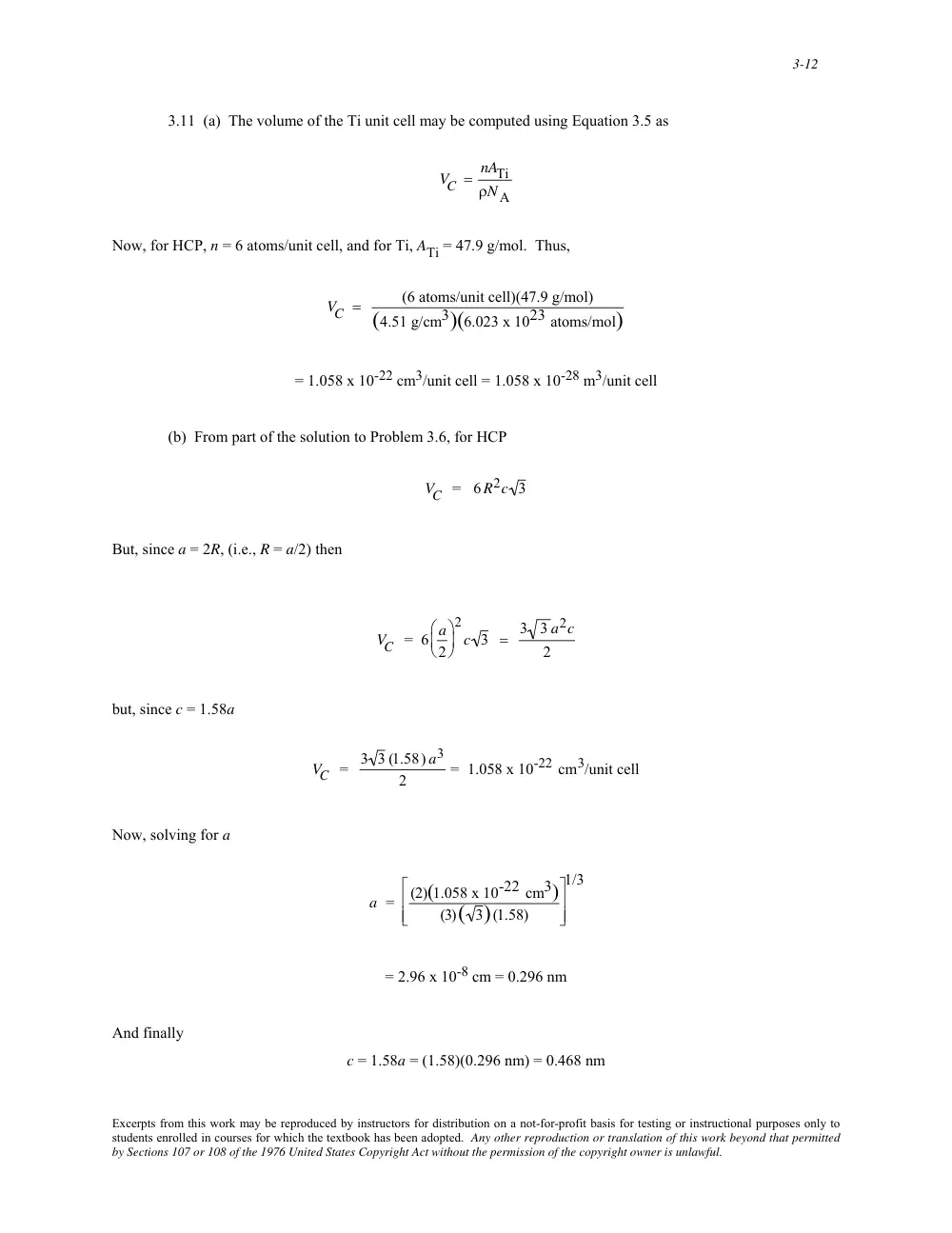
3.11 (a) The volume of the Ti unit cell may be computed using Equation 3.5 as
VC = nATi
ρN A
Now, for HCP, n = 6 atoms/unit cell, and for Ti, ATi = 47.9 g/mol. Thus,
VC =
(6 atoms/unit cell)(47.9 g/mol)
(4.51 g/cm3)(6.023 x 1023 atoms/mol)
= 1.058 x 10⁻²² cm3/unit cell = 1.058 x 10⁻²⁸ m3/unit cell
(b) From part of the solution to Problem 3.6, for HCP
VC = 6 R2c 3
But, since a = 2R, (i.e., R = a/2) then
VC = 6 a
2
⎛
⎝ ⎜
⎞
⎠ ⎟
2
c 3 = 3 3 a2c
2
but, since c = 1.58a
VC = 3 3 (1.58) a3
2
= 1.058 x 10⁻²² cm3/unit cell
Now, solving for a
a = (2)(1.058 x 10⁻²² cm3)
(3)( 3)(1.58)
⎡
⎣
⎢
⎢
⎤
⎦
⎥
⎥
1/3
= 2.96 x 10⁻⁸ cm = 0.296 nm
And finally
c = 1.58a = (1.58)(0.296 nm) = 0.468 nm
Excerpts from this work may be reproduced by instructors for distribution on a not-for-profit basis for testing or instructional purposes only to
students enrolled in courses for which the textbook has been adopted. Any other reproduction or translation of this work beyond that permitted
by Sections 107 or 108 of the 1976 United States Copyright Act without the permission of the copyright owner is unlawful.
3-13
3.12 This problem asks that we calculate the theoretical densities of Al, Ni, Mg, and W.
Since Al has an FCC crystal structure, n = 4, and VC = 16R3 2 (Equation 3.4). Also, R = 0.143 nm (1.43
x 10-8 cm) and AAl = 26.98 g/mol. Employment of Equation 3.5 yields
ρ = nAAl
VC NA
=
(4 atoms/unit cell)(26.98 g/mol)
(2)(1.43 x 10⁻⁸ cm)( 2)
[
]
3
/(unit cell)
⎧
⎨
⎩
⎫
⎬
⎭ (6.023 x 10²³ atoms/mol)
= 2.71 g/cm3
The value given in the table inside the front cover is 2.71 g/cm3.
Nickel also has an FCC crystal structure and therefore
ρ =
(4 atoms/unit cell)(58.69 g/mol)
(2)(1.25 x 10⁻⁸ cm)( 2)
[
]
3
/(unit cell)
⎧
⎨
⎩
⎫
⎬
⎭ (6.023 x 10²³ atoms/mol)
= 8.82 g/cm3
The value given in the table is 8.90 g/cm3.
Magnesium has an HCP crystal structure, and from the solution to Problem 3.6,
VC = 3 3 a2c
2
and, since c = 1.624a and a = 2R = 2(1.60 x 10⁻⁸ cm) = 3.20 x 10⁻⁸ cm
VC = (3 3)(1.624)(3.20 x 10⁻⁸ cm)3
2
= 1.38 x 10⁻²² cm3/unit cell
Also, there are 6 atoms/unit cell for HCP. Therefore the theoretical density is
ρ =
nAMg
VC NA
Excerpts from this work may be reproduced by instructors for distribution on a not-for-profit basis for testing or instructional purposes only to
students enrolled in courses for which the textbook has been adopted. Any other reproduction or translation of this work beyond that permitted
by Sections 107 or 108 of the 1976 United States Copyright Act without the permission of the copyright owner is unlawful.
3-14
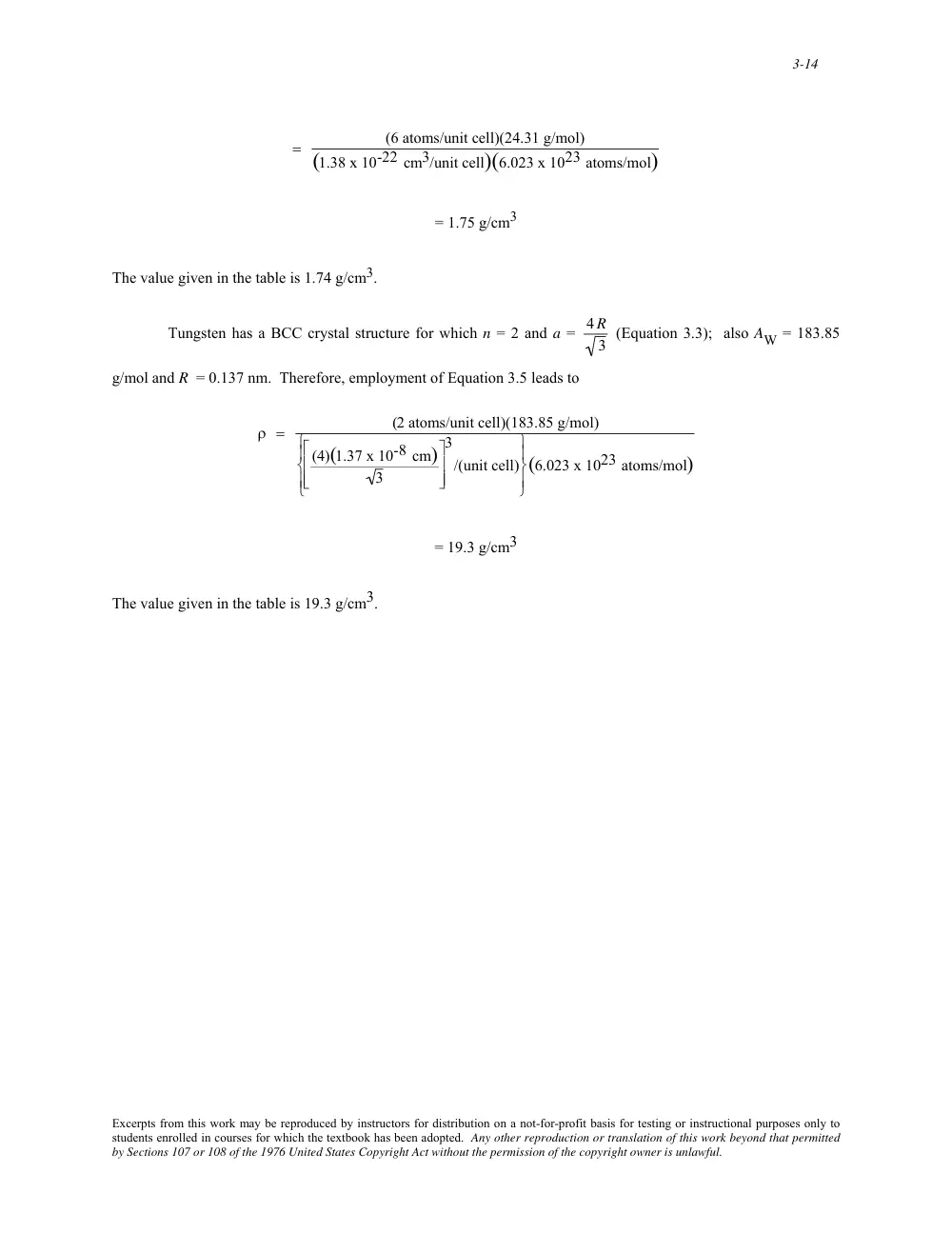
=
(6 atoms/unit cell)(24.31 g/mol)
(1.38 x 10⁻²² cm3/unit cell)(6.023 x 10²³ atoms/mol)
= 1.75 g/cm3
The value given in the table is 1.74 g/cm3.
Tungsten has a BCC crystal structure for which n = 2 and a =
4R
3 (Equation 3.3); also AW = 183.85
g/mol and R = 0.137 nm. Therefore, employment of Equation 3.5 leads to
ρ =
(2 atoms/unit cell)(183.85 g/mol)
(4)(1.37 x 10⁻⁸ cm)
3
⎡
⎣
⎢
⎢
⎤
⎦
⎥
⎥
3
/(unit cell)
⎧
⎨ ⎪
⎩ ⎪
⎫
⎬ ⎪
⎭ ⎪ (6.023 x 10²³ atoms/mol)
= 19.3 g/cm3
The value given in the table is 19.3 g/cm3.
Excerpts from this work may be reproduced by instructors for distribution on a not-for-profit basis for testing or instructional purposes only to
students enrolled in courses for which the textbook has been adopted. Any other reproduction or translation of this work beyond that permitted
by Sections 107 or 108 of the 1976 United States Copyright Act without the permission of the copyright owner is unlawful.
3-15
3.13 In order to determine whether Nb has an FCC or a BCC crystal structure, we need to compute its
density for each of the crystal structures. For FCC, n = 4, and a = 2R
2 (Equation 3.1). Also, from Figure 2.6, its
atomic weight is 92.91 g/mol. Thus, for FCC (employing Equation 3.5)
ρ =
nANb
a3NA
=
nANb
(2R 2)3NA
=
(4 atoms/unit cell)(92.91 g/mol)
(2)(1.43 × 10⁻⁸ cm)(
2)
[
]
3
/(unitcell)
⎧
⎨
⎩
⎫
⎬
⎭ (6.023 × 10²³atoms /mol)
= 9.33 g/cm3
For BCC, n = 2, and a =
4R
3 (Equation 3.3), thus
ρ =
nANb
4 R
3
⎛
⎝
⎜ ⎜
⎞
⎠
⎟ ⎟
3
NA
ρ =
(2 atoms/unit cell)(92.91 g/mol)
(4)(1.43 × 10⁻⁸ cm)
3
⎡
⎣
⎢
⎢
⎤
⎦
⎥
⎥
3
/(unitcell)
⎧
⎨ ⎪
⎩ ⎪
⎫
⎬ ⎪
⎭ ⎪ (6.023 × 10²³atoms/mol)
= 8.57 g/cm3
which is the value provided in the problem statement. Therefore, Nb has a BCC crystal structure.
Excerpts from this work may be reproduced by instructors for distribution on a not-for-profit basis for testing or instructional purposes only to
students enrolled in courses for which the textbook has been adopted. Any other reproduction or translation of this work beyond that permitted
by Sections 107 or 108 of the 1976 United States Copyright Act without the permission of the copyright owner is unlawful.
3-16
3.14 For each of these three alloys we need, by trial and error, to calculate the density using Equation 3.5,
and compare it to the value cited in the problem. For SC, BCC, and FCC crystal structures, the respective values of
n are 1, 2, and 4, whereas the expressions for a (since VC = a3) are 2R, 2 R 2 , and
4R
3 .
For alloy A, let us calculate ρ assuming a BCC crystal structure.
ρ = nAA
VC NA
=
nAA
4R
3
⎛
⎝ ⎜
⎞
⎠ ⎟
3
N A
=
(2 atoms/unit cell)(43.1 g/mol)
(4)(1.22 × 10⁻⁸ cm)
3
⎡
⎣
⎢
⎢
⎤
⎦
⎥
⎥
3
/(unit cell)
⎧
⎨ ⎪
⎩ ⎪
⎫
⎬ ⎪
⎭ ⎪ (6.023 × 10²³ atoms/mol)
= 6.40 g/cm3
Therefore, its crystal structure is BCC.
For alloy B, let us calculate ρ assuming a simple cubic crystal structure.
ρ =
nAB
(2a)3NA
=
(1 atom/unit cell)(184.4 g/mol)
[(2)(1.46 × 10⁻⁸ cm)
]
3
/(unit cell)
⎧
⎨
⎩
⎫
⎬
⎭ (6.023 × 10²³ atoms/mol)
= 12.3 g/cm3
Therefore, its crystal structure is simple cubic.
For alloy C, let us calculate ρ assuming a BCC crystal structure.
Excerpts from this work may be reproduced by instructors for distribution on a not-for-profit basis for testing or instructional purposes only to
students enrolled in courses for which the textbook has been adopted. Any other reproduction or translation of this work beyond that permitted
by Sections 107 or 108 of the 1976 United States Copyright Act without the permission of the copyright owner is unlawful.
3-17
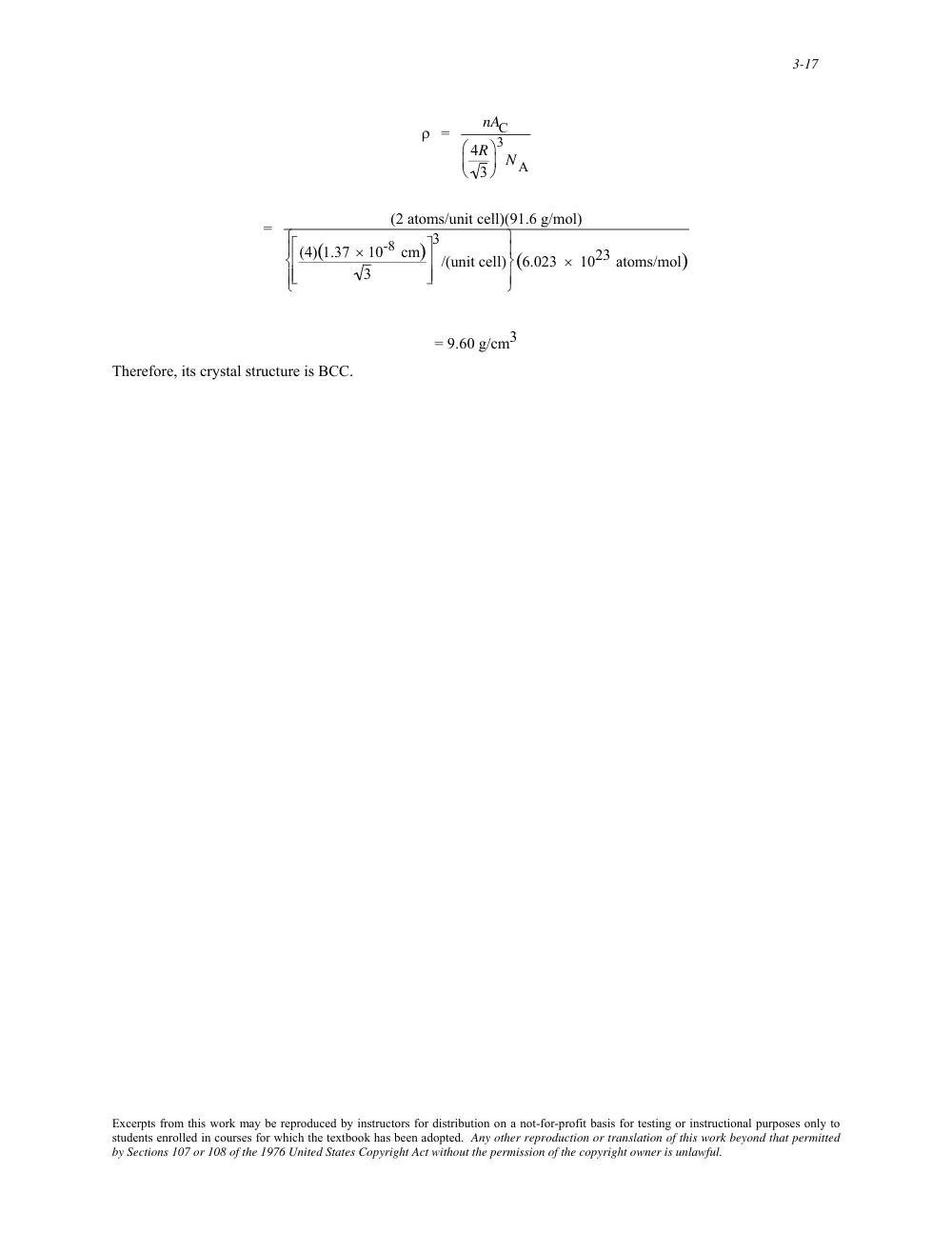
ρ =
nAC
4R
3
⎛
⎝ ⎜
⎞
⎠ ⎟
3
N A
=
(2 atoms/unit cell)(91.6 g/mol)
(4)(1.37 × 10⁻⁸ cm)
3
⎡
⎣
⎢
⎢
⎤
⎦
⎥
⎥
3
/(unit cell)
⎧
⎨ ⎪
⎩ ⎪
⎫
⎬ ⎪
⎭ ⎪ (6.023 × 10²³ atoms/mol)
= 9.60 g/cm3
Therefore, its crystal structure is BCC.
Excerpts from this work may be reproduced by instructors for distribution on a not-for-profit basis for testing or instructional purposes only to
students enrolled in courses for which the textbook has been adopted. Any other reproduction or translation of this work beyond that permitted
by Sections 107 or 108 of the 1976 United States Copyright Act without the permission of the copyright owner is unlawful.
3-18
3.15 In order to determine the APF for U, we need to compute both the unit cell volume (VC) which is just
the product of the three unit cell parameters, as well as the total sphere volume (VS) which is just the product of the
volume of a single sphere and the number of spheres in the unit cell (n). The value of n may be calculated from
Equation 3.5 as
n = ρVC N A
AU
= (19.05 g/cm3)(2.86)(5.87)(4.95)(× 10-24 cm3)(6.023 × 10²³ atoms /mol)
238.03 g/mol
= 4.01 atoms/unit cell
Therefore
APF = VS
VC
=
(4) 4
3 π R3
⎛
⎝ ⎜
⎞
⎠ ⎟
(a)(b)(c)
=
(4) 4
3 (π)(1.385Źx 10-8 cm)3
⎡
⎣ ⎢
⎤
⎦ ⎥
(2.86)(5.87)(4.95)(xŹ10-24 cm3)
= 0.536
Excerpts from this work may be reproduced by instructors for distribution on a not-for-profit basis for testing or instructional purposes only to
students enrolled in courses for which the textbook has been adopted. Any other reproduction or translation of this work beyond that permitted
by Sections 107 or 108 of the 1976 United States Copyright Act without the permission of the copyright owner is unlawful.
3-19
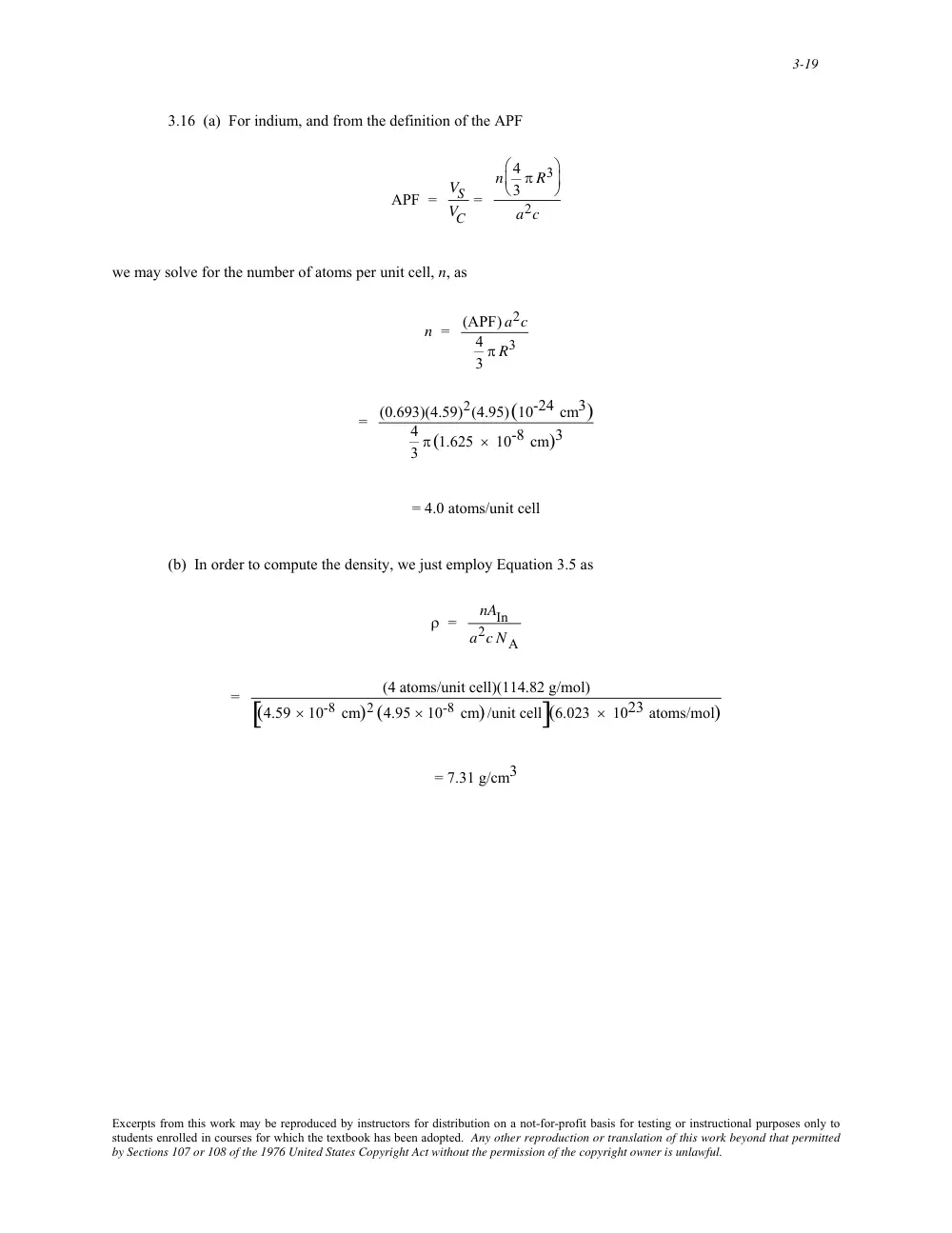
3.16 (a) For indium, and from the definition of the APF
APF = VS
VC
=
n 4
3 π R3
⎛
⎝ ⎜
⎞
⎠ ⎟
a2c
we may solve for the number of atoms per unit cell, n, as
n = (APF) a2c
4
3 π R3
= (0.693)(4.59)2(4.95)(10-24 cm3)
4
3 π(1.625 × 10⁻⁸ cm)3
= 4.0 atoms/unit cell
(b) In order to compute the density, we just employ Equation 3.5 as
ρ =
nAIn
a2c NA
=
(4 atoms/unit cell)(114.82 g/mol)
(4.59 × 10⁻⁸ cm)2 (4.95 × 10⁻⁸ cm) /unit cell
[
](6.023 × 1023 atoms/mol)
= 7.31 g/cm3
Excerpts from this work may be reproduced by instructors for distribution on a not-for-profit basis for testing or instructional purposes only to
students enrolled in courses for which the textbook has been adopted. Any other reproduction or translation of this work beyond that permitted
by Sections 107 or 108 of the 1976 United States Copyright Act without the permission of the copyright owner is unlawful.
3-20
3. 17 (a) We are asked to calculate the unit cell volume for Be. For HCP, from the solution to Problem
3.6
VC = 6R2c 3
But, c = 1.568a, and a = 2R, or c = 3.14R, and
VC = (6)(3.14) R3 3
= (6)(3.14)( 3) 0.1143 × 10⁻⁷ cm
[
]
3
= 4.87 × 10⁻²³ cm3/unit cell
(b) The theoretical density of Be is determined, using Equation 3.5, as follows:
ρ = nABe
VC NA
For HCP, n = 6 atoms/unit cell, and for Be, ABe = 9.01 g/mol (as noted inside the front cover). Thus,
ρ =
(6 atoms/unit cell)(9.01 g/mol)
(4.87 × 10⁻²³ cm3/unit cell)(6.023 × 10²³ atoms/mol)
= 1.84 g/cm3
The value given in the literature is 1.85 g/cm3.
Excerpts from this work may be reproduced by instructors for distribution on a not-for-profit basis for testing or instructional purposes only to
students enrolled in courses for which the textbook has been adopted. Any other reproduction or translation of this work beyond that permitted
by Sections 107 or 108 of the 1976 United States Copyright Act without the permission of the copyright owner is unlawful.
3-21
3.18 This problem calls for us to compute the atomic radius for Mg. In order to do this we must use
Equation 3.5, as well as the expression which relates the atomic radius to the unit cell volume for HCP; from
Problem 3.6 it was shown that
VC = 6R2c 3
In this case c = 1.624a, but, for HCP, a = 2R, which means that
VC = 6R2(1.624)(2R) 3 = (1.624)(12 3)R3
And from Equation 3.5, the density is equal to
ρ =
nAMg
VC N A
=
nAMg
(1.624)(12 3)R3N A
And, solving for R from the above equation leads to the following:
R =
nAMg
(1.624)(12
3) ρ NA
⎡
⎣
⎢
⎢
⎤
⎦
⎥
⎥
1/3
=
(6 atoms/unit cell)(24.31 g/mol)
(1.624)(12
3)(1.74 g/cm3)(6.023 × 1023 atoms/mol)
⎡
⎣
⎢
⎢
⎤
⎦
⎥
⎥
1/3
= 1.60 x 10⁻⁸ cm = 0.160 nm
Excerpts from this work may be reproduced by instructors for distribution on a not-for-profit basis for testing or instructional purposes only to
students enrolled in courses for which the textbook has been adopted. Any other reproduction or translation of this work beyond that permitted
by Sections 107 or 108 of the 1976 United States Copyright Act without the permission of the copyright owner is unlawful.
3-22
3.19 This problem asks that we calculate the unit cell volume for Co which has an HCP crystal structure.
In order to do this, it is necessary to use a result of Problem 3.6, that is
VC = 6R2c 3
The problem states that c = 1.623a, and a = 2R. Therefore
VC = (1.623)(12 3) R3
= (1.623)(12 3)(1.253 × 10⁻⁸ cm)3 = 6.64 × 10⁻²³ cm3 = 6.64 × 10⁻² nm3
Excerpts from this work may be reproduced by instructors for distribution on a not-for-profit basis for testing or instructional purposes only to
students enrolled in courses for which the textbook has been adopted. Any other reproduction or translation of this work beyond that permitted
by Sections 107 or 108 of the 1976 United States Copyright Act without the permission of the copyright owner is unlawful.
3-2
Unit Cells
Metallic Crystal Structures
3.2 For this problem, we are asked to calculate the volume of a unit cell of lead. Lead has an FCC crystal
structure (Table 3.1). The FCC unit cell volume may be computed from Equation 3.4 as
VC = 16R3 2 = (16)(0.175 × 10⁻⁹ m)3( 2) = 1.213 × 10⁻²⁸ m3
Excerpts from this work may be reproduced by instructors for distribution on a not-for-profit basis for testing or instructional purposes only to
students enrolled in courses for which the textbook has been adopted. Any other reproduction or translation of this work beyond that permitted
by Sections 107 or 108 of the 1976 United States Copyright Act without the permission of the copyright owner is unlawful.
3-23
Crystal Systems
3.20 (a) The unit cell shown in the problem statement belongs to the tetragonal crystal system since a = b
= 0.35 nm, c = 0.45 nm, and α = β = γ = 90°.
(b) The crystal structure would be called body-centered tetragonal.
(c) As with BCC, n = 2 atoms/unit cell. Also, for this unit cell
VC = (3.5 × 10⁻⁸ cm)2(4.5 × 10⁻⁸ cm)
= 5.51 × 10⁻²³ cm3/unit cell
Thus, using Equation 3.5, the density is equal to
ρ =
nA
VC NA
=
(2 atoms/unit cell)(141 g/mol)
(5.51 × 10⁻²³ cm3/unit cell)(6.023 × 10²³ atoms/mol)
= 8.49 g/cm3
Excerpts from this work may be reproduced by instructors for distribution on a not-for-profit basis for testing or instructional purposes only to
students enrolled in courses for which the textbook has been adopted. Any other reproduction or translation of this work beyond that permitted
by Sections 107 or 108 of the 1976 United States Copyright Act without the permission of the copyright owner is unlawful.
3-24
3.21 A unit cell for the face-centered orthorhombic crystal structure is presented below.
Excerpts from this work may be reproduced by instructors for distribution on a not-for-profit basis for testing or instructional purposes only to
students enrolled in courses for which the textbook has been adopted. Any other reproduction or translation of this work beyond that permitted
by Sections 107 or 108 of the 1976 United States Copyright Act without the permission of the copyright owner is unlawful.
3-25
Point Coordinates
3.22 This problem asks that we list the point coordinates for all of the atoms that are associated with the
FCC unit cell. From Figure 3.1b, the atom located of the origin of the unit cell has the coordinates 000.
Coordinates for other atoms in the bottom face are 100, 110, 010, and
1
2
1
2 0. (The z coordinate for all these points
is zero.)
For the top unit cell face, the coordinates are 001, 101, 111, 011, and
1
2
1
21. (These coordinates are the
same as bottom-face coordinates except that the “0” z coordinate has been replaced by a “1”.)
Coordinates for those atoms that are positioned at the centers of both side faces, and centers of both front
and back faces need to be specified. For the front and back-center face atoms, the coordinates are
1 1
2
1
2 and
0 1
2
1
2,
respectively. While for the left and right side center-face atoms, the respective coordinates are
1
2 0 1
2 and
1
2 1 1
2.
Excerpts from this work may be reproduced by instructors for distribution on a not-for-profit basis for testing or instructional purposes only to
students enrolled in courses for which the textbook has been adopted. Any other reproduction or translation of this work beyond that permitted
by Sections 107 or 108 of the 1976 United States Copyright Act without the permission of the copyright owner is unlawful.
3-26
3.23 Here we are asked list point coordinates for both sodium and chlorine ions for a unit cell of the
sodium chloride crystal structure, which is shown in Figure 12.2.
In Figure 12.2, the chlorine ions are situated at all corners and face-centered positions. Therefore, point
coordinates for these ions are the same as for FCC, as presented in the previous problem—that is, 000, 100, 110,
010, 001, 101, 111, 011,
1
2
1
2 0,
1
2
1
21,
1 1
2
1
2,
0 1
2
1
2 ,
1
2 0 1
2, and
1
2 1 1
2.
Furthermore, the sodium ions are situated at the centers of all unit cell edges, and, in addition, at the unit
cell center. For the bottom face of the unit cell, the point coordinates are as follows:
1
2 00,
1 1
2 0,
1
210,
0 1
2 0.
While, for the horizontal plane that passes through the center of the unit cell (which includes the ion at the unit cell
center), the coordinates are
00 1
2,
1 0 1
2,
1
2
1
2
1
2,
1 1 1
2, and
01 1
2 . And for the four ions on the top face
1
2 01,
1 1
21,
1
21 1, and
0 1
21.
Excerpts from this work may be reproduced by instructors for distribution on a not-for-profit basis for testing or instructional purposes only to
students enrolled in courses for which the textbook has been adopted. Any other reproduction or translation of this work beyond that permitted
by Sections 107 or 108 of the 1976 United States Copyright Act without the permission of the copyright owner is unlawful.
3-27
3.24 This problem calls for us to list the point coordinates of both the zinc and sulfur atoms for a unit cell
of the zinc blende structure, which is shown in Figure 12.4.
First of all, the sulfur atoms occupy the face-centered positions in the unit cell, which from the solution to
Problem 3.22, are as follows: 000, 100, 110, 010, 001, 101, 111, 011,
1
2
1
2 0,
1
2
1
21,
1 1
2
1
2,
0 1
2
1
2,
1
2 0 1
2, and
1
21 1
2.
Now, using an x-y-z coordinate system oriented as in Figure 3.4, the coordinates of the zinc atom that lies
toward the lower-left-front of the unit cell has the coordinates
3
4
1
4
1
4, whereas the atom situated toward the lower-
right-back of the unit cell has coordinates of
1
4
3
4
1
4. Also, the zinc atom that resides toward the upper-left-back of
the unit cell has the
1
4
1
4
3
4 coordinates. And, the coordinates of the final zinc atom, located toward the upper-right-
front of the unit cell, are
3
4
3
4
3
4.
Excerpts from this work may be reproduced by instructors for distribution on a not-for-profit basis for testing or instructional purposes only to
students enrolled in courses for which the textbook has been adopted. Any other reproduction or translation of this work beyond that permitted
by Sections 107 or 108 of the 1976 United States Copyright Act without the permission of the copyright owner is unlawful.
3-28
3.25 A tetragonal unit in which are shown the
1 1 1
2 and
1
2
1
4
1
2 point coordinates is presented below.
Excerpts from this work may be reproduced by instructors for distribution on a not-for-profit basis for testing or instructional purposes only to
students enrolled in courses for which the textbook has been adopted. Any other reproduction or translation of this work beyond that permitted
by Sections 107 or 108 of the 1976 United States Copyright Act without the permission of the copyright owner is unlawful.
3-29
3.26 First of all, open the “Molecular Definition Utility”; it may be found in either of “Metallic Crystal
Structures and Crystallography” or “Ceramic Crystal Structures” modules.
In the “Step 1” window, it is necessary to define the atom type, a color for the spheres (atoms), and specify
an atom size. Let us enter “Sn” as the name of the atom type (since “Sn” the symbol for tin). Next it is necessary to
choose a color from the selections that appear in the pull-down menu—for example, “LtBlue” (light blue). In the
“Atom Size” window, it is necessary to enter an atom size. In the instructions for this step, it is suggested that the
atom diameter in nanometers be used. From the table found inside the front cover of the textbook, the atomic radius
for tin is 0.151 nm, and, therefore, the atomic diameter is twice this value (i.e., 0.302 nm); therefore, we enter the
value “0.302”. Now click on the “Register” button, followed by clicking on the “Go to Step 2” button.
In the “Step 2” window we specify positions for all of the atoms within the unit cell; their point
coordinates are specified in the problem statement. Now we must enter a name in the box provided for each of the
atoms in the unit cell. For example, let us name the first atom “Sn1”. Its point coordinates are 000, and, therefore,
we enter a “0” (zero) in each of the “x”, “y”, and “z” atom position boxes. Next, in the “Atom Type” pull-down
menu we select “Sn”, our only choice, and the name we specified in Step 1. For the next atom, which has point
coordinates of 100, let us name it “Sn2”; since it is located a distance of a units along the x-axis the value of
“0.583” is entered in the “x” atom position box (since this is the value of a given in the problem statement); zeros
are entered in each of the “y” and “z” position boxes. We next click on the “Register” button. This same procedure
is repeated for all 13 of the point coordinates specified in the problem statement. For the atom having point
coordinates of “111” respective values of “0.583”, “0.583”, and “0.318” are entered in the x, y, and z atom position
boxes, since the unit cell edge length along the y and z axes are a (0.583) and c (0.318 nm), respectively. For
fractional point coordinates, the appropriate a or c value is multiplied by the fraction. For example, the second
point coordinate set in the right-hand column,
1
2 0 3
4, the x, y, and z atom positions are
1
2 (0.583) = 0.2915, 0, and
3
4 (0.318) = 0.2385, respectively. The x, y, and z atom position entries for all 13 sets of point coordinates are as
follows:
0, 0, and 0
0, 0.583, and 0.318
0.583, 0, and 0
0.2915, 0, and 0.2385
0.583, 0.583, and 0
0.2915, 0.583, and 0.2385
0, 0.583, and 0
0.583, 0.2915, and 0.0795
0, 0, and 0.318
0, 0.2915, 0.0795
0.583, 0, and 0.318
0.2915, 0.2915, and 0.159
0.583, 0.583, and 0.318
In Step 3, we may specify which atoms are to be represented as being bonded to one another, and which
type of bond(s) to use (single solid, single dashed, double, and triple are possibilities), or we may elect to not
Excerpts from this work may be reproduced by instructors for distribution on a not-for-profit basis for testing or instructional purposes only to
students enrolled in courses for which the textbook has been adopted. Any other reproduction or translation of this work beyond that permitted
by Sections 107 or 108 of the 1976 United States Copyright Act without the permission of the copyright owner is unlawful.
3-30
represent any bonds at all (in which case we click on the “Go to Step 4” button). If it is decided to show bonds,
probably the best thing to do is to represent unit cell edges as bonds.
The window in Step 4 presents all the data that have been entered; you may review these data for
accuracy. If any changes are required, it is necessary to close out all windows back to the one in which corrections
are to be made, and then reenter data in succeeding windows. When you are fully satisfied with your data, click on
the “Generate” button, and the image that you have defined will be displayed. The image may then be rotated by
using mouse click-and-drag.
Your image should appear as
[Note: Unfortunately, with this version of the Molecular Definition Utility, it is not possible to save either the data
or the image that you have generated. You may use screen capture (or screen shot) software to record and store
your image.]
Excerpts from this work may be reproduced by instructors for distribution on a not-for-profit basis for testing or instructional purposes only to
students enrolled in courses for which the textbook has been adopted. Any other reproduction or translation of this work beyond that permitted
by Sections 107 or 108 of the 1976 United States Copyright Act without the permission of the copyright owner is unlawful.
3-31
Crystallographic Directions
3.27 This problem calls for us to draw a [21 1] direction within an orthorhombic unit cell (a ≠ b ≠ c, α = β
= γ = 90°). Such a unit cell with its origin positioned at point O is shown below. We first move along the +x-axis
2a units (from point O to point A), then parallel to the +y-axis -b units (from point A to point B). Finally, we
proceed parallel to the z-axis c units (from point B to point C). The [21 1] direction is the vector from the origin
(point O) to point C as shown.
Excerpts from this work may be reproduced by instructors for distribution on a not-for-profit basis for testing or instructional purposes only to
students enrolled in courses for which the textbook has been adopted. Any other reproduction or translation of this work beyond that permitted
by Sections 107 or 108 of the 1976 United States Copyright Act without the permission of the copyright owner is unlawful.
3-32
3.28 This problem asks that a [1 01] direction be drawn within a monoclinic unit cell (a ≠ b ≠ c, and α = β
= 90º ≠ γ). One such unit cell with its origin at point O is sketched below. For this direction, we move from the
origin along the minus x-axis a units (from point O to point P). There is no projection along the y-axis since the
next index is zero. Since the final index is a one, we move from point P parallel to the z-axis, c units (to point Q).
Thus, the [1 01] direction corresponds to the vector passing from the origin to point Q, as indicated in the figure.
Excerpts from this work may be reproduced by instructors for distribution on a not-for-profit basis for testing or instructional purposes only to
students enrolled in courses for which the textbook has been adopted. Any other reproduction or translation of this work beyond that permitted
by Sections 107 or 108 of the 1976 United States Copyright Act without the permission of the copyright owner is unlawful.
3-33
3.29 We are asked for the indices of the two directions sketched in the figure. For direction 1, the
projection on the x-axis is a, while projections on the y- and z-axes are -b/2 and -c, respectively. This is a [21 2 ]
direction as indicated in the summary below.
x
y
z
Projections
a
-b/2
-c
Projections in terms of a, b, and c
1
-1/2
-1
Reduction to integers
2
-1
-2
Enclosure
[21 2 ]
Direction 2 is [102] as summarized below.
x
y
z
Projections
a/2
0b
c
Projections in terms of a, b, and c
1/2
0
1
Reduction to integers
1
0
2
Enclosure
[102]
Excerpts from this work may be reproduced by instructors for distribution on a not-for-profit basis for testing or instructional purposes only to
students enrolled in courses for which the textbook has been adopted. Any other reproduction or translation of this work beyond that permitted
by Sections 107 or 108 of the 1976 United States Copyright Act without the permission of the copyright owner is unlawful.
3-3
3.3 This problem calls for a demonstration of the relationship
a = 4R
3 for BCC. Consider the BCC unit
cell shown below
Using the triangle NOP
(NP)2 = a2 + a2 = 2a2
And then for triangle NPQ,
(NQ)2 = (QP)2 + (NP)2
But NQ = 4R, R being the atomic radius. Also, QP = a. Therefore,
(4R)2 = a2 + 2a2
or
a = 4R
3
Excerpts from this work may be reproduced by instructors for distribution on a not-for-profit basis for testing or instructional purposes only to
students enrolled in courses for which the textbook has been adopted. Any other reproduction or translation of this work beyond that permitted
by Sections 107 or 108 of the 1976 United States Copyright Act without the permission of the copyright owner is unlawful.
3-34
3.30 The directions asked for are indicated in the cubic unit cells shown below.
Excerpts from this work may be reproduced by instructors for distribution on a not-for-profit basis for testing or instructional purposes only to
students enrolled in courses for which the textbook has been adopted. Any other reproduction or translation of this work beyond that permitted
by Sections 107 or 108 of the 1976 United States Copyright Act without the permission of the copyright owner is unlawful.
3-35
3.31 Direction A is a [1 10]direction, which determination is summarized as follows. We first of all
position the origin of the coordinate system at the tail of the direction vector; then in terms of this new coordinate
system
x
y
z
Projections
– a
b
0c
Projections in terms of a, b, and c
–1
1
0
Reduction to integers
not necessary
Enclosure
[1 10]
Direction B is a [121] direction, which determination is summarized as follows. The vector passes through
the origin of the coordinate system and thus no translation is necessary. Therefore,
x
y
z
Projections
a
2
b
c
2
Projections in terms of a, b, and c
1
2
1
1
2
Reduction to integers
1
2
1
Enclosure
[121]
Direction C is a [01 2 ] direction, which determination is summarized as follows. We first of all position
the origin of the coordinate system at the tail of the direction vector; then in terms of this new coordinate system
x
y
z
Projections
0a
− b
2
– c
Projections in terms of a, b, and c
0
–