
MECH 340 Lecture, Fall 2004
American University of Beirut · Engineering Materials · 48 pages





Showing the first 10 of 48 pages. Download the PDF to see all of it.
More MECH 340 files
Show the text of this lab
4-1
CHAPTER 4
IMPERFECTIONS IN SOLIDS
PROBLEM SOLUTIONS
Vacancies and Self-Interstitials
4.1 In order to compute the fraction of atom sites that are vacant in copper at 1357 K, we must employ
Equation 4.1. As stated in the problem, Qv = 0.90 eV/atom. Thus,
N v
N = exp − Qv
kT
⎛
⎝
⎜
⎞
⎠
⎟ = exp −
0.90 eV/atom
(8.62 × 10⁻⁵ eV/atom- K)(1357 K)
⎡
⎣
⎢
⎢
⎤
⎦
⎥
⎥
= 4.56 x 10⁻⁴
Excerpts from this work may be reproduced by instructors for distribution on a not-for-profit basis for testing or instructional purposes only to
students enrolled in courses for which the textbook has been adopted. Any other reproduction or translation of this work beyond that permitted
by Sections 107 or 108 of the 1976 United States Copyright Act without the permission of the copyright owner is unlawful.
4-2
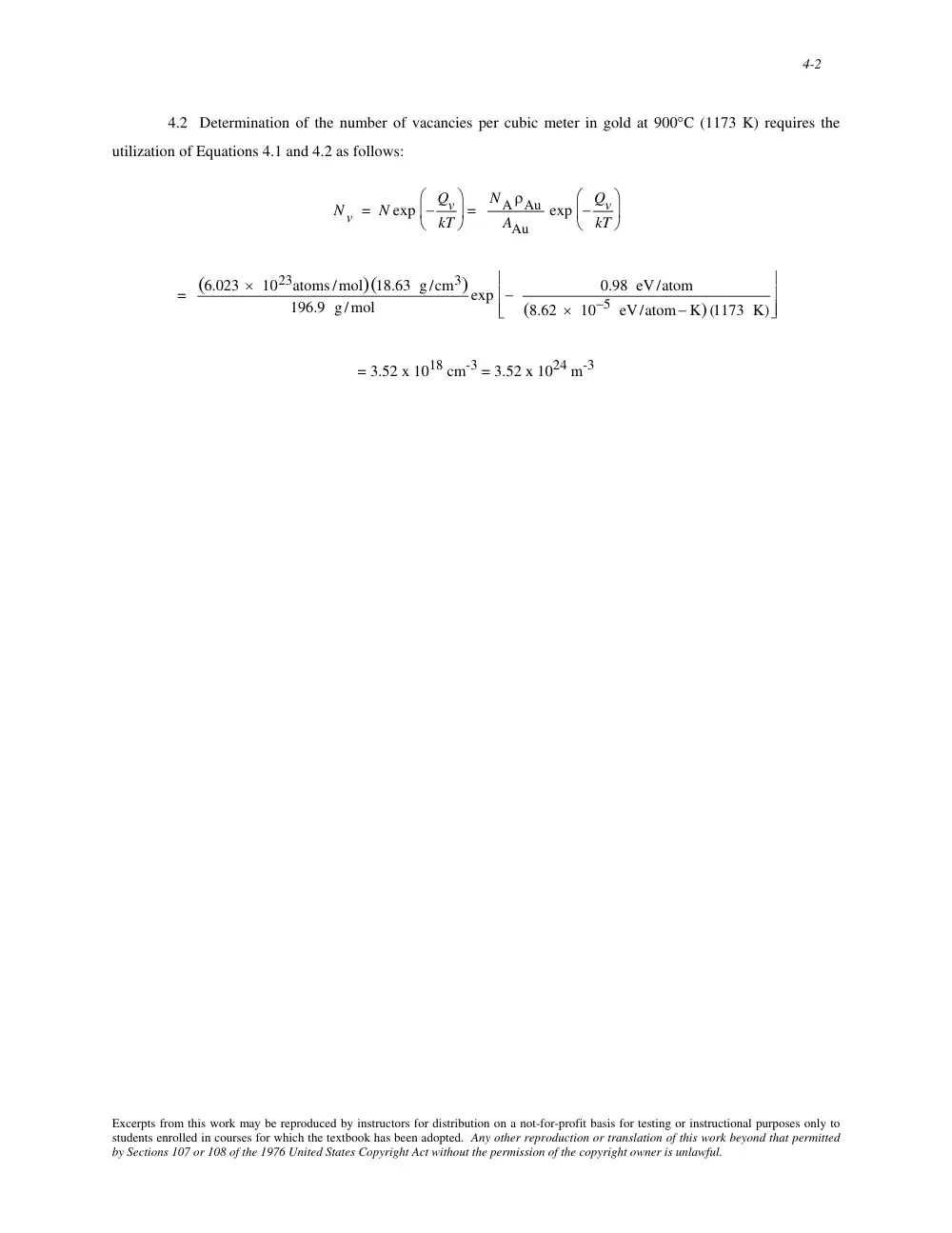
4.2 Determination of the number of vacancies per cubic meter in gold at 900°C (1173 K) requires the
utilization of Equations 4.1 and 4.2 as follows:
Nv = N exp − Qv
kT
⎛
⎝ ⎜
⎞
⎠ ⎟ = NAρAu
AAu
exp − Qv
kT
⎛
⎝ ⎜
⎞
⎠ ⎟
= (6.023 × 10²³atoms /mol)(18.63 g/cm3)
196.9 g/mol
exp −
0.98 eV/atom
(8.62 × 10⁻⁵ eV/atom− K) (1173 K)
⎡
⎣
⎢
⎢
⎤
⎦
⎥
⎥
= 3.52 x 1018 cm-3 = 3.52 x 1024 m-3
Excerpts from this work may be reproduced by instructors for distribution on a not-for-profit basis for testing or instructional purposes only to
students enrolled in courses for which the textbook has been adopted. Any other reproduction or translation of this work beyond that permitted
by Sections 107 or 108 of the 1976 United States Copyright Act without the permission of the copyright owner is unlawful.
4-3
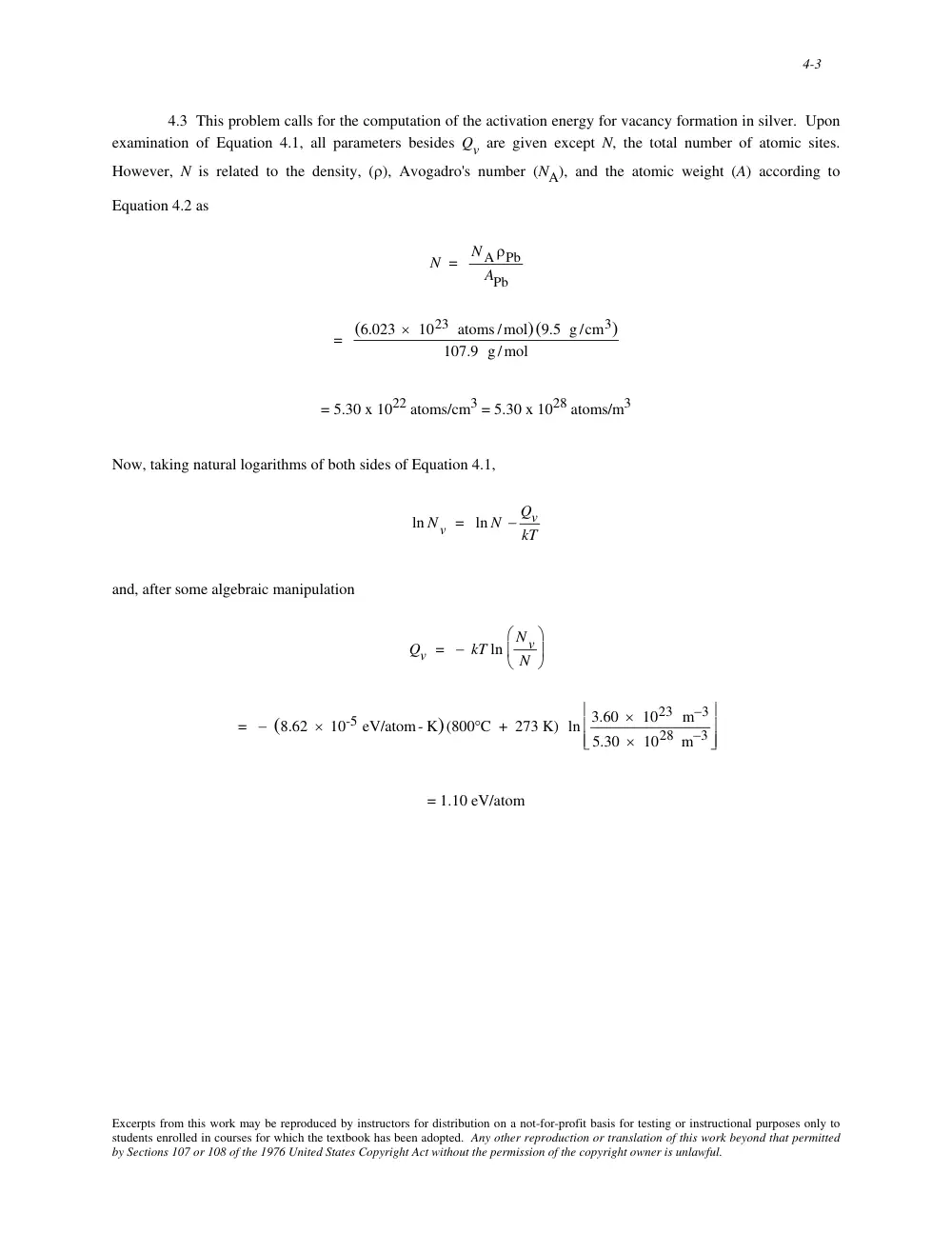
4.3 This problem calls for the computation of the activation energy for vacancy formation in silver. Upon
examination of Equation 4.1, all parameters besides Qv are given except N, the total number of atomic sites.
However, N is related to the density, (ρ), Avogadro's number (NA), and the atomic weight (A) according to
Equation 4.2 as
N = N AρPb
APb
= (6.023 × 10²³ atoms /mol)(9.5 g /cm3)
107.9 g/mol
= 5.30 x 10²² atoms/cm3 = 5.30 x 1028 atoms/m3
Now, taking natural logarithms of both sides of Equation 4.1,
ln Nv = ln N − Qv
kT
and, after some algebraic manipulation
Qv = − kT ln Nv
N
⎛
⎝ ⎜
⎞
⎠ ⎟
= − (8.62 × 10⁻⁵ eV/atom- K)(800°C + 273 K) ln 3.60 × 10²³ m−3
5.30 × 1028 m−3
⎡
⎣
⎢
⎢
⎤
⎦
⎥
⎥
= 1.10 eV/atom
Excerpts from this work may be reproduced by instructors for distribution on a not-for-profit basis for testing or instructional purposes only to
students enrolled in courses for which the textbook has been adopted. Any other reproduction or translation of this work beyond that permitted
by Sections 107 or 108 of the 1976 United States Copyright Act without the permission of the copyright owner is unlawful.
4-4
Impurities in Solids
4.4 In this problem we are asked to cite which of the elements listed form with Ni the three possible solid
solution types. For complete substitutional solubility the following criteria must be met: 1) the difference in atomic
radii between Ni and the other element (∆R%) must be less than ±15%, 2) the crystal structures must be the same,
3) the electronegativities must be similar, and 4) the valences should be the same, or nearly the same. Below are
tabulated, for the various elements, these criteria.
Crystal
∆Electro-
Element
∆R%
Structure
negativity
Valence
Ni
FCC
2+
C
–43
H
–63
O
–52
Ag
+16
FCC
+0.1
1+
Al
+15
FCC
-0.3
3+
Co
+0.6
HCP
0
2+
Cr
+0.2
BCC
-0.2
3+
Fe
-0.4
BCC
0
2+
Pt
+11
FCC
+0.4
2+
Zn
+7
HCP
-0.2
2+
(a) Pt is the only element that meets all of the criteria and thus forms a substitutional solid solution having
complete solubility. At elevated temperatures Co and Fe experience allotropic transformations to the FCC crystal
structure, and thus display complete solid solubility at these temperatures.
(b) Ag, Al, Co, Cr, Fe, and Zn form substitutional solid solutions of incomplete solubility. All these metals
have either BCC or HCP crystal structures, and/or the difference between their atomic radii and that for Ni are
greater than ±15%, and/or have a valence different than 2+.
(c) C, H, and O form interstitial solid solutions. These elements have atomic radii that are significantly
smaller than the atomic radius of Ni.
Excerpts from this work may be reproduced by instructors for distribution on a not-for-profit basis for testing or instructional purposes only to
students enrolled in courses for which the textbook has been adopted. Any other reproduction or translation of this work beyond that permitted
by Sections 107 or 108 of the 1976 United States Copyright Act without the permission of the copyright owner is unlawful.
4-5
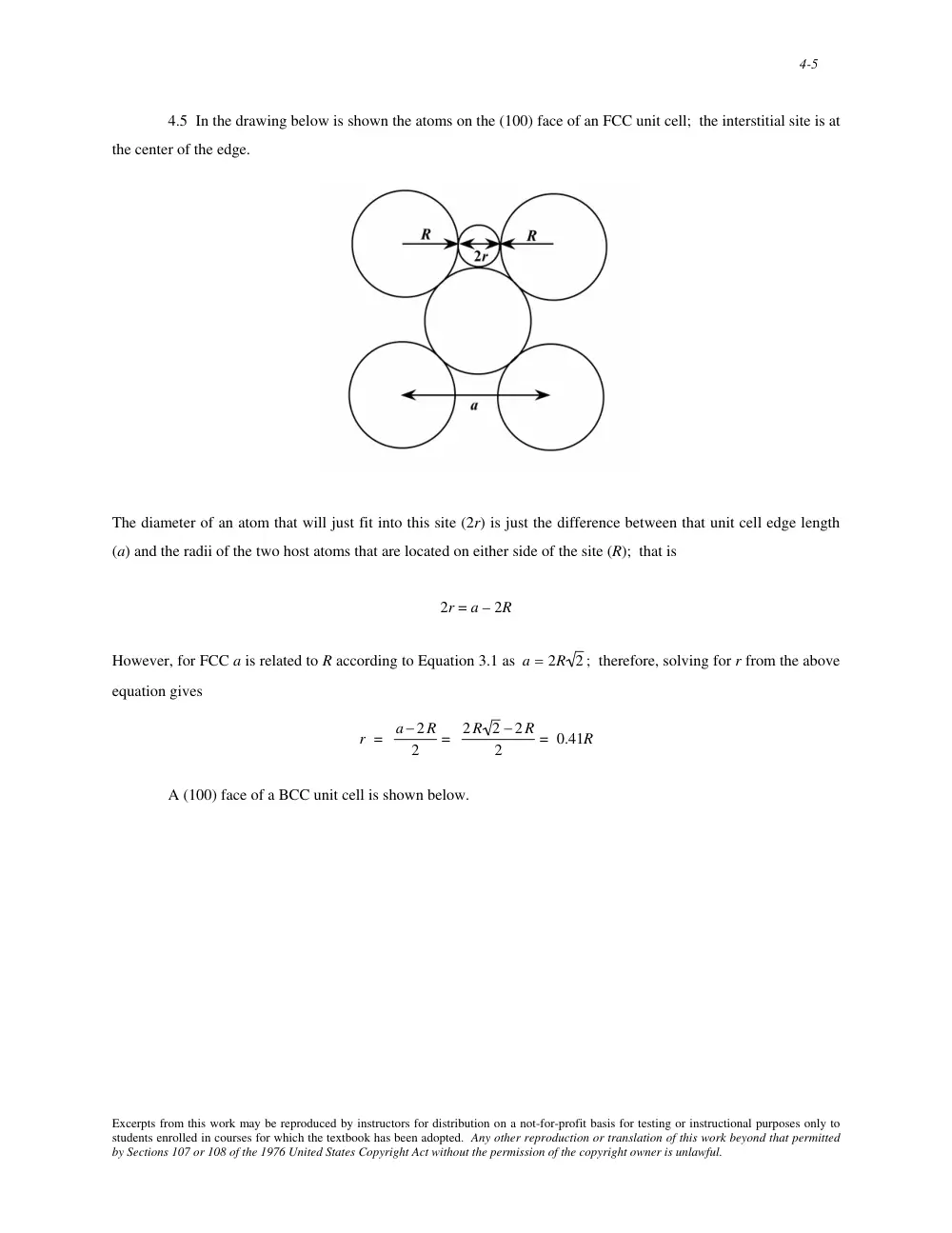
4.5 In the drawing below is shown the atoms on the (100) face of an FCC unit cell; the interstitial site is at
the center of the edge.
The diameter of an atom that will just fit into this site (2r) is just the difference between that unit cell edge length
(a) and the radii of the two host atoms that are located on either side of the site (R); that is
2r = a – 2R
However, for FCC a is related to R according to Equation 3.1 as a = 2R 2 ; therefore, solving for r from the above
equation gives
r = a− 2R
2
= 2 R 2 − 2R
2
= 0.41R
A (100) face of a BCC unit cell is shown below.
Excerpts from this work may be reproduced by instructors for distribution on a not-for-profit basis for testing or instructional purposes only to
students enrolled in courses for which the textbook has been adopted. Any other reproduction or translation of this work beyond that permitted
by Sections 107 or 108 of the 1976 United States Copyright Act without the permission of the copyright owner is unlawful.
4-6
The interstitial atom that just fits into this interstitial site is shown by the small circle. It is situated in the plane of
this (100) face, midway between the two vertical unit cell edges, and one quarter of the distance between the bottom
and top cell edges. From the right triangle that is defined by the three arrows we may write
a
2
⎛
⎝ ⎜
⎞
⎠ ⎟
2
+ a
4
⎛
⎝ ⎜
⎞
⎠ ⎟
2
= (R + r) 2
However, from Equation 3.3,
a = 4R
3 , and, therefore, making this substitution, the above equation takes the form
4R
2 3
⎛
⎝ ⎜
⎞
⎠ ⎟
2
+
4R
4 3
⎛
⎝ ⎜
⎞
⎠ ⎟
2
= R2 + 2Rr + r2
After rearrangement the following quadratic equation results:
r2 + 2Rr − 0.667R 2 = 0
And upon solving for r:
r = −(2R) ±
(2R)2 − (4)(1)(−0.667R2)
2
Excerpts from this work may be reproduced by instructors for distribution on a not-for-profit basis for testing or instructional purposes only to
students enrolled in courses for which the textbook has been adopted. Any other reproduction or translation of this work beyond that permitted
by Sections 107 or 108 of the 1976 United States Copyright Act without the permission of the copyright owner is unlawful.
4-7
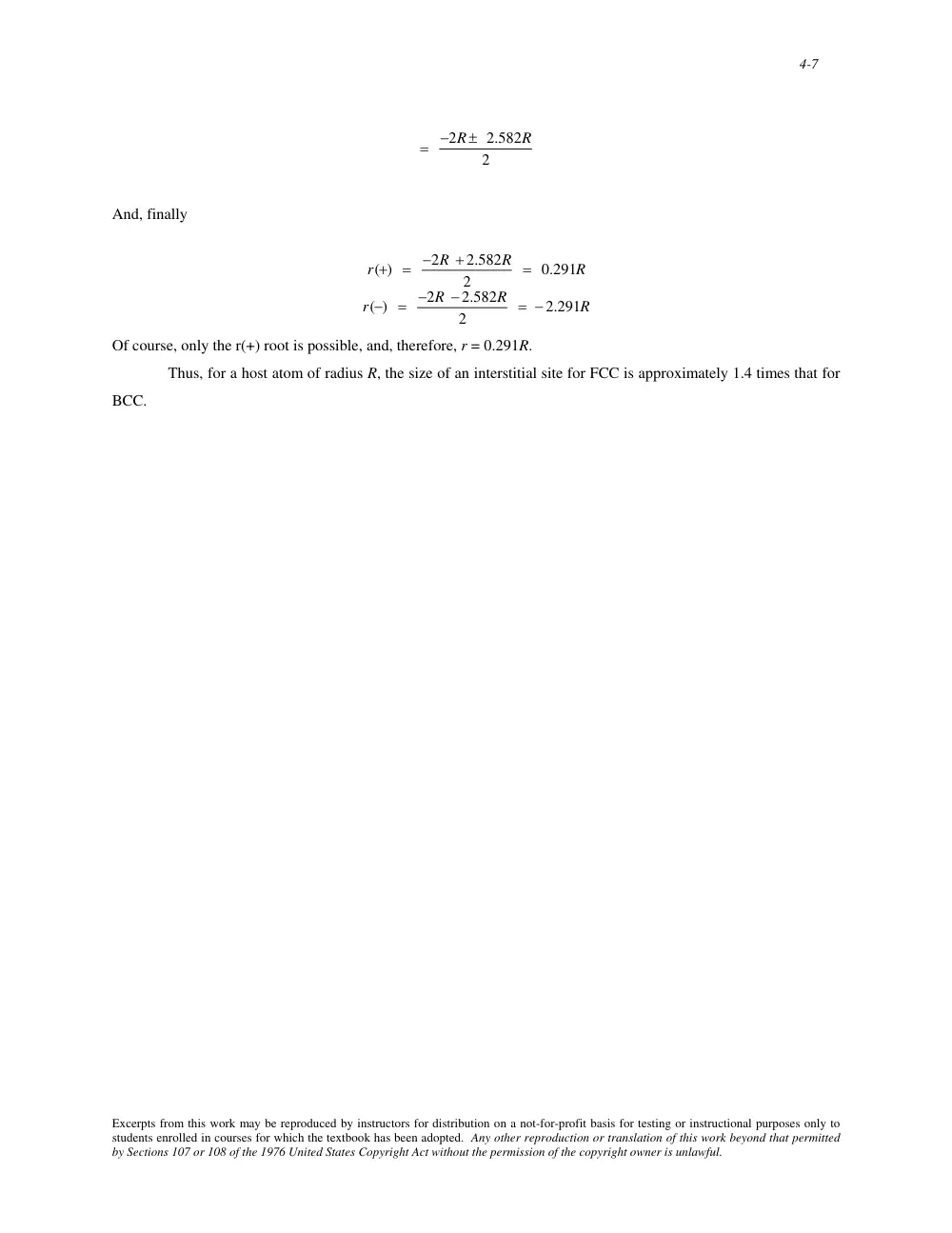
= −2R± 2.582R
2
And, finally
r(+) = −2R + 2.582R
2
= 0.291R
r(−) = −2R − 2.582R
2
= − 2.291R
Of course, only the r(+) root is possible, and, therefore, r = 0.291R.
Thus, for a host atom of radius R, the size of an interstitial site for FCC is approximately 1.4 times that for
BCC.
Excerpts from this work may be reproduced by instructors for distribution on a not-for-profit basis for testing or instructional purposes only to
students enrolled in courses for which the textbook has been adopted. Any other reproduction or translation of this work beyond that permitted
by Sections 107 or 108 of the 1976 United States Copyright Act without the permission of the copyright owner is unlawful.
4-8
Specification of Composition
4.6 (a) This problem asks that we derive Equation 4.7a. To begin, C1 is defined according to Equation
4.3 as
C1 =
m1
m1 + m2
× 100
or, equivalently
C1 =
m1
'
m1
' + m2
'
× 100
where the primed m's indicate masses in grams. From Equation 4.4 we may write
m1
' = nm1 A1
m 2
'
= nm2 A2
And, substitution into the C1 expression above
C1 =
nm1 A1
nm1 A1 + nm2 A2
× 100
From Equation 4.5 it is the case that
nm1 = C1
' (nm1 + nm2)
100
nm2 = C2
' (nm1 + nm2)
100
And substitution of these expressions into the above equation leads to
Excerpts from this work may be reproduced by instructors for distribution on a not-for-profit basis for testing or instructional purposes only to
students enrolled in courses for which the textbook has been adopted. Any other reproduction or translation of this work beyond that permitted
by Sections 107 or 108 of the 1976 United States Copyright Act without the permission of the copyright owner is unlawful.
4-9
C1 =
C1
' A1
C1
' A1 + C2
' A2
× 100
which is just Equation 4.7a.
(b) This problem asks that we derive Equation 4.9a. To begin,
is defined as the mass of component 1
per unit volume of alloy, or
C1
"
C1
"
= m1
V
If we assume that the total alloy volume V is equal to the sum of the volumes of the two constituents--i.e., V = V1 +
V2--then
C1
" =
m1
V1 + V2
Furthermore, the volume of each constituent is related to its density and mass as
V1 = m1
ρ1
V2 = m2
ρ2
This leads to
C1
" =
m1
m1
ρ1
+ m2
ρ2
From Equation 4.3, m1 and m2 may be expressed as follows:
m1 = C1(m1 + m2)
100
Excerpts from this work may be reproduced by instructors for distribution on a not-for-profit basis for testing or instructional purposes only to
students enrolled in courses for which the textbook has been adopted. Any other reproduction or translation of this work beyond that permitted
by Sections 107 or 108 of the 1976 United States Copyright Act without the permission of the copyright owner is unlawful.
4-10
m2 = C2 (m1 + m2)
100
Substitution of these equations into the preceding expression yields
C1
" =
C1(m1 + m2)
100
C1(m1 + m2)
100
ρ1
+
C2 (m1 + m2)
100
ρ2
=
C1
C1
ρ1
+ C2
ρ2
If the densities ρ1 and ρ2 are given in units of g/cm3, then conversion to units of kg/m3 requires that we multiply
this equation by 103, inasmuch as
1 g/cm3 = 103 kg/m3
Therefore, the previous equation takes the form
C1
" =
C1
C1
ρ1
+ C2
ρ2
x 103
which is the desired expression.
(c) Now we are asked to derive Equation 4.10a. The density of an alloy ρave is just the total alloy mass M
divided by its volume V
ρave = M
V
Or, in terms of the component elements 1 and 2
Excerpts from this work may be reproduced by instructors for distribution on a not-for-profit basis for testing or instructional purposes only to
students enrolled in courses for which the textbook has been adopted. Any other reproduction or translation of this work beyond that permitted
by Sections 107 or 108 of the 1976 United States Copyright Act without the permission of the copyright owner is unlawful.
4-11
ρave = m1 + m2
V1 + V2
[Note: here it is assumed that the total alloy volume is equal to the separate volumes of the individual components,
which is only an approximation; normally V will not be exactly equal to (V1 + V2)].
Each of V1 and V2 may be expressed in terms of its mass and density as,
V1 = m1
ρ1
V2 = m2
ρ2
When these expressions are substituted into the above equation, we get
ρave = m1 + m2
m1
ρ1
+ m2
ρ2
Furthermore, from Equation 4.3
m1 = C1(m1 + m2)
100
m2 = C2 (m1 + m2)
100
Which, when substituted into the above ρave expression yields
ρave =
m1 + m2
C1(m1 + m2)
100
ρ1
+
C2 (m1 + m2)
100
ρ2
And, finally, this equation reduces to
=
100
C1
ρ1
+ C2
ρ2
Excerpts from this work may be reproduced by instructors for distribution on a not-for-profit basis for testing or instructional purposes only to
students enrolled in courses for which the textbook has been adopted. Any other reproduction or translation of this work beyond that permitted
by Sections 107 or 108 of the 1976 United States Copyright Act without the permission of the copyright owner is unlawful.
4-13
4.7 In order to compute composition, in atom percent, of a 92.5 wt% Ag-7.5 wt% Cu alloy, we employ
Equation 4.6 as
CAg
' =
CAgACu
CAgACu + CCu AAg
× 100
=
(92.5)(63.55 g/mol)
(92.5)(63.55 g/mol) + (7.5)(107.87g/mol) × 100
= 87.9 at%
CCu
' =
CCu AAg
CAgACu + CCu AAg
× 100
=
(7.5)(107.87 g/mol)
(92.5)(63.55 g/mol) + (7.5)(107.87g/mol) × 100
= 12.1 at%
Excerpts from this work may be reproduced by instructors for distribution on a not-for-profit basis for testing or instructional purposes only to
students enrolled in courses for which the textbook has been adopted. Any other reproduction or translation of this work beyond that permitted
by Sections 107 or 108 of the 1976 United States Copyright Act without the permission of the copyright owner is unlawful.
4-14
4.8 In order to compute composition, in weight percent, of a 5 at% Cu-95 at% Pt alloy, we employ
Equation 4.7 as
CCu =
CCu
'
ACu
CCu
'
ACu + CPt
' APt
× 100
=
(5)(63.55 g /mol)
(5)(63.55 g /mol) + (95)(195.08 g /mol) × 100
= 1.68 wt%
CPt =
CPt
' APt
CCu
' ACu + CPt
' APt
× 100
=
(95)(195.08 g /mol)
(5)(63.55 g/mol) + (95)(195.08 g/mol) x 100
= 98.32 wt%
Excerpts from this work may be reproduced by instructors for distribution on a not-for-profit basis for testing or instructional purposes only to
students enrolled in courses for which the textbook has been adopted. Any other reproduction or translation of this work beyond that permitted
by Sections 107 or 108 of the 1976 United States Copyright Act without the permission of the copyright owner is unlawful.
4-15
4.9 The concentration, in weight percent, of an element in an alloy may be computed using a modified
form of Equation 4.3. For this alloy, the concentration of iron (CFe) is just
CFe =
mFe
mFe + mC + mCr
× 100
=
105 kg
105 kg + 0.2 kg + 1.0 kg × 100 = 98.87 wt%
Similarly, for carbon
CC =
0.2 kg
105 kg + 0.2 kg + 1.0 kg × 100 = 0.19 wt%
And for chromium
CCr =
1.0 kg
105 kg + 0.2 kg + 1.0 kg × 100 = 0.94 wt%
Excerpts from this work may be reproduced by instructors for distribution on a not-for-profit basis for testing or instructional purposes only to
students enrolled in courses for which the textbook has been adopted. Any other reproduction or translation of this work beyond that permitted
by Sections 107 or 108 of the 1976 United States Copyright Act without the permission of the copyright owner is unlawful.
4-16
4.10 The concentration of an element in an alloy, in atom percent, may be computed using Equation 4.5.
However, it first becomes necessary to compute the number of moles of both Cu and Zn, using Equation 4.4. Thus,
the number of moles of Cu is just
nmCu
=
mCu
'
ACu
=
33 g
63.55 g/mol = 0.519 mol
Likewise, for Zn
nmZn
=
47 g
65.39 g /mol = 0.719 mol
Now, use of Equation 4.5 yields
CCu
'
=
nmCu
nmCu
+ nmZn
× 100
=
0.519 mol
0.519 mol + 0.719 mol × 100 = 41.9 at%
Also,
CZn
'
=
0.719 mol
0.519 mol + 0.719 mol × 100 = 58.1 at%
Excerpts from this work may be reproduced by instructors for distribution on a not-for-profit basis for testing or instructional purposes only to
students enrolled in courses for which the textbook has been adopted. Any other reproduction or translation of this work beyond that permitted
by Sections 107 or 108 of the 1976 United States Copyright Act without the permission of the copyright owner is unlawful.
4-17
4.11 In this problem we are asked to determine the concentrations, in atom percent, of the Ag-Au-Cu
alloy. It is first necessary to convert the amounts of Ag, Au, and Cu into grams.
mAg
'
= (44.5 lbm)(453.6 g/lbm) = 20,185 g
mAu
'
= (83.7 lbm)(453.6 g/lbm) = 37,966 g
mCu
'
= (5.3 lbm)(453.6 g/lbm) = 2, 404 g
These masses must next be converted into moles (Equation 4.4), as
nmAg
=
mAg
'
AAg
=
20,185 g
107.87 g/mol = 187.1 mol
nmAu
=
37,966 g
196.97 g /mol = 192.8 mol
nmCu
=
2,404 g
63.55 g /mol = 37.8 mol
Now, employment of a modified form of Equation 4.5, gives
CAg
' =
nmAg
nmAg
+ nmAu
+ nmCu
× 100
=
187.1 mol
187.1 mol + 192.8 mol + 37.8 mol × 100 = 44.8 at%
CAu
'
=
192.8 mol
187.1 mol + 192.8 mol + 37.8 mol × 100 = 46.2 at%
CCu
'
=
37.8 mol
187.1 mol + 192.8 mol + 37.8 mol × 100 = 9.0 at%
Excerpts from this work may be reproduced by instructors for distribution on a not-for-profit basis for testing or instructional purposes only to
students enrolled in courses for which the textbook has been adopted. Any other reproduction or translation of this work beyond that permitted
by Sections 107 or 108 of the 1976 United States Copyright Act without the permission of the copyright owner is unlawful.
4-18
4.12 We are asked to compute the composition of a Pb-Sn alloy in atom percent. Employment of Equation
4.6 leads to
CPb
'
=
CPb ASn
CPb ASn + CSn APb
× 100
=
5.5(118.69 g/mol)
5.5(118.69 g /mol) + 94.5(207.2 g/mol) × 100
= 3.2 at%
CSn
'
=
CSn APb
CSn APb + CPbASn
× 100
=
94.5(207.2 g/mol)
94.5(207.2 g/mol) + 5.5(118.69 g/mol) × 100
= 96.8 at%
Excerpts from this work may be reproduced by instructors for distribution on a not-for-profit basis for testing or instructional purposes only to
students enrolled in courses for which the textbook has been adopted. Any other reproduction or translation of this work beyond that permitted
by Sections 107 or 108 of the 1976 United States Copyright Act without the permission of the copyright owner is unlawful.
4-19
4.13 This problem calls for a conversion of composition in atom percent to composition in weight percent.
The composition in atom percent for Problem 4.11 is 44.8 at% Ag, 46.2 at% Au, and 9.0 at% Cu. Modification of
Equation 4.7 to take into account a three-component alloy leads to the following
CAg =
CAg
'
AAg
CAg
'
AAg + CAu
'
AAu + CCu
' ACu
× 100
=
(44.8) (107.87 g /mol)
(44.8)(107.87 g /mol) + (46.2) (196.97 g /mol) + (9.0) (63.55 g /mol) × 100
= 33.3 wt%
CAu =
CAu
'
AAu
CAg
'
AAg + CAu
'
AAu + CCu
' ACu
× 100
=
(46.2) (196.97 g /mol)
(44.8)(107.87 g /mol) + (46.2) (196.97 g /mol) + (9.0) (63.55 g /mol) × 100
= 62.7 wt%
CCu =
CCu
' ACu
CAg
' AAg + CAu
'
AAu + CCu
'
ACu
× 100
=
(9.0) (63.55 g/mol)
(44.8)(107.87 g /mol) + (46.2) (196.97 g /mol) + (9.0) (63.55 g /mol) × 100
= 4.0 wt%
Excerpts from this work may be reproduced by instructors for distribution on a not-for-profit basis for testing or instructional purposes only to
students enrolled in courses for which the textbook has been adopted. Any other reproduction or translation of this work beyond that permitted
by Sections 107 or 108 of the 1976 United States Copyright Act without the permission of the copyright owner is unlawful.
4-20
4.14 This problem calls for a determination of the number of atoms per cubic meter for lead. In order to
solve this problem, one must employ Equation 4.2,
N = N AρPb
APb
The density of Pb (from the table inside of the front cover) is 11.35 g/cm3, while its atomic weight is 207.2 g/mol.
Thus,
N = (6.023 x 10²³ atoms /mol)(11.35 g/cm3)
207.2 g /mol
= 3.30 x 10²² atoms/cm3 = 3.30 x 1028 atoms/m3
Excerpts from this work may be reproduced by instructors for distribution on a not-for-profit basis for testing or instructional purposes only to
students enrolled in courses for which the textbook has been adopted. Any other reproduction or translation of this work beyond that permitted
by Sections 107 or 108 of the 1976 United States Copyright Act without the permission of the copyright owner is unlawful.
4-21
4.15 In order to compute the concentration in kg/m3 of Si in a 0.25 wt% Si-99.75 wt% Fe alloy we must
employ Equation 4.9 as
CSi
" =
CSi
CSi
ρSi
+ CFe
ρFe
× 103
From inside the front cover, densities for silicon and iron are 2.33 and 7.87 g/cm3, respectively; and, therefore
CSi
" =
0.25
0.25
2.33 g/cm3 +
99.75
7.87 g/cm3
× 103
= 19.6 kg/m3
Excerpts from this work may be reproduced by instructors for distribution on a not-for-profit basis for testing or instructional purposes only to
students enrolled in courses for which the textbook has been adopted. Any other reproduction or translation of this work beyond that permitted
by Sections 107 or 108 of the 1976 United States Copyright Act without the permission of the copyright owner is unlawful.
4-22
4.16 We are asked in this problem to determine the approximate density of a Ti-6Al-4V titanium alloy that
has a composition of 90 wt% Ti, 6 wt% Al, and 4 wt% V. In order to solve this problem, Equation 4.10a is
modified to take the following form:
ρave =
100
CTi
ρTi
+ CAl
ρAl
+ CV
ρV
And, using the density values for Ti, Al, and V—i.e., 4.51 g/cm3, 2.71 g/cm3, and 6.10 g/cm3—(as taken from
inside the front cover of the text), the density is computed as follows:
ρave =
100
90 wt%
4.51 g /cm3 +
6 wt%
2.71 g/cm3 +
4 wt%
6.10 g/cm3
= 4.38 g/cm3
Excerpts from this work may be reproduced by instructors for distribution on a not-for-profit basis for testing or instructional purposes only to
students enrolled in courses for which the textbook has been adopted. Any other reproduction or translation of this work beyond that permitted
by Sections 107 or 108 of the 1976 United States Copyright Act without the permission of the copyright owner is unlawful.
4-23
4.17 This problem asks that we determine the unit cell edge length for a 80 wt% Ag-20 wt% Pd alloy. In
order to solve this problem it is necessary to employ Equation 3.5; in this expression density and atomic weight will
be averages for the alloy—that is
ρave = nAave
VC NA
Inasmuch as the unit cell is cubic, then VC = a3, then
ρave = nAave
a3N A
And solving this equation for the unit cell edge length, leads to
a =
nAave
ρaveNA
⎛
⎝
⎜ ⎜
⎞
⎠
⎟ ⎟
1/3
Expressions for Aave and ρave are found in Equations 4.11a and 4.10a, respectively, which, when
incorporated into the above expression yields
a =
n
100
CAg
AAg
+ CPd
APd
⎛
⎝
⎜
⎜
⎜
⎜
⎜
⎞
⎠
⎟
⎟
⎟
⎟
⎟
100
CAg
ρAg
+ CPd
ρPd
⎛
⎝
⎜
⎜
⎜
⎜
⎜
⎞
⎠
⎟
⎟
⎟
⎟
⎟
N A
⎡
⎣
⎢
⎢
⎢
⎢
⎢
⎢
⎢
⎢
⎢
⎢
⎢
⎢
⎤
⎦
⎥
⎥
⎥
⎥
⎥
⎥
⎥
⎥
⎥
⎥
⎥
⎥
1/3
Since the crystal structure is FCC, the value of n in the above expression is 4 atoms per unit cell. The
atomic weights for Ag and Pd are 107.9 and 106.4 g/mol, respectively (Figure 2.6), whereas the densities for the Ag
and Pd are 10.49 g/cm3 (inside front cover) and 12.02 g/cm3. Substitution of these, as well as the concentration
values stipulated in the problem statement, into the above equation gives
Excerpts from this work may be reproduced by instructors for distribution on a not-for-profit basis for testing or instructional purposes only to
students enrolled in courses for which the textbook has been adopted. Any other reproduction or translation of this work beyond that permitted
by Sections 107 or 108 of the 1976 United States Copyright Act without the permission of the copyright owner is unlawful.
4-24
a =
(4 atoms/unit cell)
100
80 wt%
107.9 g/mol +
20 wt%
106.4 g/mol
⎛
⎝
⎜
⎜
⎜ ⎜
⎞
⎠
⎟
⎟
⎟ ⎟
100
80 wt%
10.49 g/cm3 +
20 wt%
12.02 g/cm3
⎛
⎝
⎜
⎜
⎜
⎜
⎞
⎠
⎟
⎟
⎟
⎟
6.023 × 10²³ atoms/mol
(
)
⎡
⎣
⎢
⎢
⎢
⎢
⎢
⎢
⎢
⎢
⎢
⎢
⎤
⎦
⎥
⎥
⎥
⎥
⎥
⎥
⎥
⎥
⎥
⎥
1/3
= 4.050 × 10⁻⁸ cm = 0.4050 nm
Excerpts from this work may be reproduced by instructors for distribution on a not-for-profit basis for testing or instructional purposes only to
students enrolled in courses for which the textbook has been adopted. Any other reproduction or translation of this work beyond that permitted
by Sections 107 or 108 of the 1976 United States Copyright Act without the permission of the copyright owner is unlawful.
4-25
4.18 This problem asks that we determine, for a hypothetical alloy that is composed of 25 wt% of metal A
and 75 wt% of metal B, whether the crystal structure is simple cubic, face-centered cubic, or body-centered cubic.
We are given the densities of the these metals (ρA = 6.17 g/cm3 and ρB = 8.00 g/cm3 for B), their atomic weights
(AA = 171.3 g/mol and AB = 162.0 g/mol), and that the unit cell edge length is 0.332 nm (i.e., 3.32 x 10⁻⁸ cm). In
order to solve this problem it is necessary to employ Equation 3.5; in this expression density and atomic weight will
be averages for the alloy—that is
ρave = nAave
VC NA
Inasmuch as for each of the possible crystal structures, the unit cell is cubic, then VC = a3, or
ρave = nAave
a3N A
And, in order to determine the crystal structure it is necessary to solve for n, the number of atoms per unit
cell. For n =1, the crystal structure is simple cubic, whereas for n values of 2 and 4, the crystal structure will be
either BCC or FCC, respectively. When we solve the above expression for n the result is as follows:
n = ρavea3NA
Aave
Expressions for Aave and ρave are found in Equations 4.11a and 4.10a, respectively, which, when incorporated into
the above expression yields
n =
100
CA
ρA
+ CB
ρB
⎛
⎝
⎜
⎜
⎜
⎜
⎞
⎠
⎟
⎟
⎟
⎟
a3N A
100
CA
AA
+ CB
AB
⎛
⎝
⎜
⎜
⎜
⎜
⎞
⎠
⎟
⎟
⎟
⎟
Substitution of the concentration values (i.e., CA = 25 wt% and CB = 75 wt%) as well as values for the
other parameters given in the problem statement, into the above equation gives
Excerpts from this work may be reproduced by instructors for distribution on a not-for-profit basis for testing or instructional purposes only to
students enrolled in courses for which the textbook has been adopted. Any other reproduction or translation of this work beyond that permitted
by Sections 107 or 108 of the 1976 United States Copyright Act without the permission of the copyright owner is unlawful.
4-26
n =
100
25 wt%
6.17 g/cm3 +
75 wt%
8.00 g/cm3
⎛
⎝
⎜
⎜
⎜
⎜
⎞
⎠
⎟
⎟
⎟
⎟
(3.32 × 10⁻⁸ nm)3(6.023 × 10²³ atoms/mol)
100
25 wt%
171.3 g/mol +
75 wt%
162.0 g/mol
⎛
⎝
⎜
⎜
⎜ ⎜
⎞
⎠
⎟
⎟
⎟ ⎟
= 1.00 atom/unit cell
Therefore, on the basis of this value, the crystal structure is simple cubic.
Excerpts from this work may be reproduced by instructors for distribution on a not-for-profit basis for testing or instructional purposes only to
students enrolled in courses for which the textbook has been adopted. Any other reproduction or translation of this work beyond that permitted
by Sections 107 or 108 of the 1976 United States Copyright Act without the permission of the copyright owner is unlawful.
4-27
4.19 This problem asks that we derive Equation 4.18, using other equations given in the chapter. The
concentration of component 1 in atom percent
is just 100
where
is the atom fraction of component 1.
Furthermore,
is defined as
= N1/N where N1 and N are, respectively, the number of atoms of component 1
and total number of atoms per cubic centimeter. Thus, from the above discussion the following holds:
(C1
')
c1
'
c1
'
c1
'
c1
'
N1 = C1
' N
100
Substitution into this expression of the appropriate form of N from Equation 4.2 yields
N1 = C1
' NA ρave
100 Aave
And, finally, substitution into this equation expressions for
(Equation 4.6a), ρave (Equation 4.10a), Aave
(Equation 4.11a), and realizing that C2 = (C1 – 100), and after some algebraic manipulation we obtain the desired
expression:
C1
'
N1 =
NAC1
C1 A1
ρ1
+ A1
ρ2
(100 − C1)
Excerpts from this work may be reproduced by instructors for distribution on a not-for-profit basis for testing or instructional purposes only to
students enrolled in courses for which the textbook has been adopted. Any other reproduction or translation of this work beyond that permitted
by Sections 107 or 108 of the 1976 United States Copyright Act without the permission of the copyright owner is unlawful.
4-28
4.20 This problem asks us to determine the number of molybdenum atoms per cubic centimeter for a 16.4
wt% Mo-83.6 wt% W solid solution. To solve this problem, employment of Equation 4.18 is necessary, using the
following values:
C1 = CMo = 16.4 wt%
ρ1 = ρMo = 10.22 g/cm3
ρ2 = ρW = 19.3 g/cm3
A1 = AMo = 95.94 g/mol
Thus
NMo =
N ACMo
CMo AMo
ρMo
+ AMo
ρW
(100 − CMo)
=
(6.023 × 10²³ atoms /mol) (16.4 wt%)
(16.4 wt%)(95.94 g/mol)
10.22 g/cm3
+ 95.94 g /mol
19.3 g/cm3 (100 − 16.4 wt%)
= 1.73 x 10²² atoms/cm3
Excerpts from this work may be reproduced by instructors for distribution on a not-for-profit basis for testing or instructional purposes only to
students enrolled in courses for which the textbook has been adopted. Any other reproduction or translation of this work beyond that permitted
by Sections 107 or 108 of the 1976 United States Copyright Act without the permission of the copyright owner is unlawful.
4-29
4.21 This problem asks us to determine the number of niobium atoms per cubic centimeter for a 24 wt%
Nb-76 wt% V solid solution. To solve this problem, employment of Equation 4.18 is necessary, using the following
values:
C1 = CNb = 24 wt%
ρ1 = ρNb = 8.57 g/cm3
ρ2 = ρV = 6.10 g/cm3
A1 = ANb = 92.91 g/mol
Thus
NNb =
NACNb
CNb ANb
ρNb
+ ANb
ρV
(100 − CNb)
=
(6.023 × 10²³ atoms /mol) (24 wt%)
(24 wt%)(92.91 g/mol)
8.57 g/cm3
+ 92.91 g/mol
6.10 g/cm3 (100 − 24 wt%)
= 1.02 x 10²² atoms/cm3
Excerpts from this work may be reproduced by instructors for distribution on a not-for-profit basis for testing or instructional purposes only to
students enrolled in courses for which the textbook has been adopted. Any other reproduction or translation of this work beyond that permitted
by Sections 107 or 108 of the 1976 United States Copyright Act without the permission of the copyright owner is unlawful.
4-30
4.22 This problem asks that we derive Equation 4.19, using other equations given in the chapter. The
number of atoms of component 1 per cubic centimeter is just equal to the atom fraction of component 1
times
the total number of atoms per cubic centimeter in the alloy (N). Thus, using the equivalent of Equation 4.2, we may
write
(c1
')
N1 = c1
' N = c1
' N A ρave
Aave
Realizing that
c1
' = C1
'
100
and
C2
' = 100 − C1
'
and substitution of the expressions for ρave and Aave, Equations 4.10b and 4.11b, respectively, leads to
N1 = c1
' N Aρave
Aave
=
NAC1
' ρ1ρ2
C1
' ρ2 A1 + (100 − C1
' )ρ1A2
And, solving for
C1
'
C1
' =
100 N1ρ1 A2
NAρ1ρ2 − N1ρ2 A1 + N1ρ1 A2
Substitution of this expression for
C1 into Equation 4.7a, which may be written in the following form
'
Excerpts from this work may be reproduced by instructors for distribution on a not-for-profit basis for testing or instructional purposes only to
students enrolled in courses for which the textbook has been adopted. Any other reproduction or translation of this work beyond that permitted
by Sections 107 or 108 of the 1976 United States Copyright Act without the permission of the copyright owner is unlawful.
4-31
C1 =
C1
'