
MKTG 238 Midterm Notes, Spring 2013
American University of Beirut · Public Relations · 12 pages
Showing the first 10 of 12 pages. Download the PDF to see all of it.
Show the text of this notes
Sarah Kaakati
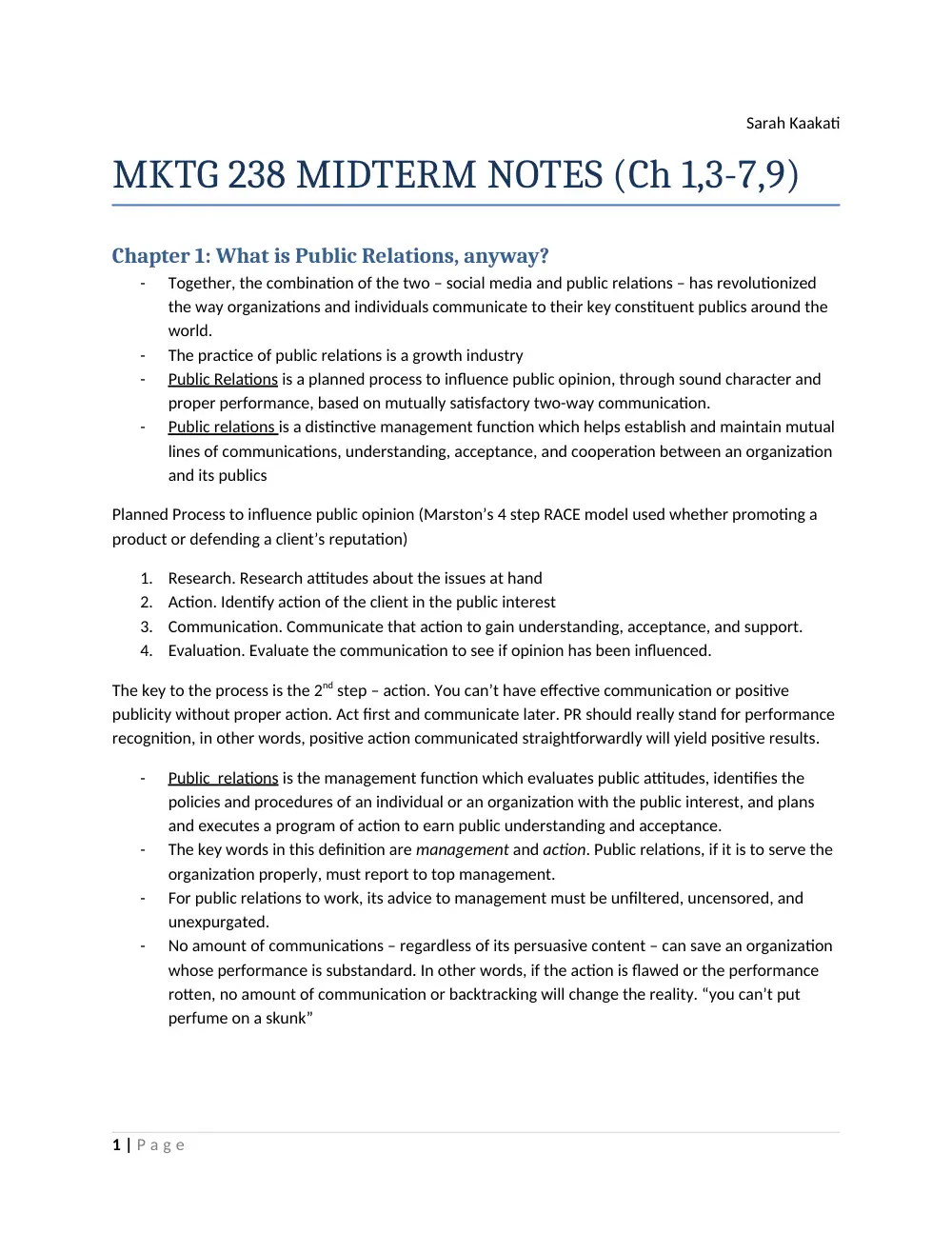
MKTG 238 MIDTERM NOTES (Ch 1,3-7,9)
Chapter 1: What is Public Relations, anyway?
-
Together, the combination of the two – social media and public relations – has revolutionized
the way organizations and individuals communicate to their key constituent publics around the
world.
-
The practice of public relations is a growth industry
-
Public Relations
is a planned process to influence public opinion, through sound character and
proper performance, based on mutually satisfactory two-way communication.
-
Public relations
is a distinctive management function which helps establish and maintain mutual
lines of communications, understanding, acceptance, and cooperation between an organization
and its publics
Planned Process to influence public opinion (Marston’s 4 step RACE model used whether promoting a
product or defending a client’s reputation)
1.
Research. Research attitudes about the issues at hand
2.
Action. Identify action of the client in the public interest
3.
Communication. Communicate that action to gain understanding, acceptance, and support.
4.
Evaluation. Evaluate the communication to see if opinion has been influenced.
The key to the process is the 2nd step – action. You can’t have effective communication or positive
publicity without proper action. Act first and communicate later. PR should really stand for performance
recognition, in other words, positive action communicated straightforwardly will yield positive results.
-
Public relations
is the management function which evaluates public attitudes, identifies the
policies and procedures of an individual or an organization with the public interest, and plans
and executes a program of action to earn public understanding and acceptance.
-
The key words in this definition are management and action. Public relations, if it is to serve the
organization properly, must report to top management.
-
For public relations to work, its advice to management must be unfiltered, uncensored, and
unexpurgated.
-
No amount of communications – regardless of its persuasive content – can save an organization
whose performance is substandard. In other words, if the action is flawed or the performance
rotten, no amount of communication or backtracking will change the reality. “you can’t put
perfume on a skunk”
1 | P a g e
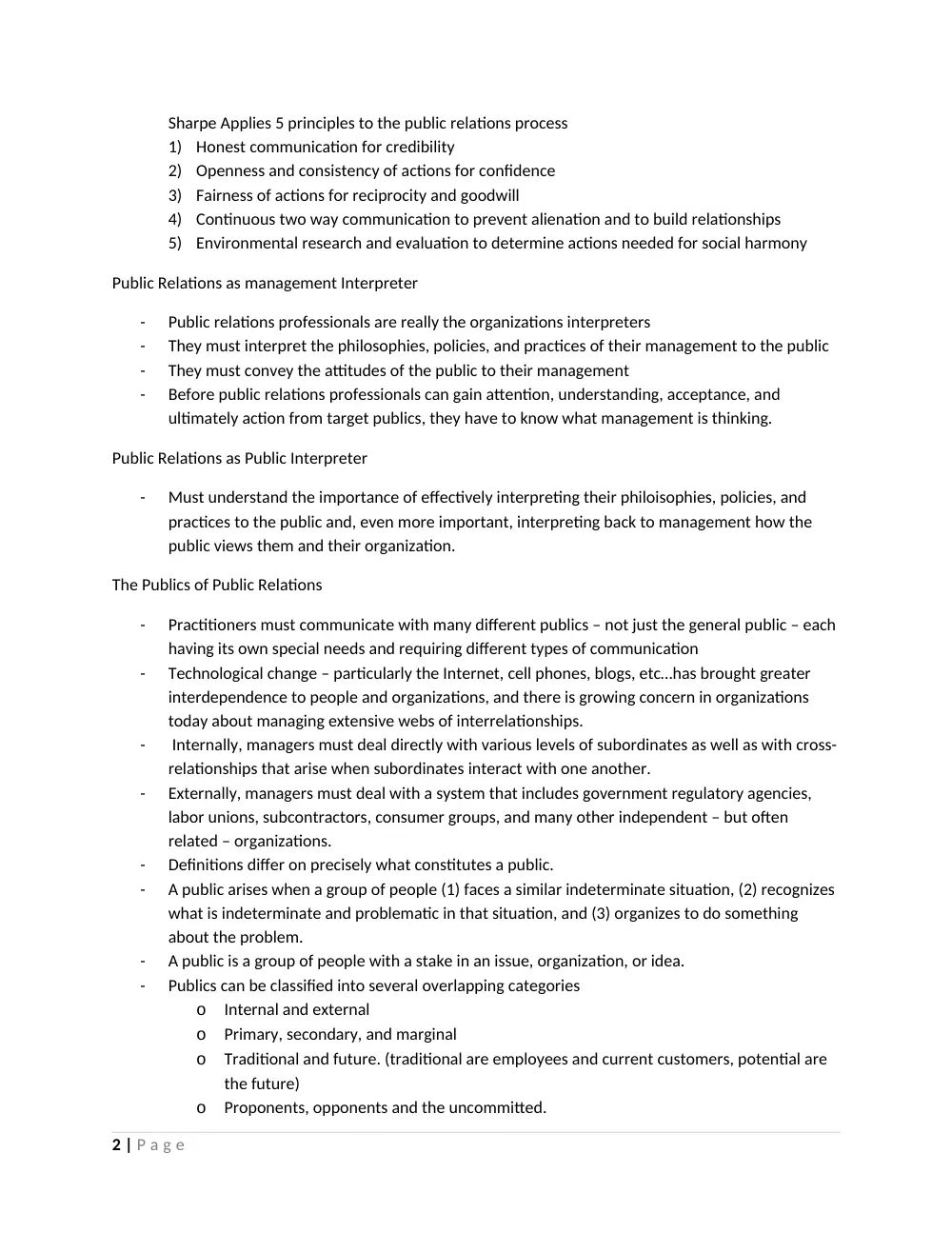
Sharpe Applies 5 principles to the public relations process
1)
Honest communication for credibility
2)
Openness and consistency of actions for confidence
3)
Fairness of actions for reciprocity and goodwill
4)
Continuous two way communication to prevent alienation and to build relationships
5)
Environmental research and evaluation to determine actions needed for social harmony
Public Relations as management Interpreter
-
Public relations professionals are really the organizations interpreters
-
They must interpret the philosophies, policies, and practices of their management to the public
-
They must convey the attitudes of the public to their management
-
Before public relations professionals can gain attention, understanding, acceptance, and
ultimately action from target publics, they have to know what management is thinking.
Public Relations as Public Interpreter
-
Must understand the importance of effectively interpreting their philoisophies, policies, and
practices to the public and, even more important, interpreting back to management how the
public views them and their organization.
The Publics of Public Relations
-
Practitioners must communicate with many different publics – not just the general public – each
having its own special needs and requiring different types of communication
-
Technological change – particularly the Internet, cell phones, blogs, etc…has brought greater
interdependence to people and organizations, and there is growing concern in organizations
today about managing extensive webs of interrelationships.
-
Internally, managers must deal directly with various levels of subordinates as well as with cross-
relationships that arise when subordinates interact with one another.
-
Externally, managers must deal with a system that includes government regulatory agencies,
labor unions, subcontractors, consumer groups, and many other independent – but often
related – organizations.
-
Definitions differ on precisely what constitutes a public.
-
A public arises when a group of people (1) faces a similar indeterminate situation, (2) recognizes
what is indeterminate and problematic in that situation, and (3) organizes to do something
about the problem.
-
A public is a group of people with a stake in an issue, organization, or idea.
-
Publics can be classified into several overlapping categories
o
Internal and external
o
Primary, secondary, and marginal
o
Traditional and future. (traditional are employees and current customers, potential are
the future)
o
Proponents, opponents and the uncommitted.
2 | P a g e
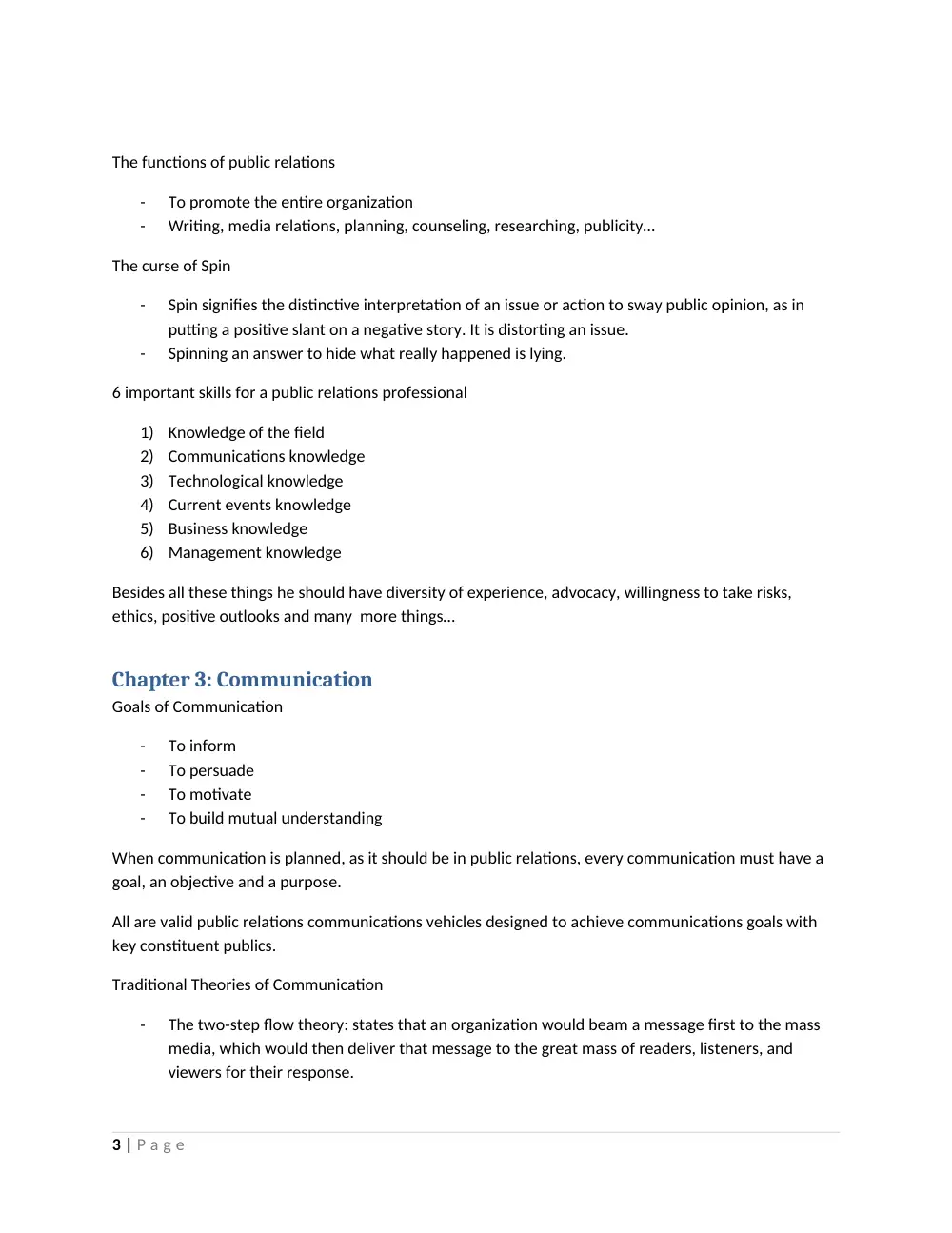
The functions of public relations
-
To promote the entire organization
-
Writing, media relations, planning, counseling, researching, publicity…
The curse of Spin
-
Spin signifies the distinctive interpretation of an issue or action to sway public opinion, as in
putting a positive slant on a negative story. It is distorting an issue.
-
Spinning an answer to hide what really happened is lying.
6 important skills for a public relations professional
1)
Knowledge of the field
2)
Communications knowledge
3)
Technological knowledge
4)
Current events knowledge
5)
Business knowledge
6)
Management knowledge
Besides all these things he should have diversity of experience, advocacy, willingness to take risks,
ethics, positive outlooks and many more things…
Chapter 3: Communication
Goals of Communication
-
To inform
-
To persuade
-
To motivate
-
To build mutual understanding
When communication is planned, as it should be in public relations, every communication must have a
goal, an objective and a purpose.
All are valid public relations communications vehicles designed to achieve communications goals with
key constituent publics.
Traditional Theories of Communication
-
The two-step flow theory: states that an organization would beam a message first to the mass
media, which would then deliver that message to the great mass of readers, listeners, and
viewers for their response.
3 | P a g e
-
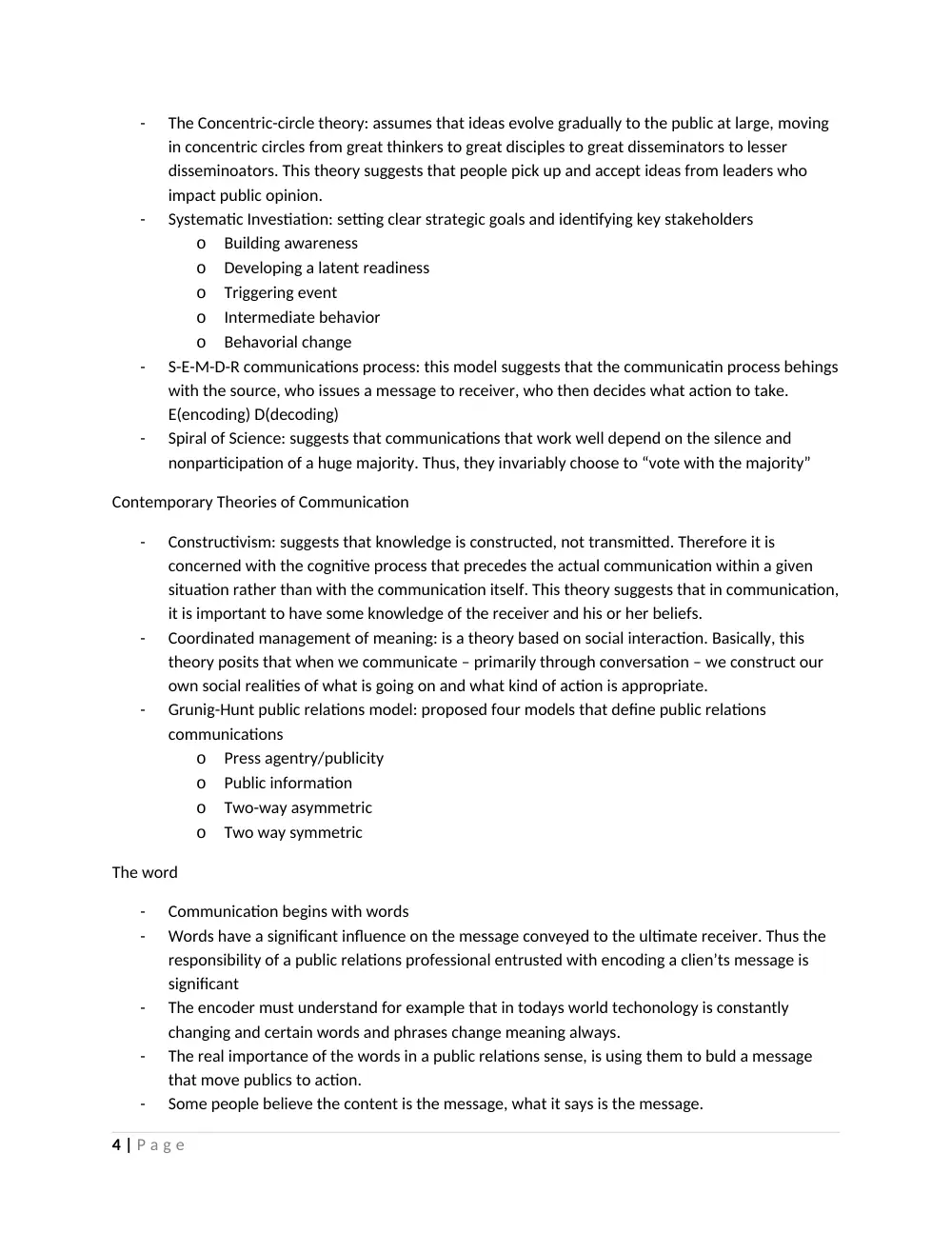
The Concentric-circle theory: assumes that ideas evolve gradually to the public at large, moving
in concentric circles from great thinkers to great disciples to great disseminators to lesser
disseminoators. This theory suggests that people pick up and accept ideas from leaders who
impact public opinion.
-
Systematic Investiation: setting clear strategic goals and identifying key stakeholders
o
Building awareness
o
Developing a latent readiness
o
Triggering event
o
Intermediate behavior
o
Behavorial change
-
S-E-M-D-R communications process: this model suggests that the communicatin process behings
with the source, who issues a message to receiver, who then decides what action to take.
E(encoding) D(decoding)
-
Spiral of Science: suggests that communications that work well depend on the silence and
nonparticipation of a huge majority. Thus, they invariably choose to “vote with the majority”
Contemporary Theories of Communication
-
Constructivism: suggests that knowledge is constructed, not transmitted. Therefore it is
concerned with the cognitive process that precedes the actual communication within a given
situation rather than with the communication itself. This theory suggests that in communication,
it is important to have some knowledge of the receiver and his or her beliefs.
-
Coordinated management of meaning: is a theory based on social interaction. Basically, this
theory posits that when we communicate – primarily through conversation – we construct our
own social realities of what is going on and what kind of action is appropriate.
-
Grunig-Hunt public relations model: proposed four models that define public relations
communications
o
Press agentry/publicity
o
Public information
o
Two-way asymmetric
o
Two way symmetric
The word
-
Communication begins with words
-
Words have a significant influence on the message conveyed to the ultimate receiver. Thus the
responsibility of a public relations professional entrusted with encoding a clien’ts message is
significant
-
The encoder must understand for example that in todays world techonology is constantly
changing and certain words and phrases change meaning always.
-
The real importance of the words in a public relations sense, is using them to buld a message
that move publics to action.
-
Some people believe the content is the message, what it says is the message.
4 | P a g e
-
Some people believe the medium is the message. That the words aren’t as important as the way
the message is carried.
-
Some people believe it is the person that is the message. Example hitler.
Recievers Bias
-
Communication a message is futile unless it helps achieve the desired goal of the communicator.
-
How a receiver decodes a message depends primarily on that person’s own perception.
-
Stereotypes influence communication (example he wears glasses so hes a nerd)
-
Symbols can be used as effective persuasive elements (American eagle)
-
Peers can influence a person to feel a certain way
-
The power of the meadia is substantial. Particularly as an agenda setter.
-
Agenda setting is the creation of public awareness by the media – the ability to tell us what
issues are important.
Feedback
-
A communicatior must get feedback from a receiver to know what messages are or are not
getting through and how to structure future communications.
-
A message may trigger several different effects
o
It may change attitudes
o
It may crystallize attitudes
o
It may create a wege of doubt
o
It may do nothing
Chapter 4: public opinion
-
Splitting public opinion into its two components, public and opinon, is perhaps the best way to
understand the concept.
-
Simply defined, public signifies a group of people who share a common interest in a specific
subject (ex: stockholders)
-
And opinion is the expression of an attitude on a particular topic. When attitudes become strong
enough they surface in the form of opinions.
-
An opinion is an expression of an attitude on a particular topic, so an attitude may more likely be
evaluations people make about specific problems or issues.
-
Attitudes are based on a number of characteristics like personal, cultural, educational, familial,
religious, social class, and race factors.
-
Attitudes are positive, negative, or nonexistent.
Maslow’s hierarchy of needs theory helps define the origins of motivation, which in turn helps explain
attitude change
5 | P a g e
1)
Physiological needs (bilological demands)
2)
Safety needs (security, protection, comfort, peace)
3)
Love needs (acceptance, belonging, membership)
4)
Esteem (recognition and prestige)
5)
Self actualization (self fulfillment and achieving goals for accomplishment)
-
According to Maslow, the needs of all five levels composed the fundamental motivating factors
for any individual or public
-
Another popular approach to motivating attitude change is the elaboration likelihood model
which says that if you put someone in a better mood encourages them to accept your argument
The power of persuasion
-
The most essential element in influencing public opinion is the principle of persuasion
-
Persuading is the goal of the vast majority of public relations programs
-
Basically persuasion means getting another person to do something through advice, reasoning,
or just plan arm-twisting.
-
Facts, emotions, personalization, and appealing to “you” are the 4 things that are evidence to
persuade.
Influencing public opinion
1)
Opinion is highly sensitive to important events
2)
Opinion is generally determined more by events than by words – unless those words are
themselves interpreted as an event.
3)
At critical times, people become more sensitive to the adequacy of their leadership. If they have
confidence in it, they are willing to assign more than usual responsibility to it; if they lack
confidence in it, they are less tolerant than usual.
4)
Once self-interest is involved, opinions are slow to change
5)
People have more opinions and are able to form opinions more easily on goals than on methods
to reach those goals
6)
By and large, if people in a democracy are provided with educational opportunities and ready
access to information, public opinion reveals a hardheaded common sense.
Polishing a corporate image
-
The point is that most organizations and individuals in the spotlight today understand, first, that
credibility is a fragile commodity, and second to maintain and improve public support they must
operate with the “implicit trust” of the public. That means that for a corporation to win
favorable public opinion isn’t an option – it’s a necessity, essential for continued long-term
success.
6 | P a g e
Managing REPUTATION
-
Reputation is gained by what one does, not by what one says. Reputation is present throughout
our lives. It’s how we choose business partners, which dentist or mechanic to visit
-
Many public relations firms have introduced reputation management divisions
Chapter 5: Management
-
Public relations today is much more a planned, persuasive social managerial science than a
knee-jerk, damage-control reaction to sudden flare-ups.
-
Top managers must constantly ask in relation to their departments, functions and assignments
things like how will we get to where we want to be or who is the key audiences we must
convince in the process?
Reporting to Top management
-
The public relations function, by definition, must report to top management.
-
Should always report to the CEO
-
For the public relations function to be valuable to management, it must remain independent,
credible, and objective.
Conceptualizing the Public Relations Plan
-
Strategic planning for public relations is an essential part of management. Planning is critical not
only to know where a particular campaign is headed but also to win the support of top
management.
-
Traditional the public relations management process involves four steps
o
1. Defining the problem or opportunity
o
2. Programming
o
3. Action
o
4. Evaluation
Creating the public relations Plan
-
The public relations plan must be spelled out in writing. Its organization must answer
management’s concerns and questions about the campaign being recommended.
Activating the Public Relations Campaign
-
Back grounding the problem
-
Preparing the proposal
-
Implementing the plan
-
Evaluating the campaign
7 | P a g e
Setting Public Relations Objectives
-
An organizations goals must define what its public relations goals will be, and the only good
goals are ones that can be measured.
Budgeting for Public Relations
-
Like any other business activity, public relations must be based on sound budgeting.
Chapter 6: Ethics
Utilitarianism: suggests considering the “greater good” rather than what may be best for the individual
Categorical Imperative: recommended acting on that maxim which you will to become a universal law
Aristotle: the golden mean of moral virtue could be found between two extreme points of view
Judeo Christian ethic prescribes loving your neighbor as you love yourself
Corporate Code of Conduct
-
To increase public confidence
-
To stem the tide of regulation
-
To improve internal operations
-
To respond to transgressions
Corporate Social Responsiblitiy
-
Product lines
-
Marketing practices
-
Environmental activities
-
External relations
-
Employee safety and health
Ethics in government
Ethics in Journalism
Ethics in Public Relations
-
Advocacy
-
Honesty
-
Expertise
-
Independence
-
Loyalty
8 | P a g e
-
Fairness
Chapter 7: The law
Public Relations and the law: an uneasy alliance
Public relations and the first amendment: the issue with freedom of speech?
Public Relations and Defamation Law
-
Defamation is the umbrella term used to describe libel – a printed falsehood – and slander – an
oral falsehood. For defamation to be proved a plaintiff must convince the court of (1) the
falsehood was communicated through print, broadcast, or other electronic means (2) The
person who is the subject of the falsehood was identified and (3) the identified person has
suffered injury in the form of monetory loss or reputation loss or mental suffering
Public Relations and Insider Trading
Public Relations and DSICLOSURE LAW
Public relations and ethics law
Public relations and Copyright Law
Public RELATIONS AND internet law
-
Censorship
-
Intellectual property
-
Cybersquatting
-
E-Fraud
Litigation Public Relations
Chapter 9
Objectivity in the Media
-
Why attract publicity? The answer, is that publicity is regarded as more credible than
advertising. To attract positive publicity requires establishing a good working relationship with
the media
-
The presumed goal of a journalist is objectivity – fairness with the intention of remaining neutral
in reporting a story. But total objectivity is impossible. All of us have biases.
9 | P a g e
Print: The Number one Medium
Electronic Media: A new dominance
The Internet Factor
-
The challenge for public relations professionals in dealing with print, electronic, or online
commentators is to foster a closer relationship between their organizations and those who
present the news. The key, once again is fairness, with each side accepting – and respecting –
the other’s role and responsibility.
Dealing with the Media
-
It falls on public relations professionals to orchestrate the relationship between their
organizations and the media, whether print, electronic or internet-based.
-
First, an organization must establish a formal media relations policy
-
Second, an organization must establish a philosophy for dealing with the media, keeping in mind
the following dozen principles
o
A reporter is a reporter
o
You are the organization
o
There is no standard issue reporter
o
Treat journalists professionally
o
Don’t sweat the skepticism
o
Don’t try to “buy” a journalist
o
Become a trusted source
o
Talk when not “selling”
o
Don’t expect “news” agreement
o
No attitude
o
Don’t lie
o
Read the paper
Attracting Publicity
-
Publicity is more powerful than advertising
-
Publicity is most often gained by dealing directly with the media, either by initiating the
communication or by reacting to inquires
-
First and most important, advertising costs money!
-
The benefits of advertising that can be “guaranteed” are
o
Content
o
Size
o
Location
o
Reach
o
Frequency
10 | P a g e
-
Publicity on the other hand, offers no such guarantees or controls. Typically, publicity is subject
to review by news editors who may decide to use all of a story, some of it, or none of it.
Value of Publicity
-
Announcing a new product or service
-
Reenergizing an old product
-
Explaining a complicated product
-
Little or no budget
-
Enhancing the organization’s reputation
-
Crisis response
Pitching Publicity
-
The activity of trying to place positive publicity in a periodical, on a news site, or in the electronic
media – of converting publicity to news is called pitching.
o
Know deadlines
o
Generally write first, then call
o
Direct the release to specific person or editor
o
Don’t badger
o
Determine how the reporter wants to be contacted
o
Use exclusives with caution
o
Do you own calling
o
Develop a relationship
o
Never lie
Online Publicity
-
News releases
-
Headlines
-
Announcements
-
Links
-
Newsletters
-
Libraries
-
Public appearances
-
Promotions
-
News wires
-
Events
Handling Media Interviews
-
Prepare
-
Relax
-
Speak in personal terms
11 | P a g e
-
Welcome the naïve question
-
Answer questions briefly and directly
-
Don’t bluff
-
State facts and back up generalities
-
No such thing as “off the record”
-
Don’t say “no comment”
-
Tell the truth
12 | P a g e