
NFSC 220 Notes Midterm Notes, Spring 2013
American University of Beirut · Food and Nutrition Awareness · 12 pages





Showing the first 10 of 12 pages. Download the PDF to see all of it.
Show the text of this notes
NFSC 220 MIDTERM NOTES by Sarah
Kaakati
Chapter 1
1.1: Good health: The nutrition Connection
-
Nutrition is the science that links foods to health and disease. It includes the processes by which
the human organism ingests, digests, absorbs, transports, and excretes food substances.
-
Food provides the energy (in the form of calories) as well as the materials needed to build and
maintain all body cells.
-
Nutrients are the substances obtained from food that are vital for growth and maintenance of a
healthy body throughout our life
-
For a substance to be considered an essential nutrient, three characteristics are needed
o
First, at least one specific biological function of the nutrient in the body must be
identified
o
Second, omission of the nutrient from the diet must lead to a decline in certain
biological functions, such as production of blood cells
o
Third, replacing the omitted nutrient in the diet before permanent damage occurs will
restore those normal biological functions
-
Cancer: a condition characterized by uncontrolled growth of abnormal cells
-
Cardiovascular disease: a general term that refers to any disease of the heart and circulatory
system. This disease is usually characterized by the deposition of fatty material in the blood
vessels
-
Cholesterol: a waxy lipid found in all body cells; it has a structure containing multiple chemical
rings. Cholesterol is found only in foods of animal origin
-
Chronic: long standing, developing over time.
-
Diabetes: a group of diseases characterized by high blood glucose.
-
Hypertension: a condition in which blood pressure remains persistently elevated
-
Kilocalorie: a unit that describes the energy content of food. Specifically, a kilocalorie is the heat
energy needed to raise the temperature of 1000 grams of water 1 degree Celsius
-
Obesity: a condition characterized by excess body fat
-
Osteoporosis: decreased bone mass related to the effects of aging
-
Risk factor: a term used when discussing factors contributing to the development of a disease
(ex: smoking)
-
Stroke: a decrease of loss in blood flow to the brain that results in the form of a blood clot
1.2 Class and sources of nutrients
1 | P a g e
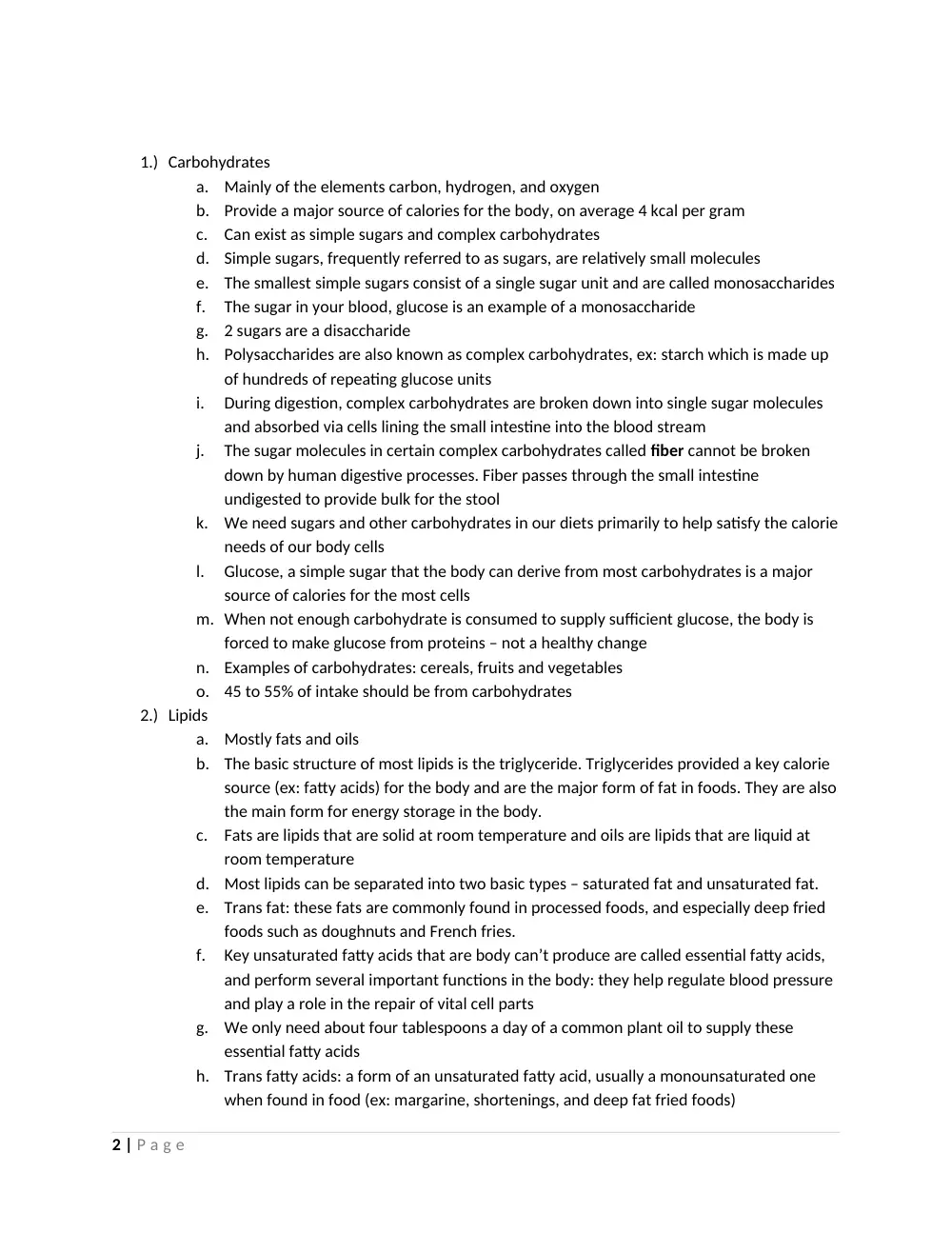
1.) Carbohydrates
a.
Mainly of the elements carbon, hydrogen, and oxygen
b.
Provide a major source of calories for the body, on average 4 kcal per gram
c.
Can exist as simple sugars and complex carbohydrates
d.
Simple sugars, frequently referred to as sugars, are relatively small molecules
e.
The smallest simple sugars consist of a single sugar unit and are called monosaccharides
f.
The sugar in your blood, glucose is an example of a monosaccharide
g.
2 sugars are a disaccharide
h.
Polysaccharides are also known as complex carbohydrates, ex: starch which is made up
of hundreds of repeating glucose units
i.
During digestion, complex carbohydrates are broken down into single sugar molecules
and absorbed via cells lining the small intestine into the blood stream
j.
The sugar molecules in certain complex carbohydrates called fiber cannot be broken
down by human digestive processes. Fiber passes through the small intestine
undigested to provide bulk for the stool
k.
We need sugars and other carbohydrates in our diets primarily to help satisfy the calorie
needs of our body cells
l.
Glucose, a simple sugar that the body can derive from most carbohydrates is a major
source of calories for the most cells
m. When not enough carbohydrate is consumed to supply sufficient glucose, the body is
forced to make glucose from proteins – not a healthy change
n.
Examples of carbohydrates: cereals, fruits and vegetables
o.
45 to 55% of intake should be from carbohydrates
2.) Lipids
a.
Mostly fats and oils
b.
The basic structure of most lipids is the triglyceride. Triglycerides provided a key calorie
source (ex: fatty acids) for the body and are the major form of fat in foods. They are also
the main form for energy storage in the body.
c.
Fats are lipids that are solid at room temperature and oils are lipids that are liquid at
room temperature
d.
Most lipids can be separated into two basic types – saturated fat and unsaturated fat.
e.
Trans fat: these fats are commonly found in processed foods, and especially deep fried
foods such as doughnuts and French fries.
f.
Key unsaturated fatty acids that are body can’t produce are called essential fatty acids,
and perform several important functions in the body: they help regulate blood pressure
and play a role in the repair of vital cell parts
g.
We only need about four tablespoons a day of a common plant oil to supply these
essential fatty acids
h.
Trans fatty acids: a form of an unsaturated fatty acid, usually a monounsaturated one
when found in food (ex: margarine, shortenings, and deep fat fried foods)
2 | P a g e
i.
Fat 9 kcal per gram
j.
Examples of lipids: fats and oils
k.
20 to 30% of calories should b from fat
3.) Proteins
a.
All proteins also contain nitrogen.
b.
Proteins are the main structural material in the body. For example proteins constitute a
major part of bone and muscle; they are also important components in blood, body
cells, enzymes, and immune factors.
c.
They provide about 4 kcal per gram
d.
Examples of proteins: meat, fish, eggs, milk and legumes
e.
25% of calories should be from proteins
4.) Vitamins
a.
The main function of vitamins is to enable many chemical reactions to occur in the body.
Some of these reactions help release the energy trapped in carbohydrates, lipids and
proteins
b.
Vitamins themselves contain no usable calories for the body
c.
13 vitamins are divided into 2 groups. Four are fat-soluble (A,D,E,K) and 9 are water
soluble (the B’s and vitamin C)
d.
The two groups of vitamins have different functions and characteristics. For example,
cooking destroys water-soluble vitamins much more readily than it does fat-soluble
vitamins. Water-soluble vitamins are also excreted from the body much more readily
than fat-soluble vitamins.
5.) Minerals
a.
Minerals are structurally simple, inorganic substances, which exist as groups of one or
more of the same atoms.
b.
All the nutrients discussed so far are organic compounds
c.
Inorganic substances for the most part do not contain carbon atoms
6.) Water
a.
Water makes up the sixth class of nutrients.
b.
Has numerous vital functions in the body, it acts as a solvent and lubricant, as a vehicle
for transporting nutrients and waste, and as a medium for temperature regulation and
chemical processes
7.) Definitions and ideas
a.
Some nutrients that perform important functions can be produced by the body if they
are missing from the diet
b.
Macronutrient: a nutrient needed in gram quantities in a diet
c.
Fiber: substances in plant foods not digested by the processes that take place in the
human stomach or small intestine. If found naturally in some foods are called dietary
fibers
d.
Food: solid or liquid material used to build body tissues and supplies energy.(cal.)
3 | P a g e
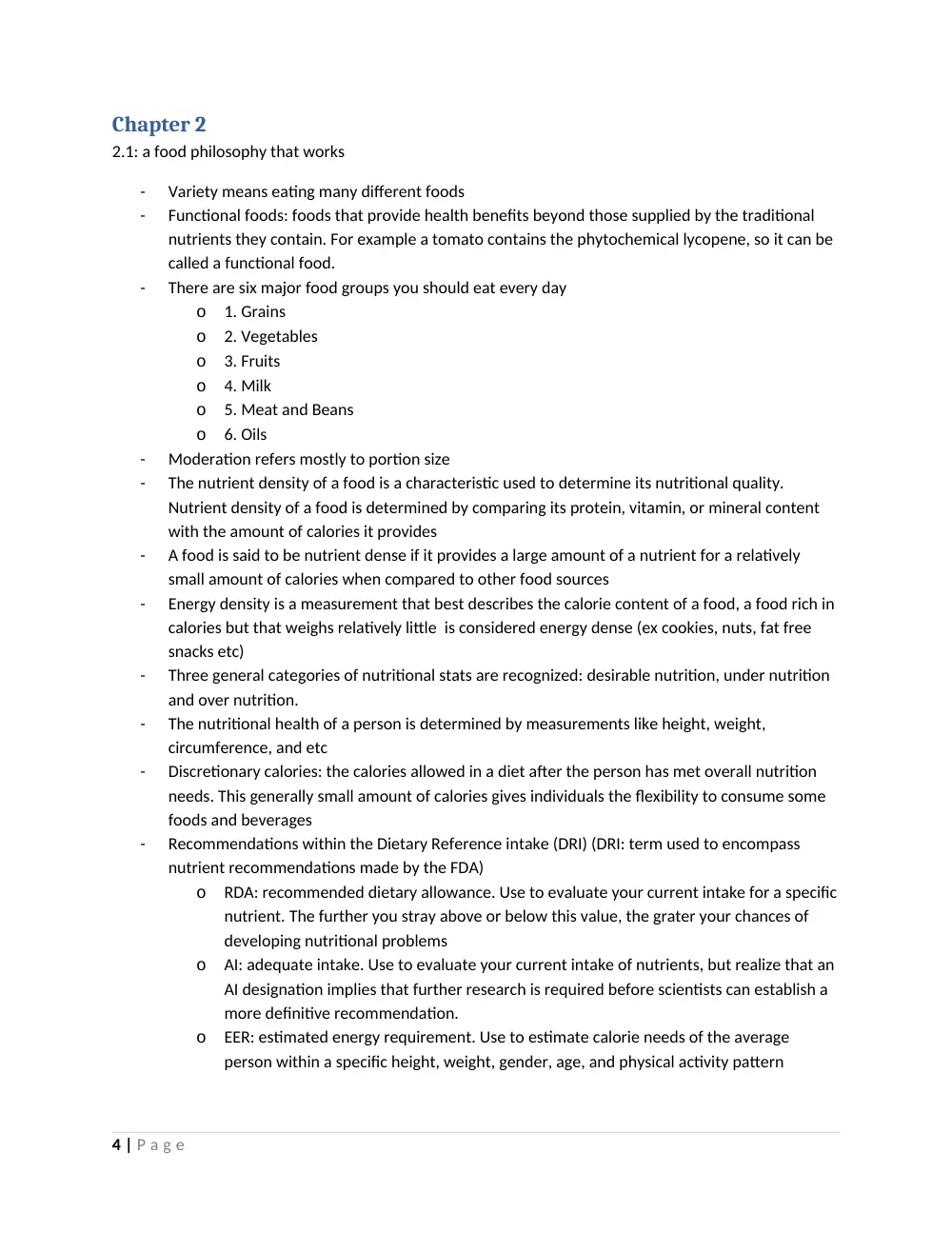
Chapter 2
2.1: a food philosophy that works
-
Variety means eating many different foods
-
Functional foods: foods that provide health benefits beyond those supplied by the traditional
nutrients they contain. For example a tomato contains the phytochemical lycopene, so it can be
called a functional food.
-
There are six major food groups you should eat every day
o
1. Grains
o
2. Vegetables
o
3. Fruits
o
4. Milk
o
5. Meat and Beans
o
6. Oils
-
Moderation refers mostly to portion size
-
The nutrient density of a food is a characteristic used to determine its nutritional quality.
Nutrient density of a food is determined by comparing its protein, vitamin, or mineral content
with the amount of calories it provides
-
A food is said to be nutrient dense if it provides a large amount of a nutrient for a relatively
small amount of calories when compared to other food sources
-
Energy density is a measurement that best describes the calorie content of a food, a food rich in
calories but that weighs relatively little is considered energy dense (ex cookies, nuts, fat free
snacks etc)
-
Three general categories of nutritional stats are recognized: desirable nutrition, under nutrition
and over nutrition.
-
The nutritional health of a person is determined by measurements like height, weight,
circumference, and etc
-
Discretionary calories: the calories allowed in a diet after the person has met overall nutrition
needs. This generally small amount of calories gives individuals the flexibility to consume some
foods and beverages
-
Recommendations within the Dietary Reference intake (DRI) (DRI: term used to encompass
nutrient recommendations made by the FDA)
o
RDA: recommended dietary allowance. Use to evaluate your current intake for a specific
nutrient. The further you stray above or below this value, the grater your chances of
developing nutritional problems
o
AI: adequate intake. Use to evaluate your current intake of nutrients, but realize that an
AI designation implies that further research is required before scientists can establish a
more definitive recommendation.
o
EER: estimated energy requirement. Use to estimate calorie needs of the average
person within a specific height, weight, gender, age, and physical activity pattern
4 | P a g e
o
UL: upper level. Use to evaluate the highest amount of a daily nutrient intake unlikely to
cause adverse health effects in the long run in almost all people (97% to 98%) in a
population. This number applies to chronic use and is set to protect even very
susceptible people in the healthy general population. As intake increases above the
upper level, the potential for adverse effects generally increases.
o
DV: daily value. Use as a rough guide for comparing the nutrient content of a food to
approximate human needs. Typically the daily value used on food labels refers to ages
four years through adulthood. It is based on a 2000 kcal diet. Some daily values also
increase slightly with higher calorie intakes.
Chapter 3
-
Merely eating food won’t nourish you. You must first digest the food – break it down into usable
forms of the essential nutrients that can be absorbed into the bloodstream. Once nutrients are
taken up by the blood stream, they can be distributed to and used by body cells.
The Digestive System
-
The foods and beverages we consume, for the most part, must undergo extensive alteration by
the digestive system to provide us with usable nutrients.
-
The processes of digestion and absorption take place in a long tube that is open at both ends
and extends from the mouth to the anus. This tube is called the gastrointestinal (GI) tract.
-
Nutrients from the food we eat must pass through the walls of the GI tract – from the inside to
the outside – to be absorbed into the bloodstream. The organs that make up the GI tract, as well
as some additional accessory organs located nearby, are collectively known as the digestive
system.
-
In the digestive system food is broken down mechanically and chemically, it is composed of six
separate organs, each organ performs one or more specific jobs.
The Organs and their functions
-
The Mouth and salivary glands: chew food, moistens food with saliva, releases starch digesting
enzymes, initiates swallowing reflex
-
Esophagus: lubricates with mucus, and moves food to stomach by swallowing
-
Stomach: Store, mix, dissolve, and continues digestion of food. Dissolves food particles with
secretions. Kills microorganisms with acid. Releases protein digesting enzyme.
-
Liver: produces bile to aid fat digestion and absorption
-
Gallbladder: store, concentrate, and later releases bile into the small intestine.
-
Pancreas: secretes sodium bicarbonates and enzymes for digesting carbohydrate, fat, and
proteins.
-
Small Intestine: mixes and propels contents. Lubricates it with mucus. Digests and absorbs most
substances using enzymes made by the pancreas and small intestine
5 | P a g e
-
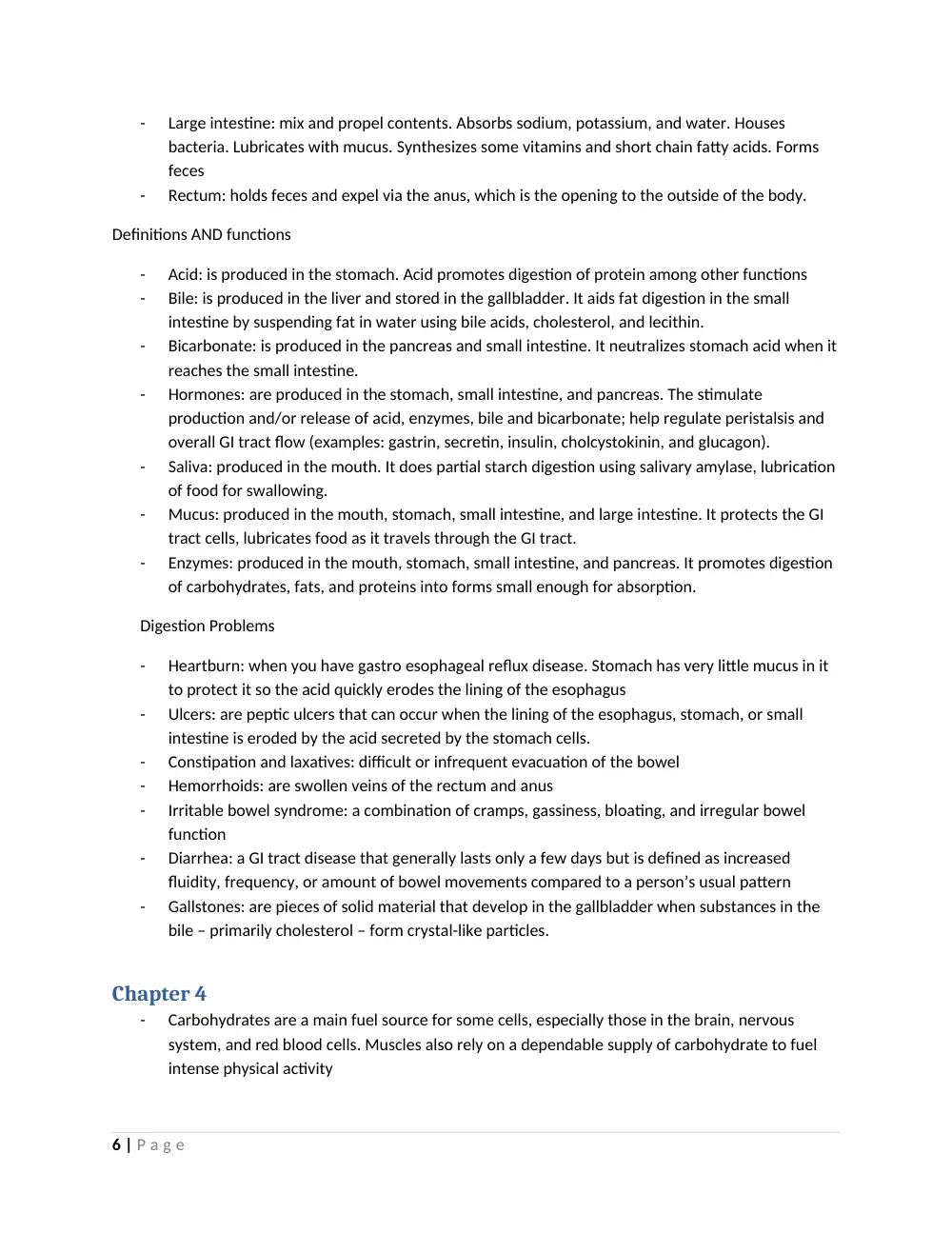
Large intestine: mix and propel contents. Absorbs sodium, potassium, and water. Houses
bacteria. Lubricates with mucus. Synthesizes some vitamins and short chain fatty acids. Forms
feces
-
Rectum: holds feces and expel via the anus, which is the opening to the outside of the body.
Definitions AND functions
-
Acid: is produced in the stomach. Acid promotes digestion of protein among other functions
-
Bile: is produced in the liver and stored in the gallbladder. It aids fat digestion in the small
intestine by suspending fat in water using bile acids, cholesterol, and lecithin.
-
Bicarbonate: is produced in the pancreas and small intestine. It neutralizes stomach acid when it
reaches the small intestine.
-
Hormones: are produced in the stomach, small intestine, and pancreas. The stimulate
production and/or release of acid, enzymes, bile and bicarbonate; help regulate peristalsis and
overall GI tract flow (examples: gastrin, secretin, insulin, cholcystokinin, and glucagon).
-
Saliva: produced in the mouth. It does partial starch digestion using salivary amylase, lubrication
of food for swallowing.
-
Mucus: produced in the mouth, stomach, small intestine, and large intestine. It protects the GI
tract cells, lubricates food as it travels through the GI tract.
-
Enzymes: produced in the mouth, stomach, small intestine, and pancreas. It promotes digestion
of carbohydrates, fats, and proteins into forms small enough for absorption.
Digestion Problems
-
Heartburn: when you have gastro esophageal reflux disease. Stomach has very little mucus in it
to protect it so the acid quickly erodes the lining of the esophagus
-
Ulcers: are peptic ulcers that can occur when the lining of the esophagus, stomach, or small
intestine is eroded by the acid secreted by the stomach cells.
-
Constipation and laxatives: difficult or infrequent evacuation of the bowel
-
Hemorrhoids: are swollen veins of the rectum and anus
-
Irritable bowel syndrome: a combination of cramps, gassiness, bloating, and irregular bowel
function
-
Diarrhea: a GI tract disease that generally lasts only a few days but is defined as increased
fluidity, frequency, or amount of bowel movements compared to a person’s usual pattern
-
Gallstones: are pieces of solid material that develop in the gallbladder when substances in the
bile – primarily cholesterol – form crystal-like particles.
Chapter 4
-
Carbohydrates are a main fuel source for some cells, especially those in the brain, nervous
system, and red blood cells. Muscles also rely on a dependable supply of carbohydrate to fuel
intense physical activity
6 | P a g e
-
Carbohydrates are a readily available fuel for all cells, both in the form of blood glucose and
glycogen stored in the liver and muscles.
-
The glycogen stored in the liver can be used to maintain blood glucose concentrations in times
when you have not eaten for several hours
-
Whole-grain breads and cereals have greater health benefits than refined and processed forms
of carbohydrate
-
Choosing the healthiest carbohydrate sources most often, while moderating intake of less
healthful sources, contributes to a healthy diet
-
Simple forms of carbohydrates are called sugars. Larger more complex forms are primarily called
either starches or fibers, depending on their digestibility by human GI tract enzymes
-
Monosaccharides and disaccharides are often referred to as simple sugars because they contain
only one or two sugar units. Food labels lump all of these sugars under one category, listing
them as “sugars.”
-
The most common monosaccharides in foods are glucose, fructose, and galactose.
-
Glucose is an important source of energy for human cells, although foods contain very little
carbohydrate as this single sugar. Most glucose comes from the digestion of starches and
sucrose (table sugar)
-
This glucose then goes on to serve as a source of fuel for cells
-
Fructose, also called fruit sugar, is another common monosaccharide. After is consumed,
fructose is absorbed by the small intestine and then transported to the liver where it is quickly
metabolized
-
The sugar galactose has nearly the same structure as glucose. Large quantities of pure galactose
do not exist in nature. Instead, galactose is usually found bonded to glucose in lactose, a sugar
found in milk and other milk products.
-
Disaccharides are sucrose(glucose +fructose), lactose(glucose +galactose), and
maltose(glucose+glucose)
-
In many foods, single-sugar units are bonded together to form a chain, known as a
polysaccharide. They are also called complex carbohydrates or starch, and may contain 1000 or
more glucose units and are found chiefly in grains, vegetables, and fruits.
-
Cellulose (a fiber) is another complex carbohydrate in plants. Although similar to amylase, it
cannot be digested by humans
-
Humans and animals store glucose in the form of glycogen. Glycogen consists of a chain of
glucose units with many branches, providing even more sites for enzyme action than
amylopectin. Because of its branched structure that can be broken down quickly, glycogen is an
ideal storage form of carbohydrate in the body.
-
The liver and muscles are the major storage sites for glycogen
-
Animal products are not good sources of glycogen or any other form of carbohydrate because
glycogen degrades almost as soon as the animal dies
-
Fiber is not a single substance but a group of substances with similar characteristics. This group
is comprised of the carbohydrates cellulose, hemicelluloses, pectins, gums, and mucilages. In
total, these constitute all the nonstarch polysaccharides in foods.
-
Amylase is a digestible straight chain type of starch composed of glucose units
7 | P a g e
-
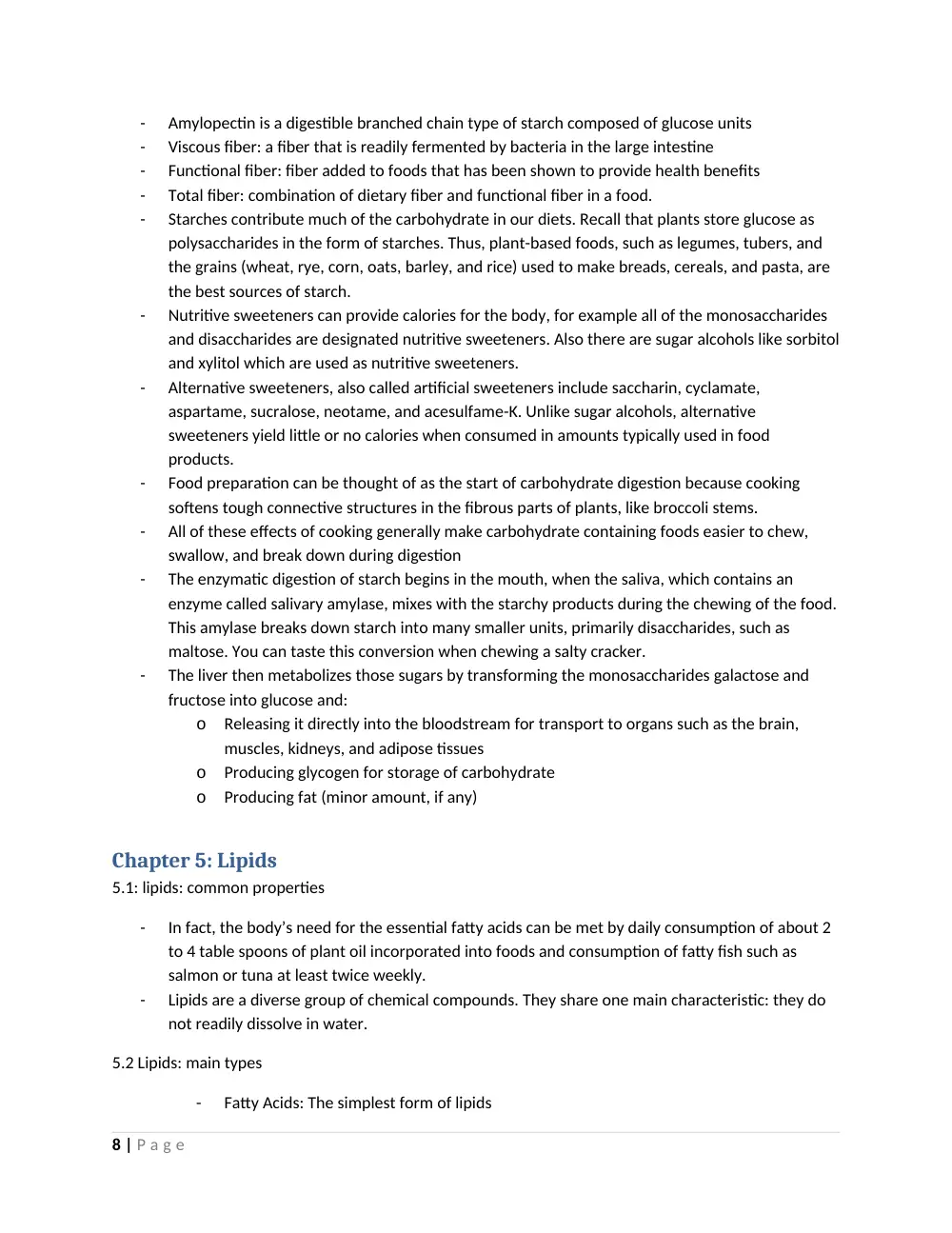
Amylopectin is a digestible branched chain type of starch composed of glucose units
-
Viscous fiber: a fiber that is readily fermented by bacteria in the large intestine
-
Functional fiber: fiber added to foods that has been shown to provide health benefits
-
Total fiber: combination of dietary fiber and functional fiber in a food.
-
Starches contribute much of the carbohydrate in our diets. Recall that plants store glucose as
polysaccharides in the form of starches. Thus, plant-based foods, such as legumes, tubers, and
the grains (wheat, rye, corn, oats, barley, and rice) used to make breads, cereals, and pasta, are
the best sources of starch.
-
Nutritive sweeteners can provide calories for the body, for example all of the monosaccharides
and disaccharides are designated nutritive sweeteners. Also there are sugar alcohols like sorbitol
and xylitol which are used as nutritive sweeteners.
-
Alternative sweeteners, also called artificial sweeteners include saccharin, cyclamate,
aspartame, sucralose, neotame, and acesulfame-K. Unlike sugar alcohols, alternative
sweeteners yield little or no calories when consumed in amounts typically used in food
products.
-
Food preparation can be thought of as the start of carbohydrate digestion because cooking
softens tough connective structures in the fibrous parts of plants, like broccoli stems.
-
All of these effects of cooking generally make carbohydrate containing foods easier to chew,
swallow, and break down during digestion
-
The enzymatic digestion of starch begins in the mouth, when the saliva, which contains an
enzyme called salivary amylase, mixes with the starchy products during the chewing of the food.
This amylase breaks down starch into many smaller units, primarily disaccharides, such as
maltose. You can taste this conversion when chewing a salty cracker.
-
The liver then metabolizes those sugars by transforming the monosaccharides galactose and
fructose into glucose and:
o
Releasing it directly into the bloodstream for transport to organs such as the brain,
muscles, kidneys, and adipose tissues
o
Producing glycogen for storage of carbohydrate
o
Producing fat (minor amount, if any)
Chapter 5: Lipids
5.1: lipids: common properties
-
In fact, the body’s need for the essential fatty acids can be met by daily consumption of about 2
to 4 table spoons of plant oil incorporated into foods and consumption of fatty fish such as
salmon or tuna at least twice weekly.
-
Lipids are a diverse group of chemical compounds. They share one main characteristic: they do
not readily dissolve in water.
5.2 Lipids: main types
-
Fatty Acids: The simplest form of lipids
8 | P a g e
o
Fatty acids are found in the main form of lipids, triglycerides. A fatty acid is
basically a long chain of carbons bonded together and flanked by hydrogens
o
Fats in foods are not composed of a single type of fatty acid. Rather, each
dietary fat, or triglyceride, is a complex mixture of many different fatty acids,
the combination of which provides each food its unique taste and smell.
o
Fatty acids can be saturated or nonsaturated
o
Fats high in saturated fatty acids, such as animal fats, remain solid at room
temperature
o
If the fatty acid contains a double bond then it is said to be unsaturated. A fatty
acid with only one double bond is monounsaturated. Canola and olive oils
contain a high percentage of monounsaturated fats.
o
Unsaturated fatty acids can exist in two different structural forms, the cis and
Trans form.
o
Some Trans fatty acids, known as conjugated linoleic acid (CLA), occur naturally.
CLA is a family of derivatives of the fatty acid linoleic acid.
o
The bacteria that live in the rumens of some animals produce trans fatty acids
that eventually appear in foods such as beef, milk and butter
o
Overall, a fat or an oil is classified as saturated monounsaturated, or
polyunsaturated based on the type of fatty acids present in the greatest
concentration
-
Triglycerides
o
Fats and oils in foods are mostly in the form of triglycerides
o
The same is true for fats found in body structures.
o
Although some fatty acids are transported in the bloodstream attached to
proteins, most fatty acids are formed into triglycerides by cells in the body
-
Phospholipids
o
Are another class of lipid. Like triglycerides, they are built on a backbone of
glycerol. However at least one fatty acid is replaced with a compound containing
phosphorus.
o
Lecithin is a common example of a phospholipid. They participate in fat
digestion, absorption, and transport.
o
The body is able to produce all the phospholipids it needs, so it is not essential
-
Sterols
o
The last class of lipids. The most common type is cholesterol
o
It doesn’t have a glycerol backbone or any fatty acids
o
It doesn’t readily dissolve in water so it is a lipid
o
Cholesterol is used to form certain hormones and bile acids and is incorporated
into cell structures
o
The body can make all the cholesterol it needs
-
Defintions
9 | P a g e
o
Cis Fatty Acid: a form of an unsaturated fatty acid that has hydrogen lying on the
same side of the carbon double bond
o
Trans fatty acid: a form of an unsaturated fatty acid, usually a monounsaturated
one when found in food, in which hydrogen is on both carbons forming the
double bond lie on opposite sides of that bond
o
Long chain fatty acid: a fatty acid that contains 12 or more carbons
o
Omega 3 fatty acid: an unsaturated fatty acid with the first double bond on the
third carbon from the methyl end
o
Omega 6 fatty acid: an unsaturated fatty acid with the first double bond on the
sixth carbon from the methyl end
o
Alpha lineolic acid: an essential omega 3 fatty acid
o
Lineolic acid: an essential omega 6 fatty acid
o
Essential fatty acids: fatty acids that must be supplied by the diet to maintain
health. Currently, only linoleic acid and alpha linoleic acid are classified as
essential.
o
Oleic acid: an omega 9 fatty acid
o
Diglyceride: a breakdown product of a triglyceride
o
Monoglyceride: a breakdown product of a triglyceride
-
Hidden Fats
o
Milk, pastries, cookies, cake, cheese, crackers…
o
“Low fat” in most cases indicates that a product contains less than 3 grams of
fat per serving. Fat free means that there is less than one-half of a gram of fat
per serving. And reduced fat means the product has at least 25% less fat than is
usually found in that type of food.
o
Fat in foods provides some satiety, flavor, and texture
Type and health effects
Main sources
State at room temp
Saturated Fatty Acids: increase
blood levels of cholesterol
Lard, fat in beef, pork, and
coconut oil, palm kennel.
Solid
Soft or liquid
Monounsaturated Fatty Acids:
Decrease blood levels of
cholesterol
Olive oil, canola oil, peanut oil
Liquid
Polyunsaturated Fatty Acids:
decrease blood levels of
cholesterol
Sunflower oil, corn oil, safflower
oil, fish oil
Liquid
Essential Fatty Acids
Omega 3: alpha-linolenic acid
Reduces inflammation
responses, blood clotting
Cold water fish (salmon, tuna),
walnuts, canola oil
Liquid
Omega 6: Linolenic acid
regulates blood pressure and
increases blood clotting
Beef, chicken, safflower oil,
sunflower oil, corn oil
Solid to liquid
Transfatty acids
Increase blood cholesterol more
Margarine, shortening
Soft to very solid
10 | P a g e
than saturated fat
Absorption: The products of fat digestion in the small intestine are fatty acids and monoglycerides.
These products diffuse into the absorptive cells of the small intestine. About 95% of dietary fat is
absorbed in this way.
Lipoprotein serves are vehicles for transport of lipids from the small intestine and liver to the body
tissues.
Lipoproteins are classified into four groups
Lipoprotein
Primary component
Key role
1)
Chylomicron
Triglyceride
Carries dietary fat from the small
intestine to cells
2)
VLDL
Triglyceride
Carries lipids made and taken up
by the liver to cells
3)
LDL
Cholesterol
Carries cholesterol made by the
liver and from other sources to
cells
4)
HDL
Protein
Contributes to cholesterol
removal from cells and in turn
excretion of it from the body
The liver is also the manufacturing site for lipids and cholesterol.
The essential fatty acids
-
We must obtain linoleic acid (an omega 6 fatty acid) and alpha linoleic (an omega 3 fatty
acid) from foods to maintain health. Hence why they are called ESSENTIAL!
-
Perform important roles in immune system function and vision, help form cell
membranes, and produce hormone like compounds.
-
Omega 6 and omega 3 fatty acids must be obtained through the diet because human
cells lack the enzymes needed to produce these fatty acids
-
Omega 9 is not essential because it can be synthesized in the body
-
If humans fail to consume enough essential fatty acids, their skin becomes flaky and
itchy, and diarrhea and other symptoms such as infections are often seen
-
Men should have 17 and 1.6 grams of omega 6 and 3 respectively)
-
Women should have 12 and 1.1 grams of omega 6 and 3 respectively
Broader roles for fatty acids and triglycerides in the body
-
Providing energy
11 | P a g e
-
Storing energy for later use
-
Insulating and protecting the body
-
Transporting fat soluble vitamins
Phospholipids in the body
-
They are found in body cells, and they participate in fat digestion in the intestine.
Cholesterol in the body
-
Cholesterol plays many vital roles in the body. It forms part of some important
hormones such as estrogen, testosterone, and a form of the active vitamin D hormone.
-
Cholesterol is also the building block of bile acids, needed for fat digestion.
-
Finally, cholesterol is an essential structural component of cells and the outer layer of
the lipoprotein particles that transport lipids in the blood
Recommendations for fat intake
-
Total fat intake should be 20 to 35% of total calories, which equates to 44 to 78 grams
per day for a person who consumes 2000 kcal daily.
12 | P a g e