
NFSC 287 Notes Introduction, Spring 2017
American University of Beirut · Food Processing · 4 pages


More NFSC 287 files
Show the text of this notes
NFSC287 Intro to processing and methods
Reasons for processing:
Creating convenience, preservation, to improve safety(Pathogens and chemical reactions: reduce activity
by cooling stop activity by freezing, destroy them by sterilization techniques, or decreasing their quality
to the safe threshold by pasteurization), extend shelf life, improve sensory qualities, make some foods
edible via processing (and make the nutrients more readily available and inhibit any action by anti-
nutritional factors), to fortify (orange juice with calcium and vitamin D)or enrich(vitamin D and calcium
in milk)
Preservation Techniques
salting (or sugar adding for other products) meats via reducing water activity by making free water less
readily available
fermenting dairy products where an acidic medium is created by using microorganisms in a controlled
media, to reduce the safety conditions for most micro-organism (just like in pickling)
canning: pressure cooking and sterilization under 120ºC therefore elimination of MO (with a certain risk
of spores)
pasteurization: non-sterility technique, enough to stabilize the food for human consumption
modifying such as the case of wheat which produces a huge set of products with a variety of sensory
properties (pasta, cereals, …)
Different Degrees of Processing:
Minimally processed Products: simply one/two-step process applied include: washing, Peeling, Juicing,
Freezing, slicing, Drying, Fermentation, Pasteurization applied to fresh cut food products
Processed Ingredients: milling, refining, crushing, exposing to chemicals applied to oils, flour, ice…
Highly Processed Products: baking, frying, smoking, toasting, puffing, fortifying, flavoring, shredding,
Steaming/boiling (Blanching veggies) applied to specific food products, highly altering their sensory
properties, involves several processing methods applied on one or more ingredients into a “different” final
product
Heat Preservation Methods: subjecting the food item to different heat processes for preservation:
Blanching, Pasteurization, canning, and sterilization.
Cold Preservation Methods:
Refrigeration (Decreasing temperature) []
Production
Processing
Distribution
Retail
•Home Preparation
•Home consumers
Restaurants
•Restaurant Prep
•Restaurant
consumers
NFSC287 Intro to processing and methods
Freezing (decreasing temperature below the freezing point of water) depends on water content: seizes the
means of production of microorganisms along with enzymatic activity
Food Composition contributing to altered food products depending on processing methods:
As the main constituent of foods (70% of natural foods), WATER is a detrimental factor playing a huge
role in quality and safety where more water means allows the mobility of almost any microorganism as
their mode of transportation and as a viability factor along with it being the main contributor to chemical
reactions
CARBS provide sweetness as a main sensory property, made of mono di and poly saccharides. Their
main importance in processing lies in the fact that they’re suitable as fermentable substrates in the
presence of suitable bacteria for the process.
PROTEINS’ most important quality is the fact that elastic structure helps in achieving products with
several ranges of elasticity, providing a range of achievable sensory attributes. Functional attributes
include: Dispersability, solubility, viscosity, cohesion, elasticity, and foaming ability.
FATS & OILS differ in the saturation of their hydrocarbons therefore exist in different states (liquid and
solid) due to the difference in their melting and freezing attributes (wide range of temperatures)
They usually improve sensory properties due to their distinctive properties (that also allow them to
constitute great heat transfer media).
MINERALS & VITAMINS: where vitamins are more heat/pH sensitive
homework: for Monday
starch what it’s made of
rice corn wheat flours capioca (amylose to amylopectin ratio)
water solubility
what happens to starch when exposed to heat in the presence of water
different stages throughout
what are the two processes associated with starch, explain retro-gradation and gelatinization
1.5 spacing
apa citation
Shelf Life: length of time these products have before they become unsuitable for sale or human
consumption
most shelf life claims on products are based on quality rather than safety: dates are a recommendation
period for storage, during which the defined quality of a specified proportion of the goods remains
acceptable under expected (or specified) conditions of distribution, storage and display. Beyond this
period, the product’s quality is no longer guaranteed.
Affected by: light, heat, humidity, gas transmission, mechanical stress, contamination
Deterioration begins with the moment food are harvested but is aggravated due to biological spoilage
mechanisms:
internal factors causing deterioration to occur as activation enzymes are activated and spoilage
Microorganisms make use of surrounding nutrients, once ingredients are harvested
external factors such as heat, light, humidity, volatile gases, and bruising which may also cause external
microorganisms to speed up deterioration (vibration during transportation causes mechanical injury)
Abiotic deterioration is due to: lipid rancidity, Oxidation, Maillard reaction, volatile aromas and flavors,
off-flavors, moisture permeation, and temperature
NFSC287 Intro to processing and methods
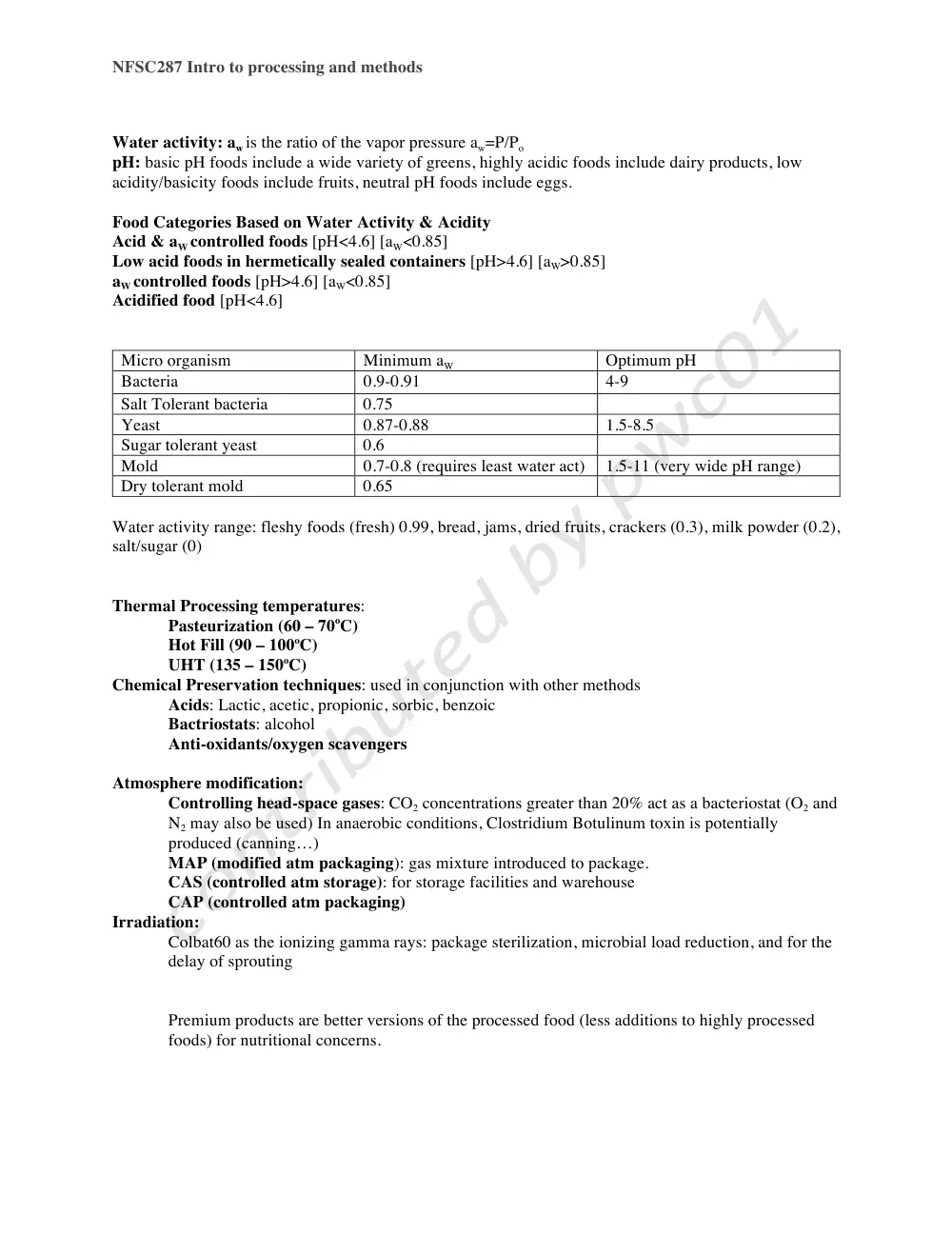
Water activity: aw is the ratio of the vapor pressure aw=P/Po
pH: basic pH foods include a wide variety of greens, highly acidic foods include dairy products, low
acidity/basicity foods include fruits, neutral pH foods include eggs.
Food Categories Based on Water Activity & Acidity
Acid & aW controlled foods [pH<4.6] [aW<0.85]
Low acid foods in hermetically sealed containers [pH>4.6] [aW>0.85]
aW controlled foods [pH>4.6] [aW<0.85]
Acidified food [pH<4.6]
Micro organism
Minimum aW
Optimum pH
Bacteria
0.9-0.91
4-9
Salt Tolerant bacteria
0.75
Yeast
0.87-0.88
1.5-8.5
Sugar tolerant yeast
0.6
Mold
0.7-0.8 (requires least water act)
1.5-11 (very wide pH range)
Dry tolerant mold
0.65
Water activity range: fleshy foods (fresh) 0.99, bread, jams, dried fruits, crackers (0.3), milk powder (0.2),
salt/sugar (0)
Thermal Processing temperatures:
Pasteurization (60 – 70oC)
Hot Fill (90 – 100oC)
UHT (135 – 150oC)
Chemical Preservation techniques: used in conjunction with other methods
Acids: Lactic, acetic, propionic, sorbic, benzoic
Bactriostats: alcohol
Anti-oxidants/oxygen scavengers
Atmosphere modification:
Controlling head-space gases: CO2 concentrations greater than 20% act as a bacteriostat (O2 and
N2 may also be used) In anaerobic conditions, Clostridium Botulinum toxin is potentially
produced (canning…)
MAP (modified atm packaging): gas mixture introduced to package.
CAS (controlled atm storage): for storage facilities and warehouse
CAP (controlled atm packaging)
Irradiation:
Colbat60 as the ionizing gamma rays: package sterilization, microbial load reduction, and for the
delay of sprouting
Premium products are better versions of the processed food (less additions to highly processed
foods) for nutritional concerns.
NFSC287 Intro to processing and methods
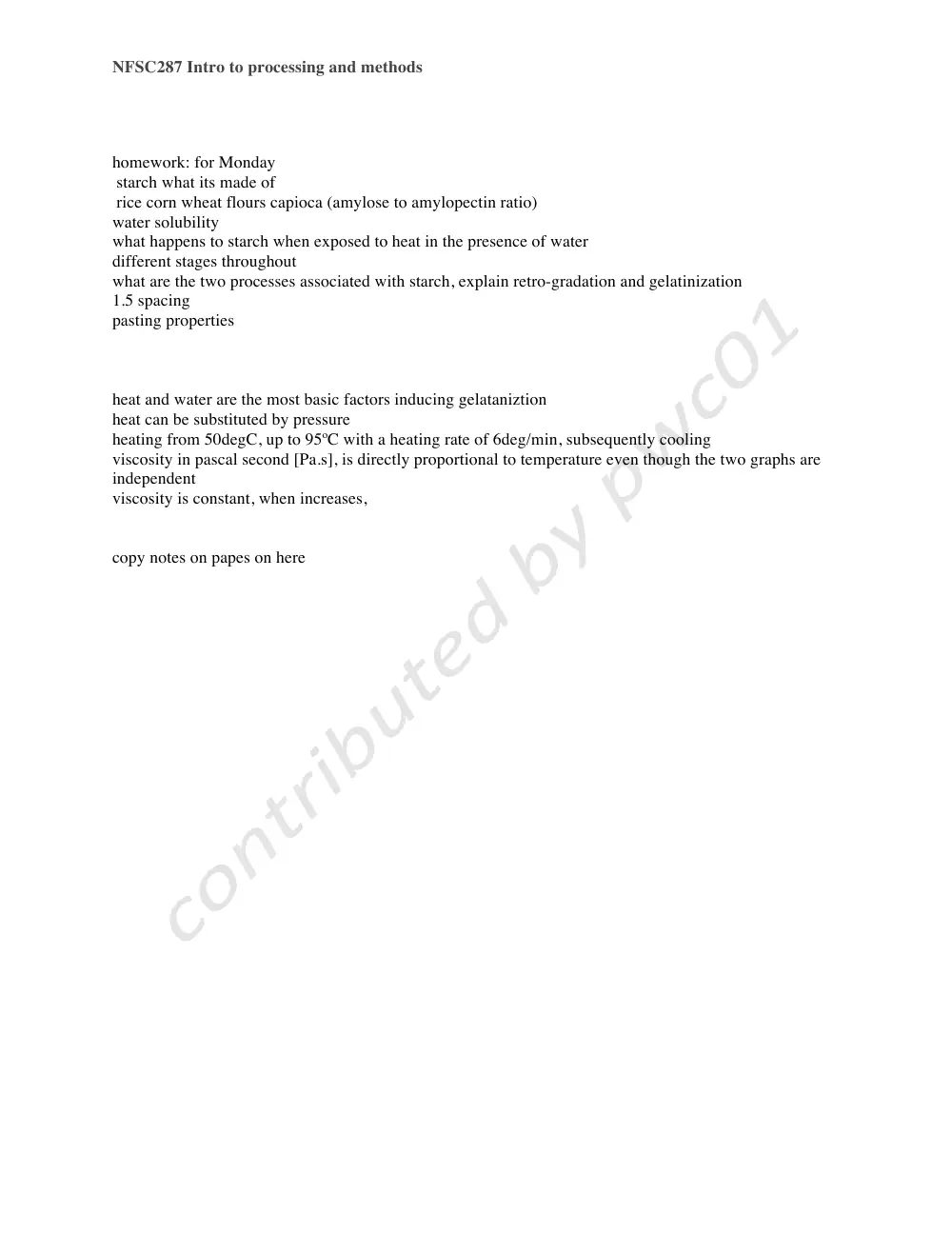
homework: for Monday
starch what its made of
rice corn wheat flours capioca (amylose to amylopectin ratio)
water solubility
what happens to starch when exposed to heat in the presence of water
different stages throughout
what are the two processes associated with starch, explain retro-gradation and gelatinization
1.5 spacing
pasting properties
heat and water are the most basic factors inducing gelataniztion
heat can be substituted by pressure
heating from 50degC, up to 95ºC with a heating rate of 6deg/min, subsequently cooling
viscosity in pascal second [Pa.s], is directly proportional to temperature even though the two graphs are
independent
viscosity is constant, when increases,
copy notes on papes on here