
PHIL 224 Midterm, Spring 2015
American University of Beirut · Phillosophy of Religion · 1 page · Prof. Patrick Lewtas
Stuck on a question? A tutor can walk you through it.
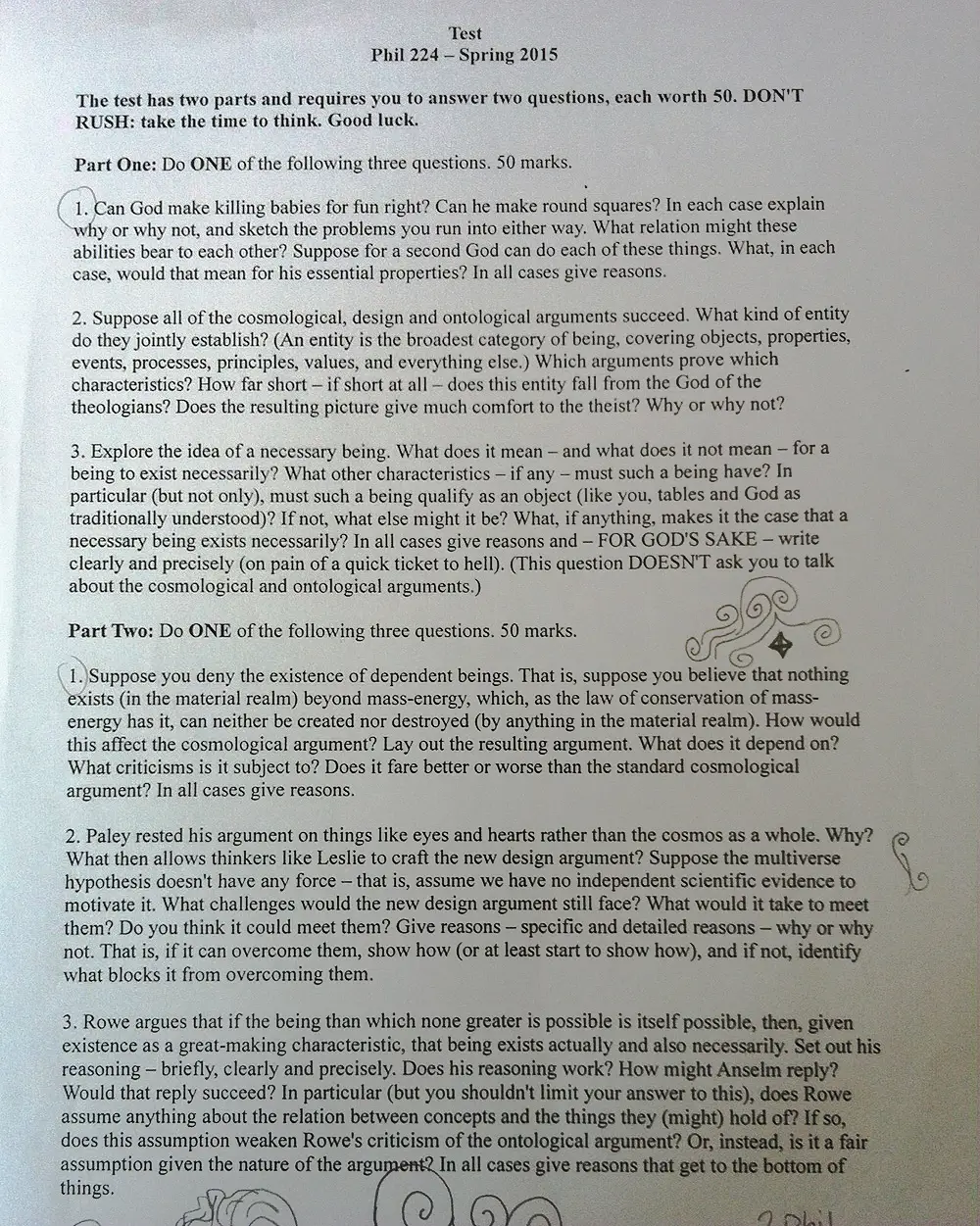
Show the text of this exam
Test
Phil 224 — Spring 2015
The test has two parts and requires you to answer two questions, each worth 50. DON'T
RUSH: take the time to think. Good luck.
Part One: Do ONE of the following three questions. 50 marks.
1. Can God make killing babies for fun right? Can he make round squares? In each case explain
why or why not, and sketch the problems you run into either way. What relation might these
abilities bear to each other? Suppose for a second God can do each of these things. What, in each
case, would that mean for his essential properties? In all cases give reasons.
2. Suppose all of the cosmological, design and ontological arguments succeed. What kind of entity
do they jointly establish? (An entity is the broadest category of being, covering objects, properties,
events, processes, principles, values, and everything else.) Which arguments prove which
characteristics? How far short —if short at all — does this entity fall from the God of the
theologians? Does the resulting picture give much comfort to the theist? Why or why not?
3. Explore the idea of a necessary being. What does it mean — and what does it not mean — for a
being to exist necessarily? What other characteristics — if any — must such a being have? In
particular (but not only), must such a being qualify as an object (like you, tables and God as
traditionally understood)? If not, what else might it be? What, if anything, makes it the case that a
necessary being exists necessarily? In all cases give reasons and - FOR GOD'S SAKE — write
clearly and precisely (on pain of a quick ticket to hell). (This question DOESN'T ask you to talk
about the cosmological and ontological arguments.)
Part Two: Do ONE of the following three questions. 50 marks. WK 7S
1.)Suppose you deny the existence of dependent beings. That is, suppose you believe that nothing
exists (in the material realm) beyond mass-energy, which, as the law of conservation of mass-
energy has it, can neither be created nor destroyed (by anything in the material realm). How would
this affect the cosmological argument? Lay out the resulting argument. What does it depend on?
What criticisms is it subject to? Does it fare better or worse than the standard cosmological
argument? In all cases give reasons.
What then allows thinkers like Leslie to craft the new design argument? Suppose the multiverse
hypothesis doesn't have any force — that is, assume we have no independent scientific evidence to
motivate it. What challenges would the new design argument still face? What would it take to meet
them? Do you think it could meet them? Give reasons — specific and detailed reasons — why or why
not. That is, if it can overcome them, show how (or at least start to show how), and if not, identify
what blocks it from overcoming them.
2. Paley rested his argument on things like eyes and hearts rather than the cosmos as a whole. Why? S;
3) Rowe argues that if the being than which none greater is possible is itself Possible, t
assume anything about the relation between concepts and the ae they (m
does this assumption weaken Rowe's criticism of the ontological argument
assumption given the nature of the argu In all cases give reasons
things
a Wi (Oo) Gye