
PHYS 210 Exam, Spring 2008
American University of Beirut · Introductory Physics II · 7 pages




More PHYS 210 files
Show the text of this exam
1. A coin of mass m=5.0 g is dropped from a height of {h} m. If it
reaches a terminal velocity of {v} m/s, and the rest of the energy is
converted to heating the coin, what is the change in temperature (in °C)
of the coin? (The specific heat of copper is 387 J/kg °C and take the
gravitational acceleration g=10 m/s2.)
T
cm T
m
mgh
tv 2
2
1
2. An amount of {n} moles of an ideal gas expands isothermally at 100°C
to {f} times its initial volume. Find the heat flow into the system (in kilo
joule).
5)
ln(
5)
ln(
0
int
nRT
Q
nR
V
nRT dV
pdV
W
W
Q
W
Q
E
f
i
f
i
V
V
V
V
3. A total amount of heat {Q} J is added to a substance of a mass
{ m} Kg. Initially the substance is solid of a melting temperature 313 K. After
adding the heat, the substance is completely transformed to liquid at 357 K. If
the specific heat of the liquid is c=1200 J/(Kg.K), what is the latent heat of this
substance (give answer in terms of 103 J/Kg)?
m
cm T
Q
L
mL
cm T
Q
f
f
)
(
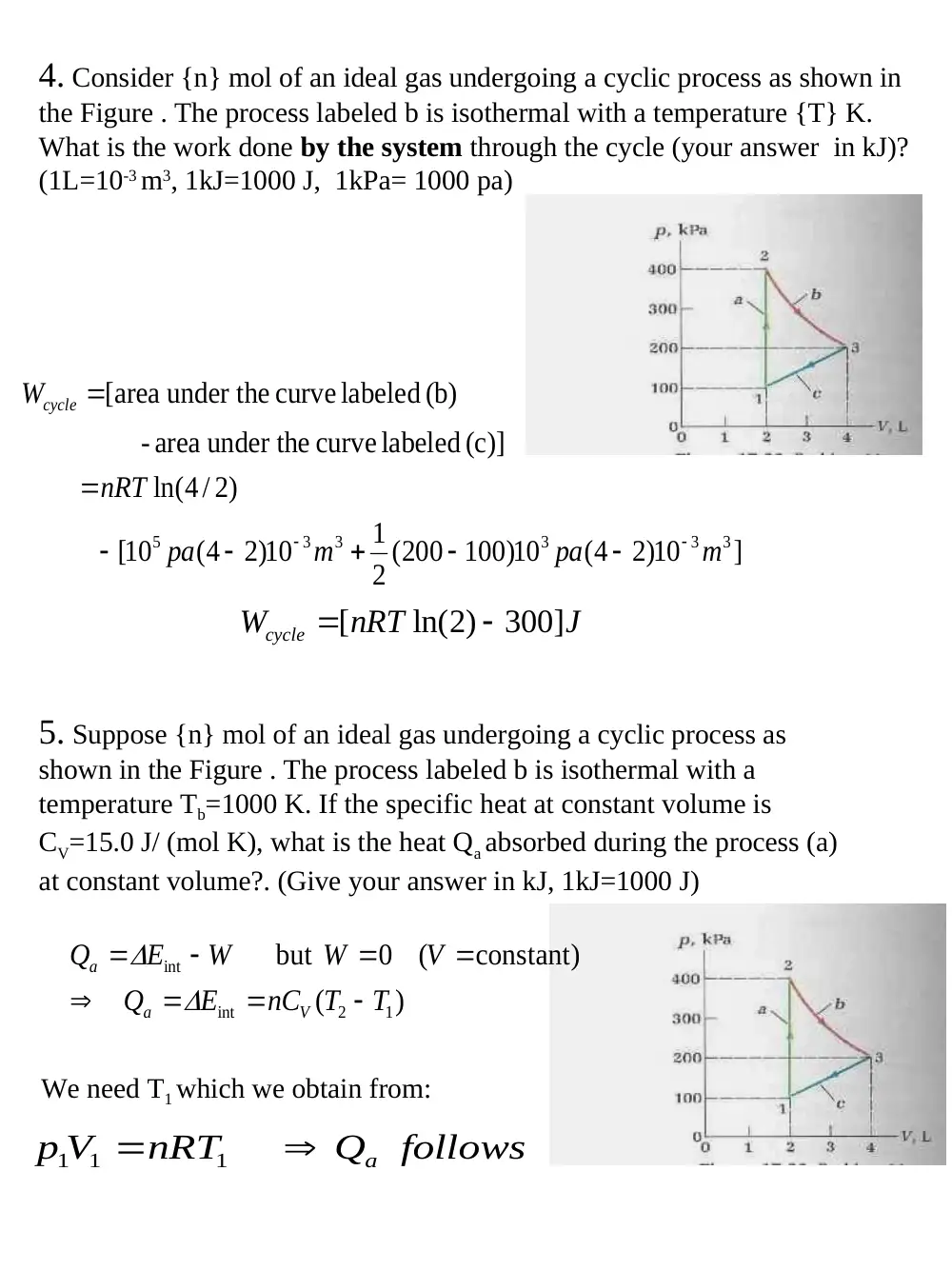
4. Consider {n} mol of an ideal gas undergoing a cyclic process as shown in
the Figure . The process labeled b is isothermal with a temperature {T} K.
What is the work done by the system through the cycle (your answer in kJ)?
(1L=10-3 m3, 1kJ=1000 J, 1kPa= 1000 pa)
]
2)10
(4
200 100)10
(
2
1
2)10
(4
[10
ln(4/ 2)
- area under the curve labeled (c)]
area under the curve labeled (b)
[
3
3
3
3
3
5
m
pa
m
pa
nRT
Wcycle
J
nRT
Wcycle
300]
ln(2)
[
5. Suppose {n} mol of an ideal gas undergoing a cyclic process as
shown in the Figure . The process labeled b is isothermal with a
temperature Tb=1000 K. If the specific heat at constant volume is
CV=15.0 J/ (mol K), what is the heat Qa absorbed during the process (a)
at constant volume?. (Give your answer in kJ, 1kJ=1000 J)
)
(
constant)
(
0
but
1
2
int
int
T
nC T
E
Q
V
W
W
E
Q
V
a
a
We need T1 which we obtain from:
follows
Q
nRT
p V
a
1
1
1
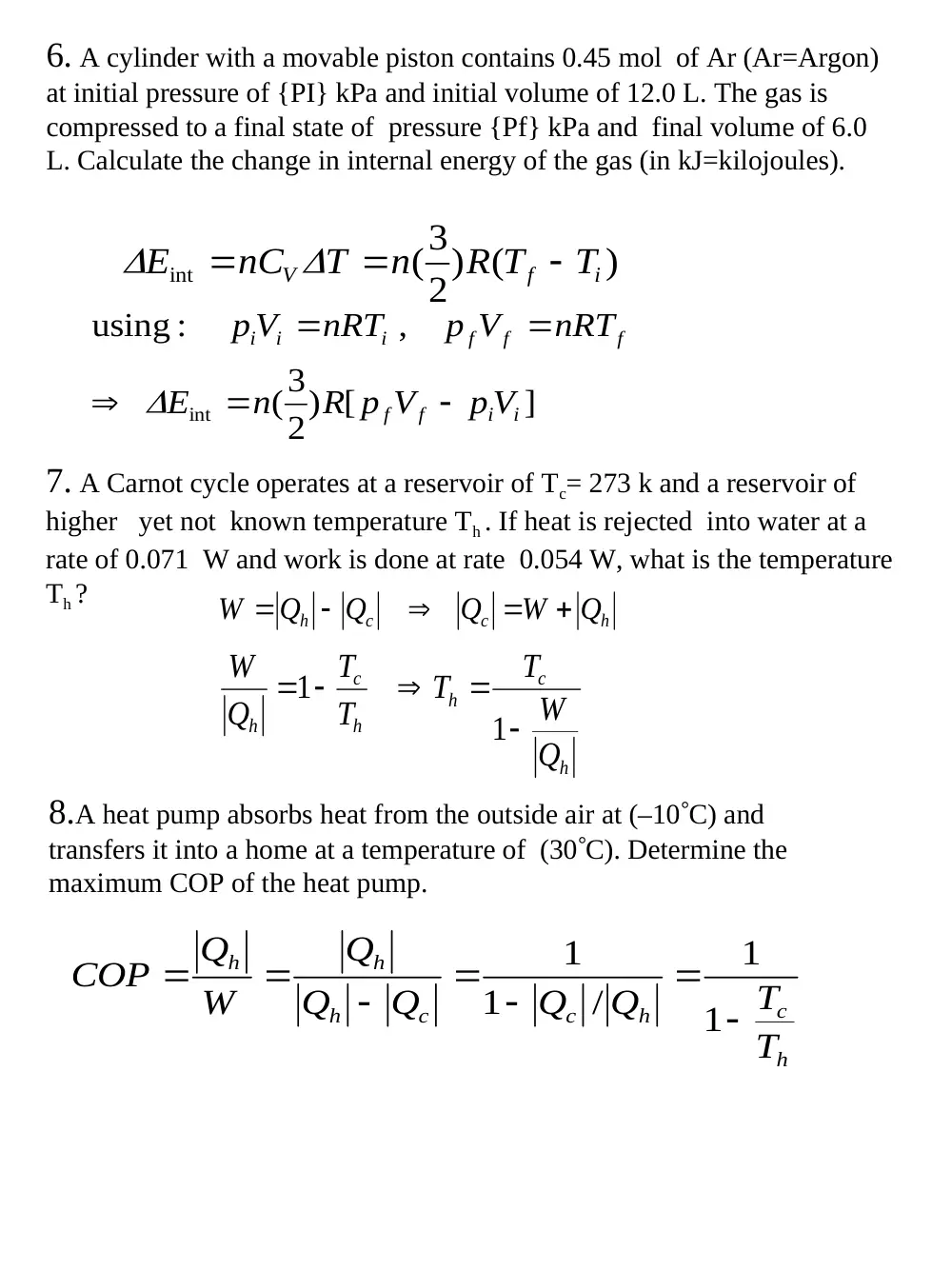
6. A cylinder with a movable piston contains 0.45 mol of Ar (Ar=Argon)
at initial pressure of {PI} kPa and initial volume of 12.0 L. The gas is
compressed to a final state of pressure {Pf} kPa and final volume of 6.0
L. Calculate the change in internal energy of the gas (in kJ=kilojoules).
)
2) (
3
(
int
i
f
V
T
R T
n
T
nC
E
]
2) [
3
(
,
:
using
int
i
i
f
f
f
f
f
i
i
i
pV
R p V
n
E
nRT
p V
nRT
V
p
7. A Carnot cycle operates at a reservoir of Tc= 273 k and a reservoir of
higher yet not known temperature Th . If heat is rejected into water at a
rate of 0.071 W and work is done at rate 0.054 W, what is the temperature
Th ?
8.A heat pump absorbs heat from the outside air at (–10C) and
transfers it into a home at a temperature of (30C). Determine the
maximum COP of the heat pump.
h
c
c
h
Q
W
Q
Q
Q
W
h
c
h
h
c
h
Q
W
T
T
T
T
Q
W
1
1
h
c
h
c
c
h
h
h
T
T
Q
Q
Q
Q
Q
W
Q
COP
1
1
/
1
1
W
m
m
V
V
V
p V
W
W
s
W
s
)
(
9. Two kilograms of water at 100°C is converted to steam at 1 atm. Find
the work done (in J) by the steam. (The density of steam at 100°C is 0.598
kg/m3, density of water is 1000 kg/m3)
10. An ideal gas is allowed to expand adiabatically until its
volume increases by 50%. By approximately what factor is the
pressure reduced? ( = 5/3.)
2
1
)
5.1(
1
)
5.1(
i
f
i
f
i i
p
p
V
p
V
p
11. A gas expands at constant pressure of 2.0x10⁵` Pa (1Pa=1N/m2) and the
volume changes by 0.04 m3 . The heat added to the gas is 1.2x10⁴ J and the
internal energy of the final state state is 2.6x10⁴ J.
The internal energy of the initial state is (in J):
KJ
pa
x
J
x
J
x
W
Q
E
E
W
Q
E
E
f
i
i
f
22
( .0 04)
( 2 10
10
2.1
10
6.2
)
(
)
(
)
(
)
(
5
4
4
int
int
int
int
12. A gas expands as shown in the graph. If the heat taken in during this
process is 1.02x10⁶ J, the change in internal energy of the gas (in J) is
J
area
W
6
5
5
.2 43 10
.1 01310
[12 12 ]
.1 01310
2)]
2)(6
2 (8
1
)1
2)(2
[(8
)
(
J
J
J
Q W
E
6
6
6
int
10
4.1
.2 43 10
.1 02 10
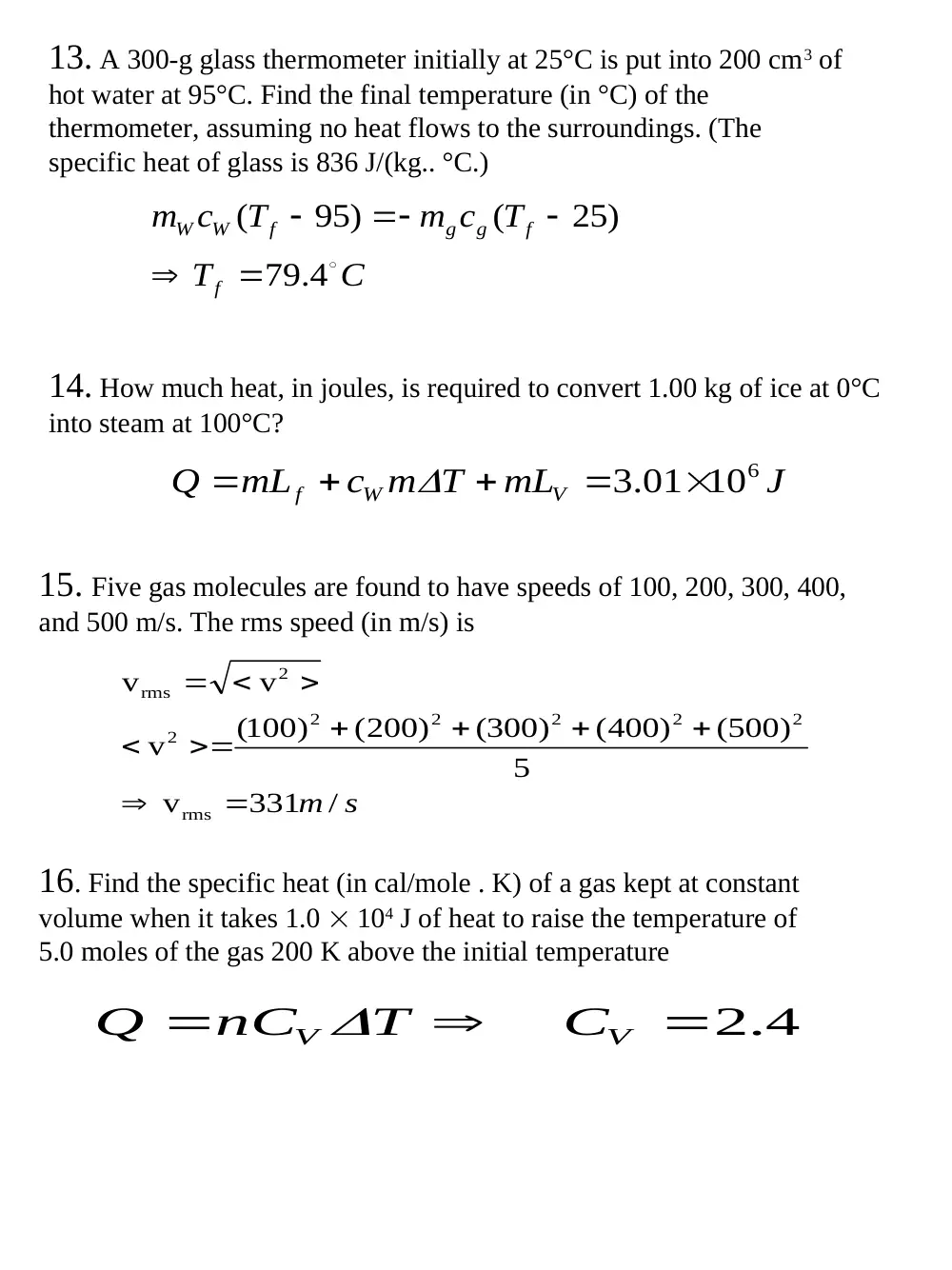
13. A 300-g glass thermometer initially at 25°C is put into 200 cm3 of
hot water at 95°C. Find the final temperature (in °C) of the
thermometer, assuming no heat flows to the surroundings. (The
specific heat of glass is 836 J/(kg.. °C.)
C
T
T
m c
T
c
m
f
f
g
g
f
W
W
4.
79
25)
(
95)
(
14. How much heat, in joules, is required to convert 1.00 kg of ice at 0°C
into steam at 100°C?
J
mL
c m T
mL
Q
V
W
f
3.01 106
15. Five gas molecules are found to have speeds of 100, 200, 300, 400,
and 500 m/s. The rms speed (in m/s) is
331m / s
v
5
(500)
(400)
(300)
(200)
(100)
v
v
v
rms
2
2
2
2
2
2
2
rms
16. Find the specific heat (in cal/mole . K) of a gas kept at constant
volume when it takes 1.0 104 J of heat to raise the temperature of
5.0 moles of the gas 200 K above the initial temperature
2.4
V
V
C
T
nC
Q
17. One mole of a diatomic ideal gas is heated from 20 C to 120 C at
constant pressure. The change of its internal energy is:
R
C
T
nC
Q
p
P
2
7
,
18. A sample of an ideal gas has the macroscopic parameter (P,V,T). A
second sample has (2P,2V,2T). If the average molecular kinetic energy
for the first sample is <KE>, then the average molecular kinetic energy of
the second sample is:
KE
proportional T
KE
2
19. The rms speed for molecules of a gas at 300 k is 1900 m/s. If the
temperature of the gas is increased to 606 k, the rms speed becomes:
m s
m
kT
prop
/
2700
3001900
606
.
vrms
20. A gasoline engine absorbs 2500 J of heat and performs 1000 J of
mechanical work in each cycle. The amount of heat expelled in each
cycle is
J
Q
Q
Q
W
c
c
h
1500
21. A refrigerator has a coefficient of performance of 4. If the refrigerator
absorbs 30 cal of heat from the cold reservoir in each cycle, the heat
expelled (in cal) into the heat reservoir is
cal
W
Q
Q
W
Q
COP
c
h
c
37.5
22. A heat engine absorbs 2500 J of heat from a hot reservoir and expels 1000
J to a cold reservoir. When it is run in reverse, with the same reservoirs, the
engine pumps 2500 J of heat to the hot reservoir, requiring 1500 J of work to
do so. Find the ratio of the work done by the heat engine to the work done by
the pump. Is the heat engine reversible?
J
Q
Q
W
c
h
eng
1500
In reverse:
so reversible
W
W
J
W
pump
eng
pump
0.1
1500
23. A heat engine operates between two reservoirs with efficiency of 35%. If
heat Qc=6500 J is exhausted to the low temperature reservoir in a cycle, how
much heat is extracted from the high temperature reservoir in one cycle?
h
c
h
Q
Q
Q
e
e
1
0.35