
PHYS 210 Final 2015, Spring 2017
American University of Beirut · Introductory Physics II · 31 pages

Showing the first 10 of 31 pages. Download the PDF to see all of it.
More PHYS 210 files
- Final Collection Finals with Solution · Spring 2017Final exam · with solutionView
- Final · Fall 2014Final examView
- Final · Fall 2014Final examView
- Final · Fall 2014Final examView
- Final With Solutions · Fall 2013Final exam · with solutionView
- Final · Fall 2011Final examView
- Final · Fall 2011Final examView
- Final Moodle · Fall 2011Final examView
Show the text of this final exam
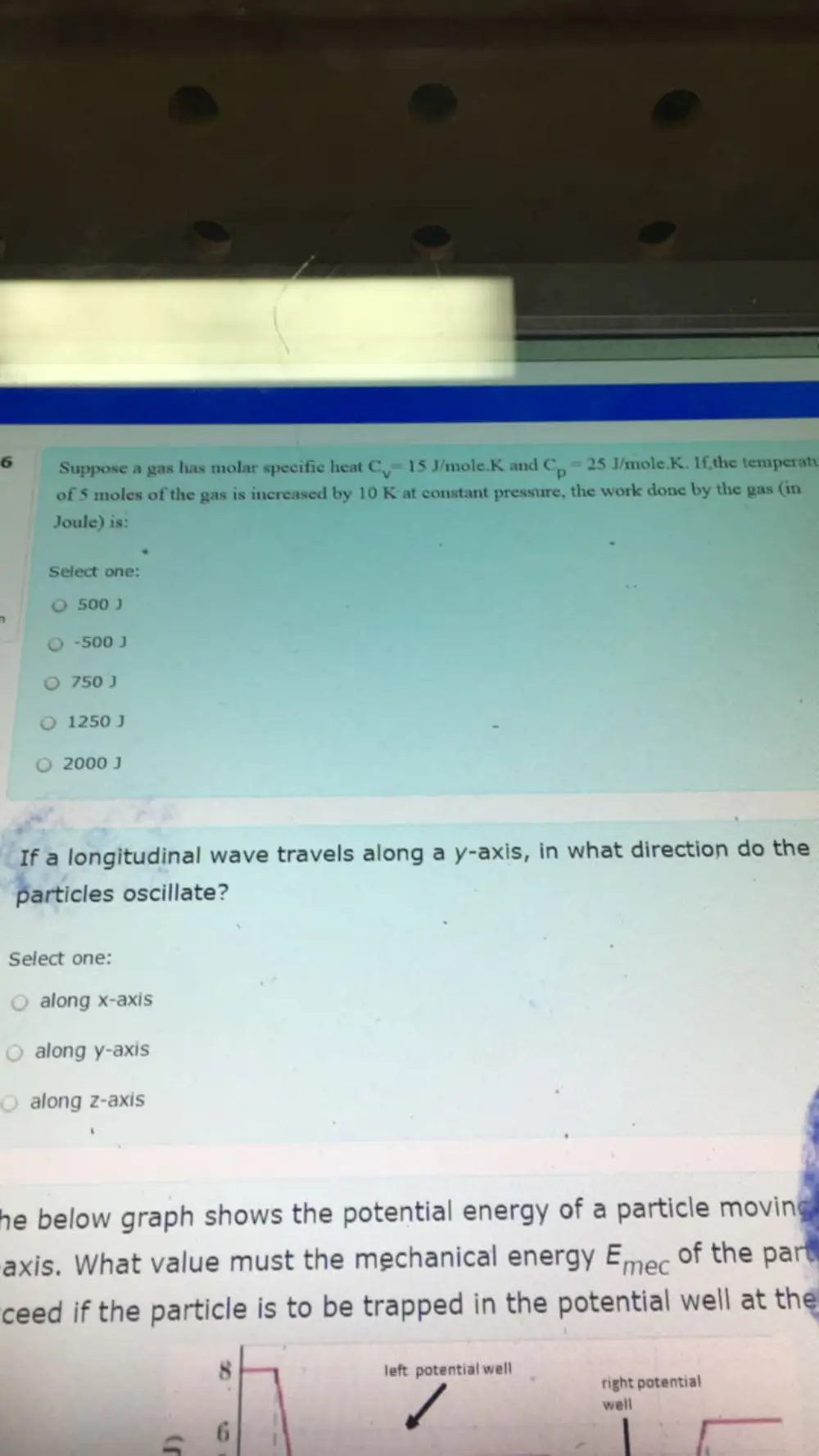
6 Suppose a gas has molar specific heat C= 15 J/mole.K and C,=25 Jimole.K. [fithe temperat
of § moles of the gas is increased by 10 K at constant pressure, the work done by the gas Gn
Joule) is:
* -
Select one:
© 500]
© -500)
) 750 3
1250 J
2000 J
If a longitudinal wave travels along a y-axis, in what direction do the
particles oscillate?
Select one:
along x-axis
along y-axis
he below graph shows the potential energy of a particle moving
axis. What value must the mechanical energy E,,.,, of the pare
ceed if the particle is to be trapped in the potential well at the
aiong Z-ax!s
s left potential well
|
’ right potential
| re A well
es aa
O atong 2-8
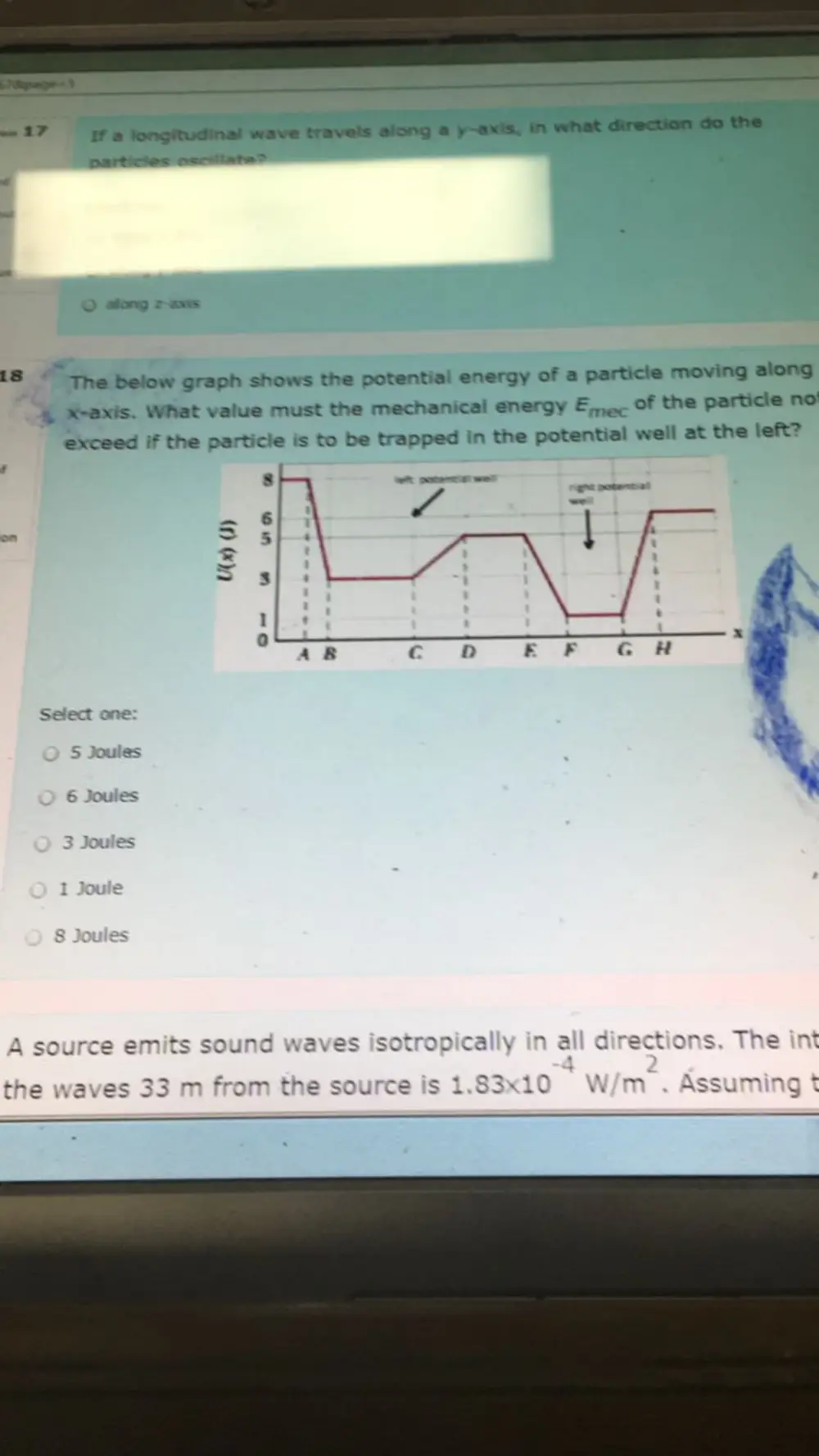
the below graph shows the potential energy of a particle moving along
“{ Saxis. What value must the mechanical energy Emec Of the particle no
on
exceed if the particle is to be trapped in the potential well at the left?
U(x) U)
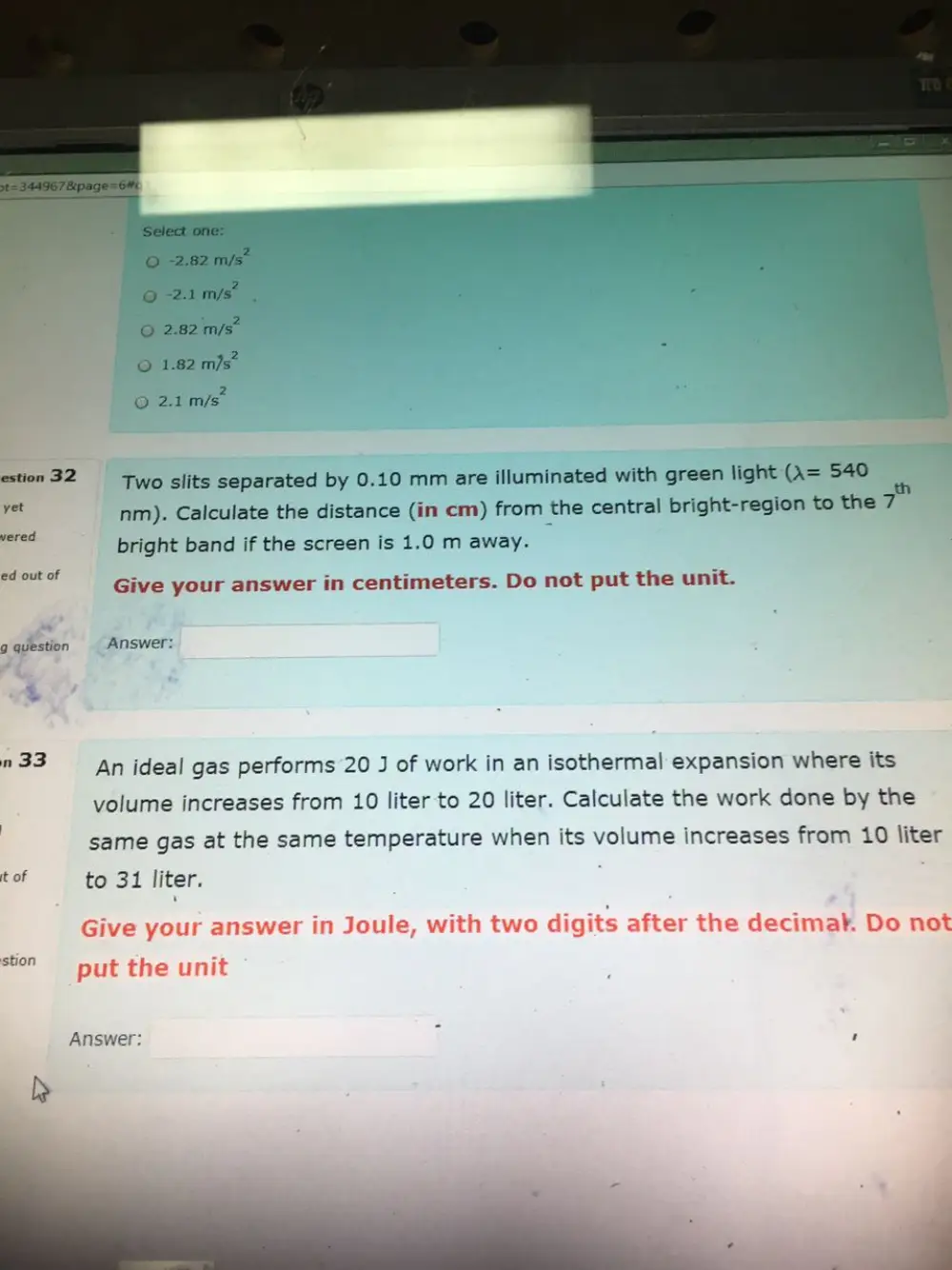
estion 32 Two slits separated by 0.10 mm are illuminated with green light (A= 540
— nm). Calculate the distance (in cm) from the central bright-region to the is
“ss bright band if the screen is 1.0 m away.
ed out of
Give your answer in centimeters. Do not put the unit.
g question Answer:
¢
_
n 33 An ideal gas performs 20 J of work in an isothermal expansion where its
volume increases from 10 liter to 20 liter. Calculate the work done by the
same gas at the same temperature when its volume increases from 10 liter
t of to 31 liter.
Give your answer in Joule, with two digits after the decimak. Do not
stion
put the unit
Answer: { ;
ined at @ = 40° while ~ |
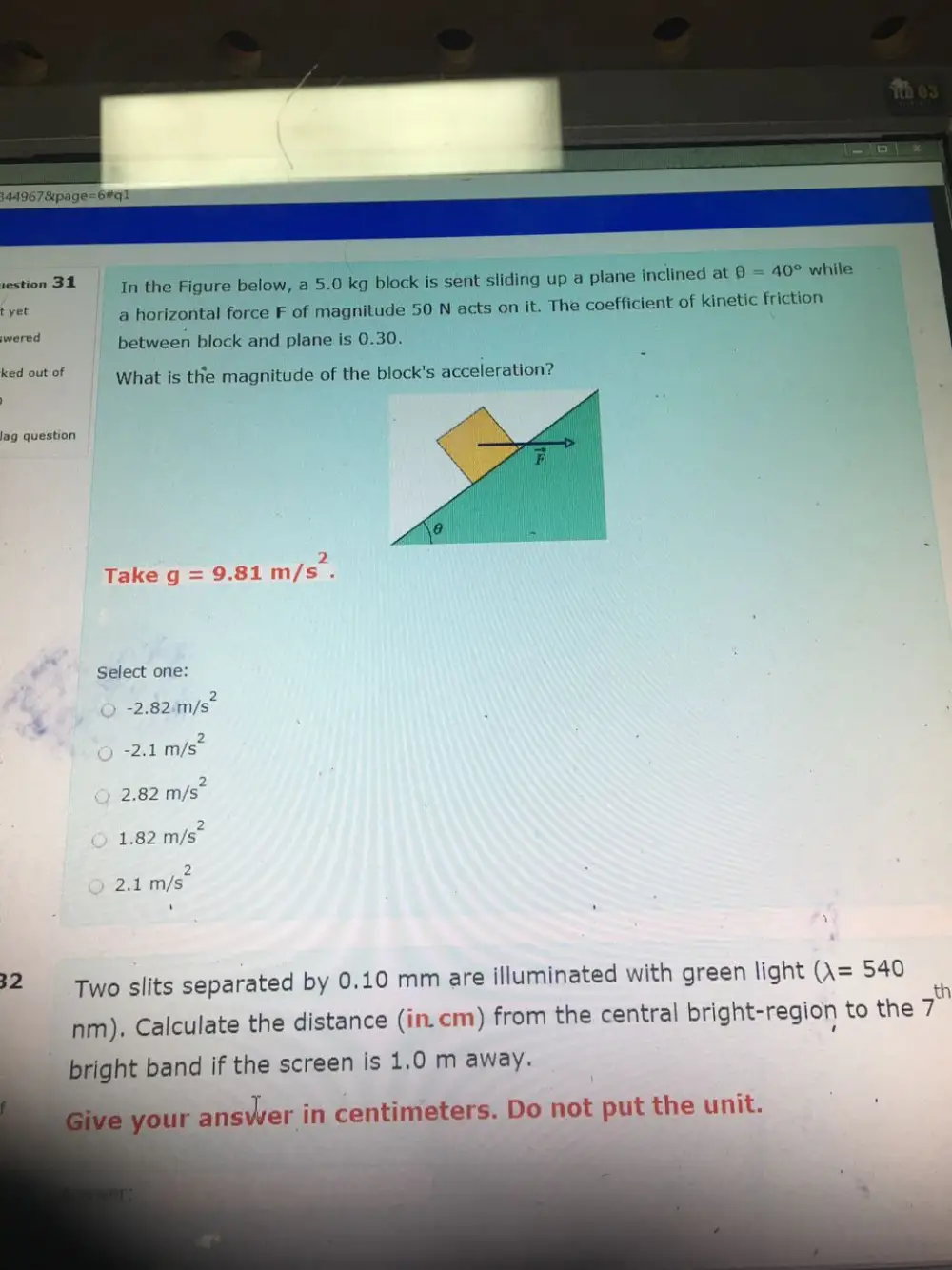
sestion 31 In the Figure below, a 5.0 kg block is sent sliding up a plane incl
Ae a horizontal force F of magnitude 50 N acts on it. The coefficient of kinetic friction §
prered between block and plane is 0.30.
BAG out of What is the magnitude of the block's acceleration? x
lag question
2
Take g = 9.81 m/s .
Select one:
2
-2.82:m/s
2
-2.1 m/s
2
2.82 m/s
1.82 m/s
2.1 m/s”
arated by 0.10 mm are illuminated with green light (A= 540
32 Two slits sep
(in.cm) from the central bright-region to the 7
nm). Calculate the distance
bright band if the screen Is 1.0 m away.
your answer in centimeters. Do not put the unit.
th
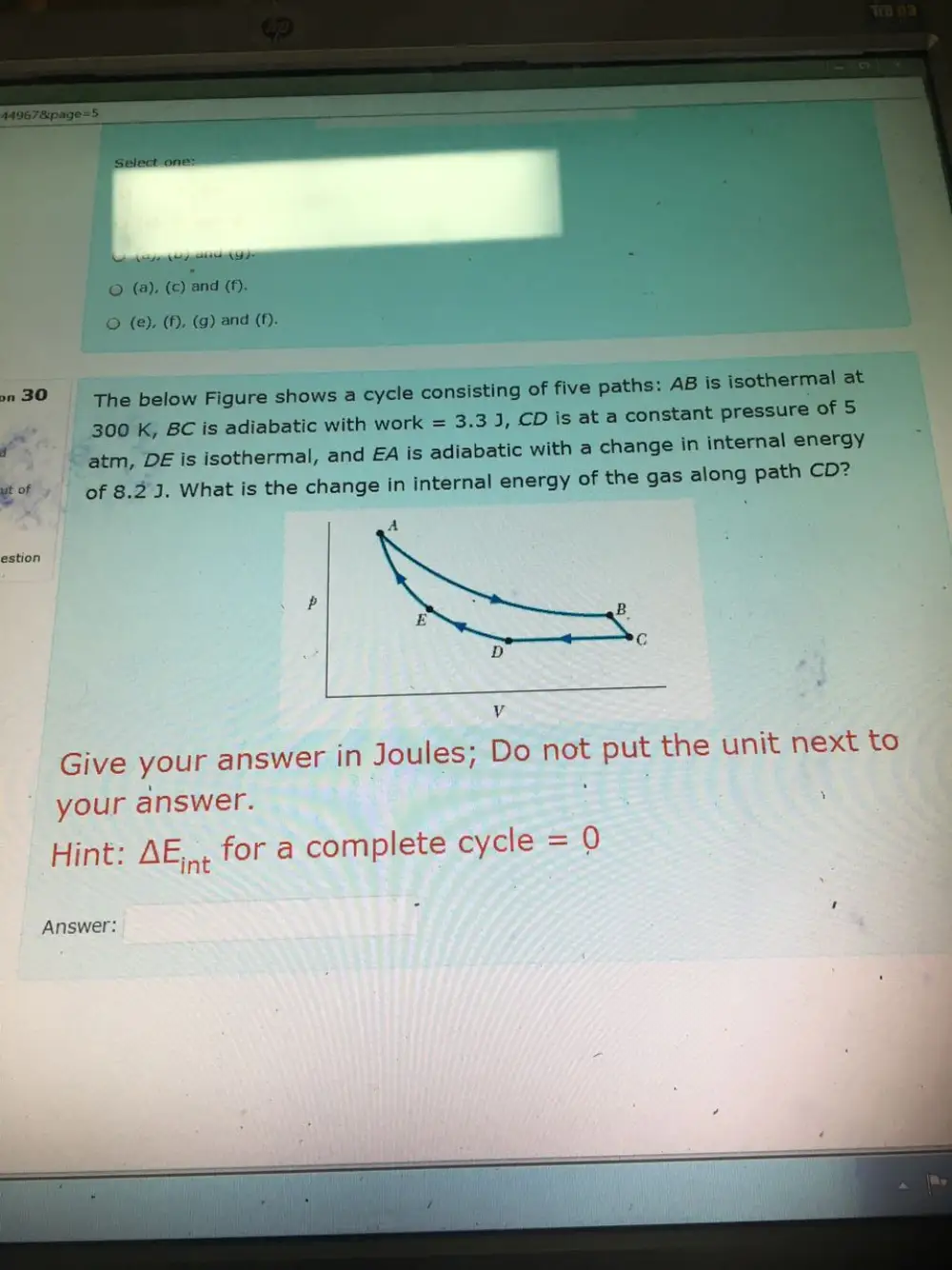
slow Figure shows a cycle consisting of five paths: AB
t a constant pressu
) K, BC is adiabatic with work = 3.3], cDisa
” ites Wada
ae ft ~ atm, DE is isothermal, and EA is adiabatic with a change in internal energy
ee » of 8.2 J. What is the change in internal energy of the gas along path CD? '
' :
estion
P
E B
Vv
Give your answer in Joules; Do not put the unit next to
your answer.
Hint: AE,., for a complete cycle = 0
‘
Answer:
Question 1
Not yet
answered
Marked out of
2.00
r Flag question
Question 2
ot yet
nswered
arked out of
00
Flag question
stion 3
jet
ered
2d out of
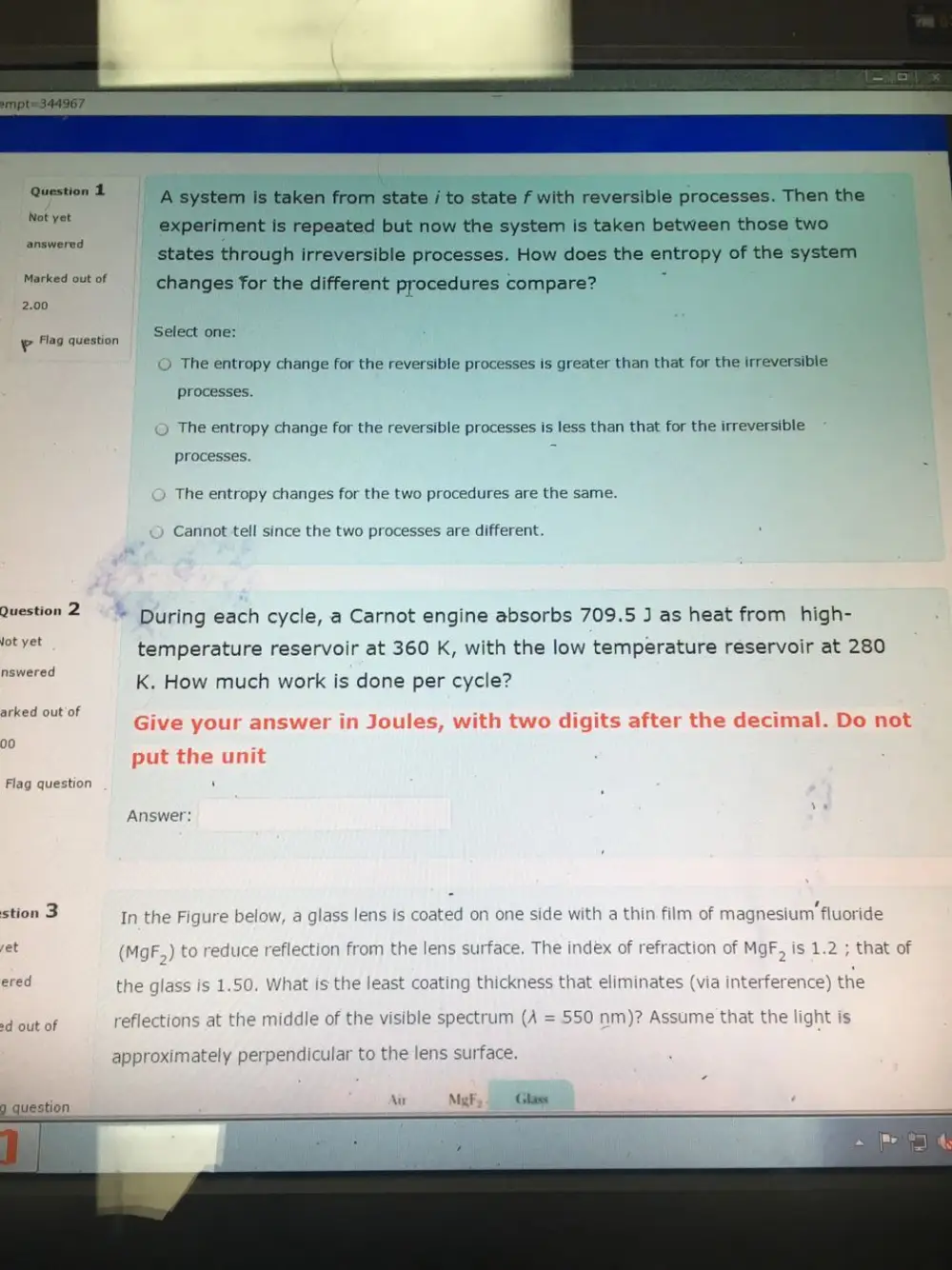
A system is taken from state j to state f with reversible processes. Then the
experiment is repeated but now the system is taken between those two
states through irreversible processes. How does the entropy of the system
changes for the different procedures compare?
Select one:
© The entropy change for the reversible processes is greater than that for the irreversible
processes.
The entropy change for the reversible processes is less than that for the irreversible
processes.
The entropy changes for the two procedures are the same.
Cannot tell since the two processes are different.
During each cycle, a Carnot engine absorbs 709.5 J as heat from high-
temperature reservoir at 360 K, with the low temperature reservoir at 280
K. How much work is done per cycle?
GI e decimal. Do not
F
h
Answer:
; '.
In the Fiqure below, a glass lens is coated on one side with a thin filn lagnesium fluoride
MqgF.) t duce reflection from the lens surface. The index of refractic MaF.. is 1.2 « that of
the glass is 1.50. What is the least coating thickness that elimin terference) the
eflections at the middle of the visible spectrur A= 550 nr at the S
approximately perpendicular to the lens surface.
\u Mut Chae
question
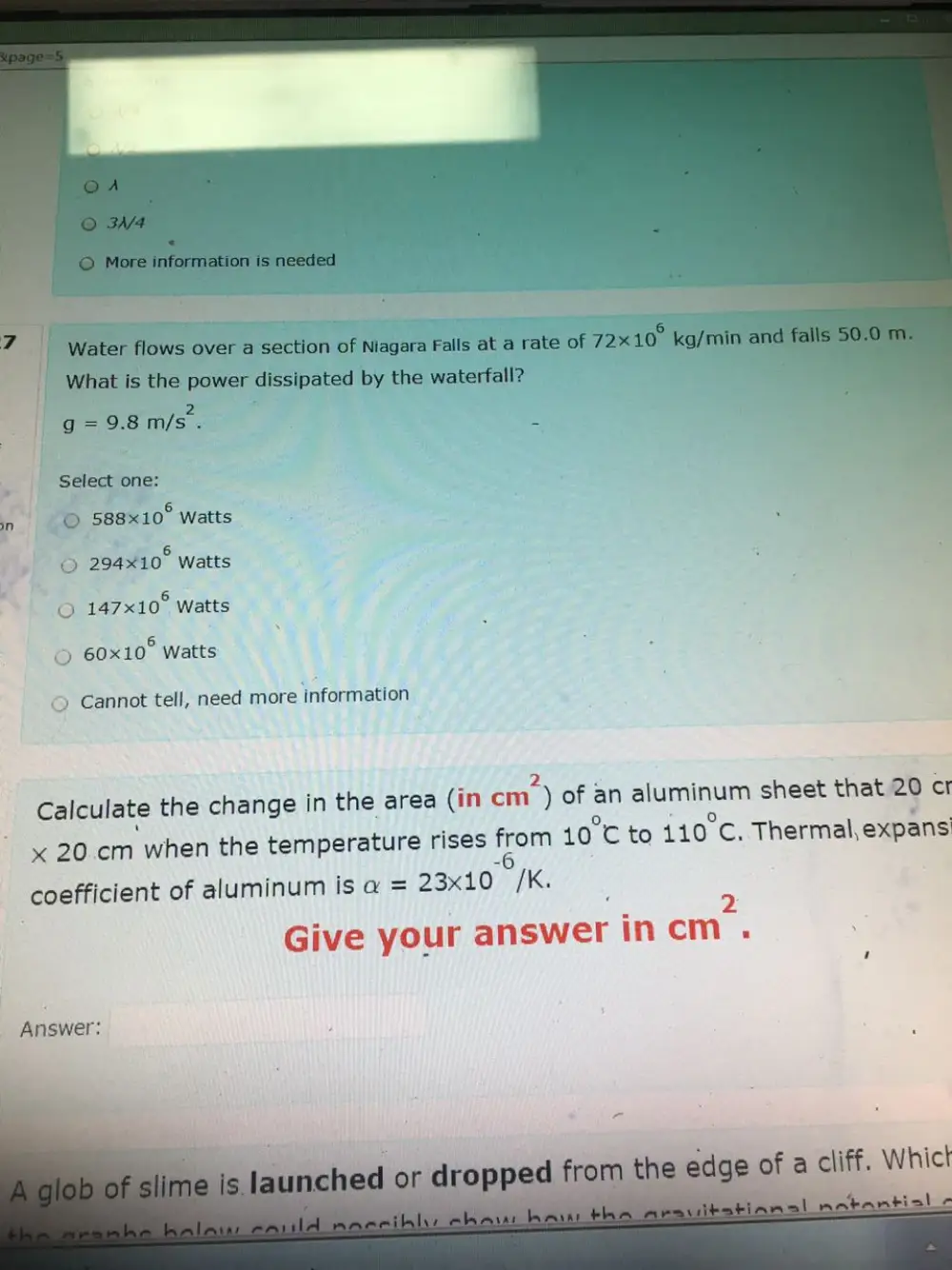
8 | Calculate the change in the area (in cm *Yof 2 an almine sheet that 2
20 cm when the temperature rises from 10°C to 110°C. Thermal expansion
m . coefficient of aluminum is a = 23x10 wy
ut of * bd 2 2 ' 1
Z Give your answer In cm . |
ot
estion Answer:
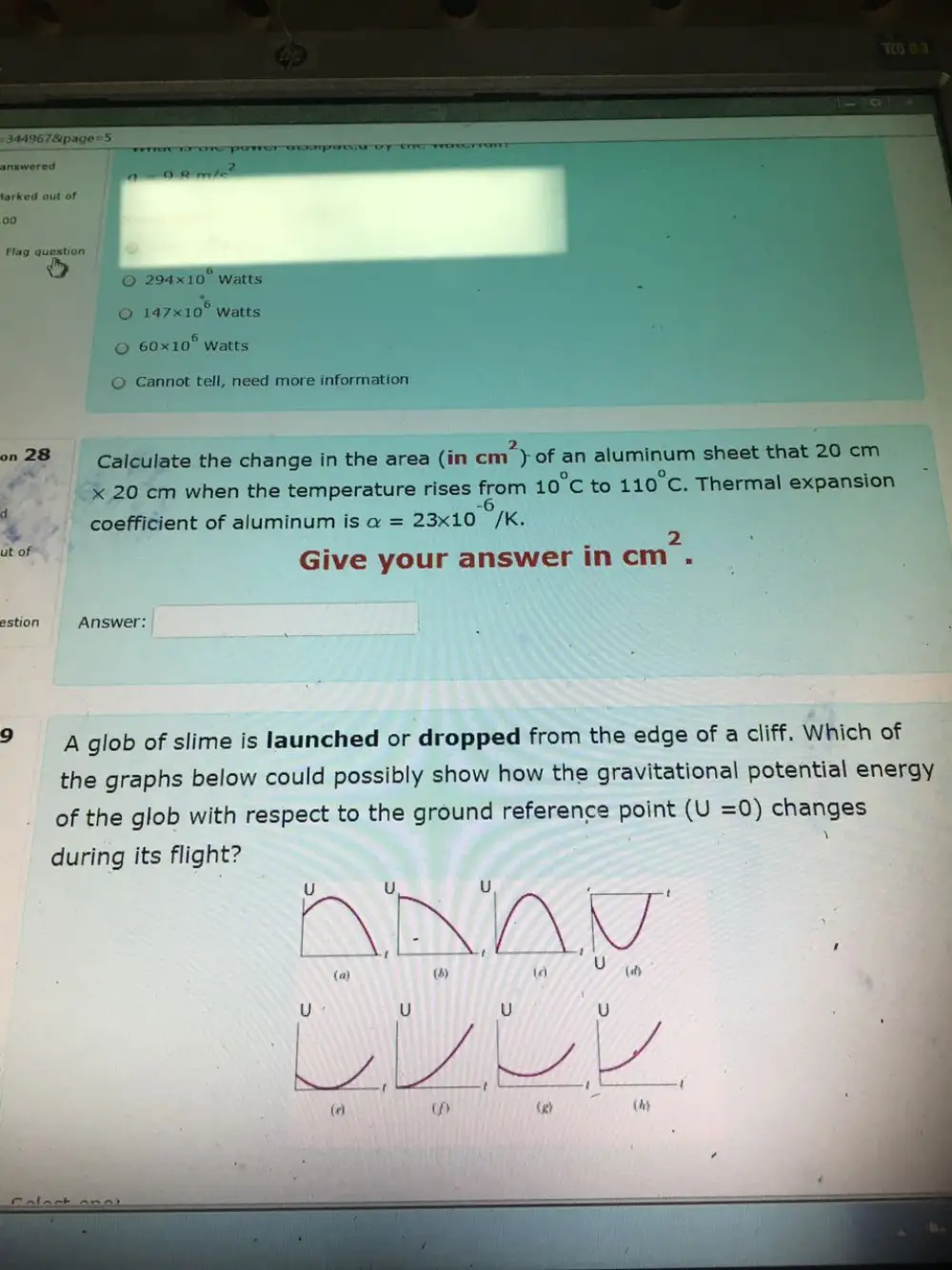
? A glob of slime is launched or dropped from the edge of a cliff. Which of
the graphs below could possibly show how the gravitational potential energy
of the glob with respect to the ground reference point (U =0) changes
during its flight?
LENA
A
coefficient of aluminum is a = 23x10 °/kK.
Z ™ 2
Give your answer incm .
Answer:
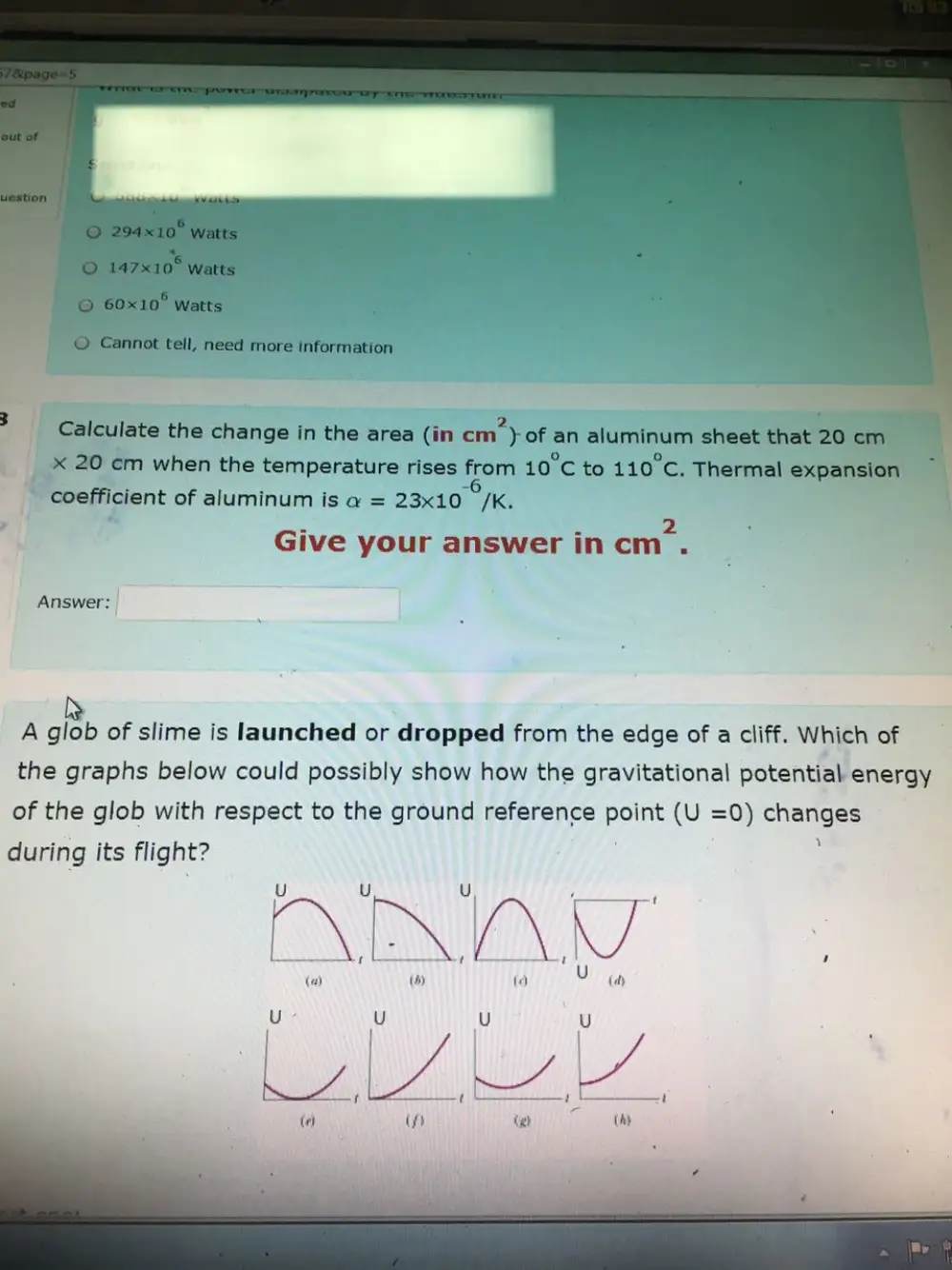
A glob of slime is launched or dropped from the edge of a cliff. Which of
the graphs below could possibly show how the gravitational potential energy
of the glob with respect to the ground reference point (U =0) changes
)
U U U. ALTIBEI A
ASA} L- MAY thy ’
ta) (+) {a U {dy
U U U U
Ne Wee
i SRYOTUSEE?) bet Ait 1
{rl if) (gd (hy
during its flight?
Wha he power dissipated by the waterfall?
| 9=9.8 m/s’. .
Select one:
© 588%10° Watts
Oo 294X10° Watts
© 147x10° Watts
© 60x10° Watts
© Cannot tell, need more information
ncm *) of é a oglihe tt sheet that 20 cr
Calculate the change in the area (i
rom 10 °C to 410 C. Thermal, expans
x 20 cm when the temperature rises 2
coefficient of aluminum is a = 23x10 °K.
2
Give your answer incm .
Answer: