
PHYS 211 Exam 2, Fall 2014
American University of Beirut · Electricity and Magnetism · 6 pages · Dr. Hani Hamzeh
More PHYS 211 files
- Exam 2 · Fall 2017ExamView
- Exam 1 85% Solved · Fall 2016Exam · with solutionView
- Exam 2 Fall 1617 with Solution · Fall 2016Exam · with solutionView
- Exam 1 · Fall 2014ExamView
- Exam 1 Quiz 1 Solution Fall 2014 · Fall 2014Exam · with solutionView
- Exam 2 Fall 2014 Quiz 2 Solution · Fall 2014Exam · with solutionView
- Exam 2 · Spring 2014ExamView
- Exam 1 with Solution · Spring 2013Exam · with solutionView
Show the text of this exam
1
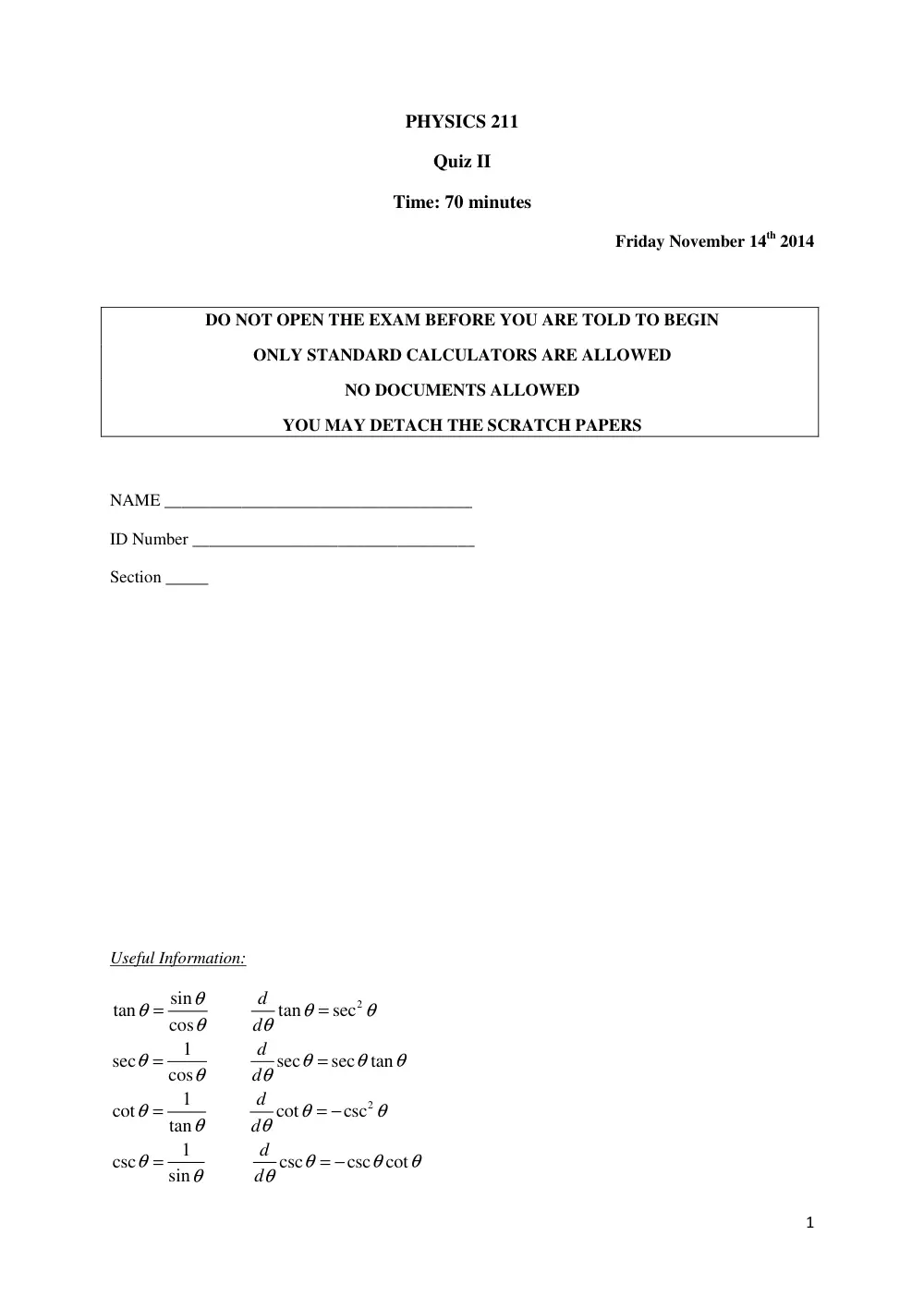
PHYSICS 211
Quiz II
Time: 70 minutes
Friday November 14th 2014
DO NOT OPEN THE EXAM BEFORE YOU ARE TOLD TO BEGIN
ONLY STANDARD CALCULATORS ARE ALLOWED
NO DOCUMENTS ALLOWED
YOU MAY DETACH THE SCRATCH PAPERS
NAME ____________________________________
ID Number _________________________________
Section _____
Useful Information:
2
2
sin
tan
tan
sec
cos
1
sec
sec
sec
tan
cos
1
cot
cot
csc
tan
1
csc
csc
csc
cot
sin
d
d
d
d
d
d
d
d
θ
θ
θ
θ
θ
θ
θ
θ
θ
θ
θ
θ
θ
θ
θ
θ
θ
θ
θ
θ
θ
θ
θ
=
=
=
=
=
= −
=
= −
2
I.
(25 points) ~20 minutes
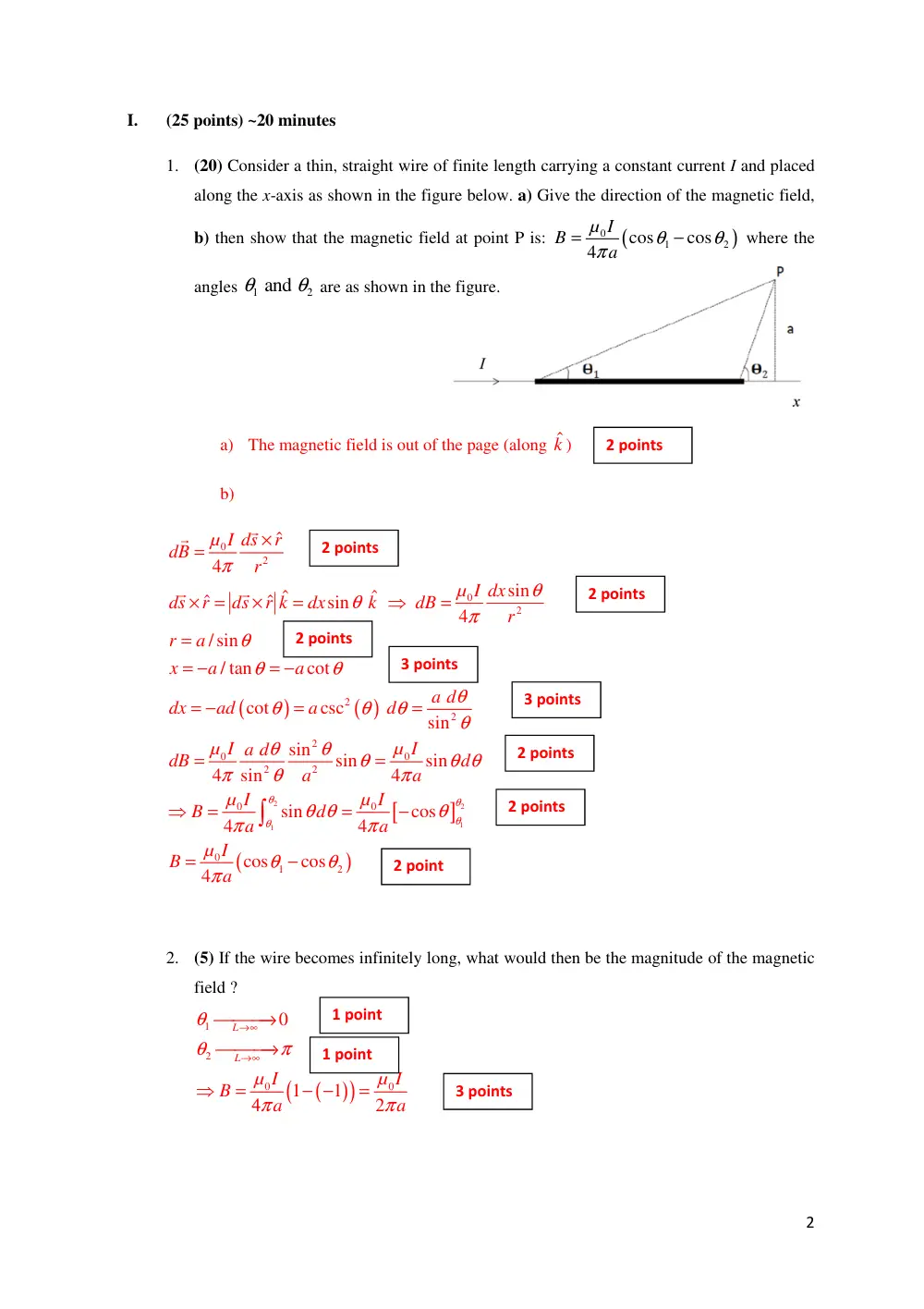
1. (20) Consider a thin, straight wire of finite length carrying a constant current I and placed
along the x-axis as shown in the figure below. a) Give the direction of the magnetic field,
b) then show that the magnetic field at point P is:
(
)
0
1
2
cos
cos
4
µ I
B
a
θ
θ
= π
−
where the
angles
1
θ and 2
θ are as shown in the figure.
a) The magnetic field is out of the page (along ˆk )
b)
(
)
( )
[
]
2
2
1
1
0
2
0
2
2
2
2
0
0
2
2
0
0
0
ˆ
4
sin
ˆ
ˆ
ˆ
ˆ
sin
4
/sin
/ tan
cot
cot
csc
sin
sin
sin
sin
4
sin
4
sin
cos
4
4
4
µ I ds
r
dB
r
µ I dx
ds
r
ds
r k
dx
k
dB
r
r
a
x
a
a
a d
dx
ad
a
d
µ I
µ I
a d
dB
d
a
a
µ I
µ I
B
d
a
a
µ I
B
a
θ
θ
θ
θ
π
θ
θ
π
θ
θ
θ
θ
θ
θ
θ
θ
θ
θ
θ
θ θ
π
θ
π
θ θ
θ
π
π
π
×
=
×
=
×
=
⇒
=
=
= −
= −
= −
=
=
=
=
⇒
=
=
−
=
∫
�
�
�
�
(
)
1
2
cos
cos
θ
θ
−
2. (5) If the wire becomes infinitely long, what would then be the magnitude of the magnetic
field ?
(
)
(
)
1
2
0
0
0
1
1
2
L
L
µ I
µ I
B
a
a
θ
θ
π
π
π
→∞
→∞
→
→
⇒
=
− −
=
4
2 points
2 points
2 points
2 points
3 points
3 points
2 points
2 point
2 points
1 point
1 point
3 points
3
II.
(20 points) ~ 15 minutes
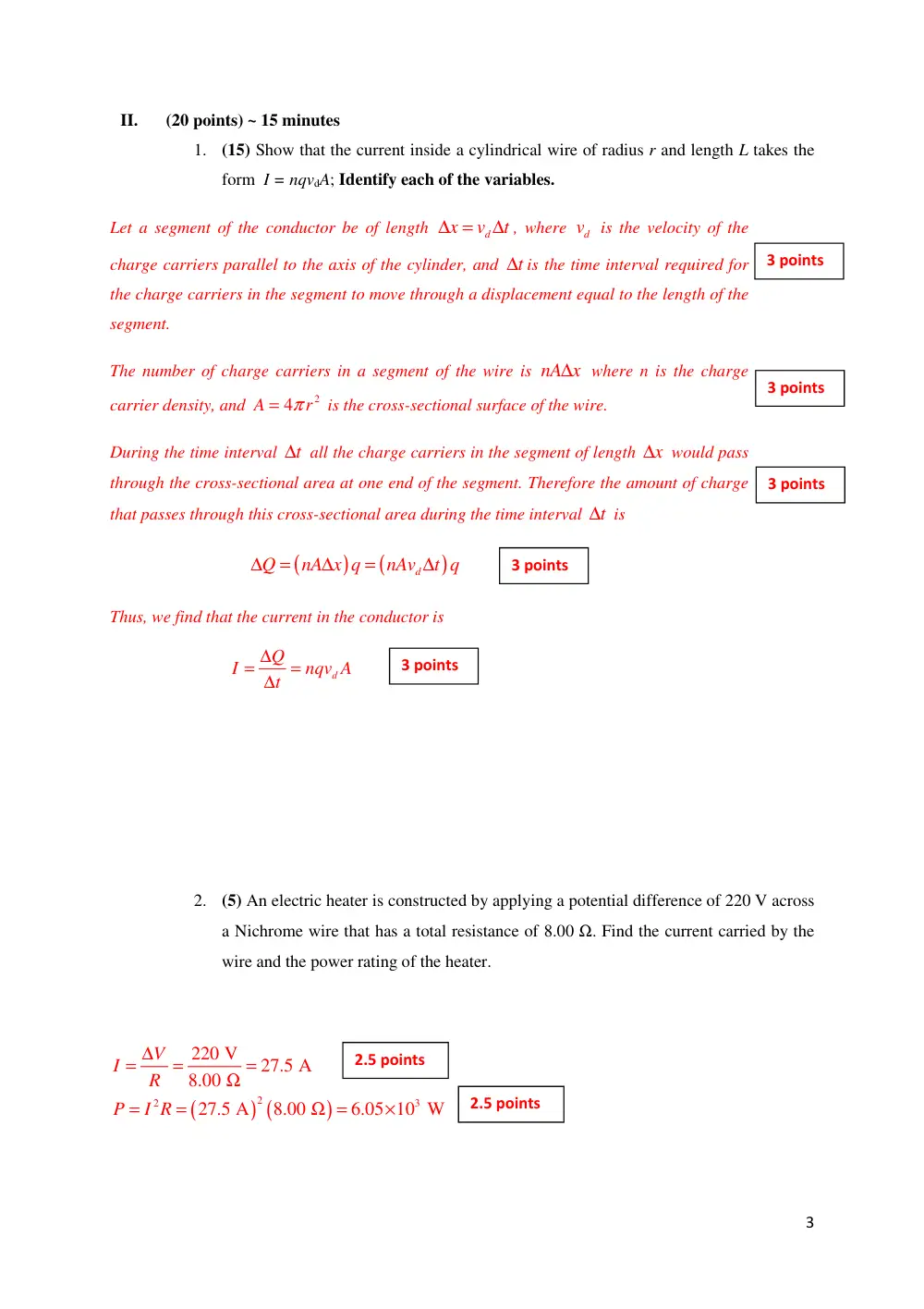
1. (15) Show that the current inside a cylindrical wire of radius r and length L takes the
form I = nqvdA; Identify each of the variables.
Let a segment of the conductor be of length
d
x
v
t
∆ =
∆ , where
dv is the velocity of the
charge carriers parallel to the axis of the cylinder, and
t
∆ is the time interval required for
the charge carriers in the segment to move through a displacement equal to the length of the
segment.
The number of charge carriers in a segment of the wire is nA x
∆ where n is the charge
carrier density, and
2
4
A
= π r
is the cross-sectional surface of the wire.
During the time interval t
∆ all the charge carriers in the segment of length x
∆ would pass
through the cross-sectional area at one end of the segment. Therefore the amount of charge
that passes through this cross-sectional area during the time interval t
∆ is
(
)
(
)
d
Q
nA x q
nAv
t q
∆
=
∆
=
∆
Thus, we find that the current in the conductor is
d
Q
I
nqv A
t
= ∆
=
∆
2. (5) An electric heater is constructed by applying a potential difference of 220 V across
a Nichrome wire that has a total resistance of 8.00 Ω. Find the current carried by the
wire and the power rating of the heater.
(
) (
)
2
2
3
220 V
27.5 A
8.00
27.5 A
8.00
6.05 10 W
V
I
R
P
I R
= ∆
=
=
Ω
=
=
Ω =
×
3 points
3 points
3 points
3 points
3 points
2.5 points
2.5 points
4
III.
(25 points) ~15 minutes
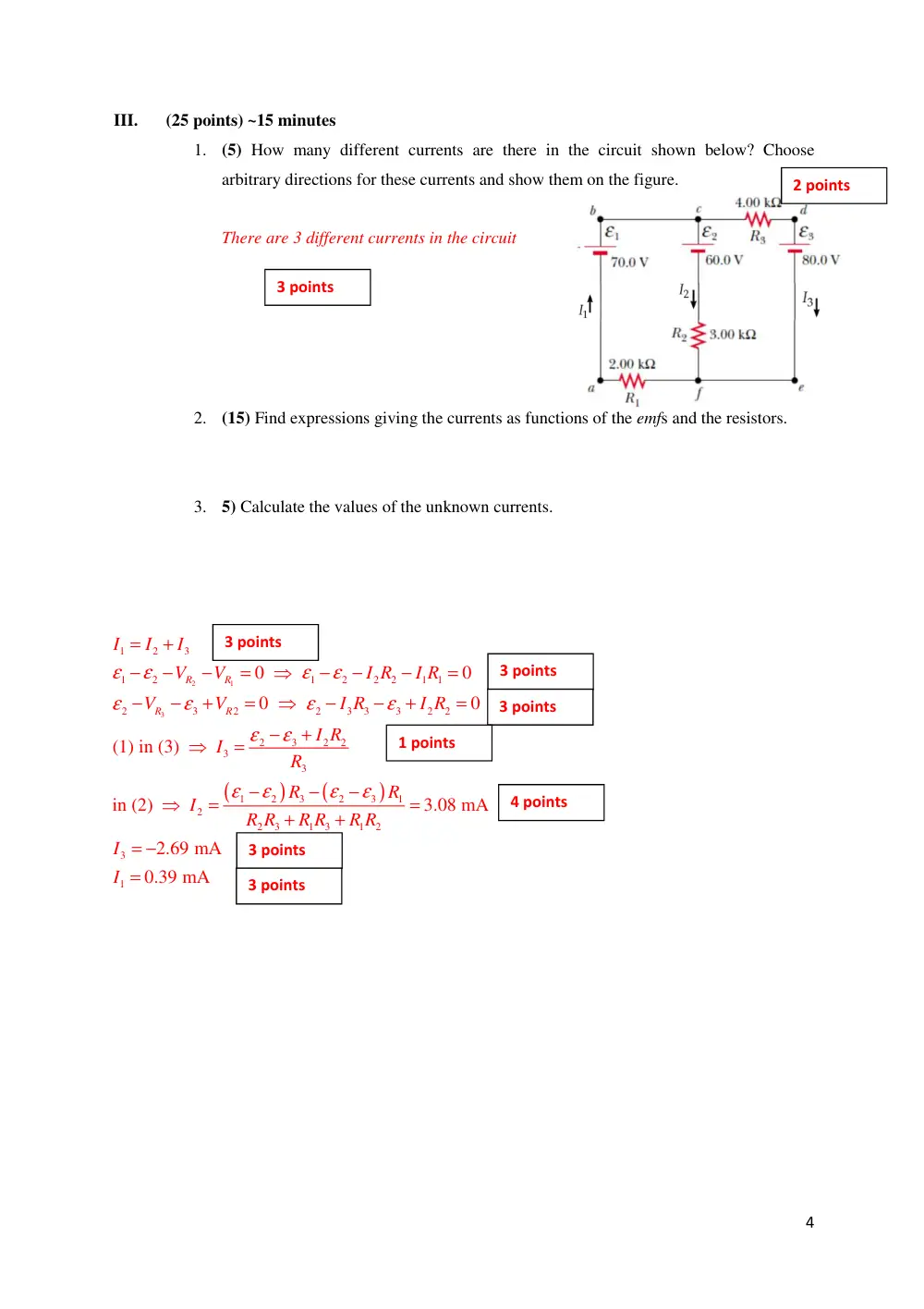
1. (5) How many different currents are there in the circuit shown below? Choose
arbitrary directions for these currents and show them on the figure.
There are 3 different currents in the circuit
2. (15) Find expressions giving the currents as functions of the emfs and the resistors.
3. 5) Calculate the values of the unknown currents.
(
)
(
)
2
1
3
1
2
3
1
2
1
2
2
2
1
1
2
3
2
2
3
3
3
2
2
2
3
2
2
3
3
1
2
3
2
3
1
2
2
3
1
3
1
2
3
1
0
0
0
0
(1) in (3)
in (2)
3.08 mA
2.69 mA
0.39 mA
R
R
R
R
I
I
I
V
V
I R
I R
V
V
I R
I R
I R
I
R
R
R
I
R R
R R
R R
I
I
ε
ε
ε
ε
ε
ε
ε
ε
ε
ε
ε
ε
ε
ε
=
+
−
−
−
=
⇒
−
−
−
=
−
−
+
=
⇒
−
−
+
=
−
+
⇒
=
−
−
−
⇒
=
=
+
+
= −
=
3 points
2 points
3 points
3 points
3 points
4 points
3 points
3 points
1 points
5
IV.
(30 points) ~20 minutes
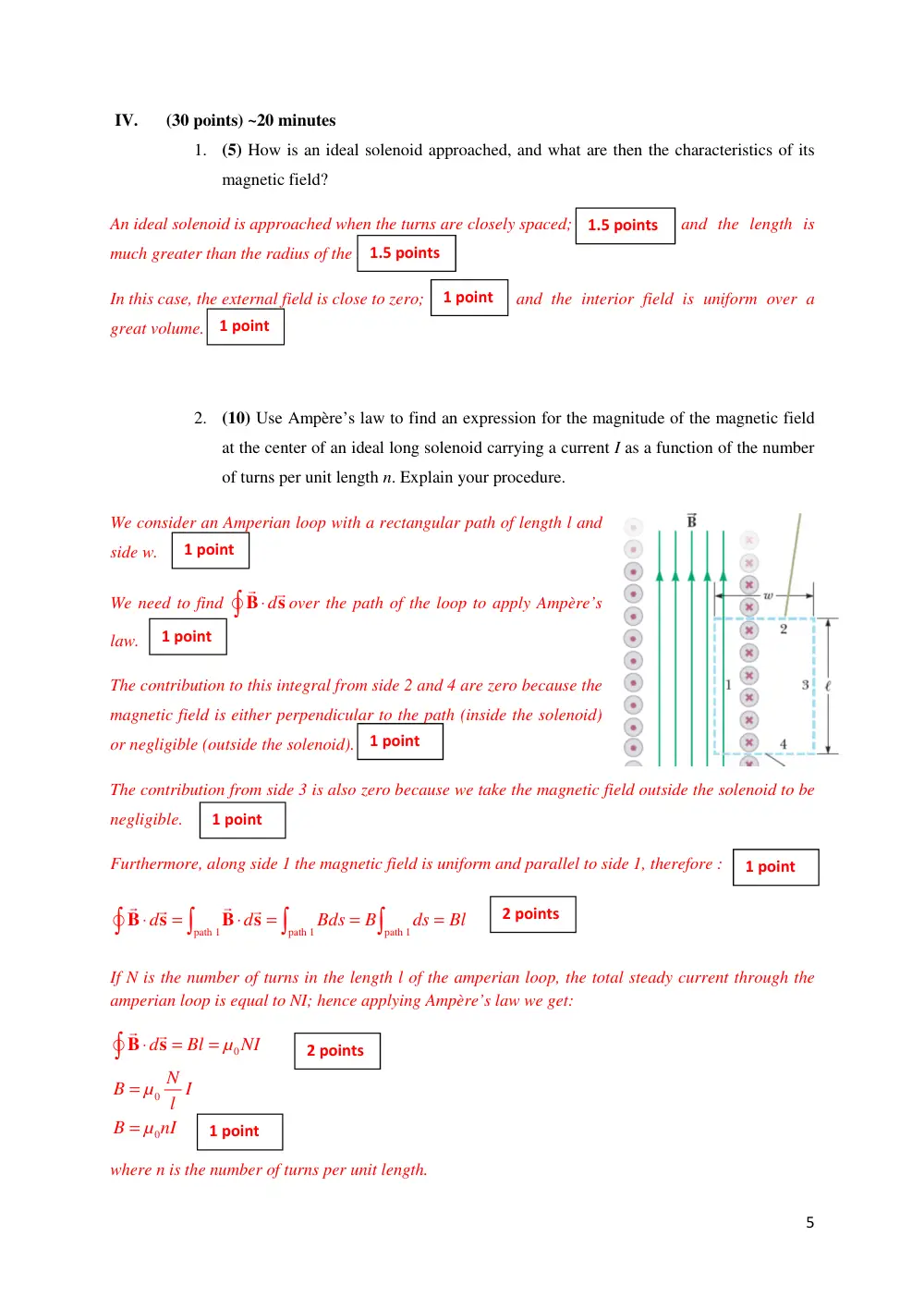
1. (5) How is an ideal solenoid approached, and what are then the characteristics of its
magnetic field?
An ideal solenoid is approached when the turns are closely spaced;
and the length is
much greater than the radius of the turns.
In this case, the external field is close to zero;
and the interior field is uniform over a
great volume.
2. (10) Use Ampère’s law to find an expression for the magnitude of the magnetic field
at the center of an ideal long solenoid carrying a current I as a function of the number
of turns per unit length n. Explain your procedure.
We consider an Amperian loop with a rectangular path of length l and
side w.
We need to find
∫ B⋅d
s
�
�
�
over the path of the loop to apply Ampère’s
law.
The contribution to this integral from side 2 and 4 are zero because the
magnetic field is either perpendicular to the path (inside the solenoid)
or negligible (outside the solenoid).
The contribution from side 3 is also zero because we take the magnetic field outside the solenoid to be
negligible.
Furthermore, along side 1 the magnetic field is uniform and parallel to side 1, therefore :
path 1
path 1
path 1
d
d
Bds
B
ds
Bl
⋅
=
⋅
=
=
=
∫
∫
∫
∫
B
s
B
s
�
�
�
�
�
If N is the number of turns in the length l of the amperian loop, the total steady current through the
amperian loop is equal to NI; hence applying Ampère’s law we get:
0
0
0
d
Bl
µ NI
N
B
µ
l I
B
µ nI
⋅
=
=
=
=
∫ B
s
�
�
�
where n is the number of turns per unit length.
1.5 points
1.5 points
1 point
1 point
1 point
1 point
1 point
1 point
2 points
2 points
1 point
1 point
6
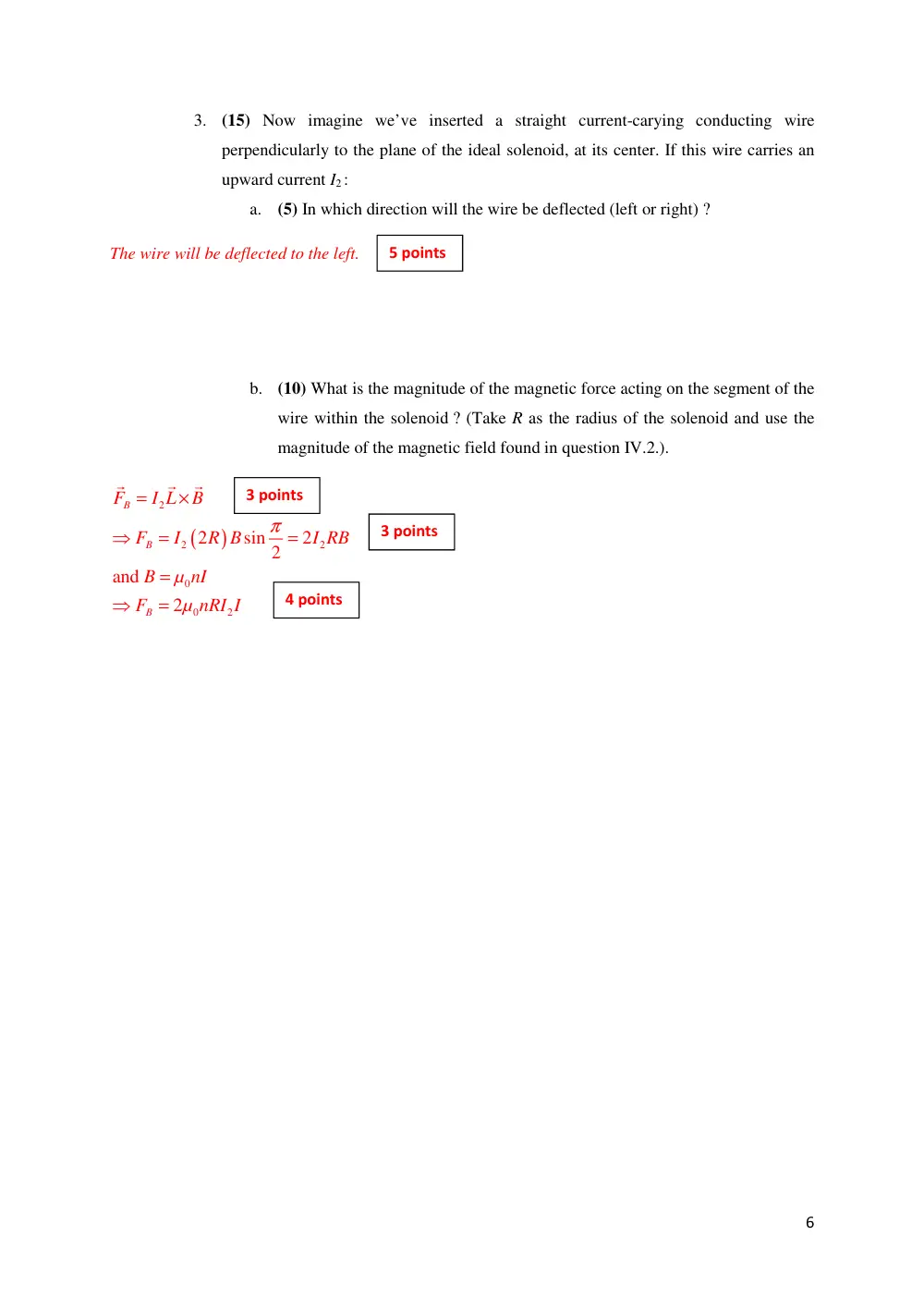
3. (15) Now imagine we’ve inserted a straight current-carying conducting wire
perpendicularly to the plane of the ideal solenoid, at its center. If this wire carries an
upward current I2 :
a. (5) In which direction will the wire be deflected (left or right) ?
The wire will be deflected to the left.
b. (10) What is the magnitude of the magnetic force acting on the segment of the
wire within the solenoid ? (Take R as the radius of the solenoid and use the
magnitude of the magnetic field found in question IV.2.).
(
)
2
2
2
0
0
2
2
sin
2
2
and
2
B
B
B
F
I L
B
F
I
R B
I RB
B
µ nI
F
µ nRI I
π
=
×
⇒
=
=
=
⇒
=
�
�
�
5 points
3 points
3 points
4 points