
PHYS 211 Syllabus, Spring 2018
American University of Beirut · Electricity and Magnetism · 3 pages
More PHYS 211 files
- Syllabus · Spring 2019LabView
- Syllabus · Fall 2015LabView
- Syllabus · Fall 2014LabView
- Exam 2 · Fall 2017ExamView
- Exam 1 85% Solved · Fall 2016Exam · with solutionView
- Exam 2 Fall 1617 with Solution · Fall 2016Exam · with solutionView
- Exam 2 Fall 2014 Quiz 2 Solution · Fall 2014Exam · with solutionView
- Exam 1 · Fall 2014ExamView
Show the text of this lab
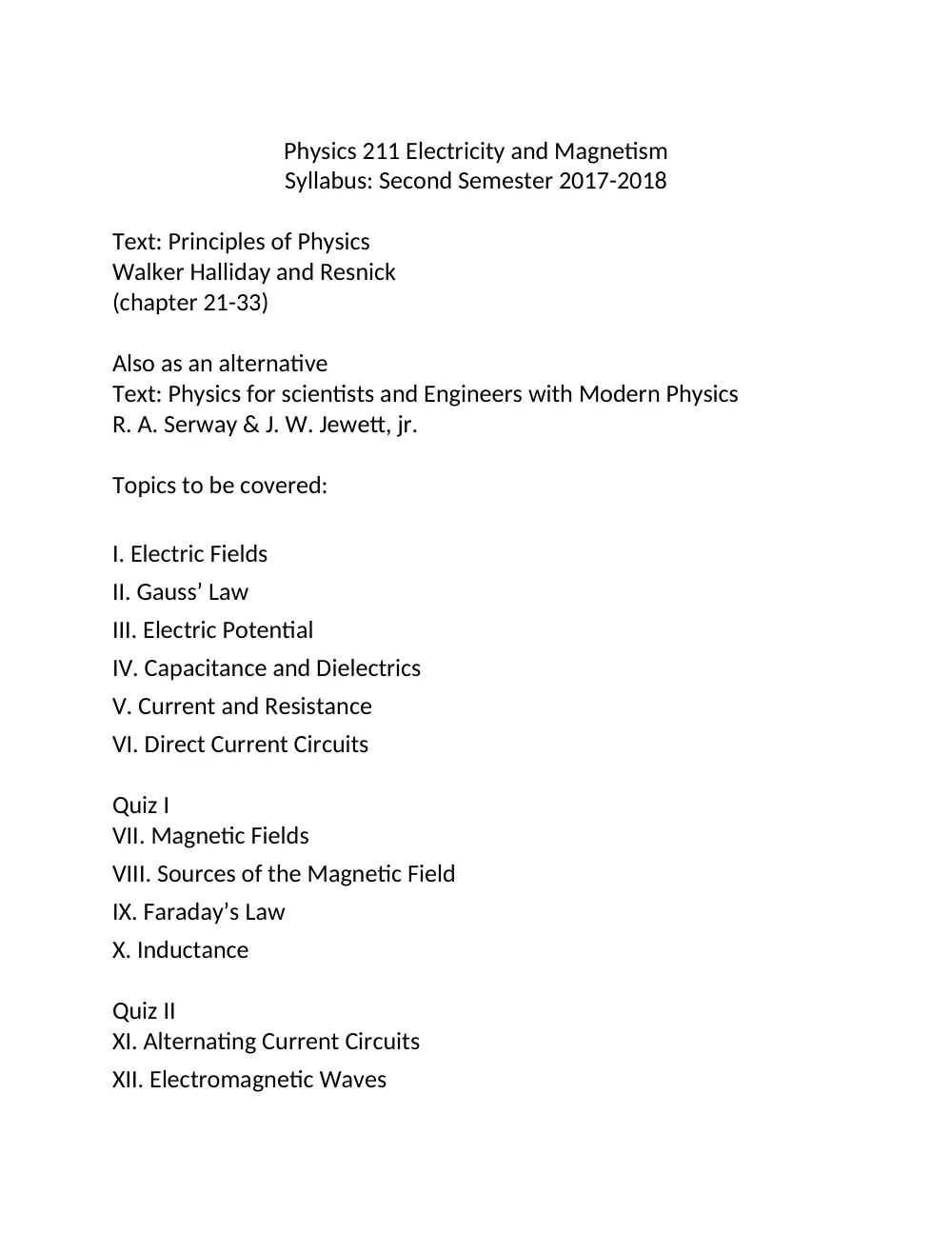
Physics 211 Electricity and Magnetism
Syllabus: Second Semester 2017-2018
Text: Principles of Physics
Walker Halliday and Resnick
(chapter 21-33)
Also as an alternative
Text: Physics for scientists and Engineers with Modern Physics
R. A. Serway & J. W. Jewett, jr.
Topics to be covered:
I. Electric Fields
II. Gauss’ Law
III. Electric Potential
IV. Capacitance and Dielectrics
V. Current and Resistance
VI. Direct Current Circuits
Quiz I
VII. Magnetic Fields
VIII. Sources of the Magnetic Field
IX. Faraday’s Law
X. Inductance
Quiz II
XI. Alternating Current Circuits
XII. Electromagnetic Waves
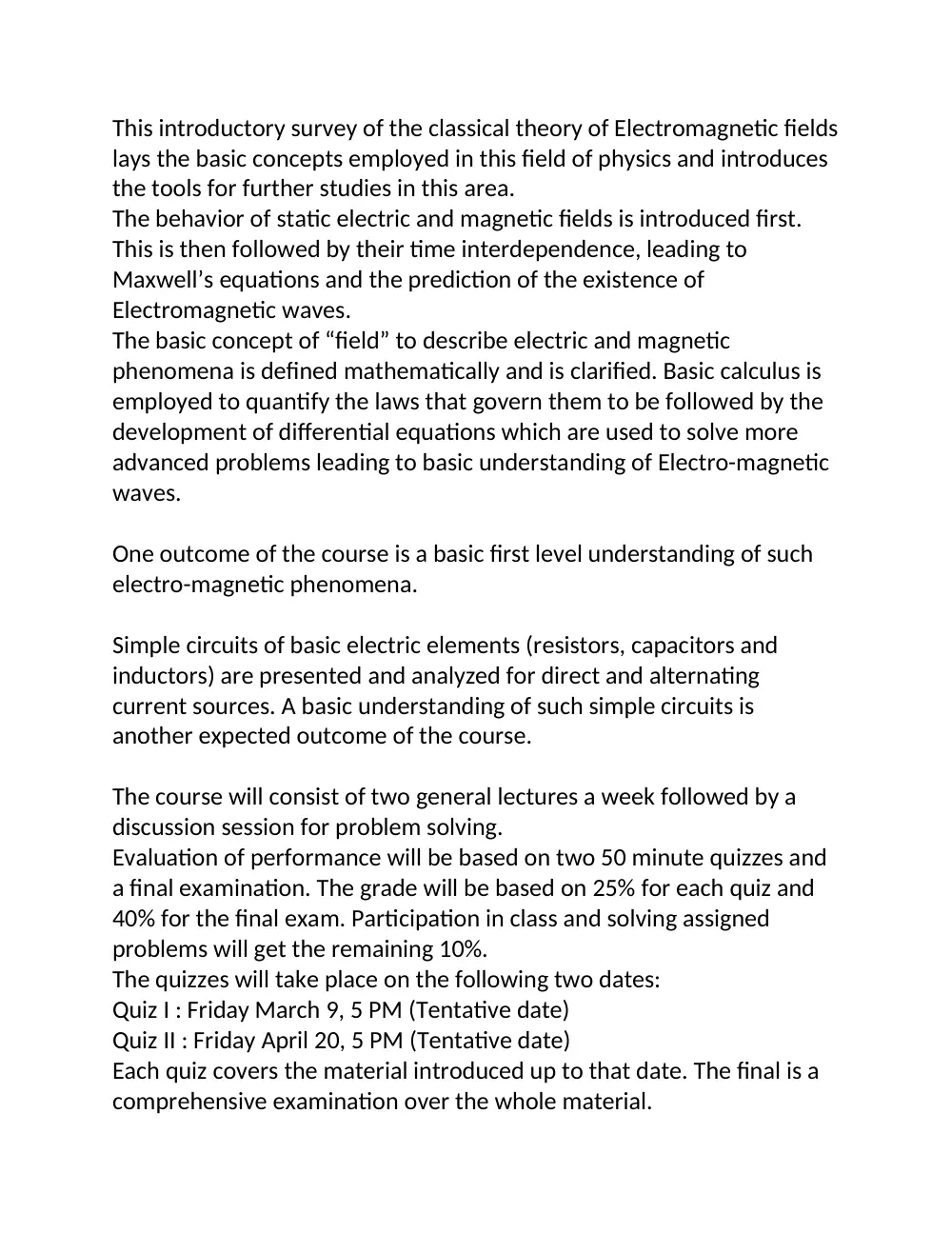
This introductory survey of the classical theory of Electromagnetic fields
lays the basic concepts employed in this field of physics and introduces
the tools for further studies in this area.
The behavior of static electric and magnetic fields is introduced first.
This is then followed by their time interdependence, leading to
Maxwell’s equations and the prediction of the existence of
Electromagnetic waves.
The basic concept of “field” to describe electric and magnetic
phenomena is defined mathematically and is clarified. Basic calculus is
employed to quantify the laws that govern them to be followed by the
development of differential equations which are used to solve more
advanced problems leading to basic understanding of Electro-magnetic
waves.
One outcome of the course is a basic first level understanding of such
electro-magnetic phenomena.
Simple circuits of basic electric elements (resistors, capacitors and
inductors) are presented and analyzed for direct and alternating
current sources. A basic understanding of such simple circuits is
another expected outcome of the course.
The course will consist of two general lectures a week followed by a
discussion session for problem solving.
Evaluation of performance will be based on two 50 minute quizzes and
a final examination. The grade will be based on 25% for each quiz and
40% for the final exam. Participation in class and solving assigned
problems will get the remaining 10%.
The quizzes will take place on the following two dates:
Quiz I : Friday March 9, 5 PM (Tentative date)
Quiz II : Friday April 20, 5 PM (Tentative date)
Each quiz covers the material introduced up to that date. The final is a
comprehensive examination over the whole material.
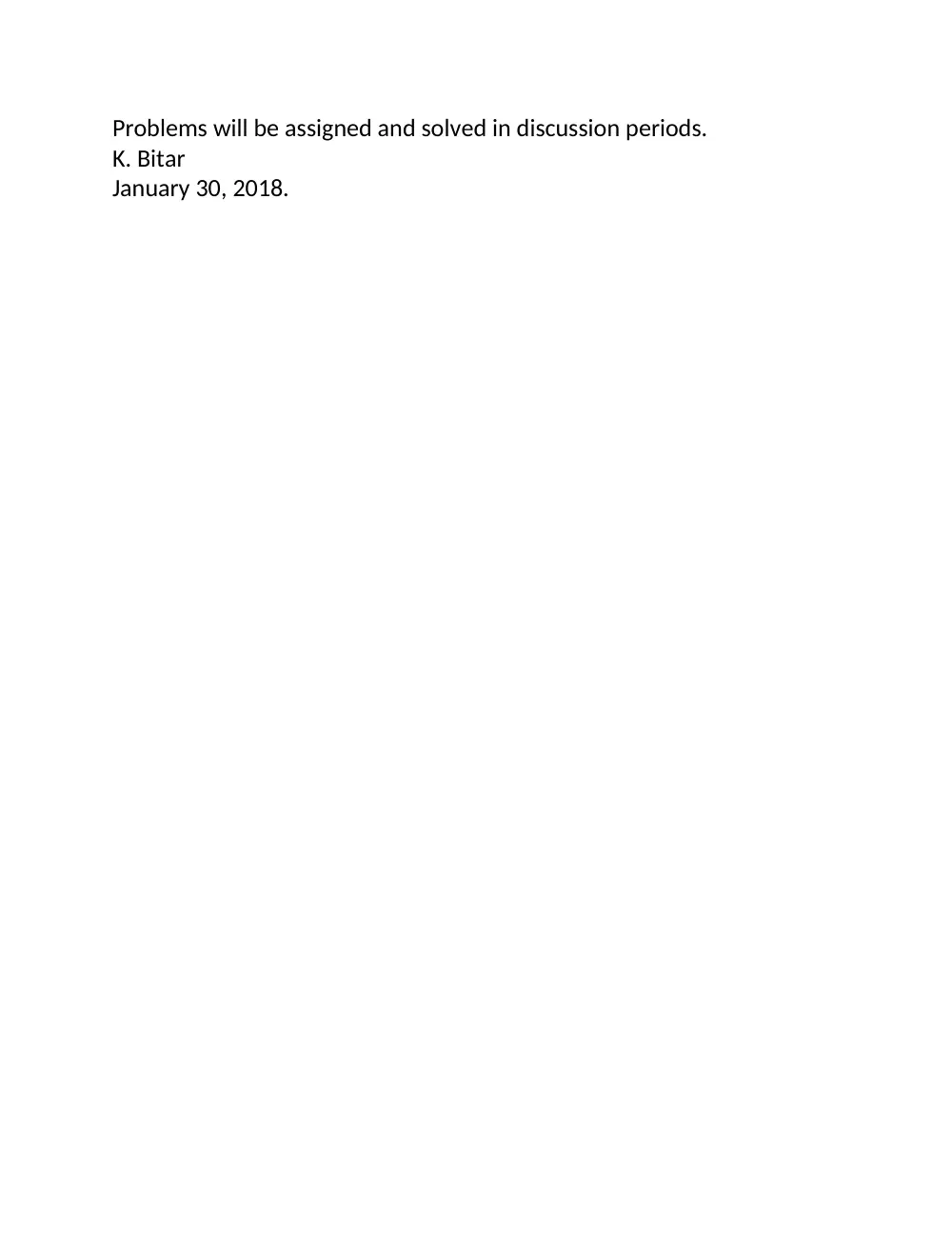
Problems will be assigned and solved in discussion periods.
K. Bitar
January 30, 2018.