
PHYS 220 Final, Spring 2008
American University of Beirut · Electromagnetic Theory · 2 pages
More PHYS 220 files
Show the text of this final exam
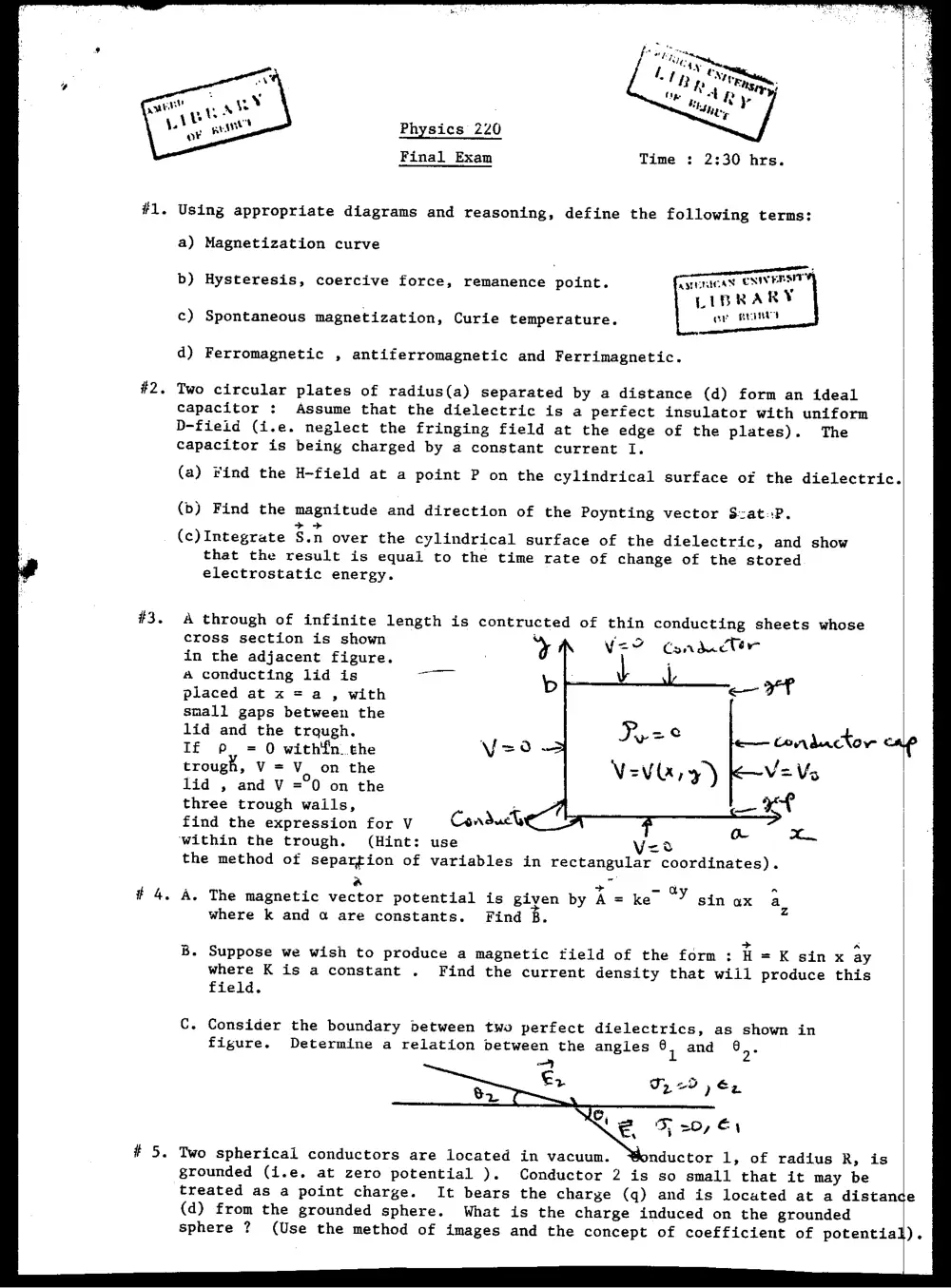
Physics 220
Final Exam Time : 2:30 hrs.
#1. Using appropriate diagrams and reasoning, define the following terms:
a) Magnetization curve
b) Hysteresis, coercive force, remanence point.
c) Spontaneous magnetization, Curie temperature.
d) Ferromagnetic , antiterromagnetic and Ferrimagnetic.
Two circular plates of radius(a) separated by a distance (d) form an ideal
capacitor : Assume that the dielectric is a perfect insulator with uniform
D-fieid (i.e. neglect the fringing field at the edge of the plates). The
capacitor is being charged by a constant current I.
(a) Find the H-field at a point P on the cylindrical surface of the dielectric.
(b) Find the magnitude and direction of the Poynting vector S:at::P.
>_>
(c)Integrate S.n over the cylindrical surface of the dielectric, and show
that the result is equal to the time rate of change of the stored
electrostatic energy.
#3. A through of infinite length is contructed of thin conducting sheets whose
cross section is shown ‘ V=e7 Conductor
in the adjacent figure. ; .
A conducting lid is mt
placed at x = a , with <
small gaps between the
lid and the trough. . Prae tw to
If e. = 0 within. the <— Conductor cap
trough, V = V, on the Vevloy) Va Vs
lid , and V = 0 on the
three trough wails, P 7 — xf
find the expression for V ao
within the trough. (Hint: use Ved
the method of separtion of variables in rectangular coordinates).
a -
A. The magnetic vector potential is giyen by A = ke
where k and a are constants. Find B.
- dy
sin ax a
Zz
> ‘
B. Suppose we wish to produce a magnetic field of the form : H = K sin x ay
where K is a constant . Find the current density that wiil produce this
field.
C. Consider the boundary between two perfect dielectrics, as shown in
figure. Determine a relation between the angles 8 and Q,-
Two spherical conductors are located in vacuum. mductor 1, of radius R, is
grounded (i.e. at zero potential ). Conductor 2 is so small that it may be
treated as a point charge. It bears the charge (q) and is located at a distande
(d) from the grounded sphere. What is the charge induced on the grounded
sphere ? (Use the method of images and the concept of coefficient of potential).
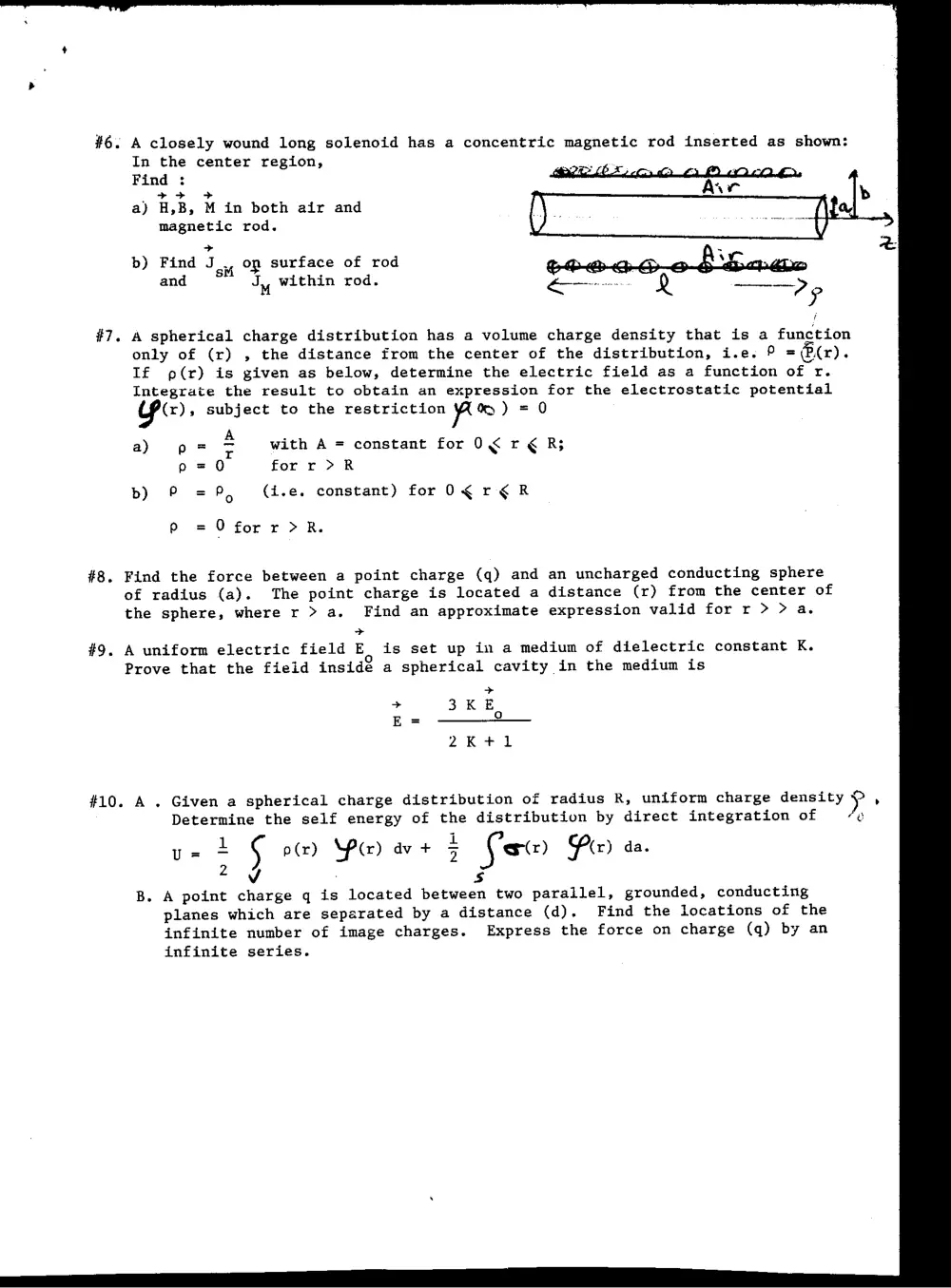
#6. A closely wound long solenoid has a concentric magnetic rod inserted as shown:
In the center region, —
Find : REALE chase OAL
te > Ave b
a) H,B, M in both air and
magnetic rod.
>
we
b) Find Jig OF surface of rod 6000-60 mene
and Sy within rod. or Q —? >
#7. A spherical charge distribution has a volume charge density that is a function
only of (r) , the distance from the center of the distribution, i.e. 9 = B(r).
If p(r) is given as below, determine the electric field as a function of r.
Integrate the result to obtain an expression for the electrostatic potential
fx), subject to the restriction fer =0
a) p= 4 with A = constant for 0¢ r¢ R;
p=0 for r>R
b) & =P, (i.e. constant) for O<¢ r¢R
e = 0 for r>R.
#8. Find the force between a point charge (q) and an uncharged conducting sphere
of radius (a). The point charge is located a distance (r) from the center of
the sphere, where r > a. Find an approximate expression valid for r >> a.
>
#9. A uniform electric field E, is set up in a medium of dielectric constant K.
Prove that the fieid insidé a spherical cavity in the medium is
>
> 3 KE
E= ——2
2KkK+1
#10. A . Given a spherical charge distribution of radius R, uniform charge density y ,
Determine the self energy of the distribution by direct integration of
i
y- ¢ o(r) P(r) av + F Vo) Pix) aa.
a4 5
B. A point charge q is located between two parallel, grounded, conducting
planes which are separated by a distance (d). Find the locations of the
infinite number of image charges. Express the force on charge (q) by an
infinite series.
é