
PHYS 235 Final, Fall 2007
American University of Beirut · Statistical Physics · 2 pages

More PHYS 235 files
Show the text of this final exam
PHYSICS 235
Final Examination
January 27, 2008
Duration 3 hours
1. Sketch qualitatively and comment very briefly:
a) Probability density for a velocity component along Y-direction (classical particle)
b) Probability density for the speed (velocity modulus) - classical particle in 3-dimentional space
c) Probability density for the speed (velocity modulus) - classical particle in 2-dimentional space
d) Chemical potential as function of temperature for a Fermi gas
e) Chemical potential as function of temperature for a Bose gas
f)
Spectral density of the blackbody radiation vs. frequency for two temperatures
T1, T2
2
1
5.1 T
T =
2. Atoms with internal degree of freedom
Consider an ideal monatomic gas. Each atom has two internal electronic energy states: the ground state
and one excited state higher by energy Δ. These states are independent of the translational motion of
atoms which can be treated semi-classically.
Find the following and compare to the standard monatomic gas:
a) The single-particle partition function Z1(N,V,T)
b) the Helmholtz free energy as a function of (N, V, T)
c) the pressure
d) the total average energy
e) the chemical potential
f)
the Gibbs free energy change compared to standard monatomic gas
What happens in the limits
0
and
Δ →
Δ → ∞
kT
kT
?
Real atoms actually have excited electronic states with Δ∼1 eV. At room temperature, which limit is
relevant?
Hint: On top of the standard description of the single particle Hamiltonian, there will be an additional
quantum number with only two values (0,1) corresponding to the two internal eigenstates.
3. Two gases pushing each other.
An isothermal cylinder is divided into two compartments by a sliding frictionless piston. The first
compartment contains the gas of particles of mass m and spin 3/2, the second contains the gas of
particles of the same mass m but spin 1/2. The position of the piston adjusts itself until equilibrium is
reached.
Thermostat
1. Formulate the equilibrium condition governing the piston position (you can use either the
2. Find the equilibrium density ratio in the two compartments
extremal property for the total free energy, or thebasic mechanical arguements ).
2
1n
n
(a) at zero temperature, and
3.
Wh is the criterion for the temperature to be high in this case?
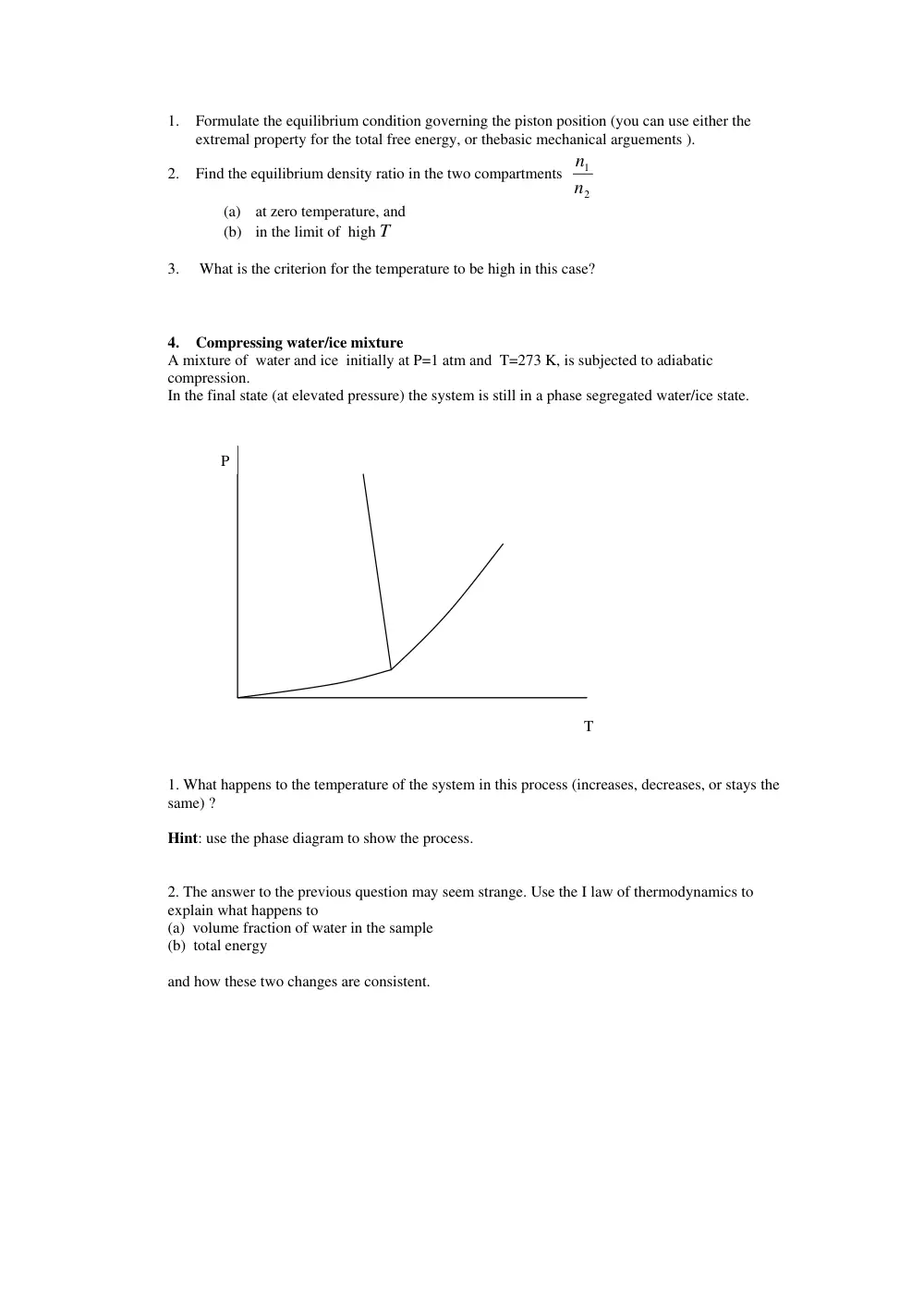
4. Compressing water/ice mixture
P=1 atm and T=273 K, is subjected to adiabatic
e (at elevated pressure) the system is still in a phase segregated water/ice state.
. What happens to the temperature of the system in this process (increases, decreases, or stays the
int: use the phase diagram to show the process.
. The answer to the previous question may seem strange. Use the I law of thermodynamics to
ter in the sample
nd how these two changes are consistent.
(b) in the limit of high T
at
A mixture of water and ice initially at
compression.
In the final stat
P
T
1
same) ?
H
2
explain what happens to
(a) volume fraction of wa
(b) total energy
a