
PHYS 301 Final, Fall 2007
American University of Beirut · Classical Mechanics · 1 page
Stuck on a question? A tutor can walk you through it.
Show the text of this final exam
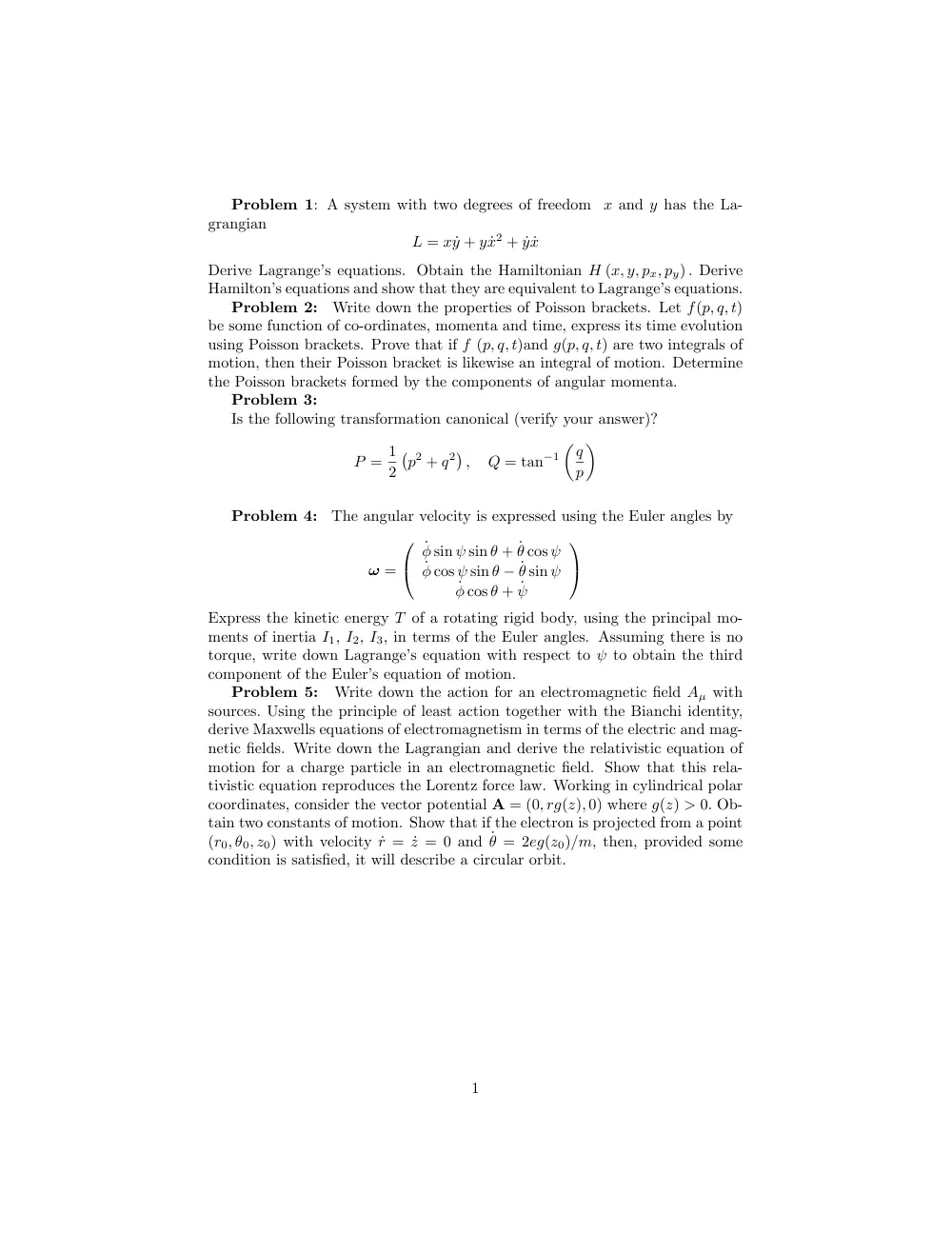
Problem 1: A system with two degrees of freedom x and y has the La-
grangian
L = x _y + y _x2 + _y _x
Derive Lagrange’s equations. Obtain the Hamiltonian H (x; y; px; py) : Derive
Hamilton’s equations and show that they are equivalent to Lagrange’s equations.
Problem 2:
Write down the properties of Poisson brackets. Let f(p; q; t)
be some function of co-ordinates, momenta and time, express its time evolution
using Poisson brackets. Prove that if f (p; q; t)and g(p; q; t) are two integrals of
motion, then their Poisson bracket is likewise an integral of motion. Determine
the Poisson brackets formed by the components of angular momenta.
Problem 3:
Is the following transformation canonical (verify your answer)?
P = 1
2
�
p2 + q2�
;
Q = tan�1
�q
p
�
Problem 4:
The angular velocity is expressed using the Euler angles by
! =
0
@
_� sin sin � + _� cos
_� cos sin � � _� sin
_� cos � + _
1
A
Express the kinetic energy T of a rotating rigid body, using the principal mo-
ments of inertia I1; I2; I3; in terms of the Euler angles. Assuming there is no
torque, write down Lagrange’s equation with respect to to obtain the third
component of the Euler’s equation of motion.
Problem 5:
Write down the action for an electromagnetic …eld A� with
sources: Using the principle of least action together with the Bianchi identity,
derive Maxwells equations of electromagnetism in terms of the electric and mag-
netic …elds. Write down the Lagrangian and derive the relativistic equation of
motion for a charge particle in an electromagnetic …eld. Show that this rela-
tivistic equation reproduces the Lorentz force law. Working in cylindrical polar
coordinates, consider the vector potential A = (0; rg(z); 0) where g(z) > 0: Ob-
tain two constants of motion. Show that if the electron is projected from a point
(r0; �0; z0) with velocity _r = _z = 0 and _� = 2eg(z0)=m; then, provided some
condition is satis…ed, it will describe a circular orbit.
1