
PHYS 302 Final, Spring 1997
American University of Beirut · Statistical Mechanics · 4 pages
Show the text of this final exam
aris ot Vor Mis
LIBRE ARY |
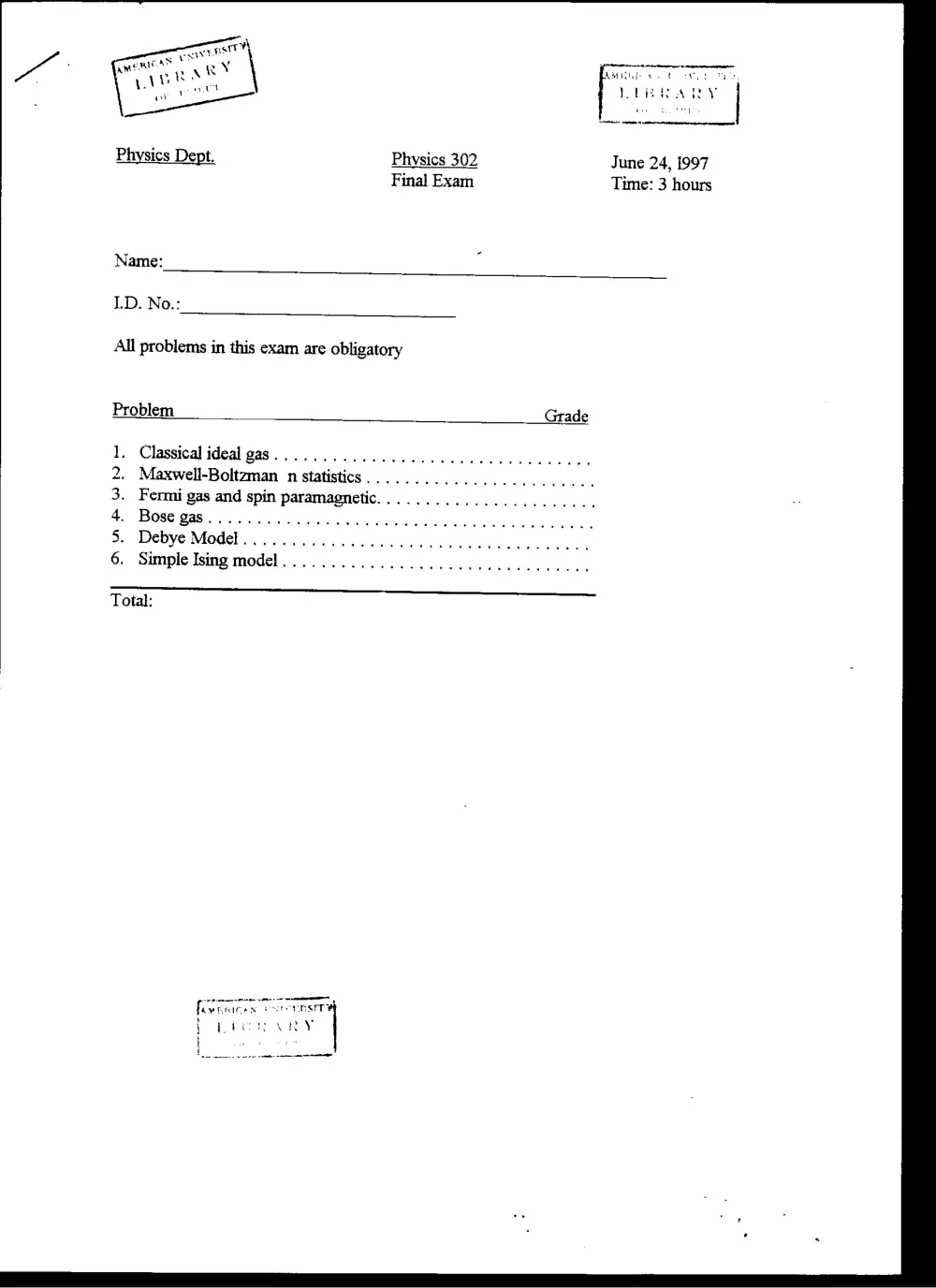
Physics Dept. Physics 302 June 24, 1997
Final Exam Time: 3 hours
Name: :
LD. No.:
All problems in this exam are obligatory
Problem Grade
Bose £88 06. e cee e eee eeees
Aw WN
Total:
[Qi S oe ensrry
tout ’
iy
! a
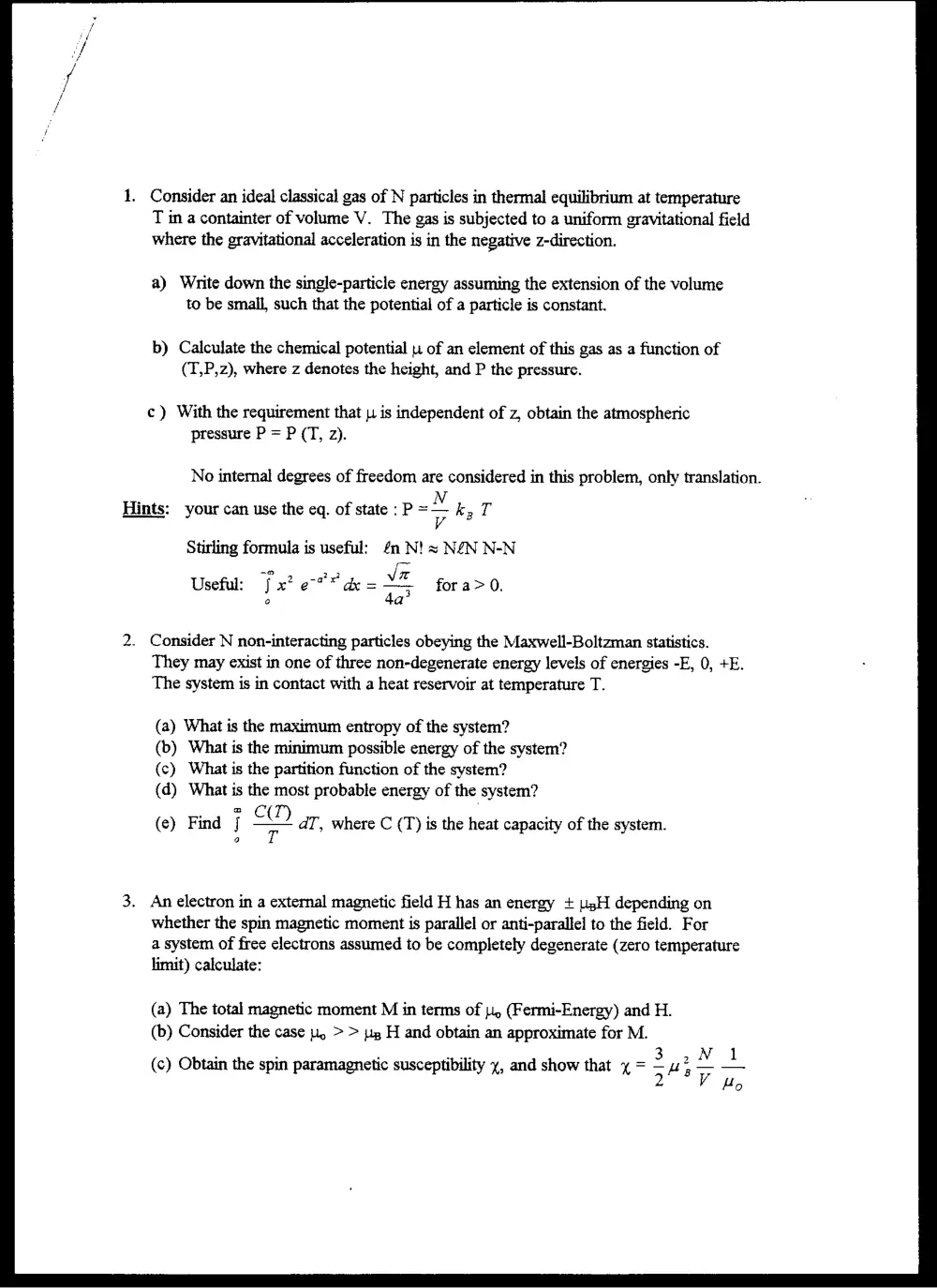
1. Consider an ideal classical gas of N particles in thermal equilibrium at temperature
T ma containter of volume V. The gas is subjected to a uniform gravitational field
where the gravitational acceleration is in the negative z-direction.
a) Write down the single-particle energy assuming the extension of the volume
to be small, such that the potential of a particle is constant.
b) Calculate the chemical potential u of an element of this gas as a function of
(T,P,z), where z denotes the height, and P the pressure.
c) With the requirement that 1 is independent of z, obtain the atmospheric
pressure P = P (T, z).
No internal degrees of freedom are considered in this problem, only translation.
Hints: your can use the eq. of state : P -< k,T
Stirling formula is useful: én N! » NEN N-N
va
5 fora>Oo.
Useful: fx? oe?" dx =
@ 4a
2. Consider N non-interacting particles obeying the Maxwell-Boltzman statistics.
They may exist in one of three non-degenerate energy levels of energies -E, 0, +E.
The system is in contact with a heat reservoir at temperature T.
(a) What is the maximum entropy of the system?
(b) What is the minimum possible energy of the system?
(c) What is the partition function of the system?
(d) What is the most probable energy of the system?
(e) Find j a“ aT, where C (T) is the heat capacity of the system.
3. An electron in a external magnetic field H has an energy + gH depending on
whether the spin magnetic moment is parallel or anti-parallel to the field. For
a system of free electrons assumed to be completely degenerate (zero temperature
limit) calculate:
(a) The total magnetic moment M in terms of 11, (Fermi-Energy) and H.
(b) Consider the case 4, > > Us H and obtain an approximate for M.
(c) Obtain the spin paramagnetic susceptibility y, and show that 1 = Su 3 >
1
Ho
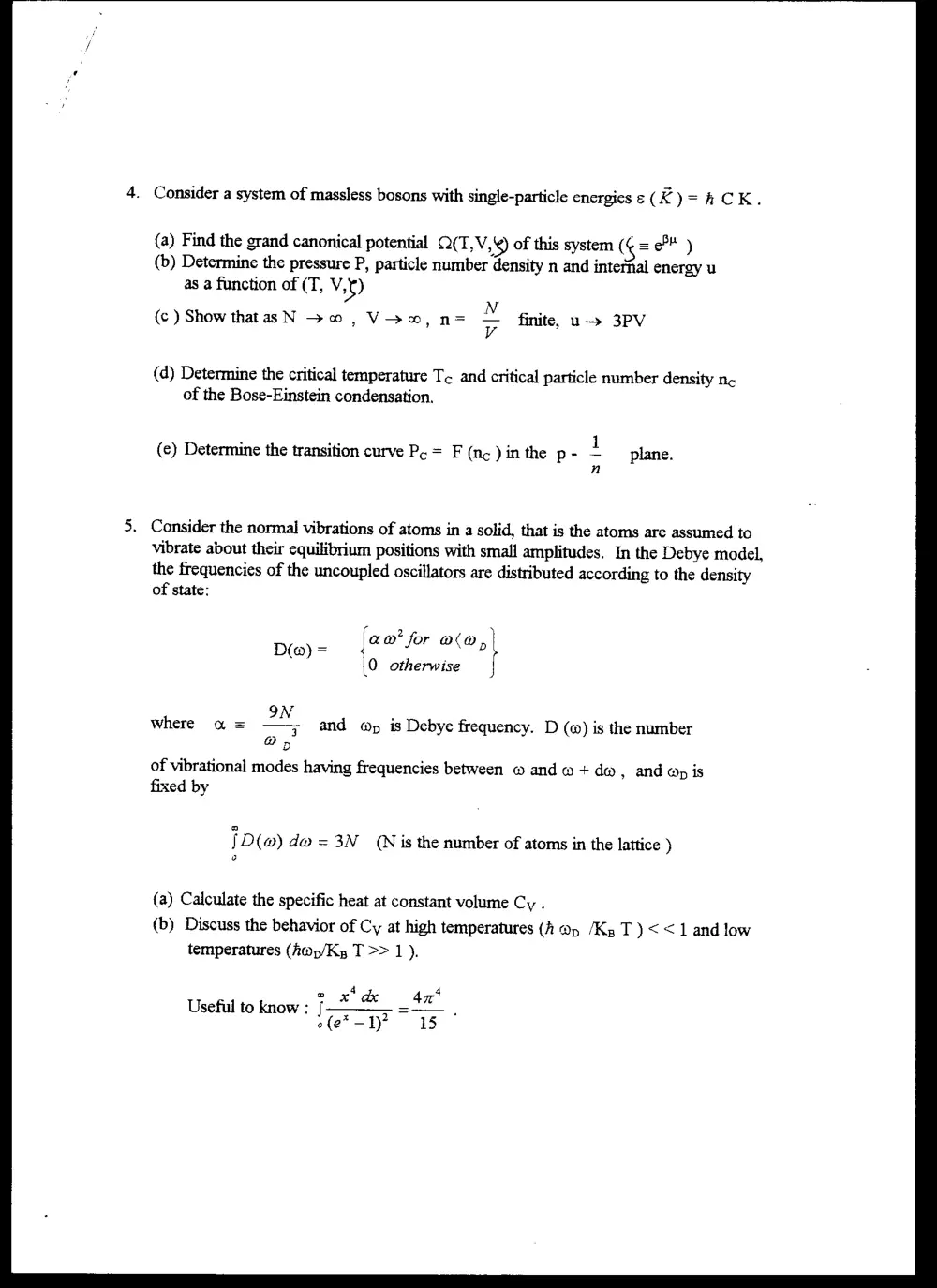
4. Consider a system of massless bosons with single-particle energies (K)= ACK.
(a) Find the grand canonical potential ((T, V, 6) of this system (& =ePh )
(b) Determine the pressure P, particle number density n and internal energy u
as a function of (T, V0)
(c ) Show thatas N > 0 , Vow, n= . finite, u—> 3PV
(d) Determine the critical temperature Te and critical particle number density n,
of the Bose-Einstein condensation.
(e) Determine the transition curve Po = F (nc ) in the p- i plane.
n
5. Consider the normal vibrations of atoms in a solid, that is the atoms are assumed to
vibrate about their equilibrium positions with small amplitudes. In the Debye model,
the frequencies of the uncoupled oscillators are distributed according to the density
of state:
2
D() = ae jor mee
0 otherwise
ON
where « z and @p is Debye frequency. D (@) is the number
i]
@ »
of vibrational modes having frequencies between © and w + dw , and @p is
fixed by
1D(a) dw =3N (Nis the number of atoms in the lattice )
(a) Calculate the specific heat at constant volume Cy .
(b) Discuss the behavior of Cy at high temperatures (h @p /Kg T) << 1 and low
temperatures (f@p/Kg T >> 1).
@ 4 4
Useful to know : je 4%
e(e*—-1P 15
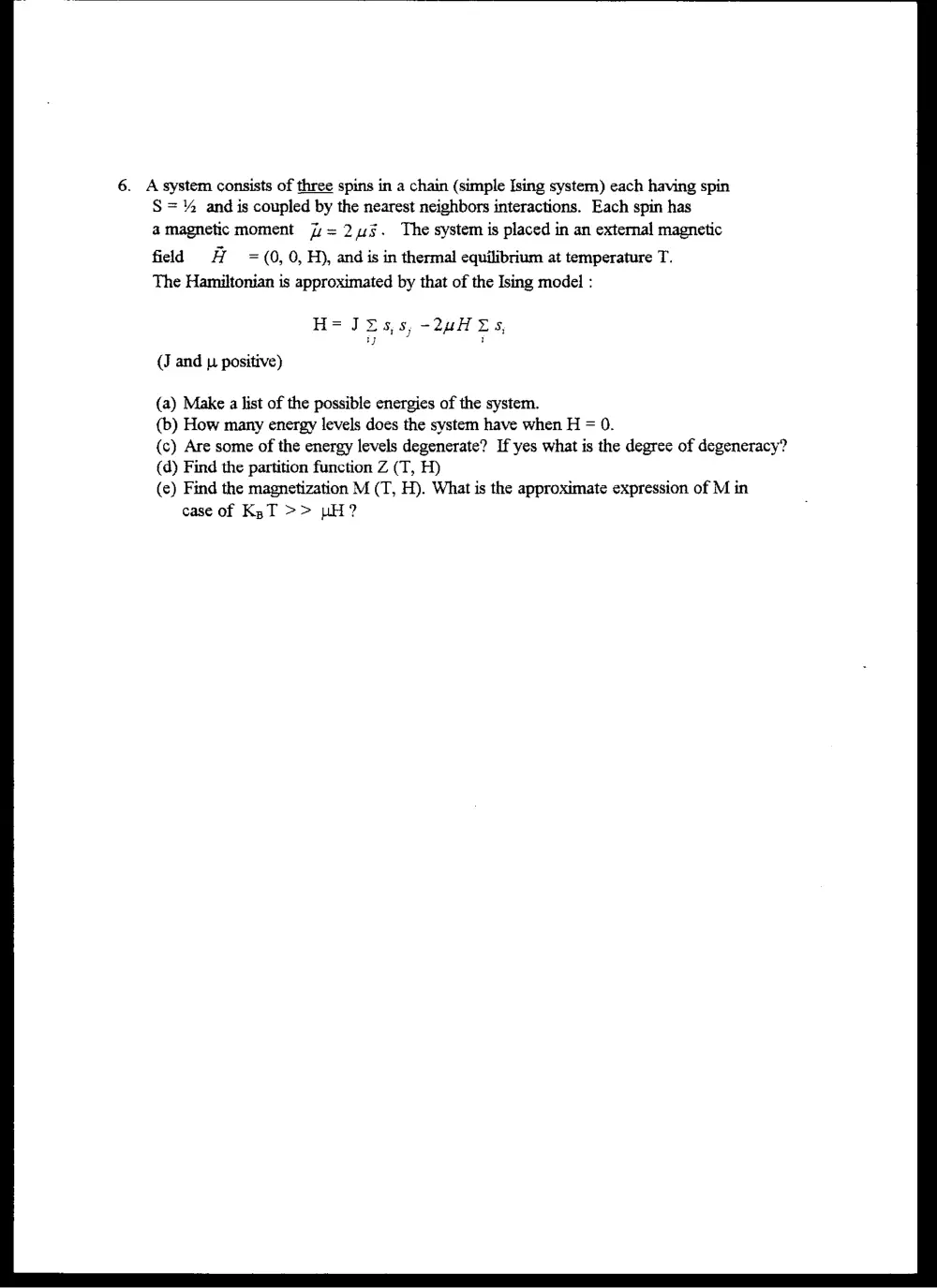
6. A system consists of three spins in a chain (simple Ising system) each having spin
S =% and is coupled by the nearest neighbors interactions. Each spin has
a magnetic moment 7; = 25. The system is placed in an external magnetic
field # =(0, 0, H), and is in thermal equilibrium at temperature T.
The Hamiltonian is approximated by that of the Ising model :
H= J2s,s, -2uH Zs,
iy
(J and y positive)
(a) Make a list of the possible energies of the system.
(b) How many energy levels does the system have when H = 0.
(c) Are some of the energy levels degenerate? If yes what is the degree of degeneracy?
(d) Find the partition function Z (T, H)
(e) Find the magnetization M (T, H). What is the approximate expression of M in
case of Kg T >> pH?