
PSPA 201 Chapter 4, Fall 2016
American University of Beirut · Introduction to Political Science · 5 pages
More PSPA 201 files
Show the text of this chapter
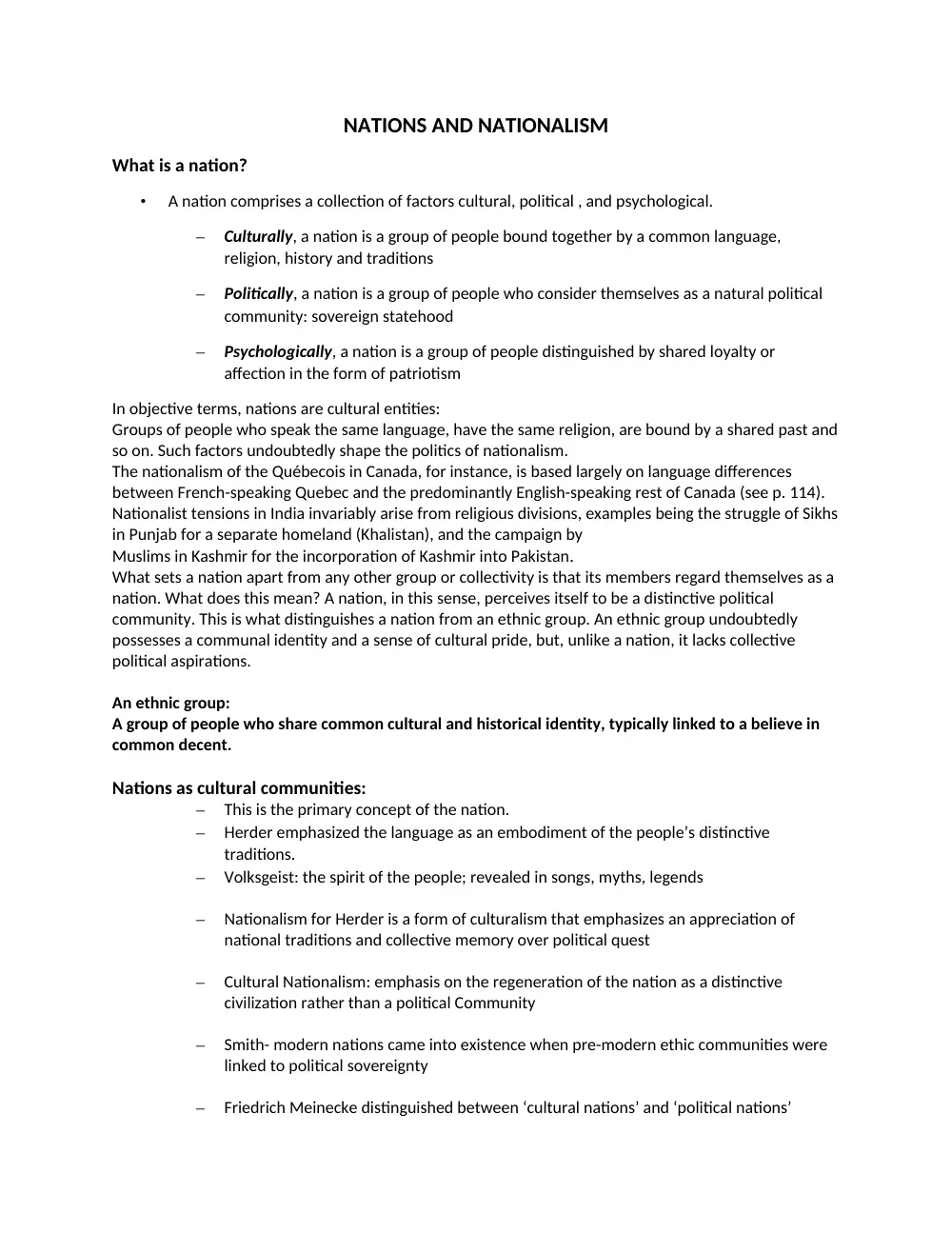
NATIONS AND NATIONALISM
What is a nation?
•
A nation comprises a collection of factors cultural, political , and psychological.
–
Culturally, a nation is a group of people bound together by a common language,
religion, history and traditions
–
Politically, a nation is a group of people who consider themselves as a natural political
community: sovereign statehood
–
Psychologically, a nation is a group of people distinguished by shared loyalty or
affection in the form of patriotism
In objective terms, nations are cultural entities:
Groups of people who speak the same language, have the same religion, are bound by a shared past and
so on. Such factors undoubtedly shape the politics of nationalism.
The nationalism of the Québecois in Canada, for instance, is based largely on language differences
between French-speaking Quebec and the predominantly English-speaking rest of Canada (see p. 114).
Nationalist tensions in India invariably arise from religious divisions, examples being the struggle of Sikhs
in Punjab for a separate homeland (Khalistan), and the campaign by
Muslims in Kashmir for the incorporation of Kashmir into Pakistan.
What sets a nation apart from any other group or collectivity is that its members regard themselves as a
nation. What does this mean? A nation, in this sense, perceives itself to be a distinctive political
community. This is what distinguishes a nation from an ethnic group. An ethnic group undoubtedly
possesses a communal identity and a sense of cultural pride, but, unlike a nation, it lacks collective
political aspirations.
An ethnic group:
A group of people who share common cultural and historical identity, typically linked to a believe in
common decent.
Nations as cultural communities:
–
This is the primary concept of the nation.
–
Herder emphasized the language as an embodiment of the people’s distinctive
traditions.
–
Volksgeist: the spirit of the people; revealed in songs, myths, legends
–
Nationalism for Herder is a form of culturalism that emphasizes an appreciation of
national traditions and collective memory over political quest
–
Cultural Nationalism: emphasis on the regeneration of the nation as a distinctive
civilization rather than a political Community
–
Smith- modern nations came into existence when pre-modern ethic communities were
linked to political sovereignty
–
Friedrich Meinecke distinguished between ‘cultural nations’ and ‘political nations’
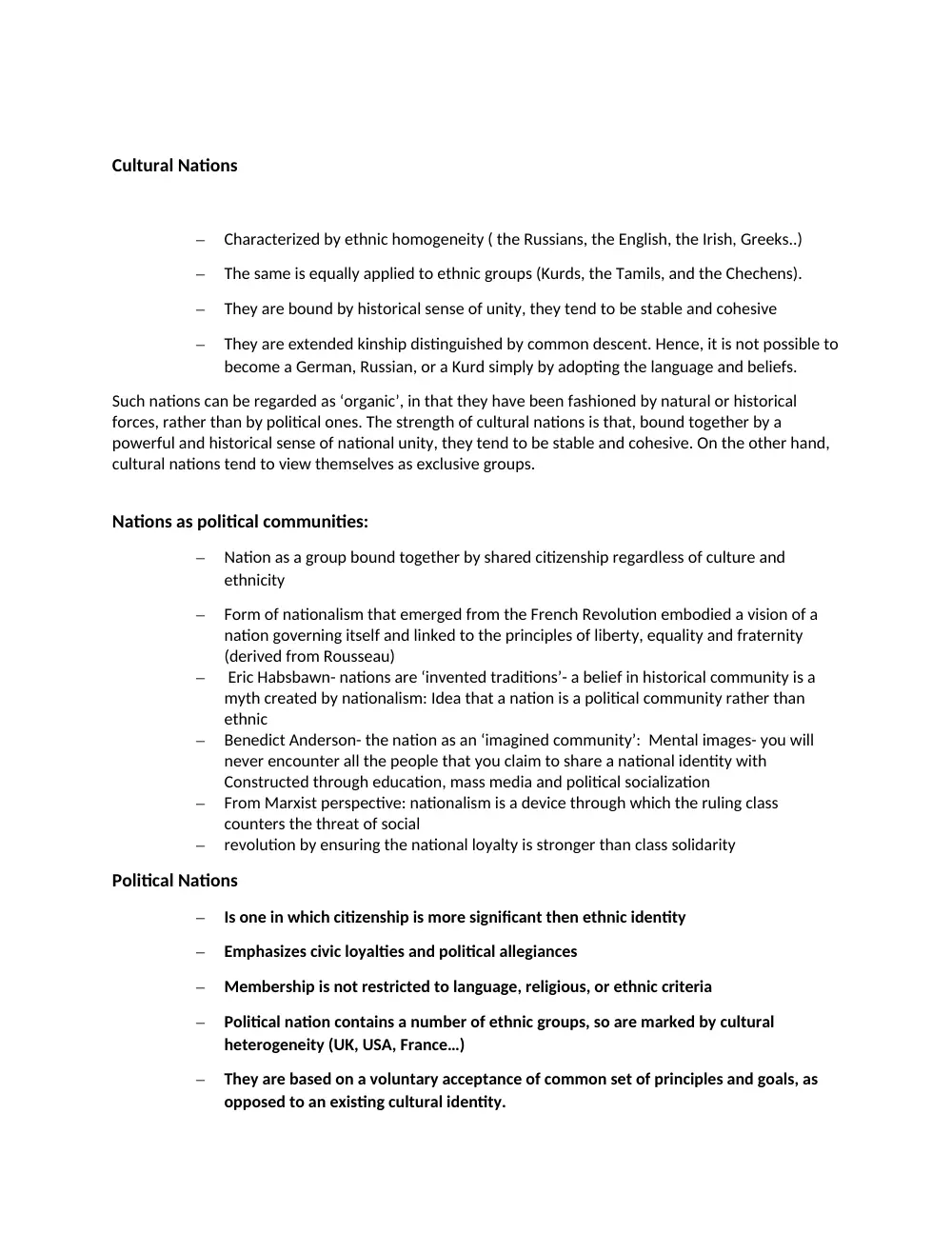
Cultural Nations
–
Characterized by ethnic homogeneity ( the Russians, the English, the Irish, Greeks..)
–
The same is equally applied to ethnic groups (Kurds, the Tamils, and the Chechens).
–
They are bound by historical sense of unity, they tend to be stable and cohesive
–
They are extended kinship distinguished by common descent. Hence, it is not possible to
become a German, Russian, or a Kurd simply by adopting the language and beliefs.
Such nations can be regarded as ‘organic’, in that they have been fashioned by natural or historical
forces, rather than by political ones. The strength of cultural nations is that, bound together by a
powerful and historical sense of national unity, they tend to be stable and cohesive. On the other hand,
cultural nations tend to view themselves as exclusive groups.
Nations as political communities:
–
Nation as a group bound together by shared citizenship regardless of culture and
ethnicity
–
Form of nationalism that emerged from the French Revolution embodied a vision of a
nation governing itself and linked to the principles of liberty, equality and fraternity
(derived from Rousseau)
–
Eric Habsbawn- nations are ‘invented traditions’- a belief in historical community is a
myth created by nationalism: Idea that a nation is a political community rather than
ethnic
–
Benedict Anderson- the nation as an ‘imagined community’: Mental images- you will
never encounter all the people that you claim to share a national identity with
Constructed through education, mass media and political socialization
–
From Marxist perspective: nationalism is a device through which the ruling class
counters the threat of social
–
revolution by ensuring the national loyalty is stronger than class solidarity
Political Nations
–
Is one in which citizenship is more significant then ethnic identity
–
Emphasizes civic loyalties and political allegiances
–
Membership is not restricted to language, religious, or ethnic criteria
–
Political nation contains a number of ethnic groups, so are marked by cultural
heterogeneity (UK, USA, France…)
–
They are based on a voluntary acceptance of common set of principles and goals, as
opposed to an existing cultural identity.
–
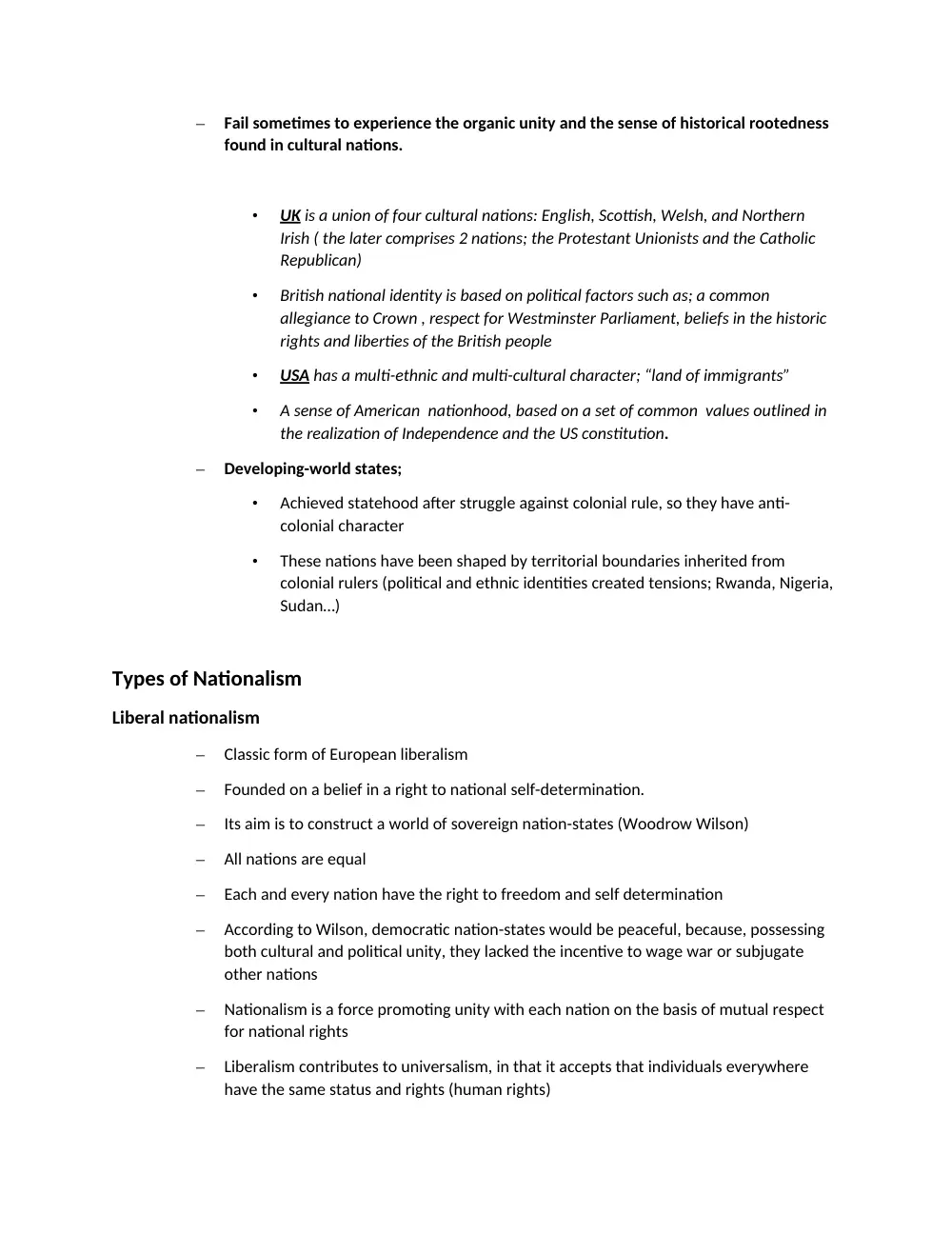
Fail sometimes to experience the organic unity and the sense of historical rootedness
found in cultural nations.
•
UK
is a union of four cultural nations: English, Scottish, Welsh, and Northern
Irish ( the later comprises 2 nations; the Protestant Unionists and the Catholic
Republican)
•
British national identity is based on political factors such as; a common
allegiance to Crown , respect for Westminster Parliament, beliefs in the historic
rights and liberties of the British people
•
USA
has a multi-ethnic and multi-cultural character; “land of immigrants”
•
A sense of American nationhood, based on a set of common values outlined in
the realization of Independence and the US constitution.
–
Developing-world states;
•
Achieved statehood after struggle against colonial rule, so they have anti-
colonial character
•
These nations have been shaped by territorial boundaries inherited from
colonial rulers (political and ethnic identities created tensions; Rwanda, Nigeria,
Sudan…)
Types of Nationalism
Liberal nationalism
–
Classic form of European liberalism
–
Founded on a belief in a right to national self-determination.
–
Its aim is to construct a world of sovereign nation-states (Woodrow Wilson)
–
All nations are equal
–
Each and every nation have the right to freedom and self determination
–
According to Wilson, democratic nation-states would be peaceful, because, possessing
both cultural and political unity, they lacked the incentive to wage war or subjugate
other nations
–
Nationalism is a force promoting unity with each nation on the basis of mutual respect
for national rights
–
Liberalism contributes to universalism, in that it accepts that individuals everywhere
have the same status and rights (human rights)
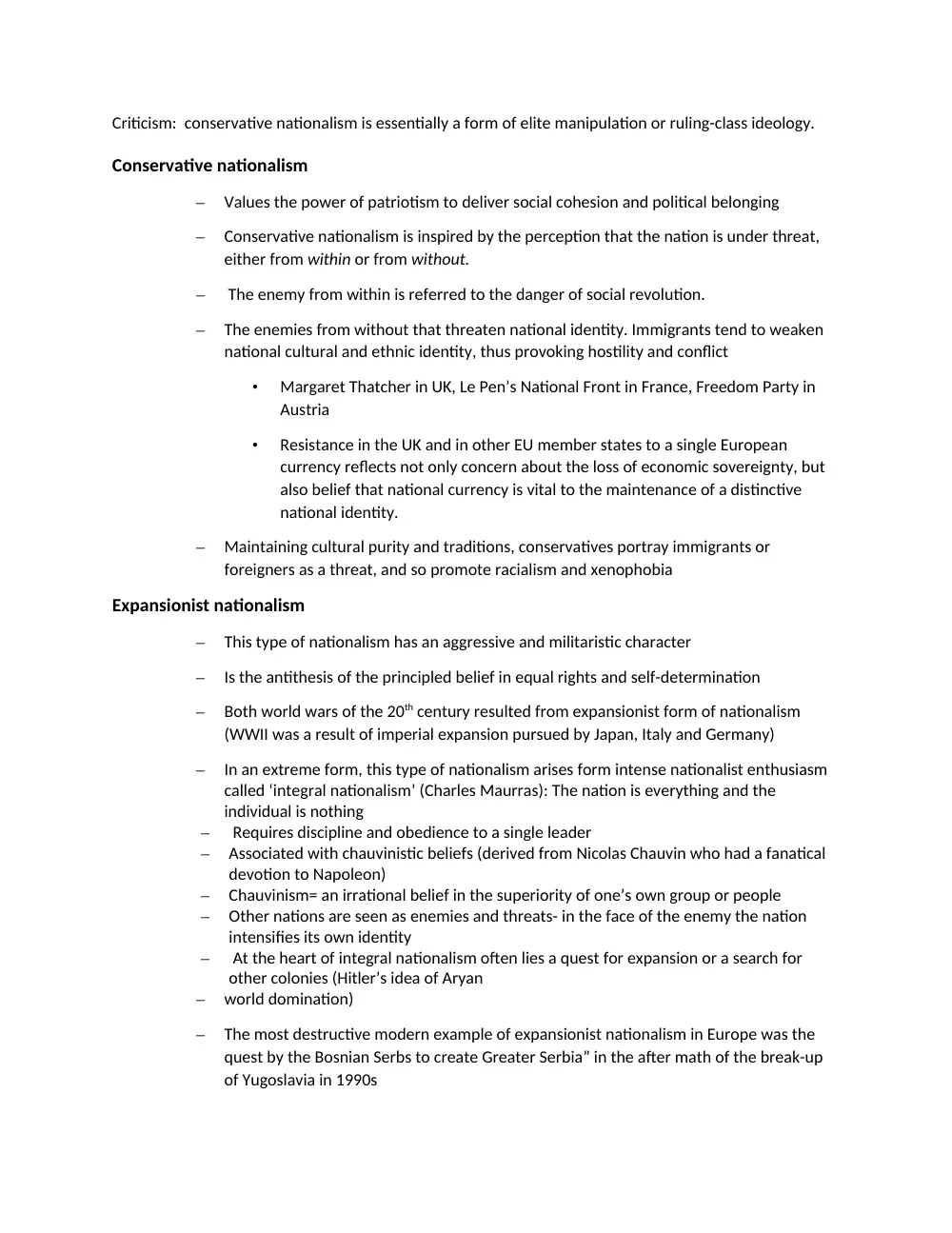
Criticism: conservative nationalism is essentially a form of elite manipulation or ruling-class ideology.
Conservative nationalism
–
Values the power of patriotism to deliver social cohesion and political belonging
–
Conservative nationalism is inspired by the perception that the nation is under threat,
either from within or from without.
–
The enemy from within is referred to the danger of social revolution.
–
The enemies from without that threaten national identity. Immigrants tend to weaken
national cultural and ethnic identity, thus provoking hostility and conflict
•
Margaret Thatcher in UK, Le Pen’s National Front in France, Freedom Party in
Austria
•
Resistance in the UK and in other EU member states to a single European
currency reflects not only concern about the loss of economic sovereignty, but
also belief that national currency is vital to the maintenance of a distinctive
national identity.
–
Maintaining cultural purity and traditions, conservatives portray immigrants or
foreigners as a threat, and so promote racialism and xenophobia
Expansionist nationalism
–
This type of nationalism has an aggressive and militaristic character
–
Is the antithesis of the principled belief in equal rights and self-determination
–
Both world wars of the 20th century resulted from expansionist form of nationalism
(WWII was a result of imperial expansion pursued by Japan, Italy and Germany)
–
In an extreme form, this type of nationalism arises form intense nationalist enthusiasm
called ‘integral nationalism’ (Charles Maurras): The nation is everything and the
individual is nothing
–
Requires discipline and obedience to a single leader
–
Associated with chauvinistic beliefs (derived from Nicolas Chauvin who had a fanatical
devotion to Napoleon)
–
Chauvinism= an irrational belief in the superiority of one’s own group or people
–
Other nations are seen as enemies and threats- in the face of the enemy the nation
intensifies its own identity
–
At the heart of integral nationalism often lies a quest for expansion or a search for
other colonies (Hitler’s idea of Aryan
–
world domination)
–
The most destructive modern example of expansionist nationalism in Europe was the
quest by the Bosnian Serbs to create Greater Serbia” in the after math of the break-up
of Yugoslavia in 1990s
–
National Chauvinism is another type of expansionist nationalism focusing on ethnic and
racial superiority (refers to Nicolas Chauvin, French soldier noted for his devotion to
Napoleon..)
–
Examples of Mussolini's Italy and Hitler's Germany..
Anticolonial and Postcolonial nationalism
•
The experience of colonialism shaped the development of different types of nationalism across
much of Africa and Asia
•
Early forms of anti-colonialism were inspired by the idea of national self-determination
•
Colonialism turned nationalism into a political creed of global significance (independence
movements all over the world
•
National liberation often had both an economic and political dimension-this explains why some
movements looked to socialism as a vehicle for expressing nationalist ambitions
•
Since the 1970s, Marxism-Leninism has often been displaced by forms of religious
fundamentalism
A future for the nation-state?
The most widely recognized form of political organization worldwide is the nation-state, which is often
seen as the sole legitimate unit of political rule. Its strength is that it offers the prospect of both cultural
cohesion and political unity, thus allowing those who share a common cultural or ethnic identity to
exercise the right to independence and self-government
•
The nation-state faces a number of challenges:
–
1) Centrifugal pressures generated by an increase in cultural and ethnic diversity
–
2) The growth of international organizations and jurisdiction and the advance of cultural
and economic globalization
–
3) The need to find international solutions to the environmental crisis.
–
4) A global monoculture