
PSPA 201 Final, Fall 2007
American University of Beirut · Introduction to Political Science · 4 pages


More PSPA 201 files
Show the text of this final exam
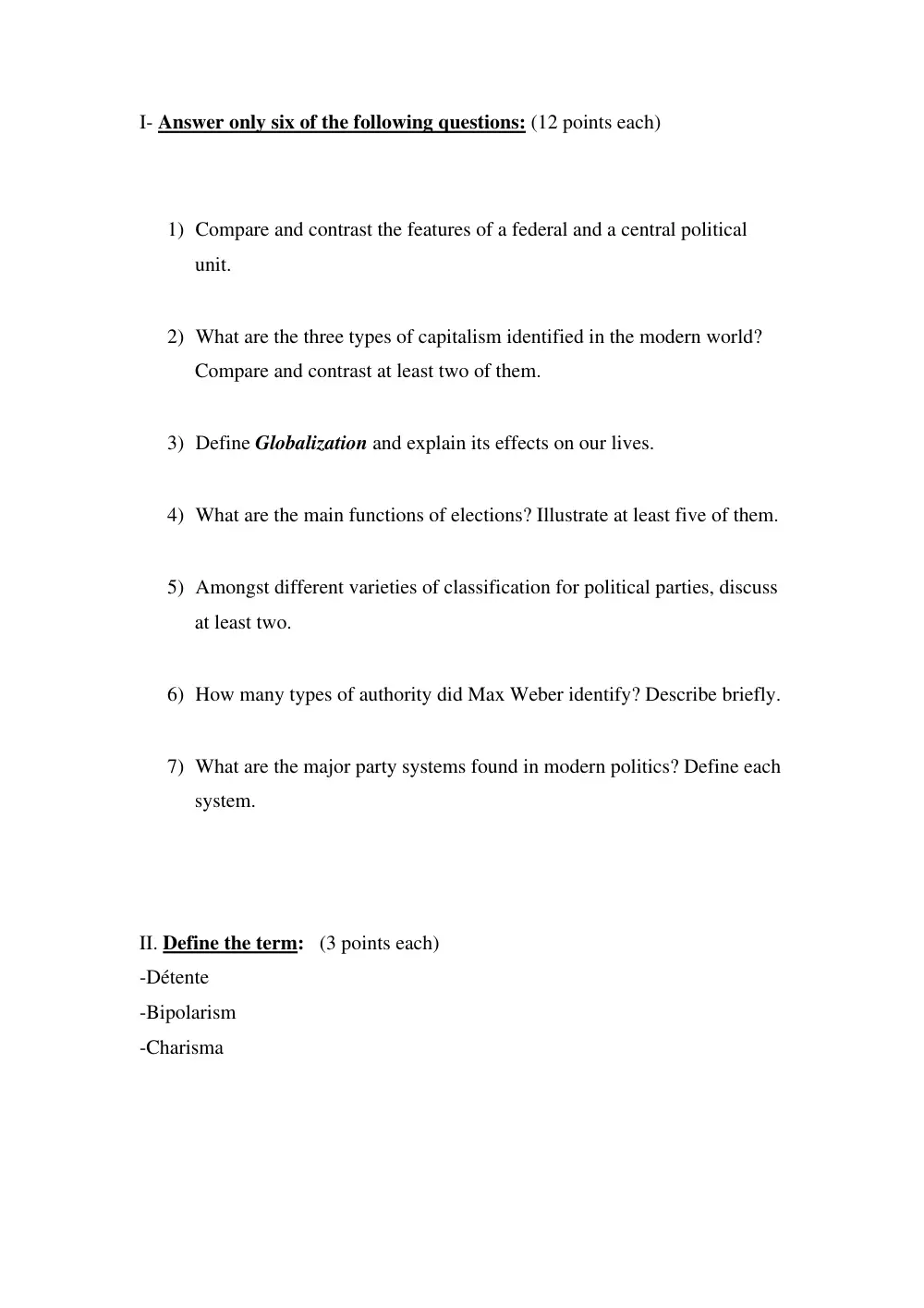
I- Answer only six of the following questions: (12 points each)
1) Compare and contrast the features of a federal and a central political
unit.
2) What are the three types of capitalism identified in the modern world?
Compare and contrast at least two of them.
3) Define Globalization and explain its effects on our lives.
4) What are the main functions of elections? Illustrate at least five of them.
5) Amongst different varieties of classification for political parties, discuss
at least two.
6) How many types of authority did Max Weber identify? Describe briefly.
7) What are the major party systems found in modern politics? Define each
system.
II. Define the term: (3 points each)
-Détente
-Bipolarism
-Charisma
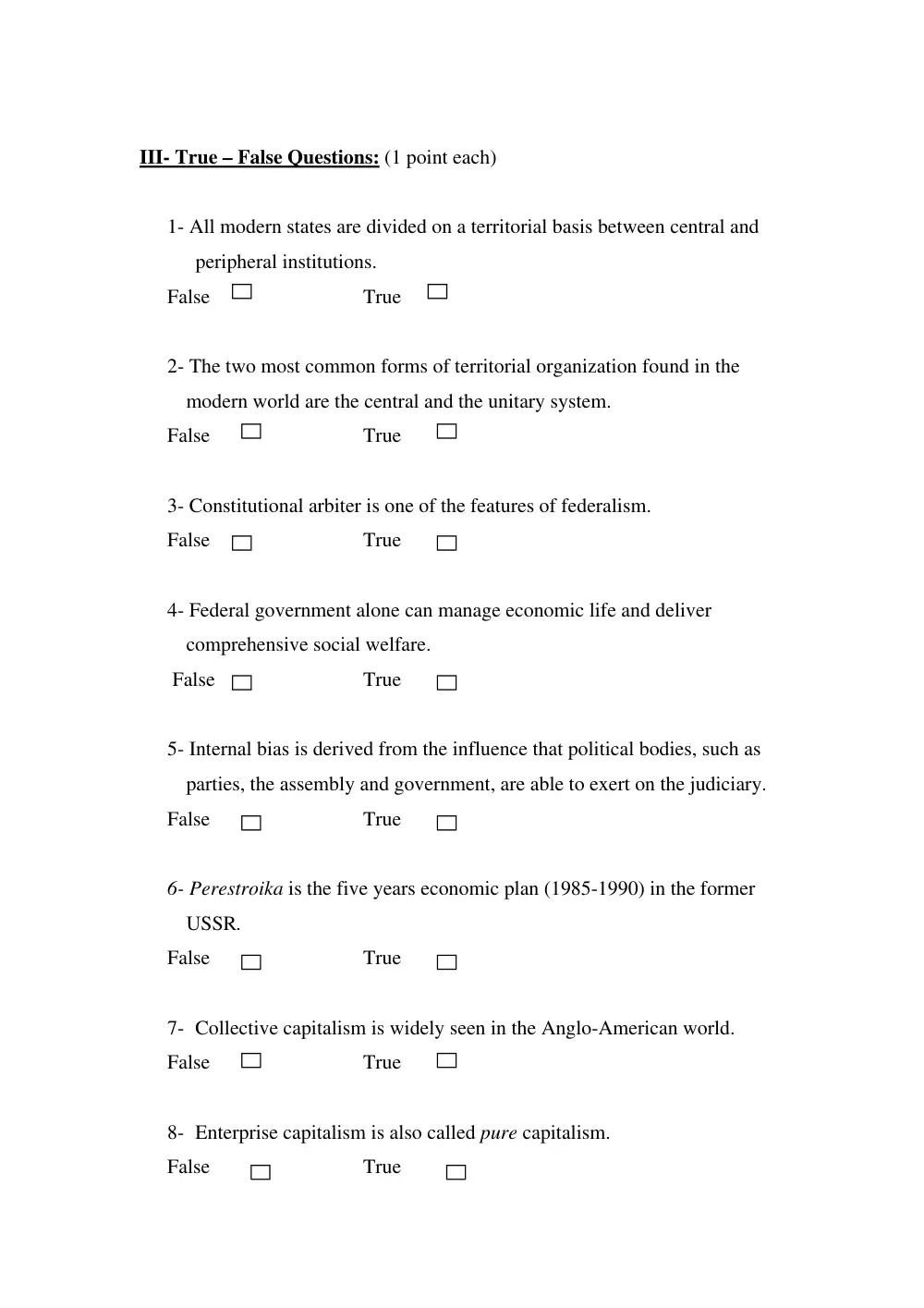
III- True – False Questions: (1 point each)
1- All modern states are divided on a territorial basis between central and
peripheral institutions.
False
True
2- The two most common forms of territorial organization found in the
modern world are the central and the unitary system.
False
True
3- Constitutional arbiter is one of the features of federalism.
False
True
4- Federal government alone can manage economic life and deliver
comprehensive social welfare.
False
True
5- Internal bias is derived from the influence that political bodies, such as
parties, the assembly and government, are able to exert on the judiciary.
False
True
6- Perestroika is the five years economic plan (1985-1990) in the former
USSR.
False
True
7- Collective capitalism is widely seen in the Anglo-American world.
False
True
8- Enterprise capitalism is also called pure capitalism.
False
True
9- Globalization has promoted marketization in many different ways.
False
True
10- Building legitimacy is one of the reasons why authoritarian regimes
hold elections.
False
True
11- Mass parties are also considered anticonstitutional parties.
False
True
12- Convention is a rule of conduct or behavior based on law and not
custom and precedent.
False
True
13- Legislatures make law, executives implement law and Judiciaries
interpret law.
False
True
14- Judges may be political in more than one sense.
False
True
15- Parties seen as part of “the Left” are characterized by a commitment to
change, in the form of either social reform or economic transformation.
False
True
16- Marketization is the extension of market relationships, based on
commercial exchange and material self-interest.
False
True
17- When crises break at in either domestic or international politics, it is the
legislative that responds.
False
True
18- Parties thought to constitute “the Right” generally uphold the existing
social order and are a force of continuity.
False
True
19- An overwhelming number of states possess unwritten constitutions that
lay down major constitutional provisions.
False
True