
PSPA 202 Final, Fall 2007
American University of Beirut · Introduction to Public Administration · 7 pages



More PSPA 202 files
Show the text of this final exam
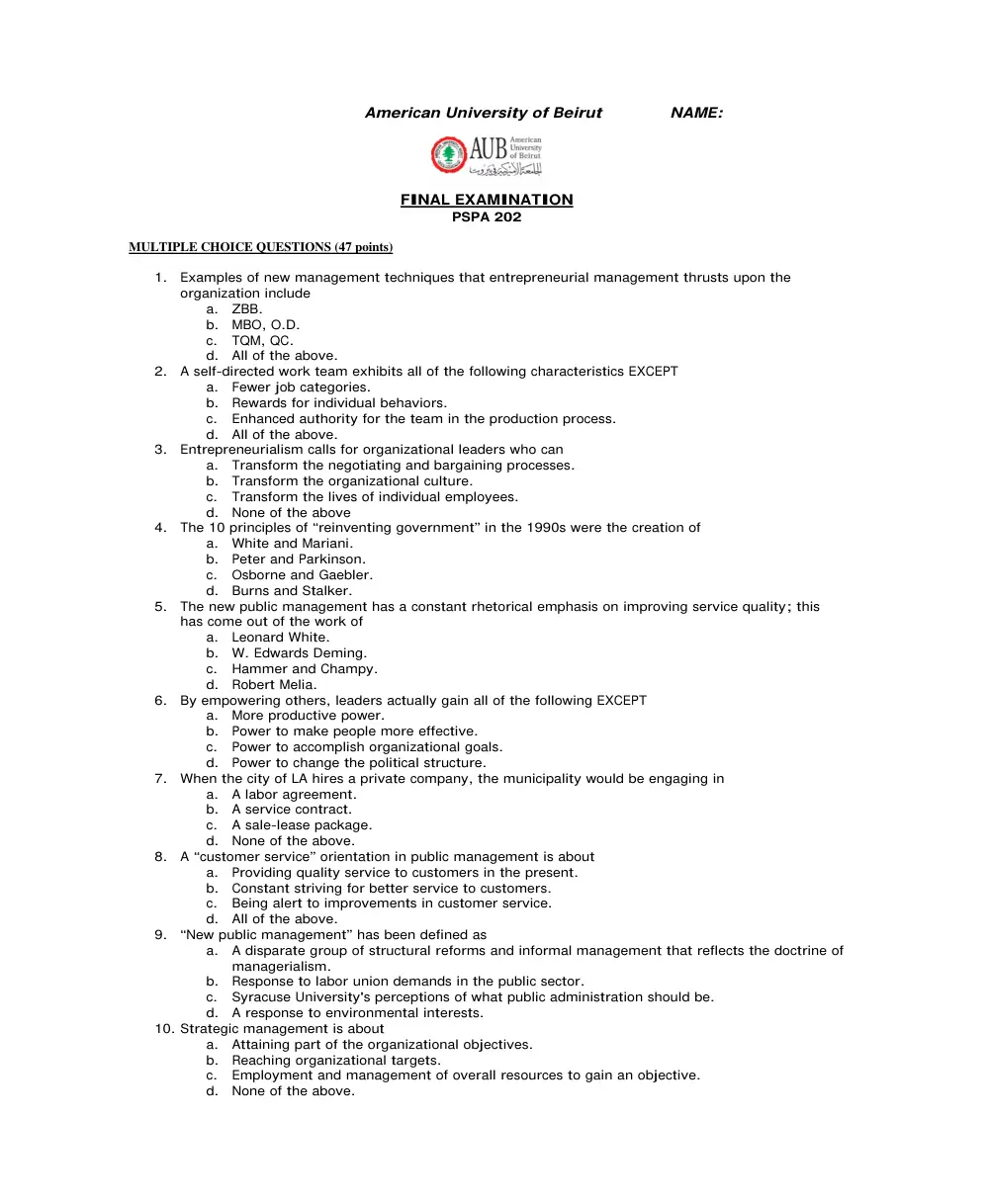
American University of Beirut NAME:
FINAL EXAMINATION
PSPA 202
MULTIPLE CHOICE QUESTIONS (47 points)
1. Examples of new management techniques that entrepreneurial management thrusts upon the
organization include
a. ZBB.
b. MBO, O.D.
c.
TQM, QC.
d. All of the above.
2. A self-directed work team exhibits all of the following characteristics EXCEPT
a. Fewer job categories.
b. Rewards for individual behaviors.
c.
Enhanced authority for the team in the production process.
d. All of the above.
3. Entrepreneurialism calls for organizational leaders who can
a. Transform the negotiating and bargaining processes.
b. Transform the organizational culture.
c.
Transform the lives of individual employees.
d. None of the above
4. The 10 principles of “reinventing government” in the 1990s were the creation of
a. White and Mariani.
b. Peter and Parkinson.
c.
Osborne and Gaebler.
d. Burns and Stalker.
5. The new public management has a constant rhetorical emphasis on improving service quality; this
has come out of the work of
a. Leonard White.
b. W. Edwards Deming.
c.
Hammer and Champy.
d. Robert Melia.
6. By empowering others, leaders actually gain all of the following EXCEPT
a. More productive power.
b. Power to make people more effective.
c.
Power to accomplish organizational goals.
d. Power to change the political structure.
7. When the city of LA hires a private company, the municipality would be engaging in
a. A labor agreement.
b. A service contract.
c.
A sale-lease package.
d. None of the above.
8. A “customer service” orientation in public management is about
a. Providing quality service to customers in the present.
b. Constant striving for better service to customers.
c.
Being alert to improvements in customer service.
d. All of the above.
9. “New public management” has been defined as
a. A disparate group of structural reforms and informal management that reflects the doctrine of
managerialism.
b. Response to labor union demands in the public sector.
c.
Syracuse University's perceptions of what public administration should be.
d. A response to environmental interests.
10. Strategic management is about
a. Attaining part of the organizational objectives.
b. Reaching organizational targets.
c.
Employment and management of overall resources to gain an objective.
d. None of the above.
11. The statement of strategic planning objectives calls for
a) Self-actualization, survival, safety, esteem, love, organizational requirement.
b) Succinct, directional, time-limited, and measurable objectives.
c) Assessment, decision making, evaluation.
d) Inputs, transformation, outputs.
12. Which of the following is NOT a variable of the matching process in strategic
management, according to H. Igor Ansoff?
a) Capability
b) Strategy
c) Environment
d) Assessment
13. When the personal interests of an officeholder influence his or her decisions on official
policy, this individual has a
a) Communal interest.
b) Consensus of opinion.
c) Conflict of interest.
d) Conscientious objection.
14. A SWOT analysis is one that evaluates
a) The strengths of an organization.
b) The weaknesses of an organization.
c) The opportunities for an organization as well as possible threats.
d) All of the above.
15. An example of a public monopoly is
a) The telephone and communications industry.
b) The electric utility.
c) The natural gas provider.
d) The local transit authority.
16. Which of the following is NOT one of the four factors that affect the use of strategic
management concepts in the public sector?
a. The public-private paradox
b. The importance of being close to the center
c.
The organizational language, culture, and place
d. The politics-administration dichotomy
17. The idea that an aristocracy of power elites within an organization rules the organization is known as
the
a. Iron Triangle.
b. Contingency Theory.
c.
Iron Law of Oligarchy.
d. Iron Curtain.
18. According to theories of French and Raven, Martin Luther King, Jr., exemplified which
style of power in his leadership of the civil rights movement?
a. Referent power
b. Coercive power
c.
Expert power
d. Reward power
19. All of the following are part of a new style of federal leadership EXCEPT
a. involving all employees and developing a clear vision and shared sense of
mission.
b. Communicating through every layer in an organization.
c.
Keeping staff working within organizational boundaries.
d. Asking subordinates for input on what is needed to get the job done.
20. When supervisors fail to delegate work because they have little faith in the ability of their employees
to make decisions, they are engaging in
a. Overmanagement.
b. Participative management.
c.
Scientific management.
d. Micromanagement.
21. In a democracy, public administrators work within
a. A rule of men.
b. A rule of a few.
c.
A rule of law.
d. None of the above.
22. Mary Parker Follet developed and espoused which theory of management?
a. Systems theory
b. Law of situation
c.
Scientific management theory
d. Time and motion theory
23. The theory that states that leaders are born and not made is known as the
a. Transactional theory of leadership.
b. Transformational theory of leadership.
c.
Trait theory of leadership.
d. Contingency theory of leadership.
24. Collective bargaining refers to negotiations by labor unions on behalf of
a. individuals in organizations.
b. groups in organizations.
c.
groups across organizations.
d. a, b, and c.
25. Civil service reform traces its beginnings to the
a. Civil Rights Act of 1964.
b. Equal Employment Opportunity Act of 1972.
c.
Pendleton Act of 1883.
d. Civil Service Reform Act of 1978.
26. The U.S. merit system of civil service came about primarily due to the excesses of the
a. Republican Party in the Jefferson administration.
b. Spoils and patronage system.
c.
Elrod v. Burns Supreme Court case.
d. Reinventing government movement.
27. The most common techniques of impasse resolution in labor-management relations
are
a. Judgment from an administrative law judge.
b. Jury-determined cases in a court of law.
c.
Arbitration, mediation, and fact-finding.
d. a, b, and c.
28. The AFL-CIO is an organization that
a. Engages in collective bargaining.
b. Is a union of unions.
c.
Is an example of a laissez-faire system.
d. Is also known as the Congress of Industrial Organizations.
29. The first statute that set forth the basic private sector model of labor relations was
a. Civil Service Reform Act of 1978.
b. Wagner Act of 1935.
c.
Pendleton Act of 1883.
d. Taft-Hartley Act of 1947.
30. The Federal Service Impasses Panel is a body that is included under
a. The Federal Labor Relations Authority.
b. The Merit Systems Protection Board.
c.
The National Labor Relations Board.
d. The Civil Rights Act.
31. Affirmative action in the workplace is a broad term that means
a. Compensatory justice.
b. A proactive effort to include women and minorities in appropriate numbers in the workplace.
c.
a and b.
d. None of the above.
32. “Sexual harassment,” as a form of sex discrimination
a. Was included in the Civil Rights Act of 1964.
b. Includes harassment of men by women.
c.
Includes same sex harassment.
d. All of the above
33. Nonracial discrimination includes
a. Sexual and age discrimination.
b. Pregnancy and disabilities discrimination.
c.
Age discrimination.
d. All of the above.
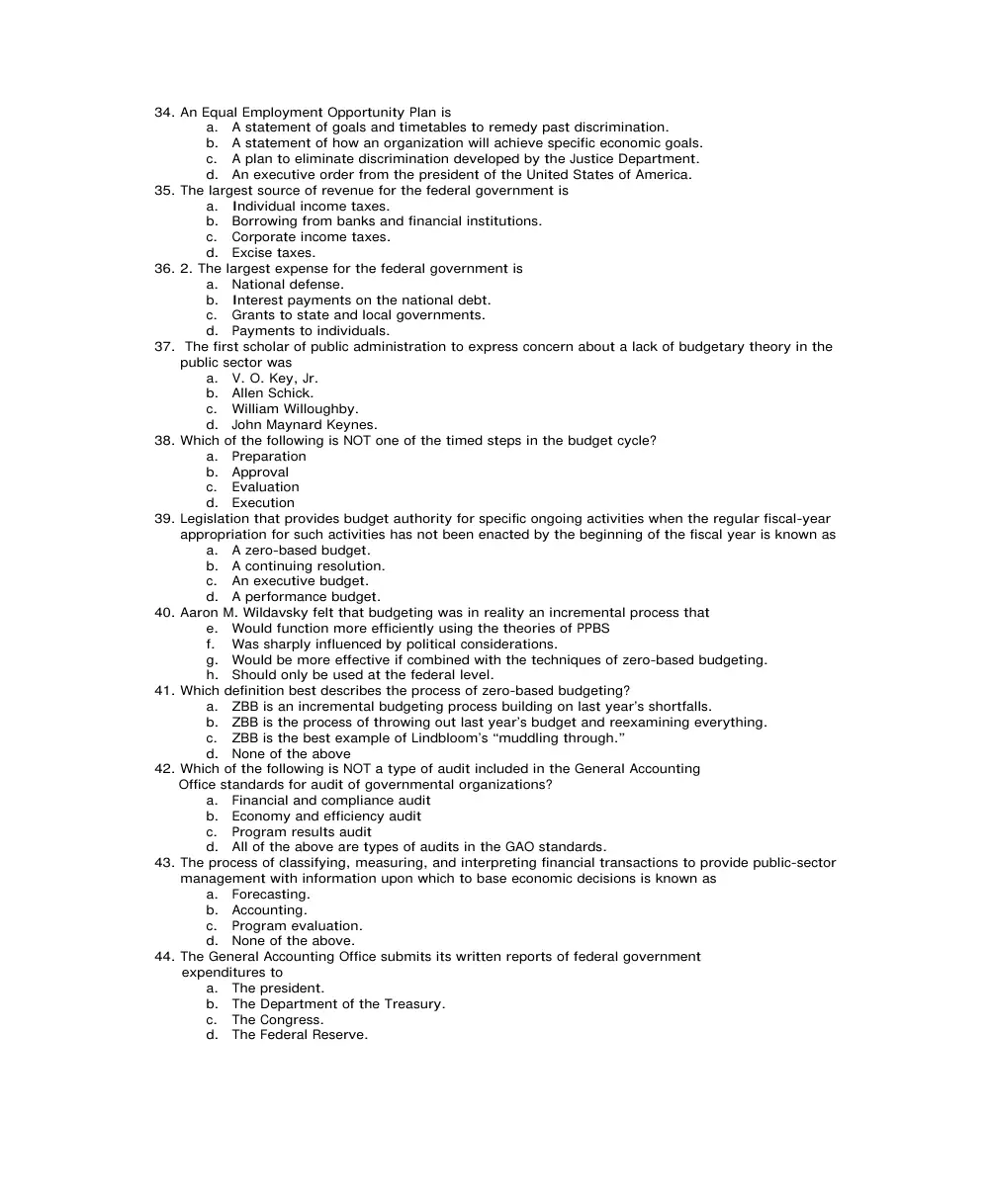
34. An Equal Employment Opportunity Plan is
a. A statement of goals and timetables to remedy past discrimination.
b. A statement of how an organization will achieve specific economic goals.
c.
A plan to eliminate discrimination developed by the Justice Department.
d. An executive order from the president of the United States of America.
35. The largest source of revenue for the federal government is
a. Individual income taxes.
b. Borrowing from banks and financial institutions.
c.
Corporate income taxes.
d. Excise taxes.
36. 2. The largest expense for the federal government is
a. National defense.
b. Interest payments on the national debt.
c.
Grants to state and local governments.
d. Payments to individuals.
37. The first scholar of public administration to express concern about a lack of budgetary theory in the
public sector was
a. V. O. Key, Jr.
b. Allen Schick.
c.
William Willoughby.
d. John Maynard Keynes.
38. Which of the following is NOT one of the timed steps in the budget cycle?
a. Preparation
b. Approval
c.
Evaluation
d. Execution
39. Legislation that provides budget authority for specific ongoing activities when the regular fiscal-year
appropriation for such activities has not been enacted by the beginning of the fiscal year is known as
a. A zero-based budget.
b. A continuing resolution.
c.
An executive budget.
d. A performance budget.
40. Aaron M. Wildavsky felt that budgeting was in reality an incremental process that
e. Would function more efficiently using the theories of PPBS
f.
Was sharply influenced by political considerations.
g. Would be more effective if combined with the techniques of zero-based budgeting.
h. Should only be used at the federal level.
41. Which definition best describes the process of zero-based budgeting?
a. ZBB is an incremental budgeting process building on last year’s shortfalls.
b. ZBB is the process of throwing out last year’s budget and reexamining everything.
c.
ZBB is the best example of Lindbloom’s “muddling through.”
d. None of the above
42. Which of the following is NOT a type of audit included in the General Accounting
Office standards for audit of governmental organizations?
a. Financial and compliance audit
b. Economy and efficiency audit
c.
Program results audit
d. All of the above are types of audits in the GAO standards.
43. The process of classifying, measuring, and interpreting financial transactions to provide public-sector
management with information upon which to base economic decisions is known as
a. Forecasting.
b. Accounting.
c.
Program evaluation.
d. None of the above.
44. The General Accounting Office submits its written reports of federal government
expenditures to
a. The president.
b. The Department of the Treasury.
c.
The Congress.
d. The Federal Reserve.
45. Which of the following four questions is designed to assess the effectiveness of a policy?
a. Is the responsibility for specific tasks clearly delegated?
b. Are employees adequately qualified to perform their tasks?
c.
Are the various purposes of the program compatible?
d. Is the waste of resources being avoided?
46. The review of an agency’s hiring practices to ensure that there is no discrimination by government
contractors on the basis of race, creed, color, religion, or national origin would be an example of
a. A compliance audit.
b. A performance audit.
c.
An internal audit.
d. A financial audit.
47. Which of the following principles must be followed in order for an auditor to retain
the independence needed to be effective in conducting an audit?
a. The auditor must be located outside line management.
b. There must be a high reporting line for audit results.
c.
There must be reasonable latitude in the selection of assignments.
d. All of the above
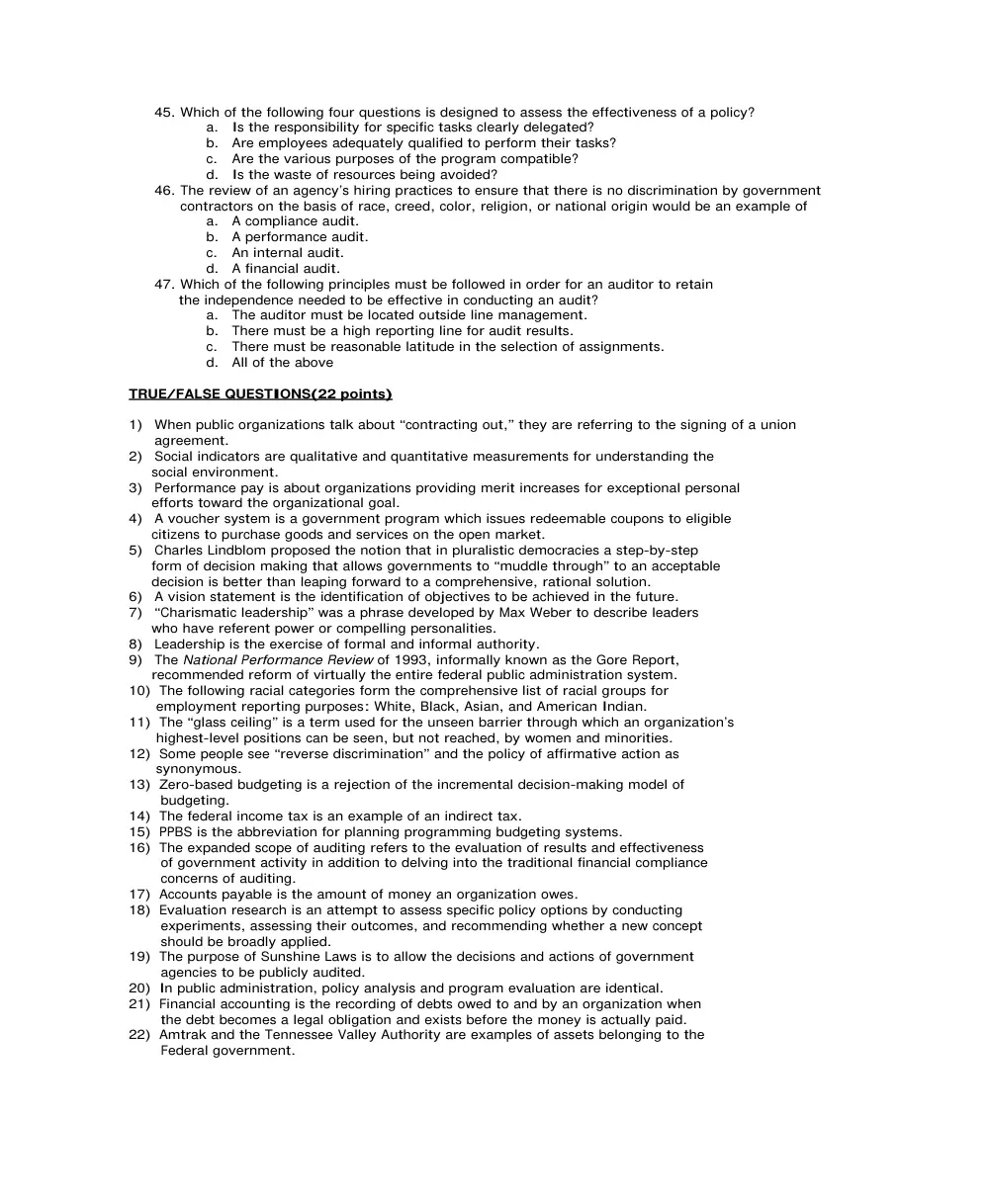
TRUE/FALSE QUESTIONS(22 points)
1) When public organizations talk about “contracting out,” they are referring to the signing of a union
agreement.
2) Social indicators are qualitative and quantitative measurements for understanding the
social environment.
3) Performance pay is about organizations providing merit increases for exceptional personal
efforts toward the organizational goal.
4) A voucher system is a government program which issues redeemable coupons to eligible
citizens to purchase goods and services on the open market.
5) Charles Lindblom proposed the notion that in pluralistic democracies a step-by-step
form of decision making that allows governments to “muddle through” to an acceptable
decision is better than leaping forward to a comprehensive, rational solution.
6) A vision statement is the identification of objectives to be achieved in the future.
7) “Charismatic leadership” was a phrase developed by Max Weber to describe leaders
who have referent power or compelling personalities.
8) Leadership is the exercise of formal and informal authority.
9) The National Performance Review of 1993, informally known as the Gore Report,
recommended reform of virtually the entire federal public administration system.
10) The following racial categories form the comprehensive list of racial groups for
employment reporting purposes: White, Black, Asian, and American Indian.
11) The “glass ceiling” is a term used for the unseen barrier through which an organization’s
highest-level positions can be seen, but not reached, by women and minorities.
12) Some people see “reverse discrimination” and the policy of affirmative action as
synonymous.
13) Zero-based budgeting is a rejection of the incremental decision-making model of
budgeting.
14) The federal income tax is an example of an indirect tax.
15) PPBS is the abbreviation for planning programming budgeting systems.
16) The expanded scope of auditing refers to the evaluation of results and effectiveness
of government activity in addition to delving into the traditional financial compliance
concerns of auditing.
17) Accounts payable is the amount of money an organization owes.
18) Evaluation research is an attempt to assess specific policy options by conducting
experiments, assessing their outcomes, and recommending whether a new concept
should be broadly applied.
19) The purpose of Sunshine Laws is to allow the decisions and actions of government
agencies to be publicly audited.
20) In public administration, policy analysis and program evaluation are identical.
21) Financial accounting is the recording of debts owed to and by an organization when
the debt becomes a legal obligation and exists before the money is actually paid.
22) Amtrak and the Tennessee Valley Authority are examples of assets belonging to the
Federal government.
CASE STUDY AND ANALYSIS (25 points)
Choose one of these two cases and answer the related question
I- A SWOT ANALYSIS
You are the newly appointed warden of the Cedarville County Jail. Because there are many problems existing
in the jail administration in Cedarville, you have been brought in as a “change agent.” You have come to your
position from a previous position in Illinois in the same capacity. You are known there for being an
entrepreneurial and transformational leader. You will bring with you part of your strategic management team
– your deputy warden for human resources and your deputy warden for administration. The jail in Cedarville
is a recently built incarceration facility with the latest in security technology and inmate housing for the two
separate parts of the jail—Adult Offenders Incarceration Facility and the Juvenile Facility. The physical space
serves as a model for this type of incarceration facility. There is willingness on the part of the county
government to put additional revenue and resources into the facility to make it work; you have a honeymoon
period of two years to do this.
Among the issues raised in your appointment documents as CEO to this facility are the following:
1. Security issues and keeping inmates inside the prison is the paramount concern. Beyond this, the
strategic management needs to be strengthened with additional talent in the area of financial
management. The accounting system is in disarray.
2. There are employee morale problems. Officers are not properly trained in the use of restraint and
safety techniques. There are some drug and alcohol abuse problems among the employees. Women
have traditionally been employed only in the lower clerical ranks. The jail has a “macho” culture,
which the county wants to see being changed to a more caretaking culture with emphasis on
rehabilitation and training for inmates and a special-needs program for juvenile offender.
3. Counseling, library, and chaplain services are not available to staff and inmates. The organization
could outsource (privatize) gardening, laundry, and janitorial services more cheaply than what is
provided in-house through work.
There will be a state review of how the juvenile offenders are managed in Cedarville. If there are continuing
problems in this area, the state is considering a voucher program to enable juvenile offenders to be moved to
the Catholic Juvenile Male Institutional Facility, a non-profit organization outside Cedarville, or to the Raleigh
Institution for Young Men, a private detention center in Cedarville. If the review is bad, the Cedarville jail
stands to lose a substantial portion of its budget. Conversely, if the state review shows that juveniles should
be retained at Cedarville, the state and federal governments will kick in with substantial grant-in-aid funding.
The county supervisors want you to accomplish the following major strategic tasks within your first three
months in office.
QUESTIONS
1. What would be the first step you would take before developing SWOT analysis?(2 points)
2. Develop: SWOT (STRENGTHS, WEAKNESSES, OPPORTUNITIES, and THREATS) analysis(20
points)
3. How would your analysis benefit the organization?(3 points)
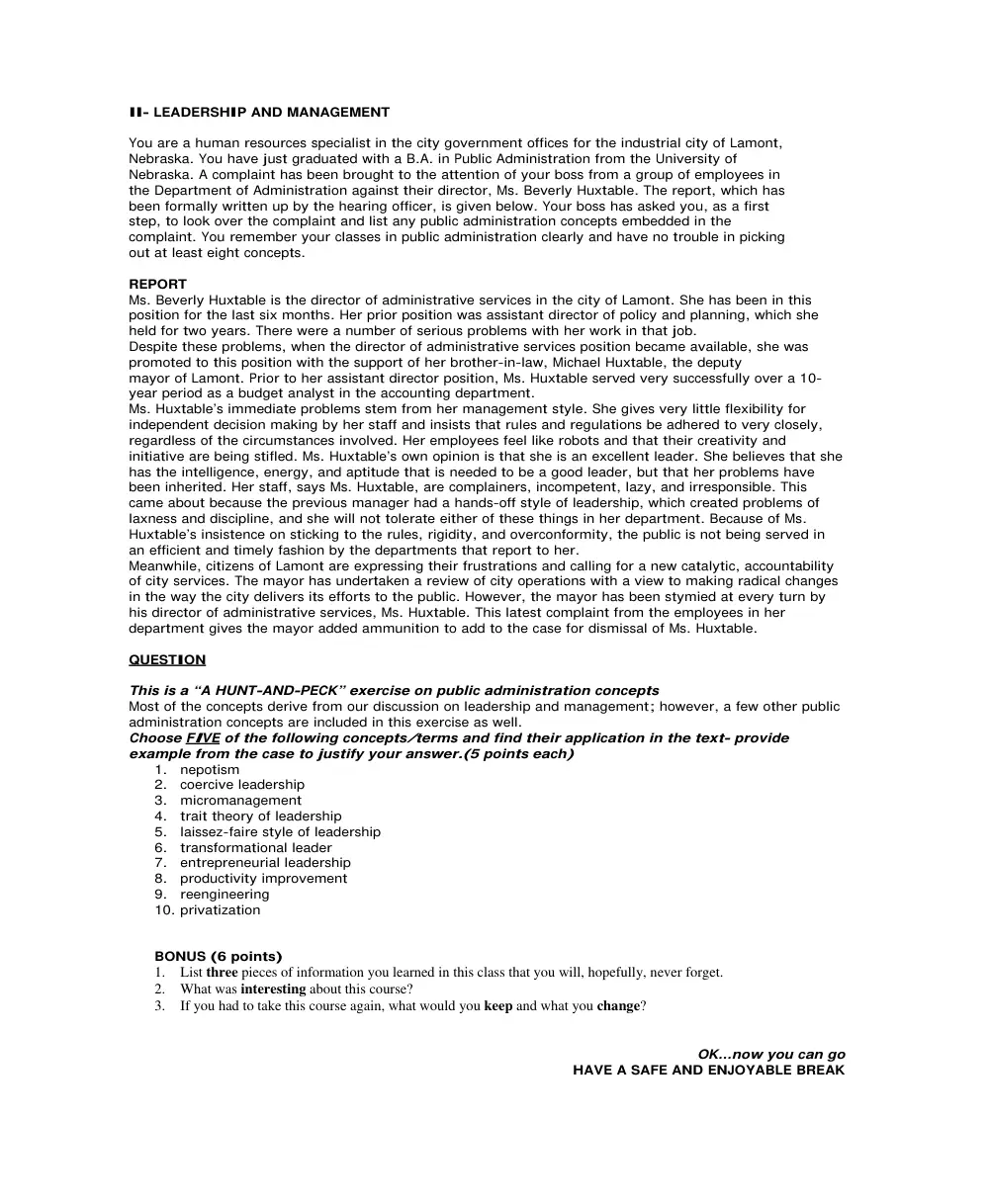
II- LEADERSHIP AND MANAGEMENT
You are a human resources specialist in the city government offices for the industrial city of Lamont,
Nebraska. You have just graduated with a B.A. in Public Administration from the University of
Nebraska. A complaint has been brought to the attention of your boss from a group of employees in
the Department of Administration against their director, Ms. Beverly Huxtable. The report, which has
been formally written up by the hearing officer, is given below. Your boss has asked you, as a first
step, to look over the complaint and list any public administration concepts embedded in the
complaint. You remember your classes in public administration clearly and have no trouble in picking
out at least eight concepts.
REPORT
Ms. Beverly Huxtable is the director of administrative services in the city of Lamont. She has been in this
position for the last six months. Her prior position was assistant director of policy and planning, which she
held for two years. There were a number of serious problems with her work in that job.
Despite these problems, when the director of administrative services position became available, she was
promoted to this position with the support of her brother-in-law, Michael Huxtable, the deputy
mayor of Lamont. Prior to her assistant director position, Ms. Huxtable served very successfully over a 10-
year period as a budget analyst in the accounting department.
Ms. Huxtable’s immediate problems stem from her management style. She gives very little flexibility for
independent decision making by her staff and insists that rules and regulations be adhered to very closely,
regardless of the circumstances involved. Her employees feel like robots and that their creativity and
initiative are being stifled. Ms. Huxtable’s own opinion is that she is an excellent leader. She believes that she
has the intelligence, energy, and aptitude that is needed to be a good leader, but that her problems have
been inherited. Her staff, says Ms. Huxtable, are complainers, incompetent, lazy, and irresponsible. This
came about because the previous manager had a hands-off style of leadership, which created problems of
laxness and discipline, and she will not tolerate either of these things in her department. Because of Ms.
Huxtable’s insistence on sticking to the rules, rigidity, and overconformity, the public is not being served in
an efficient and timely fashion by the departments that report to her.
Meanwhile, citizens of Lamont are expressing their frustrations and calling for a new catalytic, accountability
of city services. The mayor has undertaken a review of city operations with a view to making radical changes
in the way the city delivers its efforts to the public. However, the mayor has been stymied at every turn by
his director of administrative services, Ms. Huxtable. This latest complaint from the employees in her
department gives the mayor added ammunition to add to the case for dismissal of Ms. Huxtable.
QUESTION
This is a “A HUNT-AND-PECK” exercise on public administration concepts
Most of the concepts derive from our discussion on leadership and management; however, a few other public
administration concepts are included in this exercise as well.
Choose FIVE of the following concepts/terms and find their application in the text- provide
example from the case to justify your answer.(5 points each)
1. nepotism
2. coercive leadership
3. micromanagement
4. trait theory of leadership
5. laissez-faire style of leadership
6. transformational leader
7. entrepreneurial leadership
8. productivity improvement
9. reengineering
10. privatization
BONUS (6 points)
1. List three pieces of information you learned in this class that you will, hopefully, never forget.
2. What was interesting about this course?
3. If you had to take this course again, what would you keep and what you change?
OK…now you can go
HAVE A SAFE AND ENJOYABLE BREAK