
PSPA 210 Final, Fall 2007
American University of Beirut · Survey of Political Theory · 5 pages

More PSPA 210 files
Show the text of this final exam
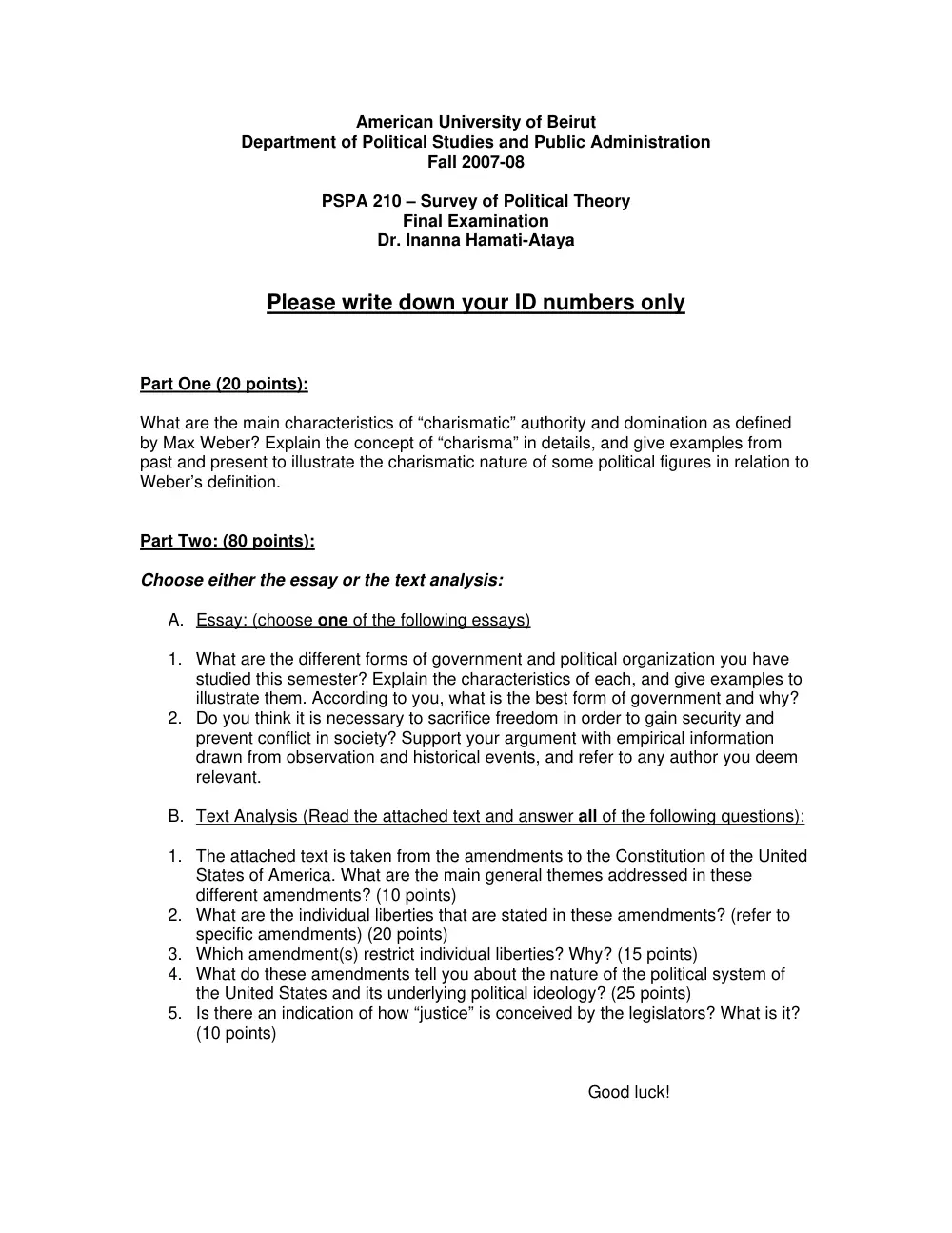
American University of Beirut
Department of Political Studies and Public Administration
Fall 2007-08
PSPA 210 – Survey of Political Theory
Final Examination
Dr. Inanna Hamati-Ataya
Please write down your ID numbers only
Part One (20 points):
What are the main characteristics of “charismatic” authority and domination as defined
by Max Weber? Explain the concept of “charisma” in details, and give examples from
past and present to illustrate the charismatic nature of some political figures in relation to
Weber’s definition.
Part Two: (80 points):
Choose either the essay or the text analysis:
A. Essay: (choose one of the following essays)
1. What are the different forms of government and political organization you have
studied this semester? Explain the characteristics of each, and give examples to
illustrate them. According to you, what is the best form of government and why?
2. Do you think it is necessary to sacrifice freedom in order to gain security and
prevent conflict in society? Support your argument with empirical information
drawn from observation and historical events, and refer to any author you deem
relevant.
B. Text Analysis (Read the attached text and answer all of the following questions):
1. The attached text is taken from the amendments to the Constitution of the United
States of America. What are the main general themes addressed in these
different amendments? (10 points)
2. What are the individual liberties that are stated in these amendments? (refer to
specific amendments) (20 points)
3. Which amendment(s) restrict individual liberties? Why? (15 points)
4. What do these amendments tell you about the nature of the political system of
the United States and its underlying political ideology? (25 points)
5. Is there an indication of how “justice” is conceived by the legislators? What is it?
(10 points)
Good luck!
Amendments to the US Constitution
Amendment I
Congress shall make no law respecting an establishment of religion, or prohibiting the
free exercise thereof; or abridging the freedom of speech, or of the press; or the right of
the people peaceably to assemble, and to petition the Government for a redress of
grievances.
Amendment II
A well regulated Militia, being necessary to the security of a free State, the right of the
people to keep and bear Arms, shall not be infringed.
Amendment III
No Soldier shall, in time of peace be quartered in any house, without the consent of the
Owner, nor in time of war, but in a manner to be prescribed by law.
Amendment IV
The right of the people to be secure in their persons, houses, papers, and effects,
against unreasonable searches and seizures, shall not be violated, and no Warrants
shall issue, but upon probable cause, supported by Oath or affirmation, and particularly
describing the place to be searched, and the persons or things to be seized.
Amendment V
No person shall be held to answer for a capital, or otherwise infamous crime, unless on
a presentment or indictment of a Grand Jury, except in cases arising in the land or naval
forces, or in the Militia, when in actual service in time of War or public danger; nor shall
any person be subject for the same offence to be twice put in jeopardy of life or limb; nor
shall be compelled in any criminal case to be a witness against himself, nor be deprived
of life, liberty, or property, without due process of law; nor shall private property be taken
for public use, without just compensation.
Amendment VI
In all criminal prosecutions, the accused shall enjoy the right to a speedy and public trial,
by an impartial jury of the State and district wherein the crime shall have been
committed, which district shall have been previously ascertained by law, and to be
informed of the nature and cause of the accusation; to be confronted with the witnesses
against him; to have compulsory process for obtaining witnesses in his favor, and to
have the Assistance of Counsel for his defence.
Amendment VII
In Suits at common law, where the value in controversy shall exceed twenty dollars, the
right of trial by jury shall be preserved, and no fact tried by a jury, shall be otherwise re-
examined in any Court of the United States, than according to the rules of the common
law.
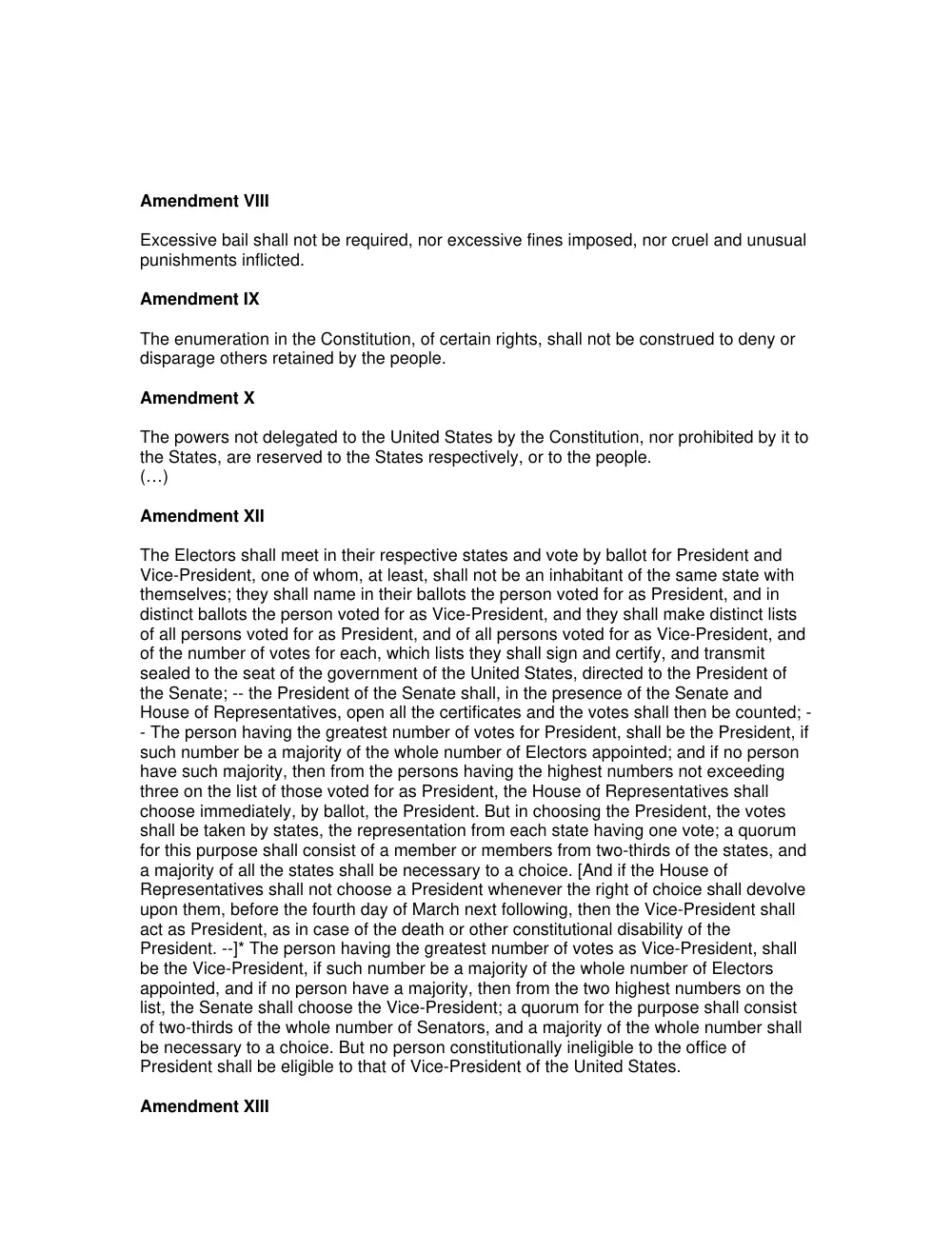
Amendment VIII
Excessive bail shall not be required, nor excessive fines imposed, nor cruel and unusual
punishments inflicted.
Amendment IX
The enumeration in the Constitution, of certain rights, shall not be construed to deny or
disparage others retained by the people.
Amendment X
The powers not delegated to the United States by the Constitution, nor prohibited by it to
the States, are reserved to the States respectively, or to the people.
(…)
Amendment XII
The Electors shall meet in their respective states and vote by ballot for President and
Vice-President, one of whom, at least, shall not be an inhabitant of the same state with
themselves; they shall name in their ballots the person voted for as President, and in
distinct ballots the person voted for as Vice-President, and they shall make distinct lists
of all persons voted for as President, and of all persons voted for as Vice-President, and
of the number of votes for each, which lists they shall sign and certify, and transmit
sealed to the seat of the government of the United States, directed to the President of
the Senate; -- the President of the Senate shall, in the presence of the Senate and
House of Representatives, open all the certificates and the votes shall then be counted; -
- The person having the greatest number of votes for President, shall be the President, if
such number be a majority of the whole number of Electors appointed; and if no person
have such majority, then from the persons having the highest numbers not exceeding
three on the list of those voted for as President, the House of Representatives shall
choose immediately, by ballot, the President. But in choosing the President, the votes
shall be taken by states, the representation from each state having one vote; a quorum
for this purpose shall consist of a member or members from two-thirds of the states, and
a majority of all the states shall be necessary to a choice. [And if the House of
Representatives shall not choose a President whenever the right of choice shall devolve
upon them, before the fourth day of March next following, then the Vice-President shall
act as President, as in case of the death or other constitutional disability of the
President. --]* The person having the greatest number of votes as Vice-President, shall
be the Vice-President, if such number be a majority of the whole number of Electors
appointed, and if no person have a majority, then from the two highest numbers on the
list, the Senate shall choose the Vice-President; a quorum for the purpose shall consist
of two-thirds of the whole number of Senators, and a majority of the whole number shall
be necessary to a choice. But no person constitutionally ineligible to the office of
President shall be eligible to that of Vice-President of the United States.
Amendment XIII
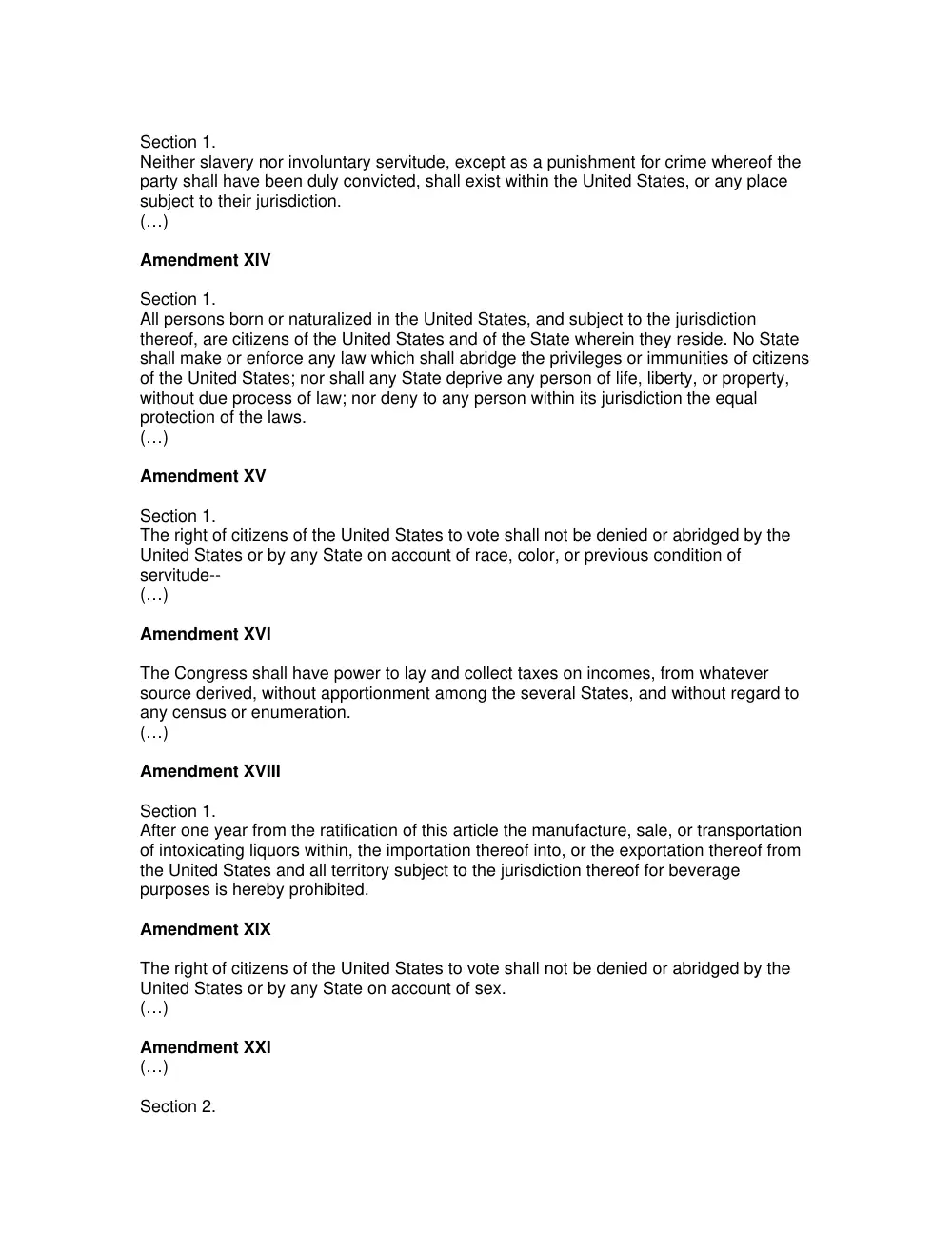
Section 1.
Neither slavery nor involuntary servitude, except as a punishment for crime whereof the
party shall have been duly convicted, shall exist within the United States, or any place
subject to their jurisdiction.
(…)
Amendment XIV
Section 1.
All persons born or naturalized in the United States, and subject to the jurisdiction
thereof, are citizens of the United States and of the State wherein they reside. No State
shall make or enforce any law which shall abridge the privileges or immunities of citizens
of the United States; nor shall any State deprive any person of life, liberty, or property,
without due process of law; nor deny to any person within its jurisdiction the equal
protection of the laws.
(…)
Amendment XV
Section 1.
The right of citizens of the United States to vote shall not be denied or abridged by the
United States or by any State on account of race, color, or previous condition of
servitude--
(…)
Amendment XVI
The Congress shall have power to lay and collect taxes on incomes, from whatever
source derived, without apportionment among the several States, and without regard to
any census or enumeration.
(…)
Amendment XVIII
Section 1.
After one year from the ratification of this article the manufacture, sale, or transportation
of intoxicating liquors within, the importation thereof into, or the exportation thereof from
the United States and all territory subject to the jurisdiction thereof for beverage
purposes is hereby prohibited.
Amendment XIX
The right of citizens of the United States to vote shall not be denied or abridged by the
United States or by any State on account of sex.
(…)
Amendment XXI
(…)
Section 2.
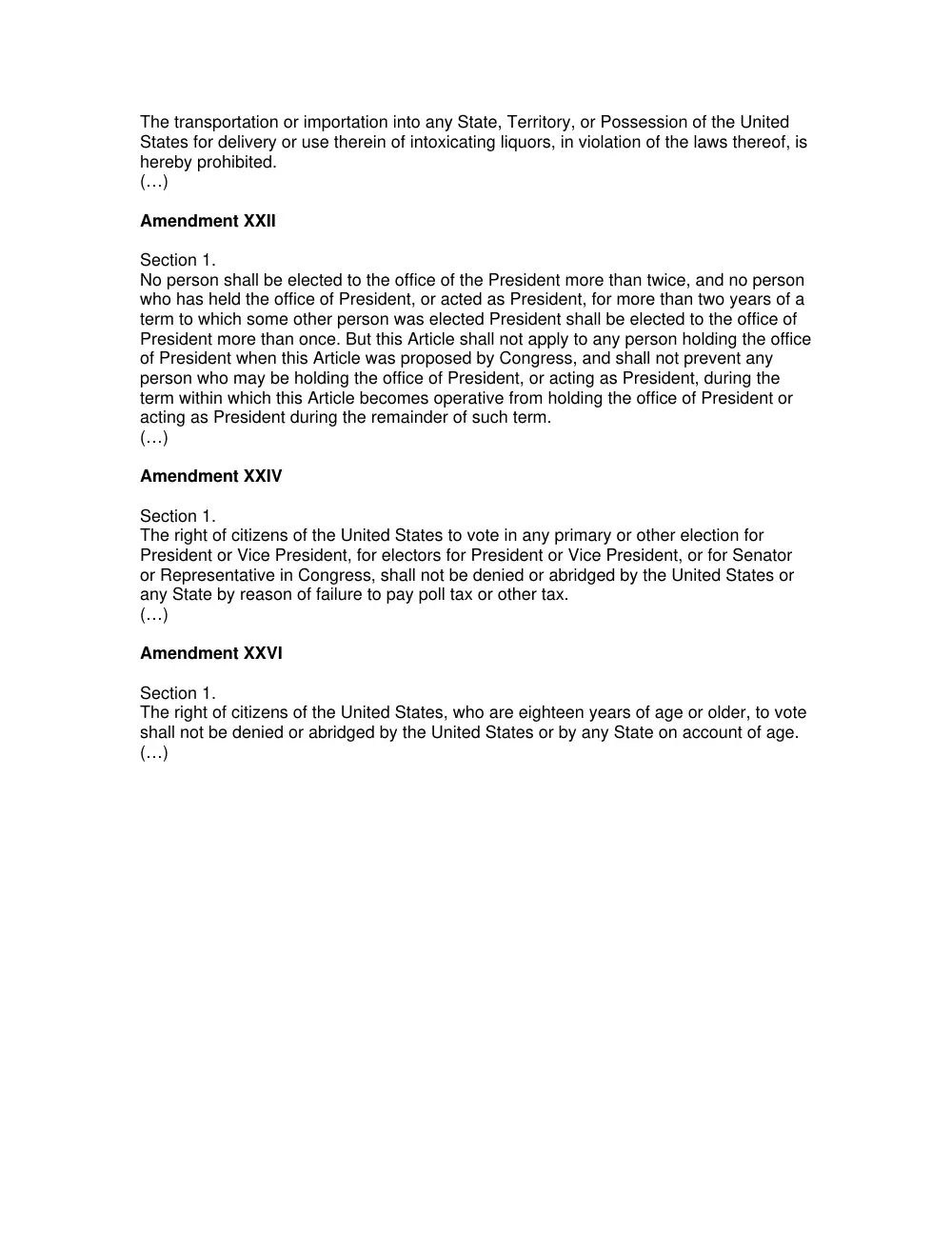
The transportation or importation into any State, Territory, or Possession of the United
States for delivery or use therein of intoxicating liquors, in violation of the laws thereof, is
hereby prohibited.
(…)
Amendment XXII
Section 1.
No person shall be elected to the office of the President more than twice, and no person
who has held the office of President, or acted as President, for more than two years of a
term to which some other person was elected President shall be elected to the office of
President more than once. But this Article shall not apply to any person holding the office
of President when this Article was proposed by Congress, and shall not prevent any
person who may be holding the office of President, or acting as President, during the
term within which this Article becomes operative from holding the office of President or
acting as President during the remainder of such term.
(…)
Amendment XXIV
Section 1.
The right of citizens of the United States to vote in any primary or other election for
President or Vice President, for electors for President or Vice President, or for Senator
or Representative in Congress, shall not be denied or abridged by the United States or
any State by reason of failure to pay poll tax or other tax.
(…)
Amendment XXVI
Section 1.
The right of citizens of the United States, who are eighteen years of age or older, to vote
shall not be denied or abridged by the United States or by any State on account of age.
(…)