
PSPA 233 Final, Spring 2001
American University of Beirut · International and Regional Organizations · 4 pages
More PSPA 233 files
Show the text of this final exam
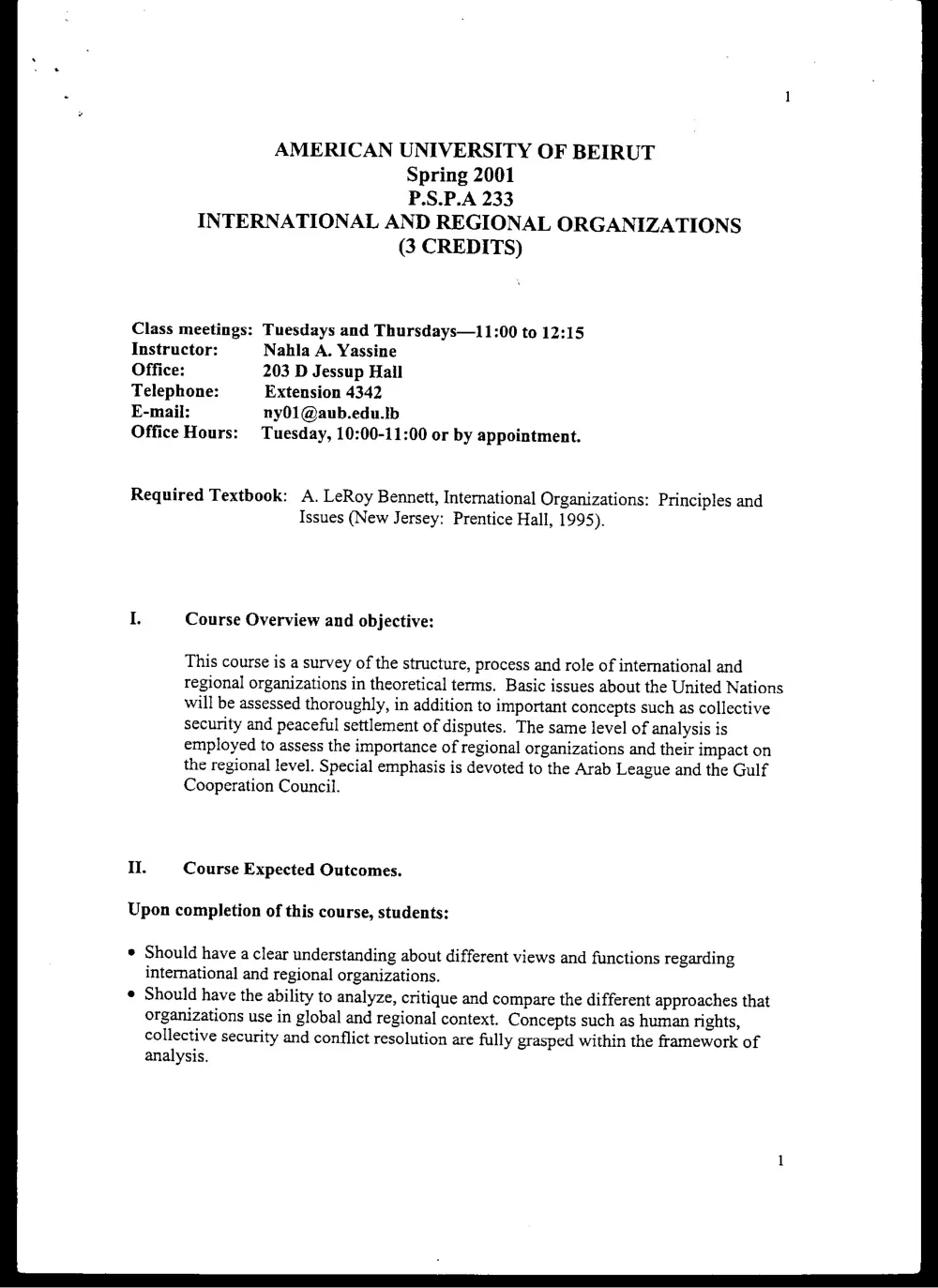
AMERICAN UNIVERSITY OF BEIRUT
Spring 2001
P.S.P.A 233
INTERNATIONAL AND REGIONAL ORGANIZATIONS
(3 CREDITS)
Class meetings: Tuesdays and Thursdays—1 1:00 to 12:15
Instructor: Nahla A. Yassine
Office: 203 D Jessup Hail
Telephone: Extension 4342
E-mail: ny01@aub.edu.Ib
Office Hours: Tuesday, 10:00-11:00 or by appointment.
Required Textbook: A. LeRoy Bennett, International Organizations: Principles and
Issues (New Jersey: Prentice Hall, 1995).
L Course Overview and objective:
This course is a survey of the structure, process and role of international and
regional organizations in theoretical terms. Basic issues about the United Nations
will be assessed thoroughly, in addition to important concepts such as collective
security and peaceful settlement of disputes. The same level of analysis is
employed to assess the importance of regional organizations and their impact on
the regional level. Special emphasis is devoted to the Arab League and the Gulf
Cooperation Council.
Il. Course Expected Outcomes.
Upon completion of this course, students:
¢ Should have a clear understanding about different views and functions regarding
international and regional organizations.
Should have the ability to analyze, critique and compare the different approaches that
organizations use in global and regional context. Concepts such as human rights,
collective security and conflict resolution are fully grasped within the framework of
analysis.
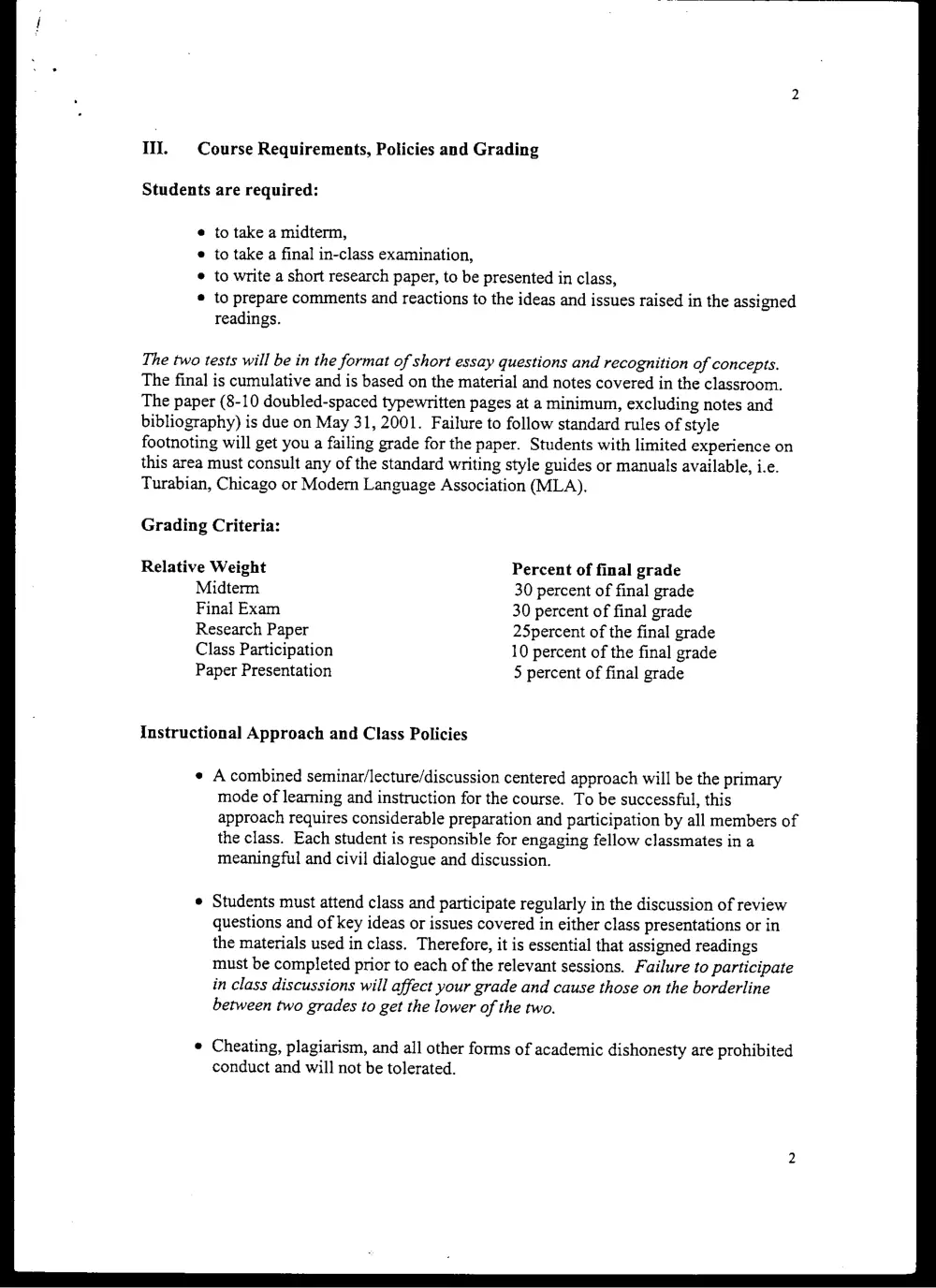
III. Course Requirements, Policies and Grading
Students are required:
to take a midterm,
to take a final in-class examination,
e
e
© to write a short research paper, to be presented in class,
e
to prepare comments and reactions to the ideas and issues raised in the assigned
readings.
The two tests will be in the format of short essay questions and recognition of concepts.
The final is cumulative and is based on the material and notes covered in the classroom.
The paper (8-10 doubled-spaced typewritten pages at a minimum, excluding notes and
bibliography) is due on May 31, 2001. Failure to follow standard rules of style
footnoting will get you a failing grade for the paper. Students with limited experience on
this area must consult any of the standard writing style guides or manuals available, i.e.
Turabian, Chicago or Modern Language Association (MLA).
Grading Criteria:
Relative Weight Percent of final grade
Midterm 30 percent of final grade
Final Exam 30 percent of final grade
Research Paper 25percent of the final grade
Class Participation 10 percent of the final grade
Paper Presentation 5 percent of final grade
Instructional Approach and Class Policies
¢ A combined seminar/lecture/discussion centered approach will be the primary
mode of learning and instruction for the course. To be successful, this
approach requires considerable preparation and participation by all members of
the class. Each student is responsible for engaging fellow classmates in a
meaningful and civil dialogue and discussion.
¢ Students must attend class and participate regularly in the discussion of review
questions and of key ideas or issues covered in either class presentations or in
the materials used in class. Therefore, it is essential that assigned readings
must be completed prior to each of the relevant sessions. Failure to participate
in class discussions will affect your grade and cause those on the borderline
between two grades to get the lower of the two.
¢ Cheating, plagiarism, and all other forms of academic dishonesty are prohibited
conduct and will not be tolerated.
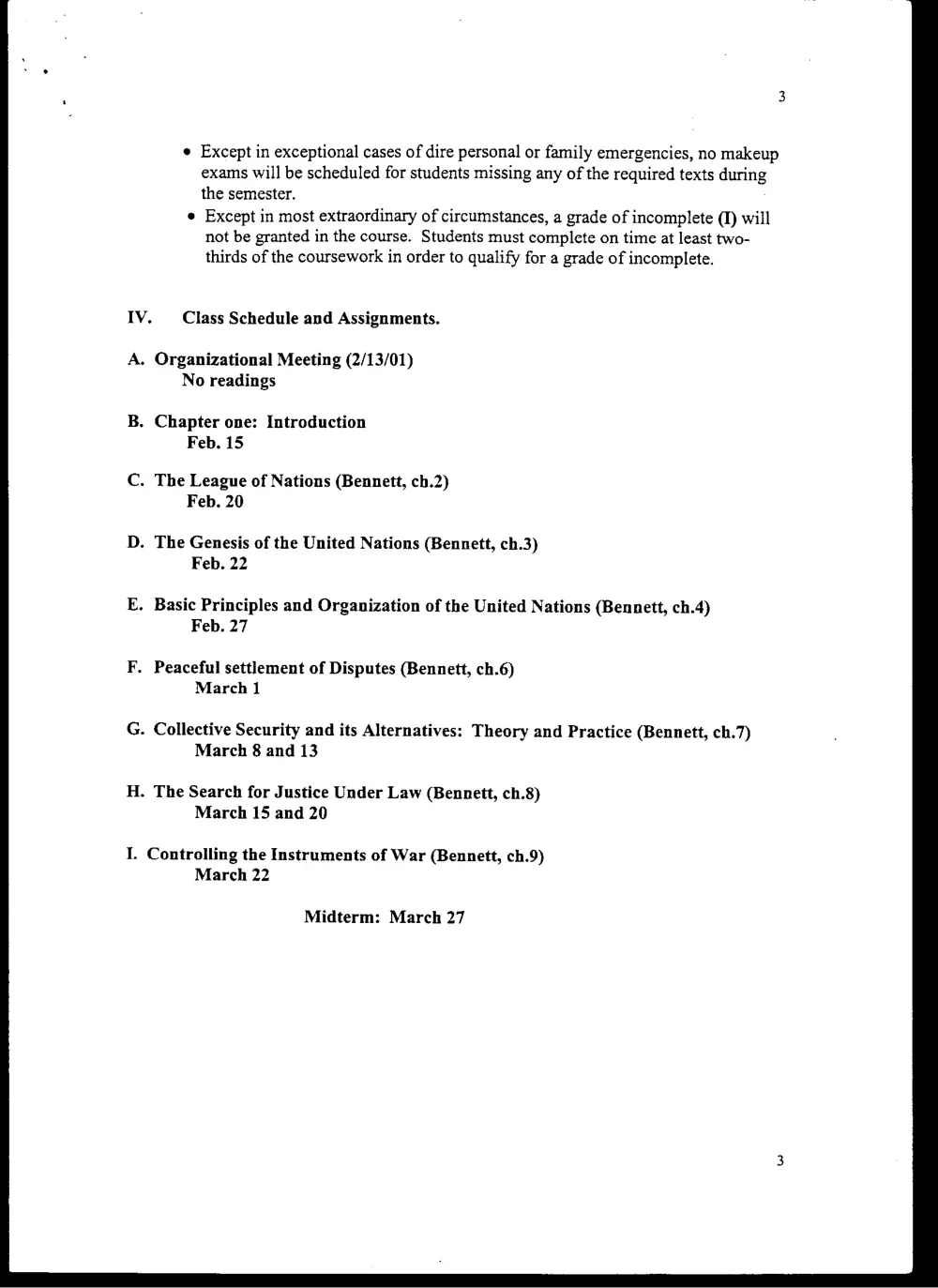
e Except in exceptional cases of dire personal or family emergencies, no makeup
exams will be scheduled for students missing any of the required texts during
the semester.
e Except in most extraordinary of circumstances, a grade of incomplete (1) will
not be granted in the course. Students must complete on time at least two-
thirds of the coursework in order to qualify for a grade of incomplete.
IV. Class Schedule and Assignments.
A. Organizational Meeting (2/13/01)
No readings
B. Chapter one: Introduction
Feb. 15
C. The League of Nations (Bennett, ch.2)
Feb. 20
D. The Genesis of the United Nations (Bennett, ch.3)
Feb. 22
E. Basic Principles and Organization of the United Nations (Bennett, ch.4)
Feb. 27
F. Peaceful settlement of Disputes (Bennett, ch.6)
March 1
G. Collective Security and its Alternatives: Theory and Practice (Bennett, ch.7)
March 8 and 13
H. The Search for Justice Under Law (Bennett, ch.8)
March 15 and 20
I. Controlling the Instruments of War (Bennett, ch.9)
March 22
Midterm: March 27
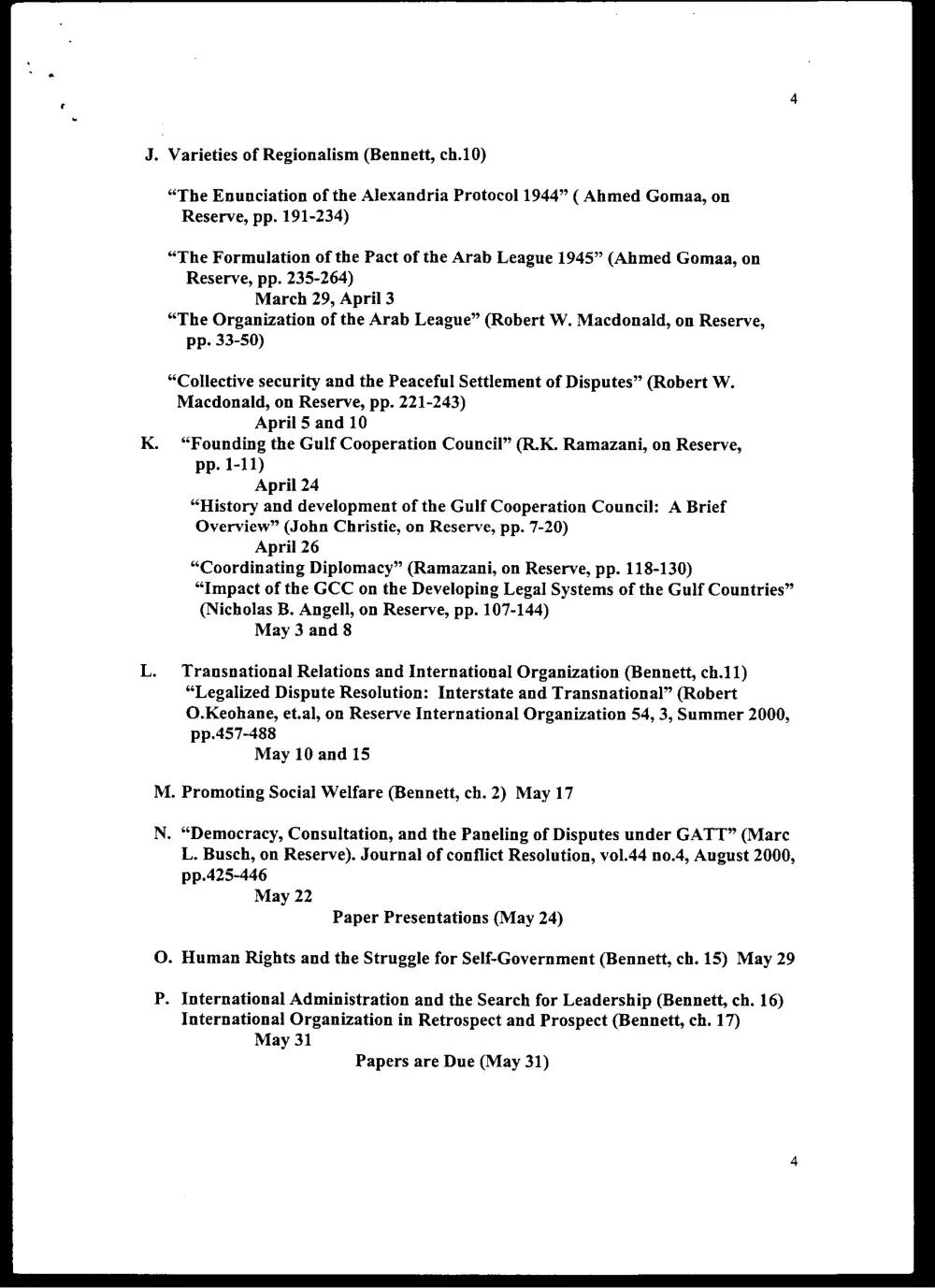
. Varieties of Regionalism (Bennett, ch.10)
K.
“The Enunciation of the Alexandria Protocol 1944” ( Anmed Gomaa, on
Reserve, pp. 191-234)
“The Formulation of the Pact of the Arab League 1945” (Ahmed Gomaa, on
Reserve, pp. 235-264)
March 29, April 3
“The Organization of the Arab League” (Robert W. Macdonald, on Reserve,
pp. 33-50)
“Collective security and the Peaceful Settlement of Disputes” (Robert W.
Macdonald, on Reserve, pp. 221-243)
April 5 and 10
“Founding the Gulf Cooperation Council” (R.K. Ramazani, on Reserve,
pp. 1-11)
April 24
“History and development of the Gulf Cooperation Council: A Brief
Overview” (John Christie, on Reserve, pp. 7-20)
April 26
“Coordinating Diplomacy” (Ramazani, on Reserve, pp. 118-130)
“Impact of the GCC on the Developing Legal Systems of the Gulf Countries”
(Nicholas B. Angell, on Reserve, pp. 107-144)
May 3 and 8
Transnational Relations and International Organization (Bennett, ch.11)
“Legalized Dispute Resolution: Interstate and Transnational” (Robert
O.Keohane, et.al, on Reserve International Organization 54, 3, Summer 2000,
pp.457-488
May 10 and 15
. Promoting Social Welfare (Bennett, ch. 2) May 17
. “Democracy, Consultation, and the Paneling of Disputes under GATT” (Mare
L. Busch, on Reserve). Journal of conflict Resolution, vol.44 no.4, August 2000,
pp.425-446
May 22
Paper Presentations (May 24)
. Human Rights and the Struggle for Self-Government (Bennett, ch. 15) May 29
. International Administration and the Search for Leadership (Bennett, ch. 16)
International Organization in Retrospect and Prospect (Bennett, ch. 17)
May 31
Papers are Due (May 31)