
SBHS 216 Final, Fall 1998
American University of Beirut · Arab Culture and Society · 8 pages

Show the text of this final exam
January 1999 SBS 216 Prof. M. Faour
Final Examination
Name:
(49 points) Part I. True or False
___ 1. The amount of mahr is affected by the age at which female marriage occurs.
2. Arabs have maintained intimate relationships with their close kin because the
extended family remains prevalent in Arab society,
3. Barakat argues that cultural norms assign family power to the father, but in real
life, the wife exercises power over the husband.
4. Arab family life has many aspects such as sentimentality, commitment, and claims
of self-denial.
___5. The use of rote learning (ra/gin) with children leads to dependency and equality.
___ 6. Polygamy is forbidden in Morocco.
7. The state is the most significant agency of socialization of the young in the Arab
countries.
_— 8. Residents of Addarb el-Ahmar hara in Cairo dislike individuals whose standards of
privacy (privacy of the the family/house) are high.
__ 9. Most families in Addarb el-thmar hara have no other relatives in the hara.
___ 10. In Addarb el-Ahmar, there is lack of differentiation of the use of space within the
lodging unit.
11. AAl el-sanaa engage in occupations that do not require technical skills.
12. Dreams of Trespass is a book written by Sherifa Zuhur.
13. In Dreams of Trespass. Muslim women fantasized about walking in unfamiliar
streets among men.
I4. In Dreams of Trespass. the author distinguishes between two types of harems:
“imperial” and “dynastic.”
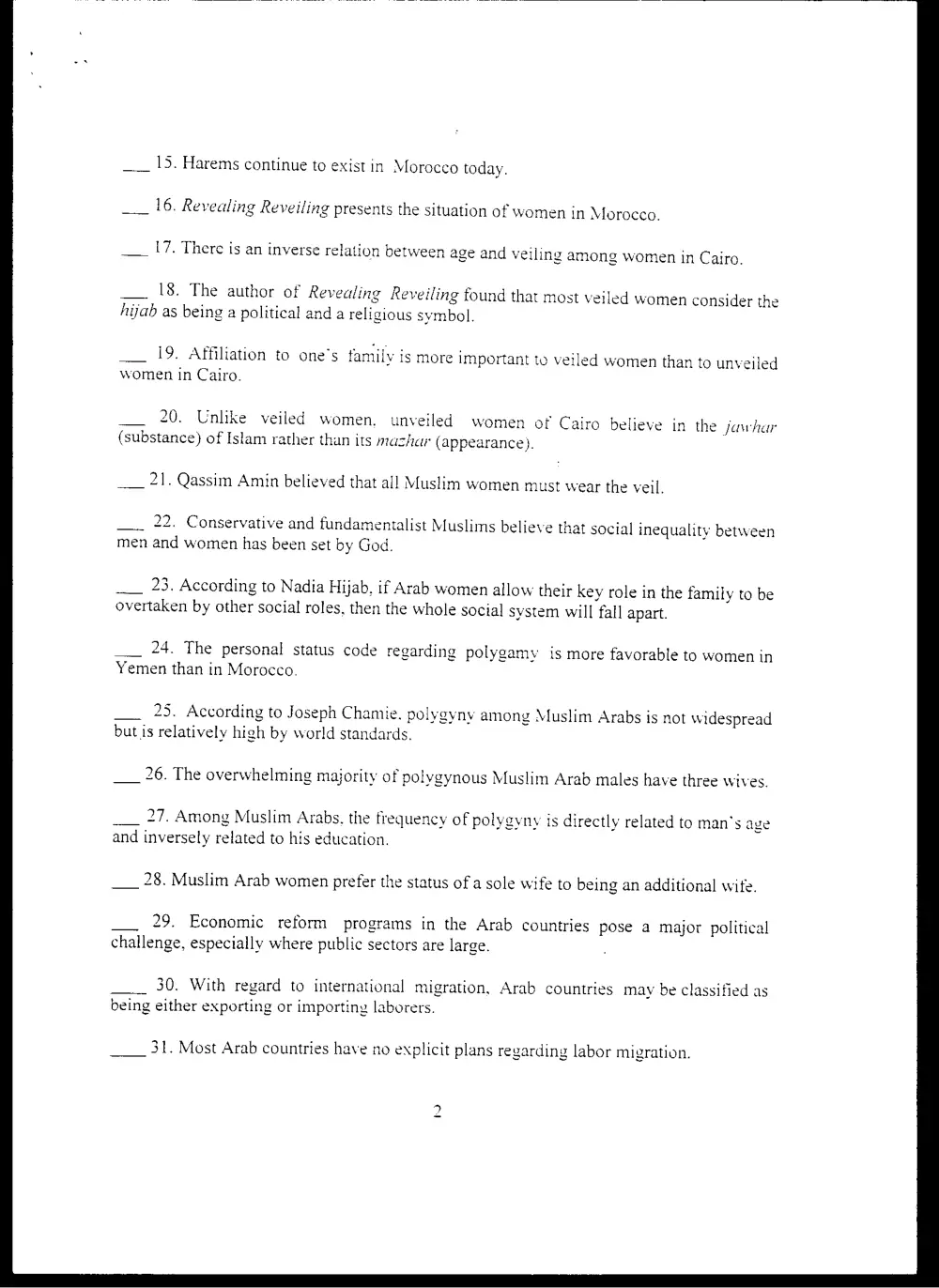
15. Harems continue to exist in Morocco today.
16. Revealing Reveiling presents the situation of women in Morocco.
(7. There is an inverse relation between age and veiling among women in Cairo.
__ 18. The author of Revealing Reveiling found that most veiled women consider the
hijab as being a political and a religious symbol.
19. Affiliation to one’s family is more important to veiled women than to unveiled
women in Cairo.
20. Unlike veiled women, unveiled women of Cairo believe in the jawher
(substance) of Islam rather than its mazhar (appearance).
21. Qassim Amin believed that all Muslim women must wear the veil.
22. Conservative and fundamentalist Muslims believe that social inequality between
men and women has been set by God.
__ 23. According to Nadia Hijab, if Arab women allow their key role in the family to be
overtaken by other social roles, then the whole social system will fall apart.
24. The personal status code regarding polygamy is more favorable to women in
Yemen than in Morocco.
25. According to Joseph Chamie. polygyny among Muslim Arabs is not widespread
but is relatively high by world standards.
26. The overwhelming majority of polygynous Muslim Arab males have three wives.
27. Among Muslim Arabs, the frequency of polygyny is directly related to man’s age
and inversely related to his education.
28. Muslim Arab women prefer the status of a sole wife to being an additional wife.
29. Economic reform programs in the Arab countries pose a major political
challenge, especially where public sectors are large.
30. With regard to international migration, Arab countries may be classified as
being either exporting or importing laborers.
31. Most Arab countries have no explicit plans regarding labor migration.
2
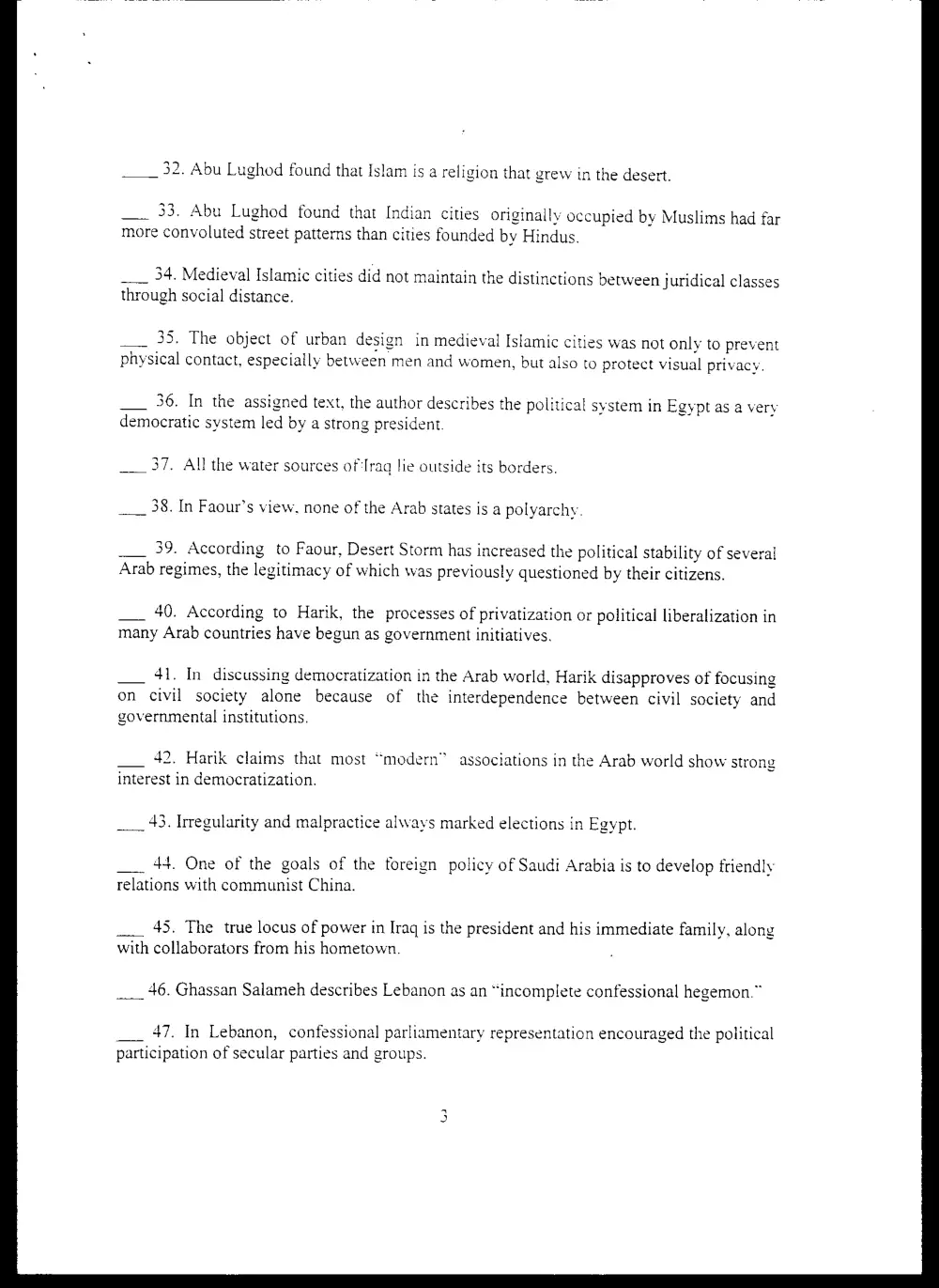
32. Abu Lughod found that Islam is a religion that grew in the desert.
___ 33. Abu Lughod found that Indian cities originally occupied by Muslims had far
more convoluted street patterns than cities founded by Hindus.
34. Medieval Islamic cities did not maintain the distinctions between juridical classes
through social distance.
35. The object of urban design in medieval Islamic cities was not only to prevent
physical contact, especially between men and women, but also to protect visual privacy.
36. In the assigned text, the author describes the political system in Egypt as a very
democratic system led by a strong president.
37. All the water sources of ‘Iraq lie outside its borders.
38. In Faour’s view. none of the Arab states is a polyarchy.
39. According to Faour, Desert Storm has increased the political stability of several
Arab regimes, the legitimacy of which was previously questioned by their citizens.
40. According to Harik, the processes of privatization or political liberalization in
many Arab countries have begun as government initiatives.
41. In discussing democratization in the Arab world, Harik disapproves of focusing
on ctvil society alone because of the interdependence between civil society and
governmental institutions.
42. Harik claims that most “modern” associations in the Arab world show strong
interest in democratization.
43. Irregularity and malpractice always marked elections in Egypt.
__ 44. One of the goals of the foreign policy of Saudi Arabia is to develop friendly
relations with communist China.
45. The true locus of power in Iraq is the president and his immediate family, along
with collaborators from his hometown.
46. Ghassan Salameh describes Lebanon as an “incomplete confessional hegemon.”
47, In Lebanon, confessional parliamentary representation encouraged the political
participation of secular parties and groups.
4
)
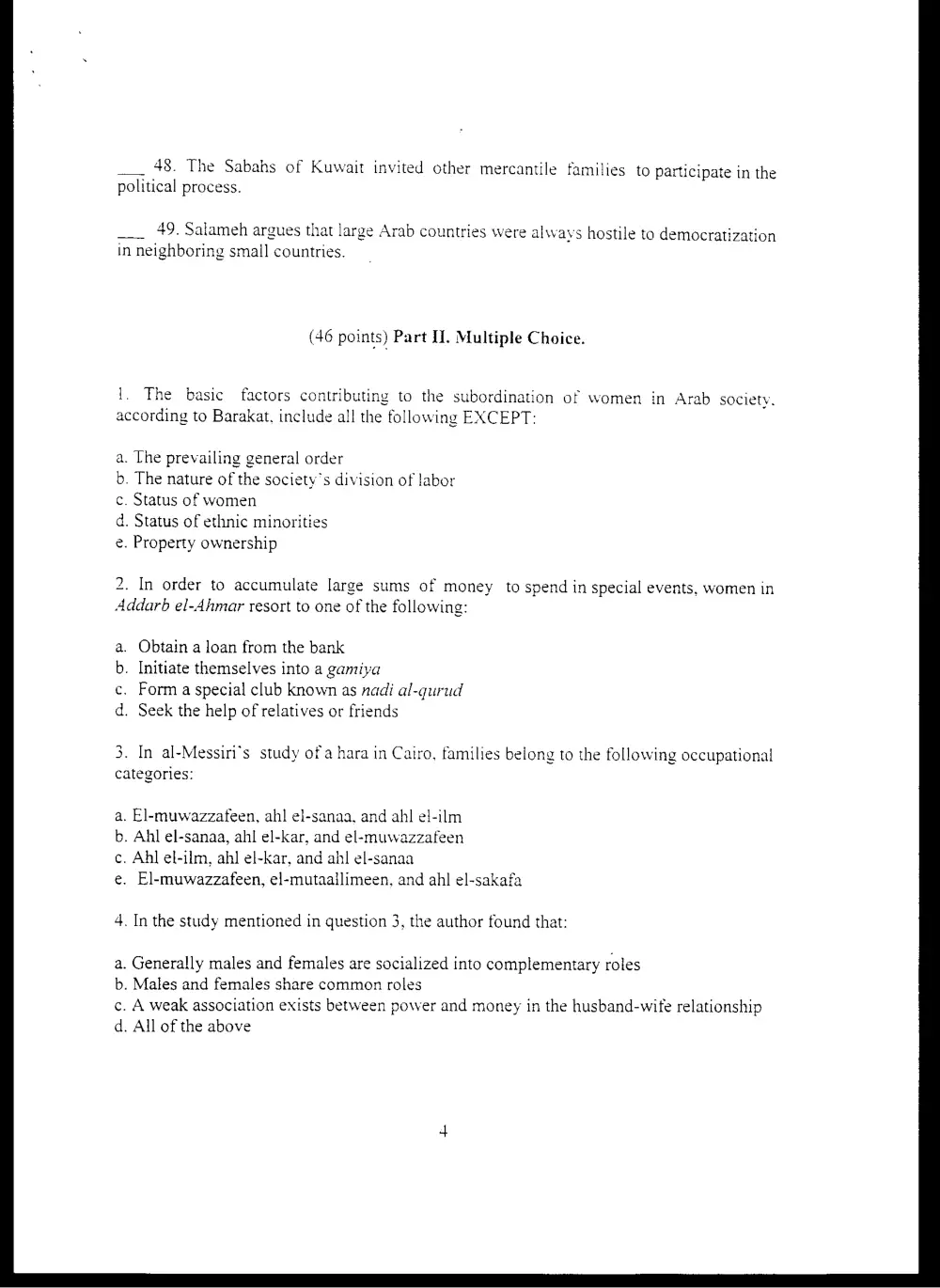
48. The Sabahs of Kuwait invited other mercantile families to participate in the
political process.
49. Salameh argues that large Arab countries were always hostile to democratization
in neighboring small countries.
(46 points) Part I. Multiple Choice.
1. The basic factors contributing to the subordination of women in Arab society.
according to Barakat, include all the following EXCEPT:
a. The prevailing general order
b. The nature of the society's division of labor
c. Status of women
d. Status of ethnic minorities
e. Property ownership
2. In order to accumulate large sums of money to spend in special events, women in
Addarb el-Ahmar resort to one of the following:
Obtain a loan from the bank
Initiate themselves into a gamiya
Form a special club known as nadi al-qurud
Seek the help of relatives or friends
aosep
4
3. In al-Messiri’s study of a hara in Cairo, families belong to the following occupational
categories:
. El-muwazzafeen, ah! el-sanaa, and ahl el-ilm
. Ahl el-sanaa, ahl el-kar, and el-muwazzafeen
. Ahl el-ilm, ahl el-kar, and ahl el-sanaa
El-muwazzafeen, el-mutaallimeen, and ahl el-sakafa
oaon7 fp
4. In the study mentioned in question 3, the author found that:
. Generally males and females are socialized into complementary roles
Males and females share common roles
A weak association exists between power and money in the husband-wife relationship
All of the above
a
b.
c.
d.
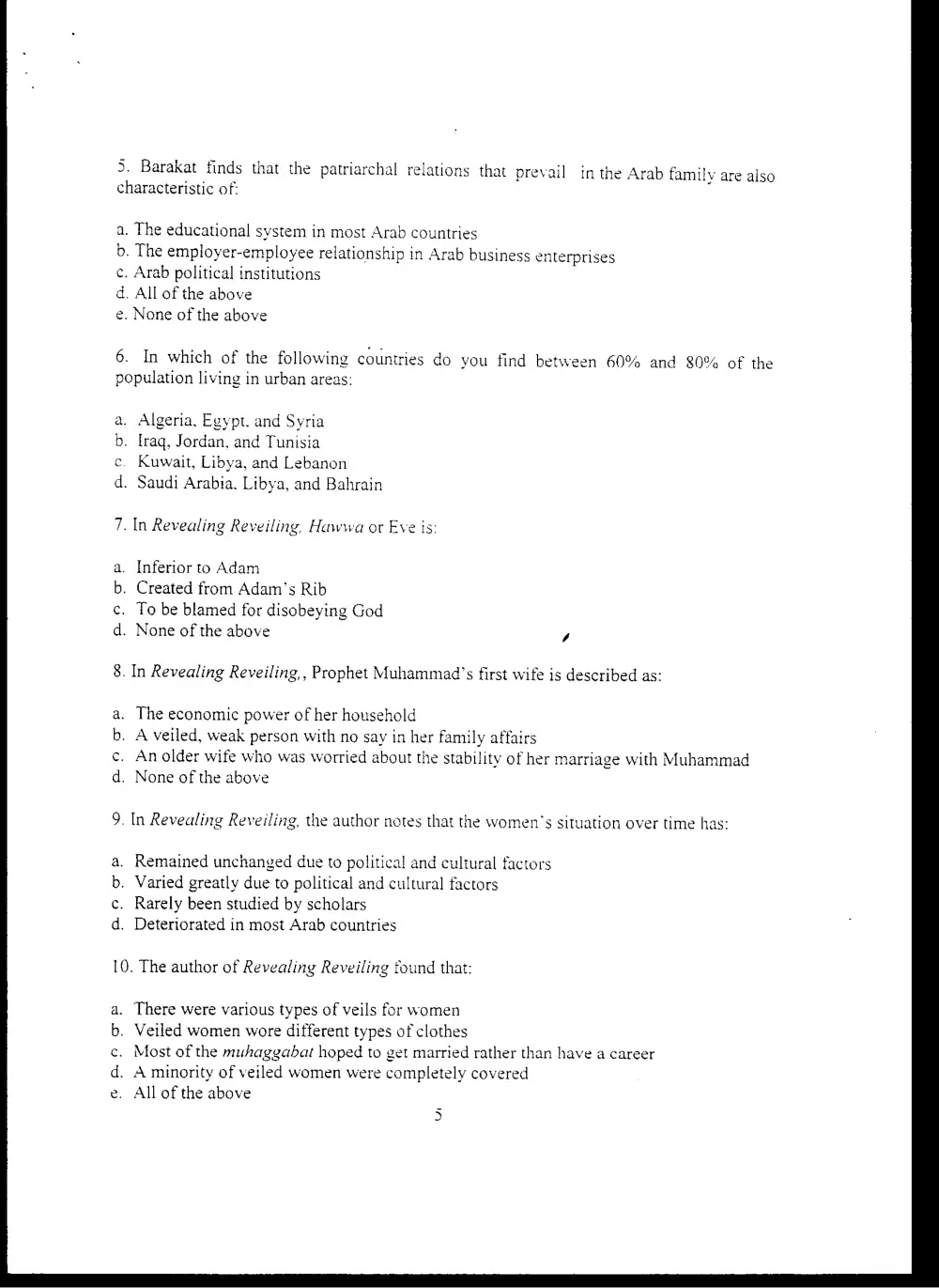
5. Barakat finds that the patriarchal relations that prevail in the Arab family are also
characteristic of:
a. The educational system in most Arab countries
b. The employer-employee relationship in Arab business enterprises
c. Arab political institutions
d. All of the above
e. None of the above
6. In which of the following countries do you find between 60% and 80% of the
population living in urban areas:
Algeria, Egypt. and Syria
. traq, Jordan, and Tunisia
Kuwait, Libya, and Lebanon
. Saudi Arabia. Libya, and Bahrain
aoa
7. In Revealing Reveiling, Hawwa or Eve is:
a. Inferior to Adam
b. Created from Adam’s Rib
c. To be blamed for disobeying God
d. None of the above ,
8. In Revealing Reveiling,, Prophet Muhammad's first wife is described as:
a. The economic power of her household
b. A veiled, weak person with no say in her family affairs
c. An older wife who was worried about the stability of her marriage with Muhammad
d. None of the above
9. In Revealing Reveiling, the author notes that the women’s situation over time has:
a. Remained unchanged due to political and cultural factors
b. Varied greatly due to political and cultural factors
c. Rarely been studied by scholars
d. Deteriorated in most Arab countries
10. The author of Revealing Reveiling found that:
There were various types of veils for women
Veiled women wore different types of clothes
Most of the muhaggabat hoped to get married rather than have a career
A minority of veiled women were completely covered
All of the above
TROT Pp
5
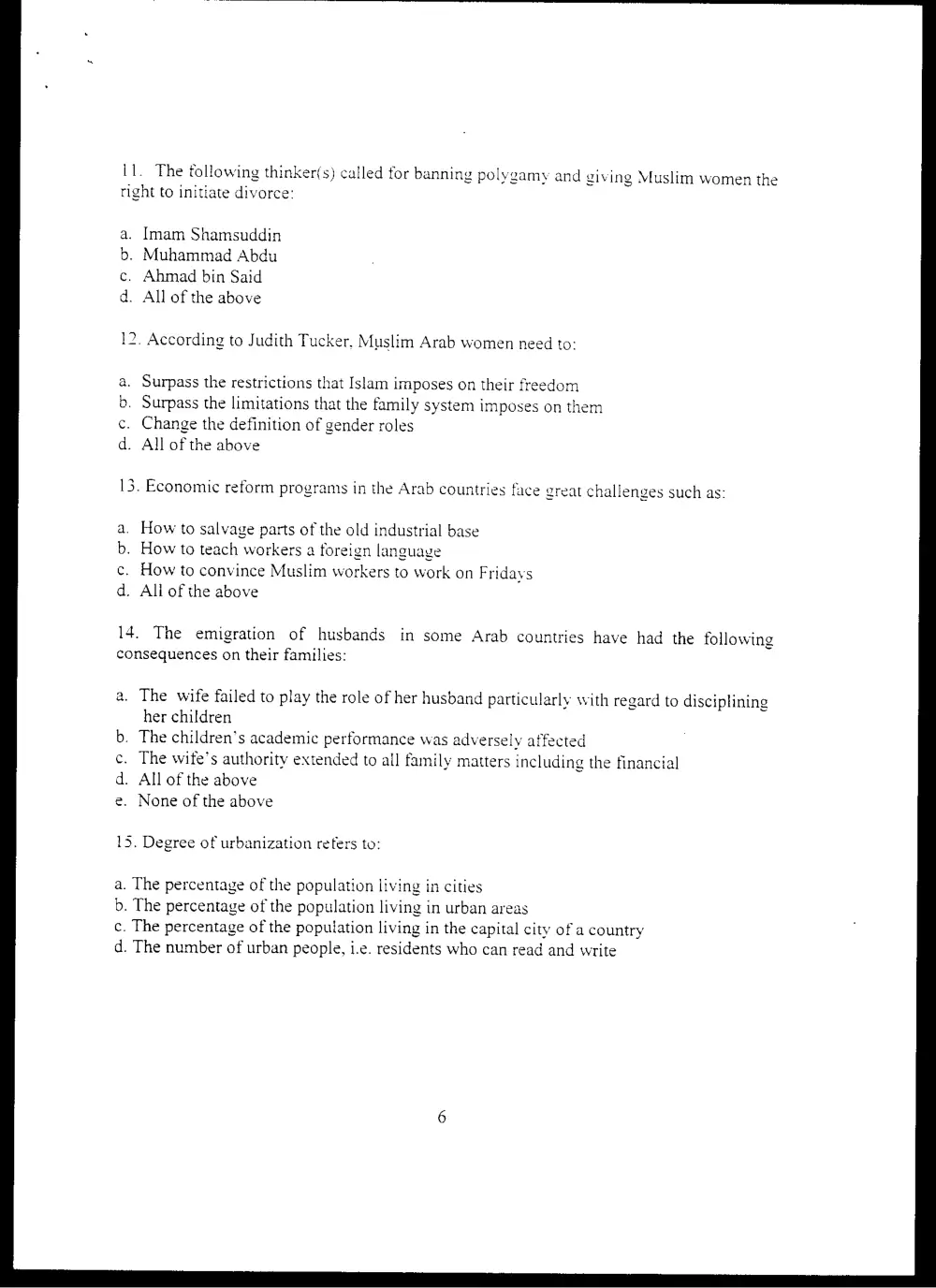
11. The following thinker(s) called for banning polygamy and giving Muslim women the
right to initiate divorce:
a. Imam Shamsuddin
b. Muhammad Abdu
c. Ahmad bin Said
d. All of the above
12. According to Judith Tucker, Muslim Arab women need to:
a. Surpass the restrictions that Islam imposes on their freedom
b. Surpass the limitations that the family system imposes on them
c. Change the definition of gender roles
d. All of the above
13. Economic reform programs in the Arab countries face great challenges such as:
a. How to salvage parts of the old industrial base
b. How to teach workers a foreign language
c. How to convince Muslim workers to work on Fridays
d. All of the above
14. The emigration of husbands in some Arab countries have had the following
consequences on their families:
a. The wife failed to play the role of her husband particularly with regard to disciplining
her children
b. The children’s academic performance was adversely affected
c. The wite’s authority extended to all family matters including the financial
d. All of the above
e. None of the above
15. Degree of urbanization reters to:
a. The percentage of the population living in cities
b. The percentage of the population living in urban areas
c. The percentage of the population living in the capital city of a country
d. The number of urban people, i.e. residents who can read and write
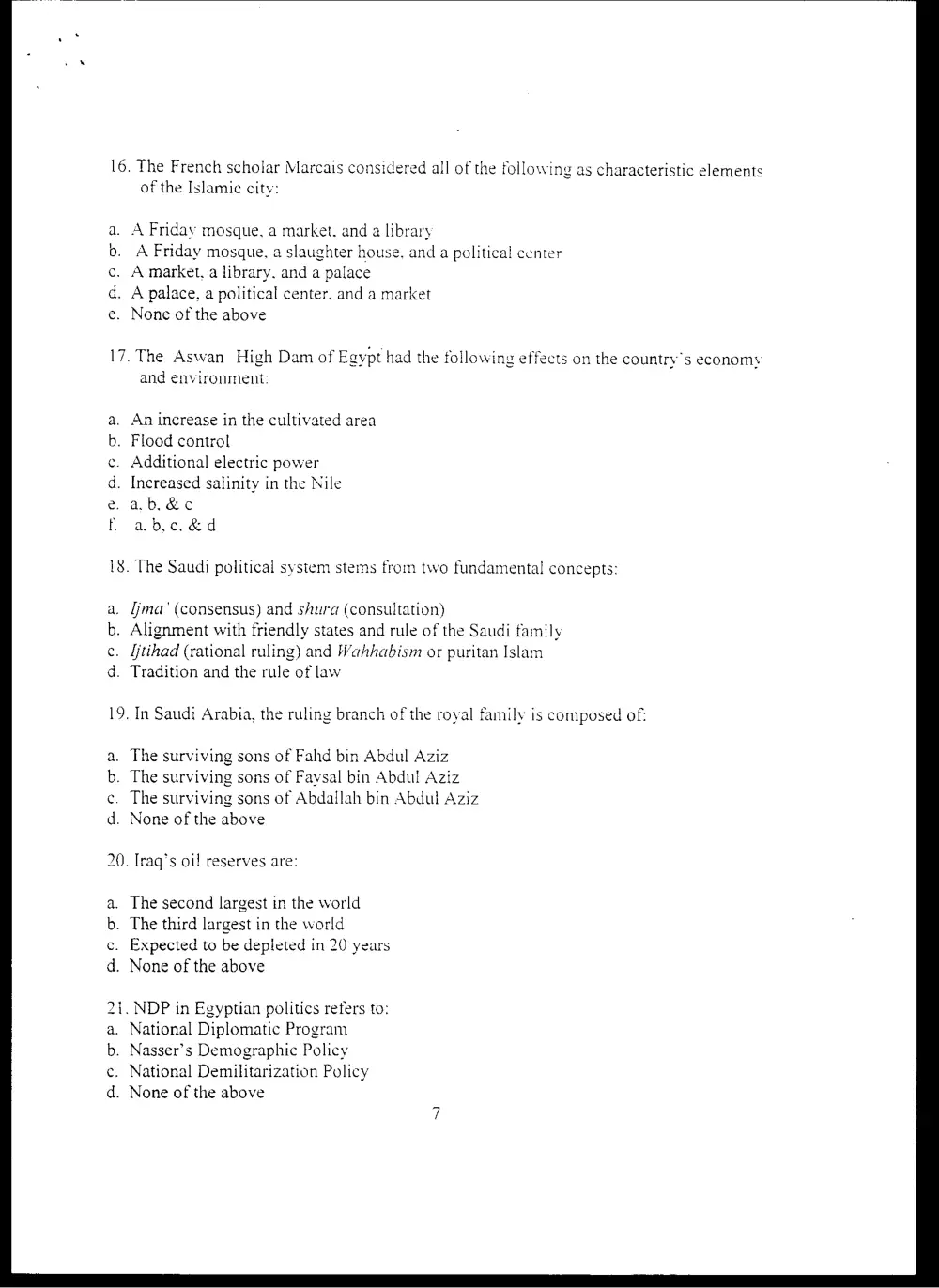
16. The French scholar Marcais considered all of the following as characteristic elements
of the Islamic city:
a. A Friday mosque, a market, and a library
b. A Friday mosque, a slaughter house. and a political center
c. A market, a library. and a palace
d. A palace, a political center. and a market
e. None of the above
17. The Aswan High Dam of Egypt had the following effects on the country’s economy
and environment:
a. An increase in the cultivated area
b. Flood control
c. Additional electric power
d. Increased salinity in the Nile
e ab&ec
ho abe&d
18. The Saudi political system stems from two fundamental concepts:
a. [jma’ (consensus) and shwra (consultation)
b. Alignment with friendly states and rule of the Saudi family
c. Utihad (rational ruling) and Wahhabism or puritan Islam
d. Tradition and the rule of law
19. In Saudi Arabia, the ruling branch of the royal family is composed of:
The surviving sons of Fahd bin Abdul Aziz
The surviving sons of Faysal bin Abdul Aziz
The surviving sons of Abdallah bin Abdul Aziz
None of the above
aoe
20. Iraq’s oi! reserves are:
a. The second largest in the world
b. The third largest in the world
c. Expected to be depleted in 20 years
d. None of the above
21. NDP in Egyptian politics refers to:
a. National Diplomatic Program
b. Nasser’s Demographic Policy
c. National Demilitarization Policy
d. None of the above
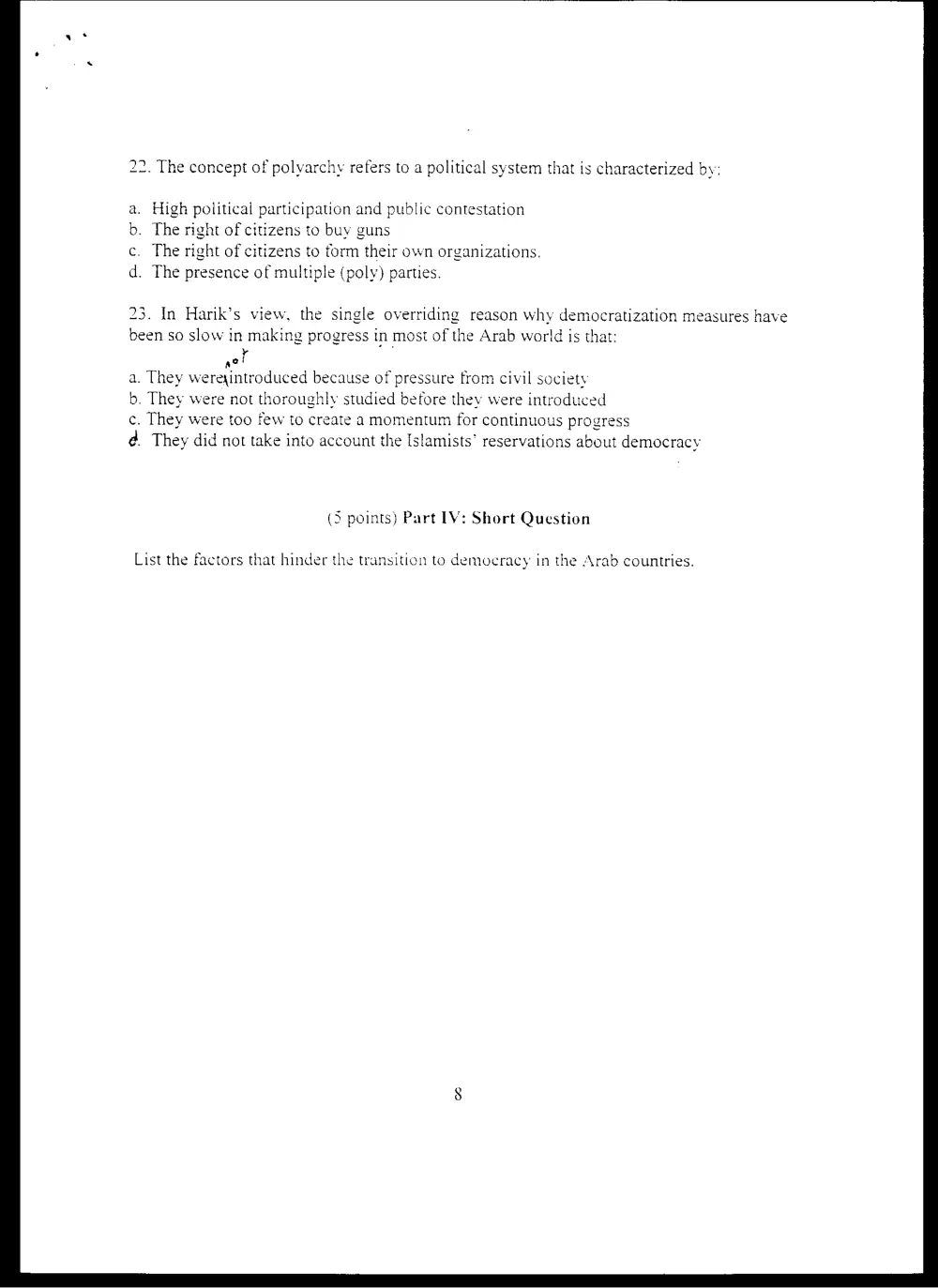
22. The concept of polyarchy refers to a political system that is characterized by:
a. High political participation and public contestation
b. The right of citizens to buy guns
c. The right of citizens to form their own organizations.
d. The presence of multiple (poly) parties.
23. In Harik’s view, the single overriding reason why democratization measures have
been so slow in making progress in most of the Arab world is that:
y
aol
a. They wereyintroduced because of pressure from civil society
b. They were not thoroughly studied before they were introduced
c. They were too few to create a momentum for continuous progress
é They did not take into account the Islamists’ reservations about democracy
(5 points) Part IV: Short Question
List the factors that hinder the transition to democracy in the Arab countries.