
STAT 230 Syllabus, Spring 2020
American University of Beirut · Introduction to Probability and Random Variables · 2 pages

More STAT 230 files
- Lecture 4- Chapter 2.4 · Spring 2019LabView
- Lecture 4- Examples About Chapters 2.4 · Spring 2019LabView
- Lecture 2- Chapters 2.1 & 2.2 · Spring 2019LabView
- Lecture 1- Chapter 1 · Spring 2019LabView
- Lecture 3- Chapters 2.1, 2.2 & 2.4 · Spring 2019LabView
- Syllabus · Spring 2016LabView
- Lecture Chapter 1.3 · Summer 2015LabView
- Lecture Chapter 1.1 · Summer 2015LabView
Show the text of this lab
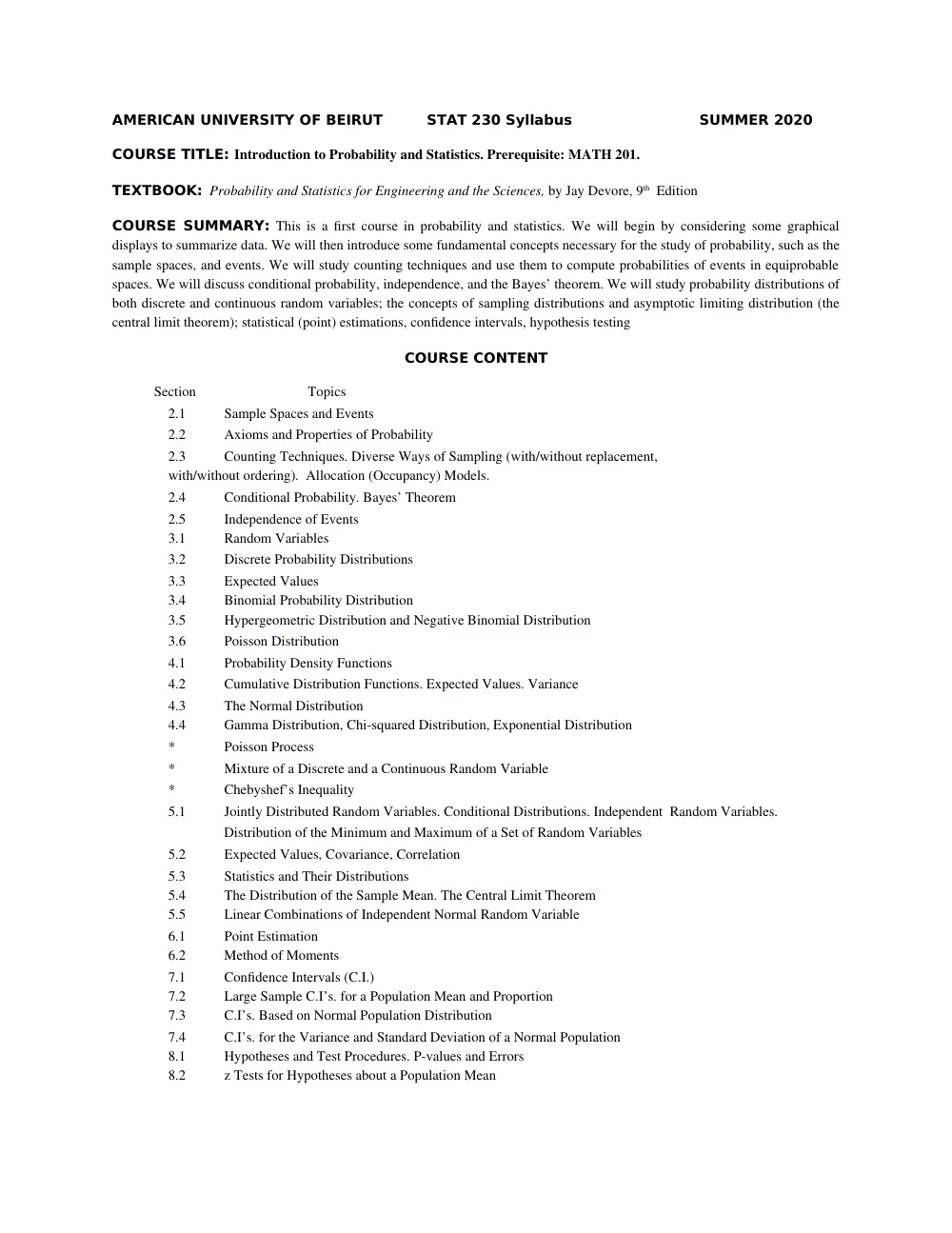
AMERICAN UNIVERSITY OF BEIRUT STAT 230 Syllabus SUMMER 2020
COURSE TITLE: Introduction to Probability and Statistics. Prerequisite: MATH 201.
TEXTBOOK: Probability and Statistics for Engineering and the Sciences, by Jay Devore, 9th Edition
COURSE SUMMARY: This is a first course in probability and statistics. We will begin by considering some graphical
displays to summarize data. We will then introduce some fundamental concepts necessary for the study of probability, such as the
sample spaces, and events. We will study counting techniques and use them to compute probabilities of events in equiprobable
spaces. We will discuss conditional probability, independence, and the Bayes’ theorem. We will study probability distributions of
both discrete and continuous random variables; the concepts of sampling distributions and asymptotic limiting distribution (the
central limit theorem); statistical (point) estimations, confidence intervals, hypothesis testing
COURSE CONTENT
Section Topics
2.1
Sample Spaces and Events
2.2
Axioms and Properties of Probability
2.3
Counting Techniques. Diverse Ways of Sampling (with/without replacement,
with/without ordering). Allocation (Occupancy) Models.
2.4
Conditional Probability. Bayes’ Theorem
2.5
Independence of Events
3.1
Random Variables
3.2
Discrete Probability Distributions
3.3
Expected Values
3.4
Binomial Probability Distribution
3.5
Hypergeometric Distribution and Negative Binomial Distribution
3.6
Poisson Distribution
4.1
Probability Density Functions
4.2
Cumulative Distribution Functions. Expected Values. Variance
4.3
The Normal Distribution
4.4
Gamma Distribution, Chi-squared Distribution, Exponential Distribution
*
Poisson Process
*
Mixture of a Discrete and a Continuous Random Variable
*
Chebyshef’s Inequality
5.1
Jointly Distributed Random Variables. Conditional Distributions. Independent Random Variables.
Distribution of the Minimum and Maximum of a Set of Random Variables
5.2
Expected Values, Covariance, Correlation
5.3
Statistics and Their Distributions
5.4
The Distribution of the Sample Mean. The Central Limit Theorem
5.5
Linear Combinations of Independent Normal Random Variable
6.1
Point Estimation
6.2 Method of Moments
7.1
Confidence Intervals (C.I.)
7.2
Large Sample C.I’s. for a Population Mean and Proportion
7.3
C.I’s. Based on Normal Population Distribution
7.4
C.I’s. for the Variance and Standard Deviation of a Normal Population
8.1
Hypotheses and Test Procedures. P-values and Errors
8.2
z Tests for Hypotheses about a Population Mean
8.3
The One-Sample t Test
8.4
Tests Concerning a Population Proportion
Suggested Problems
Chapter 1: 11,22,25,33,35,39,40-44,49,50,55,57,58,61,68,69,74,78
Chapter 2: 1-5, 7-9, 11-13, 15-22, 24-32, 34-53, 55-75, 77-90, 92, 95, 103, 109, 110, 112-114
Chapter 3: 2, 4-10, 12-15, 17-19, 23, 24, 27-30, 32-38, 42, 44, 45, 47-50, 52, 55-57, 59-63, 66-70, 72, 73, 75-81, 83,
85, 86, 88, 91, 92, 96, 97, 99, 102, 107, 111, 113, 114, 117
Chapter 4: 1-13, 15-22, 24, 26, 28-32, 35-38, 40-42, 44, 46-48, 51, 52, 55, 57, 59, 60, 62-65, 67, 69, 71, 99, 100,
106, 107, 114, 117
Chapter 5: 1, 3, 4, 6-13, 15, 20-28, 30, 33, 35-38, 41, 46, 47, 49-60, 62, 64-68, 72-75, 77, 84, 90, 92, 97, 98
Chapter 6: 1-4, 8, 10, 12, 13, 15, 17, 18, 21, 22, 32 (a), 34
Chapter 7: 1-7, 11-14, 16, 19, 22, 23, 25, 29-34, 42-46, 50, 51, 54, 55
Chapter 8: 1, 2, 5-9,, 11, 13, 14-16, 18-22, 24-26, 29, 30, 33-35, 38, 39, 41-45, 48, 49, 51, 52, 65, 66, 69, 76, 77
GRADING POLICY: The assessment will be based on two tests. The percentages will depend on the content covered in the final test. Should
the final test be cumulative, the weights for the first and second tests will be (.4, .6). Otherwise the tests will have equal weights.
Unique Learning Needs of Students with Disabilities. AUB strives to make learning experiences as accessible
as possible. If you anticipate or experience academic barriers due to a disability (including mental health, chronic
or temporary medical conditions), please inform your lecturer immediately so that we can privately discuss
options. In order to help establish reasonable accommodations and facilitate a smooth accommodation process,
you are encouraged to contact the Accessible Education Office: accessibility@aub.edu.lb; +961-1-350000, x3246;
West Hall, 314.
Academic Integrity. Please refer to AUBStudent Code of Conduct
http://www.aub.edu.lb/pnp/generaluniversitypolicies/Documents/StudentCodeConduct/StudentCodeConduct.pdf , in particular to
section 1.1, which concerns academic misconduct including cheating, plagiarism, in-class disruption, and dishonesty. Please be
aware that misconduct is vigorously prosecuted and that AUB has a zero tolerance policy. Course policy is that credible evidence
of cheating will result in course failure.
Non-Discrimination. AUB is committed to facilitating a campus free of all forms of discrimination including sex/
gender-based harassment prohibited by Title IX. The University’s non-discrimination policy applies to, and
protects, all students, faculty, and staff. If you think you have experienced discrimination or harassment, including
sexual misconduct, we encourage you to tell someone promptly. If you speak to a faculty or staff member about an
issue such as harassment, sexual violence, or discrimination, the information will be kept as private as possible,
however, faculty and designated staff are required to bring it to the attention of the University’s Title IX
Coordinator. Faculty can refer you to fully confidential resources, and you can find information and contacts at
www.aub.edu.lb/titleix . To report an incident, contact the University's Title IX Coordinator Trudi Hodges at 01-
350000 ext. 2514, or titleix@aub.edu.lb . An anonymous report may be submitted online via EthicsPoint at
www.aub.ethicspoint.com