
STAT 234 Final, Fall 2005
American University of Beirut · Introduction to Statistical Inference · 1 page
Stuck on a question? A tutor can walk you through it.
More STAT 234 files
Show the text of this final exam
STAT 234
Final Exam
Feb 2, 2006
Time = 1 hour
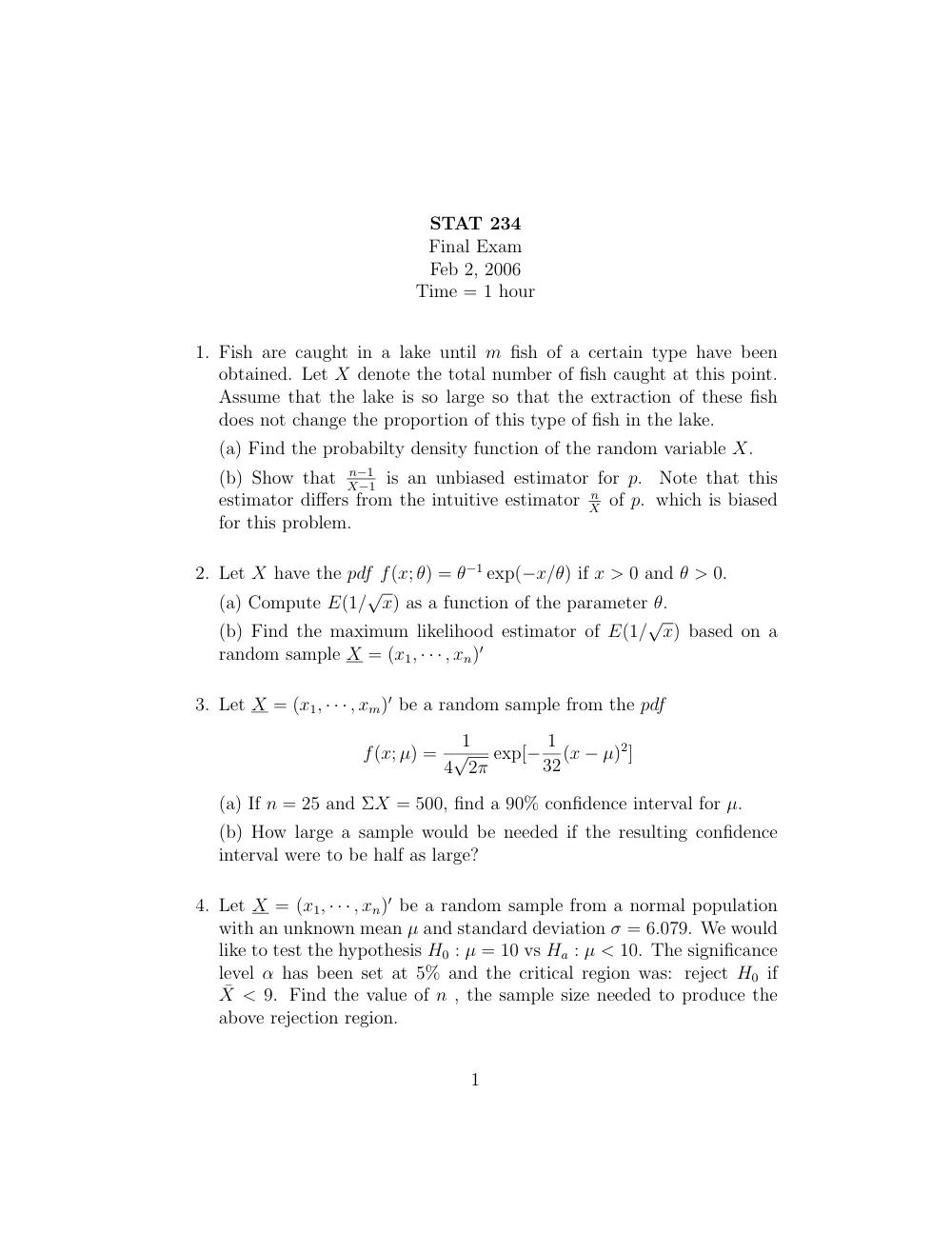
1. Fish are caught in a lake until m fish of a certain type have been
obtained. Let X denote the total number of fish caught at this point.
Assume that the lake is so large so that the extraction of these fish
does not change the proportion of this type of fish in the lake.
(a) Find the probabilty density function of the random variable X.
(b) Show that
n−1
X−1 is an unbiased estimator for p.
Note that this
estimator differs from the intuitive estimator
n
X of p. which is biased
for this problem.
2. Let X have the pdf f(x; θ) = θ−1 exp(−x/θ) if x > 0 and θ > 0.
(a) Compute E(1/√x) as a function of the parameter θ.
(b) Find the maximum likelihood estimator of E(1/√x) based on a
random sample X = (x1, · · · , xn)′
3. Let X = (x1, · · · , xm)′ be a random sample from the pdf
f(x; µ) =
1
4
√
2π exp[− 1
32(x − µ)2]
(a) If n = 25 and ΣX = 500, find a 90% confidence interval for µ.
(b) How large a sample would be needed if the resulting confidence
interval were to be half as large?
4. Let X = (x1, · · · , xn)′ be a random sample from a normal population
with an unknown mean µ and standard deviation σ = 6.079. We would
like to test the hypothesis H0 : µ = 10 vs Ha : µ < 10. The significance
level α has been set at 5% and the critical region was: reject H0 if
¯X < 9. Find the value of n , the sample size needed to produce the
above rejection region.
1