
STAT 236 Final, Spring 2000
American University of Beirut · Sampling Techniques · 1 page
Stuck on a question? A tutor can walk you through it.
More STAT 236 files
Show the text of this final exam
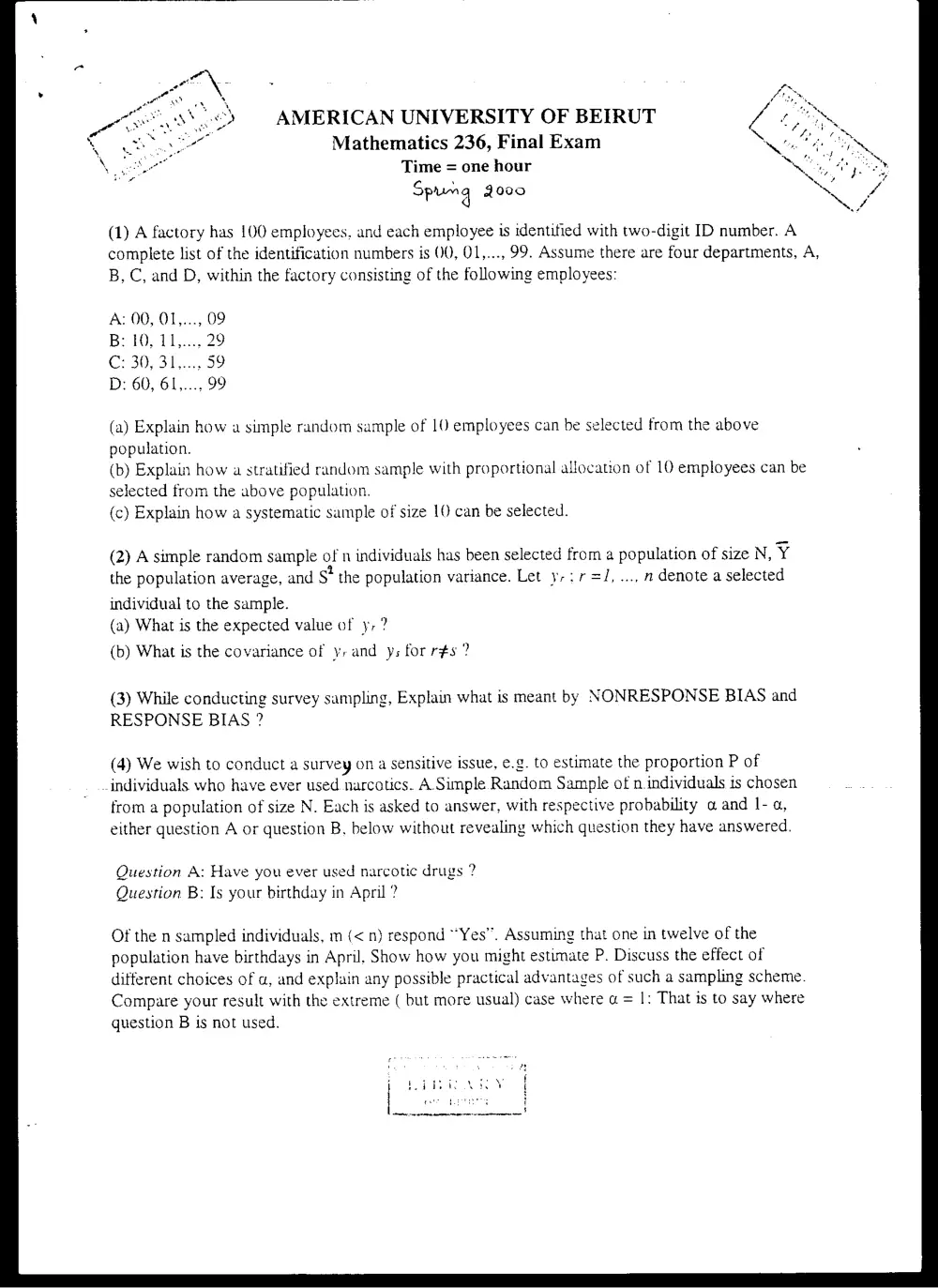
AMERICAN UNIVERSITY OF BEIRUT
Mathematics 236, Final Exam
Time = one hour
Spung Qoo0o
(1) A factory has 100 employees, and each employee is identified with two-digit ID number. A
complete list of the identification numbers is 00, 01,..., 99. Assume there are four departments, A,
B, C, and D, within the factory consisting of the following employees:
A: 00, O1,..., 09
B: 10, 11,..., 29
C: 30, 31,..., 59
D: 60, 61,..., 99
(a) Explain how a simple random sample of 10 employees can be selected from the above
population.
(b) Explain how a stratified random sample with proportional allocation of 10 employees can be
selected from the above population.
(c) Explain how a systematic sample of size 1() can be selected.
(2) A simple random sample of n individuals has been selected from a population of size N, Y
the population average, and S* the population variance. Let y,:r =I, ..., n denote a selected
individual to the sample.
(a) What is the expected value of y,?
(b) What is the covariance of y, and ys for r#s ?
(3) While conducting survey sampling, Explain what is meant by NONRESPONSE BIAS and
RESPONSE BIAS ?
(4) We wish to conduct a survey on a sensitive issue, e.g. to estimate the proportion P of
individuals who have ever used narcotics. A-Simple Random Sample of n individuals is chosen
from a population of size N. Each is asked to answer, with respective probability a and I- a,
either question A or question B. below without revealing which question they have answered.
Question A: Have you ever used narcotic drugs ?
Question B: Is your birthday in April ?
Of the n sampled individuals, m (<n) respond “Yes”. Assuming that one in twelve of the
population have birthdays in April, Show how you might estimate P. Discuss the effect of
different choices of a, and explain any possible practical advantages of such a sampling scheme.
Compare your result with the extreme ( but more usual) case where « = 1: That is to say where
question B is not used.