
BIO 101 Lecture 101, Fall 2017
American University of Science and Technology · Introduction to Biology · 6 pages
More BIO 101 files
Show the text of this lab
Topic 8
Gene Activity: How Genes Work
Function of Genes
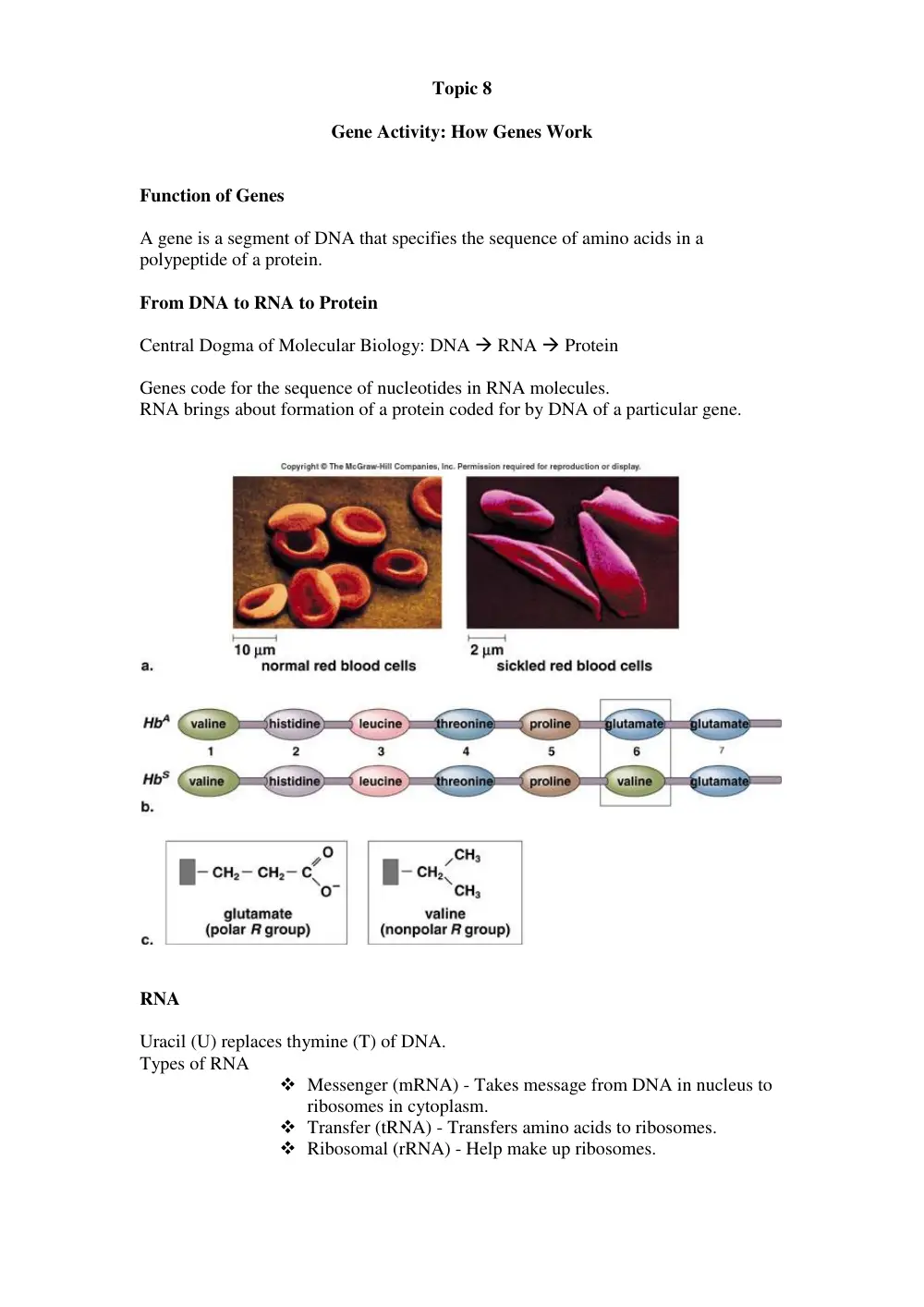
A gene is a segment of DNA that specifies the sequence of amino acids in a
polypeptide of a protein.
From DNA to RNA to Protein
Central Dogma of Molecular Biology: DNA RNA Protein
Genes code for the sequence of nucleotides in RNA molecules.
RNA brings about formation of a protein coded for by DNA of a particular gene.
RNA
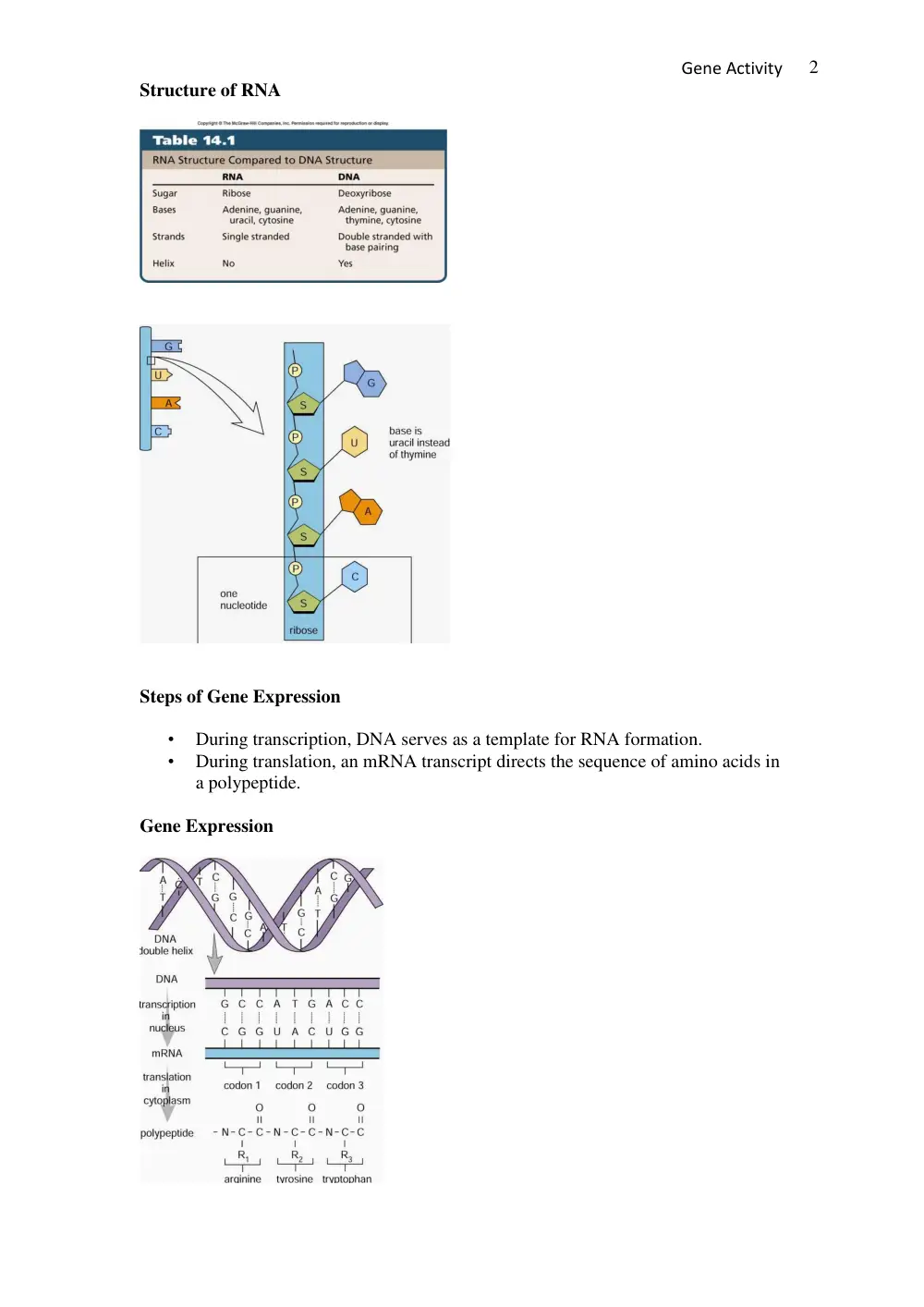
Uracil (U) replaces thymine (T) of DNA.
Types of RNA
Messenger (mRNA) - Takes message from DNA in nucleus to
ribosomes in cytoplasm.
Transfer (tRNA) - Transfers amino acids to ribosomes.
Ribosomal (rRNA) - Help make up ribosomes.
Gene Activity
2
Structure of RNA
Steps of Gene Expression
•
During transcription, DNA serves as a template for RNA formation.
•
During translation, an mRNA transcript directs the sequence of amino acids in
a polypeptide.
Gene Expression
Gene Activity
3
The Genetic Code
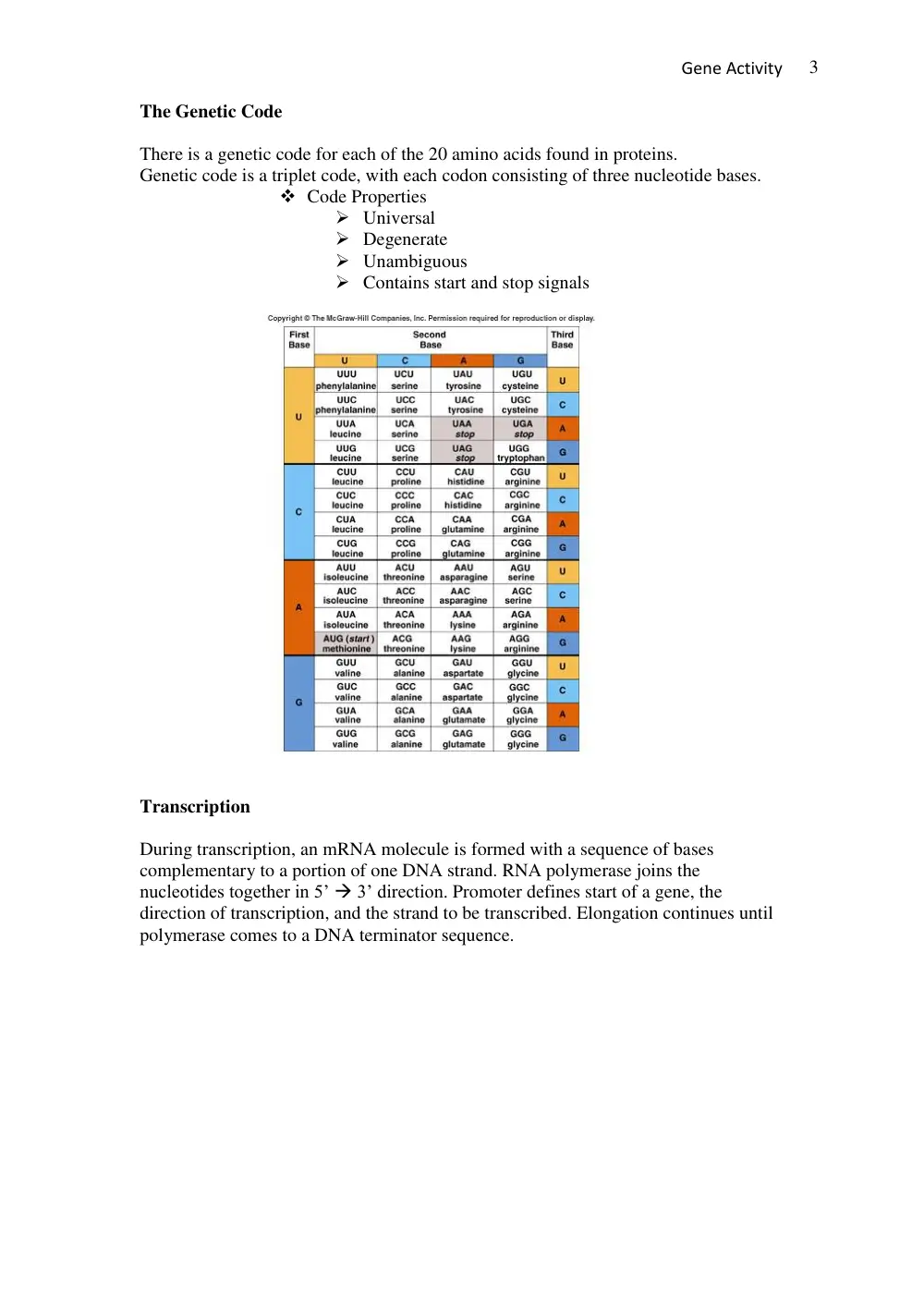
There is a genetic code for each of the 20 amino acids found in proteins.
Genetic code is a triplet code, with each codon consisting of three nucleotide bases.
Code Properties
Universal
Degenerate
Unambiguous
Contains start and stop signals
Transcription
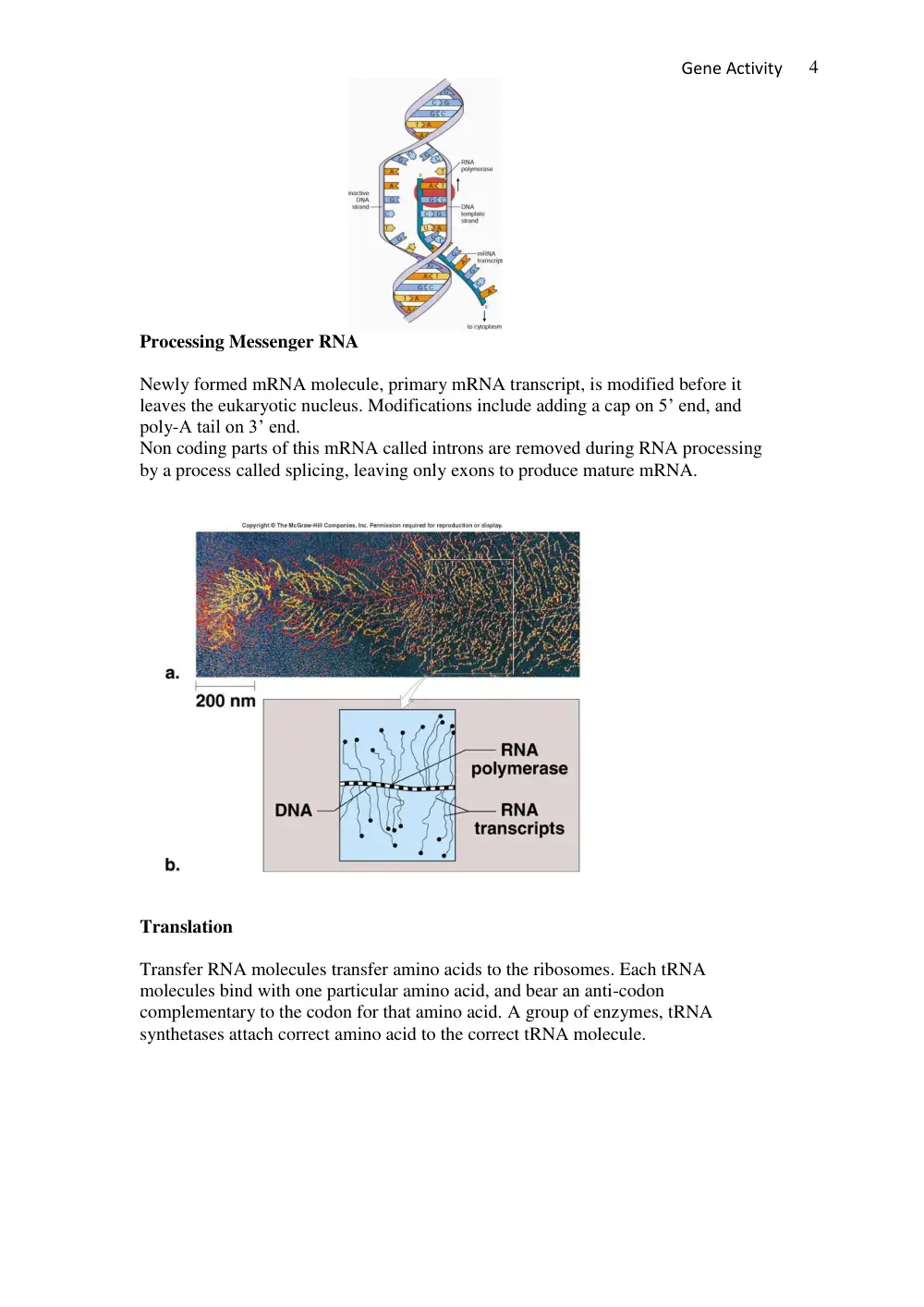
During transcription, an mRNA molecule is formed with a sequence of bases
complementary to a portion of one DNA strand. RNA polymerase joins the
nucleotides together in 5’ 3’ direction. Promoter defines start of a gene, the
direction of transcription, and the strand to be transcribed. Elongation continues until
polymerase comes to a DNA terminator sequence.
Gene Activity
4
Processing Messenger RNA
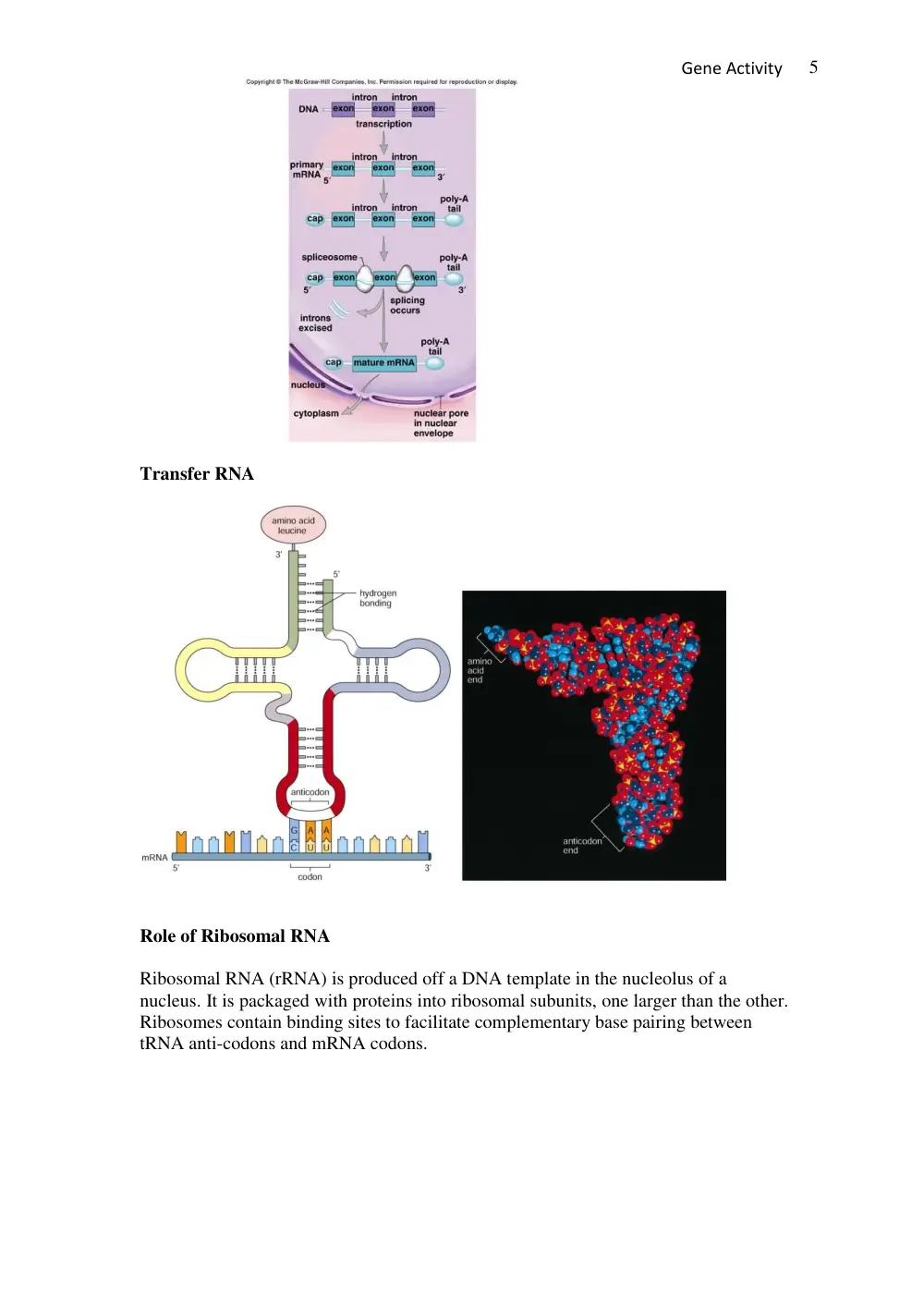
Newly formed mRNA molecule, primary mRNA transcript, is modified before it
leaves the eukaryotic nucleus. Modifications include adding a cap on 5’ end, and
poly-A tail on 3’ end.
Non coding parts of this mRNA called introns are removed during RNA processing
by a process called splicing, leaving only exons to produce mature mRNA.
Translation
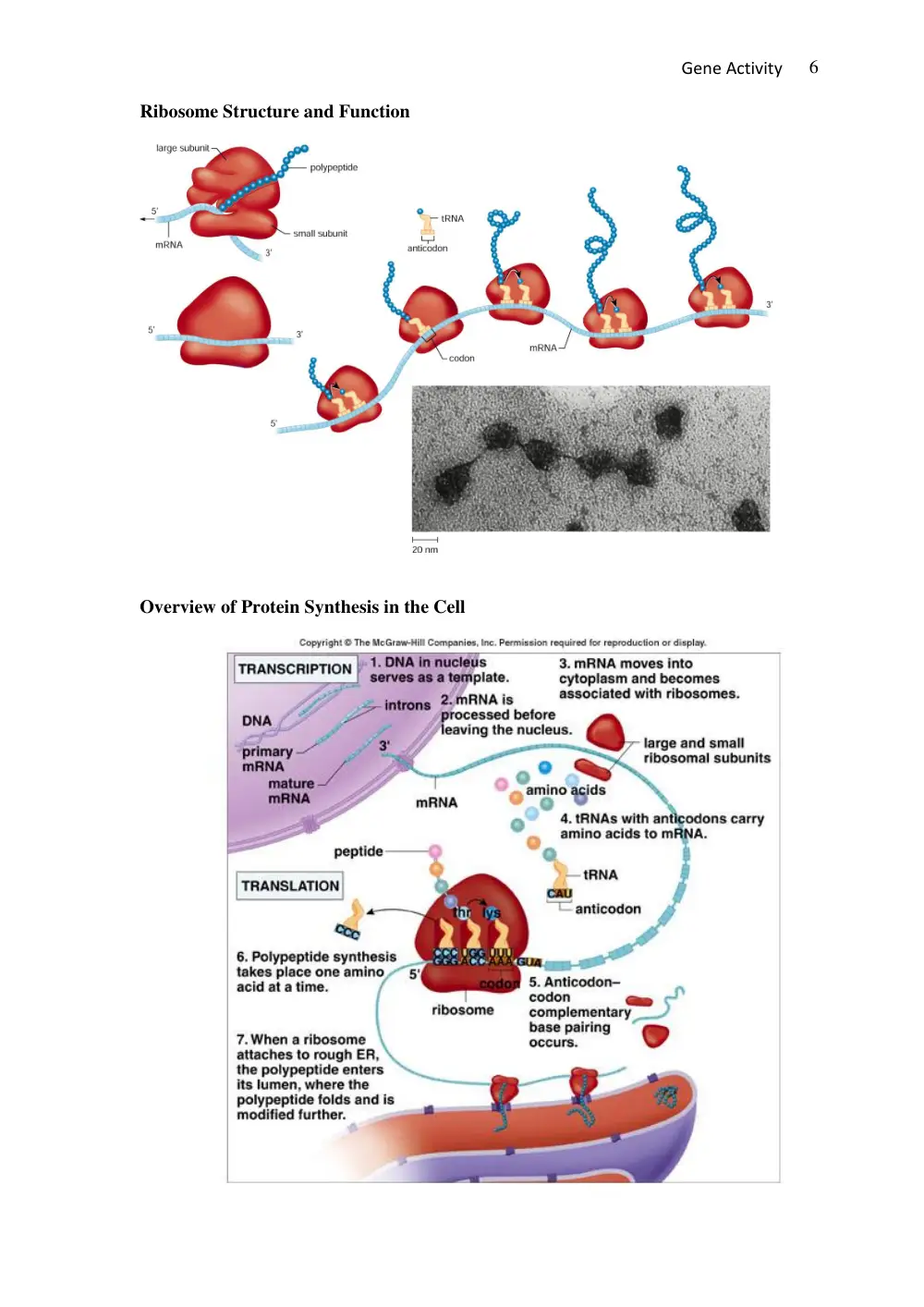
Transfer RNA molecules transfer amino acids to the ribosomes. Each tRNA
molecules bind with one particular amino acid, and bear an anti-codon
complementary to the codon for that amino acid. A group of enzymes, tRNA
synthetases attach correct amino acid to the correct tRNA molecule.
Gene Activity
5
Transfer RNA
Role of Ribosomal RNA
Ribosomal RNA (rRNA) is produced off a DNA template in the nucleolus of a
nucleus. It is packaged with proteins into ribosomal subunits, one larger than the other.
Ribosomes contain binding sites to facilitate complementary base pairing between
tRNA anti-codons and mRNA codons.
Gene Activity
6
Ribosome Structure and Function
Overview of Protein Synthesis in the Cell