
CCE 301 Midterm, Spring 2014
American University of Science and Technology · Electronics · 11 pages





Showing the first 10 of 11 pages. Download the PDF to see all of it.
More CCE 301 files
Show the text of this exam
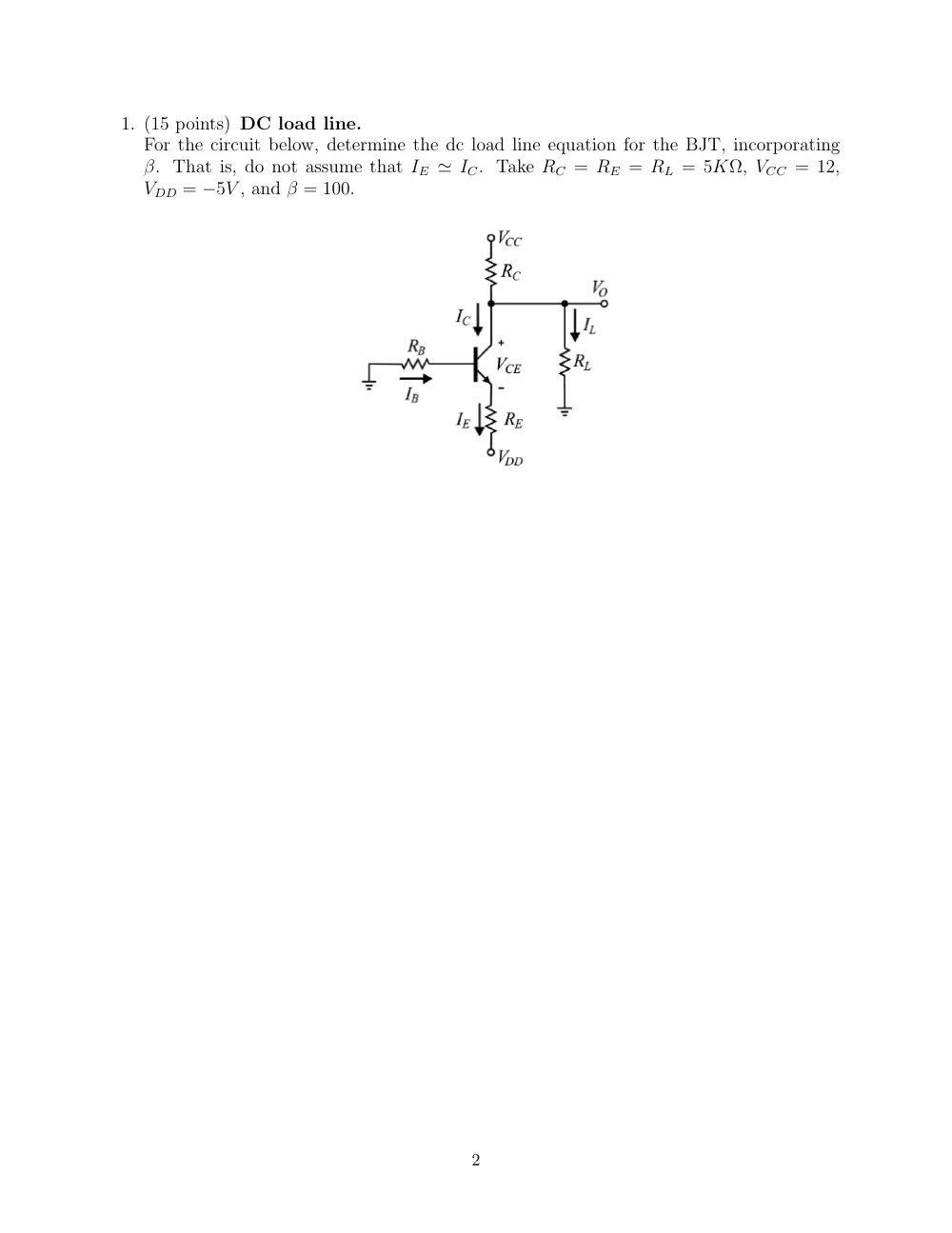
1. (15 points) DC load line.
For the circuit below, determine the dc load line equation for the BJT, incorporating
β. That is, do not assume that IE ≃ IC. Take RC = RE = RL = 5KΩ, VCC = 12,
VDD = −5V , and β = 100.
2
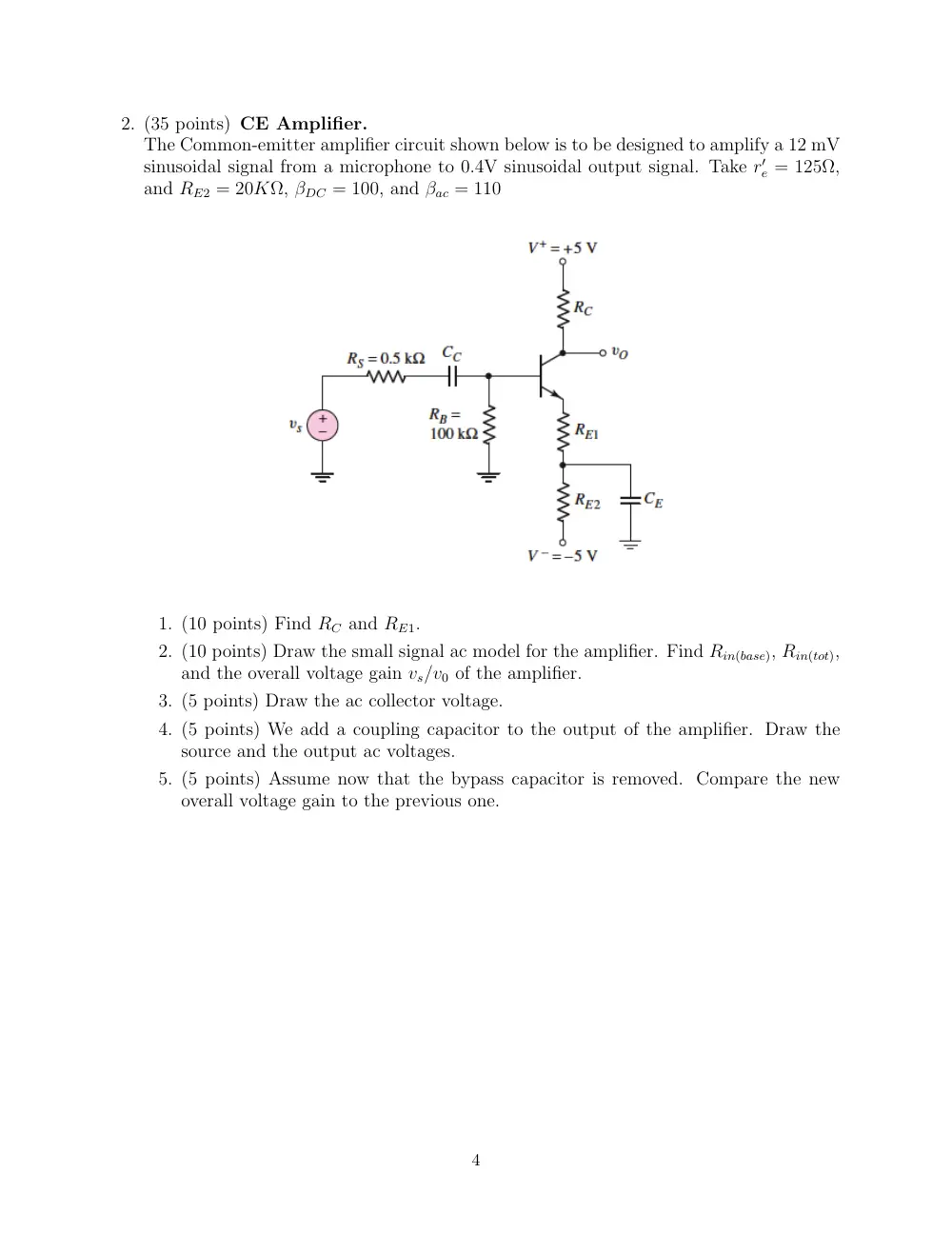
2. (35 points) CE Amplifier.
The Common-emitter amplifier circuit shown below is to be designed to amplify a 12 mV
sinusoidal signal from a microphone to 0.4V sinusoidal output signal. Take r′
e = 125Ω,
and RE2 = 20KΩ, βDC = 100, and βac = 110
1. (10 points) Find RC and RE1.
2. (10 points) Draw the small signal ac model for the amplifier. Find Rin(base), Rin(tot),
and the overall voltage gain vs/v0 of the amplifier.
3. (5 points) Draw the ac collector voltage.
4. (5 points) We add a coupling capacitor to the output of the amplifier. Draw the
source and the output ac voltages.
5. (5 points) Assume now that the bypass capacitor is removed. Compare the new
overall voltage gain to the previous one.
4
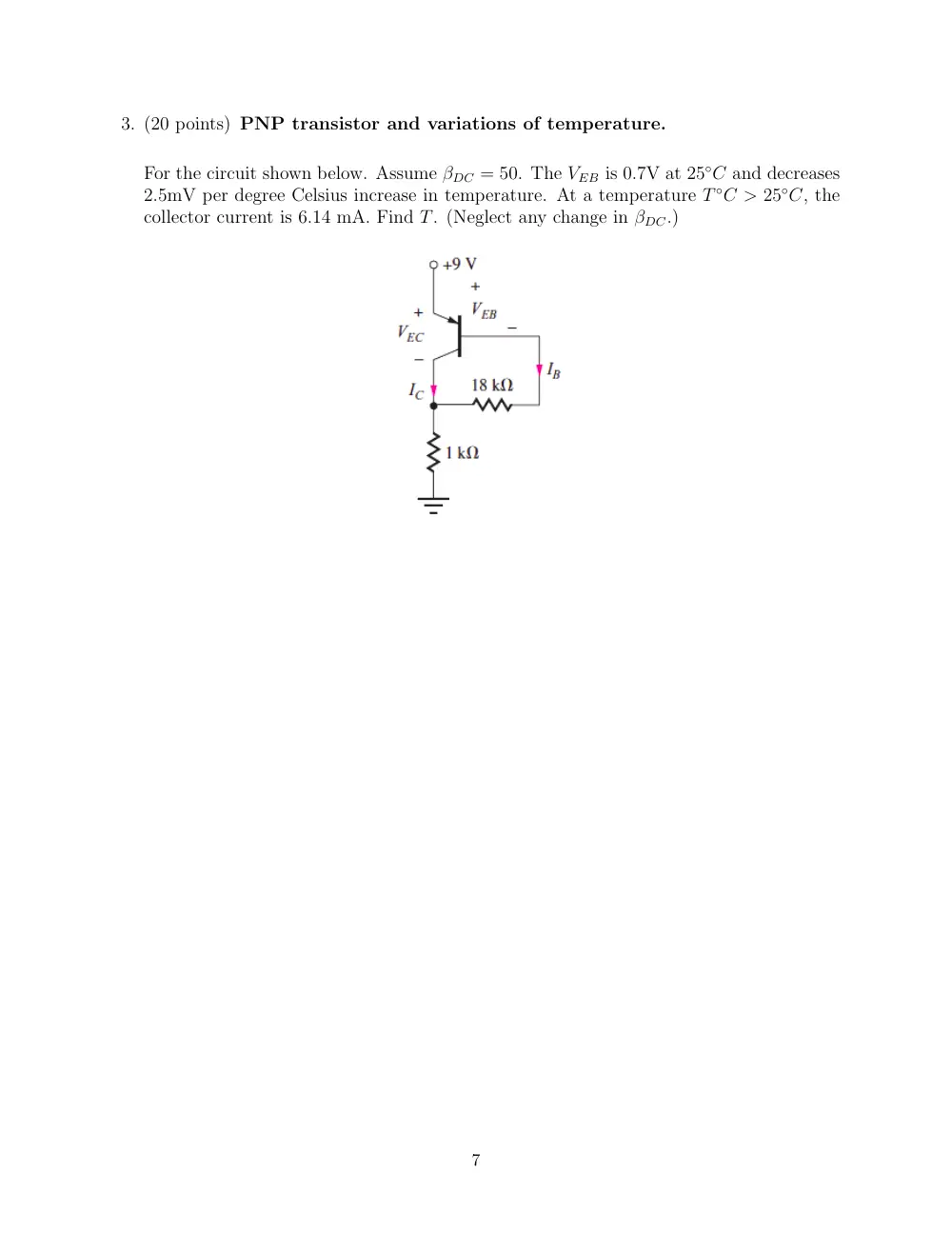
3. (20 points) PNP transistor and variations of temperature.
For the circuit shown below. Assume βDC = 50. The VEB is 0.7V at 25◦C and decreases
2.5mV per degree Celsius increase in temperature. At a temperature T ◦C > 25◦C, the
collector current is 6.14 mA. Find T. (Neglect any change in βDC.)
7
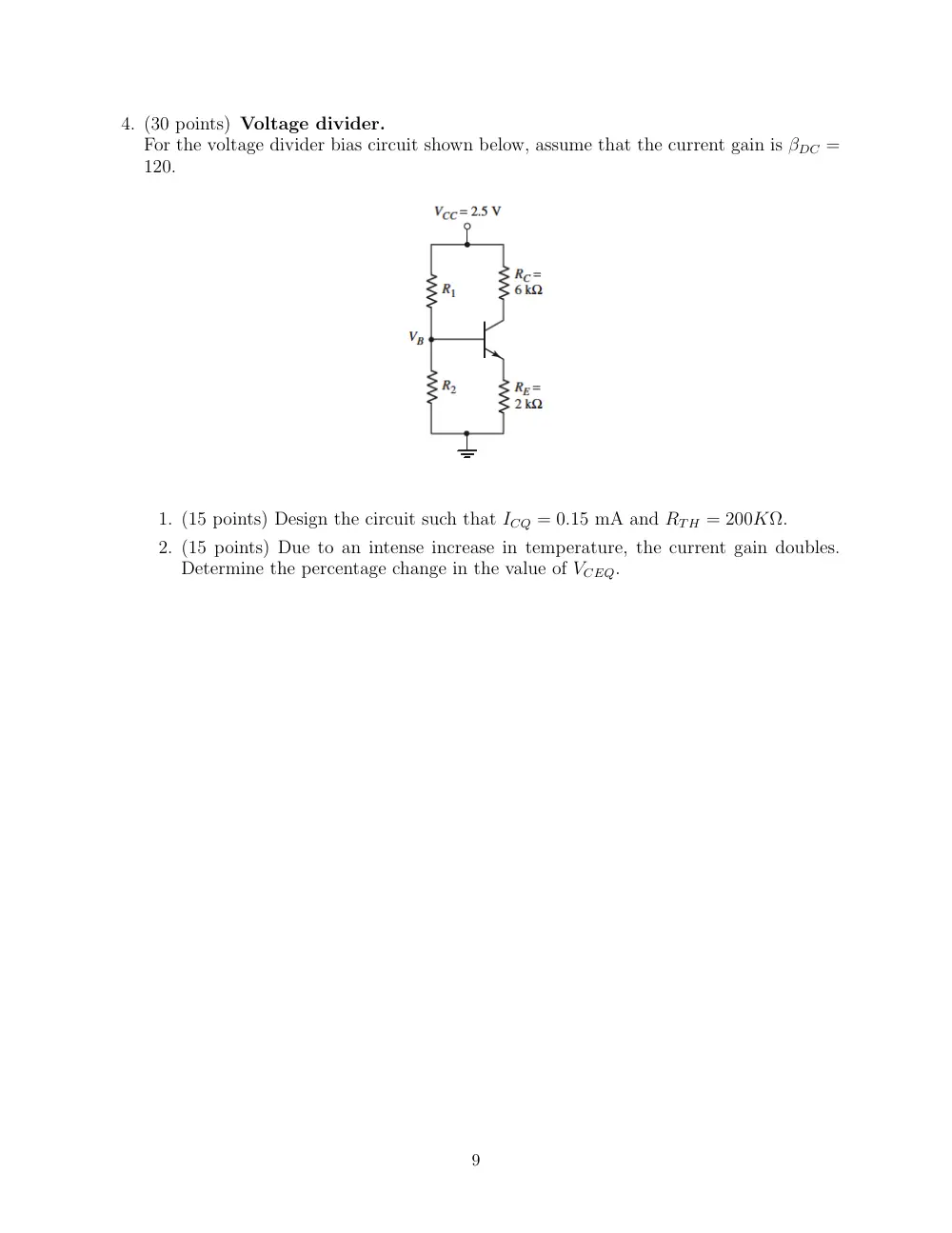
4. (30 points) Voltage divider.
For the voltage divider bias circuit shown below, assume that the current gain is βDC =
120.
1. (15 points) Design the circuit such that ICQ = 0.15 mA and RTH = 200KΩ.
2. (15 points) Due to an intense increase in temperature, the current gain doubles.
Determine the percentage change in the value of VCEQ.
9
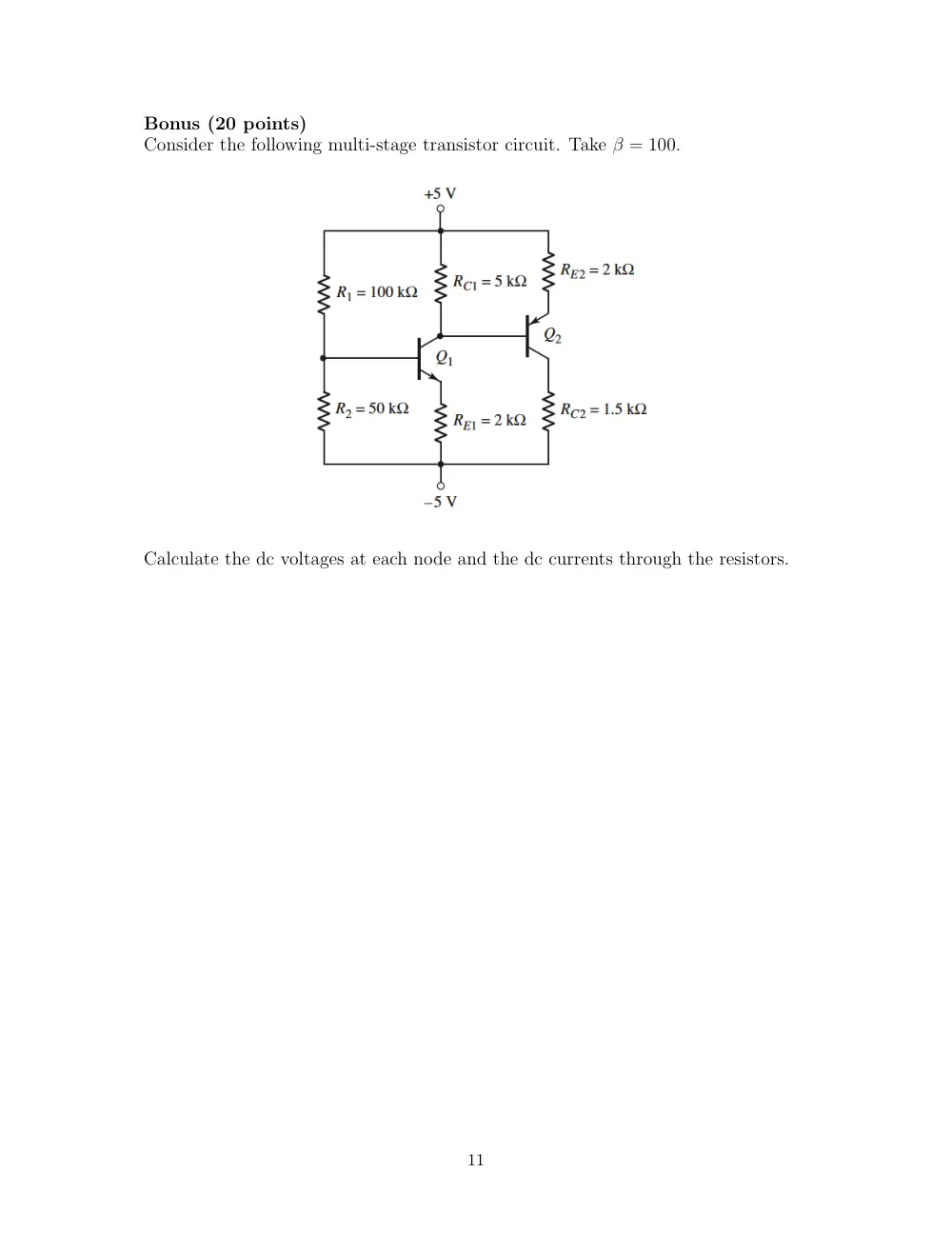
Bonus (20 points)
Consider the following multi-stage transistor circuit. Take β = 100.
Calculate the dc voltages at each node and the dc currents through the resistors.
11