
CCE 325 Midterm, Spring 2012
American University of Science and Technology · Computer Architecture · 7 pages · Dr. Abbas Tarhini

More CCE 325 files
Show the text of this exam
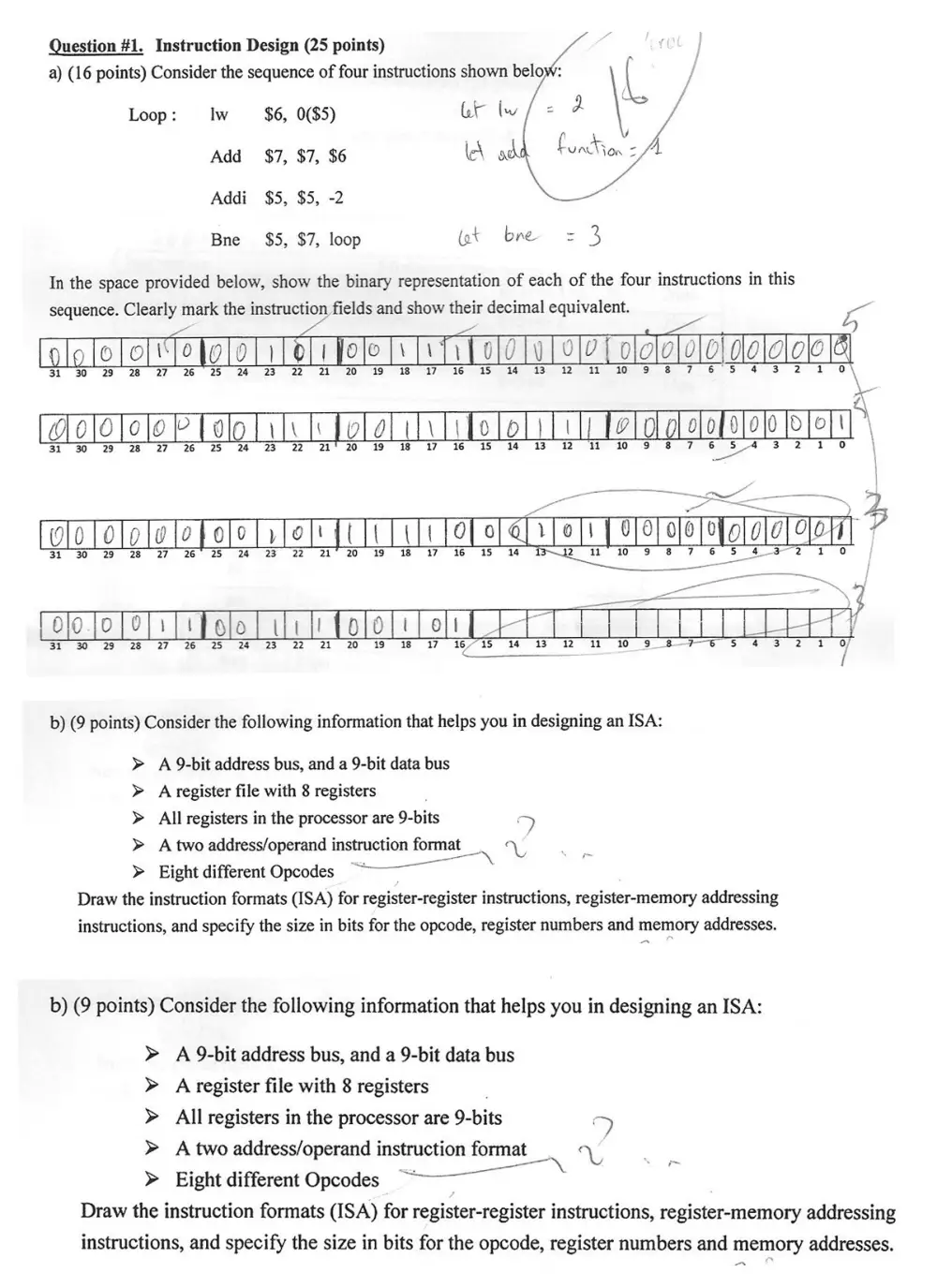
Question #1. Instruction Design (25 points)
a) (16 points) Consider the sequence of four instructions shown below:
Loop: Iw __ $6, 0($5) GF lw
Add $7, $7, $6 IA o
Addi $5, $5, -2
Bne $5, $7, loop (ot bre = 3
In the space provided below, show the binary representation of each of the four instructions in this
sequence. Clearly mark the instruction fields and show their decimal equivalent.
ee) 5
010} glolatole S|
o\
a
olo lolol" folo li To fole ifr fold [volo fo
31630 «29 28 12e) 26° 25 120 23 22 AA Ore) 1S) Pay ae ee 435425018) 10:
IS
| SS
Fr
[GololcloPTolo ht folahi T folel Tit tatot lol
29 28: 27 26 25 RS 2 0 a I SS a ds ea
qo oa DAREN ede acca
lo Joe iT bolo Ltt foto Te FFT iT Titi TLE}
7a gm Le Sc ear ee Cs Ces CO 7 a Ts CC Po act Sony Nob es Ea |
——
31
b) (9 points) Consider the following information that helps you in designing an ISA:
> A 9-bit address bus, and a 9-bit data bus
> A register file with 8 registers ;
> All registers in the processor are 9-bits a)
> A two address/operand instruction forint VU
> Eight different Opcodes ~~~
Draw the instruction formats (ISA) for register-register instructions, register-memory addressing
instructions, and specify the size in bits for the opcode, register numbers and memory addresses.
b) (9 points) Consider the following information that helps you in designing an ISA:
> A 9-bit address bus, and a 9-bit data bus
> A register file with 8 registers
> All registers in the processor are 9-bits 5
> A two address/operand ecient \ Vv
> Eight different Opcodes ~~~
Draw the instruction formats (ISA) for register-register instructions, register-memory addressing
instructions, and specify the size in bits for the opcode, register numbers and memory addresses.
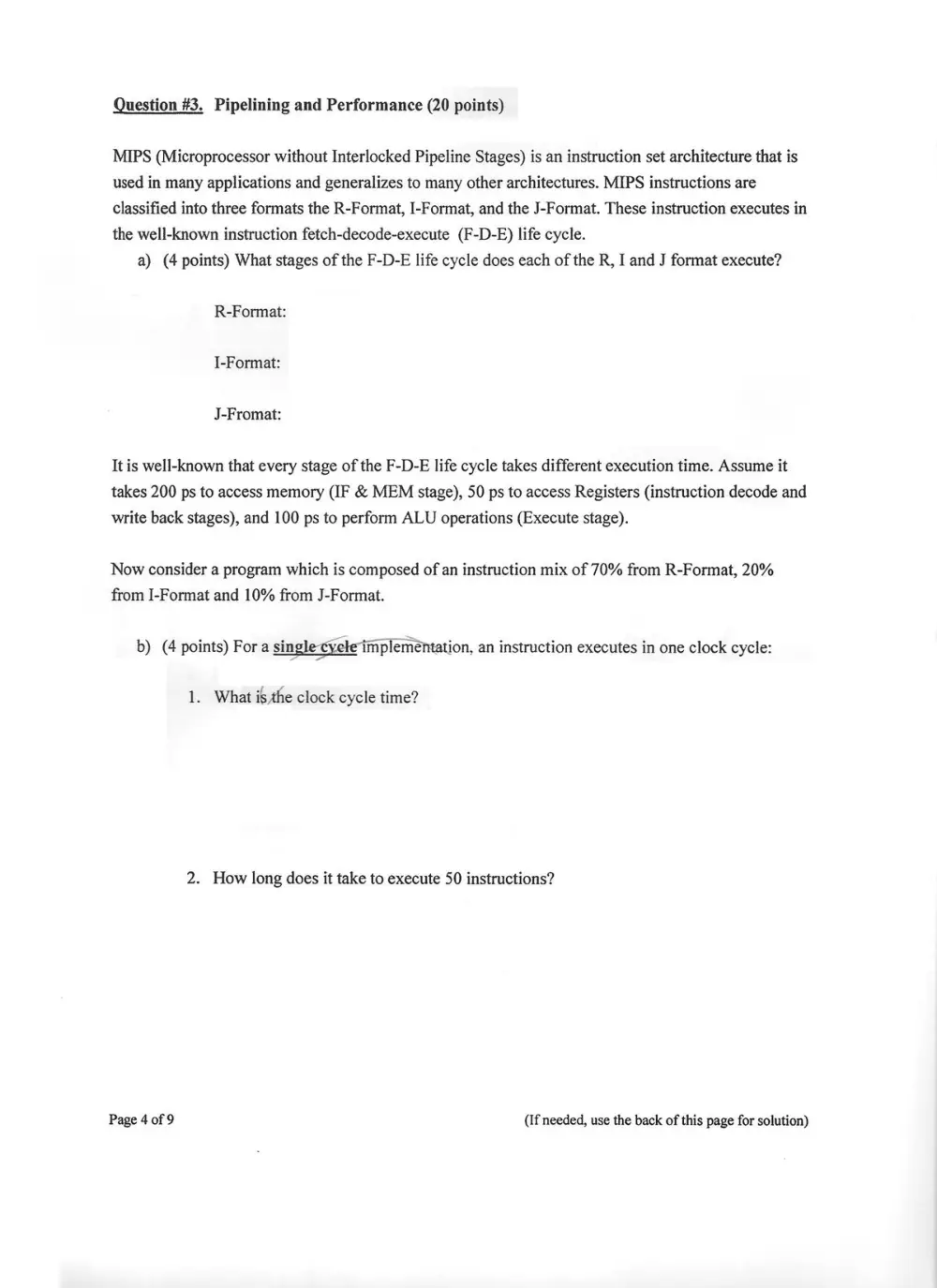
Question #3. Pipelining and Performance (20 points)
MIPS (Microprocessor without Interlocked Pipeline Stages) is an instruction set architecture that is
used in many applications and generalizes to many other architectures. MIPS instructions are
classified into three formats the R-Format, I-Format, and the J-Format. These instruction executes in
the well-known instruction fetch-decode-execute (F-D-E) life cycle.
a) (4 points) What stages of the F-D-E life cycle does each of the R, I and J format execute?
R-Format:
I-Format:
J-Fromat:
It is well-known that every stage of the F-D-E life cycle takes different execution time. Assume it
takes 200 ps to access memory (IF & MEM stage), 50 ps to access Registers (instruction decode and
write back stages), and 100 ps to perform ALU operations (Execute stage).
Now consider a program which is composed of an instruction mix of 70% from R-Format, 20%
from I-Format and 10% from J-Format.
b) (4 points) For a single cyele implementation, an instruction executes in one clock cycle:
1. What is the clock cycle time?
2. How long does it take to execute 50 instructions?
Page 4 of 9 (If needed, use the back of this page for solution)
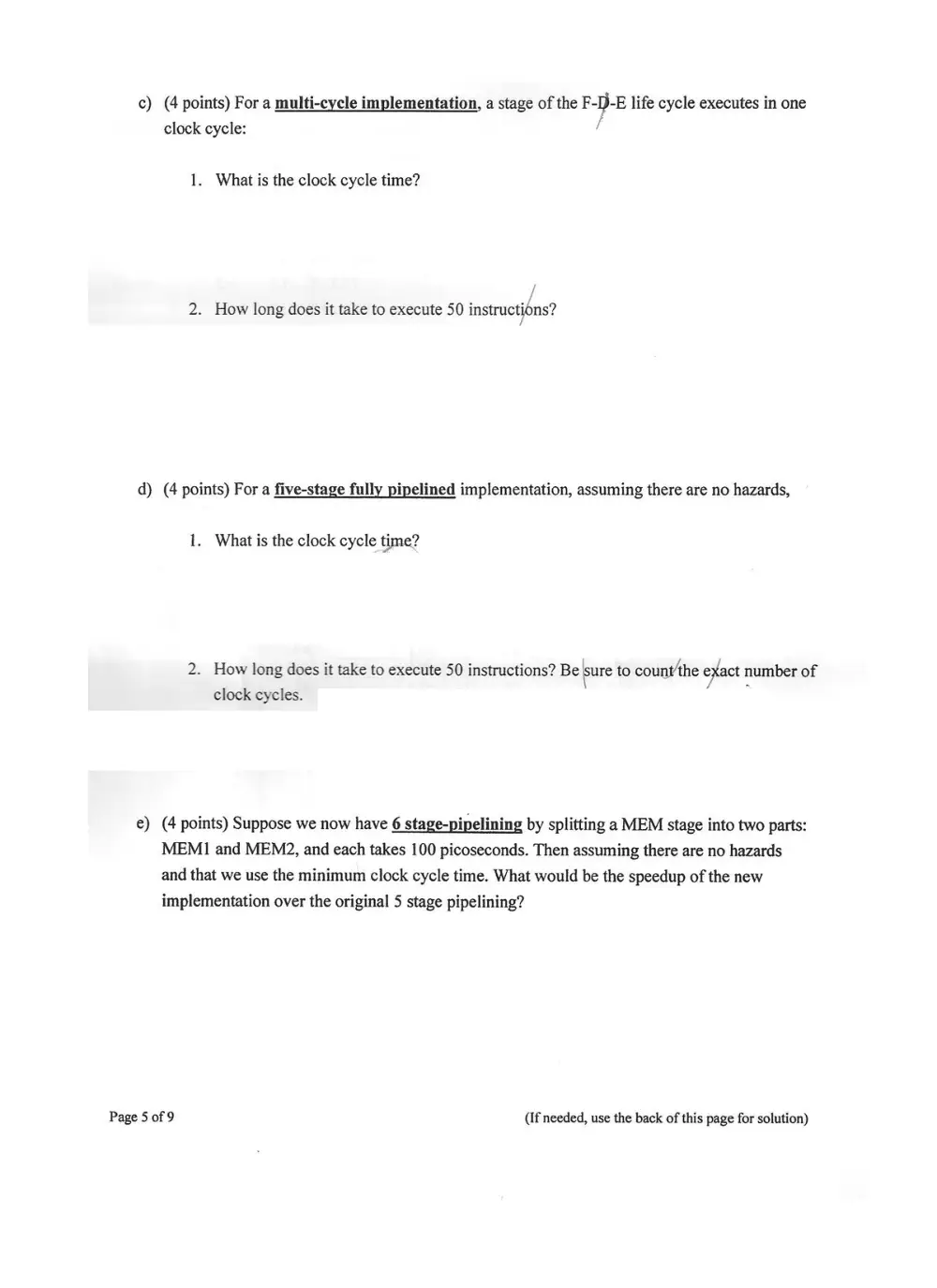
c) (4 points) For a multi-cycle implementation, a stage of the F-D-E life cycle executes in one
clock cycle:
1. What is the clock cycle time?
2. How long does it take to execute 50 instructions?
i
d) (4 points) For a five-stage fully pipelined implementation, assuming there are no hazards,
1. What is the clock cycle time?
2. How long does it take to execute 50 instructions? Be sure to count/the exact number of
clock cycles.
e) (4 points) Suppose we now have 6 stage-pip. elining by splitting a MEM stage into two parts:
MEM1I and MEM2, and each takes 100 picoseconds. Then assuming there are no hazards
and that we use the minimum clock cycle time. What would be the speedup of the new
implementation over the original 5 stage pipelining?
Page 5 of 9 (If needed, use the back of this page for solution)
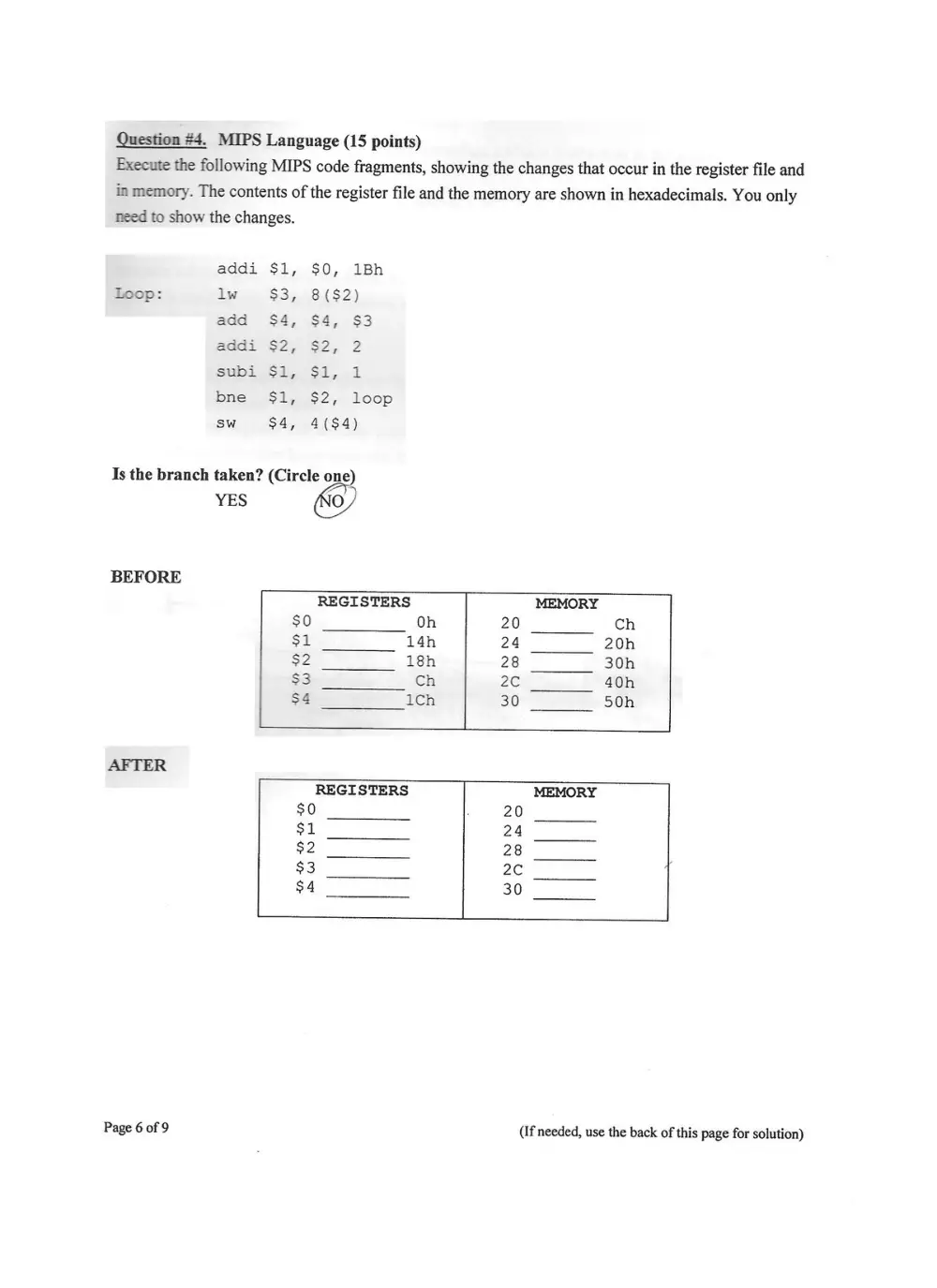
Question #4. MIPS Language (15 points)
Execute the following MIPS code fragments, showing the changes that occur in the register file and
in memory. The contents of the register file and the memory are shown in hexadecimals. You only
need to show the changes.
addi $1, $0, 1Bh
Loop: lw $3, 8($2)
add $4, $4, $3
addi $2, $2, 2
subi $1, $1, 1
bne $1, $2, loop
sw $4, 4($4)
Is the branch taken? (Circle one)
YES 60)
BEFORE
REGISTERS MEMORY
$0 Oh 20 Ch
$1 14h 24 20h
$2 18h 28 30h
$3 Ch 2c 40h
$4 1ch 30 50h
AFTER
REGISTERS MEMORY
$0 20
$l 24
$2 28
$3 2c
$4 30
Page 6 of 9
(If needed, use the back of this page for solution)
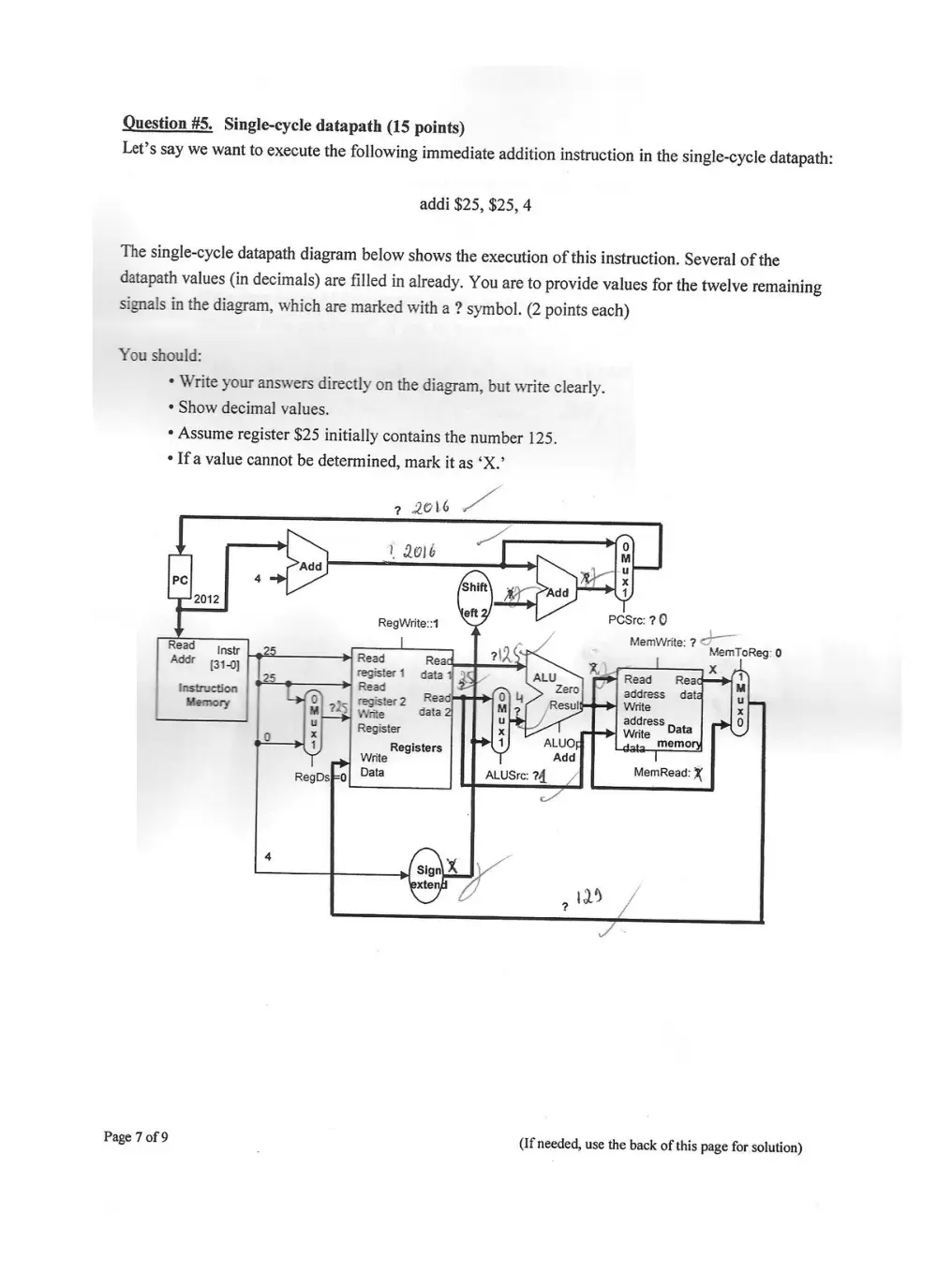
Question #5. Single-cycle datapath (15 points)
Let’s say we want to execute the following immediate addition instruction in the single-cycle datapath:
addi $25, $25, 4
The single-cycle datapath diagram below shows the execution of this instruction. Several of the
datapath values (in decimals) are filled in already. You are to provide values for the twelve remaining
signals in the diagram, which are marked with a ? symbol. (2 points each)
You should:
+ Write your answers directly on the diagram, but write clearly.
+ Show decimal values.
+ Assume register $25 initially contains the number 125.
¢ Ifa value cannot be determined, mark it as *X.’
2 2016 ra
PcSre: 70
MemWrite: ?<7—
Se ee ToRONO
Page 7 of 9 (If needed, use the back of this page for solution)
Question #6. Pipelining (10 points)
Assume the following latencies for each stage in our single-cycle processor.
IF ID ALU_| MEM |_ WB
200ps | 100ps | 200ps | 200ps | 100ps
a. Ifthe time for an ALU operation can be shortened by 25% will it affect the speedup
obtained from pipelining? If yes, by how much? If no, why not? (5 points)
b. What if the ALU operation now takes 25% more time? (5 points)
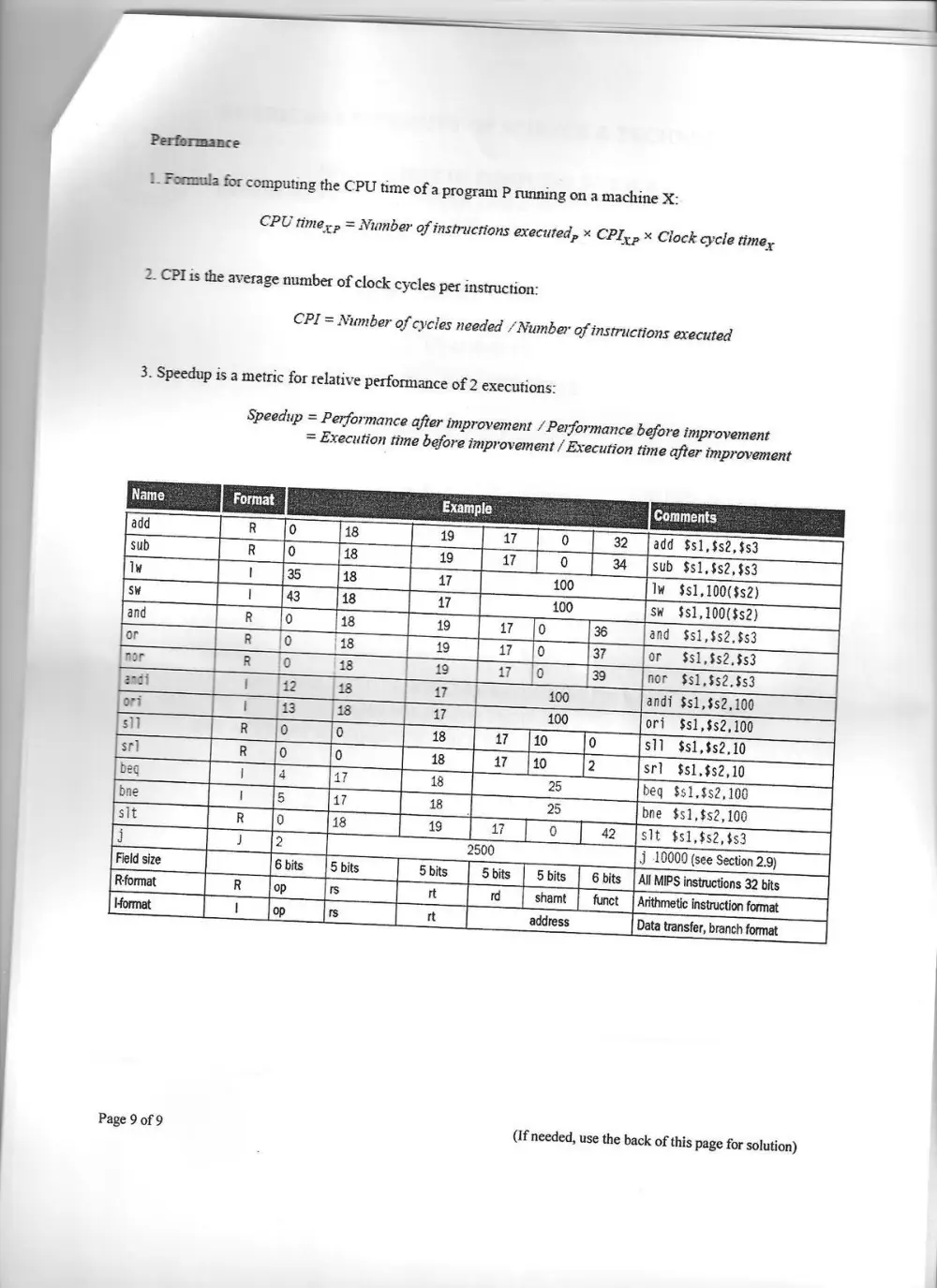
Performance
1_Fonmula for computing the CPU time of a Program P running on a machine X:
CPU timey p = Number of instructions executedy * CPI,» x Clock oyele timey
2. CPT is the average number of clock cycles per instruction:
CPI = Number of cycies needed / Number of instructions executed
3. Speedup is a metric for relative performance of 2 executions:
Speedup = Performance after improvement / Performance before improvement
= Execution time before improvement / Execution time after improvement
ean SL NN eee ee
add 0 18 19 17 0 32 {add $51,$s2,$53
R
sub R 0 18 19 17 0 34 [sub $51, $82, $53
lw 1 35 18 47 100 Iw $s1,100($s2)
SW | 43 18 17 100 SW _$s1,100($s2)
and R 0 18 19 17 [0 36 and $s1,$s2.$s3
or R 10 | 18 19 17 |0 37 or $s1,$s2,$53
nor [oR Ie 18 19 17/0 39 for $s1,$s2.$s3
andi a Ear ray 100 andi $s1,$s2, 100
ori i 13 |18 a7 100 ori $s1,$s2,100
sil R 0 0 18 17/10 Y) sl]_$s1,$s2,10
srl R 0 0 18 47/10 2 srl $s1,$52,10
beq i 4 47 18 25 beq $51,$52,100
bne | g 17 6B 25 bne $s1,$s2, 100
slt R 0 18 19 47 i) 42 Slt $s1,$s2,$s3
dj J 2) 2500 J 10000 (see Section 2.9)
Field size Sbits | 5 bits 5 bits Sbits | Spits | 6 bits All MIPS instructions 32 bits
Reformat op is rt td shamt | funct | Arithmetic instruction format
Hormat op Is tt address Data transfer, branch format
Page 9 of 9 (If needed, use the back of this page for solution)