
ENG 202 Syllabus, Fall 2015
American University of Science and Technology · Composition & Rhetoric II · 3 pages

Show the text of this lab
AMERICAN UNIVERSITY OF SCIENCE AND TECHNOLOGY
FACULTY OF ARTS AND SCIENCES
DEPARTMENT OF ENGLISH AND TRANSLATION
ENG 202—COMPOSITION AND RHETORIC II
FALL 2015-2016
__________________________________________________________________
INSTRUCTOR’S CONTACT INFORMATION
INSTRUCTOR: Denise Atallah El Azzi
OFFICE: ENGLISH DEPARTMENT—BLOCK A, 5TH FLOOR
EMAIL: datallah@aust.edu.lb
OFFICE HOURS: Mondays and Wednesdays from 9:15-10:00
COURSE DESCRIPTION: In this course, students are supposed to learn how arguments are
built so that they would engage in debates, critical thinking, substantiation and evaluation of
claims, as well as in research, which is essential in this course. In this course, students can also
improve their thinking and writing processes and correct their grammatical errors.
COURSE OBJECTIVE: This course will improve students’ writing, thinking, and reading.
The objective of this course is to make students more confident while writing or expressing their
views in debates. They get involved in discussions of different topics, generate solutions and
convincing evidence to controversies, and realize that active reading and meticulous analysis
make them profounder thinkers.
LEARNING OUTCOMES:
When the semester ends, students will be able to:
Discuss issues and ask questions related to them.
Analyze the rhetorical context of an argument.
Develop strong claims and valid evidence.
Write summaries of passages and paraphrase certain excerpts from them.
Develop critical thinking skills such as analysis, synthesis, and comparison.
Read essays from a variety of disciplines.
Organize essays coherently.
Write a research paper using a suitable documentation system
Learn how to revise and edit essays.
1
Grading Criteria
Attendance (ATT) 5%
Class Participation (CP) 5 %
Homework (HW) 10 %
Class Quizzes (CQ) 10%
Class Exams (CE)
30%
Exam I (EX I) 15 %
Exam II (EX II) 15 %
Exam III (EX III) 15 % (The lowest grade among the three exams is dropped.)
Final Examination (FIN) 25 %
Project/Term Paper (PRJ) 15 %
(5 marks are deducted for each absence.)
REQUIRED TEXTBOOKS & STORIES
Kennedy, Mary Lynch; Kennedy, William J. Writing in the Disciplines: A Reader and
Rhetoric for Academic Writers. 7th ed. Pearson, 2012.
Stories:
1-
Mansfield, Catherine. The Garden Party and Other Stories. Oxford University Press, 2008.
2- West, Clare. Far from Madding Crowd. Oxford University Press, 2008.
EXPECTATIONS
Students are expected to participate in class, give their opinions, ask questions, and seek help
whenever they encounter any difficulty. The approach followed in class is not teacher-centered
and depends mostly on students who should be ready prior to any lecture when an assignment
has been given or when a new chapter is to be explained. They are expected to predict the
content and participate while the teacher is presenting the objectives of the lesson.
POLICIES
Attendance is mandatory.
Punctuality is a value, and respecting class time is also a must.
Absences should be validly justified in order to be excused by the dean of students.
Students who have three absences (MWF) and two absences (T-TH) sign a first warning.
Four absences and above entail signing a final warning.
Students who exceed the number of absences and do not answer phone calls to justify
their absences will be given an AW (Academic Withdrawal).
Examination dates should be respected, and examinations should not be missed because
no make-up exams are given.
Assignments should be prepared diligently and handed in on time.
Plagiarism is not condoned and results in a failing grade on the assigned work.
Decent attire and appropriate behavior are expected from all students in order to
maintain a professional learning atmosphere.
Refreshments are not allowed inside the classroom.
Cellular phones are not to be used in class whatever the reason.
2
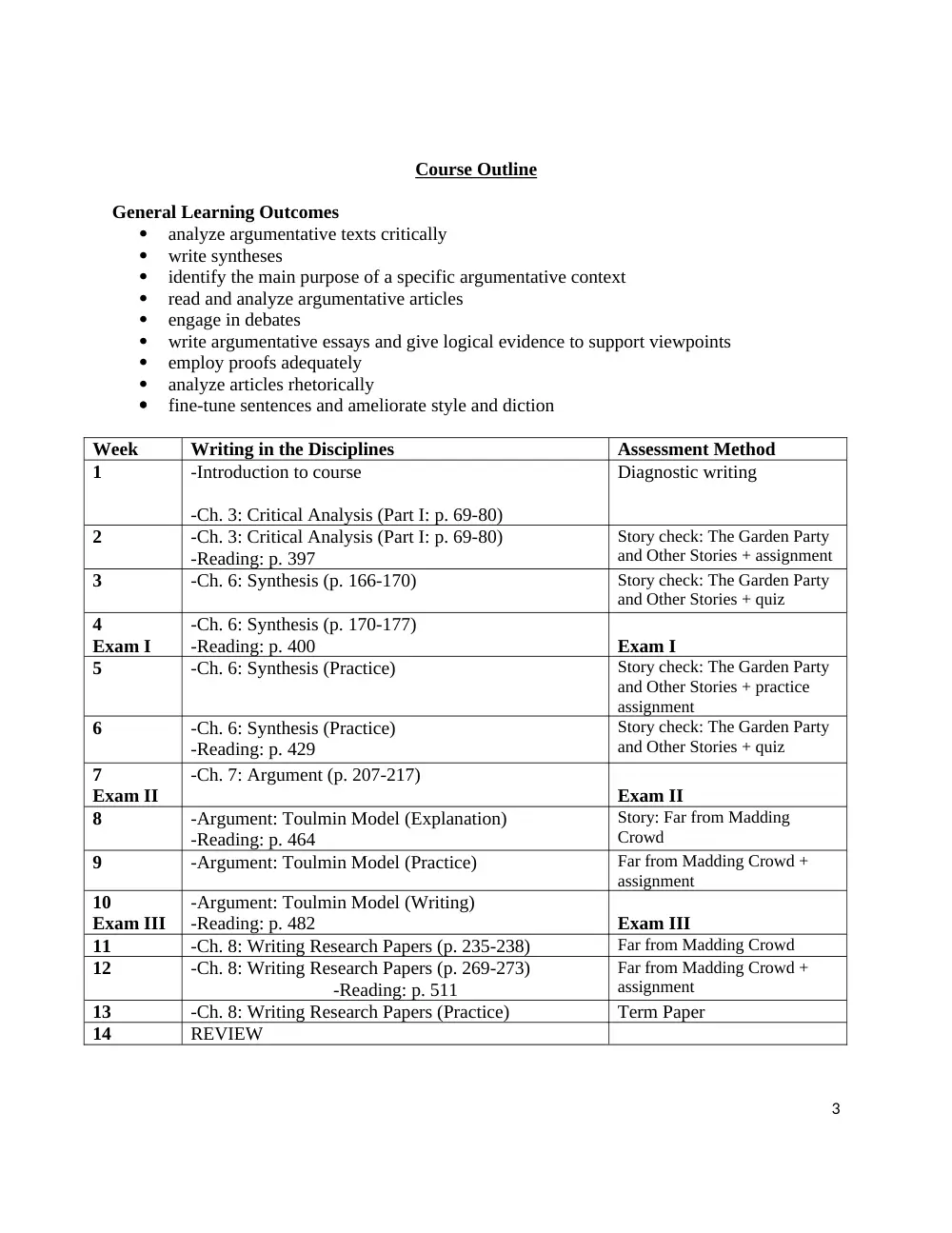
Course Outline
General Learning Outcomes
analyze argumentative texts critically
write syntheses
identify the main purpose of a specific argumentative context
read and analyze argumentative articles
engage in debates
write argumentative essays and give logical evidence to support viewpoints
employ proofs adequately
analyze articles rhetorically
fine-tune sentences and ameliorate style and diction
Week
Writing in the Disciplines
Assessment Method
1
-Introduction to course
-Ch. 3: Critical Analysis (Part I: p. 69-80)
Diagnostic writing
2
-Ch. 3: Critical Analysis (Part I: p. 69-80)
-Reading: p. 397
Story check: The Garden Party
and Other Stories + assignment
3
-Ch. 6: Synthesis (p. 166-170)
Story check: The Garden Party
and Other Stories + quiz
4
Exam I
-Ch. 6: Synthesis (p. 170-177)
-Reading: p. 400
Exam I
5
-Ch. 6: Synthesis (Practice)
Story check: The Garden Party
and Other Stories + practice
assignment
6
-Ch. 6: Synthesis (Practice)
-Reading: p. 429
Story check: The Garden Party
and Other Stories + quiz
7
Exam II
-Ch. 7: Argument (p. 207-217)
Exam II
8
-Argument: Toulmin Model (Explanation)
-Reading: p. 464
Story: Far from Madding
Crowd
9
-Argument: Toulmin Model (Practice)
Far from Madding Crowd +
assignment
10
Exam III
-Argument: Toulmin Model (Writing)
-Reading: p. 482
Exam III
11
-Ch. 8: Writing Research Papers (p. 235-238)
Far from Madding Crowd
12
-Ch. 8: Writing Research Papers (p. 269-273)
-Reading: p. 511
Far from Madding Crowd +
assignment
13
-Ch. 8: Writing Research Papers (Practice)
Term Paper
14
REVIEW
3