
REM 052 Syllabus, Fall 2015
American University of Science and Technology · Finance Skill Development · 6 pages

Show the text of this lab
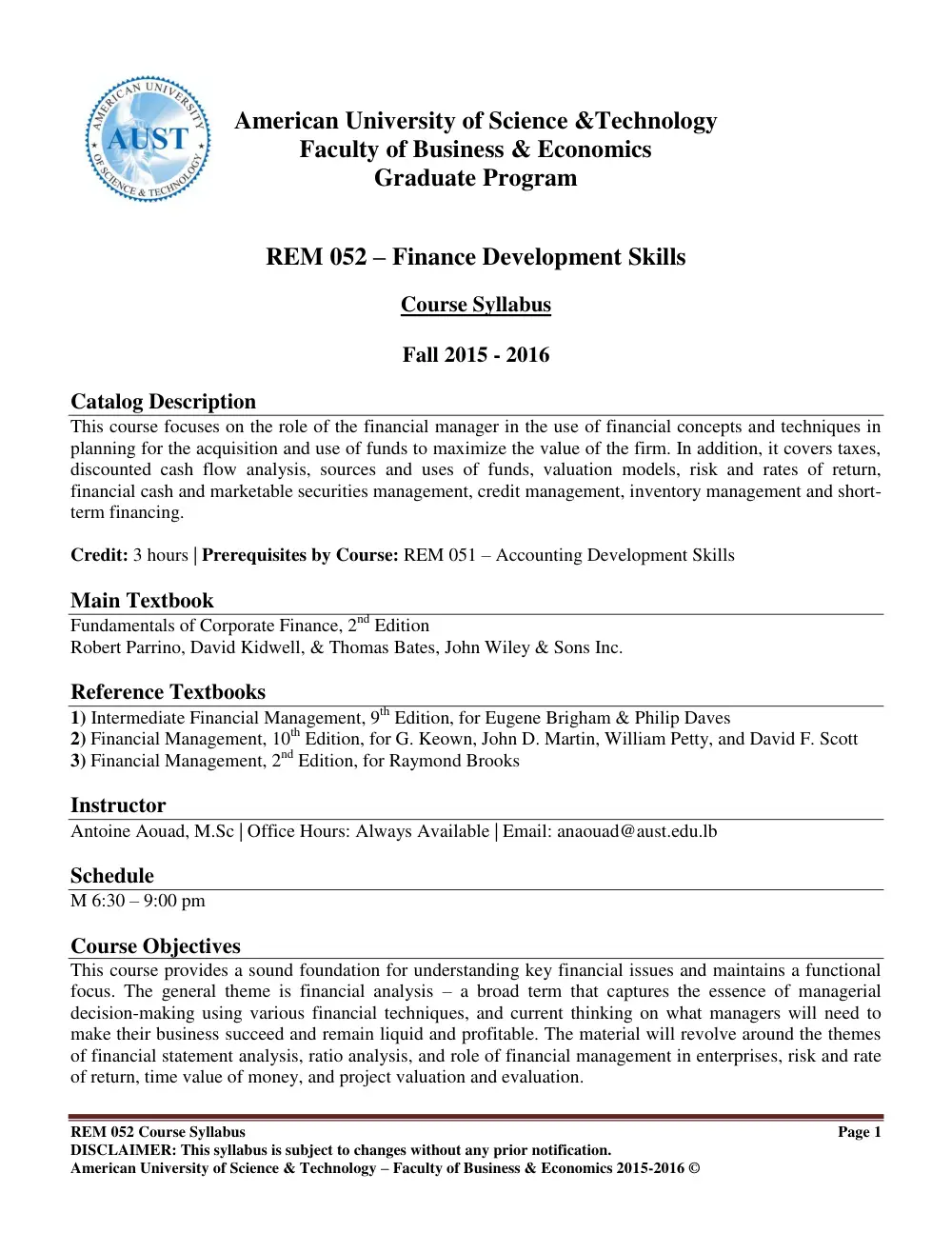
REM 052 Course Syllabus
Page 1
DISCLAIMER: This syllabus is subject to changes without any prior notification.
American University of Science & Technology – Faculty of Business & Economics 2015-2016 ©
American University of Science &Technology
Faculty of Business & Economics
Graduate Program
REM 052 – Finance Development Skills
Course Syllabus
Fall 2015 - 2016
Catalog Description
This course focuses on the role of the financial manager in the use of financial concepts and techniques in
planning for the acquisition and use of funds to maximize the value of the firm. In addition, it covers taxes,
discounted cash flow analysis, sources and uses of funds, valuation models, risk and rates of return,
financial cash and marketable securities management, credit management, inventory management and short-
term financing.
Credit: 3 hours | Prerequisites by Course: REM 051 – Accounting Development Skills
Main Textbook
Fundamentals of Corporate Finance, 2nd Edition
Robert Parrino, David Kidwell, & Thomas Bates, John Wiley & Sons Inc.
Reference Textbooks
1) Intermediate Financial Management, 9th Edition, for Eugene Brigham & Philip Daves
2) Financial Management, 10th Edition, for G. Keown, John D. Martin, William Petty, and David F. Scott
3) Financial Management, 2nd Edition, for Raymond Brooks
Instructor
Antoine Aouad, M.Sc | Office Hours: Always Available | Email: anaouad@aust.edu.lb
Schedule
M 6:30 – 9:00 pm
Course Objectives
This course provides a sound foundation for understanding key financial issues and maintains a functional
focus. The general theme is financial analysis – a broad term that captures the essence of managerial
decision-making using various financial techniques, and current thinking on what managers will need to
make their business succeed and remain liquid and profitable. The material will revolve around the themes
of financial statement analysis, ratio analysis, and role of financial management in enterprises, risk and rate
of return, time value of money, and project valuation and evaluation.
REM 052 Course Syllabus
Page 2
DISCLAIMER: This syllabus is subject to changes without any prior notification.
American University of Science & Technology – Faculty of Business & Economics 2015-2016 ©
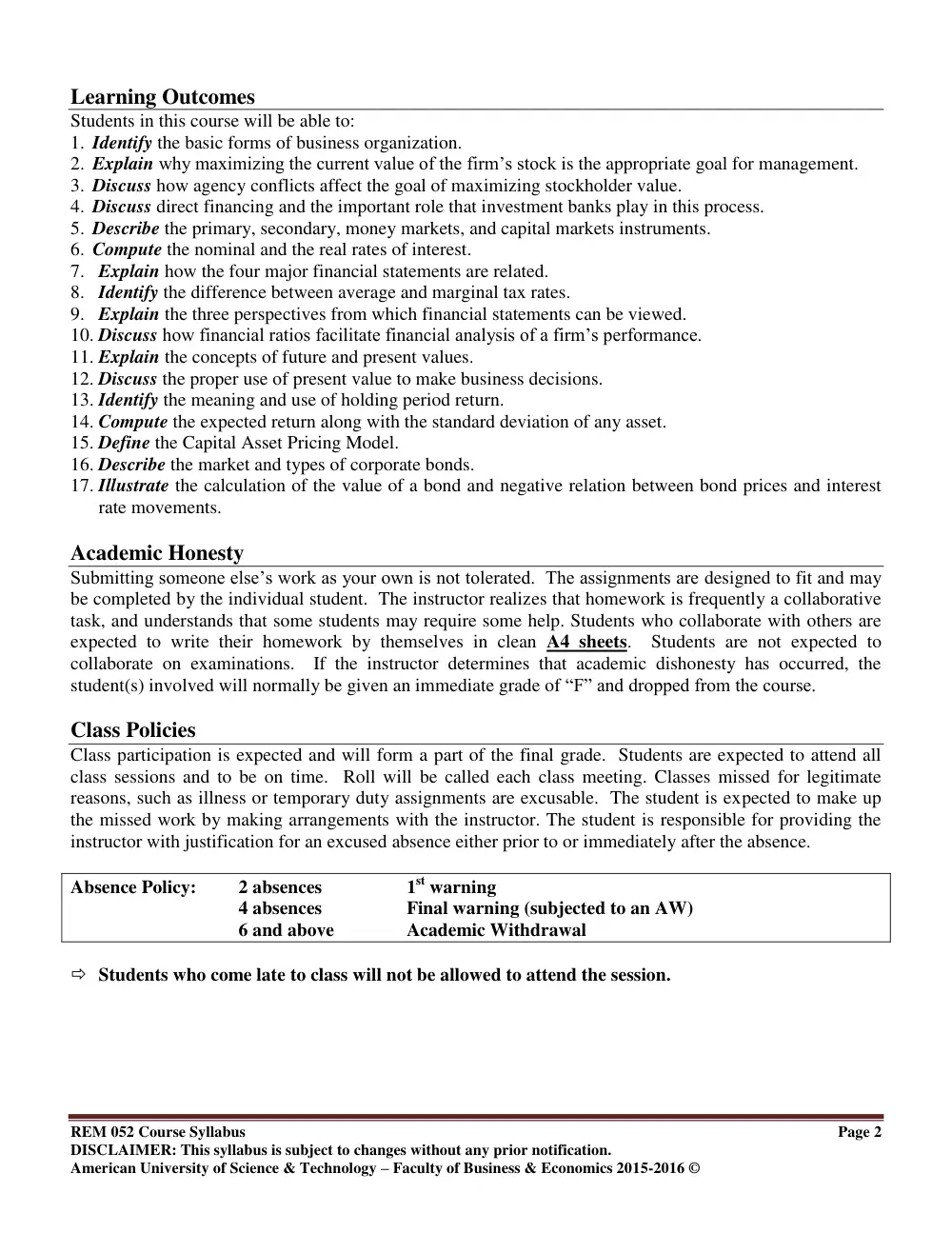
Learning Outcomes
Students in this course will be able to:
1. Identify the basic forms of business organization.
2. Explain why maximizing the current value of the firm’s stock is the appropriate goal for management.
3. Discuss how agency conflicts affect the goal of maximizing stockholder value.
4. Discuss direct financing and the important role that investment banks play in this process.
5. Describe the primary, secondary, money markets, and capital markets instruments.
6. Compute the nominal and the real rates of interest.
7. Explain how the four major financial statements are related.
8. Identify the difference between average and marginal tax rates.
9. Explain the three perspectives from which financial statements can be viewed.
10. Discuss how financial ratios facilitate financial analysis of a firm’s performance.
11. Explain the concepts of future and present values.
12. Discuss the proper use of present value to make business decisions.
13. Identify the meaning and use of holding period return.
14. Compute the expected return along with the standard deviation of any asset.
15. Define the Capital Asset Pricing Model.
16. Describe the market and types of corporate bonds.
17. Illustrate the calculation of the value of a bond and negative relation between bond prices and interest
rate movements.
Academic Honesty
Submitting someone else’s work as your own is not tolerated. The assignments are designed to fit and may
be completed by the individual student. The instructor realizes that homework is frequently a collaborative
task, and understands that some students may require some help. Students who collaborate with others are
expected to write their homework by themselves in clean A4 sheets. Students are not expected to
collaborate on examinations. If the instructor determines that academic dishonesty has occurred, the
student(s) involved will normally be given an immediate grade of “F” and dropped from the course.
Class Policies
Class participation is expected and will form a part of the final grade. Students are expected to attend all
class sessions and to be on time. Roll will be called each class meeting. Classes missed for legitimate
reasons, such as illness or temporary duty assignments are excusable. The student is expected to make up
the missed work by making arrangements with the instructor. The student is responsible for providing the
instructor with justification for an excused absence either prior to or immediately after the absence.
Absence Policy:
2 absences
1st warning
4 absences
Final warning (subjected to an AW)
6 and above
Academic Withdrawal
Students who come late to class will not be allowed to attend the session.
REM 052 Course Syllabus
Page 3
DISCLAIMER: This syllabus is subject to changes without any prior notification.
American University of Science & Technology – Faculty of Business & Economics 2015-2016 ©
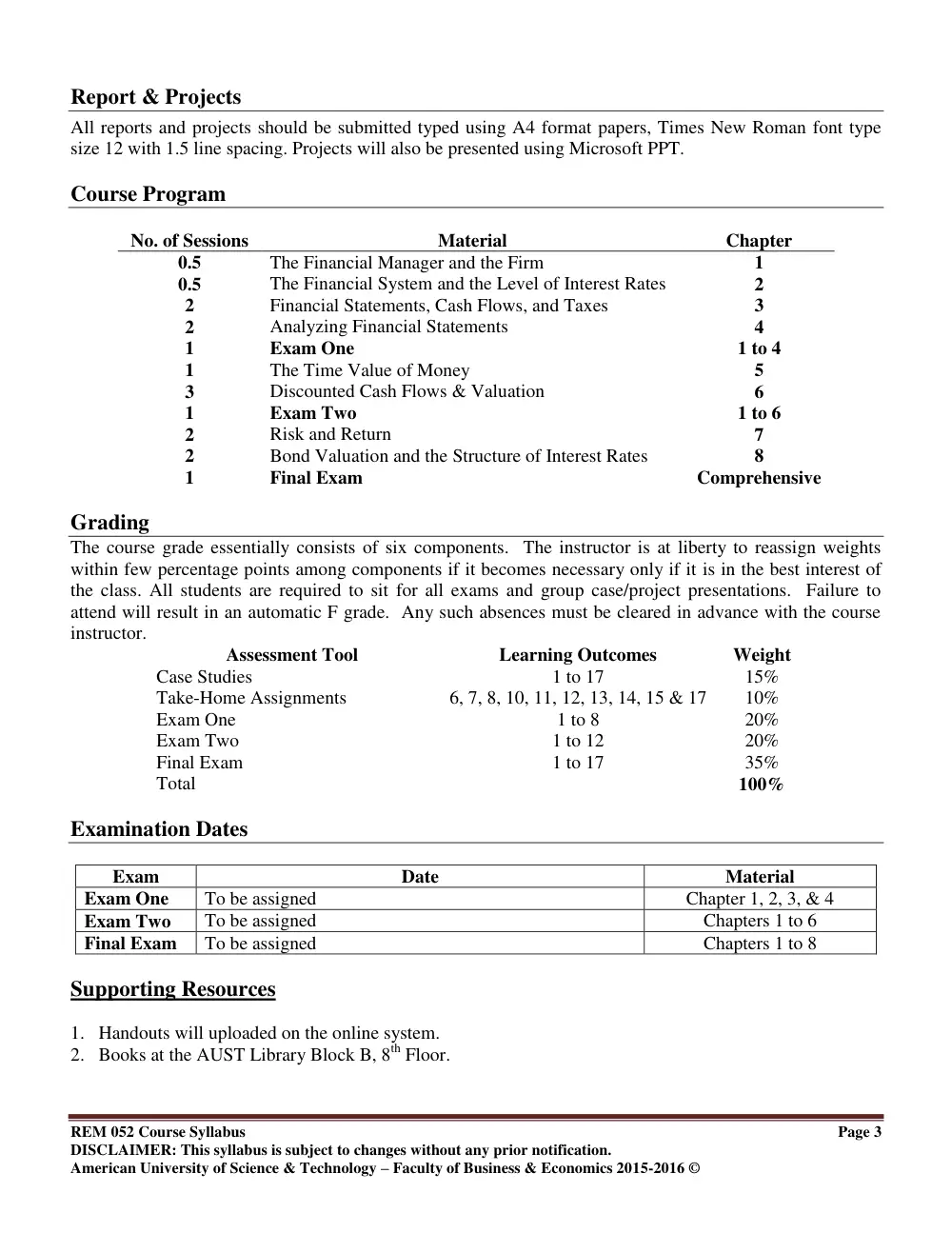
Report & Projects
All reports and projects should be submitted typed using A4 format papers, Times New Roman font type
size 12 with 1.5 line spacing. Projects will also be presented using Microsoft PPT.
Course Program
No. of Sessions
Material
Chapter
0.5
The Financial Manager and the Firm
1
0.5
The Financial System and the Level of Interest Rates
2
2
Financial Statements, Cash Flows, and Taxes
3
2
Analyzing Financial Statements
4
1
Exam One
1 to 4
1
The Time Value of Money
5
3
Discounted Cash Flows & Valuation
6
1
Exam Two
1 to 6
2
Risk and Return
7
2
Bond Valuation and the Structure of Interest Rates
8
1
Final Exam
Comprehensive
Grading
The course grade essentially consists of six components. The instructor is at liberty to reassign weights
within few percentage points among components if it becomes necessary only if it is in the best interest of
the class. All students are required to sit for all exams and group case/project presentations. Failure to
attend will result in an automatic F grade. Any such absences must be cleared in advance with the course
instructor.
Assessment Tool
Learning Outcomes
Weight
Case Studies
1 to 17
15%
Take-Home Assignments
6, 7, 8, 10, 11, 12, 13, 14, 15 & 17
10%
Exam One
1 to 8
20%
Exam Two
1 to 12
20%
Final Exam
1 to 17
35%
Total
100%
Examination Dates
Exam
Date
Material
Exam One
To be assigned
Chapter 1, 2, 3, & 4
Exam Two
To be assigned
Chapters 1 to 6
Final Exam
To be assigned
Chapters 1 to 8
Supporting Resources
1. Handouts will uploaded on the online system.
2. Books at the AUST Library Block B, 8th Floor.
REM 052 Course Syllabus
Page 4
DISCLAIMER: This syllabus is subject to changes without any prior notification.
American University of Science & Technology – Faculty of Business & Economics 2015-2016 ©
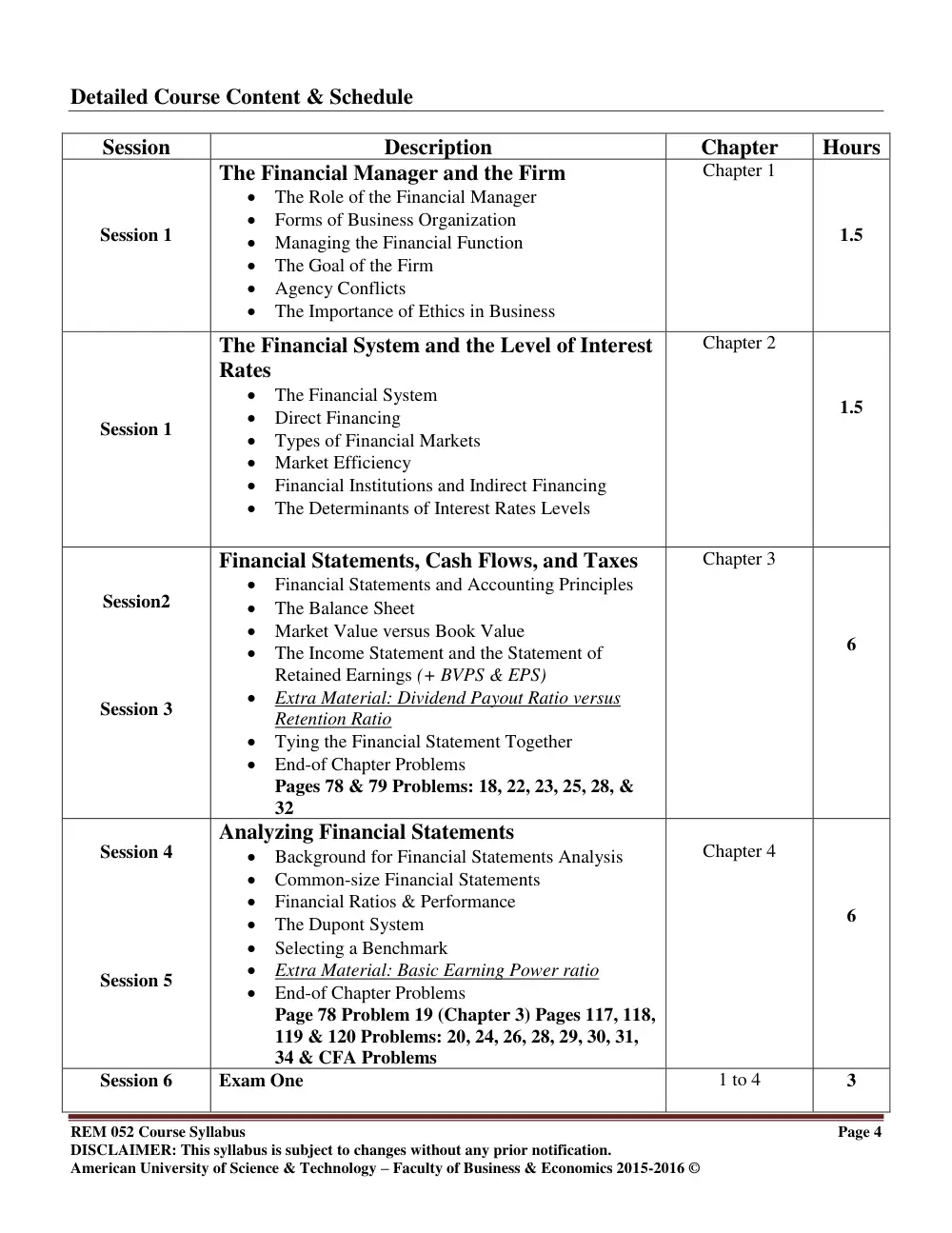
Detailed Course Content & Schedule
Session
Description
Chapter
Hours
Session 1
The Financial Manager and the Firm
The Role of the Financial Manager
Forms of Business Organization
Managing the Financial Function
The Goal of the Firm
Agency Conflicts
The Importance of Ethics in Business
Chapter 1
1.5
Session 1
The Financial System and the Level of Interest
Rates
The Financial System
Direct Financing
Types of Financial Markets
Market Efficiency
Financial Institutions and Indirect Financing
The Determinants of Interest Rates Levels
Chapter 2
1.5
Session2
Session 3
Financial Statements, Cash Flows, and Taxes
Financial Statements and Accounting Principles
The Balance Sheet
Market Value versus Book Value
The Income Statement and the Statement of
Retained Earnings (+ BVPS & EPS)
Extra Material: Dividend Payout Ratio versus
Retention Ratio
Tying the Financial Statement Together
End-of Chapter Problems
Pages 78 & 79 Problems: 18, 22, 23, 25, 28, &
32
Chapter 3
6
Session 4
Session 5
Analyzing Financial Statements
Background for Financial Statements Analysis
Common-size Financial Statements
Financial Ratios & Performance
The Dupont System
Selecting a Benchmark
Extra Material: Basic Earning Power ratio
End-of Chapter Problems
Page 78 Problem 19 (Chapter 3) Pages 117, 118,
119 & 120 Problems: 20, 24, 26, 28, 29, 30, 31,
34 & CFA Problems
Chapter 4
6
Session 6
Exam One
1 to 4
3
REM 052 Course Syllabus
Page 5
DISCLAIMER: This syllabus is subject to changes without any prior notification.
American University of Science & Technology – Faculty of Business & Economics 2015-2016 ©
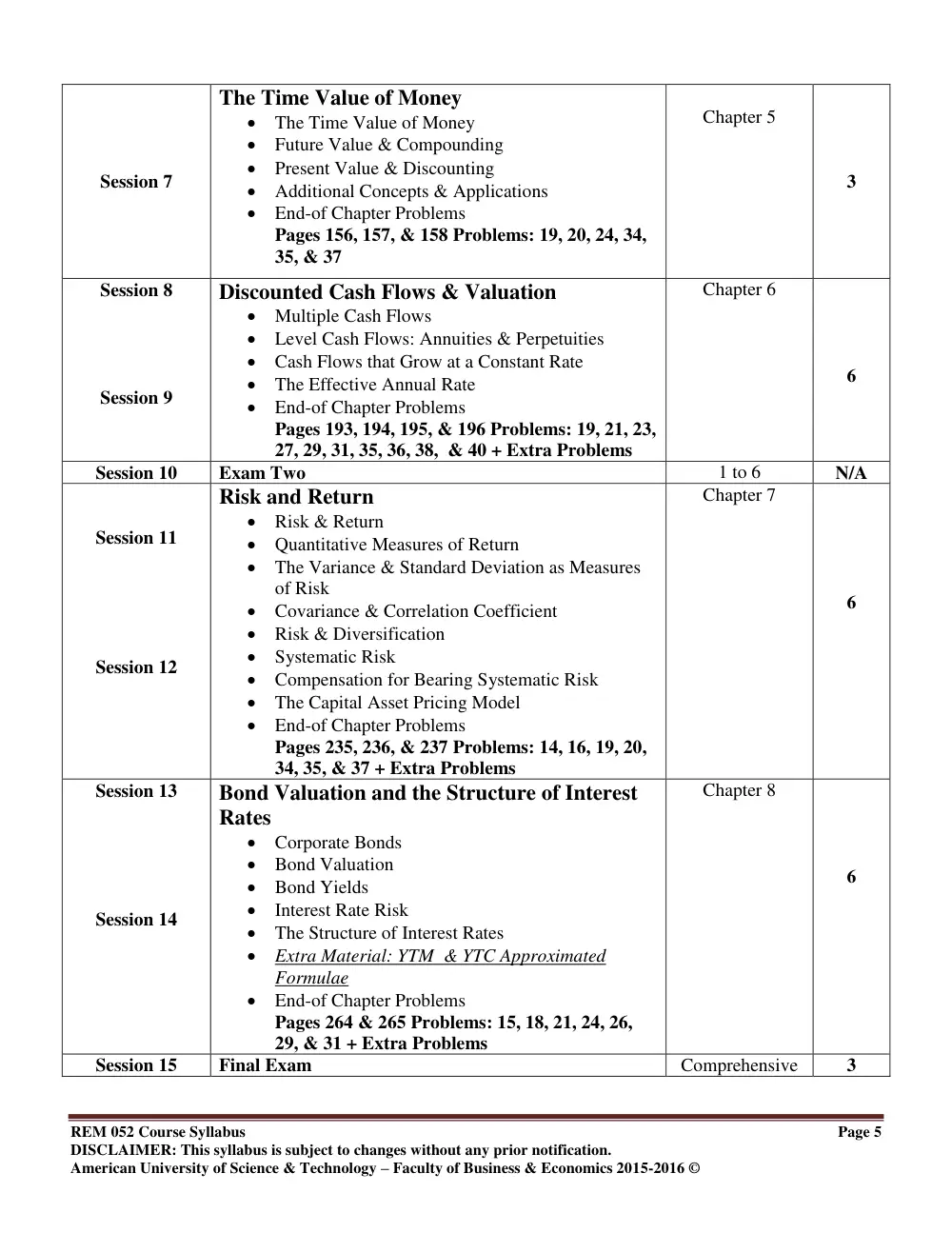
Session 7
The Time Value of Money
The Time Value of Money
Future Value & Compounding
Present Value & Discounting
Additional Concepts & Applications
End-of Chapter Problems
Pages 156, 157, & 158 Problems: 19, 20, 24, 34,
35, & 37
Chapter 5
3
Session 8
Session 9
Discounted Cash Flows & Valuation
Multiple Cash Flows
Level Cash Flows: Annuities & Perpetuities
Cash Flows that Grow at a Constant Rate
The Effective Annual Rate
End-of Chapter Problems
Pages 193, 194, 195, & 196 Problems: 19, 21, 23,
27, 29, 31, 35, 36, 38, & 40 + Extra Problems
Chapter 6
6
Session 10
Exam Two
1 to 6
N/A
Session 11
Session 12
Risk and Return
Risk & Return
Quantitative Measures of Return
The Variance & Standard Deviation as Measures
of Risk
Covariance & Correlation Coefficient
Risk & Diversification
Systematic Risk
Compensation for Bearing Systematic Risk
The Capital Asset Pricing Model
End-of Chapter Problems
Pages 235, 236, & 237 Problems: 14, 16, 19, 20,
34, 35, & 37 + Extra Problems
Chapter 7
6
Session 13
Session 14
Bond Valuation and the Structure of Interest
Rates
Corporate Bonds
Bond Valuation
Bond Yields
Interest Rate Risk
The Structure of Interest Rates
Extra Material: YTM & YTC Approximated
Formulae
End-of Chapter Problems
Pages 264 & 265 Problems: 15, 18, 21, 24, 26,
29, & 31 + Extra Problems
Chapter 8
6
Session 15
Final Exam
Comprehensive
3
REM 052 Course Syllabus
Page 6
DISCLAIMER: This syllabus is subject to changes without any prior notification.
American University of Science & Technology – Faculty of Business & Economics 2015-2016 ©
Note
Financial Calculators and Financial Tables are not allowed in this course. Students have to rely on the
mathematical formulae in all the chapters.
Course Approach
The course material will be delivered based on the following techniques:
1. Formal and informal lectures to increase the student participation and effective exposition of discussed
issues.
2. Teamwork is also encouraged to continuously apply brainstorming group problem solving techniques.
3. Debate sessions will also be conducted to stress the critical thinking approach into the exposition of
ideas and achievement of higher interactivity between students.
4. Online Problem solving sessions through the student’s “wileyPlus” website link.
Homework Format
All homework should be submitted on the due date. Homework will be graded and returned by next week
with the appropriate solution. Late homework will be penalized 50 % per class period. No homework and
projects will be accepted after the last day of classes.