
BUS 105 Problems Practice Problems, Fall 2016
Lebanese American University · Business Math · 239 pages
Showing the first 10 of 239 pages. Download the PDF to see all of it.
More BUS 105 files
Show the text of this problems
Chemistry
Higher and standard level
Specimen papers 1, 2 and 3
For first examinations in 2016
CONTENTS
Chemistry higher level paper 1 specimen question paper
Chemistry higher level paper 1 specimen markscheme
Chemistry higher level paper 2 specimen question paper
Chemistry higher level paper 2 specimen markscheme
Chemistry higher level paper 3 specimen question paper
Chemistry higher level paper 3 specimen markscheme
Chemistry standard level paper 1 specimen question paper
Chemistry standard level paper 1 specimen markscheme
Chemistry standard level paper 2 specimen question paper
Chemistry standard level paper 2 specimen markscheme
Chemistry standard level paper 3 specimen question paper
Chemistry standard level paper 3 specimen markscheme
17 pages
SPEC/4/CHEMI/HPM/ENG/TZ0/XX
SPECIMEN PAPER
CHEMISTRY
HIgHER lEvEl
PaPER 1
INSTRUCTIONS TO CANDIDATES
• Do not open this examination paper until instructed to do so.
• Answer all the questions.
• For each question, choose the answer you consider to be the best and indicate your choice on
the answer sheet provided.
• The periodic table is provided for reference on page 2 of this examination paper.
• The maximum mark for this examination paper is [40 marks].
1 hour
© International Baccalaureate Organization 2014
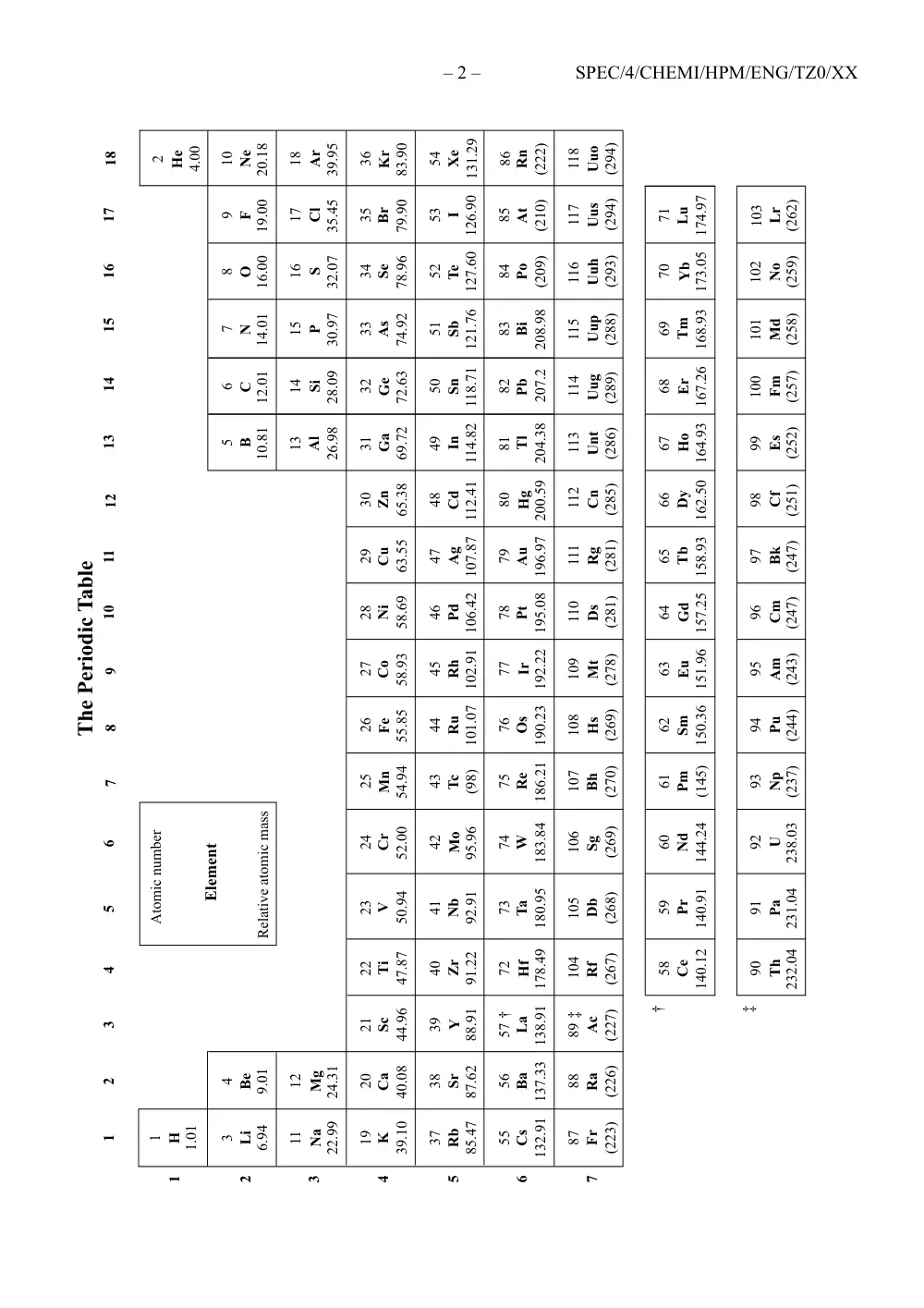
– 2 –
SPEC/4/CHEMI/HPM/ENG/TZ0/XX
88
Ra
(226)
56
Ba
137.33
38
Sr
87.62
20
Ca
40.08
12
Mg
24.31
4
Be
9.01
2
‡
†
89 ‡
Ac
(227)
57 †
La
138.91
39
Y
88.91
21
Sc
44.96
90
Th
232.04
58
Ce
140.12
72
Hf
178.49
40
Zr
91.22
22
Ti
47.87
91
Pa
231.04
59
Pr
140.91
73
Ta
180.95
41
Nb
92.91
23
V
50.94
92
U
238.03
60
Nd
144.24
74
W
183.84
42
Mo
95.96
24
Cr
52.00
55
Cs
132.91
37
Rb
85.47
19
K
39.10
11
Na
22.99
3
Li
6.94
1
H
1.01
1
Fr
87
(223)
Atomic number
Element
Relative atomic mass
93
Np
(237)
61
Pm
(145)
75
Re
186.21
43
Tc
(98)
25
Mn
54.94
94
Pu
(244)
62
Sm
150.36
76
Os
190.23
44
Ru
101.07
26
Fe
55.85
95
Am
(243)
63
Eu
151.96
77
Ir
192.22
45
Rh
102.91
27
Co
58.93
96
Cm
(247)
64
Gd
157.25
78
Pt
195.08
46
Pd
106.42
28
Ni
58.69
97
Bk
(247)
65
Tb
158.93
79
Au
196.97
47
Ag
107.87
29
Cu
63.55
The Periodic Table
98
Cf
(251)
66
Dy
162.50
80
Hg
200.59
48
Cd
112.41
30
Zn
65.38
99
Es
(252)
67
Ho
164.93
81
Tl
204.38
49
In
114.82
31
Ga
69.72
13
Al
26.98
5
B
10.81
13
100
Fm
(257)
68
Er
167.26
82
Pb
207.2
50
Sn
118.71
32
Ge
72.63
14
Si
28.09
6
C
12.01
14
101
Md
(258)
69
Tm
168.93
83
Bi
208.98
51
Sb
121.76
33
As
74.92
15
P
30.97
7
N
14.01
15
102
No
(259)
70
Yb
173.05
84
Po
(209)
52
Te
127.60
34
Se
78.96
16
S
32.07
8
O
16.00
16
103
Lr
(262)
71
Lu
174.97
85
At
(210)
53
I
126.90
35
Br
79.90
17
Cl
35.45
9
F
19.00
17
86
Rn
(222)
54
Xe
131.29
36
Kr
83.90
18
Ar
39.95
10
Ne
20.18
2
He
4.00
18
3
4
5
6
7
8
9
10
11
12
1
2
3
4
5
6
7
104
Rf
(267)
105
Db
(268)
106
Sg
(269)
107
Bh
(270)
108
Hs
(269)
109
Mt
(278)
110
Ds
(281)
111
Rg
(281)
112
Cn
(285)
113
Unt
(286)
114
Uug
(289)
115
Uup
(288)
116
Uuh
(293)
117
Uus
(294)
118
Uuo
(294)
– 3 –
Turn over
SPEC/4/CHEMI/HPM/ENG/TZ0/XX
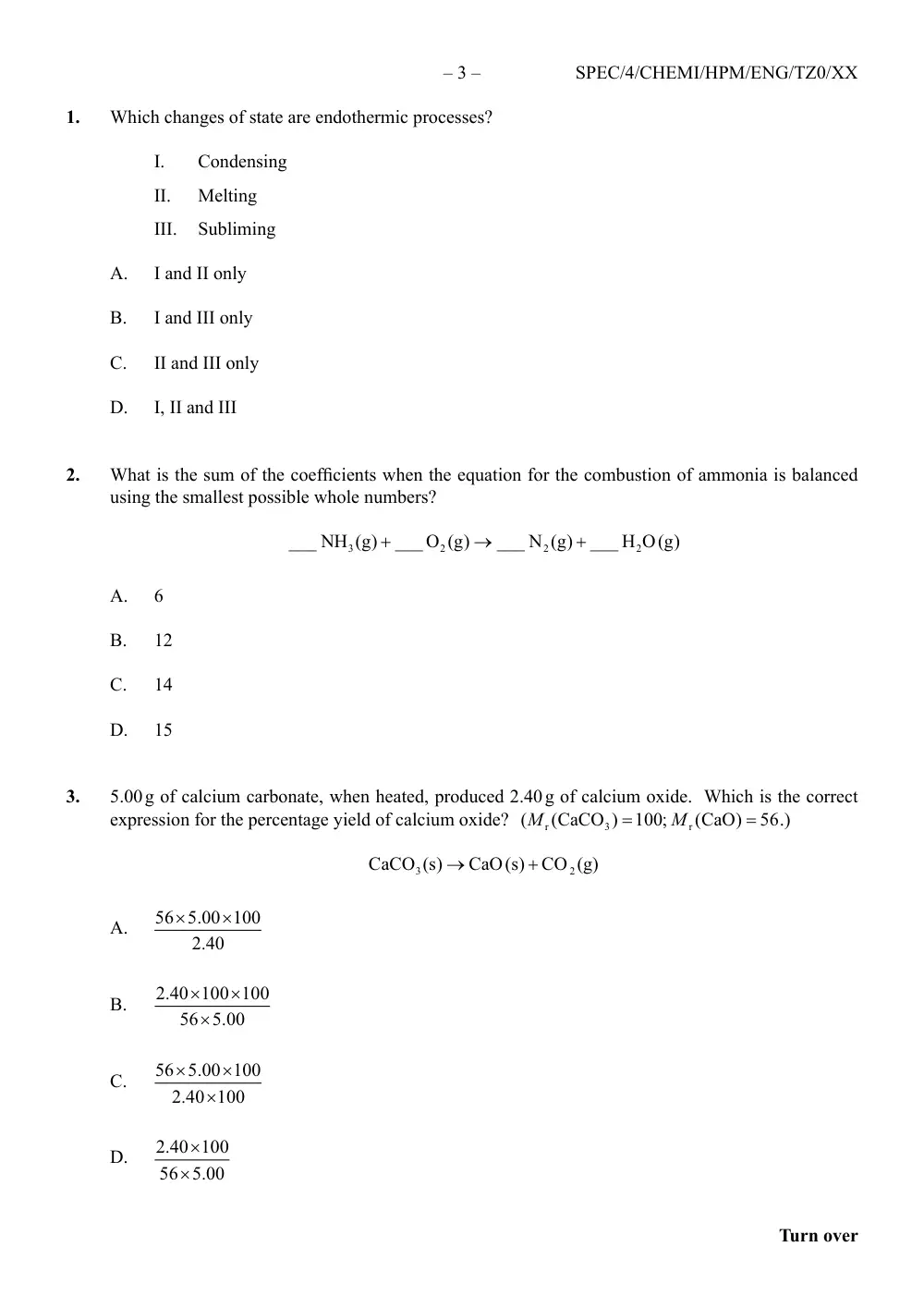
1.
Which changes of state are endothermic processes?
I.
Condensing
II.
Melting
III.
Subliming
A.
I and II only
B.
I and III only
C.
II and III only
D.
I, II and III
2.
What is the sum of the coefficients when the equation for the combustion of ammonia is balanced
using the smallest possible whole numbers?
___
)
___
)
___
)
___
)
NH (g
O (g
N (g
H O(g
3
2
2
2
+
→
+
A.
6
B.
12
C.
14
D.
15
3.
5.00 g of calcium carbonate, when heated, produced 2.40 g of calcium oxide. Which is the correct
expression for the percentage yield of calcium oxide? (
(
)
;
(
)
M
M
r
r
CaCO
CaO
3
100
56
=
=
.)
CaCO (s
CaO(s
CO (g)
3
2
)
)
→
+
A.
56 5 00 100
2 40
×
×
.
.
B.
2 40 100 100
56 5 00
.
.
×
×
×
C.
56 5 00 100
2 40 100
×
×
×
.
.
D.
2 40 100
56 5 00
.
.
×
×
– 4 –
SPEC/4/CHEMI/HPM/ENG/TZ0/XX
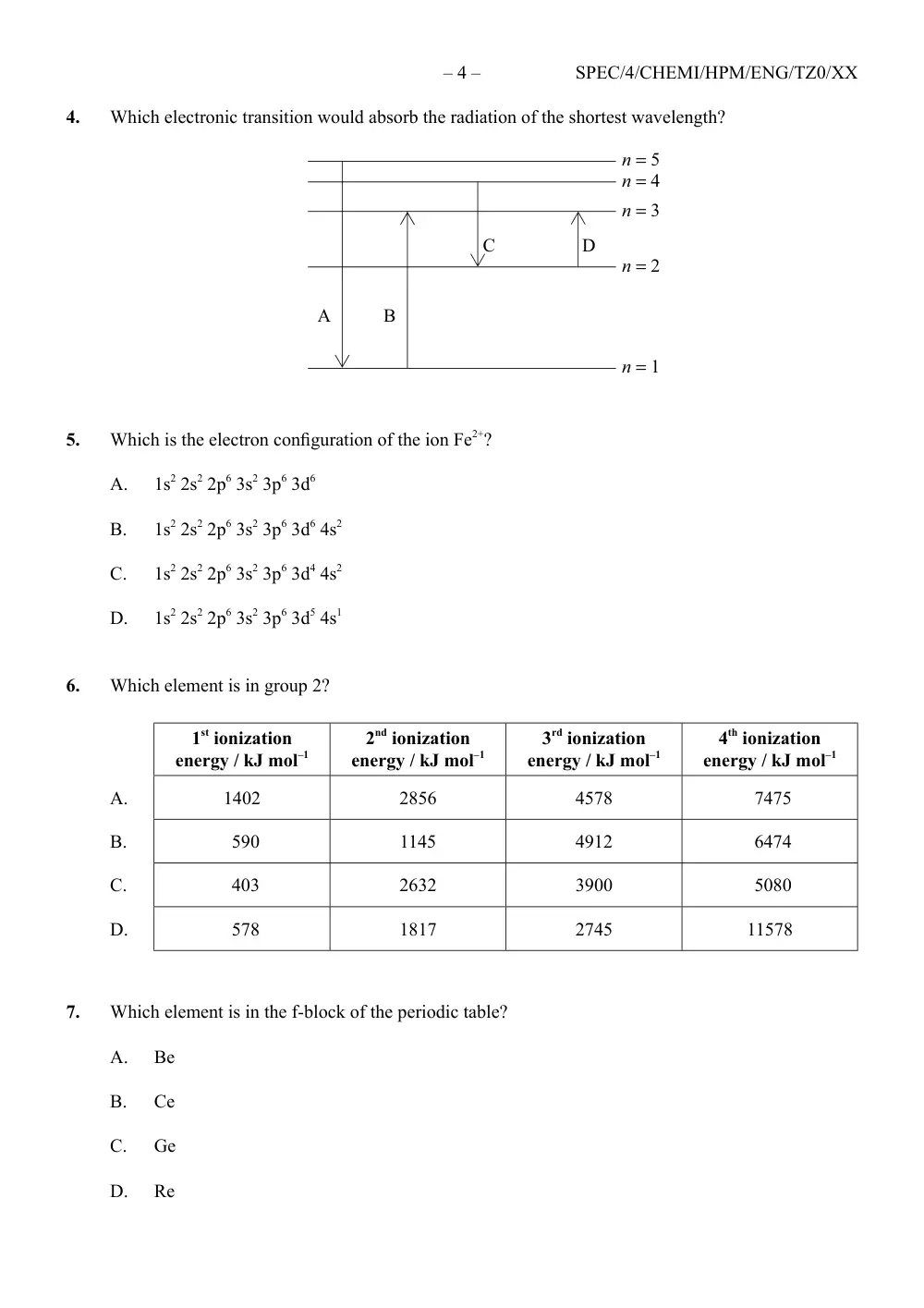
4.
Which electronic transition would absorb the radiation of the shortest wavelength?
n = 5
n = 4
n = 3
n = 2
n = 1
A
B
C
D
5.
Which is the electron configuration of the ion Fe2+?
A.
1s2 2s2 2p6 3s2 3p6 3d6
B.
1s2 2s2 2p6 3s2 3p6 3d6 4s2
C.
1s2 2s2 2p6 3s2 3p6 3d4 4s2
D.
1s2 2s2 2p6 3s2 3p6 3d5 4s1
6.
Which element is in group 2?
1st ionization
energy / kJ mol–1
2nd ionization
energy / kJ mol–1
3rd ionization
energy / kJ mol–1
4th ionization
energy / kJ mol–1
A.
1402
2856
4578
7475
B.
590
1145
4912
6474
C.
403
2632
3900
5080
D.
578
1817
2745
11578
7.
Which element is in the f-block of the periodic table?
A.
Be
B.
Ce
C.
Ge
D.
Re
– 5 –
Turn over
SPEC/4/CHEMI/HPM/ENG/TZ0/XX
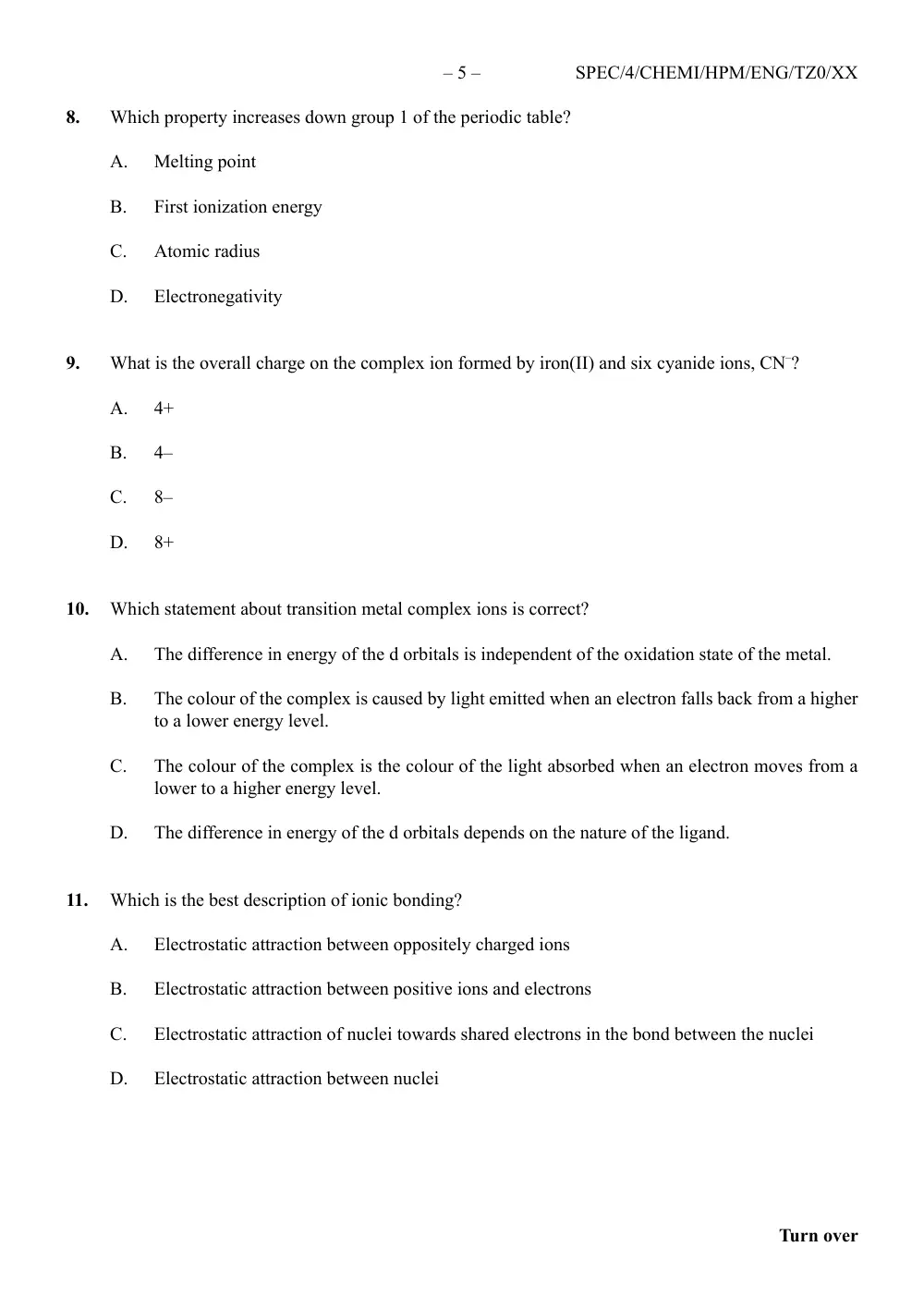
8.
Which property increases down group 1 of the periodic table?
A.
Melting point
B.
First ionization energy
C.
Atomic radius
D.
Electronegativity
9.
What is the overall charge on the complex ion formed by iron(II) and six cyanide ions, CN–?
A.
4+
B.
4–
C.
8–
D.
8+
10.
Which statement about transition metal complex ions is correct?
A.
The difference in energy of the d orbitals is independent of the oxidation state of the metal.
B.
The colour of the complex is caused by light emitted when an electron falls back from a higher
to a lower energy level.
C.
The colour of the complex is the colour of the light absorbed when an electron moves from a
lower to a higher energy level.
D.
The difference in energy of the d orbitals depends on the nature of the ligand.
11.
Which is the best description of ionic bonding?
A.
Electrostatic attraction between oppositely charged ions
B.
Electrostatic attraction between positive ions and electrons
C.
Electrostatic attraction of nuclei towards shared electrons in the bond between the nuclei
D.
Electrostatic attraction between nuclei
– 6 –
SPEC/4/CHEMI/HPM/ENG/TZ0/XX
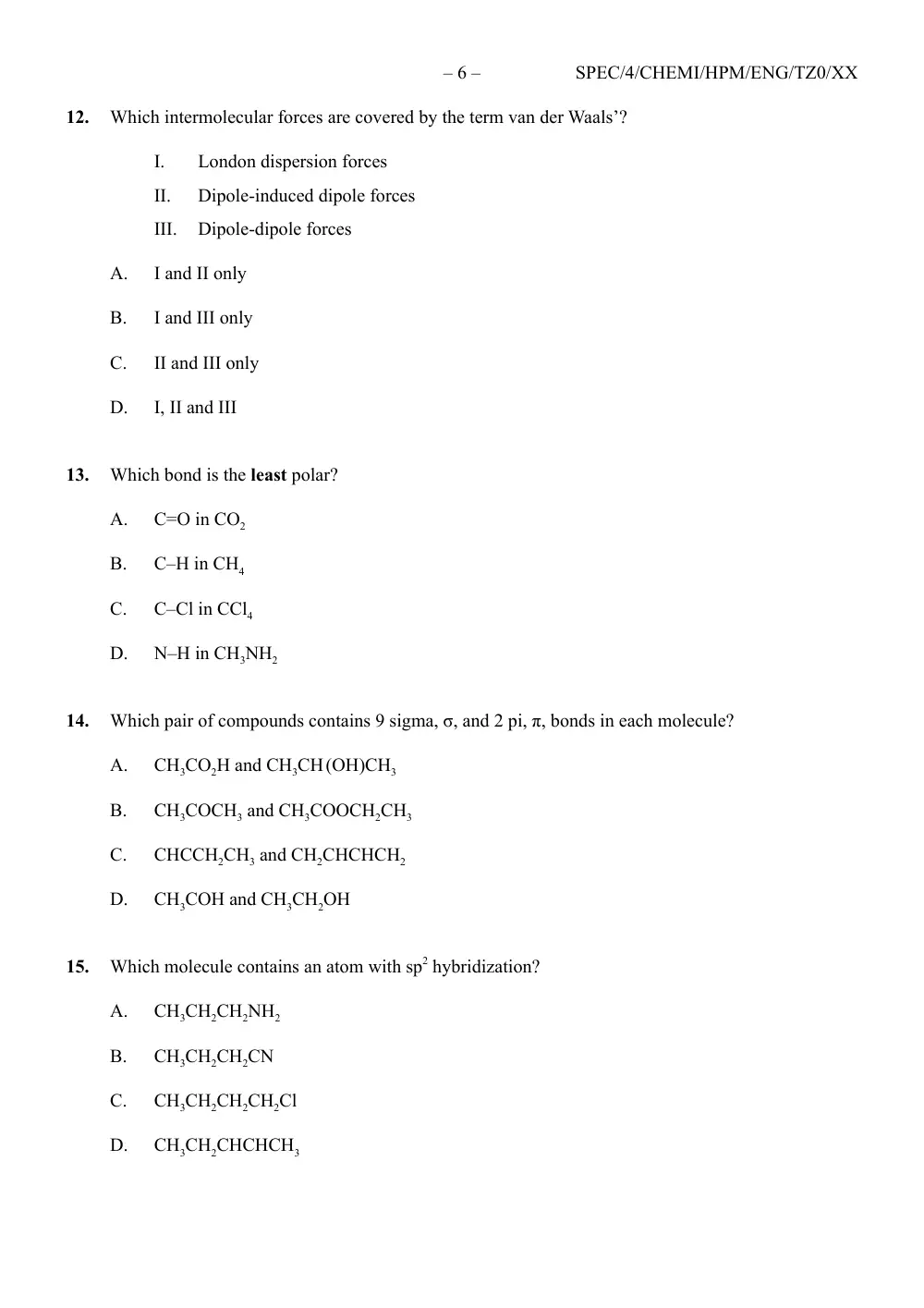
12.
Which intermolecular forces are covered by the term van der Waals’?
I.
London dispersion forces
II.
Dipole-induced dipole forces
III.
Dipole-dipole forces
A.
I and II only
B.
I and III only
C.
II and III only
D.
I, II and III
13.
Which bond is the least polar?
A.
C=O in CO2
B.
C–H in CH4
C.
C–Cl in CCl4
D.
N–H in CH3NH2
14.
Which pair of compounds contains 9 sigma, σ, and 2 pi, π, bonds in each molecule?
A.
CH3CO2H and CH3CH (OH)CH3
B.
CH3COCH3 and CH3COOCH2CH3
C.
CHCCH2CH3 and CH2CHCHCH2
D.
CH3COH and CH3CH2OH
15.
Which molecule contains an atom with sp2 hybridization?
A.
CH3CH2CH2NH2
B.
CH3CH2CH2CN
C.
CH3CH2CH2CH2Cl
D.
CH3CH2CHCHCH3
– 7 –
Turn over
SPEC/4/CHEMI/HPM/ENG/TZ0/XX
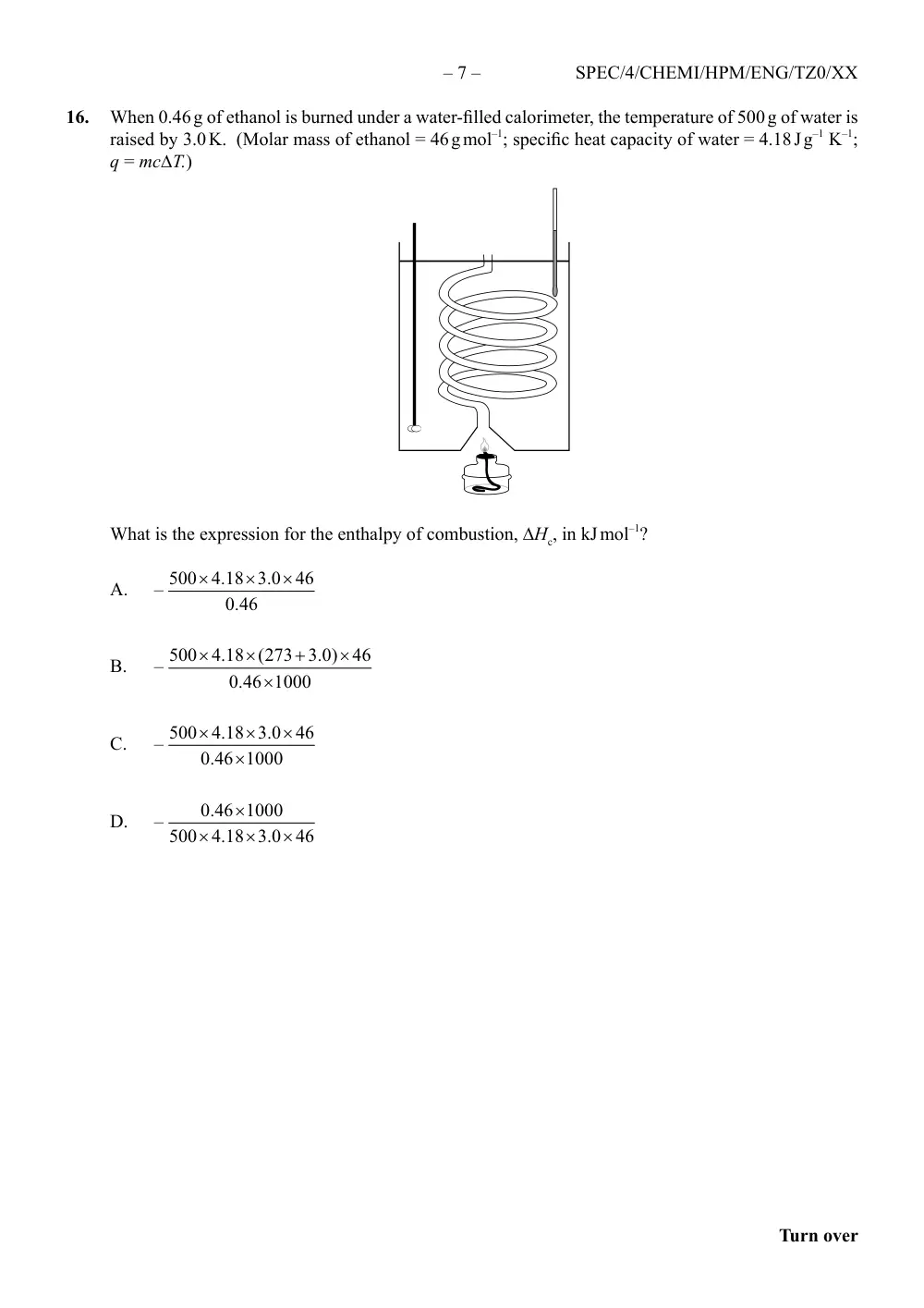
16.
When 0.46 g of ethanol is burned under a water-filled calorimeter, the temperature of 500 g of water is
raised by 3.0 K. (Molar mass of ethanol = 46 g mol–1; specific heat capacity of water = 4.18 J g–1 K–1;
q = mc∆T.)
What is the expression for the enthalpy of combustion, ∆Hc, in kJ mol–1?
A.
– 500 4 18 3 0 46
0 46
×
×
×
.
.
.
B.
– 500 4 18
273
3 0
46
0 46 1000
×
×
+
×
×
.
(
. )
.
C.
– 500 4 18 3 0 46
0 46 1000
×
×
×
×
.
.
.
D.
–
0 46 1000
500 4 18 3 0 46
.
.
.
×
×
×
×
– 8 –
SPEC/4/CHEMI/HPM/ENG/TZ0/XX
17.
Given the following information, what is the standard enthalpy of formation,
f
H
Ö , of methane?
C(s
O (g
CO (g
2
2
)
)
)
+
→
∆
H =
E kJ
H (g
O g
H O(l)
2
2
)
( )
+
→
1
2
2
∆
H =
F kJ
CH (g
2O (g
CO (g
2H O(l
4
2
2
2
)
)
)
)
+
→
+
∆
H =
G kJ
A.
E + F + G
B.
E + F – G
C.
E + 2F + G
D.
E + 2F – G
18.
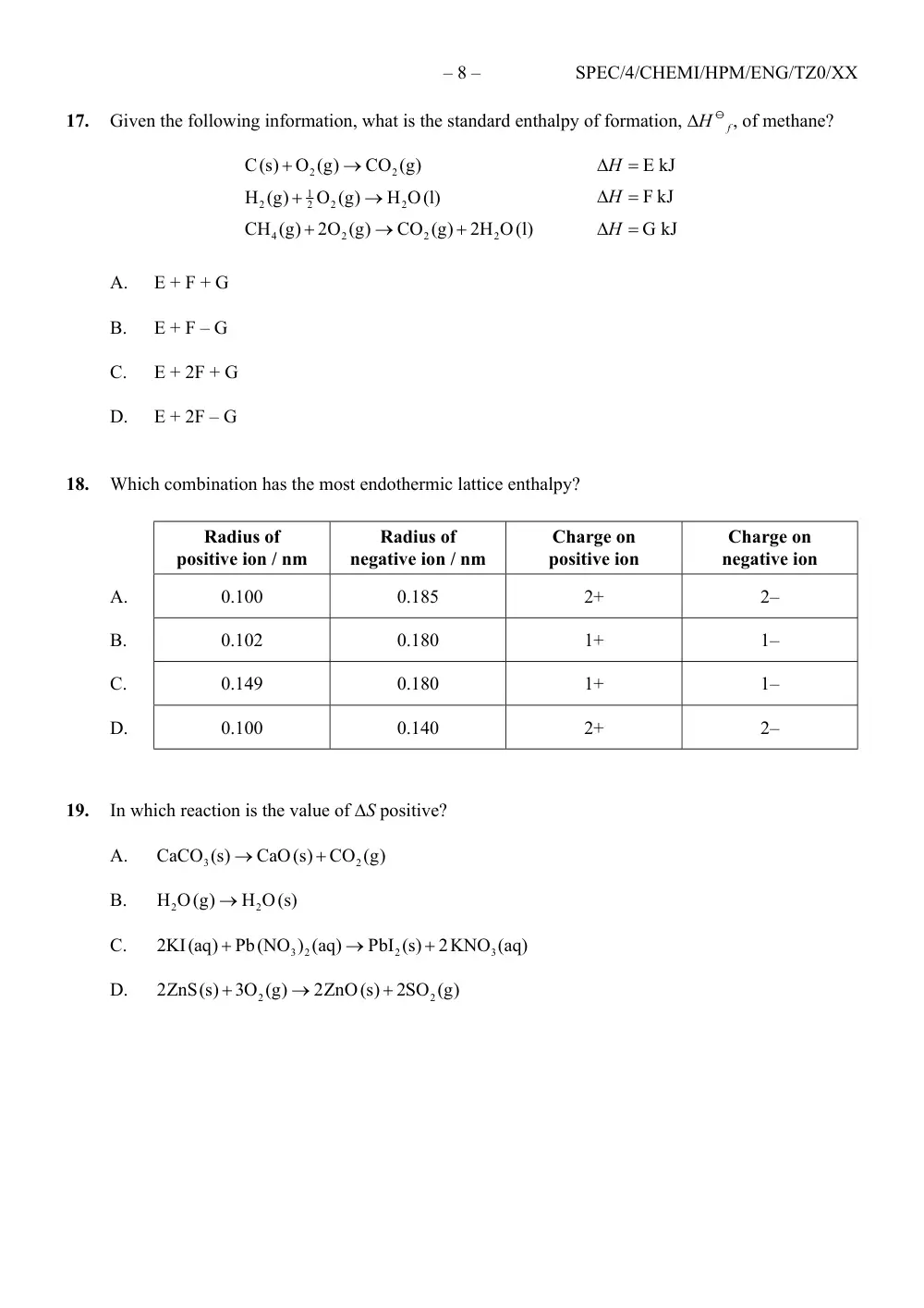
Which combination has the most endothermic lattice enthalpy?
Radius of
positive ion / nm
Radius of
negative ion / nm
Charge on
positive ion
Charge on
negative ion
A.
0.100
0.185
2+
2–
B.
0.102
0.180
1+
1–
C.
0.149
0.180
1+
1–
D.
0.100
0.140
2+
2–
19.
In which reaction is the value of ∆S positive?
A.
CaCO (s
CaO(s
CO (g
3
2
)
)
)
→
+
B.
H O(g
H O(s)
2
2
) →
C.
2KI(aq
Pb(NO
)
) (aq)
PbI (s)
KNO (aq)
+
→
+
3 2
2
3
2
D.
2
3
2
2
ZnS(s
O (g
ZnO(s
SO (g
2
2
)
)
)
)
+
→
+
– 9 –
Turn over
SPEC/4/CHEMI/HPM/ENG/TZ0/XX
20.
Which graph shows the Maxwell-Boltzmann energy distribution of a same amount of a gas at two
temperatures, where T2 is greater than T1?
A.
Fraction of particles
with kinetic energy
T1
T2
B.
Fraction of particles
with kinetic energy
T1
T2
Kinetic energy
Kinetic energy
C.
Fraction of particles
with kinetic energy
T1
T2
D.
Fraction of particles
with kinetic energy
T1
T2
Kinetic energy
Kinetic energy
21.
Which changes increase the rate of this reaction, other conditions remaining constant?
CaCO (s
HCl(aq
CaCl (aq
H O(l
CO (g
3
2
2
2
)
)
)
)
)
+
→
+
+
2
I.
Using larger lumps of calcium carbonate
II.
Increasing the temperature of the reaction mixture
III.
Increasing the concentration of hydrochloric acid
A.
I and II only
B.
I and III only
C.
II and III only
D.
I, II and III
– 10 –
SPEC/4/CHEMI/HPM/ENG/TZ0/XX
22.
The rate information below was obtained for the following reaction at a constant temperature.
H O (aq)
H (aq)
I (aq)
H O(l)
I (aq)
2
2
2
2
+
+
→
+
+
−
2
2
2
Initial [H2O2 (aq)]
/ mol dm–3
Initial [H+(aq)]
/ mol dm–3
Initial [I–(aq)]
/ mol dm–3
Initial rate of reaction
/ mol dm–3 s–1
0.005
0.05
0.015
1.31 ×10⁻⁶
0.01
0.05
0.015
2.63 ×10⁻⁶
0.01
0.05
0.03
5.25 ×10⁻⁶
0.01
0.1
0.03
5.25 ×10⁻⁶
What is the overall order of the reaction?
A.
0
B.
1
C.
2
D.
3
23.
Which reaction is most likely to be spontaneous?
Enthalpy change
Entropy
A.
exothermic
entropy decreases
B.
exothermic
entropy increases
C.
endothermic
entropy decreases
D.
endothermic
entropy increases
– 11 –
Turn over
SPEC/4/CHEMI/HPM/ENG/TZ0/XX
24.
Which conditions give the greatest equilibrium yield of methanal, H2CO (g)?
CO(g
H (g
H CO(g
kJ
2
2
)
)
)
.
+
∆
= −
H
1 8
Pressure
Temperature
A.
high
low
B.
high
high
C.
low
high
D.
low
low
25.
Which combination of temperature and equilibrium constant is most typical of a reaction going to
completion? (Refer to the equation ∆
G = −
RT
ln K
.)
Temperature
Equilibrium constant
A.
high
> 1
B.
high
< 1
C.
low
> 1
D.
low
< 1
26.
Which of the following is not amphiprotic?
A.
H2O
B.
HPO4
2–
C.
H2PO4
–
D.
H3O+
– 12 –
SPEC/4/CHEMI/HPM/ENG/TZ0/XX
27.
The pH of a solution changes from 3 to 5. What happens to the concentration of hydrogen ions?
A.
It increases by a factor of 2.
B.
It increases by a factor of 100.
C.
It decreases by a factor of 2.
D.
It decreases by a factor of 100.
28.
Which statement is correct about a Lewis base?
A.
It is an electron pair donor and can act as a nucleophile.
B.
It is an electron pair acceptor and can act as a nucleophile.
C.
It is an electron pair donor and can act as an electrophile.
D.
It is an electron pair acceptor and can act as an electrophile.
29.
Which mixture forms a buffer solution with a pH < 7?
A.
50 cm3 0.10 mol dm–3 NH4Cl (aq) + 50 cm3 0.10 mol dm–3 NH3(aq)
B.
50 cm3 0.10 mol dm–3 HCl (aq) + 100 cm3 0.10 mol dm–3 NH3(aq)
C.
50 cm3 0.10 mol dm–3 NaOH (aq) + 100 cm3 0.10 mol dm–3 CH3COOH (aq)
D.
50 cm3 0.10 mol dm–3 H2SO4(aq) + 100 cm3 0.10 mol dm–3 NH3(aq)
– 13 –
Turn over
SPEC/4/CHEMI/HPM/ENG/TZ0/XX
30.
The equations below represent reactions involved in the Winkler method for determining the
concentration of dissolved oxygen in water:
2
2
2
2
Mn (OH)
O (aq
MnO(OH
s
2
(s)
)
) ( )
+
→
MnO(OH
s
H SO (aq
Mn (SO ) (s)
H O(l
2
4
4
2
2
) ( )
)
)
2
2
3
+
→
+
Mn (SO
s
I
aq
Mn
aq
I (aq
SO
(aq
2
4
2
2
4
2
2
2
) ( )
(
)
(
)
)
)
+
→
+
+
−
+
−
2
2
3
2
6
2
S O
aq
I (aq
S O
aq
I (aq
2
2
4
−
−
−
+
→
+
(
)
)
(
)
)
What is the amount, in mol, of thiosulfate ions, S2O3
2–(aq), needed to react with the iodine, I2(aq),
formed by 1.00 mol of dissolved oxygen?
A.
2.00
B.
3.00
C.
4.00
D.
6.00
31.
What are the products when molten sodium chloride is electrolysed?
Cathode
Anode
A.
hydrogen
chlorine
B.
sodium
chloride
C.
sodium
chlorine
D.
chlorine
sodium
– 14 –
SPEC/4/CHEMI/HPM/ENG/TZ0/XX
32.
E Ö values for some half-equations are given below.
Mn
aq
e
Mn (s
2
2
+
−
+
(
)
)
E Ö = −1 18
.
V
Fe
aq
e
Fe(s)
2
2
+
−
+
(
)
E Ö = −0 45
.
V
Pb
aq
e
Pb(s)
2
2
+
−
+
(
)
E Ö = −0 13
.
V
Which reaction is spontaneous under standard conditions?
A.
Fe
aq
Mn (s
Fe(s
Mn
(aq
2
2
+
+
+
→
+
(
)
)
)
)
B.
Mn
aq
Pb(s)
Mn (s)
Pb
aq
2
2
+
+
+
→
+
(
)
(
)
C.
Fe (aq
Pb(s
Fe(s
Pb
(aq
2+
)
)
)
)
+
→
+
+
2
D.
Mn
aq
Fe(s
Mn (s
Fe (aq
2
2
+
+
+
→
+
(
)
)
)
)
33.
50.0 cm3 of 0.50 mol dm–3 aqueous copper(II) sulfate, CuSO4(aq), is electrolysed using a current of
0.50 A for 30 minutes. What mass of copper, in g, is deposited on the cathode?
(M(Cu) = 64 g mol–1; Faraday’s constant (F) = 96500 C mol–1.)
A.
50 0 0 50 64
1000
.
× .
×
B.
0 50 30 64
96500 2
.
×
×
×
C.
0 50 30 60 64
96500 2
.
×
×
×
×
D.
50 0 0 50 64
1000 2
.
× .
×
×
34.
Which is propyl propanoate?
A.
CH3CH2CH2OOCCH2CH3
B.
CH3CH2CH2COOCH2CH3
C.
CH3CH2CH2COCH2CH3
D.
CH3CH2CH2OCH2CH2CH3
– 15 –
Turn over
SPEC/4/CHEMI/HPM/ENG/TZ0/XX
35.
Which could form an addition polymer?
A.
H2NCH2CHCHCH2NH2
B.
H2N (CH2)6CO2H
C.
HO (CH2)2CO2H
D.
H2N (CH2)6NH2
36.
Which benzene derivative can be formed from methylbenzene by electrophilic substitution?
A.
CH2Cl
B.
CH2
H2C
CH2
CH2
C
CH2
CH3
H
C.
CH3
NO2
D.
CH2NH2
37.
Which compound has two enantiomeric forms?
A.
CH3CH2CBr2CH3
B.
CH3CH2CHBrCH3
C.
CH3(CH2)2CH2Br
D.
CH3CH2CHBrCH2CH3
– 16 –
SPEC/4/CHEMI/HPM/ENG/TZ0/XX
38.
Which combination in the table correctly states the value and units of the gradient?
Rate of reaction / 10–3 mol dm–3 s–1
5.0
4.0
3.0
2.0
1.0
0.010
0.020
0.030
0.040
0.050
0.060
Concentration of reactant / mol dm–3
Value
Units
A.
3 0 10
0 6 10
0 050
0 010
3
3
.
.
.
.
×
−
×
−
−
−
s–1
B.
3 0 10
0 6 10
0 050
0 010
3
3
.
.
.
.
×
−
×
−
−
−
s
C.
0 050
0 010
3 0 10
0 6 10
3
3
.
.
.
.
−
×
−
×
−
−
s–1
D.
0 050
0 010
3 0 10
0 6 10
3
3
.
.
.
.
−
×
−
×
−
−
s
– 17 –
SPEC/4/CHEMI/HPM/ENG/TZ0/XX
39.
Which technique involves the absorption of radiation by bonds between atoms?
A.
1H NMR
B.
Infrared spectroscopy
C.
X-ray crystallography
D.
Mass spectrometry
40.
The graph shows the concentration of some pollutants in a city over a 24-hour period.
Concentration
Hydrocarbons
NO
PAN
NO2
5
6
7
8
9
10 11 Noon 1
2
3
4
5
6
7
8
9
10 11 Mid- 1
2
3
4
Sunrise
am
pm
Sunset
night
Time of day
Which of the following could not be inferred from the graph?
A.
Hydrocarbons cause less harm to health than PAN.
B.
An increase in hydrocarbons is caused by the morning rush hour.
C.
PAN concentration increases as the intensity of sunlight increases.
D.
NO2 production follows the production of NO.
SPEC/4/CHEMI/HPM/ENG/TZ0/XX/M
2 pages
MARKSCHEME
SPECIMEN PAPER
CHEMISTRY
Higher Level
Paper 1
– 2 –
SPEC/4/CHEMI/HPM/ENG/TZ0/XX/M
1.
C
16.
C
31.
C
46.
–
2.
D
17.
D
32.
A
47.
–
3.
B
18.
D
33.
C
48.
–
4.
B
19.
A
34.
A
49.
–
5.
A
20.
C
35.
A
50.
–
6.
B
21.
C
36.
C
51.
–
7.
B
22.
C
37.
B
52.
–
8.
C
23.
B
38.
A
53.
–
9.
B
24.
A
39.
B
54.
–
10.
D
25.
A
40.
A
55.
–
11.
A
26.
D
41.
–
56.
–
12.
D
27.
D
42.
–
57.
–
13.
B
28.
A
43.
–
58.
–
14.
C
29.
C
44.
–
59.
–
15.
D
30.
C
45.
–
60.
–
29 pages
SPEC/4/CHEMI/HP2/ENG/TZ0/XX
SPECIMEN PAPER
CHEMISTRY
HIGHER lEvEl
PaPER 2
INSTRUCTIONS TO CANDIDATES
• Write your session number in the boxes above.
• Do not open this examination paper until instructed to do so.
• Answer all questions.
• Write your answers in the boxes provided.
• A calculator is required for this paper.
• A clean copy of the Chemistry data booklet is required for this paper.
• The maximum mark for this examination paper is [95 marks].
2 hours 15 minutes
© International Baccalaureate Organization 2014
Candidate session number
Examination code
–
32EP01
– 2 –
SPEC/4/CHEMI/HP2/ENG/TZ0/XX
Answer all questions. Write your answers in the boxes provided.
1.
Two IB students carried out a project on the chemistry of bleach.
(a)
The bleach contained a solution of sodium hypochlorite, NaClO (aq). The students
determined experimentally the concentration of hypochlorite ions, ClO–, in the bleach:
Experimental procedure:
• The bleach solution was first diluted by adding 25.00 cm3 of the bleach to a 250 cm3
volumetric flask. The solution was filled to the graduation mark with deionized water.
• 25.00 cm3 of this solution was then reacted with excess iodide in acid.
ClO (aq)
I (aq)
H (aq)
Cl (aq)
I (aq)
H O(l)
2
2
−
−
+
−
+
+
→
+
+
2
2
• The iodine formed was titrated with 0.100 mol dm–3 sodium thiosulfate solution,
Na2S2O3(aq), using starch indicator.
I (aq
2S O
(aq)
2I (aq)
S O
(aq)
2
2
3
2
4
6
2
) +
→
+
−
−
−
The following data were recorded for the titration:
First titre
Second titre
Third titre
Final burette reading of
0.100 mol dm–3 Na2S2O3(aq)
(in cm3 ± 0.05)
23.95
46.00
22.15
Initial burette reading of
0.100 mol dm–3 Na2S2O3(aq)
(in cm3 ± 0.05)
0.00
23.95
0.00
(i)
Calculate the volume, in cm3, of 0.100 mol dm–3 Na2S2O3(aq) required to react
with the iodine to reach the end point.
[1]
. . . . . . . . . . . . . . . . . . . . . . . . . . . . . . . . . . . . . . . . . . . . . . . . . . . . . . . . . . . . . . . . . .
. . . . . . . . . . . . . . . . . . . . . . . . . . . . . . . . . . . . . . . . . . . . . . . . . . . . . . . . . . . . . . . . . .
(This question continues on the following page)
32EP02
– 3 –
Turn over
SPEC/4/CHEMI/HP2/ENG/TZ0/XX
(Question 1 continued)
(ii)
Calculate the amount, in mol, of Na2S2O3(aq) that reacts with the iodine.
[1]
. . . . . . . . . . . . . . . . . . . . . . . . . . . . . . . . . . . . . . . . . . . . . . . . . . . . . . . . . . . . . . . . . .
. . . . . . . . . . . . . . . . . . . . . . . . . . . . . . . . . . . . . . . . . . . . . . . . . . . . . . . . . . . . . . . . . .
(iii) Calculate the concentration, in mol dm–3, of hypochlorite ions in the diluted
bleach solution.
[1]
. . . . . . . . . . . . . . . . . . . . . . . . . . . . . . . . . . . . . . . . . . . . . . . . . . . . . . . . . . . . . . . . . .
. . . . . . . . . . . . . . . . . . . . . . . . . . . . . . . . . . . . . . . . . . . . . . . . . . . . . . . . . . . . . . . . . .
. . . . . . . . . . . . . . . . . . . . . . . . . . . . . . . . . . . . . . . . . . . . . . . . . . . . . . . . . . . . . . . . . .
(iv) Calculate the concentration, in mol dm–3, of hypochlorite ions in the undiluted
bleach solution.
[1]
. . . . . . . . . . . . . . . . . . . . . . . . . . . . . . . . . . . . . . . . . . . . . . . . . . . . . . . . . . . . . . . . . .
. . . . . . . . . . . . . . . . . . . . . . . . . . . . . . . . . . . . . . . . . . . . . . . . . . . . . . . . . . . . . . . . . .
(This question continues on the following page)
32EP03
– 4 –
SPEC/4/CHEMI/HP2/ENG/TZ0/XX
(Question 1 continued)
(b)
Some of the group 17 elements, the halogens, show variable valency.
(i)
Deduce the oxidation states of chlorine and iodine in the following species.
[1]
NaClO:
. . . . . . . . . . . . . . . . . . . . . . . . . . . . . . . . . . . . . . . . . . . . . . . . . . . . . . . . . . . . . . . . . .
I2:
. . . . . . . . . . . . . . . . . . . . . . . . . . . . . . . . . . . . . . . . . . . . . . . . . . . . . . . . . . . . . . . . . .
(ii)
Deduce, with a reason, the oxidizing agent in the reaction of hypochlorite ions with
iodide ions in part (a).
[1]
. . . . . . . . . . . . . . . . . . . . . . . . . . . . . . . . . . . . . . . . . . . . . . . . . . . . . . . . . . . . . . . . . .
. . . . . . . . . . . . . . . . . . . . . . . . . . . . . . . . . . . . . . . . . . . . . . . . . . . . . . . . . . . . . . . . . .
. . . . . . . . . . . . . . . . . . . . . . . . . . . . . . . . . . . . . . . . . . . . . . . . . . . . . . . . . . . . . . . . . .
(iii) From a health and safety perspective, suggest why it is not a good idea to use
hydrochloric acid when acidifying the bleach.
[1]
. . . . . . . . . . . . . . . . . . . . . . . . . . . . . . . . . . . . . . . . . . . . . . . . . . . . . . . . . . . . . . . . . .
. . . . . . . . . . . . . . . . . . . . . . . . . . . . . . . . . . . . . . . . . . . . . . . . . . . . . . . . . . . . . . . . . .
(This question continues on the following page)
32EP04
– 5 –
Turn over
SPEC/4/CHEMI/HP2/ENG/TZ0/XX
(Question 1 continued)
(iv) The thiosulfate ion, S2O3
2–, is an interesting example of oxidation states.
The sulfur atoms can be considered to have an oxidation state of +6 on one atom
and –2 on the other atom. Discuss this statement in terms of your understanding
of oxidation state.
S
S
O
O
O
Lewis (electron dot) structure of thiosulfate
[2]
. . . . . . . . . . . . . . . . . . . . . . . . . . . . . . . . . . . . . . . . . . . . . . . . . . . . . . . . . . . . . . . . . .
. . . . . . . . . . . . . . . . . . . . . . . . . . . . . . . . . . . . . . . . . . . . . . . . . . . . . . . . . . . . . . . . . .
. . . . . . . . . . . . . . . . . . . . . . . . . . . . . . . . . . . . . . . . . . . . . . . . . . . . . . . . . . . . . . . . . .
. . . . . . . . . . . . . . . . . . . . . . . . . . . . . . . . . . . . . . . . . . . . . . . . . . . . . . . . . . . . . . . . . .
. . . . . . . . . . . . . . . . . . . . . . . . . . . . . . . . . . . . . . . . . . . . . . . . . . . . . . . . . . . . . . . . . .
. . . . . . . . . . . . . . . . . . . . . . . . . . . . . . . . . . . . . . . . . . . . . . . . . . . . . . . . . . . . . . . . . .
(This question continues on the following page)
32EP05
– 6 –
SPEC/4/CHEMI/HP2/ENG/TZ0/XX
(Question 1 continued)
(c)
The various changes that have been made to the definitions of oxidation and reduction
show how scientists often broaden similarities to general principles.
Combustion is also a redox type of reaction.
With reference to the combustion reaction of methane, explore two different definitions
of oxidation, choosing one which is valid and one which may be considered not valid.
CH (g
2O (g
CO (g
2H O(l)
4
2
2
2
)
)
)
+
→
+
[2]
Valid:
. . . . . . . . . . . . . . . . . . . . . . . . . . . . . . . . . . . . . . . . . . . . . . . . . . . . . . . . . . . . . . . . . . . . . . .
. . . . . . . . . . . . . . . . . . . . . . . . . . . . . . . . . . . . . . . . . . . . . . . . . . . . . . . . . . . . . . . . . . . . . . .
. . . . . . . . . . . . . . . . . . . . . . . . . . . . . . . . . . . . . . . . . . . . . . . . . . . . . . . . . . . . . . . . . . . . . . .
Not valid:
. . . . . . . . . . . . . . . . . . . . . . . . . . . . . . . . . . . . . . . . . . . . . . . . . . . . . . . . . . . . . . . . . . . . . . .
. . . . . . . . . . . . . . . . . . . . . . . . . . . . . . . . . . . . . . . . . . . . . . . . . . . . . . . . . . . . . . . . . . . . . . .
. . . . . . . . . . . . . . . . . . . . . . . . . . . . . . . . . . . . . . . . . . . . . . . . . . . . . . . . . . . . . . . . . . . . . . .
(d)
(i)
State the condensed electron configuration of sulfur.
[1]
. . . . . . . . . . . . . . . . . . . . . . . . . . . . . . . . . . . . . . . . . . . . . . . . . . . . . . . . . . . . . . . . . .
(ii)
Deduce the orbital diagram of sulfur, showing all the orbitals present in the diagram.
[1]
32EP06
– 7 –
Turn over
SPEC/4/CHEMI/HP2/ENG/TZ0/XX
2.
One of the main constituents of acid deposition is sulfuric acid, H2SO4. This acid is formed
from the sulfur dioxide pollutant, SO2.
A mechanism proposed for its formation is:
2
2
HO (g)
SO (g)
HOSO (g)
2
2
3
HOSO (g)
O (g)
HOO (g)
SO (g)
SO (g
H O(l
H SO (aq
3
2
2
4
)
)
)
+
→
(a)
State what the symbol ( ) represents in the species shown in this mechanism.
[1]
. . . . . . . . . . . . . . . . . . . . . . . . . . . . . . . . . . . . . . . . . . . . . . . . . . . . . . . . . . . . . . . . . . . . . . .
. . . . . . . . . . . . . . . . . . . . . . . . . . . . . . . . . . . . . . . . . . . . . . . . . . . . . . . . . . . . . . . . . . . . . . .
(b)
Consider the following equilibrium between the two oxides of sulfur, sulfur dioxide and
sulfur trioxide:
2
2
198
SO (g
O (g
SO (g
kJ
2
2
3
)
)
)
+
∆
= −
H
Predict, with a reason, in which direction the position of equilibrium will shift for each of
the changes listed below.
Change
Shift
Reason
Increase in temperature
. . . . . . . . . . .
. . . . . . . . . . .
. . . . . . . . . . . . . . . . . . . . . .
. . . . . . . . . . . . . . . . . . . . . .
Increase in pressure
. . . . . . . . . . .
. . . . . . . . . . .
. . . . . . . . . . . . . . . . . . . . . .
. . . . . . . . . . . . . . . . . . . . . .
Addition of a catalyst to the mixture . . . . . . . . . . .
. . . . . . . . . . .
. . . . . . . . . . . . . . . . . . . . . .
. . . . . . . . . . . . . . . . . . . . . .
[3]
(This question continues on the following page)
32EP07
– 8 –
SPEC/4/CHEMI/HP2/ENG/TZ0/XX
(Question 2 continued)
(c)
Sketch the potential energy profile for the forward reaction in part (b) to show the effect
of a catalyst on the activation energy, Eact.
[2]
Potential
energy
Progress of reaction
(d)
Other compounds present in acid rain are formed from nitrogen dioxide, NO2.
Formulate an equation for the reaction of nitrogen dioxide with water.
[1]
. . . . . . . . . . . . . . . . . . . . . . . . . . . . . . . . . . . . . . . . . . . . . . . . . . . . . . . . . . . . . . . . . . . . . . .
(e)
With reference to section 9 of the data booklet, explain the difference between the
atomic radius and the ionic radius of nitrogen.
[1]
. . . . . . . . . . . . . . . . . . . . . . . . . . . . . . . . . . . . . . . . . . . . . . . . . . . . . . . . . . . . . . . . . . . . . . .
. . . . . . . . . . . . . . . . . . . . . . . . . . . . . . . . . . . . . . . . . . . . . . . . . . . . . . . . . . . . . . . . . . . . . . .
. . . . . . . . . . . . . . . . . . . . . . . . . . . . . . . . . . . . . . . . . . . . . . . . . . . . . . . . . . . . . . . . . . . . . . .
32EP08
– 9 –
Turn over
SPEC/4/CHEMI/HP2/ENG/TZ0/XX
3.
A 0.12 mol dm–3 sodium methanoate solution dissociates completely into its ions.
(a)
Formulate the equation, including state symbols, for the equilibrium reaction of the
hydrolysis of the methanoate anion.
[1]
. . . . . . . . . . . . . . . . . . . . . . . . . . . . . . . . . . . . . . . . . . . . . . . . . . . . . . . . . . . . . . . . . . . . . . .
Sections 1 and 21 of the data booklet may be used for parts (b) to (e).
(b)
Calculate the value of Ka, the acid dissociation constant at 298 K, for an aqueous
solution of methanoic acid.
[1]
. . . . . . . . . . . . . . . . . . . . . . . . . . . . . . . . . . . . . . . . . . . . . . . . . . . . . . . . . . . . . . . . . . . . . . .
. . . . . . . . . . . . . . . . . . . . . . . . . . . . . . . . . . . . . . . . . . . . . . . . . . . . . . . . . . . . . . . . . . . . . . .
(c)
Calculate the value of Kb, the base dissociation constant, for the conjugate base.
[1]
. . . . . . . . . . . . . . . . . . . . . . . . . . . . . . . . . . . . . . . . . . . . . . . . . . . . . . . . . . . . . . . . . . . . . . .
. . . . . . . . . . . . . . . . . . . . . . . . . . . . . . . . . . . . . . . . . . . . . . . . . . . . . . . . . . . . . . . . . . . . . . .
. . . . . . . . . . . . . . . . . . . . . . . . . . . . . . . . . . . . . . . . . . . . . . . . . . . . . . . . . . . . . . . . . . . . . . .
(This question continues on the following page)
32EP09
– 10 –
SPEC/4/CHEMI/HP2/ENG/TZ0/XX
(Question 3 continued)
(d)
Determine the concentration, in mol dm–3, of hydroxide ion, [OH–(aq)], in the original
0.12 mol dm–3 sodium methanoate solution, mentioning one assumption made.
[3]
. . . . . . . . . . . . . . . . . . . . . . . . . . . . . . . . . . . . . . . . . . . . . . . . . . . . . . . . . . . . . . . . . . . . . . .
. . . . . . . . . . . . . . . . . . . . . . . . . . . . . . . . . . . . . . . . . . . . . . . . . . . . . . . . . . . . . . . . . . . . . . .
. . . . . . . . . . . . . . . . . . . . . . . . . . . . . . . . . . . . . . . . . . . . . . . . . . . . . . . . . . . . . . . . . . . . . . .
. . . . . . . . . . . . . . . . . . . . . . . . . . . . . . . . . . . . . . . . . . . . . . . . . . . . . . . . . . . . . . . . . . . . . . .
. . . . . . . . . . . . . . . . . . . . . . . . . . . . . . . . . . . . . . . . . . . . . . . . . . . . . . . . . . . . . . . . . . . . . . .
. . . . . . . . . . . . . . . . . . . . . . . . . . . . . . . . . . . . . . . . . . . . . . . . . . . . . . . . . . . . . . . . . . . . . . .
(e)
Calculate the pH of the 0.12 mol dm–3 sodium methanoate solution.
[2]
. . . . . . . . . . . . . . . . . . . . . . . . . . . . . . . . . . . . . . . . . . . . . . . . . . . . . . . . . . . . . . . . . . . . . . .
. . . . . . . . . . . . . . . . . . . . . . . . . . . . . . . . . . . . . . . . . . . . . . . . . . . . . . . . . . . . . . . . . . . . . . .
. . . . . . . . . . . . . . . . . . . . . . . . . . . . . . . . . . . . . . . . . . . . . . . . . . . . . . . . . . . . . . . . . . . . . . .
. . . . . . . . . . . . . . . . . . . . . . . . . . . . . . . . . . . . . . . . . . . . . . . . . . . . . . . . . . . . . . . . . . . . . . .
32EP10
– 11 –
Turn over
SPEC/4/CHEMI/HP2/ENG/TZ0/XX
4.
1-iodoethane reacts with sodium hydroxide.
(a)
Explain the mechanism of this reaction, using curly arrows to represent the movement
of electron pairs and showing any stereochemical features of the reaction mechanism.
[4]
(b)
State the rate expression for this reaction and identify the molecularity of the rate-
determining step (RDS).
[2]
Rate expression:
. . . . . . . . . . . . . . . . . . . . . . . . . . . . . . . . . . . . . . . . . . . . . . . . . . . . . . . . . . . . . . . . . . . . . . .
Molecularity of RDS:
. . . . . . . . . . . . . . . . . . . . . . . . . . . . . . . . . . . . . . . . . . . . . . . . . . . . . . . . . . . . . . . . . . . . . . .
(This question continues on the following page)
32EP11
– 12 –
SPEC/4/CHEMI/HP2/ENG/TZ0/XX
(Question 4 continued)
(c)
Suggest why polar, aprotic solvents are more suitable for SN2 reactions whereas polar,
protic solvents favour SN1 reactions.
[2]
SN2:
. . . . . . . . . . . . . . . . . . . . . . . . . . . . . . . . . . . . . . . . . . . . . . . . . . . . . . . . . . . . . . . . . . . . . . .
. . . . . . . . . . . . . . . . . . . . . . . . . . . . . . . . . . . . . . . . . . . . . . . . . . . . . . . . . . . . . . . . . . . . . . .
. . . . . . . . . . . . . . . . . . . . . . . . . . . . . . . . . . . . . . . . . . . . . . . . . . . . . . . . . . . . . . . . . . . . . . .
. . . . . . . . . . . . . . . . . . . . . . . . . . . . . . . . . . . . . . . . . . . . . . . . . . . . . . . . . . . . . . . . . . . . . . .
SN1:
. . . . . . . . . . . . . . . . . . . . . . . . . . . . . . . . . . . . . . . . . . . . . . . . . . . . . . . . . . . . . . . . . . . . . . .
. . . . . . . . . . . . . . . . . . . . . . . . . . . . . . . . . . . . . . . . . . . . . . . . . . . . . .