
CHM 201 Final, Fall 2013
Lebanese American University · Chemical Principles · 10 pages
More CHM 201 files
Show the text of this final exam
L.S.F.
CHM 201
FINAL
L.S.F. ALWAYS
READY TO
HELP!!
L.S.F.
Multiple choice
1. If solid ammonium fluoride (NH4F) is dissolved in pure water, will the solution formed be acidic,
basic or neutral?
For NH3, Kb = 1.8x 10⁻³; for HF, Ka = 7.2 x 10⁻⁴
a) Acidic
b) Basic
c) Neutral
d) Cannot be determined without additional information
2. Consider the below graph about the diprotic ascorbic acid (H2As for short).
Ka1
pKa
H2As ⇌ H+ + HAs-
7.9 x 10⁻⁵ 4.10
HAs- ⇌ H+ + As2- 1.6 x 10⁻¹² 11.79
The titration curve for disodium acerbate, Na2As with standard HCl is shown below:
What major species is(are) present at point III?
a) As2- and HAs-
b) HAs- only
c) HAs- and H2As
d) H2As only
e) H2As and H+
3. Consider a solution of 2.0 M HCN and 1.0 M NaCN (Ka for HCN = 6.2 x 10⁻¹⁰). Which of the
following statements is true?
a) The solution is not a buffer because [HCN] is not equal to [CN-]
b) The pH will be below 7.00 because the concentration of the acid is greater than that of the
base.
c) [OH-] > [H+]
d) The buffer will be more resistant to pH changes from addition of strong acid than to pH
changes from addition of strong base.
e) All of these statements are false.
4. Which of the following solutions will be the best buffer at a pH of 9.267? (Ka for HC2H3O2 is 1.8 x
10-3
; Kb for NH3 is 1.8 x 10⁻⁵)
a. 0.20 M HC2H3O2 and 0.20 M NaC2H3O2
L.S.F.
b. 3.0 M HC2H3O2 and 3.0 M NH4Cl
c. 0.20 M NH3 and 0.20 M NH4Cl
d. 3.0 M NH2 and 3.0 M NH4Cl
e. 3.0 M HC2H3O2 and 3.0 M NH3
5. What mass of K2CO3 is needed to prepare 200 mL of a solution having a potassium ion
concentration of 0.150 M?
a. 4.15 g
b. 10.4 g
c. 13.8 g
d. 2.07 g
e. 1.49 g
6. The concentration of oxalate ion (C2O4
2-) in a sample can be determined by titration with a
solution of permanganate ion (MnO4
-) of known concentration. The net ionic equation for this
reaction is:
2MnO4
- + 5C2O4
2- + 16H+ 2Mn2+ + 8 H2O + 10CO2
A 30.00 mL sample of an oxalate solution is found to react completely with 21.93 mL of a 0.1725
M solution of MnO4
-. What is the oxalate ion concentration in the sample?
a. 0.02914 M
b. 0.4312 M
c. 0.1821 M
d. 0.3152 M
e. 0.005044 M
7. A 707 mg sample of a gas containing only carbon and oxygen occupies a volume of 452 mL at
63°C and 745 mm Hg. Identify the gas in the sample.
a. CO
b. CO2
c. CO3
2-
d. C2O
8. 1.000 atm of oxygen gas, placed in a container having a pinhole opening in its side, leaks from the
container 2.14 times faster than does 1.000 atm of an unknown gas placed in this same
apparatus. Which of these species could be the unknown gas?
a. Cl2
b. SF6
c. Kr
d. UF6
e. Xe
L.S.F.
9. Three 1.00-L flasks at 25°C and 725 torr contain the gases CH4 (flask A), CO2 (flask B), and C2H6
(flask C). In which single flask do the molecules have the highest kinetic energy?
a. Flask A b.
flask B
c. flask C
d. all
e. none
10. Calculate the frequency of the light emitted by a hydrogen atom during a transition of its electron
from the n = 4 to the n = 1 principal energy level.
a. 1.35 x 10-51 /s
d. 8.22 x 10¹⁴ /s
b. 1.03 x 10⁸ /s
e. 3.08 x 10¹⁵ /s
c. 2.06 x 1034 /s
11. Identify the correct net ionic equation for the reaction that occurs when solution of Na3PO4 and
Ca(NO3)2 are mixed
a) Ca2+ + PO4
2-
(aq) CaPO4(S)
b) 3Ca2+
(aq) +2PO4
2-
(aq) Ca3(PO4)2(S)
c) Na+
(aq) + NO3
-
(aq) NaNO3(S)
d) Na+
(aq) + Ca2+
(aq) +PO4
2-
(aq) NaCaPO4(s)
12. In the following chemical reaction the oxiding agent is
5H2O2 + 2MnO4
- + 6H+ 2Mn2+ + 8H2O + 5O2
a) H2O2
b) MnO4
-
c) H+
d) Mn2+
e) O2
13. Which of the following exihibits the correct orders (increasing) for atomic radius and ionization
energy respectively?
a) S,O,F and F,O,S
b) F,S,O and O,S,F
c) S,F,O and S,F,O
d) F,O,S and S,O,F
e) None of the above
14. Give the number of lone pairs around the central atom and the geometry of the ion IBr2
-
a) 0 lone pairs, linear
b) 3 lone pairs bent
c) 1 lone pair, bent
d) 3 lone pairs linear
e) 2 lone pairs, bent
L.S.F.
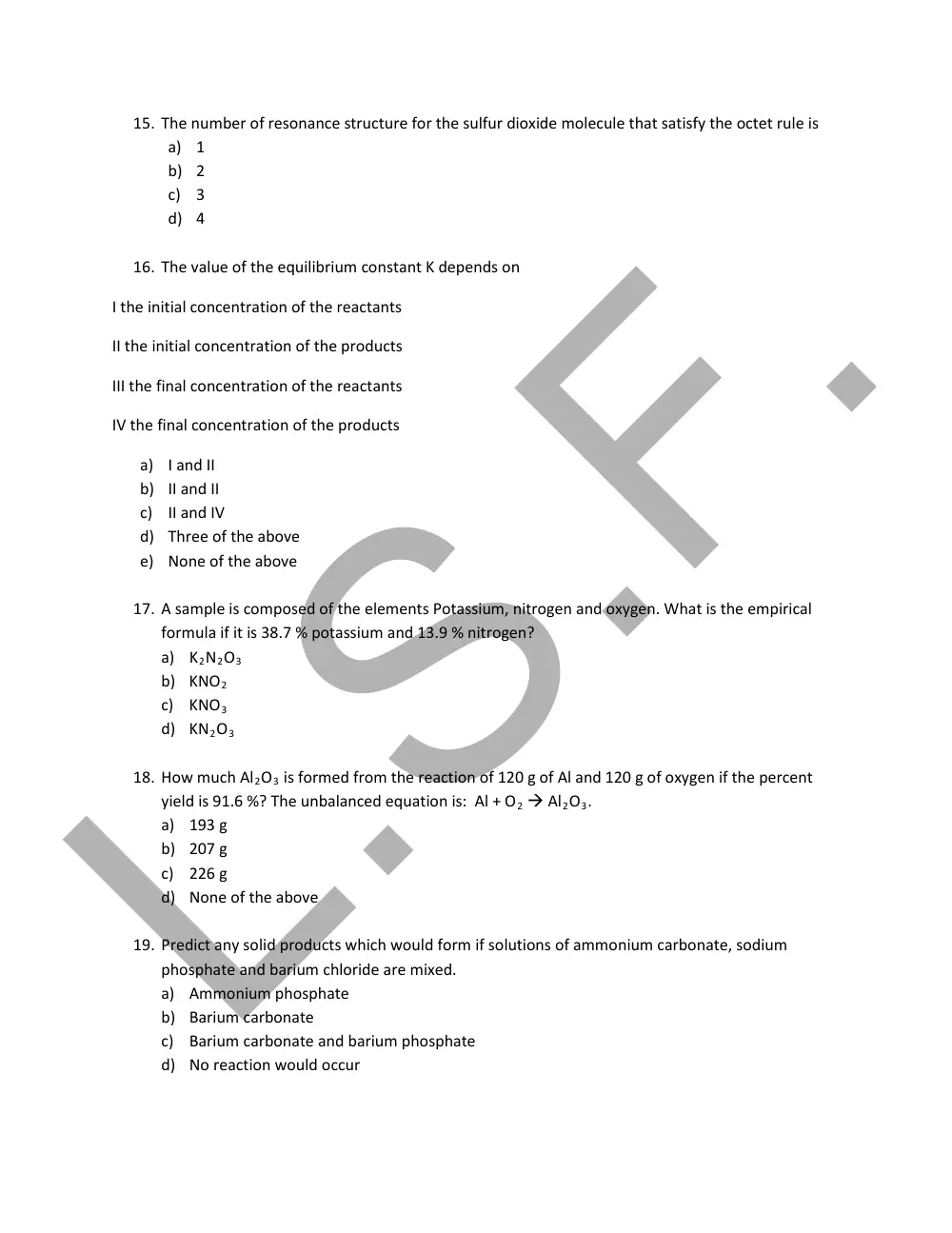
15. The number of resonance structure for the sulfur dioxide molecule that satisfy the octet rule is
a) 1
b) 2
c) 3
d) 4
16. The value of the equilibrium constant K depends on
I the initial concentration of the reactants
II the initial concentration of the products
III the final concentration of the reactants
IV the final concentration of the products
a) I and II
b) II and II
c) II and IV
d) Three of the above
e) None of the above
17. A sample is composed of the elements Potassium, nitrogen and oxygen. What is the empirical
formula if it is 38.7 % potassium and 13.9 % nitrogen?
a) K2N2O3
b) KNO2
c) KNO3
d) KN2O3
18. How much Al2O3 is formed from the reaction of 120 g of Al and 120 g of oxygen if the percent
yield is 91.6 %? The unbalanced equation is: Al + O2 Al2O3.
a) 193 g
b) 207 g
c) 226 g
d) None of the above
19. Predict any solid products which would form if solutions of ammonium carbonate, sodium
phosphate and barium chloride are mixed.
a) Ammonium phosphate
b) Barium carbonate
c) Barium carbonate and barium phosphate
d) No reaction would occur
L.S.F.
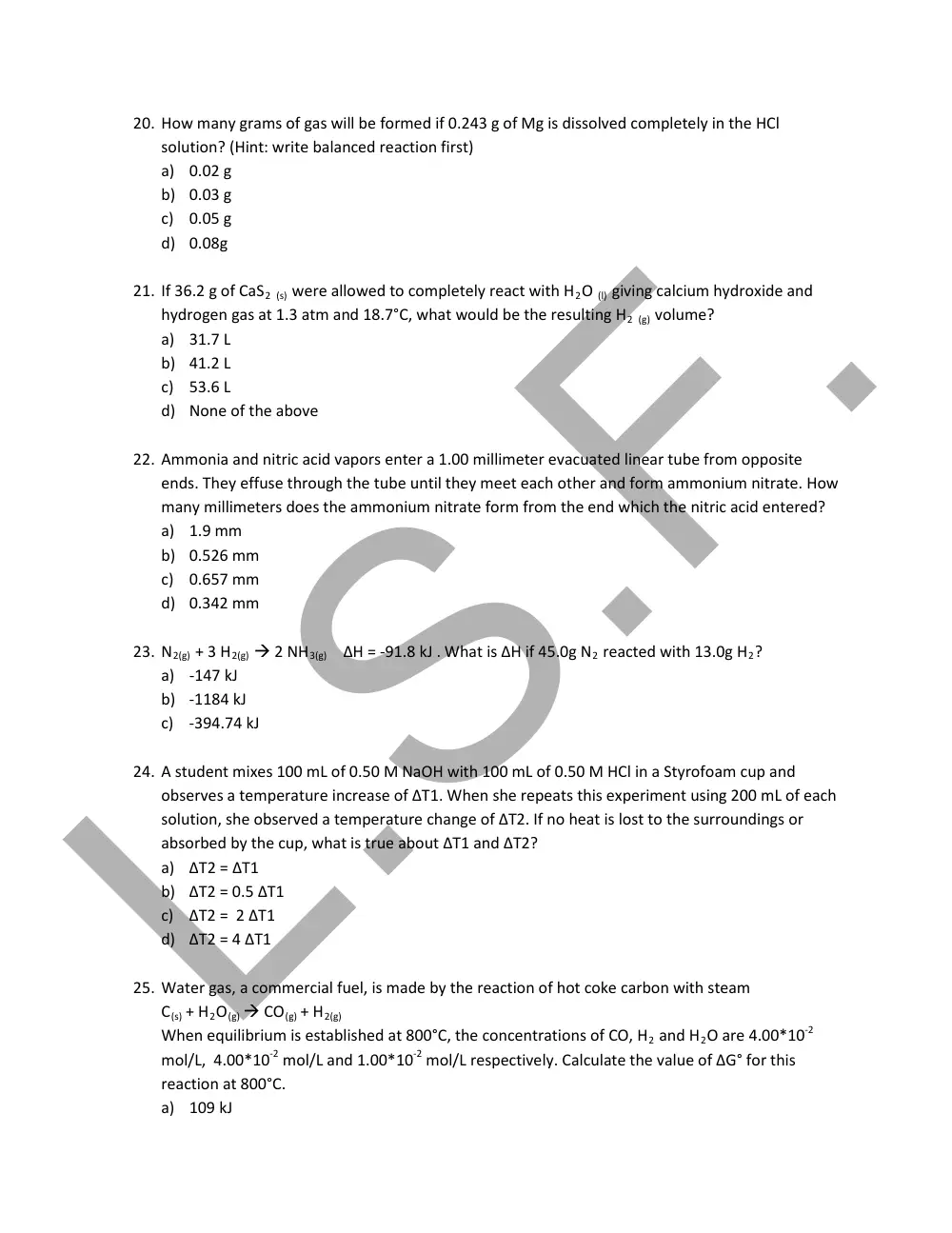
20. How many grams of gas will be formed if 0.243 g of Mg is dissolved completely in the HCl
solution? (Hint: write balanced reaction first)
a) 0.02 g
b) 0.03 g
c) 0.05 g
d) 0.08g
21. If 36.2 g of CaS2 (s) were allowed to completely react with H2O (l) giving calcium hydroxide and
hydrogen gas at 1.3 atm and 18.7°C, what would be the resulting H2 (g) volume?
a) 31.7 L
b) 41.2 L
c) 53.6 L
d) None of the above
22. Ammonia and nitric acid vapors enter a 1.00 millimeter evacuated linear tube from opposite
ends. They effuse through the tube until they meet each other and form ammonium nitrate. How
many millimeters does the ammonium nitrate form from the end which the nitric acid entered?
a) 1.9 mm
b) 0.526 mm
c) 0.657 mm
d) 0.342 mm
23. N2(g) + 3 H2(g) 2 NH3(g) ΔH = -91.8 kJ . What is ΔH if 45.0g N2 reacted with 13.0g H2?
a) -147 kJ
b) -1184 kJ
c) -394.74 kJ
24. A student mixes 100 mL of 0.50 M NaOH with 100 mL of 0.50 M HCl in a Styrofoam cup and
observes a temperature increase of ΔT1. When she repeats this experiment using 200 mL of each
solution, she observed a temperature change of ΔT2. If no heat is lost to the surroundings or
absorbed by the cup, what is true about ΔT1 and ΔT2?
a) ΔT2 = ΔT1
b) ΔT2 = 0.5 ΔT1
c) ΔT2 = 2 ΔT1
d) ΔT2 = 4 ΔT1
25. Water gas, a commercial fuel, is made by the reaction of hot coke carbon with steam
C(s) + H2O(g) CO(g) + H2(g)
When equilibrium is established at 800°C, the concentrations of CO, H2 and H2O are 4.00*10-2
mol/L, 4.00*10-2 mol/L and 1.00*10-2 mol/L respectively. Calculate the value of ΔG° for this
reaction at 800°C.
a) 109 kJ
L.S.F.
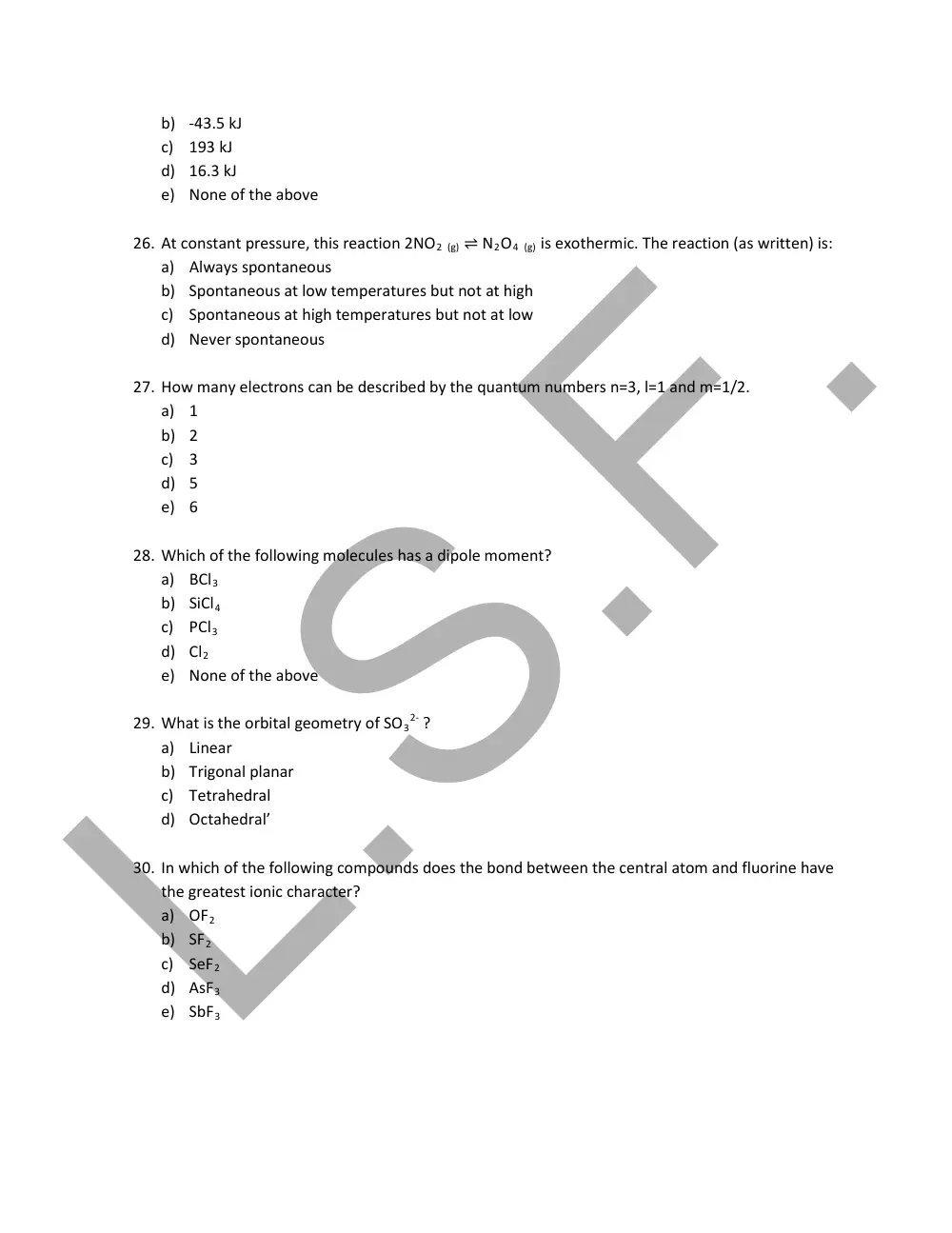
b) -43.5 kJ
c) 193 kJ
d) 16.3 kJ
e) None of the above
26. At constant pressure, this reaction 2NO2 (g) ⇌ N2O4 (g) is exothermic. The reaction (as written) is:
a) Always spontaneous
b) Spontaneous at low temperatures but not at high
c) Spontaneous at high temperatures but not at low
d) Never spontaneous
27. How many electrons can be described by the quantum numbers n=3, l=1 and m=1/2.
a) 1
b) 2
c) 3
d) 5
e) 6
28. Which of the following molecules has a dipole moment?
a) BCl3
b) SiCl4
c) PCl3
d) Cl2
e) None of the above
29. What is the orbital geometry of SO3
2- ?
a) Linear
b) Trigonal planar
c) Tetrahedral
d) Octahedral’
30. In which of the following compounds does the bond between the central atom and fluorine have
the greatest ionic character?
a) OF2
b) SF2
c) SeF2
d) AsF3
e) SbF3
L.S.F.
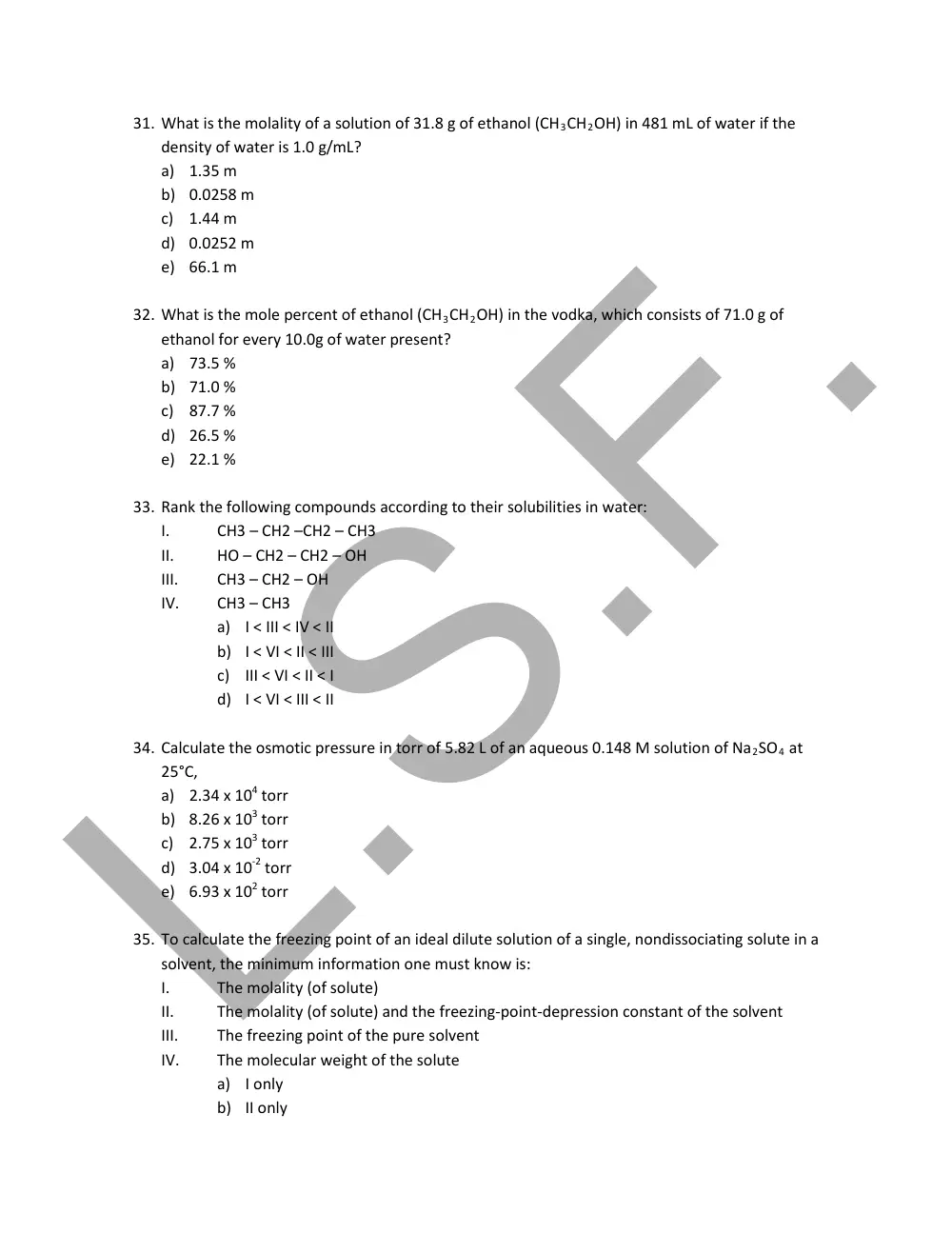
31. What is the molality of a solution of 31.8 g of ethanol (CH3CH2OH) in 481 mL of water if the
density of water is 1.0 g/mL?
a) 1.35 m
b) 0.0258 m
c) 1.44 m
d) 0.0252 m
e) 66.1 m
32. What is the mole percent of ethanol (CH3CH2OH) in the vodka, which consists of 71.0 g of
ethanol for every 10.0g of water present?
a) 73.5 %
b) 71.0 %
c) 87.7 %
d) 26.5 %
e) 22.1 %
33. Rank the following compounds according to their solubilities in water:
I.
CH3 – CH2 –CH2 – CH3
II.
HO – CH2 – CH2 – OH
III.
CH3 – CH2 – OH
IV.
CH3 – CH3
a) I < III < IV < II
b) I < VI < II < III
c) III < VI < II < I
d) I < VI < III < II
34. Calculate the osmotic pressure in torr of 5.82 L of an aqueous 0.148 M solution of Na2SO4 at
25°C,
a) 2.34 x 10⁴ torr
b) 8.26 x 10³ torr
c) 2.75 x 10³ torr
d) 3.04 x 10⁻² torr
e) 6.93 x 10² torr
35. To calculate the freezing point of an ideal dilute solution of a single, nondissociating solute in a
solvent, the minimum information one must know is:
I.
The molality (of solute)
II.
The molality (of solute) and the freezing-point-depression constant of the solvent
III.
The freezing point of the pure solvent
IV.
The molecular weight of the solute
a) I only
b) II only
L.S.F.
c) II, III only
d) II, III, VI
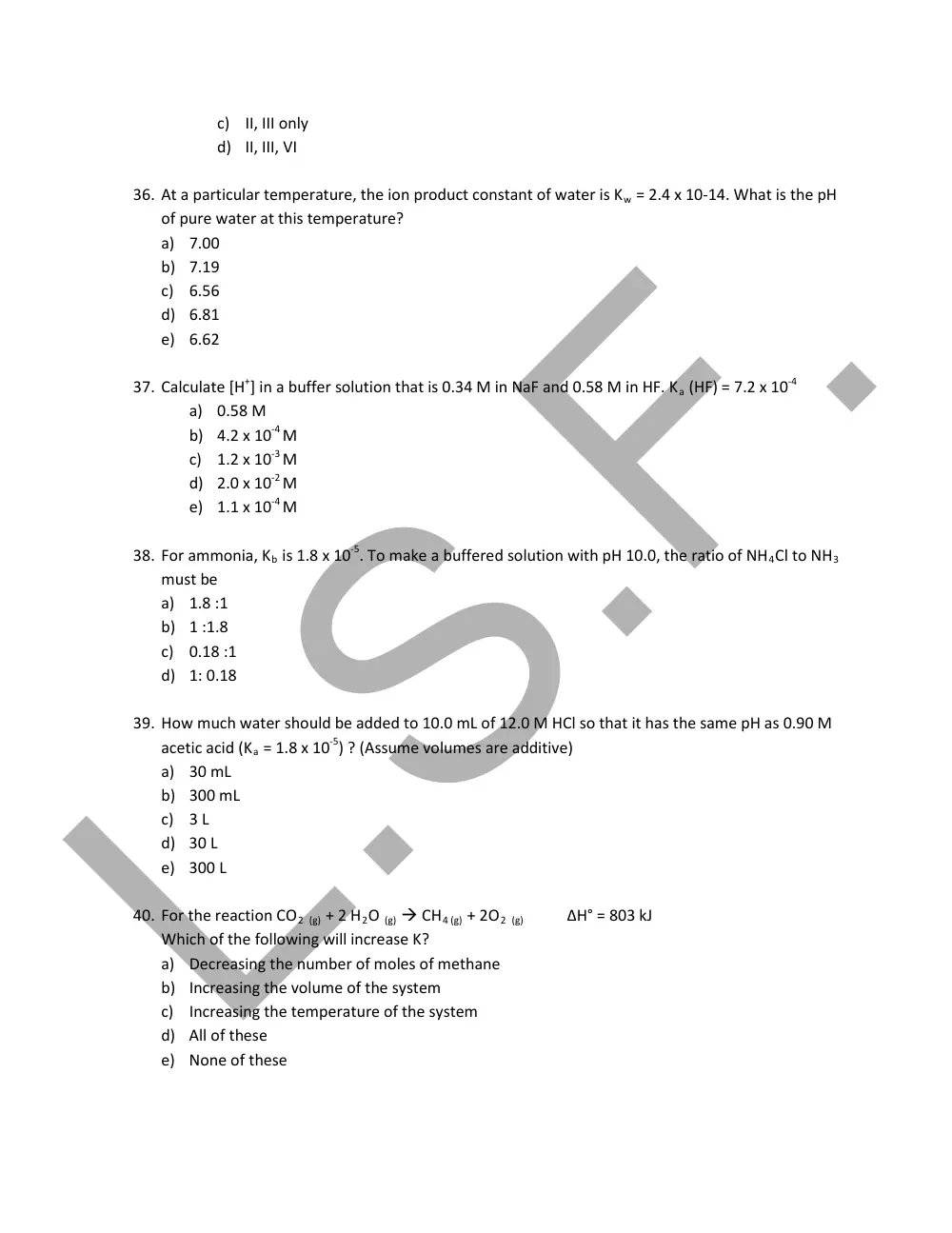
36. At a particular temperature, the ion product constant of water is Kw = 2.4 x 10⁻¹⁴. What is the pH
of pure water at this temperature?
a) 7.00
b) 7.19
c) 6.56
d) 6.81
e) 6.62
37. Calculate [H+] in a buffer solution that is 0.34 M in NaF and 0.58 M in HF. Ka (HF) = 7.2 x 10⁻⁴
a) 0.58 M
b) 4.2 x 10⁻⁴ M
c) 1.2 x 10⁻³ M
d) 2.0 x 10⁻² M
e) 1.1 x 10⁻⁴ M
38. For ammonia, Kb is 1.8 x 10⁻⁵. To make a buffered solution with pH 10.0, the ratio of NH4Cl to NH3
must be
a) 1.8 :1
b) 1 :1.8
c) 0.18 :1
d) 1: 0.18
39. How much water should be added to 10.0 mL of 12.0 M HCl so that it has the same pH as 0.90 M
acetic acid (Ka = 1.8 x 10⁻⁵) ? (Assume volumes are additive)
a) 30 mL
b) 300 mL
c) 3 L
d) 30 L
e) 300 L
40. For the reaction CO2 (g) + 2 H2O (g) CH4 (g) + 2O2 (g) ΔH° = 803 kJ
Which of the following will increase K?
a) Decreasing the number of moles of methane
b) Increasing the volume of the system
c) Increasing the temperature of the system
d) All of these
e) None of these
L.S.F.
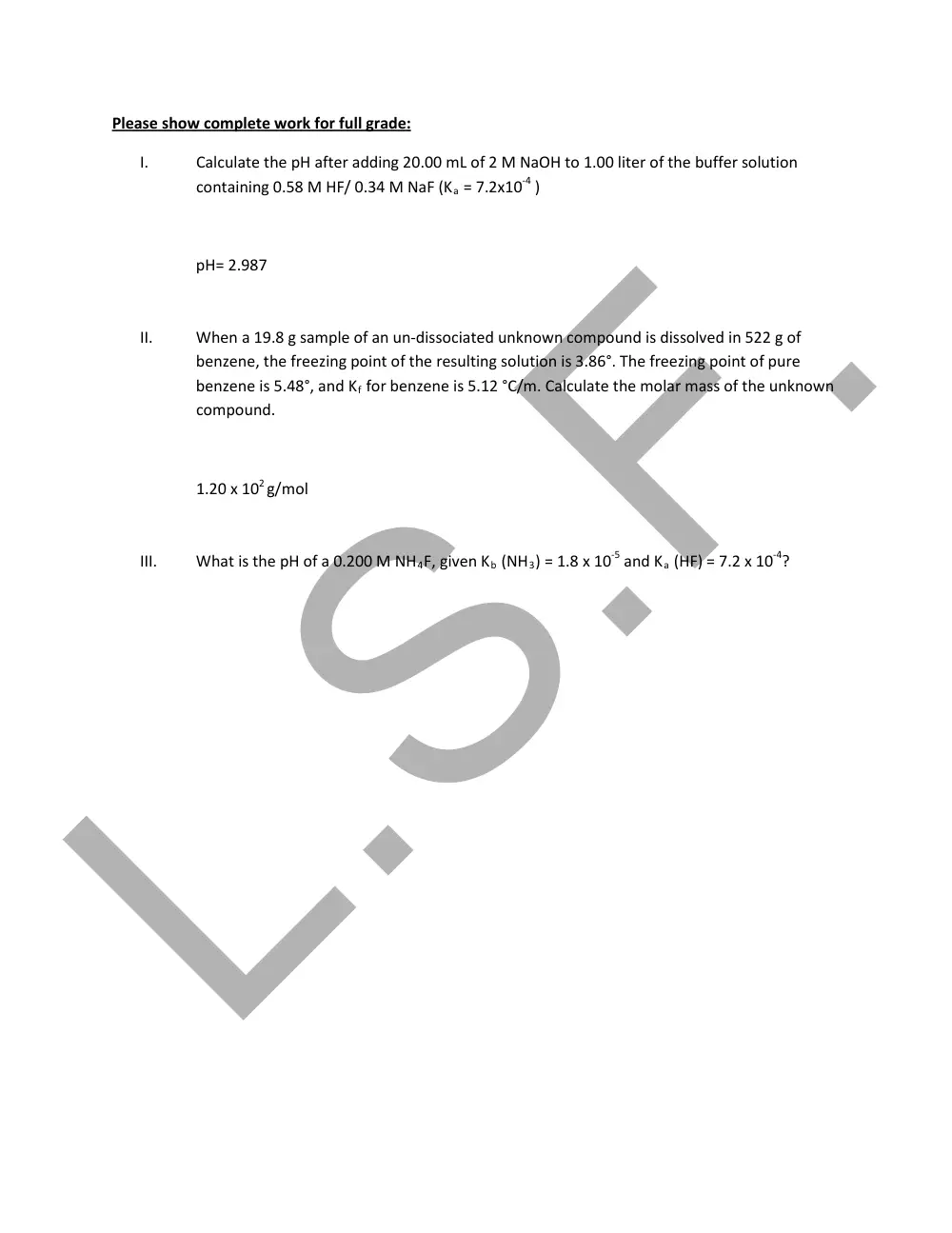
Please show complete work for full grade:
I.
Calculate the pH after adding 20.00 mL of 2 M NaOH to 1.00 liter of the buffer solution
containing 0.58 M HF/ 0.34 M NaF (Ka = 7.2x10⁻⁴ )
pH= 2.987
II.
When a 19.8 g sample of an un-dissociated unknown compound is dissolved in 522 g of
benzene, the freezing point of the resulting solution is 3.86°. The freezing point of pure
benzene is 5.48°, and Kf for benzene is 5.12 °C/m. Calculate the molar mass of the unknown
compound.
1.20 x 10² g/mol
III.
What is the pH of a 0.200 M NH4F, given Kb (NH3) = 1.8 x 10⁻⁵ and Ka (HF) = 7.2 x 10⁻⁴?
L.S.F.