
CIE 444 Problems Solved, Fall 2012
Lebanese American University · SOIL · 9 pages · Dr. Grace Estephan · with solution
More CIE 444 files
Show the text of this problems
PROBLEM #1
The dry unit weight of a particular clayey soil in its natural condition is 15 kN/m3. A
sample of this soil is used to determine the water content. The recorded masses before
and after 24 hours in the oven at 105°C are 145.3 and 123.9 g, respectively.
a) If the specific gravity of the soils G is 2.8, determine the void ratio and the degree of
saturation of the soil.
b) 15000 kN of the soil in its natural moist condition are transported to a site for use as an
embankment material with trucks having a capacity of 30m3. How many truckloads are
necessary to complete this operation?
c) Considering that for use in construction the soil has to be dried to a water content of
12%, how much extra water was carried to the construction site? How many truckloads
have essentially been “wasted” by carrying water?
TO RECEIVE CREDIT, SOLVE USING PHASE DIAGRAMS.
SOLUTION:
a) If the specific gravity of the soils G is 2.8, determine the void ratio and the degree of
saturation of the soil.
Refer to 1m3 of soil (1.e. V=1m3)
Given γd=15kN/m3
� for 1m3, Ws = 15kN
See phase diagram
From masses measured, water content (wc) = (145.3-123.9)/123.9 = 17.3%
�
s = 0.173x15= 2.59kN
w
W
wc
W
×
=
Calculate Vs and Vw using the appropriate unit weights:
Vw = Ww/γw= 2.59/9.81 = 0.26m3
Vs = Ws/γs= 15/(2.8x9.81) = 0.55m3
See phase diagram
Now you can calculate Vv=V-Vs= 1-0.55= 0.45m3 and Va=Vv-Vw= 0.45-0.26 = 0.19m3
• e = Vv/Vs = 0.45/0.55 = 0.82
• S = Vw/Vv = 0.26/0.45 = 0.58
b) 15000 kN of the soil in its natural moist condition are transported to a site for use as an
embankment material with trucks having a capacity of 30m3. How many truckloads are
necessary to complete this operation?
From the phase diagram, the total unit weight = (Ws+Ww)/V= (15+2.59)/1 = 17.59 kN/m3
� 15000 kN occupy 15000/17.59 = 852.8 m3
� Number of trucks necessary are 852.8/30 = 28.4
� 29 truckloads are necessary
1
c) Considering that for use in construction the soil has to be dried to a water content of
12%, how much extra water was carried to the construction site? How many truckloads
have essentially been “wasted” by carrying water?
• Refer to 1m3 of soil
• If the wc = 12%, you can use this wc to calculate the water present in 1m3
o Ww= 0.12x15 = 1.8 kN
•
This means that you have to eliminate 2.59-1.8 = 0.79 kN of water for every 1m3
of transported soil
•
Given that 852.8 m3 were transported, the amount of extra water is equal to
852.8x0.79 = 673.7 kN of extra water
•
This weight corresponds to 673.7/9.81 = 68.7 m3 of water which means almost
2.5 truckloads were wasted (68.7/30 = 2.29 truckloads)
See phase diagram
2
PROBLEM #2
The following method can be used to determine the density of a specimen of irregular
shape, especially of friable samples. The specimen at its natural water content is (1)
weighed, (2) painted with a thin coat of wax or paraffin (to prevent water from entering
the pores), (3) weighed again to measure (M + Mwax), and (4) weighed in water (to get the
volume of the sample + wax coating – remember Archimedes? If not …. see below).
Finally, the natural water content of the specimen is determined. A silt specimen of silty
sand is treated in this way.
From the information given below, using a phase diagram and making use only of basic
definitions and mass and volume balance, determine:
(a) total density
(b) dry density
(c) void ratio
(d) degree of saturation of the sample.
Given:
Mass of specimen at natural water content = 181.8 g
Mass of specimen + wax coating
= 215.9 g
Mass of specimen + wax in water
= 58.9 g
Natural water content
= 2.5%
Soil solid density, ρs
= 2700 kg/m3
Wax solid density, ρwax
= 940 kg/m3
Water density, ρw
= 1000 kg/m3
SOLUTION:
Recognize what you have:
On Mass Side:
• Total wet mass is known = 181.8g
� put on phase diagram
• Water content is known. It tells you how the mass is shared between water and
solids.
• Mw+Ms = 181.8g
• Mw/Ms = 0.025
� Ms(1+0.025) = 181.8g
� Ms= 177.4g
� Mw=181.8-177.4 = 4.4g
� put on phase diagram
On Volume Side:
• From Mw and density of water ρw = 1000kg/m3 = 1g/cm3, Vw=Mw/ρw = 4.4 cm3
� put on phase diagram
3
• From Ms and density of solids ρs = 2700kg/m3 = 2.7g/cm3, Vs=Ms/ρs = 65.7 cm3
� put on phase diagram
• We are still missing the Total Volume, V. To determine V, we need to make use
of Archimedes Law:
(
)
w
specimen waxinwater
specimen wax
waxedspecimen
M
M
V
/ ρ
+
+
−
=
� Vwaxedspecimen = (215.9-58.9)/1 = 157 cm3
This value includes the volume occupied by the wax, which needs to be subtracted to
obtain the total volume of the soil.
� Mwax = Mspecimen+wax - Mspecimen = 215.9 - 181.8 = 34.1 g
� Vwax = Mwax/ρwax = 34.1/0.94 = 36.3 cm3
� Total Volume, V = Vwaxedspecimen - Vwax = 157 - 36.3 = 120.7 cm3
� put on phase diagram
From V, Vs, and Vw, we can now determine the volume occupied by air
� Va = V - Vs - Vw = 120.7 - 65.7 - 4.4 = 50.6 cm3
� put on phase diagram
� Vv = Va+Vw = 50.6 + 4.4 = 55 cm3
Now you can calculate the quantities needed:
a) Total density ρ = M/V = 181.8/120.7 = 1.506 g/ cm3
b) Dry density ρd = Ms/V = 177.4/120.7 = 1.469 g/ cm3
c) Void ratio e = Vv/Vs = 55/65.7 = 0.84
d) Degree of saturation S = Vw/Vv = 4.4/55= 0.08 ~ 8%
4
PROBLEM #3
A sample of dry sand having a unit weight of 105 lbs/ft3 and a specific gravity of 2.70 is
placed in the rain. During the rain the volume of the sample remains constant, but the
degree of saturation increases to 40%. Determine the unit weight and the water content of
the soil after being in the rain. Solve using phase diagrams.
SOLUTION:
In this problem you need to construct two phase diagrams:
1- BEFORE THE RAIN
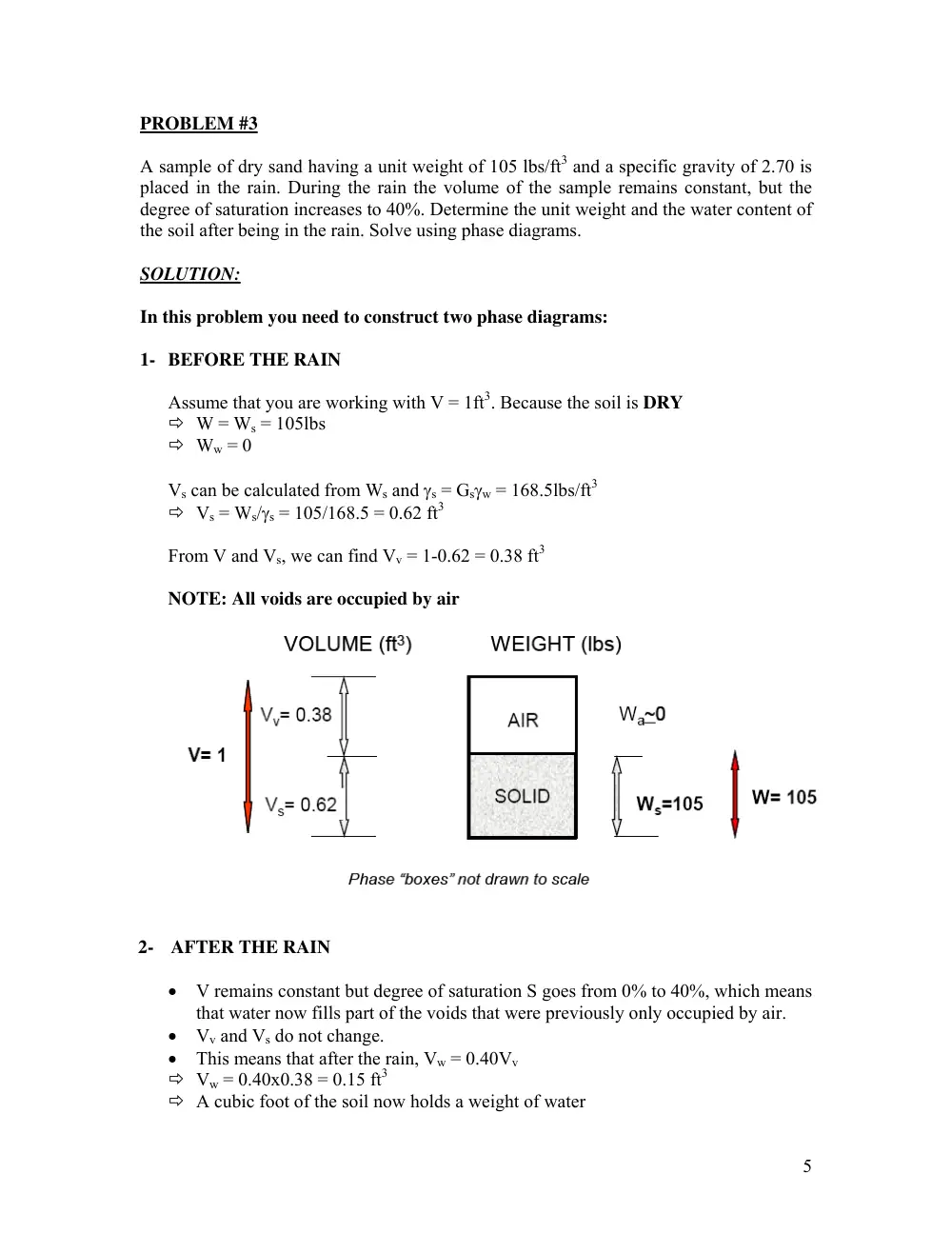
Assume that you are working with V = 1ft3. Because the soil is DRY
� W = Ws = 105lbs
� Ww = 0
Vs can be calculated from Ws and γs = Gsγw = 168.5lbs/ft3
� Vs = Ws/γs = 105/168.5 = 0.62 ft3
From V and Vs, we can find Vv = 1-0.62 = 0.38 ft3
NOTE: All voids are occupied by air
2- AFTER THE RAIN
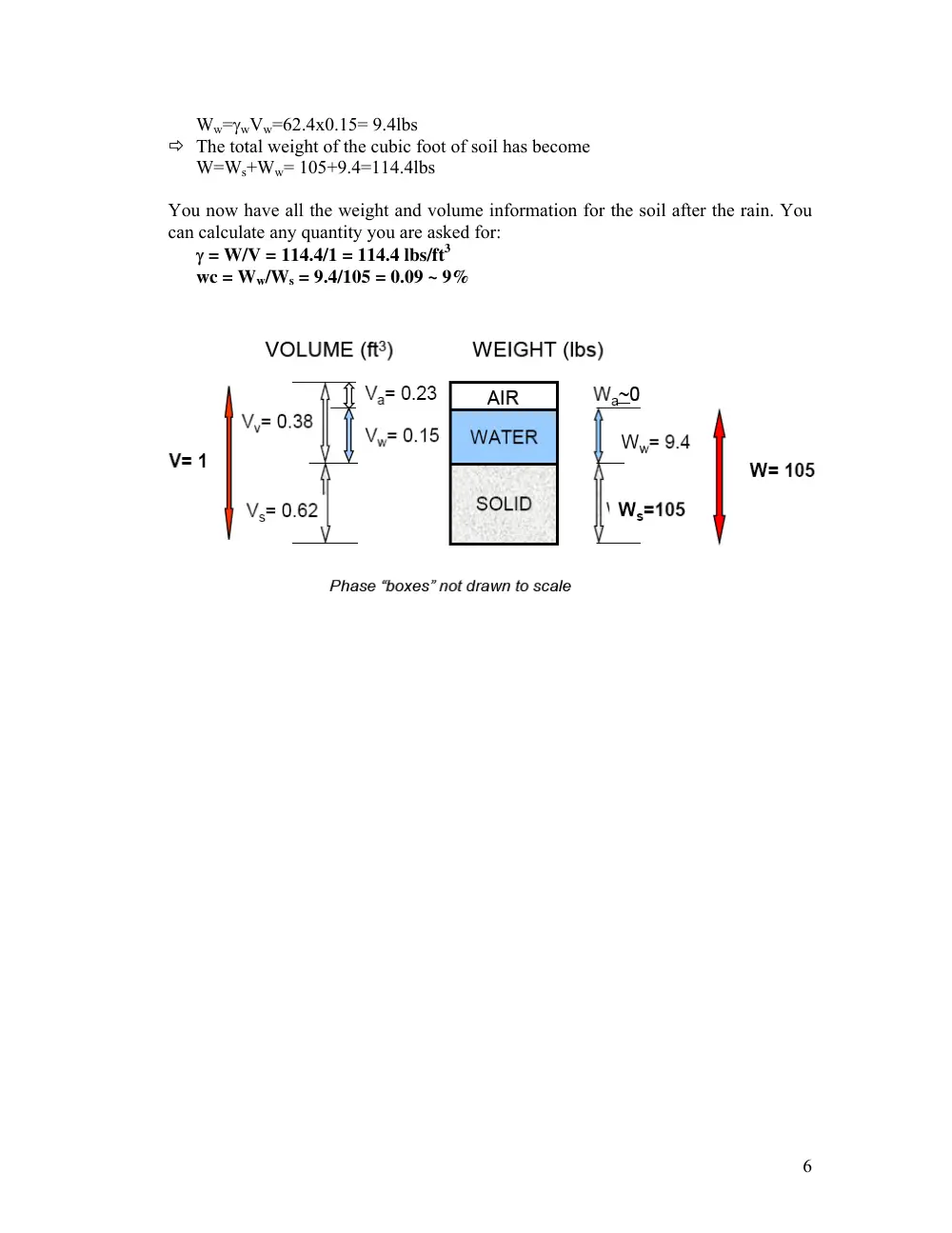
• V remains constant but degree of saturation S goes from 0% to 40%, which means
that water now fills part of the voids that were previously only occupied by air.
• Vv and Vs do not change.
• This means that after the rain, Vw = 0.40Vv
� Vw = 0.40x0.38 = 0.15 ft3
� A cubic foot of the soil now holds a weight of water
5
Ww=γwVw=62.4x0.15= 9.4lbs
� The total weight of the cubic foot of soil has become
W=Ws+Ww= 105+9.4=114.4lbs
You now have all the weight and volume information for the soil after the rain. You
can calculate any quantity you are asked for:
γ = W/V = 114.4/1 = 114.4 lbs/ft3
wc = Ww/Ws = 9.4/105 = 0.09 ~ 9%
6
PROBLEM #4
For the data given below (Gs=2.64):
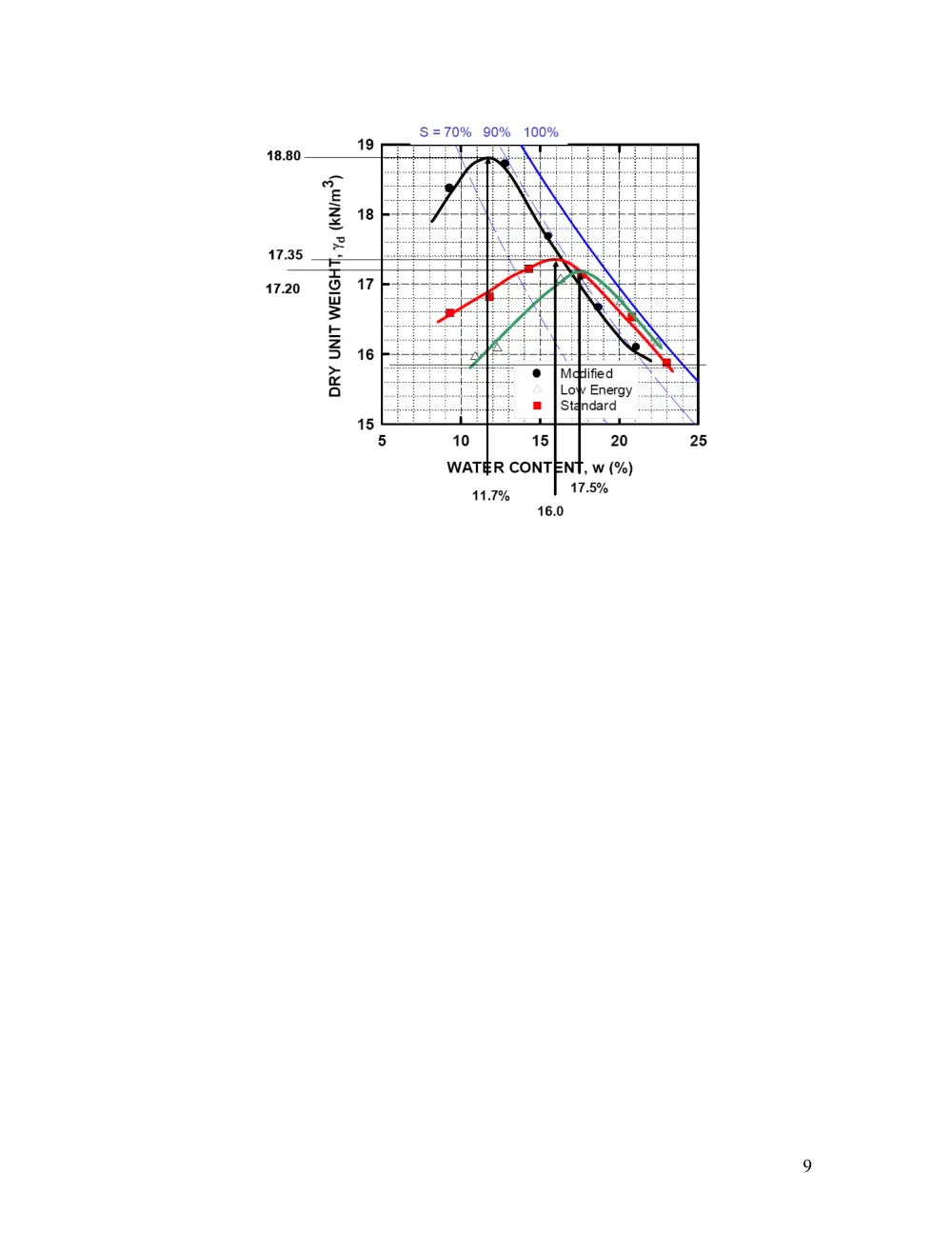
a) Plot the compaction curves
b) Establish maximum dry unit weight and optimum water content for each test
c) Compute the degree of saturation (S) at the optimum point for the modified data using
a phase diagram.
Modified
Standard
Low Energy
γ (kN/m3)
w.c. (%)
γ (kN/m3)
w.c. (%)
γ (kN/m3)
w.c. (%)
20.08
9.3
18.13
9.3
17.7
10.9
21.13
12.8
18.8
11.8
18.06
12.3
20.43
15.5
19.68
14.3
19.85
16.3
19.79
18.7
20.16
17.6
20.12
20.1
19.5
21.1
19.97
20.8
19.78
22.4
19.53
23.0
SOLUTION:
a) Plot the compaction curves
Before plotting the compaction curves, note that you need to calculate the dry unit
weights (γd) from the values of γ and wc.
Use
(
wc)
d
+
=
1
γ
γ
See data in table below and plots on figure in next page.
γ
(kN/m3)
w.c.
(%)
γ d
(kN/m
3 )
γ
(kN/m3)
w.c.
(%)
γ d
(kN/m
3 )
γ
(kN/m3)
w.c.
(%)
γ d
(kN/m
3 )
20.08
9.3
18.37
18.13
9.3
16.59
17.7
10.9
15.96
21.13
12.8
18.73
18.8
11.8
16.82
18.06
12.3
16.08
20.43
15.5
17.69
19.68
14.3
17.22
19.85
16.3
17.07
19.79
18.7
16.67
20.16
17.6
17.14
20.12
20.1
16.75
19.5
21.1
16.10
19.97
20.8
16.53
19.78
22.4
16.16
19.53
23
15.88
Modified
Standard
Low Energy
7
b) Establish maximum dry unit weight and optimum water content for each test
See derivation of optimum moisture content and maximum dry unit weight on the plot
below. Note that the plot also shows curves for S = 70, 90, and 100% calculated using:
S
G wc
G
e
G
V
V
V
G
V
W
s
w
s
w
s
v
s
s
w
s
s
d
+
=
+
=
+
=
=
1
1
γ
γ
γ
γ
c) Compute the degree of saturation (S) at the optimum point for the modified data using
a phase diagram.
For the Modified data, γd = 18.8 kN/m3 for wc = 11.7%
Using the phase relations, calculate the degree of saturation:
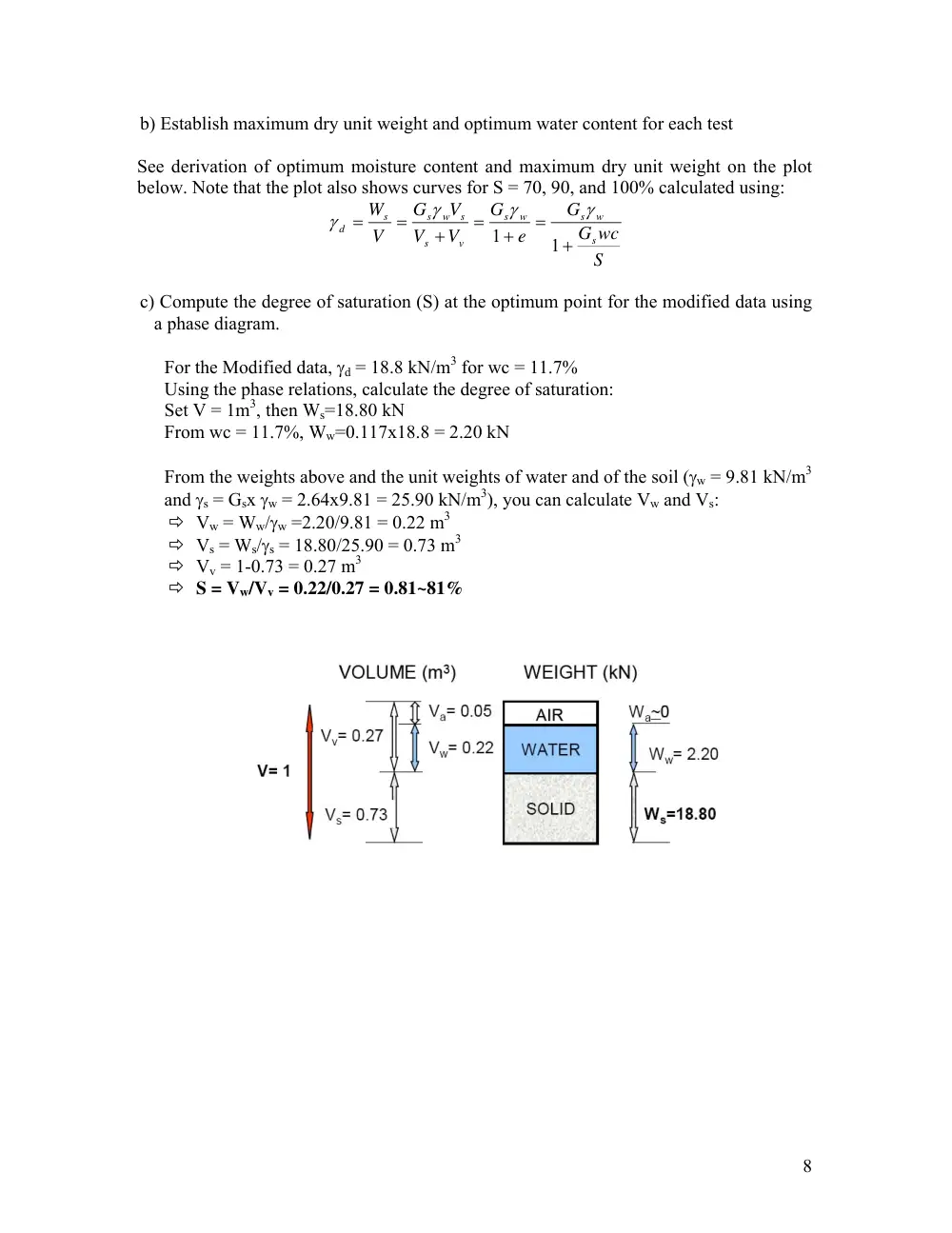
Set V = 1m3, then Ws=18.80 kN
From wc = 11.7%, Ww=0.117x18.8 = 2.20 kN
From the weights above and the unit weights of water and of the soil (γw = 9.81 kN/m3
and γs = Gsx γw = 2.64x9.81 = 25.90 kN/m3), you can calculate Vw and Vs:
� Vw = Ww/γw =2.20/9.81 = 0.22 m3
� Vs = Ws/γs = 18.80/25.90 = 0.73 m3
� Vv = 1-0.73 = 0.27 m3
� S = Vw/Vv = 0.22/0.27 = 0.81~81%
8
9