
CSC 245 Chapter 2, Spring 2015
Lebanese American University · Objects and Data Abstraction · 14 pages

Showing the first 10 of 14 pages. Download the PDF to see all of it.
More CSC 245 files
Show the text of this chapter
Objects and Data Abstraction (v1.05)
1
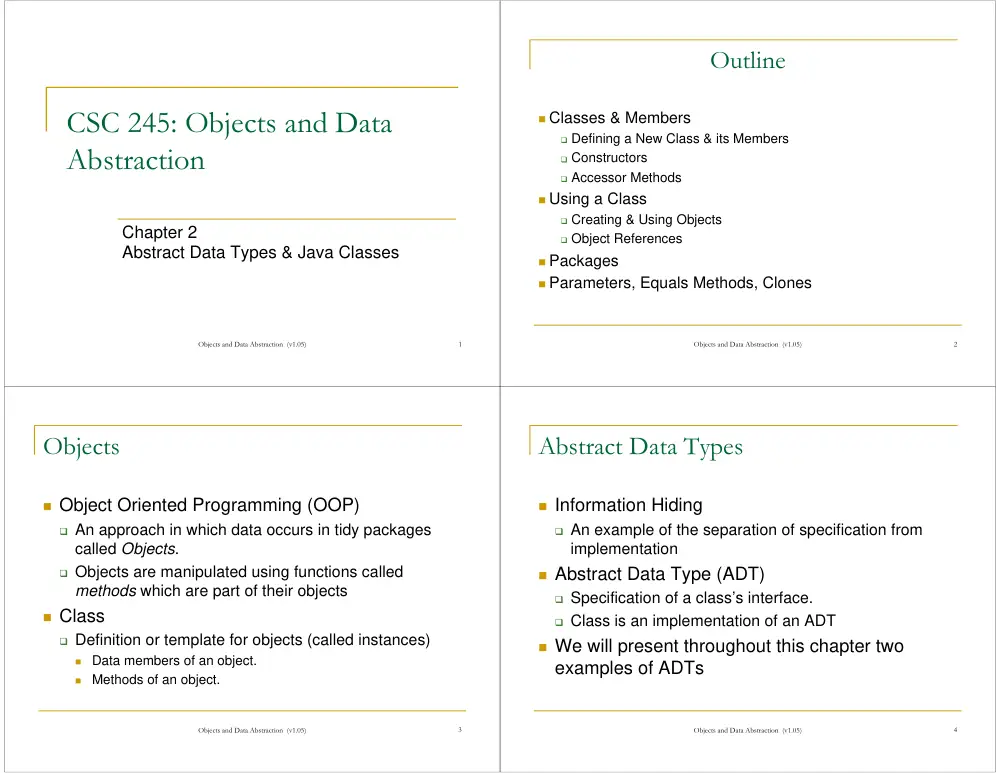
CSC 245: Objects and Data
Abstraction
Chapter 2
Abstract Data Types & Java Classes
Objects and Data Abstraction (v1.05)
2
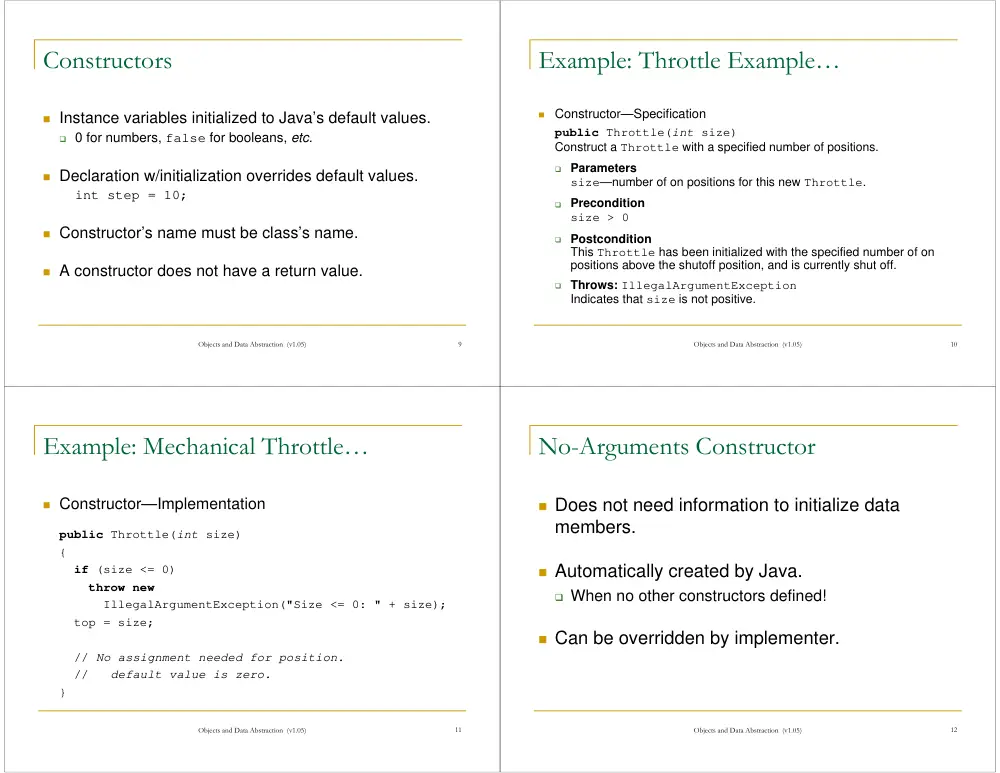
Outline
� Classes & Members
� Defining a New Class & its Members
� Constructors
� Accessor Methods
� Using a Class
� Creating & Using Objects
� Object References
� Packages
� Parameters, Equals Methods, Clones
Objects and Data Abstraction (v1.05)
3
Objects
� Object Oriented Programming (OOP)
� An approach in which data occurs in tidy packages
called Objects.
� Objects are manipulated using functions called
methods which are part of their objects
� Class
� Definition or template for objects (called instances)
� Data members of an object.
� Methods of an object.
Objects and Data Abstraction (v1.05)
4
Abstract Data Types
� Information Hiding
� An example of the separation of specification from
implementation
� Abstract Data Type (ADT)
� Specification of a class’s interface.
� Class is an implementation of an ADT
� We will present throughout this chapter two
examples of ADTs
Objects and Data Abstraction (v1.05)
5
Class Members
� A class is a new kind of data type
� A class includes
� Data
�
Integers, characters, floats, etc.
� Methods
�
Operations on objects.
� Constructors
�
Initialize data of newly created objects.
� View class as an ADT
�
Can specify which members are visible to the outside.
� Taken all together, the above elements constitute the
class members
Objects and Data Abstraction (v1.05)
6
Example: Mechanical Throttle
� Description
� A class that is used to store and manipulate the status of mechanical
throttle
� A throttle is a lever that can be moved to control fuel flow.
�
Similar to a gas pedal.
� Throttle Positions
� Shutoff position
�
Allows no fuel flow.
� On positions
�
Flow proportional to lever location.
�
Topmost position—maximum flow.
� Initialization
� Number of positions
� Throttle @ shutoff position.
Objects and Data Abstraction (v1.05)
7
Example: Mechanical Throttle…
� Constructor
� Creates new throttle with:
�
One shutoff position &
�
A specified number of on positions.
� Methods
� What is fuel flow?
�
Proportion of maximum flow.
� Is throttle on?
�
Return true/false based on state of throttle.
� Shift throttle by a given amount.
� Move throttle back to shutoff position.
Objects and Data Abstraction (v1.05)
8
Example: Mechanical Throttle…
� Defining New Class
public class Throttle {
private int top;
// topmost position of lever
private int position;
// current position of
lever
}
� Class header
� Instance variables
// Implementations of constructors & methods
// go here
Objects and Data Abstraction (v1.05)
9
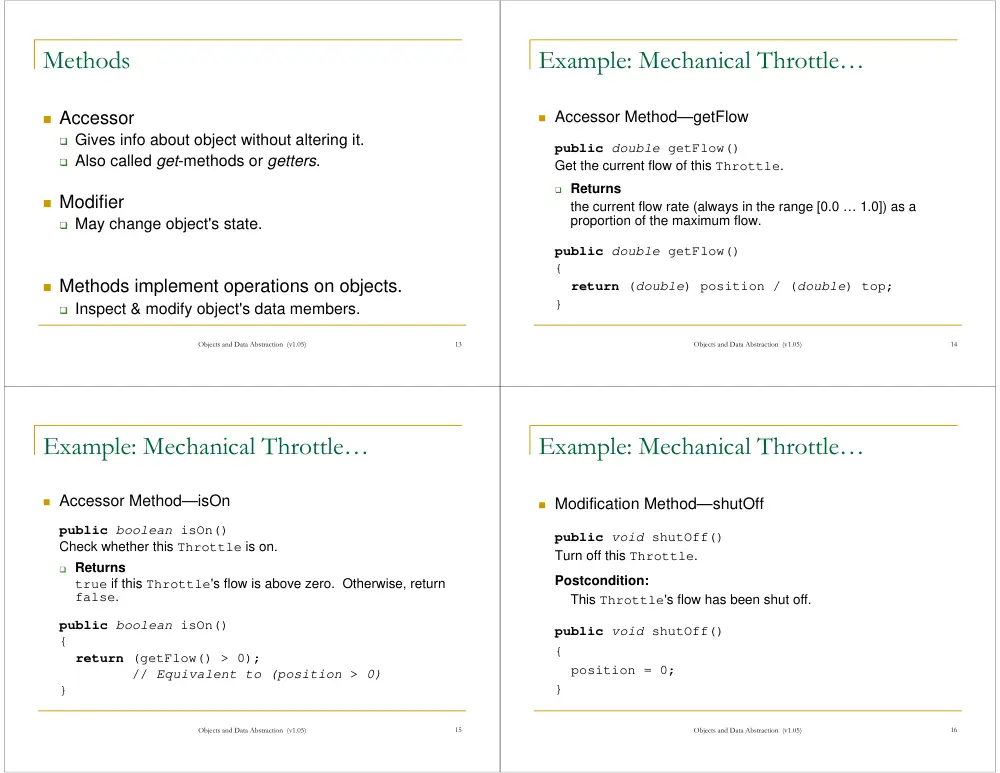
Constructors
� Instance variables initialized to Java’s default values.
� 0 for numbers, false for booleans, etc.
� Declaration w/initialization overrides default values.
int step = 10;
� Constructor’s name must be class’s name.
� A constructor does not have a return value.
Objects and Data Abstraction (v1.05)
10
Example: Throttle Example…
� Constructor—Specification
public Throttle(int size)
Construct a Throttle with a specified number of positions.
� Parameters
size—number of on positions for this new Throttle.
� Precondition
size > 0
� Postcondition
This Throttle has been initialized with the specified number of on
positions above the shutoff position, and is currently shut off.
� Throws: IllegalArgumentException
Indicates that size is not positive.
Objects and Data Abstraction (v1.05)
11
Example: Mechanical Throttle…
� Constructor—Implementation
public Throttle(int size)
{
if (size <= 0)
throw new
IllegalArgumentException("Size <= 0: " + size);
top = size;
// No assignment needed for position.
//
default value is zero.
}
Objects and Data Abstraction (v1.05)
12
No-Arguments Constructor
� Does not need information to initialize data
members.
� Automatically created by Java.
� When no other constructors defined!
� Can be overridden by implementer.
Objects and Data Abstraction (v1.05)
13
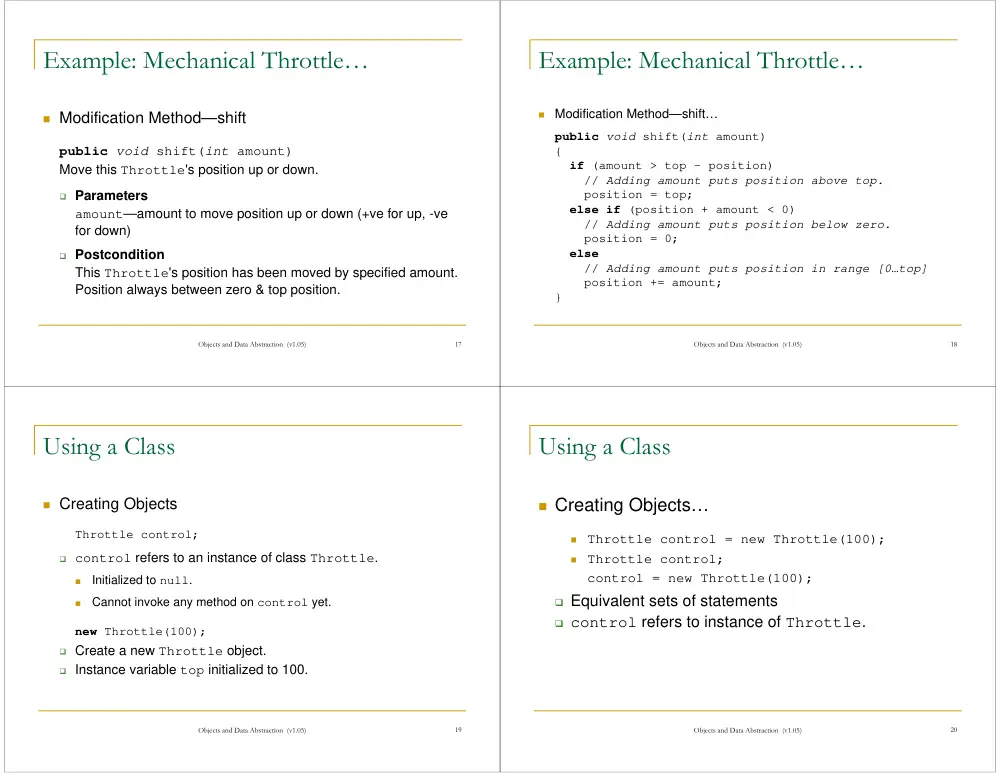
Methods
� Accessor
� Gives info about object without altering it.
� Also called get-methods or getters.
� Modifier
� May change object's state.
� Methods implement operations on objects.
� Inspect & modify object's data members.
Objects and Data Abstraction (v1.05)
14
Example: Mechanical Throttle…
� Accessor Method—getFlow
public double getFlow()
Get the current flow of this Throttle.
� Returns
the current flow rate (always in the range [0.0 … 1.0]) as a
proportion of the maximum flow.
public double getFlow()
{
return (double) position / (double) top;
}
Objects and Data Abstraction (v1.05)
15
Example: Mechanical Throttle…
� Accessor Method—isOn
public boolean isOn()
Check whether this Throttle is on.
� Returns
true if this Throttle's flow is above zero. Otherwise, return
false.
public boolean isOn()
{
return (getFlow() > 0);
// Equivalent to (position > 0)
}
Objects and Data Abstraction (v1.05)
16
Example: Mechanical Throttle…
� Modification Method—shutOff
public void shutOff()
Turn off this Throttle.
Postcondition:
This Throttle's flow has been shut off.
public void shutOff()
{
position = 0;
}
Objects and Data Abstraction (v1.05)
17
Example: Mechanical Throttle…
� Modification Method—shift
public void shift(int amount)
Move this Throttle's position up or down.
� Parameters
amount—amount to move position up or down (+ve for up, -ve
for down)
� Postcondition
This Throttle's position has been moved by specified amount.
Position always between zero & top position.
Objects and Data Abstraction (v1.05)
18
Example: Mechanical Throttle…
� Modification Method—shift…
public void shift(int amount)
{
if (amount > top – position)
// Adding amount puts position above top.
position = top;
else if (position + amount < 0)
// Adding amount puts position below zero.
position = 0;
else
// Adding amount puts position in range [0…top]
position += amount;
}
Objects and Data Abstraction (v1.05)
19
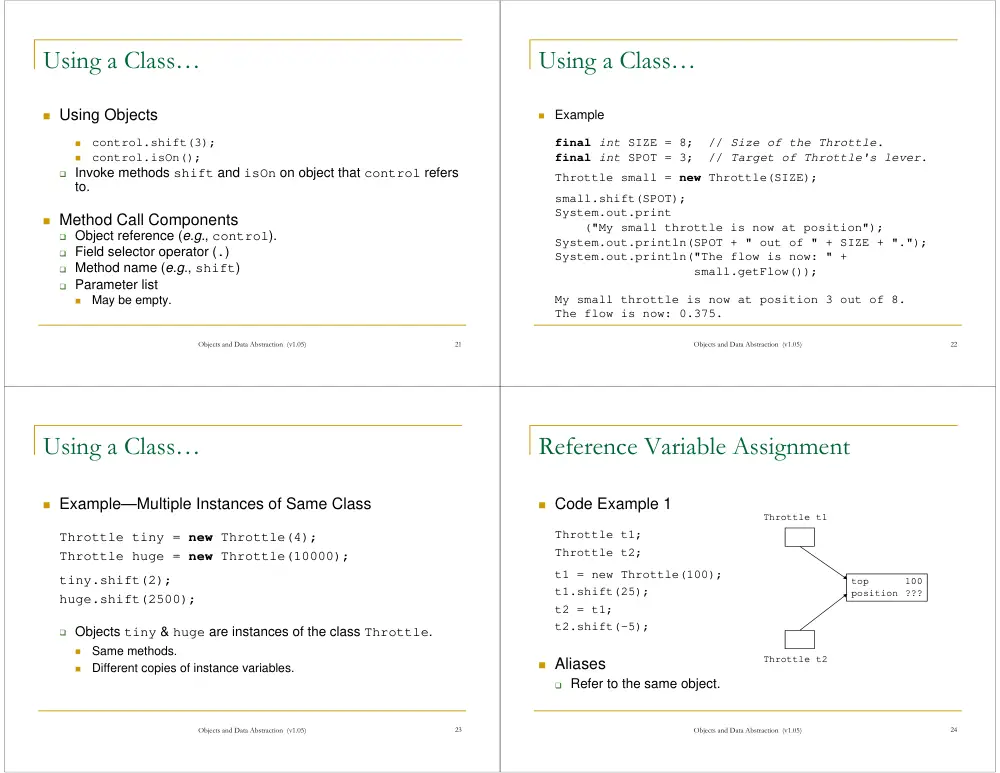
Using a Class
� Creating Objects
Throttle control;
� control refers to an instance of class Throttle.
�
Initialized to null.
�
Cannot invoke any method on control yet.
new Throttle(100);
� Create a new Throttle object.
� Instance variable top initialized to 100.
Objects and Data Abstraction (v1.05)
20
Using a Class
� Creating Objects…
� Throttle control = new Throttle(100);
� Throttle control;
control = new Throttle(100);
� Equivalent sets of statements
� control refers to instance of Throttle.
Objects and Data Abstraction (v1.05)
21
Using a Class…
� Using Objects
�
control.shift(3);
�
control.isOn();
� Invoke methods shift and isOn on object that control refers
to.
� Method Call Components
� Object reference (e.g., control).
� Field selector operator (.)
� Method name (e.g., shift)
� Parameter list
�
May be empty.
Objects and Data Abstraction (v1.05)
22
Using a Class…
� Example
final int SIZE = 8; // Size of the Throttle.
final int SPOT = 3; // Target of Throttle's lever.
Throttle small = new Throttle(SIZE);
small.shift(SPOT);
System.out.print
("My small throttle is now at position");
System.out.println(SPOT + " out of " + SIZE + ".");
System.out.println("The flow is now: " +
small.getFlow());
My small throttle is now at position 3 out of 8.
The flow is now: 0.375.
Objects and Data Abstraction (v1.05)
23
Using a Class…
� Example—Multiple Instances of Same Class
Throttle tiny = new Throttle(4);
Throttle huge = new Throttle(10000);
tiny.shift(2);
huge.shift(2500);
� Objects tiny & huge are instances of the class Throttle.
�
Same methods.
�
Different copies of instance variables.
Objects and Data Abstraction (v1.05)
24
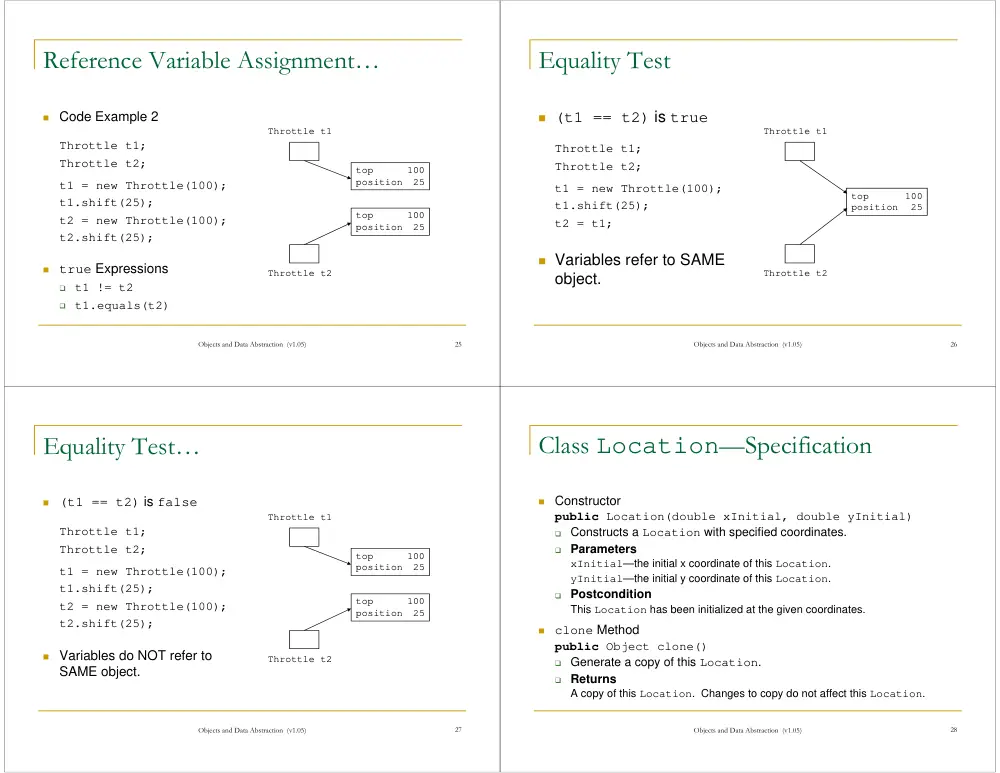
Reference Variable Assignment
� Code Example 1
Throttle t1;
Throttle t2;
t1 = new Throttle(100);
t1.shift(25);
t2 = t1;
t2.shift(-5);
� Aliases
� Refer to the same object.
Throttle t1
Throttle t2
top
100
position ???
Objects and Data Abstraction (v1.05)
25
Reference Variable Assignment…
� Code Example 2
Throttle t1;
Throttle t2;
t1 = new Throttle(100);
t1.shift(25);
t2 = new Throttle(100);
t2.shift(25);
� true Expressions
� t1 != t2
� t1.equals(t2)
Throttle t1
Throttle t2
top
100
position
25
top
100
position
25
Objects and Data Abstraction (v1.05)
26
Equality Test
� (t1 == t2) is true
Throttle t1;
Throttle t2;
t1 = new Throttle(100);
t1.shift(25);
t2 = t1;
� Variables refer to SAME
object.
Throttle t1
Throttle t2
top
100
position
25
Objects and Data Abstraction (v1.05)
27
Equality Test…
� (t1 == t2) is false
Throttle t1;
Throttle t2;
t1 = new Throttle(100);
t1.shift(25);
t2 = new Throttle(100);
t2.shift(25);
� Variables do NOT refer to
SAME object.
Throttle t1
Throttle t2
top
100
position
25
top
100
position
25
Objects and Data Abstraction (v1.05)
28
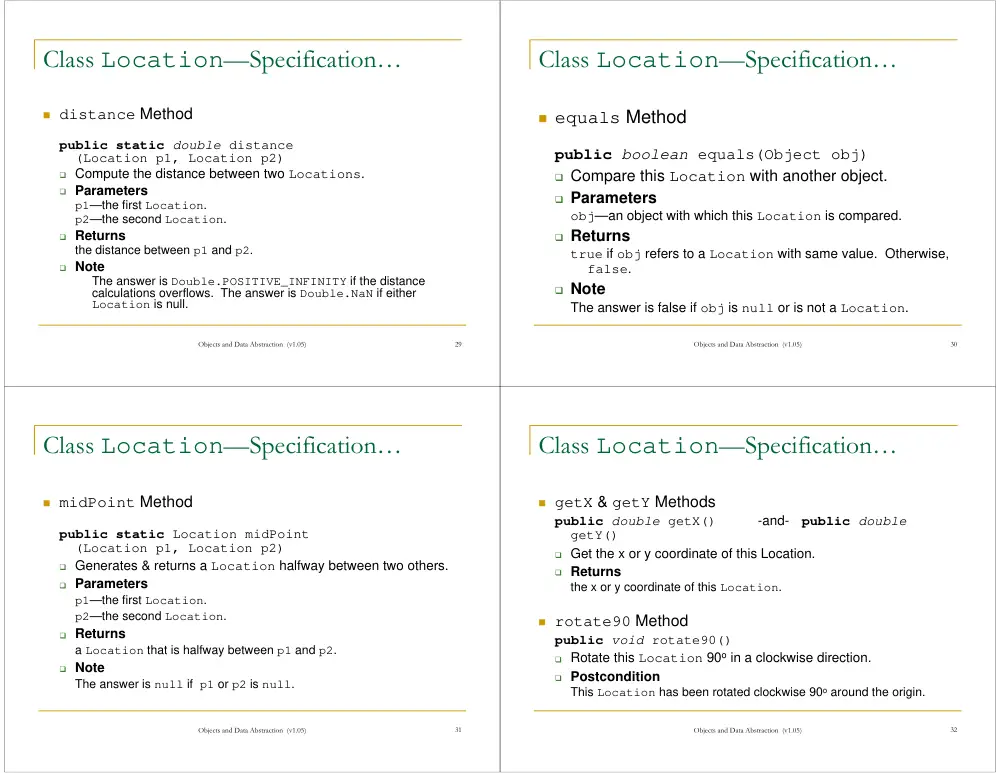
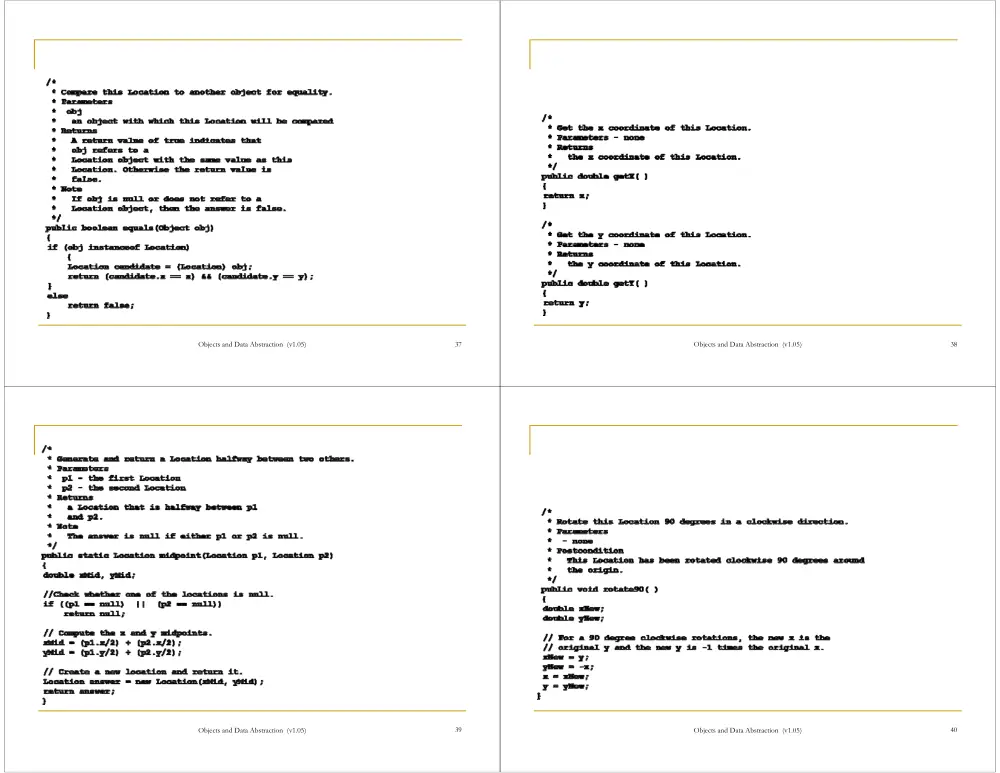
Class Location—Specification
� Constructor
public Location(double xInitial, double yInitial)
� Constructs a Location with specified coordinates.
� Parameters
xInitial—the initial x coordinate of this Location.
yInitial—the initial y coordinate of this Location.
� Postcondition
This Location has been initialized at the given coordinates.
� clone Method
public Object clone()
� Generate a copy of this Location.
� Returns
A copy of this Location. Changes to copy do not affect this Location.
Objects and Data Abstraction (v1.05)
29
Class Location—Specification…
� distance Method
public static double distance
(Location p1, Location p2)
� Compute the distance between two Locations.
� Parameters
p1—the first Location.
p2—the second Location.
� Returns
the distance between p1 and p2.
� Note
The answer is Double.POSITIVE_INFINITY if the distance
calculations overflows. The answer is Double.NaN if either
Location is null.
Objects and Data Abstraction (v1.05)
30
Class Location—Specification…
� equals Method
public boolean equals(Object obj)
� Compare this Location with another object.
� Parameters
obj—an object with which this Location is compared.
� Returns
true if obj refers to a Location with same value. Otherwise,
false.
� Note
The answer is false if obj is null or is not a Location.
Objects and Data Abstraction (v1.05)
31
Class Location—Specification…
� midPoint Method
public static Location midPoint
(Location p1, Location p2)
� Generates & returns a Location halfway between two others.
� Parameters
p1—the first Location.
p2—the second Location.
� Returns
a Location that is halfway between p1 and p2.
� Note
The answer is null if p1 or p2 is null.
Objects and Data Abstraction (v1.05)
32
Class Location—Specification…
� getX & getY Methods
public double getX()
-and-
public double
getY()
� Get the x or y coordinate of this Location.
� Returns
the x or y coordinate of this Location.
� rotate90 Method
public void rotate90()
� Rotate this Location 90o in a clockwise direction.
� Postcondition
This Location has been rotated clockwise 90o around the origin.
Objects and Data Abstraction (v1.05)
33
Class Location—Specification…
� shift Method
public void shift(double xAmount, double yAmount)
� Move this Location by given amounts along x & y axes.
� Postcondition
This Location has been moved by given amounts along the two axes.
� Note
shift may cause a coordinate to go above Double.MAX_VALUE or below –
Double.MAX_VALUE. Subsequent calls to accessor return
Double.POSITIVE_INFINITY or Double.NEGATIVE_INFINITY.
� toString Method
public String toString()
� Generate a string representation of this Location.
� Returns
�
a string representation of this Location.
Objects and Data Abstraction (v1.05)
34
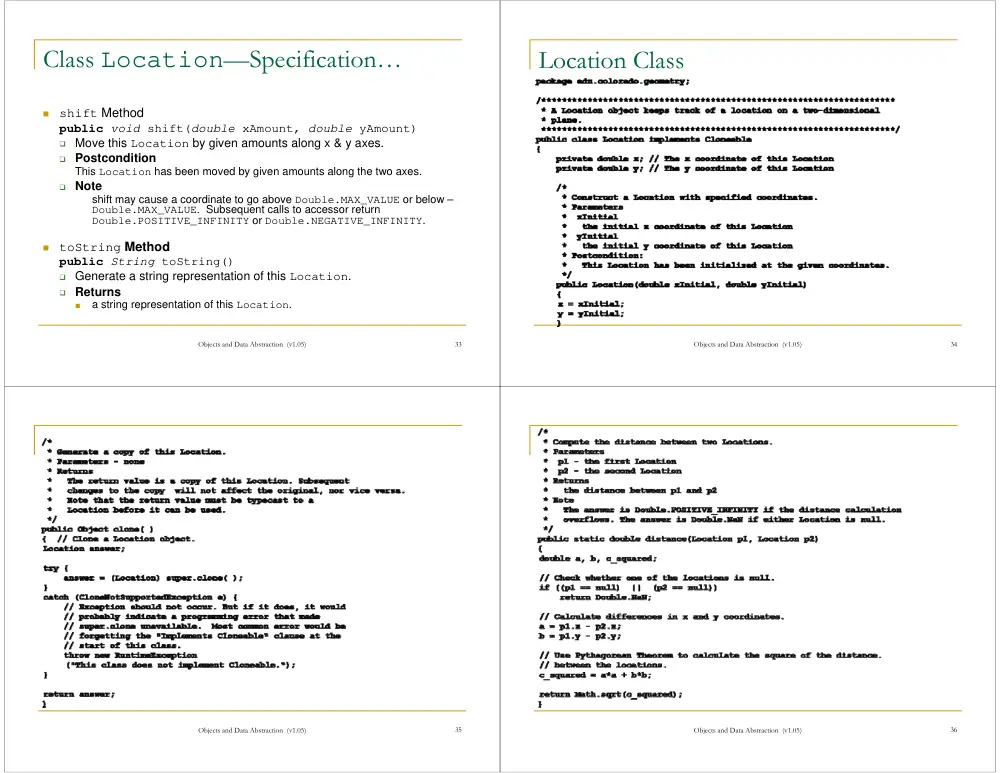
Location Class
Objects and Data Abstraction (v1.05)
35
Objects and Data Abstraction (v1.05)
36
Objects and Data Abstraction (v1.05)
37
Objects and Data Abstraction (v1.05)
38
Objects and Data Abstraction (v1.05)
39
Objects and Data Abstraction (v1.05)
40
Objects and Data Abstraction (v1.05)
41
Objects and Data Abstraction (v1.05)
42
Objects and Data Abstraction (v1.05)
43
Objects as Parameters
� Parameters
� Formal—names of parameters as defined in method header.
� Actual—names of parameters in method invocation.
� Formal parameters refer to same objects as actual
parameters.
� Changes to object in method are visible to invoking method.
� Example
� Location.midPoint(p, s);
� public static Location midPoint(Location p1,
Location p2)
Location p
x –1.0
y 0.8
Location p1
Location s
x 1.7
y -1.2
Location p2
Objects and Data Abstraction (v1.05)
44
Objects as Return Values
� midPoint Method—Specification
public static Location midPoint(Location p1,
Location p2)
Generates & returns a Location halfway between two others.
� Parameters
p1—the first location.
p2—the second location.
� Returns
a Location halfway between two others.
� Note
The answer is null if either Location is null.
Objects and Data Abstraction (v1.05)
45
Objects as Return Values…
� midPoint Method—Implementation
public static Location midPoint(Location p1, Location p2)
{
double xMid, yMid;
// Check whether one of the Locations is null.
if ((p1 == null) || (p2 == null))
return null;
// Compute the x & y midpoints.
xMid = (p1.x / 2) + (p2.x / 2);
yMid = (p1.y / 2) + (p2.y / 2);
// Create a new Location & return it.
return new Location(xMid, yMid);
}
Objects and Data Abstraction (v1.05)
46
Equals Method
� (p == s) is true
� Location p = new
Location(10,2);
� Location s = p;
� (p != s) &&
p.equals(s)
� Location p = new
Location(10,2);
� Location s = new
Location(10,0);
� s.shift(0,2);
== vs. Equals
�
Operator “==” compares primitive types.
�
Object references are equal when they refer to the same object.
�
Method Equals compares objects.
�
Instances of the same class are equal when their instance variables
have the same values.
Objects and Data Abstraction (v1.05)
47
Equals Method—Implementation
� Template
public boolean
equals(Object obj)
{
if (obj is actually
a Location)
{
// Compare contents of
location
// referred to by obj to this
// location & return value.
}
else
return false;
}
� Class Location
public boolean
equals(Object obj)
{
if (obj instanceOf
Location)
{
Location candidate =
(Location obj);
return
(candidate.x == x) &&
(candidate.y == y);
}
else
return false;
}
Objects and Data Abstraction (v1.05)
48
Clone Method
� Creates a copy of object.
� Returns reference to Object.
� Must be typecast before used.
� Class must implement Cloneable interface.
� public class Location implements Cloneable
� Should invoke clone method of superclass.
� Needed for classes that are specialized.
Objects and Data Abstraction (v1.05)
49
Clone Method…
� Template
public Object clone() {
Location ans;
try {
ans = (Location) super.clone();
}
catch (CloneNotSupportedException e) {
throw new RuntimeException
("This class does not implement Cloneable");
}
// Make necessary changes.
return ans;
}
Objects and Data Abstraction (v1.05)
50
Clone Method…
� Class Location
public Object clone() {
Location answer;
try {
answer = (Location) super.clone();
}
catch (CloneNotSupportedException e) {
// Exception should not occur. "implements Cloneable" may be absent
// from class header.
throw new RuntimeException
("This class does not implement Cloneable");
}
return answer;
}
Objects and Data Abstraction (v1.05)
51
Class Location—Demo
� Description
� Creates two locations
� Rotates one twice 90o.
� Output
The still location is at: (x=-2.0 y=-1.5)
The mobile location is at: (x=-2.0 y=-1.5)
Distance between them: 0.0
These two locations have equal coordinates.
I will rotate one location by two 90 degree turns.
The still location is at: (x=-2.0 y=-1.5)
The mobile location is at: (x=2.0 y=1.5)
Distance between them: 5.0
These two locations have different coordinates.
Objects and Data Abstraction (v1.05)
52
Class Location—Demo…
import edu.colorado.geometry.Location;
class LocationDemonstration
{
public static void main(String[ ] args)
{
final double STILL_X = -2.0;
final double STILL_Y = -1.5;
final int ROTATIONS = 2;
Location still = new Location(STILL_X, STILL_Y);
Location mobile = (Location) still.clone( );
printData(still, mobile);
System.out.println("I will rotate one location by two 90 degree turns.");
specifiedRotation(mobile, ROTATIONS);
printData(still, mobile);
}
// Other methods...
}
Objects and Data Abstraction (v1.05)
53
Class Location—Demo…
// Rotate a Location p by a specified number of
// 90 degree clockwise turns.
public static void specifiedRotation(Location p, int n)
{
while (n > 0)
{
p.rotate90( );
n--;
}
}
Objects and Data Abstraction (v1.05)
54
Class Location—Demo…
// Print some information about two locations:
// s (a "still" location) and m (a "mobile" location).
public static void printData(Location s, Location m)
{
System.out.println ("The still location is at: " + s.toString( ));
System.out.println ("The mobile location is at: " + m.toString( ));
System.out.println ("Distance between them: " + Location.distance(s, m));
if (s.equals(m))
System.out.println ("These two locations have equal coordinates.");
else
System.out.println("These two locations have different coordinates.");
System.out.println( );
}