
ECO 202 Final Sample, Fall 2013
Lebanese American University · MacroEconomics · 10 pages · Dr. Mary Habib

More ECO 202 files
- Useful File Testbanks · Spring 2016FileView
- Useful File Bnks · Spring 2016FileView
- Useful File Test Banks · Fall 2016FileView
- Questions Solutions for Chapter 21 and 22 · Fall 2016Chapter · with solutionView
- Exam 1 · Fall 2016ExamView
- Exam 2 · Fall 2016ExamView
- Syllabus · Fall 2014LabView
- Useful File Test Banks · Fall 2014FileView
Show the text of this final exam
LEBANESE AMERICAN UNIVERSITY – BYBLOS
Macroeconomics 202
Final Exam—Fall 2013
SAMPLE
Part I - Multiple Choice (10 questions; 30 points)
***Note to Class: The questions in this section will cover
only the material in chapters 27, 28, and 34.
You will get similar questions on the exam, but not
necessarily the same questions or the same topics. The
notes are on the blackboard system.
An answer key for these questions will be placed on the BB
by Friday, January 24.
Contractionary monetary policy and expansionary fiscal policy
would
a. drive the interest rate down and planned investment up.
b. decrease both the interest rate and investment.
c. leave changes in the interest rate and investment
undetermined.
d. increase both the interest rate and investment.
e. None of the above
A policy mix that consists of a decrease in government spending
and an increase in the money supply would favor ______ spending
over ______ spending.
a. investment; export
b. government; investment
c. investment; government
d. consumption; investment
e. government; consumption
Suppose there is a simultaneous increase in the money supply and
increase in taxes. Given this information, we know with certainty
that
a. r will decrease and Y will increase.
b. r will increase and Y will decrease.
c. Y will decrease.
d. r will decrease.
e. investment will decrease.
1
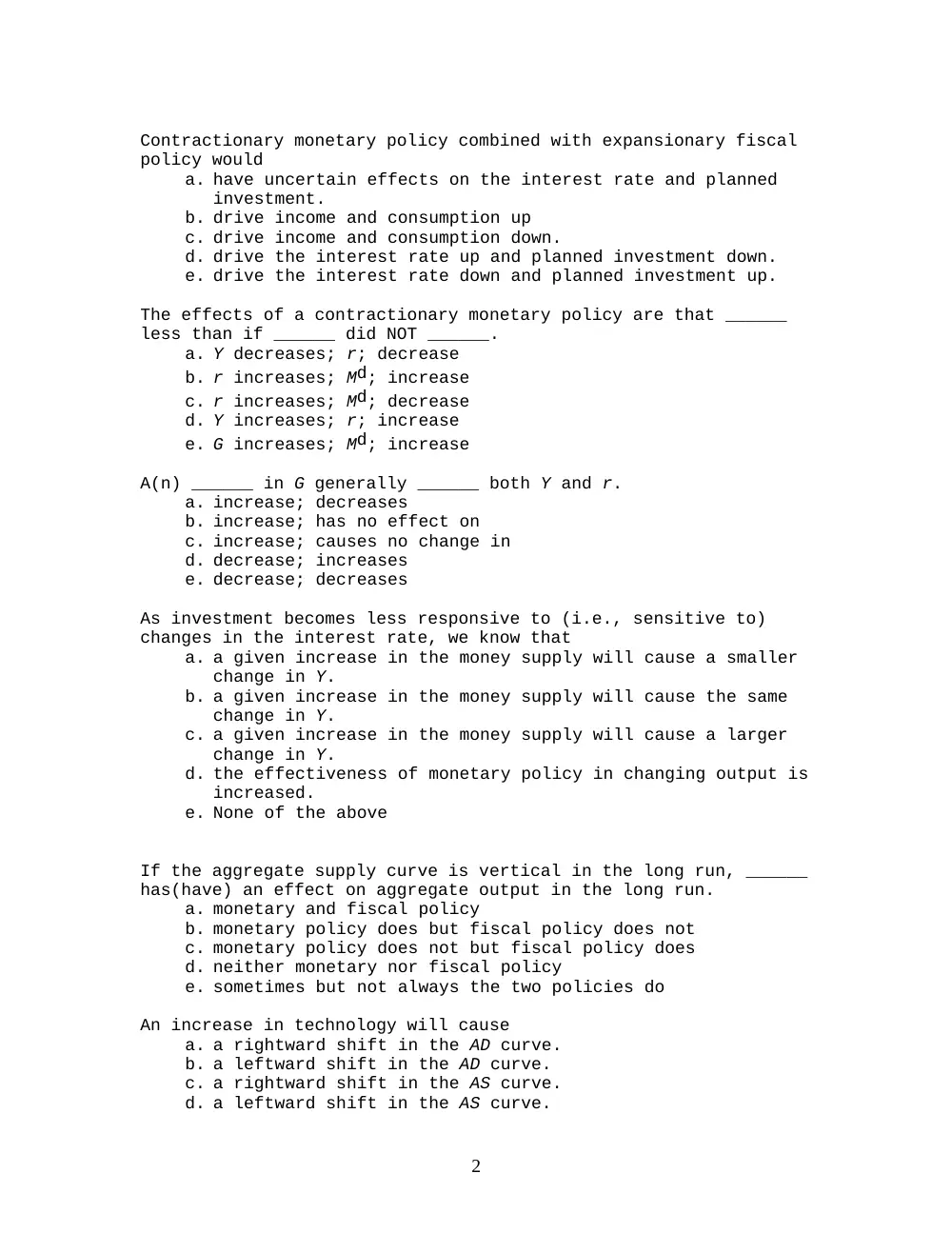
Contractionary monetary policy combined with expansionary fiscal
policy would
a. have uncertain effects on the interest rate and planned
investment.
b. drive income and consumption up
c. drive income and consumption down.
d. drive the interest rate up and planned investment down.
e. drive the interest rate down and planned investment up.
The effects of a contractionary monetary policy are that ______
less than if ______ did NOT ______.
a. Y decreases; r; decrease
b. r increases; Md; increase
c. r increases; Md; decrease
d. Y increases; r; increase
e. G increases; Md; increase
A(n) ______ in G generally ______ both Y and r.
a. increase; decreases
b. increase; has no effect on
c. increase; causes no change in
d. decrease; increases
e. decrease; decreases
As investment becomes less responsive to (i.e., sensitive to)
changes in the interest rate, we know that
a. a given increase in the money supply will cause a smaller
change in Y.
b. a given increase in the money supply will cause the same
change in Y.
c. a given increase in the money supply will cause a larger
change in Y.
d. the effectiveness of monetary policy in changing output is
increased.
e. None of the above
If the aggregate supply curve is vertical in the long run, ______
has(have) an effect on aggregate output in the long run.
a. monetary and fiscal policy
b. monetary policy does but fiscal policy does not
c. monetary policy does not but fiscal policy does
d. neither monetary nor fiscal policy
e. sometimes but not always the two policies do
An increase in technology will cause
a. a rightward shift in the AD curve.
b. a leftward shift in the AD curve.
c. a rightward shift in the AS curve.
d. a leftward shift in the AS curve.
2
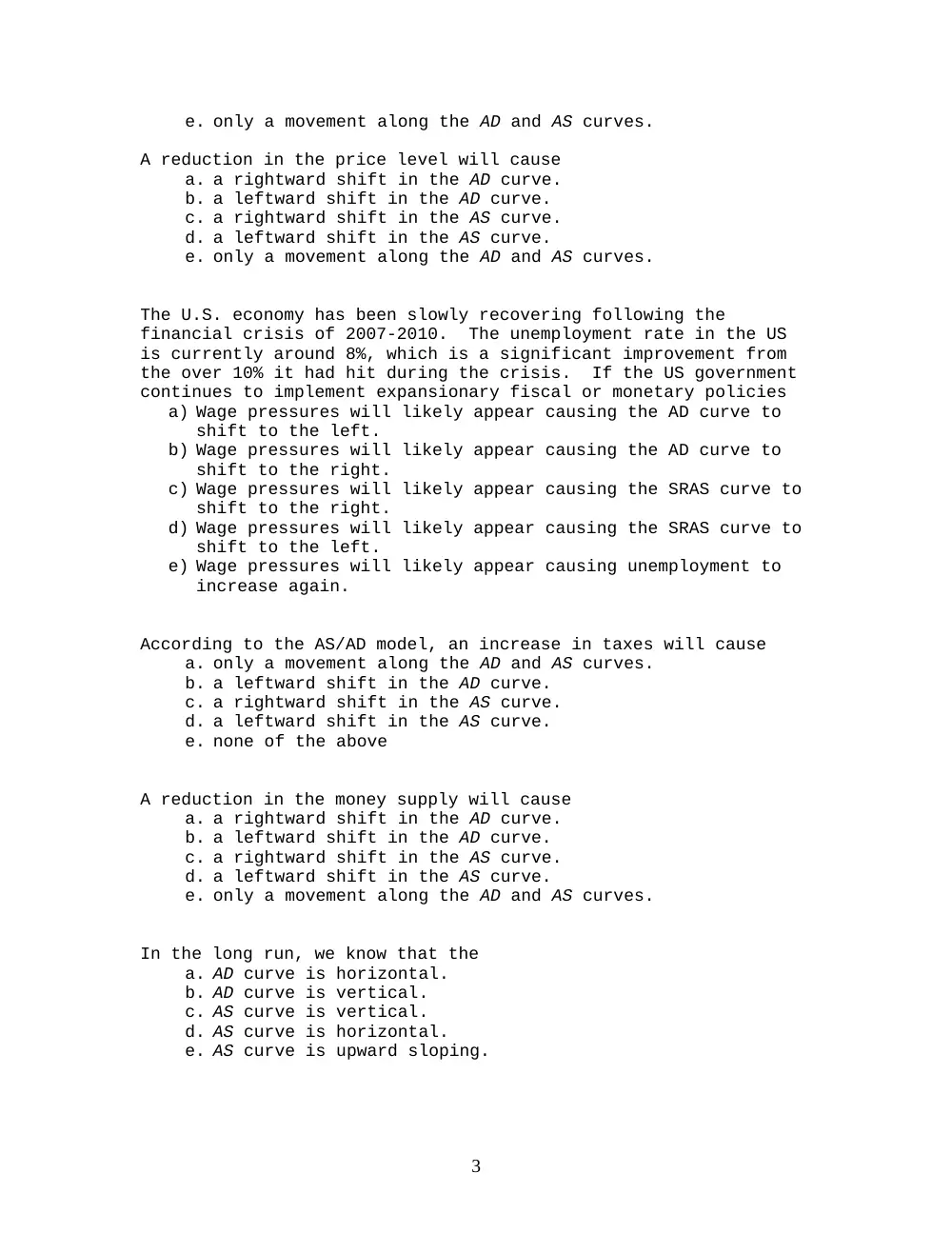
e. only a movement along the AD and AS curves.
A reduction in the price level will cause
a. a rightward shift in the AD curve.
b. a leftward shift in the AD curve.
c. a rightward shift in the AS curve.
d. a leftward shift in the AS curve.
e. only a movement along the AD and AS curves.
The U.S. economy has been slowly recovering following the
financial crisis of 2007-2010. The unemployment rate in the US
is currently around 8%, which is a significant improvement from
the over 10% it had hit during the crisis. If the US government
continues to implement expansionary fiscal or monetary policies
a) Wage pressures will likely appear causing the AD curve to
shift to the left.
b) Wage pressures will likely appear causing the AD curve to
shift to the right.
c) Wage pressures will likely appear causing the SRAS curve to
shift to the right.
d) Wage pressures will likely appear causing the SRAS curve to
shift to the left.
e) Wage pressures will likely appear causing unemployment to
increase again.
According to the AS/AD model, an increase in taxes will cause
a. only a movement along the AD and AS curves.
b. a leftward shift in the AD curve.
c. a rightward shift in the AS curve.
d. a leftward shift in the AS curve.
e. none of the above
A reduction in the money supply will cause
a. a rightward shift in the AD curve.
b. a leftward shift in the AD curve.
c. a rightward shift in the AS curve.
d. a leftward shift in the AS curve.
e. only a movement along the AD and AS curves.
In the long run, we know that the
a. AD curve is horizontal.
b. AD curve is vertical.
c. AS curve is vertical.
d. AS curve is horizontal.
e. AS curve is upward sloping.
3
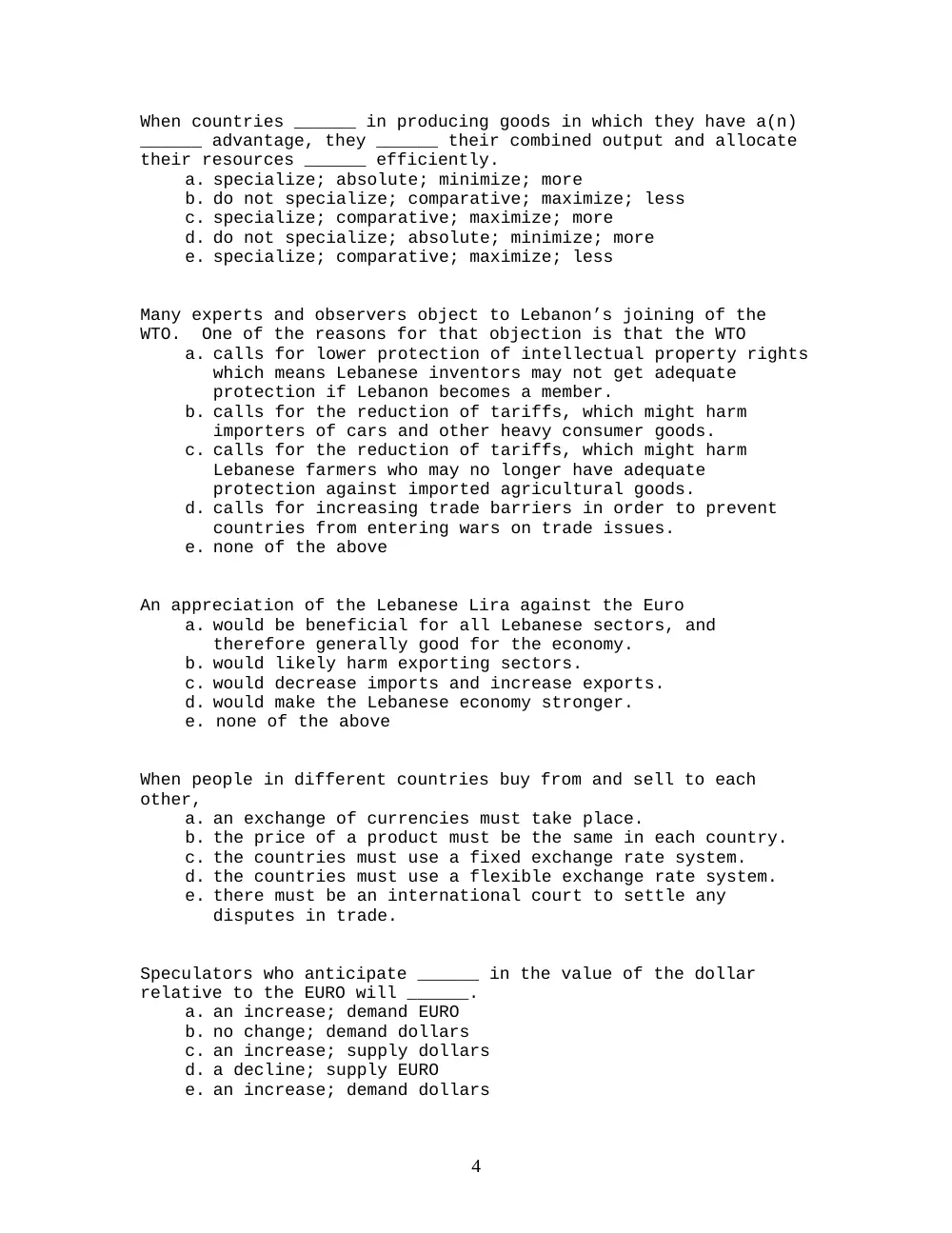
When countries ______ in producing goods in which they have a(n)
______ advantage, they ______ their combined output and allocate
their resources ______ efficiently.
a. specialize; absolute; minimize; more
b. do not specialize; comparative; maximize; less
c. specialize; comparative; maximize; more
d. do not specialize; absolute; minimize; more
e. specialize; comparative; maximize; less
Many experts and observers object to Lebanon’s joining of the
WTO. One of the reasons for that objection is that the WTO
a. calls for lower protection of intellectual property rights
which means Lebanese inventors may not get adequate
protection if Lebanon becomes a member.
b. calls for the reduction of tariffs, which might harm
importers of cars and other heavy consumer goods.
c. calls for the reduction of tariffs, which might harm
Lebanese farmers who may no longer have adequate
protection against imported agricultural goods.
d. calls for increasing trade barriers in order to prevent
countries from entering wars on trade issues.
e. none of the above
An appreciation of the Lebanese Lira against the Euro
a. would be beneficial for all Lebanese sectors, and
therefore generally good for the economy.
b. would likely harm exporting sectors.
c. would decrease imports and increase exports.
d. would make the Lebanese economy stronger.
e. none of the above
When people in different countries buy from and sell to each
other,
a. an exchange of currencies must take place.
b. the price of a product must be the same in each country.
c. the countries must use a fixed exchange rate system.
d. the countries must use a flexible exchange rate system.
e. there must be an international court to settle any
disputes in trade.
Speculators who anticipate ______ in the value of the dollar
relative to the EURO will ______.
a. an increase; demand EURO
b. no change; demand dollars
c. an increase; supply dollars
d. a decline; supply EURO
e. an increase; demand dollars
4
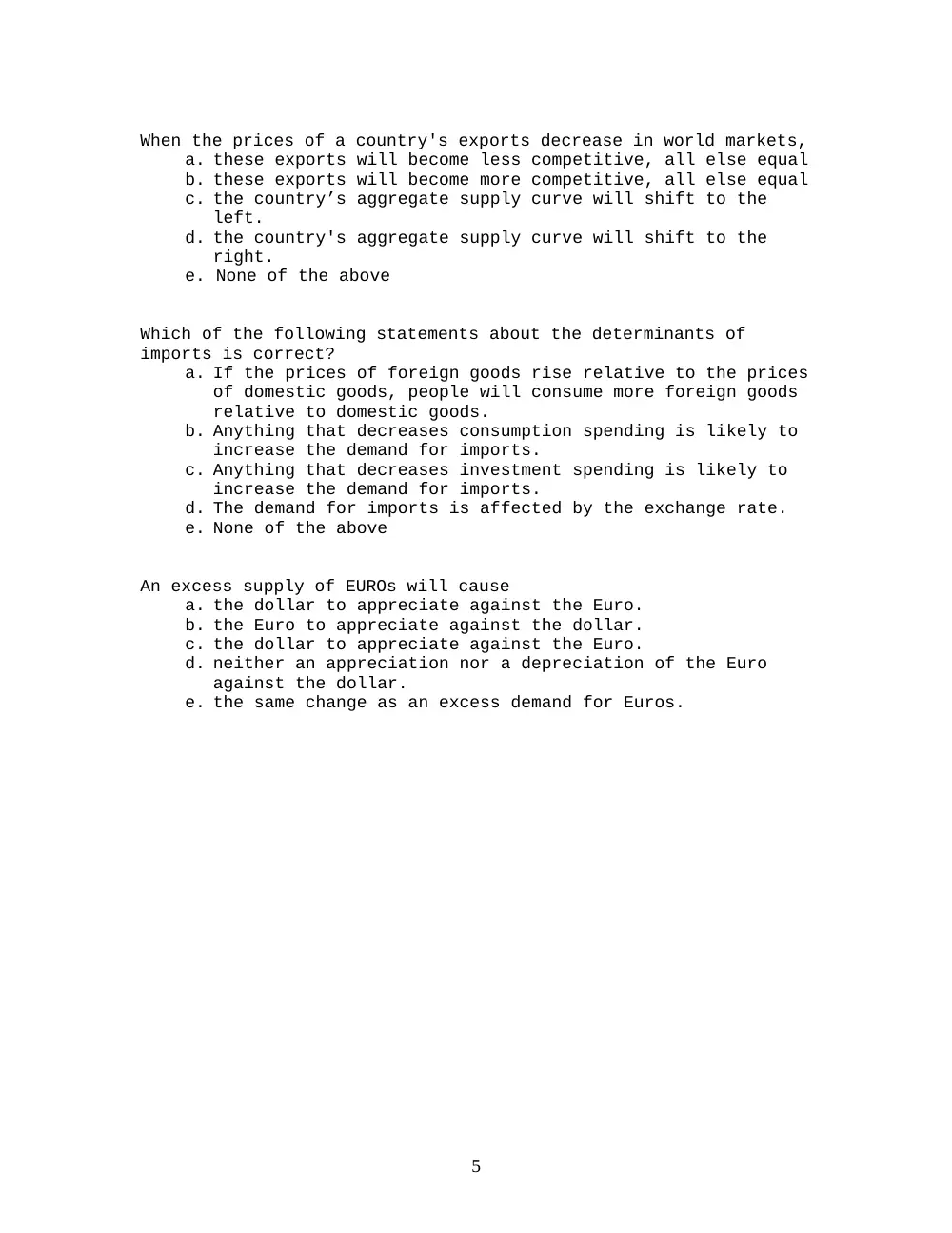
When the prices of a country's exports decrease in world markets,
a. these exports will become less competitive, all else equal
b. these exports will become more competitive, all else equal
c. the country’s aggregate supply curve will shift to the
left.
d. the country's aggregate supply curve will shift to the
right.
e. None of the above
Which of the following statements about the determinants of
imports is correct?
a. If the prices of foreign goods rise relative to the prices
of domestic goods, people will consume more foreign goods
relative to domestic goods.
b. Anything that decreases consumption spending is likely to
increase the demand for imports.
c. Anything that decreases investment spending is likely to
increase the demand for imports.
d. The demand for imports is affected by the exchange rate.
e. None of the above
An excess supply of EUROs will cause
a. the dollar to appreciate against the Euro.
b. the Euro to appreciate against the dollar.
c. the dollar to appreciate against the Euro.
d. neither an appreciation nor a depreciation of the Euro
against the dollar.
e. the same change as an excess demand for Euros.
5
Part II- Essays/Problems - New Material (2 questions; 40
points)
***Note to Class: You will get three of those questions on
the final exam, out of which you must answer 2 (so you have
a choice of 2 out of 3). Any substitution will
automatically result in loss of credit (4 points). Careful
preparation is recommended. Answers must be comprehensive
and precise.
***Another Note: As you prepare these questions, always
remember, the more you write, the better. If you think it
may be relevant WRITE IT!! Perfect scores will only be
awarded to complete, mature answers.
1) This question has three parts: a) Define and graphically
illustrate the “crowding-out” effect. b) What factor influences
the extent to which crowding-out occurs? c) What type of policy
may the government implement to reduce this effect? [Hint: The
answer to part b is stated clearly in the notes for chapter 27 on
BlackBoard under the section dealing with this topic. I didn’t
go over it in class so it’s up to you to find the correct
answer.]
2) Summarize the effects of contractionary monetary policy.
Illustrate graphically those effects on the equilibrium levels of
output and interest rate [Hint: There are short-run as well as
long-run effects.]
3) Define the short-run aggregate supply curve and provide a
summarized (but full) explanation of its shape.
4) An economy’s aggregate demand is the horizontal summation of
the individual demand curves for all the products consumed in the
economy. a) Do you agree with this statement? b) How is the
aggregate demand curve derived? c) List and explain three
important factors that may shift this curve.
5) The economies of the U.S. and most Western European nations
have experiences recessions and increases in unemployment over
the last several years (since the beginning of the financial
crisis in the summer of 2008 following the collapse of property
prices in the US and the failure of several major banks). This
has prompted many of those governments to implement fiscal
stimulus packages designed to ease up the crisis. a) Taking the
US economy as an example, use aggregate supply and demand curves
6
to describe and explain the effects of these policies on the
equilibrium output and price level on the short-run. b) What
might the effect of these policies be on the long-run if they are
maintained even after the US economy returns to its natural
level?
6) This question consists of a factual background, a hypothetical
situation, and 2 questions. Make sure you read everything
carefully before you begin.
Real Background: Both Lebanon and the island nation of Cyprus
have been involved in recent attempts to locate and explore
offshore natural gas fields. The two nations have demarcated
their sea boundaries in preparation for exploration in the hopes
of becoming natural gas exporters. It is well known that both
nations also export chemicals and related products. In 2011,
according to the Ministry of Economy and Trade data, Lebanon
exported a total of $320 million worth of goods under that
category. The figure for Cyprus was approximately $266 million
for the same year (according to statistics published by that
government).
Hypothetical Situation: Assume that the world works according to
the Ricardian model of international trade, and that the two
countries produce as follows:
*unit labor requirements for chemicals in Lebanon = 20
*unit labor requirements for natural gas in Lebanon = 100
*unit labor requirements for chemicals in Cyprus = 12
*unit labor requirements for natural gas in Cyprus = 72
Questions: a) State fully the Ricardian theory of comparative
advantage and explain how it differs from the concept of absolute
advantage that economists prior to Ricardo thought motivated
trade. b) Using the numbers above, decide which country will have
the comparative advantage in which product and explain the
resulting trade outcome.
7
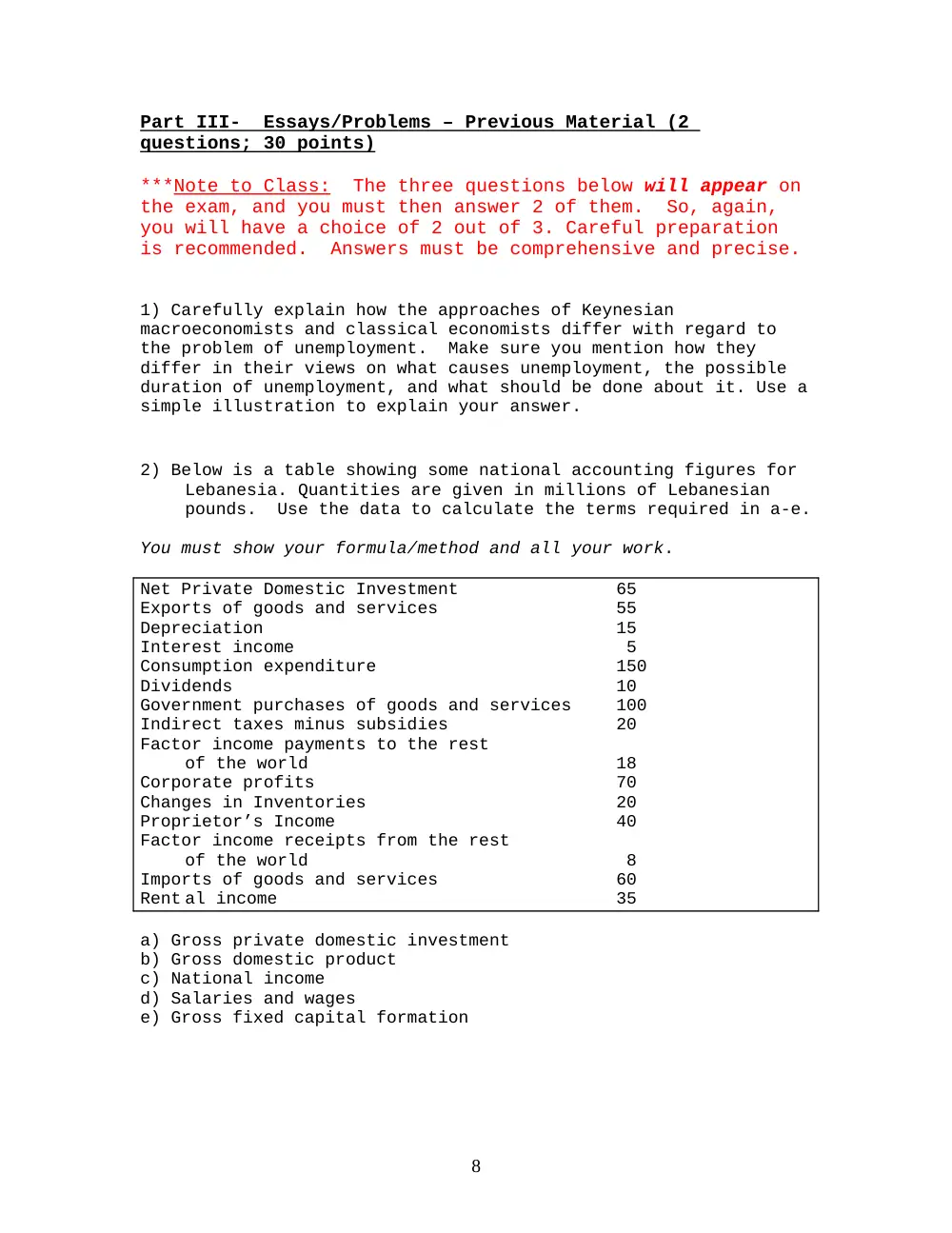
Part III- Essays/Problems – Previous Material (2
questions; 30 points)
***Note to Class: The three questions below will appear on
the exam, and you must then answer 2 of them. So, again,
you will have a choice of 2 out of 3. Careful preparation
is recommended. Answers must be comprehensive and precise.
1) Carefully explain how the approaches of Keynesian
macroeconomists and classical economists differ with regard to
the problem of unemployment. Make sure you mention how they
differ in their views on what causes unemployment, the possible
duration of unemployment, and what should be done about it. Use a
simple illustration to explain your answer.
2) Below is a table showing some national accounting figures for
Lebanesia. Quantities are given in millions of Lebanesian
pounds. Use the data to calculate the terms required in a-e.
You must show your formula/method and all your work.
Net Private Domestic Investment
65
Exports of goods and services
55
Depreciation
15
Interest income
5
Consumption expenditure
150
Dividends
10
Government purchases of goods and services
100
Indirect taxes minus subsidies
20
Factor income payments to the rest
of the world
18
Corporate profits
70
Changes in Inventories
20
Proprietor’s Income
40
Factor income receipts from the rest
of the world
8
Imports of goods and services
60
Rent al income
35
a) Gross private domestic investment
b) Gross domestic product
c) National income
d) Salaries and wages
e) Gross fixed capital formation
8
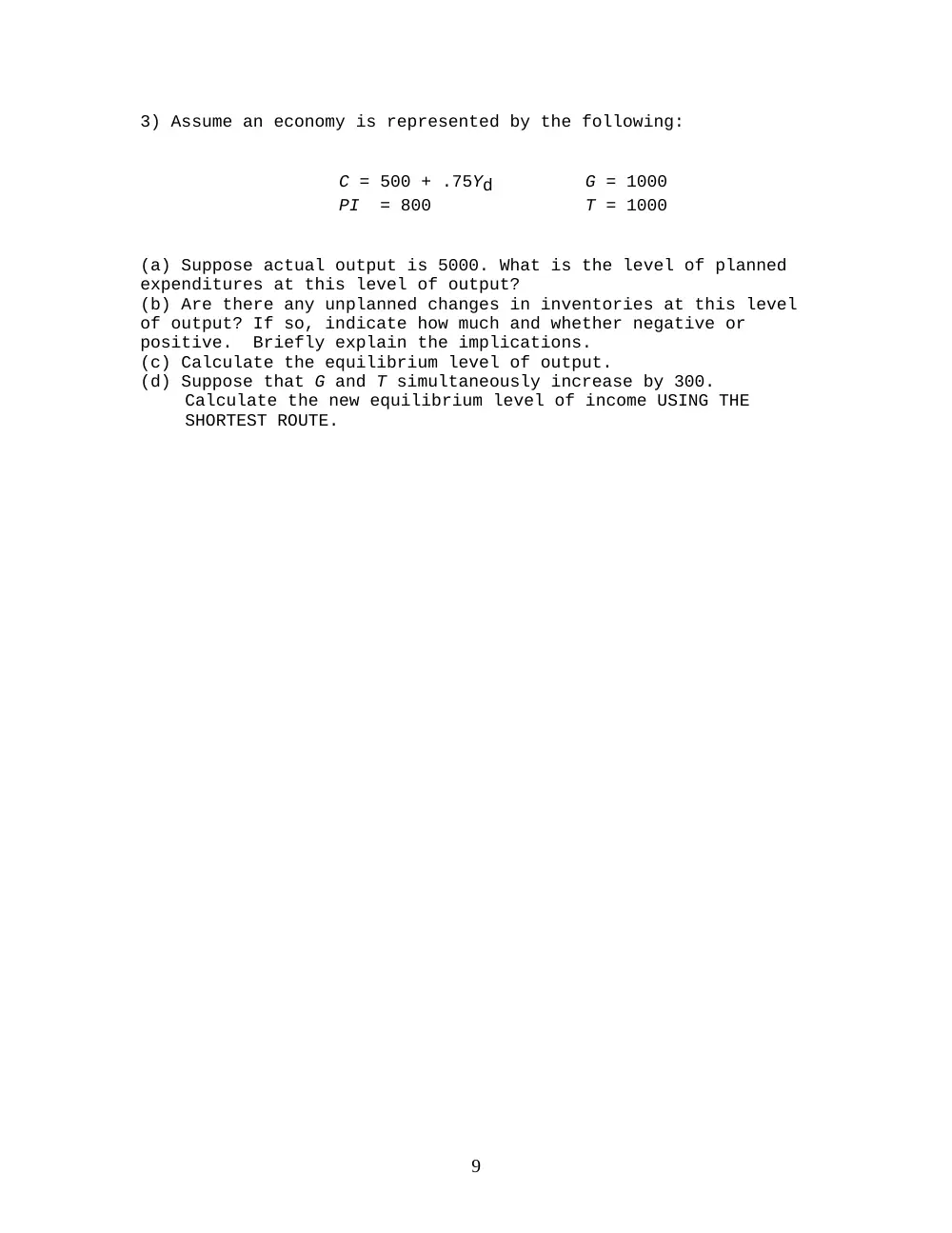
3) Assume an economy is represented by the following:
C = 500 + .75Yd G = 1000
PI = 800 T = 1000
(a) Suppose actual output is 5000. What is the level of planned
expenditures at this level of output?
(b) Are there any unplanned changes in inventories at this level
of output? If so, indicate how much and whether negative or
positive. Briefly explain the implications.
(c) Calculate the equilibrium level of output.
(d) Suppose that G and T simultaneously increase by 300.
Calculate the new equilibrium level of income USING THE
SHORTEST ROUTE.
9
Part IV- Bonus (8 Points)
Introductory Note: You may accumulate additional bonus
points (up to 8) by preparing an answer to the following
question and writing it during the final. On the exam the
question will be clearly marked as a bonus question. The
material for this part is contained in the notes to chapter
35 on BB.
The question has two parts. Each is graded separately. You may
answer the first part only or both.
1) Briefly define national balance of payments records. Name and
explain the three main accounts of the typical national BOP
tables. To help with the explanation, you should list at least
three items that may appear under each of the two primary
accounts (6 pts).
2) The terms “BOP deficit” and “BOP surplus” are often mentioned
in the media when discussing a country’s international economic
situation. For example, during the 2009-2011 period, Lebanon was
able to achieve a BOP surplus for three consecutive years.
Briefly explain what that means (2 pts).
10