
ENG 102 Syllabus
Lebanese American University · English II · 7 pages



More ENG 102 files
- Syllabus · Fall 2014LabView
- Notes Claims (fact , Value or Policy ) · Spring 2015NotesView
- Project High Protein Diet · Fall 2014ProjectView
- Notes For Research Paper · Fall 2013NotesView
- Notes For Research Paper · Fall 2013NotesView
- Notes For Research Paper · Fall 2013NotesView
- Midterm Mock Exam Questions · Spring 2012ExamView
- Midterm Mock Exam · Spring 2012ExamView
Show the text of this lab
+
Course code and title:
Semester and year:
Class Time and
location:
ENG 102, English II
Fall 2016
Multi-Section Course
Last Revised on:
August 20, 2016
CATALOG DESCRIPTION
This course is designed to develop advanced reading and writing skills associated with academic work.
Emphasis is on the analytical and critical reading of texts as well as on writing in a variety of argumentative
modes. Students also develop a research paper by learning how to formulate researchable questions, and how to
locate, integrate and cite appropriate academic resources from the library, the electronic media and the
community.
Prerequisite: ENG101 (English I) or EEE score of 600-649 or its equivalent
COURSE PREREQUISITE/CO-REQUISITE:
Prerequisite: ENG101 English 1, or EEE score between 600–649, or its equivalent.
INSTRUCTOR
Name:
Stephanie Farah
Email:
sfarah@lau.edu.lb
Office:
Nicol 207
Office Hours: MWF 12:00 – 1:00
COURSE LEARNING OUTCOMES
1. Determine and critically analyze an author’s purpose, implied meanings, tone,
assumptions and quality of evidence
2. Learn the basic structure of argumentative writings, including position
argument, causal argument and problem solution argument
3. Demonstrate knowledge of basic argumentation strategies in reading and
writing
4. Write an argumentative essay channeled towards the research paper
5. Use a process approach to writing an academic paper with guidance
6. Use databases and library reference tools to locate and use sources for
research.
7. Cite sources ethically using APA format
8. Reflect on one’s own performance and learning by using task assessment
strategies
9. Engage in speaking/listening activities for a variety of purposes
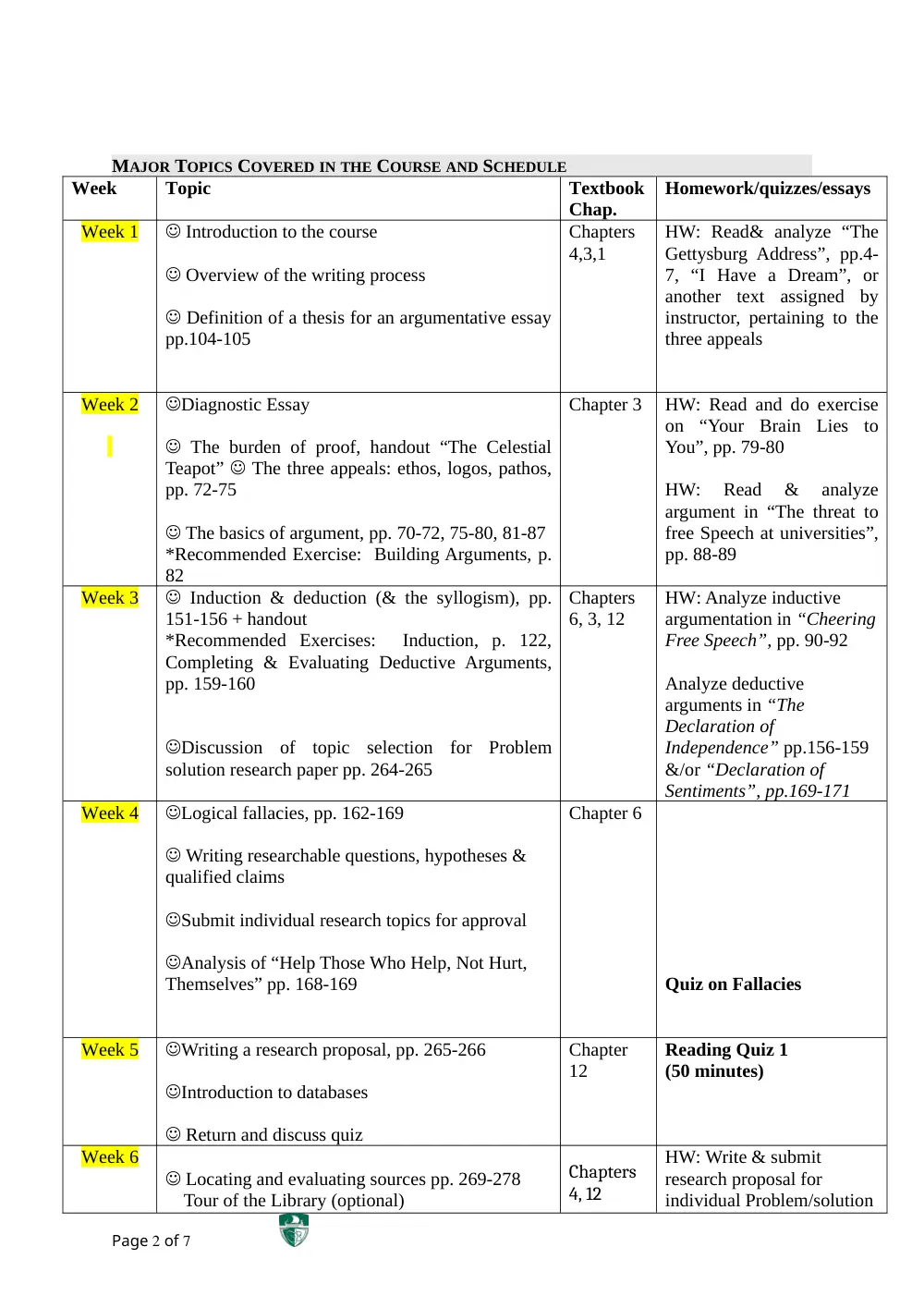
MAJOR TOPICS COVERED IN THE COURSE AND SCHEDULE
Week
Topic
Textbook
Chap.
Homework/quizzes/essays
Week 1
Introduction to the course
Overview of the writing process
Definition of a thesis for an argumentative essay
pp.104-105
Chapters
4,3,1
HW: Read& analyze “The
Gettysburg Address”, pp.4-
7, “I Have a Dream”, or
another text assigned by
instructor, pertaining to the
three appeals
Week 2
Diagnostic Essay
The burden of proof, handout “The Celestial
Teapot” The three appeals: ethos, logos, pathos,
pp. 72-75
The basics of argument, pp. 70-72, 75-80, 81-87
*Recommended Exercise: Building Arguments, p.
82
Chapter 3
HW: Read and do exercise
on “Your Brain Lies to
You”, pp. 79-80
HW:
Read & analyze
argument in “The threat to
free Speech at universities”,
pp. 88-89
Week 3
Induction & deduction (& the syllogism), pp.
151-156 + handout
*Recommended Exercises: Induction, p. 122,
Completing & Evaluating Deductive Arguments,
pp. 159-160
Discussion of topic selection for Problem
solution research paper pp. 264-265
Chapters
6, 3, 12
HW: Analyze inductive
argumentation in “Cheering
Free Speech”, pp. 90-92
Analyze deductive
arguments in “The
Declaration of
Independence” pp.156-159
&/or “Declaration of
Sentiments”, pp.169-171
Week 4
Logical fallacies, pp. 162-169
Writing researchable questions, hypotheses &
qualified claims
Submit individual research topics for approval
Analysis of “Help Those Who Help, Not Hurt,
Themselves” pp. 168-169
Chapter 6
Quiz on Fallacies
Week 5
Writing a research proposal, pp. 265-266
Introduction to databases
Return and discuss quiz
Chapter
12
Reading Quiz 1
(50 minutes)
Week 6
Locating and evaluating sources pp. 269-278
Tour of the Library (optional)
Chapters
4, 12
HW: Write & submit
research proposal for
individual Problem/solution
Page 2 of 7
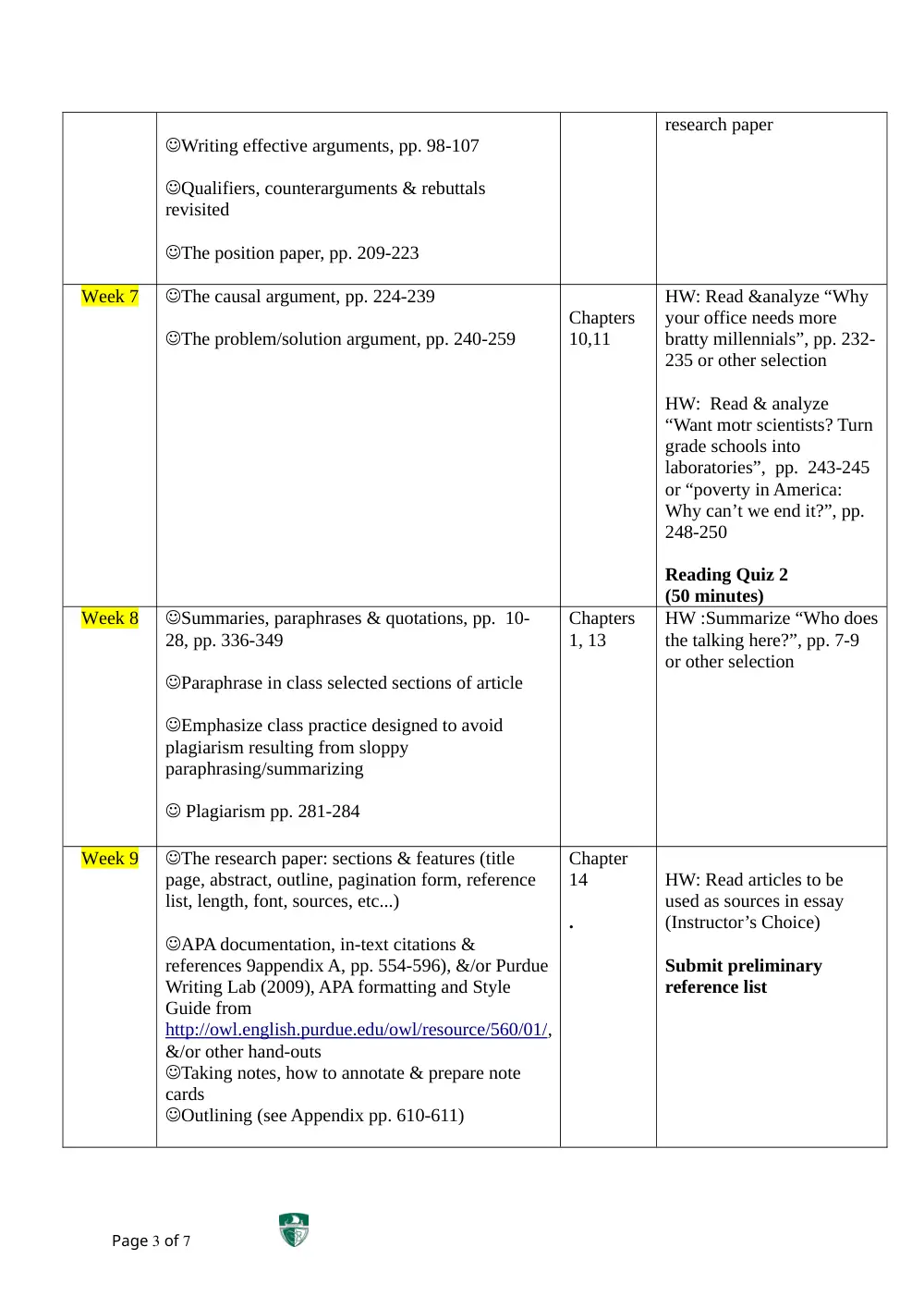
Writing effective arguments, pp. 98-107
Qualifiers, counterarguments & rebuttals
revisited
The position paper, pp. 209-223
research paper
Week 7
The causal argument, pp. 224-239
The problem/solution argument, pp. 240-259
Chapters
10,11
HW: Read &analyze “Why
your office needs more
bratty millennials”, pp. 232-
235 or other selection
HW: Read & analyze
“Want motr scientists? Turn
grade schools into
laboratories”, pp. 243-245
or “poverty in America:
Why can’t we end it?”, pp.
248-250
Reading Quiz 2
(50 minutes)
Week 8
Summaries, paraphrases & quotations, pp. 10-
28, pp. 336-349
Paraphrase in class selected sections of article
Emphasize class practice designed to avoid
plagiarism resulting from sloppy
paraphrasing/summarizing
Plagiarism pp. 281-284
Chapters
1, 13
HW :Summarize “Who does
the talking here?”, pp. 7-9
or other selection
Week 9
The research paper: sections & features (title
page, abstract, outline, pagination form, reference
list, length, font, sources, etc...)
APA documentation, in-text citations &
references 9appendix A, pp. 554-596), &/or Purdue
Writing Lab (2009), APA formatting and Style
Guide from
http://owl.english.purdue.edu/owl/resource/560/01/,
&/or other hand-outs
Taking notes, how to annotate & prepare note
cards
Outlining (see Appendix pp. 610-611)
Chapter
14
.
HW: Read articles to be
used as sources in essay
(Instructor’s Choice)
Submit preliminary
reference list
Page 3 of 7
Week10
Note-taking (see appendix p.623)
Chapter
14
Submit Preliminary
outline for essay
Week11
Note taking
Chapter
13
Submit Note-taking
assignment
ESSAY: DRAFT I (to be
written in class
Week12
Notes on writing the first draft, pp. 288-298
(optional)
Analyze sample APA paper, (appendix A, pp.
554-596)
Develop Documented essay into a research paper
Chapters
13, 14
ESSAY: DRAFT II (in
class OR at home)
Develop essay outline to
paper outline
Week13
Work on developing the research paper
Question/answer session on paper format & style
Write abstract in class
Individual student conferences (as needed)
Week14
Recommendations for revision
Submit Research Paper
Week15
Oral defense of Problem-solution research
papers
Page 4 of 7
TEXTBOOK
Seyler, D. U. (2015). Read, reason, write: An argument text and reader (Customized ed.).
New York: McGraw-Hill
Available at Malik’s Bookshop (Beirut), Librairie de Liban (Byblos)
FURTHER REFERENCES
Glenn, C., Miller, R. K., & Webb, S. S. (2004). The Hodge’s Harbrace Handbook (15thed.)
Boston, Massachusetts: Thomson Heinlen.
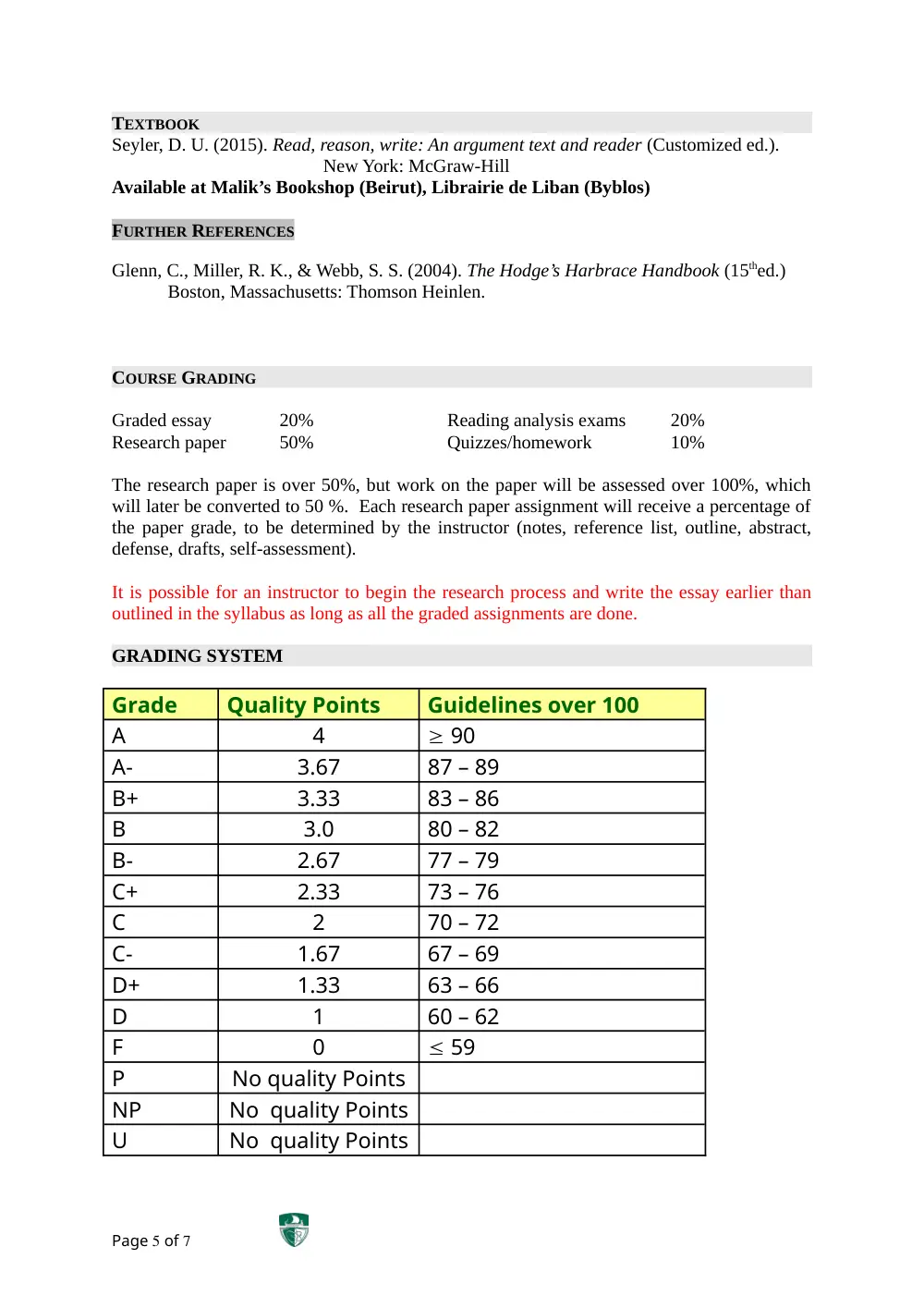
COURSE GRADING
Graded essay
20%
Reading analysis exams
20%
Research paper
50%
Quizzes/homework
10%
The research paper is over 50%, but work on the paper will be assessed over 100%, which
will later be converted to 50 %. Each research paper assignment will receive a percentage of
the paper grade, to be determined by the instructor (notes, reference list, outline, abstract,
defense, drafts, self-assessment).
It is possible for an instructor to begin the research process and write the essay earlier than
outlined in the syllabus as long as all the graded assignments are done.
GRADING SYSTEM
Grade
Quality Points
Guidelines over 100
A
4
90
A-
3.67
87 – 89
B+
3.33
83 – 86
B
3.0
80 – 82
B-
2.67
77 – 79
C+
2.33
73 – 76
C
2
70 – 72
C-
1.67
67 – 69
D+
1.33
63 – 66
D
1
60 – 62
F
0
59
P
No quality Points
NP
No quality Points
U
No quality Points
Page 5 of 7
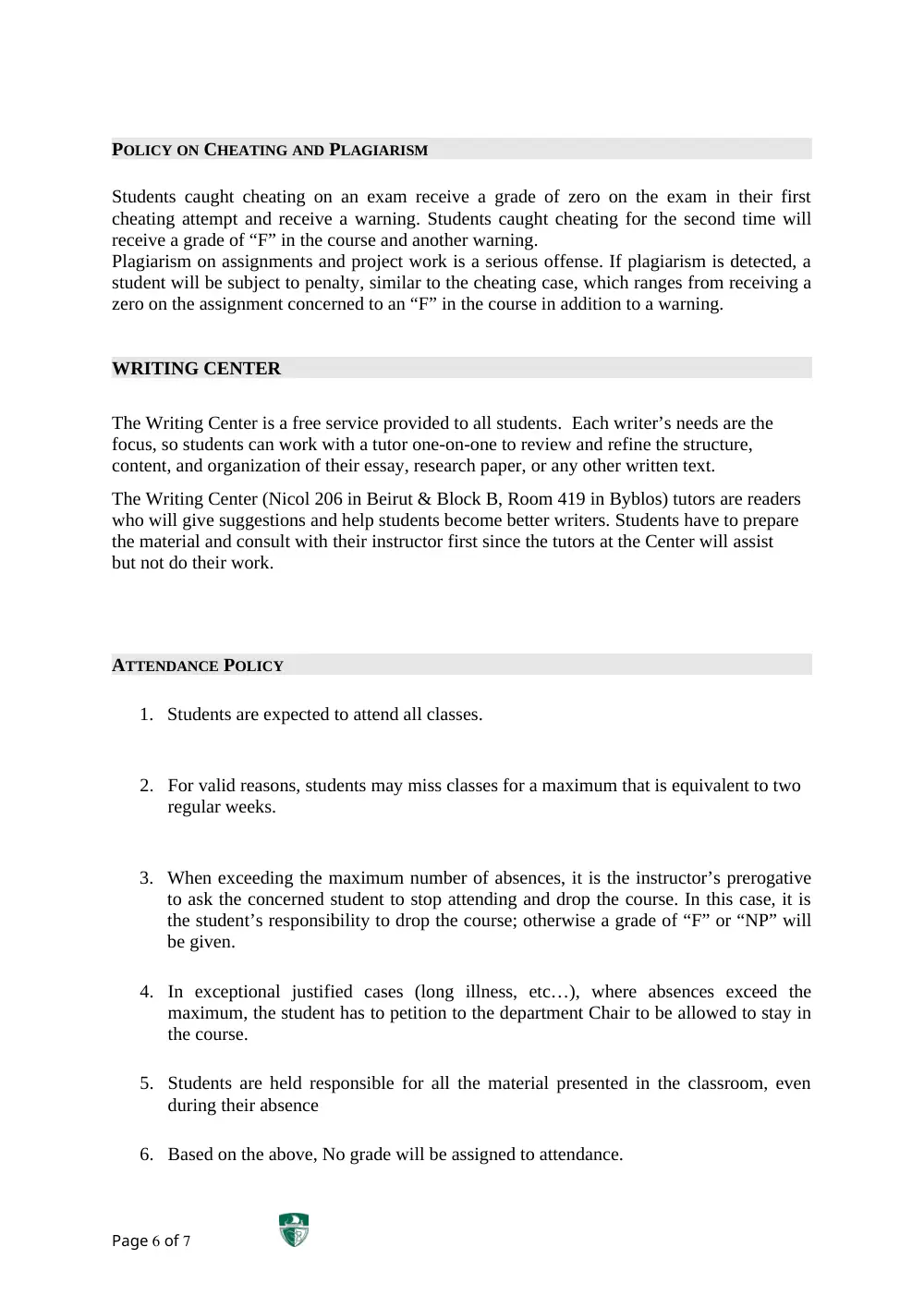
POLICY ON CHEATING AND PLAGIARISM
Students caught cheating on an exam receive a grade of zero on the exam in their first
cheating attempt and receive a warning. Students caught cheating for the second time will
receive a grade of “F” in the course and another warning.
Plagiarism on assignments and project work is a serious offense. If plagiarism is detected, a
student will be subject to penalty, similar to the cheating case, which ranges from receiving a
zero on the assignment concerned to an “F” in the course in addition to a warning.
WRITING CENTER
The Writing Center is a free service provided to all students. Each writer’s needs are the
focus, so students can work with a tutor one-on-one to review and refine the structure,
content, and organization of their essay, research paper, or any other written text.
The Writing Center (Nicol 206 in Beirut & Block B, Room 419 in Byblos) tutors are readers
who will give suggestions and help students become better writers. Students have to prepare
the material and consult with their instructor first since the tutors at the Center will assist
but not do their work.
ATTENDANCE POLICY
1. Students are expected to attend all classes.
2. For valid reasons, students may miss classes for a maximum that is equivalent to two
regular weeks.
3. When exceeding the maximum number of absences, it is the instructor’s prerogative
to ask the concerned student to stop attending and drop the course. In this case, it is
the student’s responsibility to drop the course; otherwise a grade of “F” or “NP” will
be given.
4. In exceptional justified cases (long illness, etc…), where absences exceed the
maximum, the student has to petition to the department Chair to be allowed to stay in
the course.
5. Students are held responsible for all the material presented in the classroom, even
during their absence
6. Based on the above, No grade will be assigned to attendance.
Page 6 of 7
WITHDRAWAL POLICY
Page 7 of 7
1.
A student who withdraws after the Drop/Add period and by the end of the 5th week of classes
(10th day of classes for Summer Modules) will obtain a “WI” on that particular course.
The student may process such request directly through the Registrar’s Office.
2.
A student who withdraws from a course between the 6th week and the end of the 10th week of
Classes (18th day of classes for Summer Modules) will receive either a “WP” or a “WF”. “WP”
or “WF” will be determined by the instructor based on the achieved academic performance in
that course till the time of withdrawal.
3.
The “WI” and the “WP” will not count as a Repeat; whereas the “WF” will count as a Repeat.
4.
“WI”, “WP” and “WF” will not count towards the GPA calculation.
WI is equivalent to Early Withdrawal
WP is equivalent to Withdrawal/Pass
WF is equivalent to Withdrawal/Fail
5. Deadline for withdrawal from courses: October 4, 2016 (WI); November 9, 2016 (WP/WF)
It is the student’s responsibility to drop the course)