
ENG 212 Lecture
Lebanese American University · Literature II · 9 pages · Dr. Larissa Vassilenko


More ENG 212 files
Show the text of this lab
through. She used the time, though. She read an ar-
ticle in a women’s Pocket-size magazine, called “Sex
Is Fun—or Hell.” She washed her comb and brush,
She took the Spot out of the skirt of her beige suit.
She moved the button on her Saks blouse. She
tweezed out two freshly surfaced hairs in her mole.
When -the Operator finally rang her toom, she was
Sitting on the window seat and had almost finished put-
ting lacquer on the nails of her left hand.
She was a girl who for a tinging phone dropped
exactly nothing. She looked as if her phone had been
ringing continually ever since she had teached pu-
berty,
With her little lacquer brush, while the Phone was
tinging, she went over the nail of her little finger, ac-
through the air. With her dry hand, she picked up a
‘Gongested ashtray from the window seat and carried
‘it with her over to the night table, on which the
‘phone stood. She sat down on one of the made-up
“twin beds and—it was the fifth or sixth ring—picked
‘up the phone.
_ Hello,” she said, keeping the fingers of her left
thand outstretched and away from her white silk dress-
‘ing gown, which was all that she was wearing, ex-
“cept mules—her rings were in the bathroom.
_ I have your call to New York now, Mrs. Glass,”
the operator said.
_ “Thank you,” said the girl, and made room on the
“night table for the ashtray.
es woman’s voice came through. “Muriel? Is that
“you?”
_ The girl turned the receiver slightly away from her
‘ear. “Yes, Mother. How are you?” she said.
_ “Pye been worried to death about you. Why
| haven't you phoned? Are you all right?”
_ “f tried to get you last night and the night before.
The phone here’s been—”
“Are you all right, Muriel?”
The girl increased the angle between the receiver
and her ear. “I’m fine. I’m hot. This is the hottest
day they've had in Florida in—”
“Why haven’t you called me? I’ve been worried
fae
“Mother, darling, don’t yell at me. I can hear you”
beautifully,” said the girl. “I called you twice last
night. Once just after—”
“I told your father you’d probably call last night.
But, no, he had to—Are you all right, Muriel? Tell
me the truth.”
“Ym fine. Stop asking me that, please.”
[4]
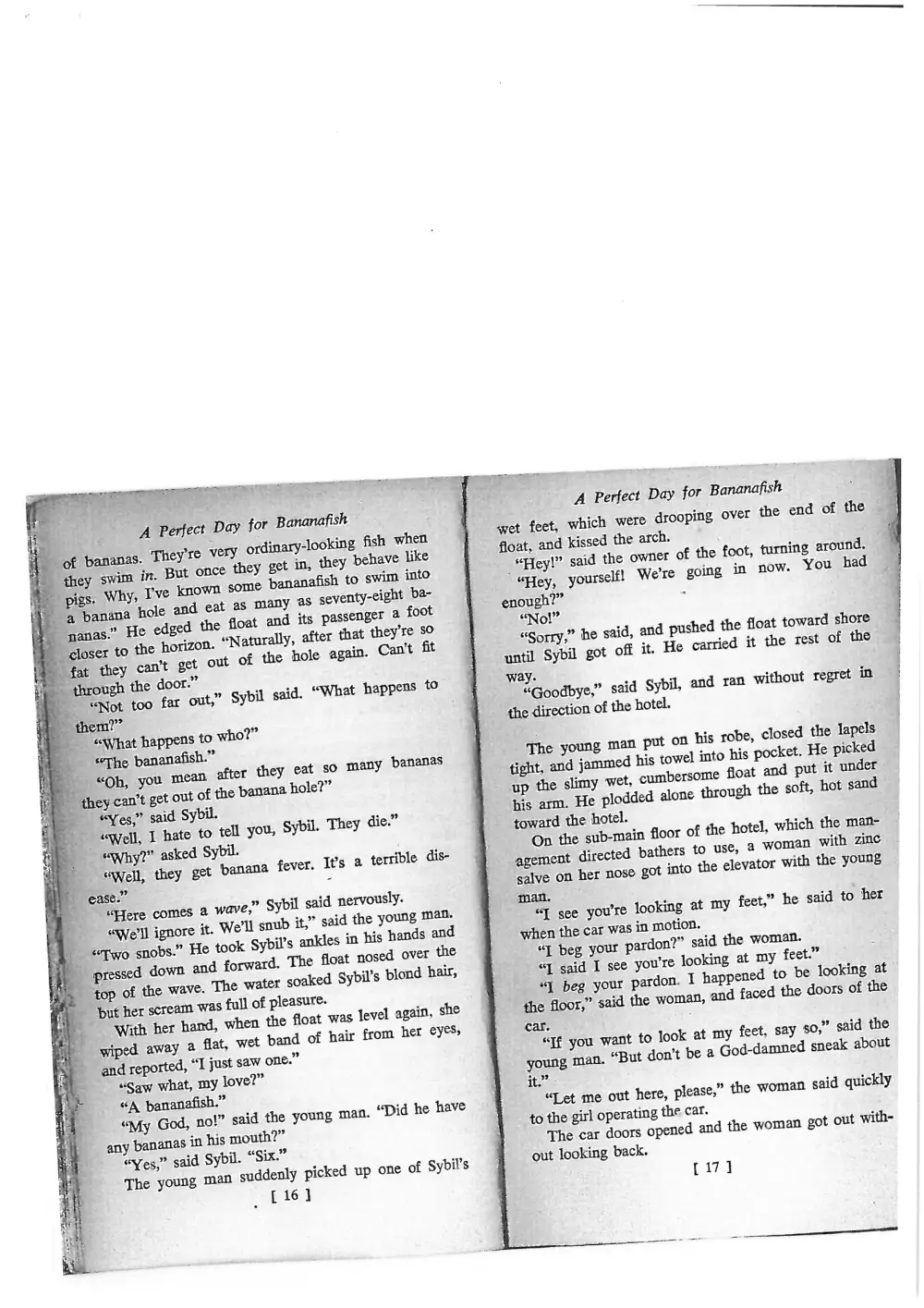
A Perfect Day for Bananafish
“When did you get there?” :
“J don’t know. Wednesday morning, early.”
“Who drove?”
“He did,” said the girl. “And don’t get excited. He
drove very nicely. I was amazed.”
“He drove? Muriel, you gave me your word of—”
“Mother,” the girl interrupted, “I just told you. He
drove very nicely. Under fifty the whole way, as a
matter of fact.” '
‘Did he try any of that funny business with th
trees ?ni st
“T said he drove very nicely, Mother. Now, please.
J asked him to stay close to the white line, and all,
and he knew what I meant, and he did. He was even
trying not to look at the trees—you could tell. Did
Daddy get the car fixed, incidentally?”
“Not yet. They want four hundred dollars, just to—”
_ “Mother, Seymour told Daddy that he’d pay for it.
There’s no reason for—”
- “Well, we'll see. How did he behave—in the car
and all?”
“All right,” said the girl.
“Did he keep calling you that awful—”
“No. He has something new now.”
“What?”
“Oh, what’s the difference, Mother?”
“Muriel, I want to know. Your father—”
“All right, all right. He calls me Miss Spiritual
Tramp of 1948,” the girl said, and giggled.
“Tt isn’t funny, Muriel. It isn’t funny at all. It’s hor-
tible. It’s sad, actually. When I think how—”
“Mother,” the girl interrupted, “listen to me. You
- remember that book he sent me from Germany? You
know—those German poems. What’d I do with it?
Pve been racking my—”
[5]
A Perfect Day for Bananafish
“You have it.”
“Are you sure?” said the girl,
“Certainly. That is, I have it. It’s in Freddy’s room.
You left it here and I didn’t have room for it in the—
Why? Does he want it?”
“No. Only, he asked me about it, when we were
driving down. He wanted to know if I’d read it.”
“It was in German!”
“Yes, dear. That doesn’t make any difference,” said
the girl, crossing her legs. “He said that the poems
happen to be written by the only great poet of the
century. He said I should’ve bought a translation or
something. Or learned the language, if you please.”
“Awful. Awful. It’s sad, actually, is what it is. Your
father said last night—”
“Just a second, Mother,” the girl said. She went
Over to the window seat for her cigarettes, lit one,
and returned to her seat on the bed. “Mother?” she
said, exhaling smoke.
“Muriel. Now, listen to me.”
“Tm listening.”
“Your father talked to Dr, Sivetski.”
“Oh?” said the girl.
“He told him everything, At least, he said he did
—you know your father. The trees. That business with
the window. Those horrible things he said to Granny
about her plans for passing away. What he did with
all those lovely pictures from Bermuda—everything.”
“Well?” said the girl.
“Well. In the first place, he said it was a perfect
crime the Army released him from the hospital—my
word of honor. He very definitely told your father
there’s a chance—a very great chance, he said—that
Seymour may completely lose control of himself. My
word of honor.”
[6]
A Perfect Day for Bananafish ¢
“There’s a psychiatrist here at the hotel,” said the
gu. -
“Who? What’s his name?”
“J don’t know. Rieser or something. He’s supposed
to be very good.”
“Never heard of him.” 2
“Well, he’s supposed to be very good, anyway.
“Muriel, don’t be fresh, please. We’re very wor-
tied about you. Your father wanted to wire you last
night to come home, as a matter of f{—”
“Pm not coming home right now, Mother. So re-
lax.” 3 :
“Muriel. My word of honor. Dr. Sivetski said Sey-
mour may completely lose contr—”
“J just got here, Mother. This is the first vacation .
Ive had in years, and I’m not going to just pack
everything and come home,” said the girl. “I couldn’t
travel now anyway. I’m so sunburned I can hardly
move.” ?
“You're badly sunburned? Didn’t you use that jar
of Bronze I put in your bag? I put it right—”
“T used it. I’m burned anyway.”
“That’s terrible. Where are you burned?”
“All over, dear, all over.”
“That’s terrible.”
“Tl live.”
“Tell me, did you talk to this psychiatrist?”
“Well, sort of,” said the girl. ;
“What'd he say? Where was Seymour when you
talked to him?”
“In the Ocean Room, playing the piano. He’s played
the piano both nights we’ve been here.”
“Well, what’d he say?”
“Oh, nothing much. He spoke to me first. I was
sitting next to him at Bingo last night, and he asked
at
: A Perfect Day for Bananafish
me if that wasn’t my husband
the other room. I said yes,
if Seymour’s been sick or something. So I said—”
“Why'd he ask that?”
“I don’t know, Mother. I guess because he’s so |
pale and all,” said the girl. “Anyway, after Bingo he
and his wife asked me if I wouldn't like to join them |
for a drink. So I did. His wife was horrible. You re-
member that awful dinner dress we saw in Bonwit’s
you'd have to have a tiny,
window? The one you said
tiny—”
“The green?”
“She had it on. And all hips. She kept asking me
if Seymour’s related to that Suzanne Glass that has
that place on Madison Avenue—the millinery.”
“What'd he say, though? The doctor.”
“Ob. Well, nothing much, really. I mean we were
in the bar and all. It was terribly noisy.”
“Yes, but did—did you tell him what he tried to
do with Granny’s chair?”
“No, Mother. I didn’t go into details very much,”
said the girl. “Tl probably get a chance to talk to
him again. He's in the bar all day long.”
“Did he say he thought there was a chance he might
Do something to
you!”
“Not exactly,” said the girl. “He had to have more
facts, Mother. They have to know about your child-
hood—all that stuff. I told
t you, we could hardly talk,
it was so noisy in there,”
“Well. How’s your blue coat?”
“All right. I had some of the padding taken out.”
“How are the clothes this year?”
“Terrible, But out of this world,
—everything,” said the girl. ;
[8]
You see sequins
playing the piano in
it was, and he asked me
A Perfect Day for Bananafish
“How’s your room?” :
“Al right. Just all tight, though. We couldn’t get
the room we had before the war,” said the girl. “The
people are awful this year. You should see what sits
next to us in the dining room. At the next table. They
Took as if they drove down in a truck.”
“Well, it’s that way all over. How’s your ballerina?”
“Tt’s too long. I told you it was too long.”
“Muriel, I’m only going to ask you once more— °
are you really all right?”
“Yes, Mother,” said the girl. “For the nineticth
¢ime.””
“And you don’t want to come home?”
“No, Mother.” ‘
“Your father said last night that he’d be more than
willing to pay for it if you’d go away someplace by
yourself and think things over. You could take a love-
ly cruise. We both thought—”
“No, thanks,” said the girl, and uncrossed her legs.
“Mother, this call is costing a for—”
“When I think of how you waited for that boy all
through the war—I mean when you think of all those
crazy little wives who—”
“Mother,” said the girl, “we’d better hang up. Sey- ©
tour may come in any minute.”
“Where is he?”
“On the beach,”
“On the beach? By himself? Does he behave him-
self on the beach?”
“Mother,” said the girl, “you talk about him as
though he were a raving maniac—”
“I said nothing of the kind, Muriel.”
“Well, you sound that way. I mean all he does is
lie there. He won’t take his bathrobe off.”
“He won't take his bathrobe off? Why not?”
[9]
_ A Perfect Day for Bananafish -
“I don’t know. I guess because he’s so pale.”
“My goodness, he needs the sun. Can’t you make
him?”
“You know Seymour,” said the girl, and crossed |
her legs again. “He says he doesn’t want a lot of fools |
looking at his tattoo.”
“He doesn’t have any tattoo! Did he get one in the
Army?”
“No, Mother. No, dear,” said the girl, and stood |
up. “Listen, I'll call you tomorrow, maybe.”
“Muriel. Now, listen to me.”
“Yes, Mother,” said the girl,
her right leg.
“Call me the instant he does, or says, anything at
all funny—you know what I mean. Do you hear me?”
“Mother, I’m not afraid of Seymour.”
“Muriel, I want you to Promise me.”
“All right, I promise. Goodbye, Mother,” said the
girl. “My love to Daddy.” She hung up.
putting her weight on
“See more glass,” said Sybil Carpenter, who was
staying at the hotel with her mother, “Did you see
more glass?”
“Pussycat, stop saying that. It’s
solutely crazy. Hold still, please.”
Mrs. Carpenter was putting sun-tan oil on Sybil’s
shoulders, spreading it down over the delicate, wing-
like blades of her back, Sybil was sitting insecurely
on a huge, inflated beach ball, facing the ocean. She
was wearing a canary-yellow two-piece bathing suit,
one piece of which she would not actually be needing
for another nine or ten years,
“It was really just an ordinary silk handkerchief —
you could see when you got up close,” said the woman
[10]
driving Mommy ab-
A Perfect Day for Bananafish
‘in the beach chair beside Mrs. Carpenter's. “I wish
I knew how she tied it. It was teally darling.”
“Tt sounds darling,” Mrs. Carpenter agreed. “Sybil,
hold still, pussy.”
“Did you see more glass?” said Sybil.
Mrs. Carpenter sighed. “All right,” she said. She
replaced the cap on the sun-tan oil bottle. “Now mun
| and play, pussy. Mommy’s going up to the hotel and
have a Martini with Mrs, Hubbel. I'll bring you the
olive.”
Set loose, Sybil immediately ran down to the flat
part of the beach and began to walk in the direction
of Fisherman’s Pavilion. Stopping only to sink a foot
in a soggy, collapsed castle, she was soon out of the
“area reserved for guests of the hotel.
She walked for about a quarter of a mile and then
suddenly broke into an oblique run up the soft part
of the beach. She stopped short when she reached the
place where a young man was lying on his back.
“Are you going in the water, see more glass?” she
Said,
The young man started, his right hand going to the
lapels of his terry-cloth robe. He turned over on his
stomach, letting a sausaged towel fall away from his
eyes, and squinted up at Sybil.
“Hey. Hello, Sybil.”
“Are you going in the water?”
“I was waiting for you,” said the young man.
“What’s new?”
“What?” said Sybil.
“What’s new? What’s on the program?”
“My daddy’s coming tomorrow on a nairiplane,”
Sybil said, kicking sand.
“Not in my face, baby,” the young man said, put-
[11]
iT i ee Re
A Perfect Day for Bananafish
ting his hand on Sybil’s ankle. “Well, it’s about time
he got here, your daddy, I’ve been expecting him hour-
Ty. Hourly.”
“Where’s the lady?” Sybil said.
“The lady?” the young man brushed some sand out _
of his thin hair. “That’s hard to say, Sybil. She may
be im any one of a thousand places, At the hair
dresser’s, Having her hair dyed mink. Or making dolls |
for poor children, in her room.” Lying prone now, he |
made two fists, set one on top of the other, and rested
his chin on the top one. “Ask me something else,
Sybil,” he said, “That’s a fine bathing suit you have
on. If there’s one thing I like, it’s a blue bathing suit.”
_ Sybil stared at him, then looked down at her pro-
truding stomach. “This is a yellow,” she said. “This
is a yellow.”
“It is? Come a little closer.”
Sybil took a step forward.
“You're absolutely right. What a fool I am.”
“Are you going in the water?” Sybil said.
“Tm seriously considering it. I'm giving it plenty of
thought, Sybil, you'll be glad to know.”
~ Sybil prodded the rubber float that the young man
sometimes used as a head-rest. “It needs air,” she said.
“You're right. It needs more air than I’m willing to
admit.” He took away his fists and let his chin rest
on the sand. “Sybil,” he said, “you're looking fine, It’s
good to see you. Tell me about yourself.” He reached
in front of him and took both of Sybil’s ankles in his
hands. “I’m Capricorn,” he said. “What are you?”
“Sharon Lipschutz said you let her sit on the piano
seat with you,” Sybil said,
“Sharon Lipschutz said that?”
Sybil nodded vigorously.
He let go of her ankles, drew in his hands, and
[12]
sits ce beeeeenee COR Tae
‘Perfect Day for Bananafish S
: oF + + “Well. a
side of his face on his right forearm. “Well,
“you know how those things happen, Sybil. T
@ there, playing. And you were nowhere in
And Sharon Lipschutz came over and sat down
. me. I couldn’t push her off, could 1?”
= :
nded she was you.” Fs
immediately stooped and began to dig in the
*s go in the water,” she said. é
Tight,” said the young man. “I think I can
t in.” é
ext time, push her off,” Sybil said.
who off?” 3
aron Lipschutz.” :
‘Ah, Sharon Lipschutz,” said the young man.
that name comes up. Mixing memory and de-
’ He suddenly got to his feet. He looked at the
“Sybil,” he said, “Ill tell you what we'll do.
and narrow, and his trunks were royal blue. He folded
the robe, first lengthwise, then in thirds. He unrolled
the towel he had used over his eyes, spread it out
on the sand, and then laid the folded robe on top of
it. He bent over, picked up the float, and secured it
under his right arm. Then, with his left hand, he took
Sybil’s hand.
The two started to walk down to the ocean.
_ “I imagine you’ve seen quite a few bananafish in
_ your day,” the young man said.
: [13]
soe nop eR RET
A Perfect Day for Bananafish
Sybil shook her head.
“You haven’t? Where do you live, anyway?”
**¥ don’t know,” said Sybil.
“Sure you know. You must know. Sharon Lip-
schutz knows where she lives and she’s only three and
@ half.”
Sybil stopped walking and yanked her hand away
from him. She picked up an ordinary beach shell and
looked at it with elaborate interest. She threw it down.
“Whirly Wood, Connecticut,” she said, and resumed
walking, stomach foremost.
“Whirly Wood, Connecticut,” said the young man.
“Ts that anywhere near Whirly Wood, Connecticut, by
any chance?”
Sybil looked at him. “That’s where I live,” she said
impatiently. “I live in Whirly Wood, Connecticut.”
She ran a few steps ahead of him, caught up her left
foot in her left hand, and hopped two or three times.
“You have no idea how clear that makes every-
thing,” the young man said.
Sybil released her foot. “Did you read ‘Little Black
Sambo’?” she said.
“It's very funny you ask me that,” he said. “It so
happens I just finished reading it last night.” He
reached down and took back Sybil’s hand. “What did
you think of it?” he asked her.
“Did the tigers run all around that tree?”
“I thought they’d never stop. I’never saw so many
tigers,”
“There were only six,” Sybil said.
“Only six!” said the young man. “Do you cali that
only?”
“Do you like wax?” Sybil asked.
“Do I like what?” asked the young man.
“Wax.”
[14]
A Perfect Day for Bananafish
“Very much. Don’t you?”
Sybil nodded. “Do you like olives?” she asked.
“Olives—yes. Olives and wax. I never go anyplace
without ’em.”
“Do you like Sharon Lipschutz?” Sybil asked.
“Yes. Yes, I do,” said the young man. “What I like
particularly about her is that she never does anything
mean to little dogs in the lobby of the hotel. That lit-
tle toy bull that belongs to that lady from Canada,
for instance. You probably won’t believe this, but
some little girls like to poke that little dog with balloon
sticks. Sharon doesn’t. She’s never mean or unkind.
That's why I like her so much.”
Sybil was silent.
“I like to chew candles,” she said finally, :
“Who doesn’t?” said the young man, getting his feet
wet. “Wow! It’s cold.” He dropped the rubber float
on its back. “No, wait just a second, Sybil, Wait’ll
‘we get out a little bit.”
They waded out till the water was up to Sybil’s
waist. Then the young man picked her up and laid
her down on her stomach on the float.
“Don’t you ever wear a bathing cap or anything?”
he asked.
“Don’t let go,” Sybil ordered. “You hold me, now.”
“Miss Carpenter. Please. I know my business,” the
young man said. “You just keep your eyes open for
any bananafish. This is a perfect day for bananafish.”
“T don’t see any,” Sybil said.
“That’s understandable. Their habits are very pe-
culiar.” He kept pushing the float. The water was not
quite up to his chest, “They lead a very tragic life,”
he said. “You know what they do, Sybil?”
-She shook her head.
“Well, they swim into a hole where there’s a lot
[15]
A Perfect Day for Bananafish
| of bananas. They're very ordinary-looking fish when
"they swim in. But once they get in, they behave like
“pigs. Why, Tive known some pananafish to swim into
‘a banana hole and eat as many as seventy-eight ba-
_ nanas.” He edged the float and its passenger 4 foot
"closer to the horizon. “Naturally, after that they're so
them?”
“What happens to who?”
«The bananafish.”
s “Qh, you mean after they eat so many bananas
they can’t get out of the banana hole?”
Yes,” said. Sybil.
«well, I hate to tell you, Sybil. They die.”
. » asked Sybil.
‘= “well, they get banana fever. It's a terrible dis-
1 ease.” z
“PJere comes 4 wave,” Sybil said nervously.
f “we'll ignore it. We'll snub it,” said the young man.
«Two snobs.” He took Sybil’s ankles in his hands and
pressed down and forward. The float nosed over the
~ top of the wave. The water soaked Sybil’s blond hair,
put her scream was full of pleasure.
With ber hand, when the float was level again, she
wiped away 4 flat, wet band of hair from her eyes,
and reported, “J just saw one.”
“yes,” said Sybil. Si
The young man suddenly picked up one of Sybil’s
[16]
A Perfect Day for Bananafish
wet feet, which were drooping over the end of the
float, and kissed the arch.
“Hey!” said the owner of the foot, turning around.
“Hey, yourself! We're going in now. You had
enough?” :
“No!”
“Sorry,” he said, and pushed the float toward shore
until Sybil got off it. He carried it the rest of the
way.
“Goodbye,” said Sybil, and ran without regret in
the direction of the hotel.
The young man put on his robe, closed the lapels
tight, and jammed his towel into his pocket. He picked
up the slimy wet, cumbersome float and put it under
his arm. He plodded alone through the soft, hot sand
toward the hotel.
On the sub-main floor of the hotel, which the man-
agement directed bathers to use, a woman with zine
salve on her nose got into the elevator with the young
man.
“J see you're looking at my feet,” he said to her
when the car was in motion.
“J beg your pardon?” said the woman.
“q said I see you're Jooking at my feet.”
car.
“Tf you want to Jook at my feet, say 50,” said the
young man. “But don’t be a God-damned sneak about
itt
“Let me out here, please,” the woman said quickly
to the girl operating the car.
The car doors opened and the woman got out with-
out looking back.
[17]
the pieces —
useage, opened it, and from under a pile of shorts E
and undershirts he took out an Ortgies calibre 7.65
itomatic. He released the magazine, looked at it, —
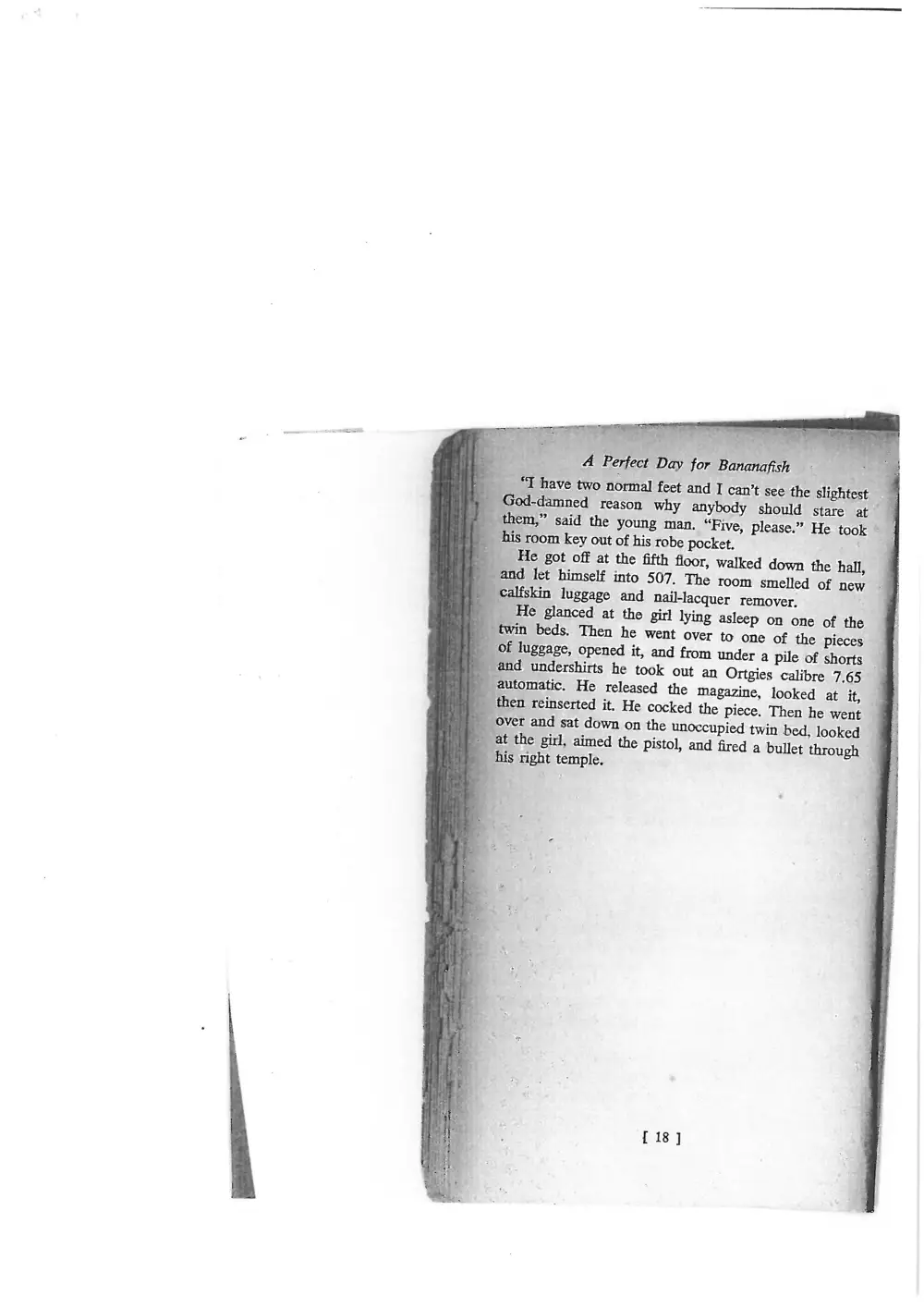
{ 18]
. §