
MTH 201 Final, Fall 2006
Lebanese American University · Calculus III · 10 pages
More MTH 201 files
- Lecture Final Exam Revision · Spring 2016Final examView
- Final With Solutions · Fall 2015Final exam · with solutionView
- Final · Fall 2015Final examView
- Final · Spring 2013Final examView
- Final · Fall 2012Final examView
- Final · Fall 2012Final examView
- Final · Fall 2012Final examView
- Final · Fall 2012Final examView
Show the text of this final exam
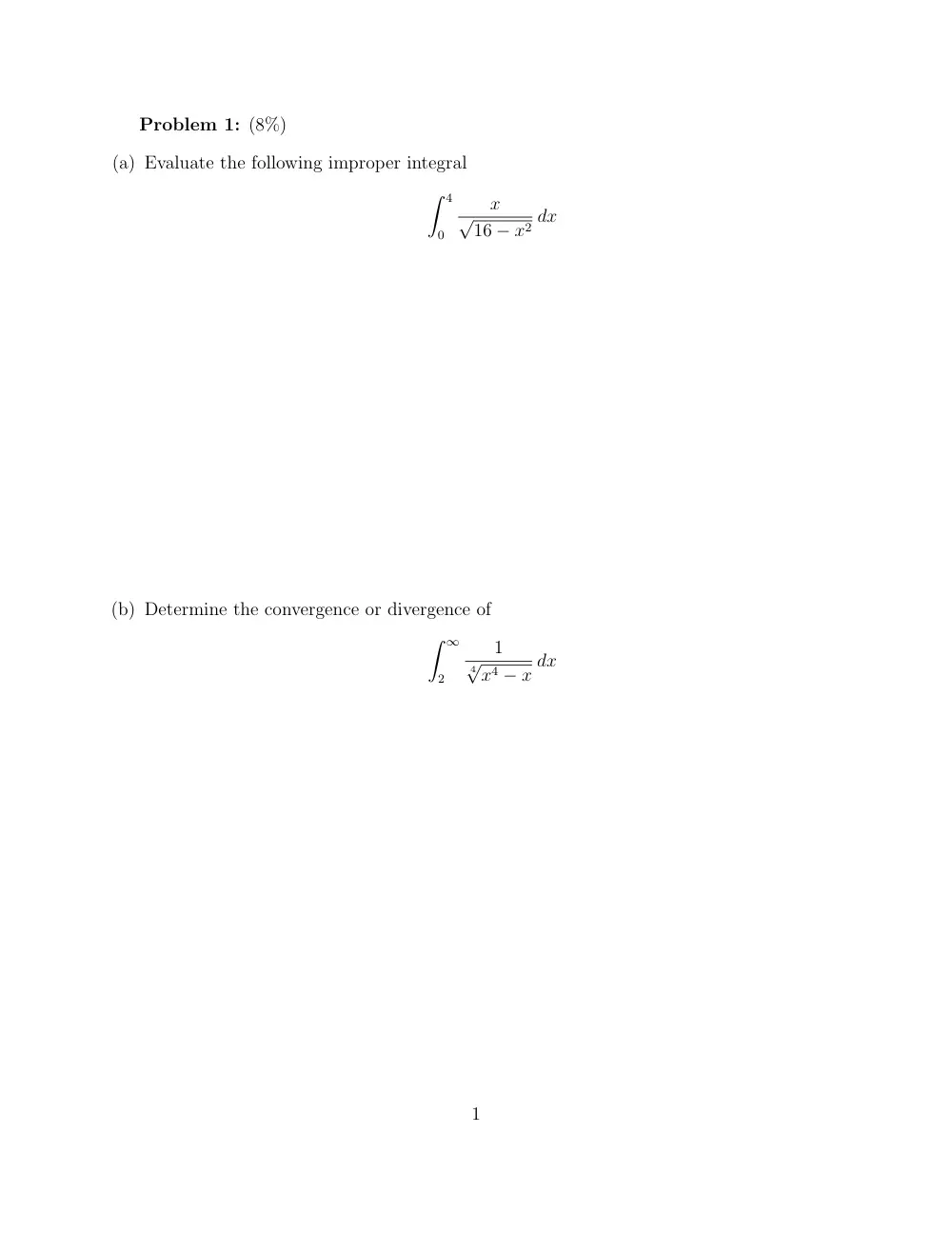
Problem 1: (8%)
(a) Evaluate the following improper integral
� 4
0
x
√
16 − x2 dx
(b) Determine the convergence or divergence of
� ∞
2
1
4√
x4 − x dx
1
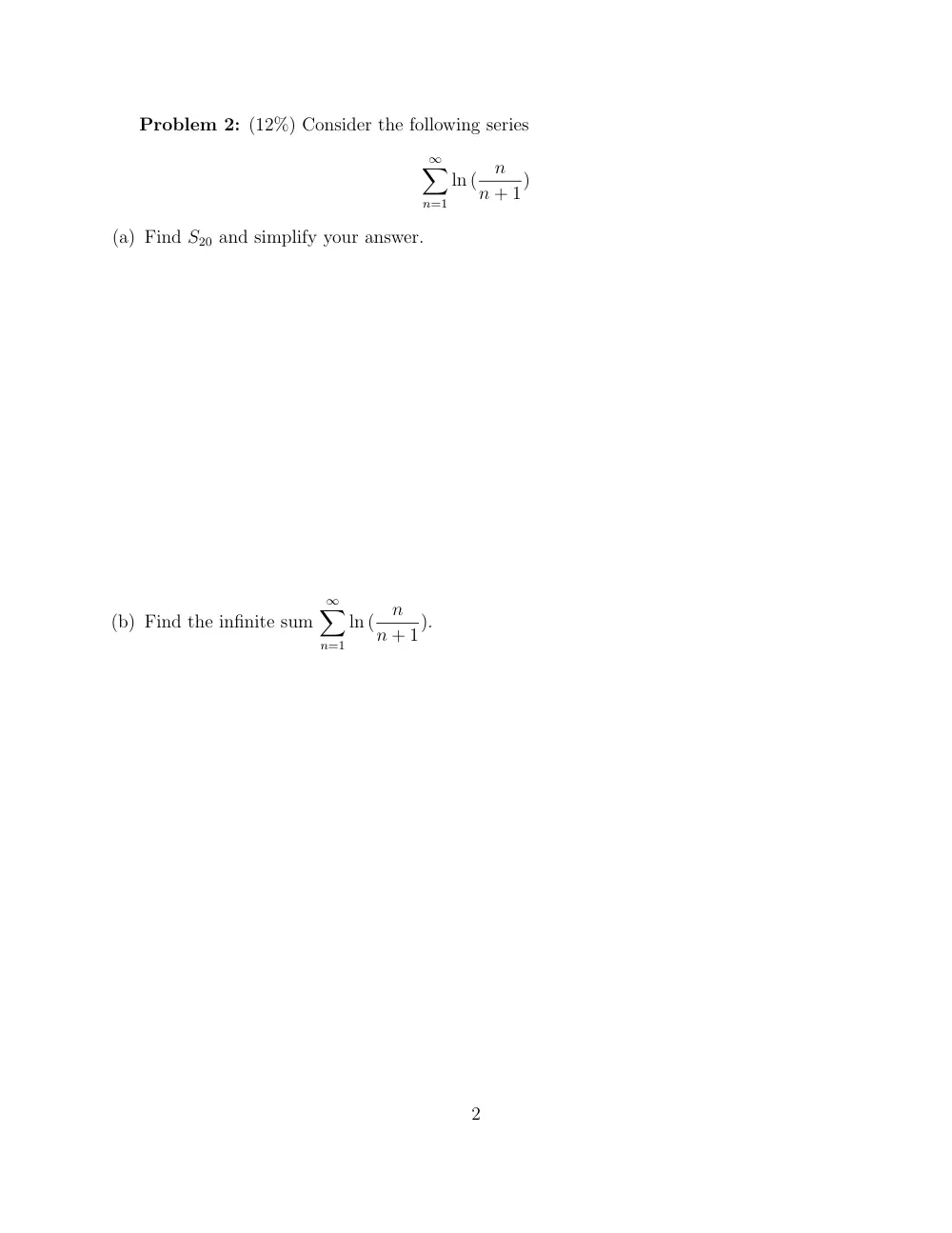
Problem 2: (12%) Consider the following series
∞
�
n=1
ln (
n
n + 1)
(a) Find S20 and simplify your answer.
(b) Find the infinite sum
∞
�
n=1
ln (
n
n + 1).
2
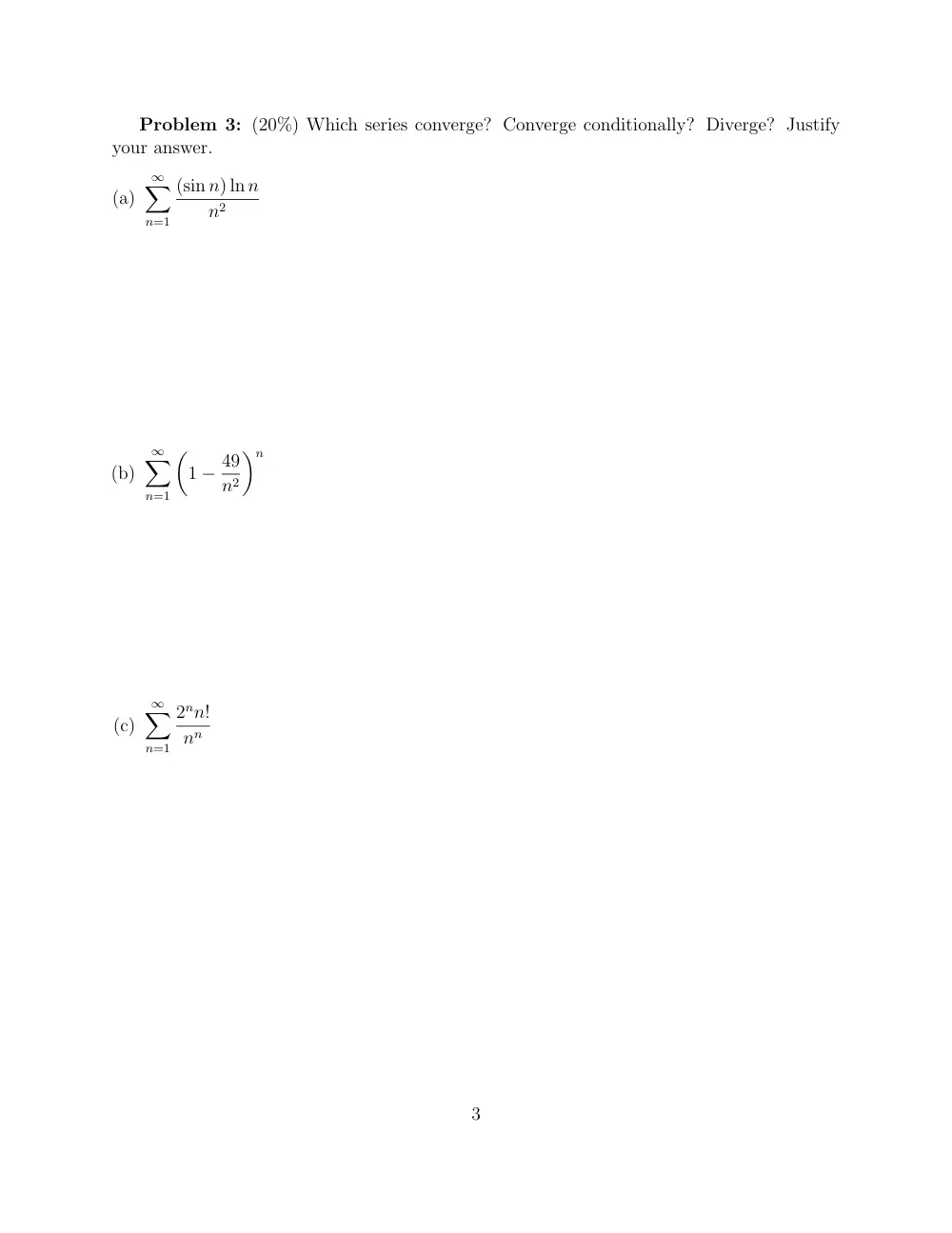
Problem 3: (20%) Which series converge? Converge conditionally? Diverge? Justify
your answer.
(a)
∞
�
n=1
(sin n) ln n
n2
(b)
∞
�
n=1
�
1 − 49
n2
�n
(c)
∞
�
n=1
2nn!
nn
3
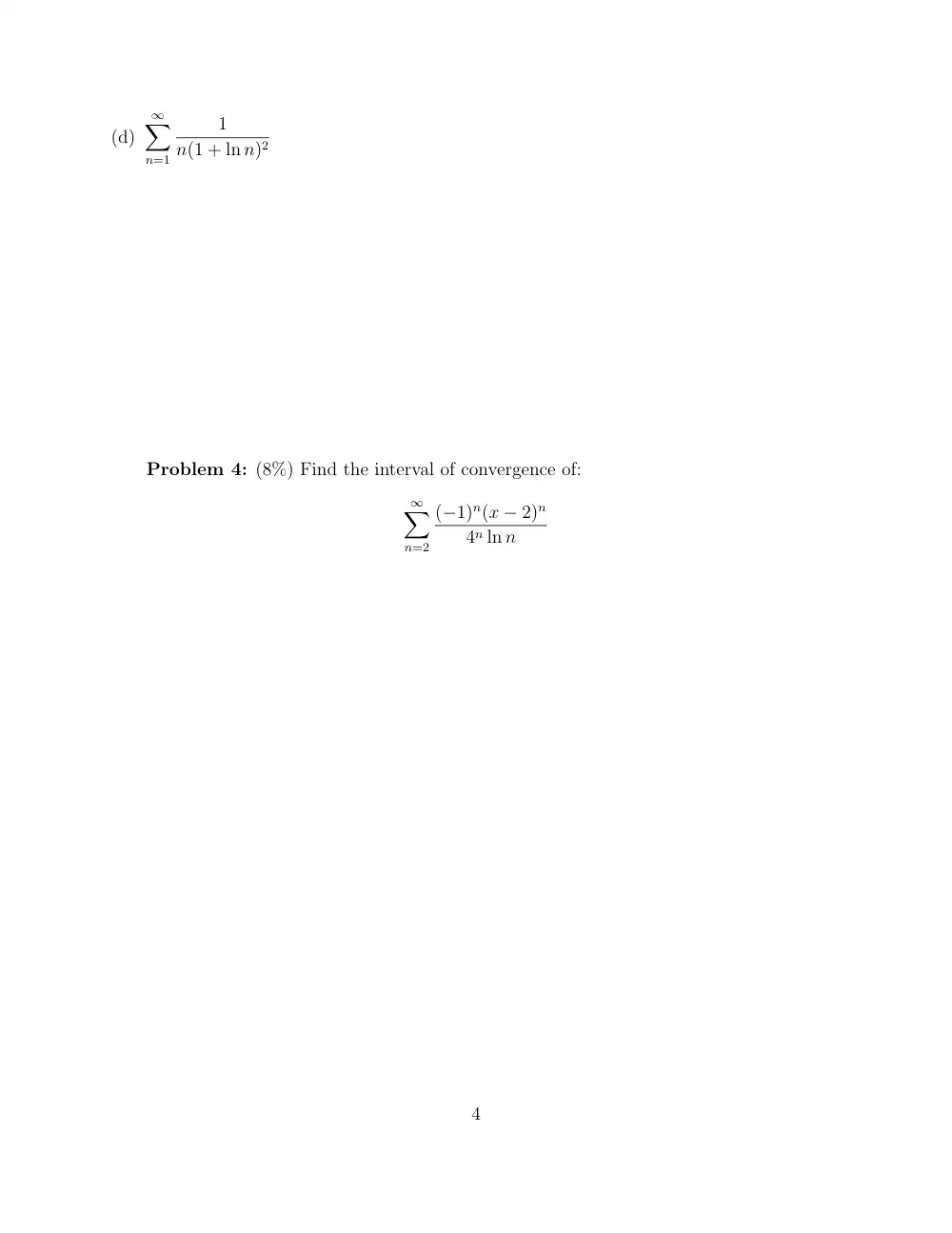
(d)
∞
�
n=1
1
n(1 + ln n)2
Problem 4: (8%) Find the interval of convergence of:
∞
�
n=2
(−1)n(x − 2)n
4n ln n
4
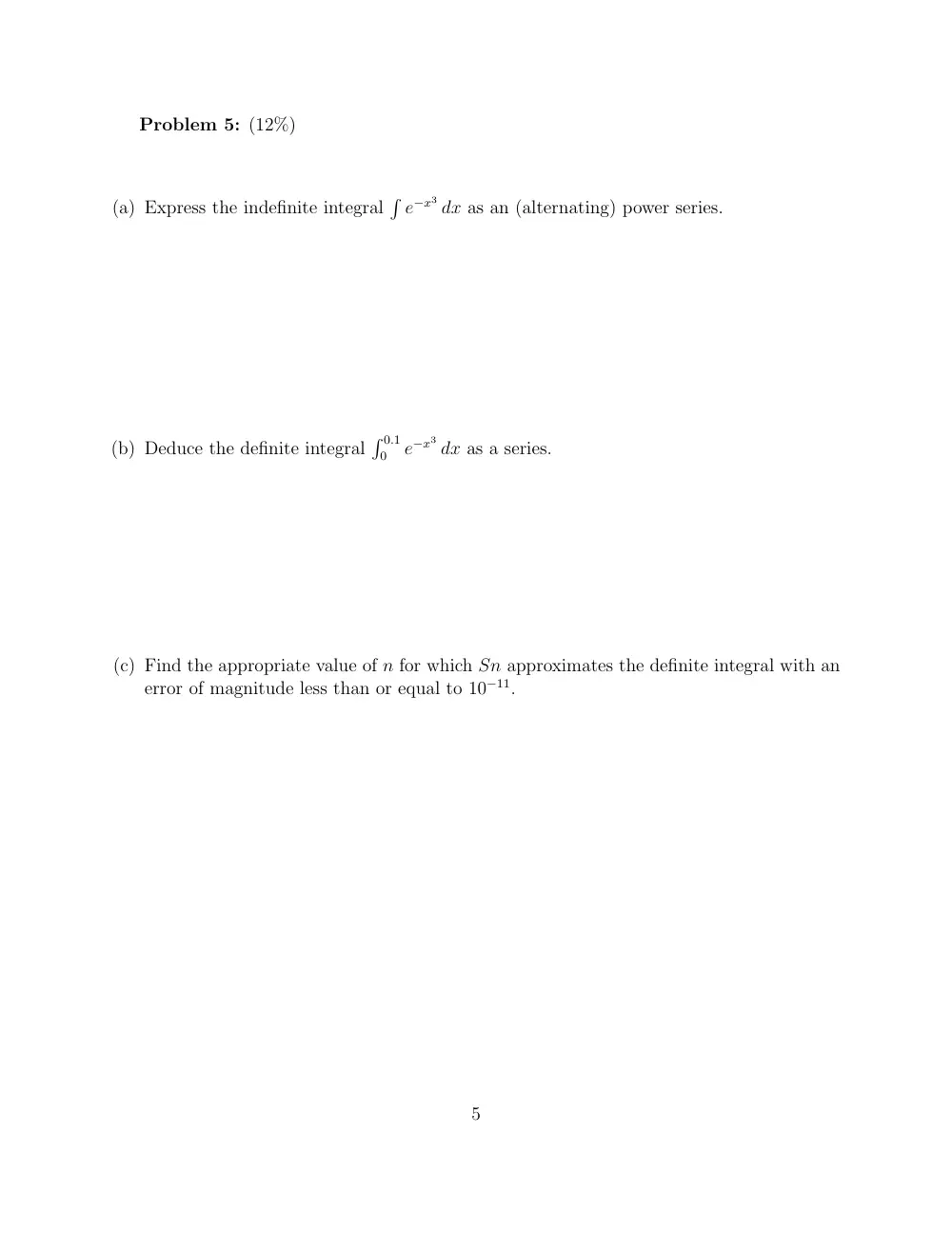
Problem 5: (12%)
(a) Express the indefinite integral
�
e−x3 dx as an (alternating) power series.
(b) Deduce the definite integral
� 0.1
0
e−x3 dx as a series.
(c) Find the appropriate value of n for which Sn approximates the definite integral with an
error of magnitude less than or equal to 10−11.
5
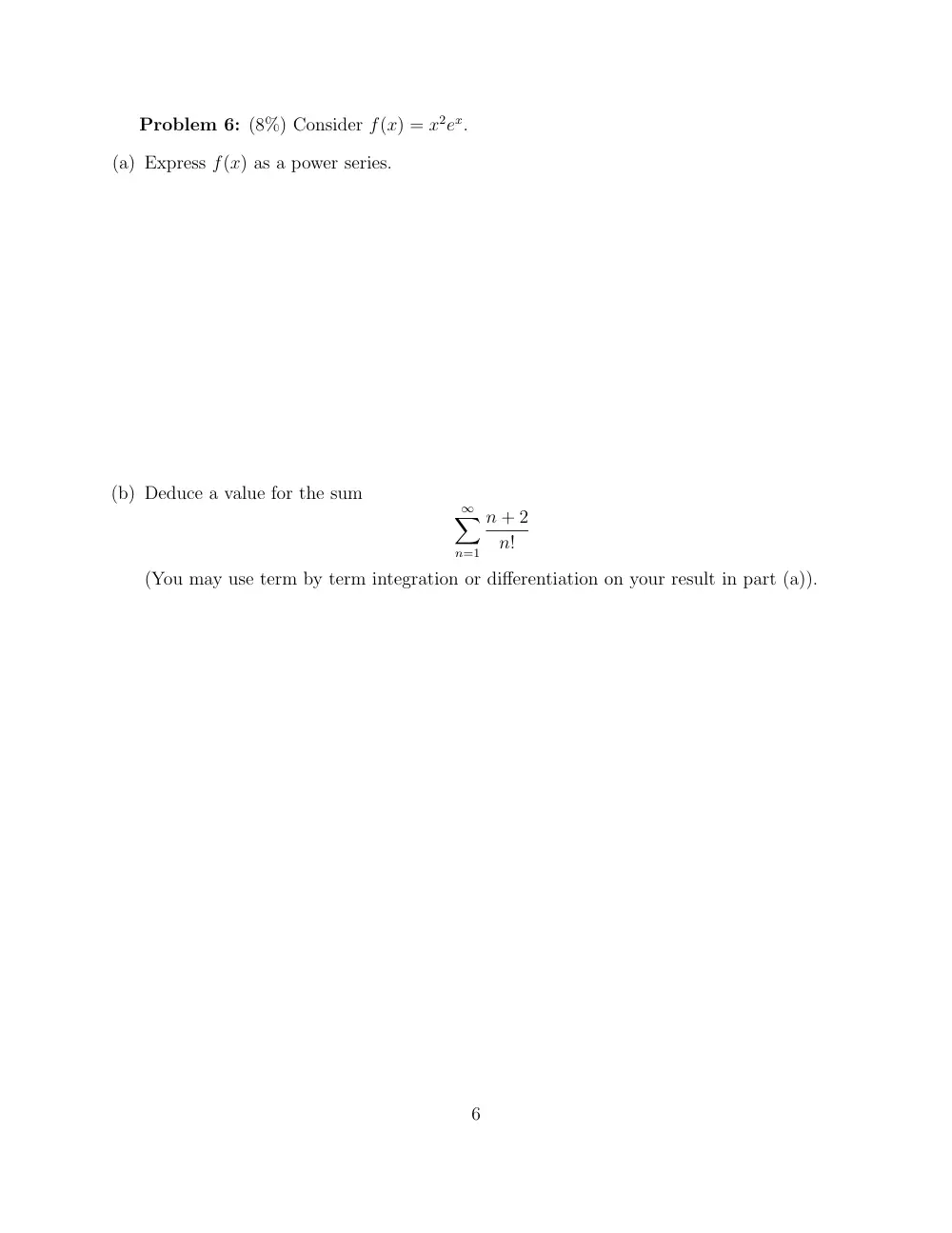
Problem 6: (8%) Consider f(x) = x2ex.
(a) Express f(x) as a power series.
(b) Deduce a value for the sum
∞
�
n=1
n + 2
n!
(You may use term by term integration or differentiation on your result in part (a)).
6
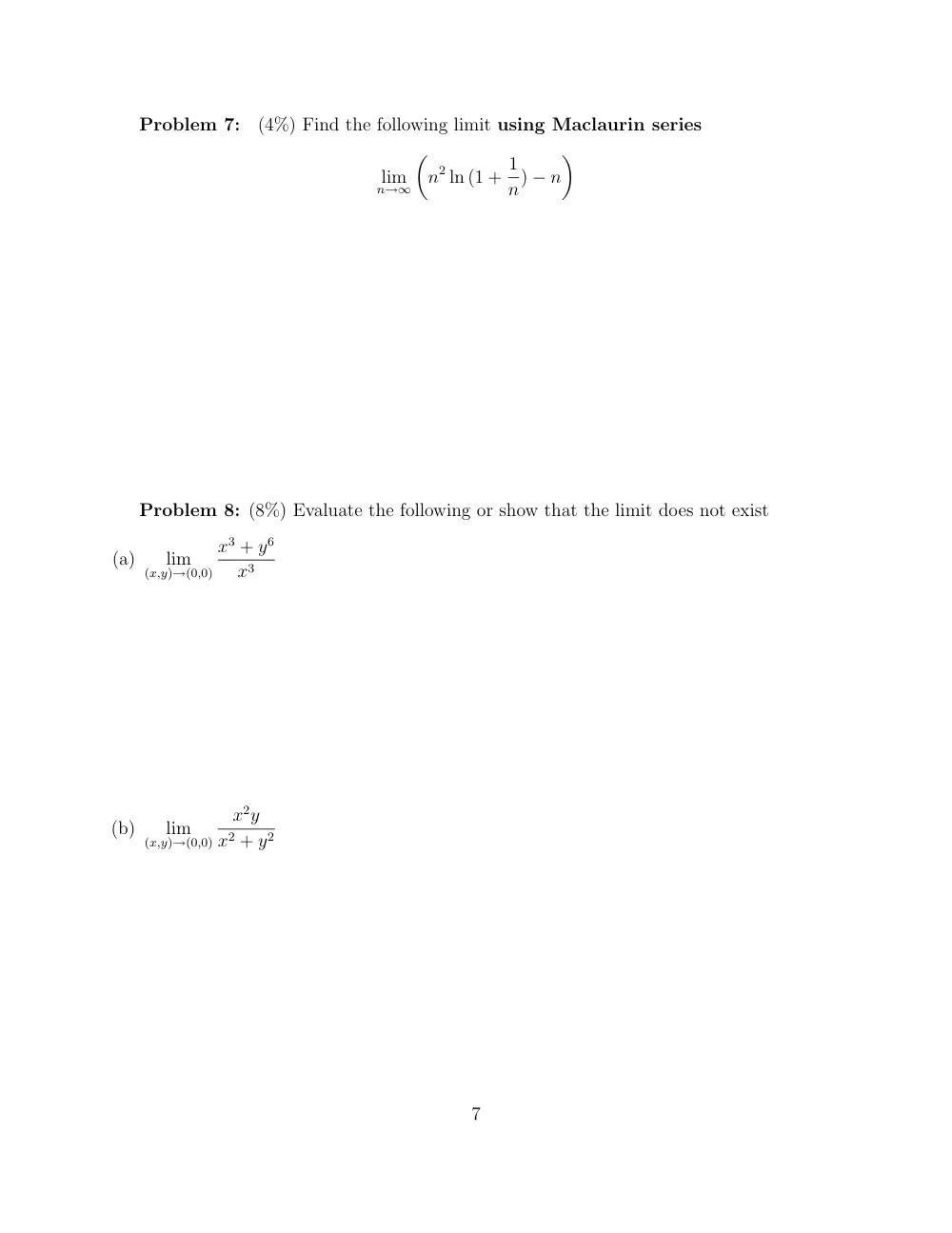
Problem 7:
(4%) Find the following limit using Maclaurin series
lim
n→∞
�
n2 ln (1 + 1
n) − n
�
Problem 8: (8%) Evaluate the following or show that the limit does not exist
(a)
lim
(x,y)→(0,0)
x3 + y6
x3
(b)
lim
(x,y)→(0,0)
x2y
x2 + y2
7
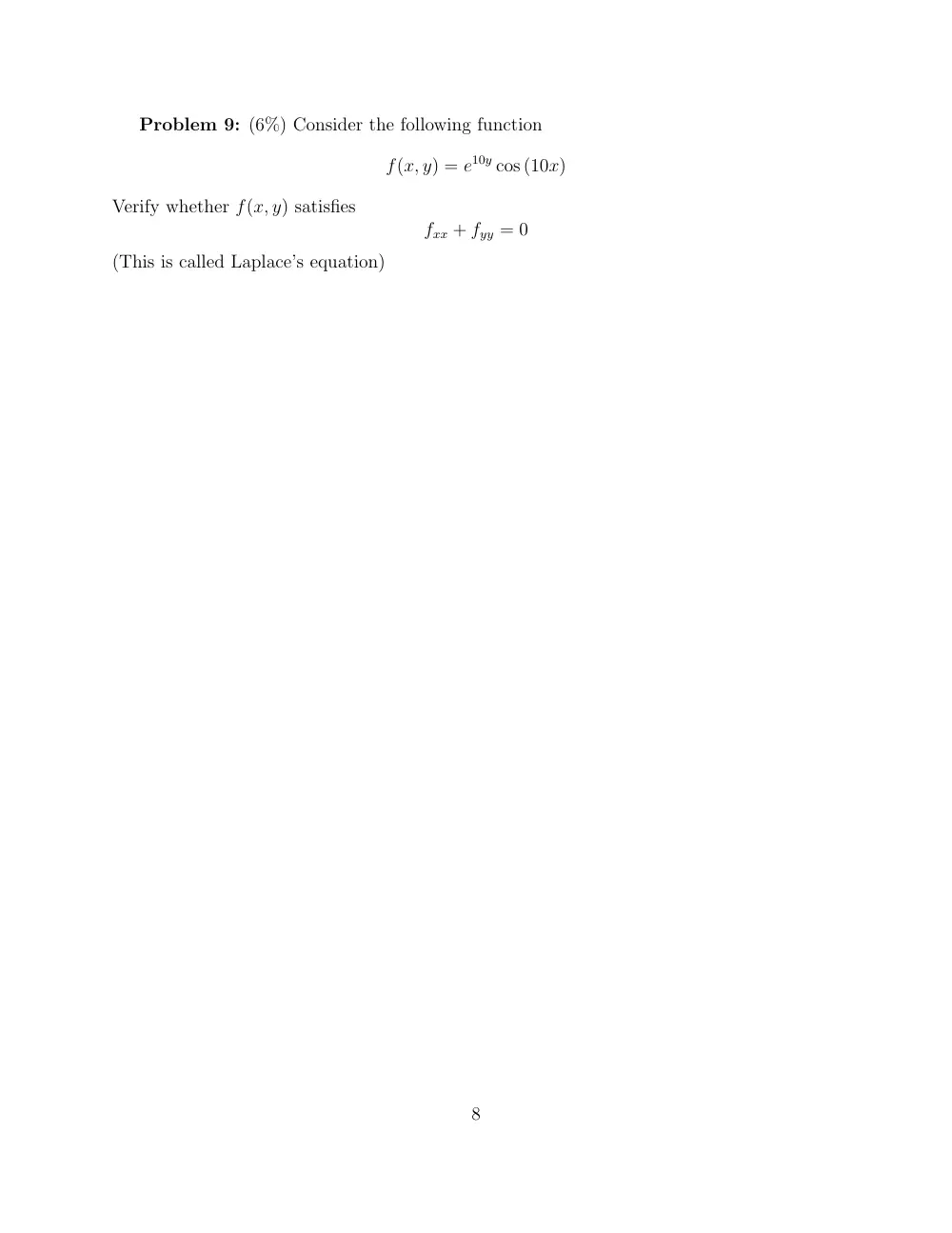
Problem 9: (6%) Consider the following function
f(x, y) = e10y cos (10x)
Verify whether f(x, y) satisfies
fxx + fyy = 0
(This is called Laplace’s equation)
8
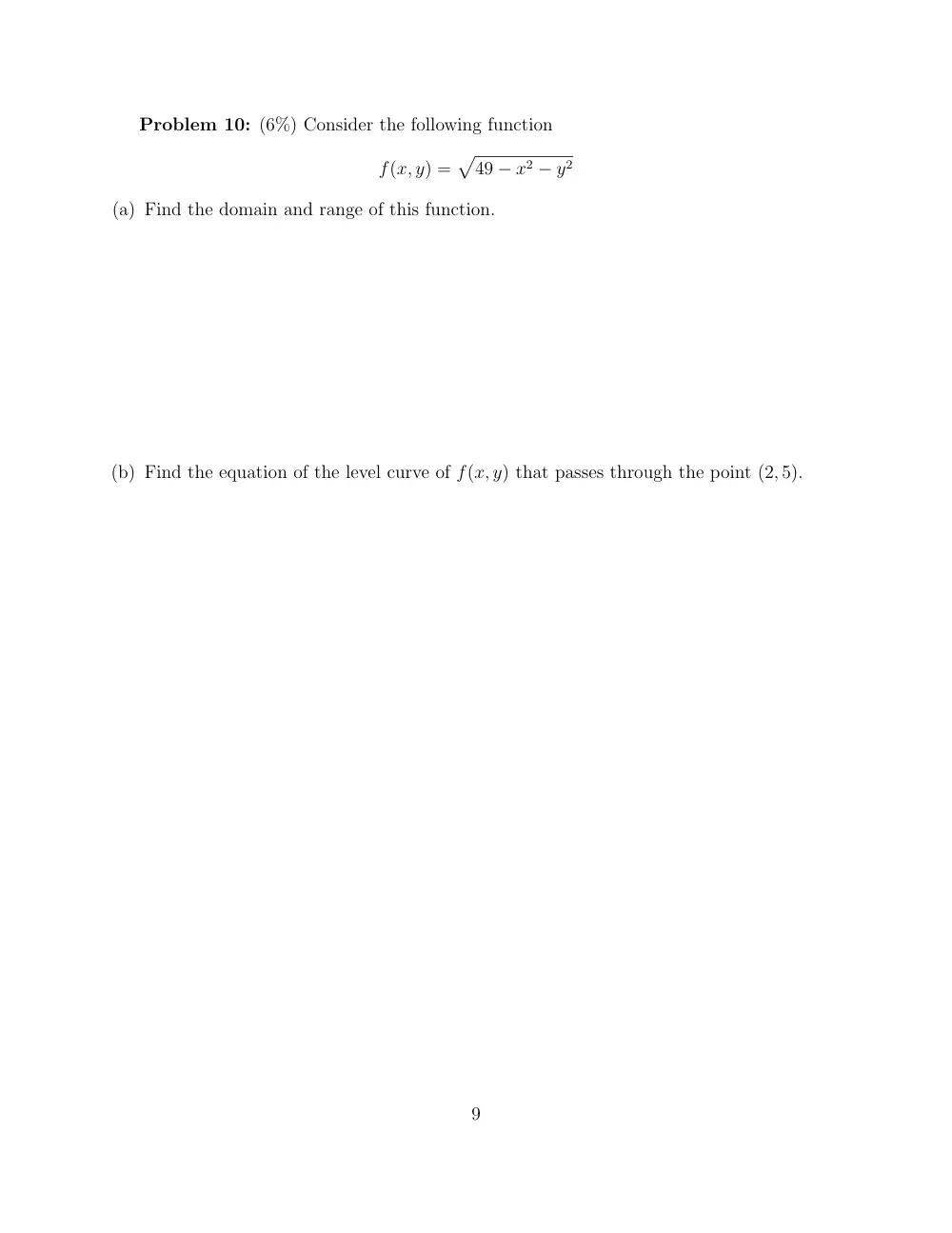
Problem 10: (6%) Consider the following function
f(x, y) =
�
49 − x2 − y2
(a) Find the domain and range of this function.
(b) Find the equation of the level curve of f(x, y) that passes through the point (2, 5).
9
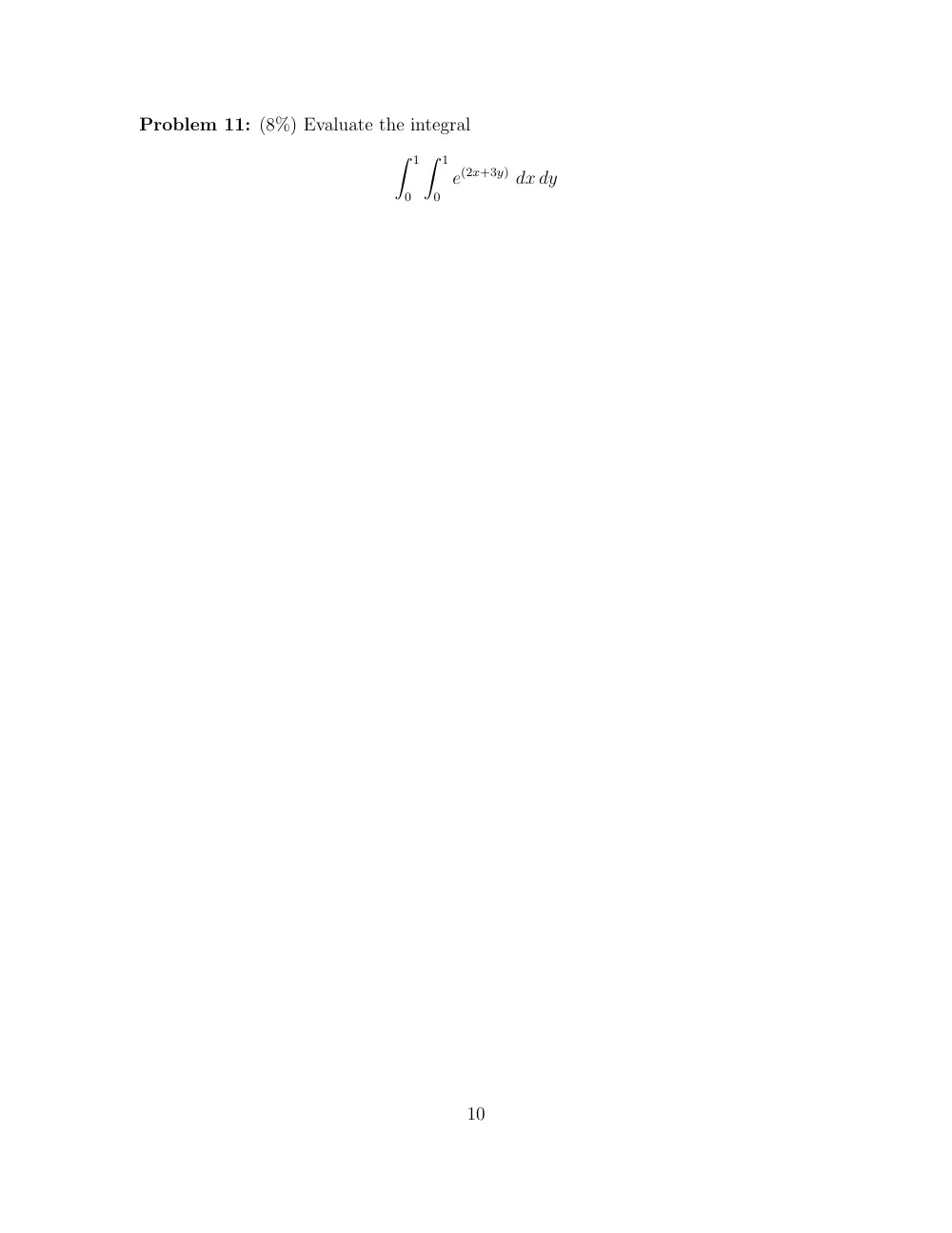
Problem 11: (8%) Evaluate the integral
� 1
0
� 1
0
e(2x+3y) dx dy
10