
MTH 201 Homework 2 Solution, Fall 2016
Lebanese American University · Calculus III · 5 pages · Dr. Leila Issa · with solution

More MTH 201 files
- Homework 4 Solution · Fall 2016Homework · with solutionView
- Homework 1 · Fall 2016HomeworkView
- Homework 5 · Fall 2016HomeworkView
- Homework 2 · Fall 2016HomeworkView
- Homework 1 Solution · Fall 2016Homework · with solutionView
- Homework 3 · Fall 2016HomeworkView
- Homework 3 Solution · Fall 2016Homework · with solutionView
- Homework 4 · Fall 2016HomeworkView
Show the text of this homework
!"#$%&'()*+,(
(
(
(
(
(
(
(
(
(
(
(
(
(
(
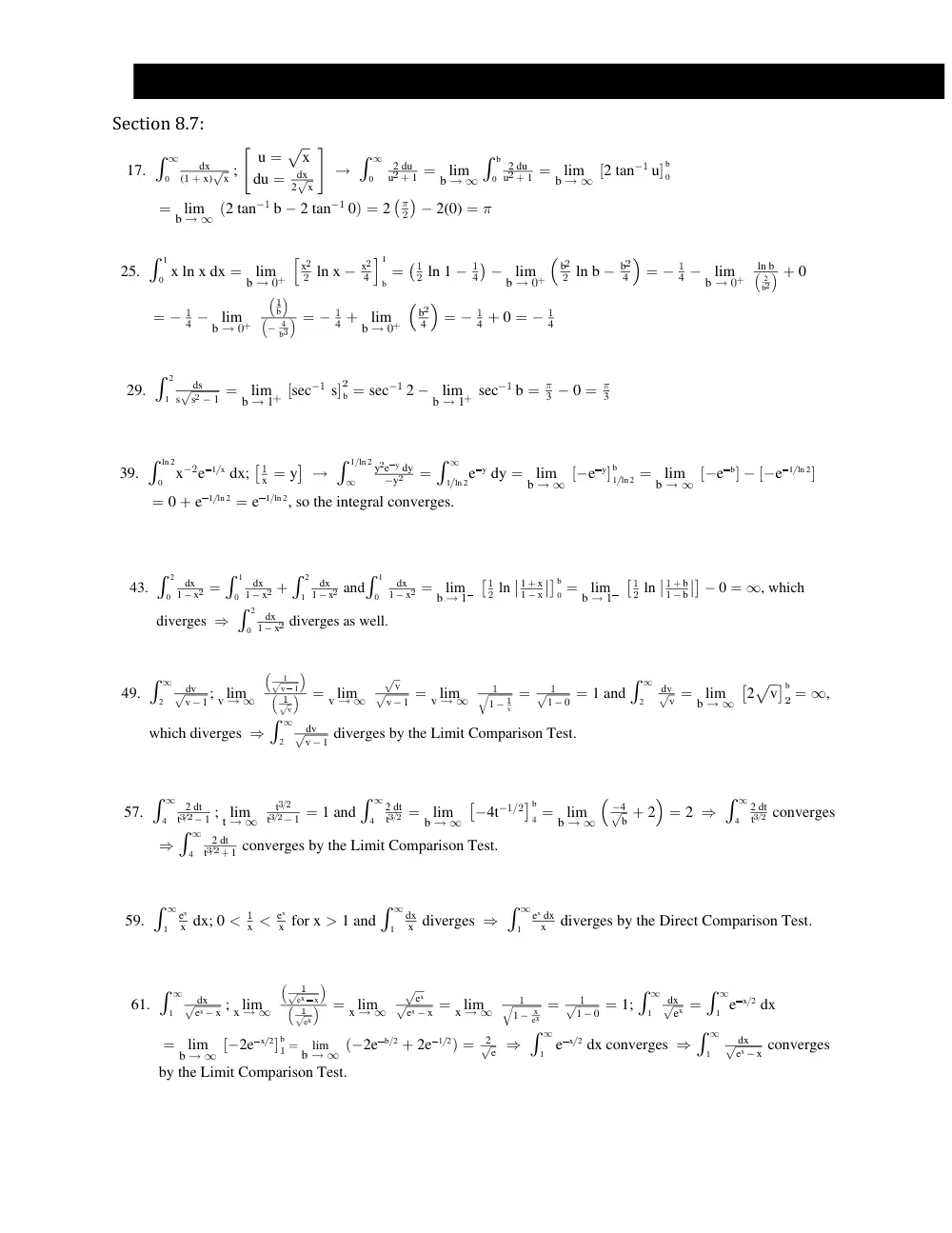
17.
;
lim
lim 2 tan
u
u
x
du
'
'
'
0
0
0
b
b
0
dx
2 du
2 du
(1 x)
x
dx
2
x
u 1
u 1
�
�
�
�"
È
È
–
—
È
c
d
œ
œ
Ä
œ
œ
b
b
Ä _
Ä _
lim 2 tan
b
2 tan
0
2
2(0)
œ
�
œ
�
œ
b Ä _ a
b
ˆ ‰
�"
�"
#
1
1
25.
x ln x dx
lim
ln x
ln 1
lim
ln b
lim
0
'
0
1
1
b
œ
�
œ
�
�
�
œ �
�
�
b
b
b
Ä !
Ä !
Ä !
’
“
Š
‹
ˆ
‰
x
x
b
b
ln b
4
4
4
4
#
#
#
"
"
"
Š
2 ‹
b
lim
lim
0
œ �
�
œ �
�
œ �
�
œ �
"
"
"
"
�
4
4
4
4
4
b
b
b
Ä !
Ä !
Š ‹
Š
‹
b
4
b
Š
‹
29.
lim sec
s
sec
2
lim sec
b
0
'
1
2
b
ds
s
s 1
3
3
È
�
�"
�"
�"
œ
œ
�
œ
�
œ
b
1
b
1
Ä
Ä
c
d
1
1
39.
x
e
dx;
y
e dy
lim
e
lim
e
e
'
'
'
0
1 ln 2
ln 2
1 ln 2
1 x
y
y
b
1 ln 2
b
1 ln 2
�#
"
�
�
‘
c
d
c
d
c
d
x
y
y e
dy
œ
Ä
œ
œ
�
œ
�
� �
y
b
b
Ä _
Ä _
0
e
e
, so the integral converges.
œ
�
1 ln 2 œ
1 ln 2
43.
and
lim
ln
lim
ln
0
, which
'
'
'
'
0
0
1
0
2
1
2
1
b
0
dx
dx
dx
dx
1
x
b
1
x
1
x
1
x
1
x
1
x
1
b
�
�
�
�
#
�
#
�
"
�
"
" �
œ
�
œ
œ
�
œ _
b
1
b
1
Ä
Ä
�
‘
�
‘
¸
¸
¸
¸
diverges
diverges as well.
Ê '
0
2
dx
1
x
�
49.
; lim
lim
lim
1 and
lim 2
v
,
'
'
2
2
b
dv
dv
v
1
v
1
1
0
v
1
v
È
È
È
È
Š
‹
Š
‹
È
É
�
�
�
"
"
�
v
v
v
b
Ä _
Ä _
Ä _
Ä _
1
v
1
v
œ
œ
œ
œ
œ
œ _
v
�
‘
È
which diverges
diverges by the Limit Comparison Test.
Ê '
2
dv
v
1
È �
57.
; lim
1 and
lim
4t
lim
2
2
converges
'
'
'
4
4
4
b
4
2 dt
t
2 dt
4
2 dt
t
1
t
1
t
t
b
�
�
�"Î#
�
t
b
b
Ä _
Ä _
Ä _
œ
œ
�
œ
�
œ
Ê
�
‘
Š
‹
È
converges by the Limit Comparison Test.
Ê '
4
2 dt
t
1
�
59.
dx; 0
for x
1 and
diverges
diverges by the Direct Comparison Test.
'
'
'
1
1
1
e
e
dx
e dx
x
x
x
x
x
x
x
x
�
�
�
Ê
"
61.
; lim
lim
lim
1;
e
dx
'
'
'
1
1
1
x 2
dx
dx
e
x
e
x
e
1
1
0
È
È
È
È
Š
‹
Š
‹
È
É
x
x
x
�
�
"
"
�
�
x
x
x
Ä _
Ä _
Ä _
e
x
e
x
e
x
x
x
x
œ
œ
œ
œ
œ
e
lim
2e
2e
2e
e
dx converges
converges
œ
�
�
�
œ
Ê
Ê
b
b lim
Ä _
œ
Ä _
c
d
a
b
x 2
b 2
1 2
x 2
b
1
1
2
dx
e
e
x
È
È
'
'
x �
by the Limit Comparison Test.
MATH 201 Homework II Solutions - October 20, 2011MATH
(
(
(
-./#$%#"(01".#%2"2,(
(
(
(
(
(
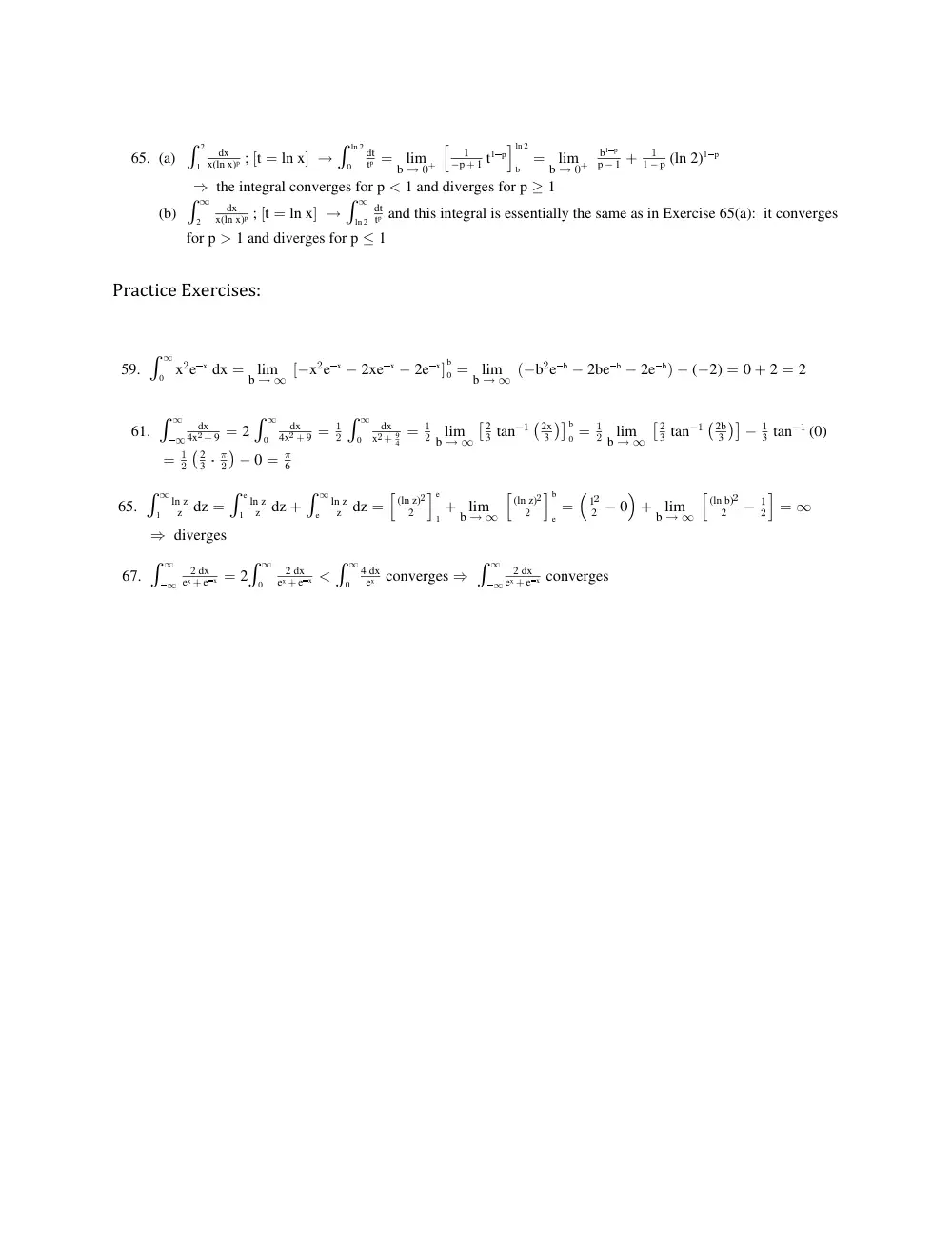
65. (a)
; t
ln x
lim
t
lim
(ln 2)
'
'
1
0
2
ln 2
1 p
1 p
ln 2
b
dx
dt
b
x(ln x)
t
p
1
p
1
1
p
p
p
1 p
c
d
’
“
œ
Ä
œ
œ
�
b
b
Ä !
Ä !
"
"
� �
�
�
the integral converges for p
1 and diverges for p
1
Ê
�
(b)
; t
ln x
and this integral is essentially the same as in Exercise 65(a): it converges
'
'
2
ln 2
dx
dt
x(ln x)
t
p
p
c
d
œ
Ä
for p
1 and diverges for p
1
�
Ÿ
59.
x e dx
lim
x e
2xe
2e
lim
b e
2be
2e
( 2)
0
2
2
'
0
x
x
x
x
b
b
b
b
0
#
#
#
œ
�
�
�
œ
�
�
�
� �
œ
�
œ
b
b
Ä _
Ä _
c
d
a
b
61.
2
lim
tan
lim
tan
tan
(0)
'
'
'
dx
dx
dx
2
2x
2
2b
4x
9
4x
9
3
3
3
3
3
x
�
�
#
#
#
"
"
"
"
�
�"
�"
�"
œ
œ
œ
œ
�
0
0
b
0
9
4
b
b
Ä _
Ä _
�
‘
�
‘
ˆ
‰
ˆ
‰
0
œ
�
œ
"
#
#
ˆ
‰
2
3
6
† 1
1
65.
dz
dz
dz
lim
0
lim
'
'
'
1
1
e
e
e
b
1
e
ln z
ln z
ln z
1
z
z
z
2
2
2
(ln z)
(ln z)
(ln b)
œ
�
œ
�
œ
�
�
�
œ _
’
“
’
“
Š
‹
’
“
b
b
Ä _
Ä _
#
#
"
diverges
Ê
67.
2
converges
converges
'
'
'
'
2 dx
2 dx
4 dx
2 dx
e
e
e
e
e
e
e
x
x
x
x
x
x
x
�
�
�
œ
�
Ê
0
0
1. Is it true that the improper integral
� ∞
a f(x) converges, whenever f(x) → 0. Prove or
give a counterexample.
This is NOT true. For example consider
� ∞
1
1
x dx.
We know from the p-integral test that this integral diverges (case p = 1).
Yet,
limx→∞ 1/x = 0.
2. Evaluate the following integrals:
Both integrals are improper of Type I. In both cases, we can explicitly compute the
answer.
•
� ∞
e
1
x(ln x+3)2 dx
We need to compute
lim
b→∞
� b
e
1
x(ln x + 3)2 dx.
We first evaluate the integral by substitution by letting u = ln x, du
dx = 1/x, to get
(up to a constant)
�
du
(u + 3)2 = −(u + 3)−2+1 = −(ln x + 3)−1
We now compute the limit:
lim
b→∞
�
− (ln x + 3)−1�b
e = 0 + 1/4 = 1/4
•
� ∞
0
√
tan−1(x)
1+x2
dx
We need to compute
lim
b→∞
� b
0
�
tan−1(x)
1 + x2
dx.
We evaluate this integral by substitution. Let u = tan−1 x, then du =
1
1+x2dx,
obtaining (up to a constant):
� �
tan−1(x)
1 + x2
dx =
�
u1/2du = (2/3)u3/2 = (2/3)(tan−1 x)2/3.
We can now take the limit
lim
b→∞
�
(2/3)(tan−1 x)2/3�b
0 = (2/3 lim
b→∞[(tan−1 b)3/2−(tan−1 0)3/2] = (2/3)
�
(π
2 )3/2−0
�
1
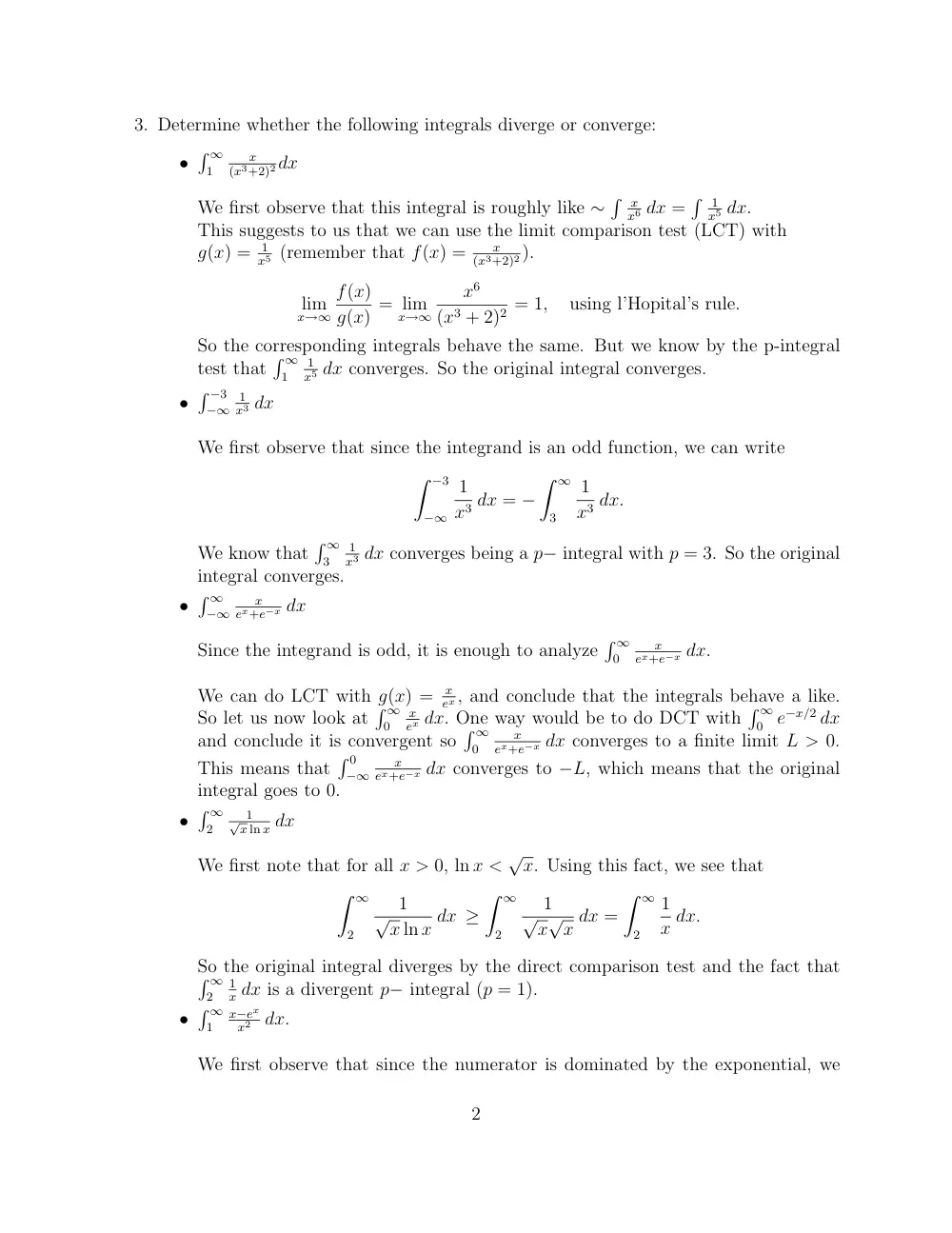
3. Determine whether the following integrals diverge or converge:
•
� ∞
1
x
(x3+2)2dx
We first observe that this integral is roughly like ∼
�
x
x6 dx =
�
1
x5 dx.
This suggests to us that we can use the limit comparison test (LCT) with
g(x) =
1
x5 (remember that f(x) =
x
(x3+2)2).
lim
x→∞
f(x)
g(x) = lim
x→∞
x6
(x3 + 2)2 = 1,
using l’Hopital’s rule.
So the corresponding integrals behave the same. But we know by the p-integral
test that
� ∞
1
1
x5 dx converges. So the original integral converges.
•
� −3
−∞
1
x3 dx
We first observe that since the integrand is an odd function, we can write
� −3
−∞
1
x3 dx = −
� ∞
3
1
x3 dx.
We know that
� ∞
3
1
x3 dx converges being a p− integral with p = 3. So the original
integral converges.
•
� ∞
−∞
x
ex+e−x dx
Since the integrand is odd, it is enough to analyze
� ∞
0
x
ex+e−x dx.
We can do LCT with g(x) =
x
ex, and conclude that the integrals behave a like.
So let us now look at
� ∞
0
x
ex dx. One way would be to do DCT with
� ∞
0 e−x/2 dx
and conclude it is convergent so
� ∞
0
x
ex+e−x dx converges to a finite limit L > 0.
This means that
� 0
−∞
x
ex+e−x dx converges to −L, which means that the original
integral goes to 0.
•
� ∞
2
1
√x ln x dx
We first note that for all x > 0, ln x < √x. Using this fact, we see that
� ∞
2
1
√x ln x dx ≥
� ∞
2
1
√x√x dx =
� ∞
2
1
x dx.
So the original integral diverges by the direct comparison test and the fact that
� ∞
2
1
x dx is a divergent p− integral (p = 1).
•
� ∞
1
x−ex
x2 dx.
We first observe that since the numerator is dominated by the exponential, we
2
suspect this integral to diverge. We can prove so by using the limit comparison
test and comparing the integral with
� ex
x2. But before doing that, we need to
insure that the integrand is positive (to be able to use the limit comparison test).
We first rewrite
� ∞
1
x − ex
x2
dx = −
� ∞
1
ex − x
x2
dx.
and work with
� ∞
1
ex − x
x2
dx.
Now let g(x) = ex
x2 and f(x) = ex−x
x2 . We compute
lim
x→∞
f(x)
g(x) = lim
x→∞
ex − x
ex
= 1.
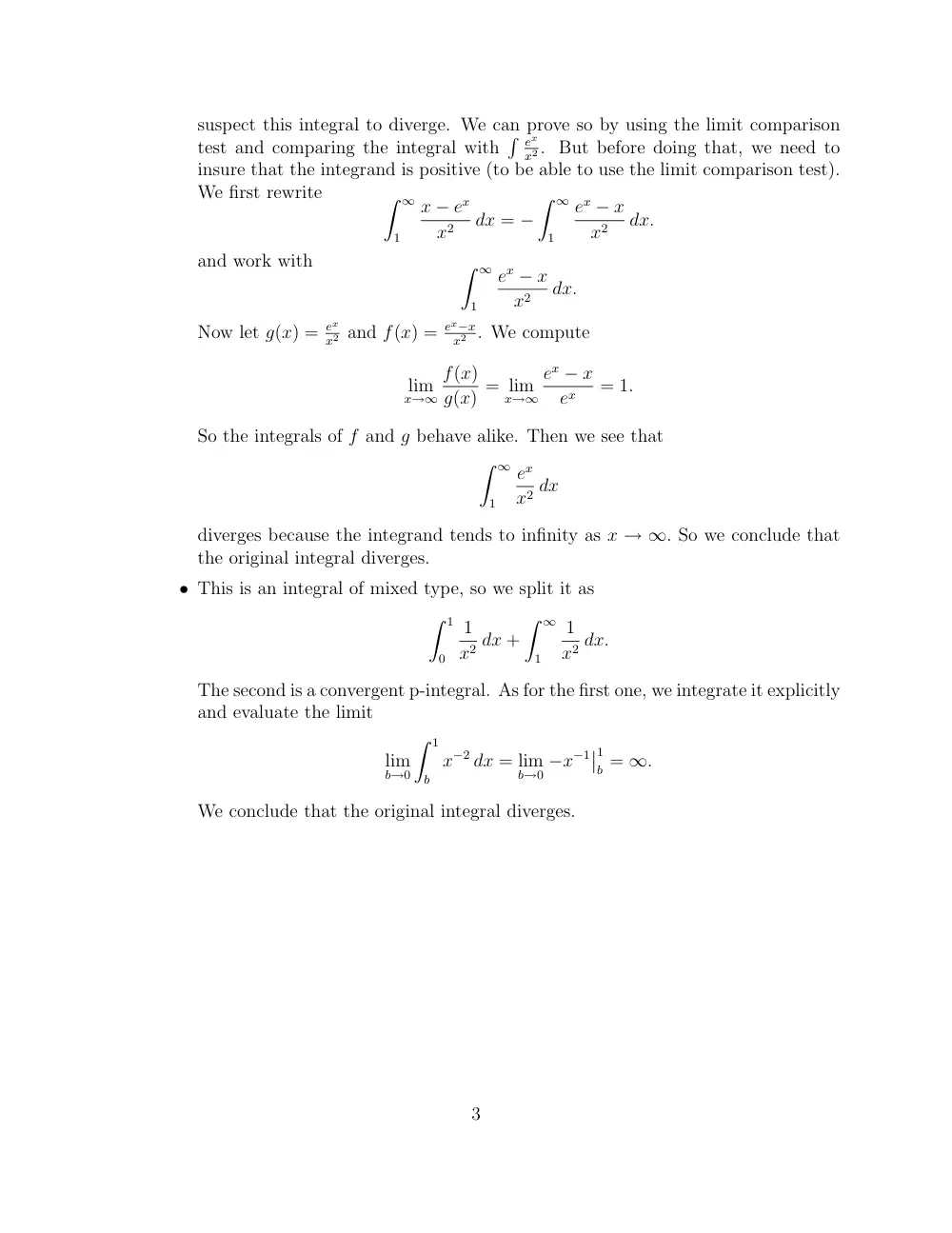
So the integrals of f and g behave alike. Then we see that
� ∞
1
ex
x2 dx
diverges because the integrand tends to infinity as x → ∞. So we conclude that
the original integral diverges.
• This is an integral of mixed type, so we split it as
� 1
0
1
x2 dx +
� ∞
1
1
x2 dx.
The second is a convergent p-integral. As for the first one, we integrate it explicitly
and evaluate the limit
lim
b→0
� 1
b
x−2 dx = lim
b→0 −x−1��1
b = ∞.
We conclude that the original integral diverges.
3