
MTH 206 Final, Spring 2013
Lebanese American University · Calculus IV · 12 pages · Dr. May Hamdan



Showing the first 10 of 12 pages. Download the PDF to see all of it.
More MTH 206 files
- Exam 2012 to 2015 Exam 1-2-Final · Spring 2017Final examView
- Final Answer and Sollution · Spring 2014Final exam · with solutionView
- Final with solutions · Spring 2013Final exam · with solutionView
- Final W Solution · Spring 2010Final exam · with solutionView
- FinalFinal examView
- Exam 3-with Solutions · Fall 2016Exam · with solutionView
- Syllabus · Fall 2016LabView
- Exam 1 Exam and Solution · Spring 2014Exam · with solutionView
Show the text of this final exam
206-Final-S’12
1 | P a g e
LEBANESE AMERICAN UNIVERSITY
DEPARTMENT OF COMPUTER SCIENCE AND MATHEMATICS
MTH 206 - CALCULUS 3
FINAL EXAM – SPRING 2012
Instructors (circle one): Dr. May Hamdan
Dr. Leila Issa
Duration: 120 minutes
Name:
ID#:
• This exam consists of 12 pages and 11 problems.
• Answer the questions below on the space provided. You can use the back
pages for scratch or for more space for your answers. Please specify.
• Make sure you justify all your answers.
Question Number
Grade
1. 8%
2. 8%
3. 8%
4. 8%
5. 8%
6. 8%
7. 12%
8. 9%
9. 8%
10. 8%
11. 15%
TOTAL
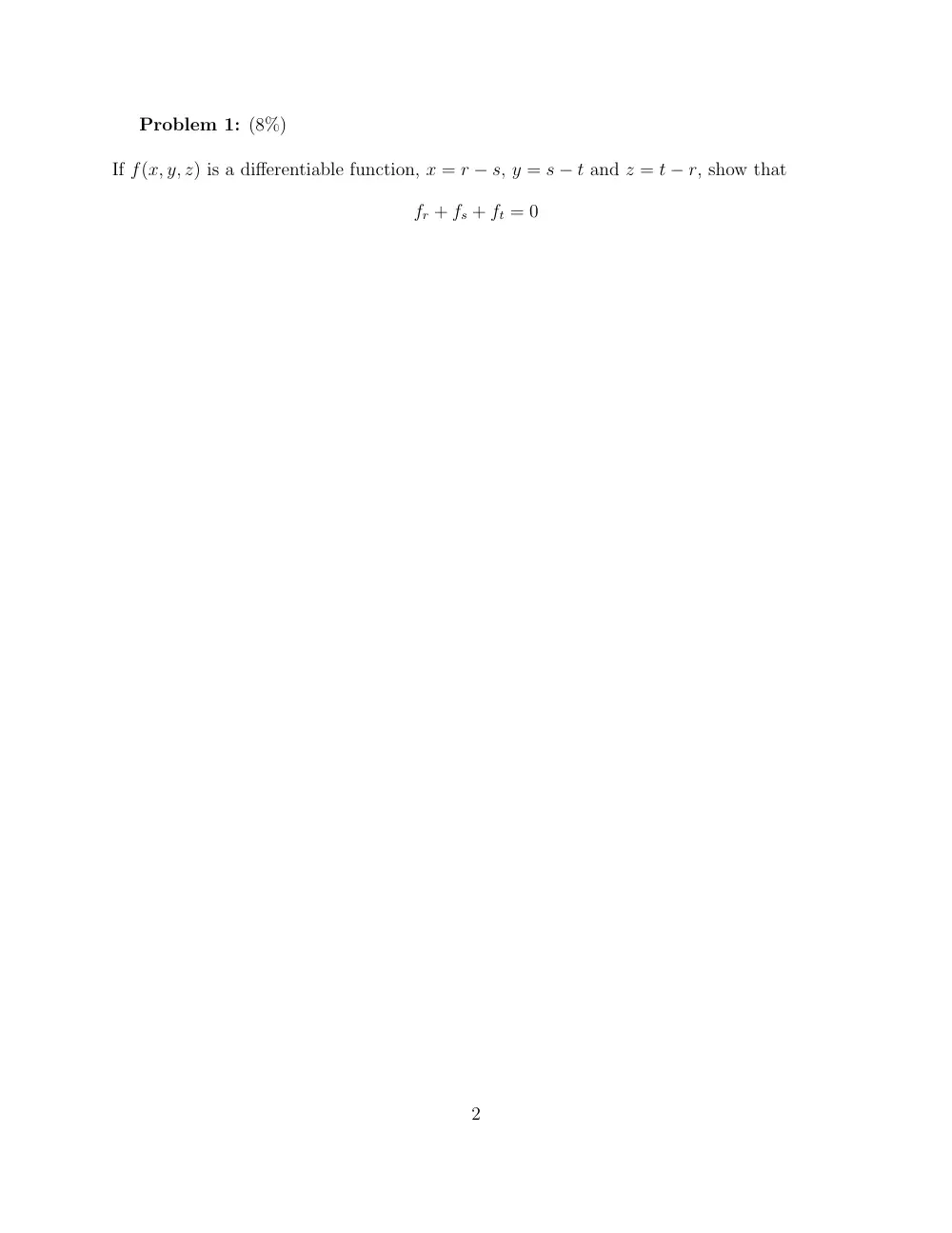
Problem 1: (8%)
If f(x, y, z) is a differentiable function, x = r − s, y = s − t and z = t − r, show that
fr + fs + ft = 0
2
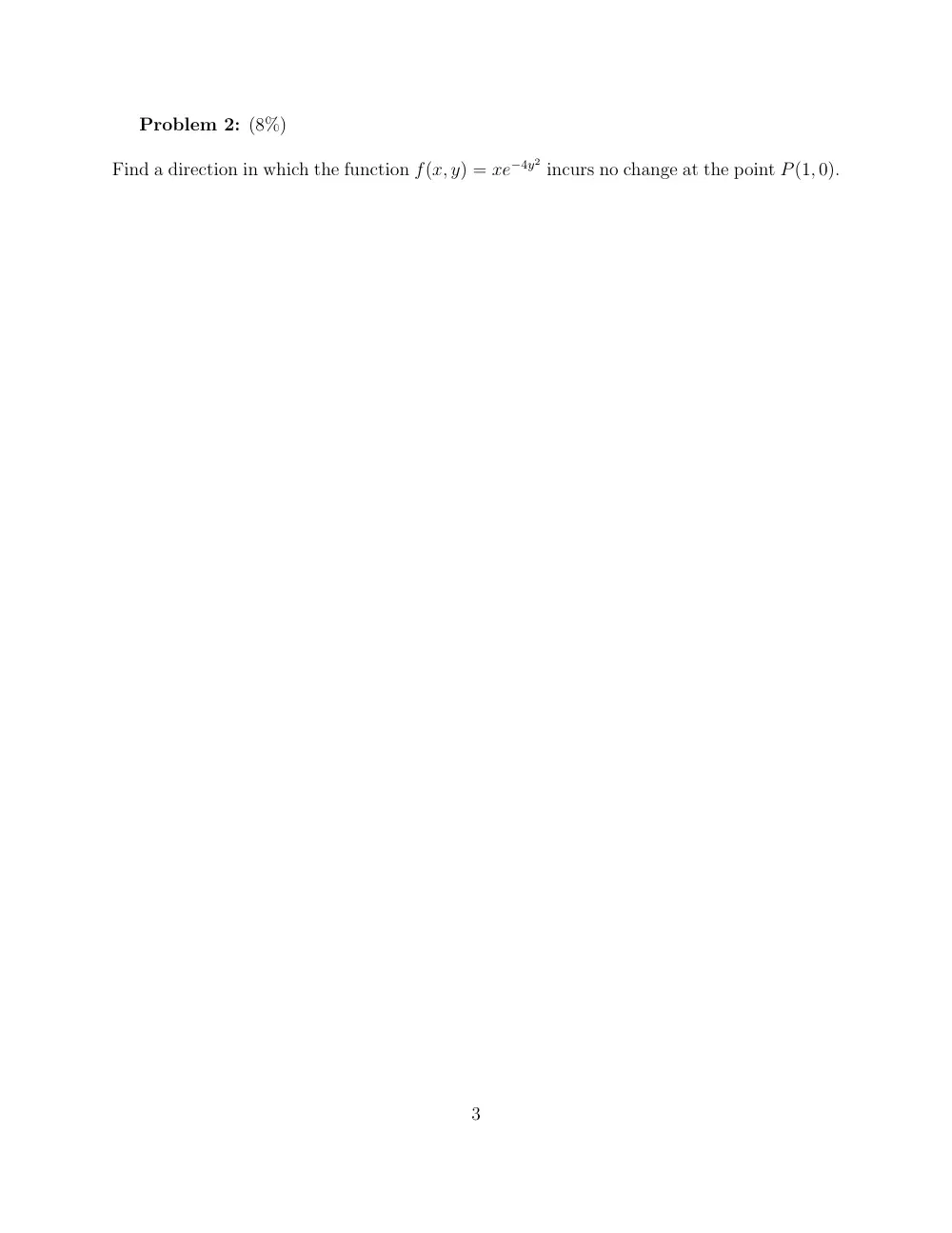
Problem 2: (8%)
Find a direction in which the function f(x, y) = xe−4y2 incurs no change at the point P(1, 0).
3
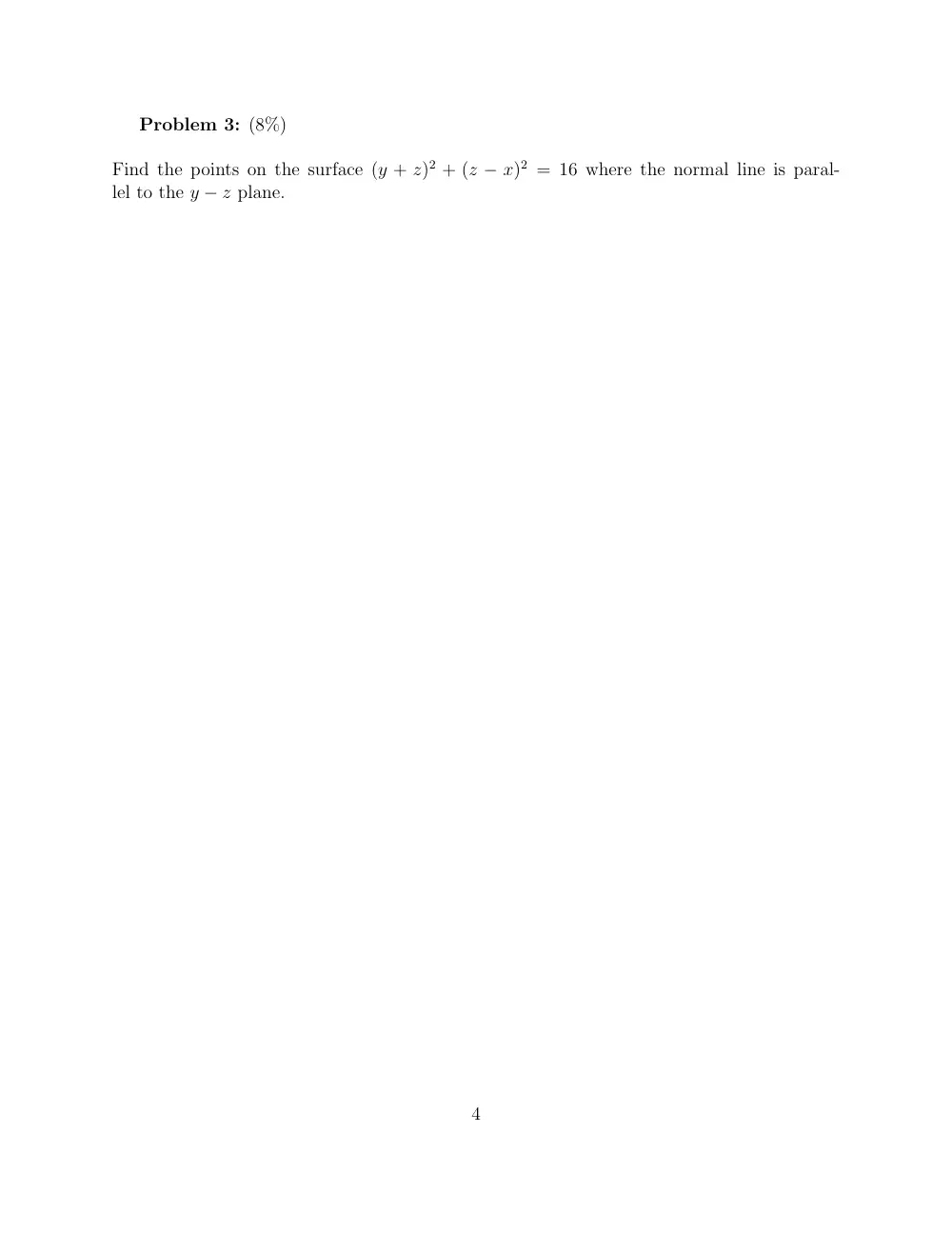
Problem 3: (8%)
Find the points on the surface (y + z)2 + (z − x)2 = 16 where the normal line is paral-
lel to the y − z plane.
4
Problem 4: (8%)
Let f(x, y) = e10x−5y. Using linearization, approximate f(0.05, −0.03).
5
Problem 5: (8%)
If the sum of squares of two real numbers is 10, find the maximum of their product.
6
Problem 6: (8%)
Find the volume of the region bounded above by the sphere x2 + y2 + z2 = 2 and below by
the paraboloid z = x2 + y2.
7
Problem 7: (12%)
At a point P, the velocity and acceleration of a particle moving in the plane are ⃗v = 3⃗i + 4⃗j
and ⃗a = 5⃗i + 15⃗j. Find the curvature of the particle’s path at the point P.
8
Problem 8: (9%)
Name formulas and theorems that connect the following. Make sure you mention the rele-
vant conditions in each case (you may need more than one step to go from one integral to
another):
(a) Line integral to surface integral
(b) Line integral to triple integral
(c) Surface integral to double integral
9
Problem 9: (8%)
Use the most efficient method to compute
�
C ⃗F · d⃗r, where
⃗F = 1
y
⃗i + (1
z − x
y2)⃗j − y
z2⃗k,
and C is the circle in the y − z plane centered at (0, 2, 1) with radius 1.
10
Problem 10: (8%)
Use the most efficient method to find the outward flux of the vector field
⃗F = x⃗i + y⃗j + z⃗k
across the boundary of the cube bounded by x = ±1, y = ±1 and z = ±1.
11
Problem 11: (15%)
(a) Let f(x) be the periodic function of period T = 2 defined as
f(x) = |x| for − 1 ≤ x ≤ 1
Find the Fourier series of the function f(x) (you may want to use integration by parts
in the process).
(b) Let g(x) be the periodic function of period T = 2 defined as
g(x) =
�
x,
0 ≤ x < 1,
2 + (x − 1)2,
1 ≤ x < 2.
To what value does the Fourier series of g(x) converge at the point x = 1? Justify.
(c) Write in your own words why are Fourier series useful.
12