
MTH 207 Final, Fall 2011
Lebanese American University · Discrete Structures I · 11 pages · Dr. Chadi Nour





Showing the first 10 of 11 pages. Download the PDF to see all of it.
More MTH 207 files
- Final Finals for Several Years · Fall 2014Final examView
- Final Exam + Solution 2013 · Fall 2013Final exam · with solutionView
- Final Sample · Fall 2012Final examView
- Questions Practicing for the Final · Fall 2012Final examView
- Final Sample · Fall 2012Final examView
- Final · Fall 2010Final examView
- Exam 2 Sample · Spring 2016ExamView
- Exam 3- with Solutions · Fall 2016Exam · with solutionView
Show the text of this final exam
Lebanese American University
Fall 2011
Byblos
Discrete Structure I
Final Exam
Name:
Date: 25/01/2012
Duration: 2h 15
ID:
Part I: Problems (70 pts)
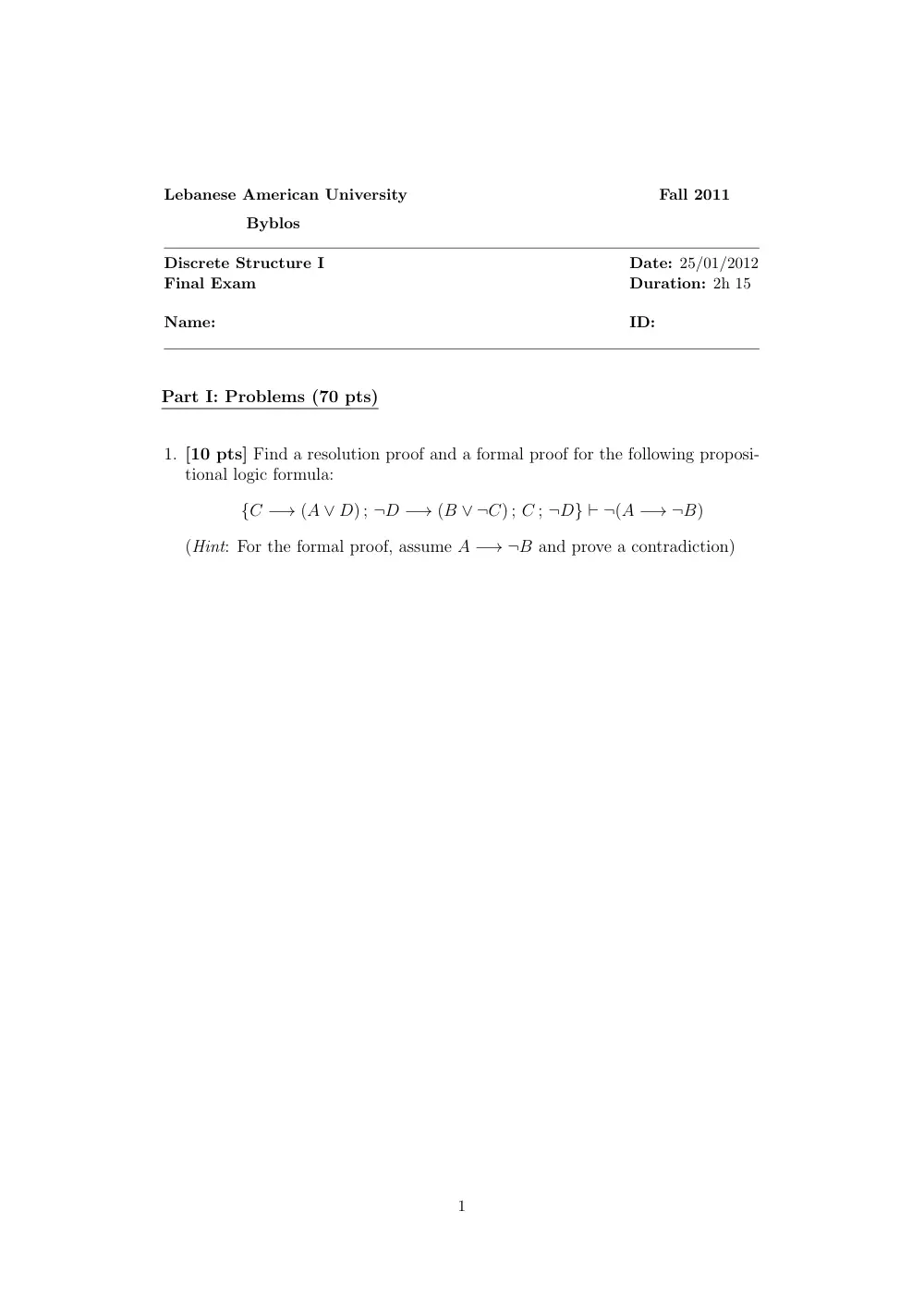
1. [10 pts] Find a resolution proof and a formal proof for the following proposi-
tional logic formula:
{C −! (A _ D) ; ¬D −! (B _ ¬C) ; C ; ¬D} ` ¬(A −! ¬B)
(Hint: For the formal proof, assume A −! ¬B and prove a contradiction)
1
2
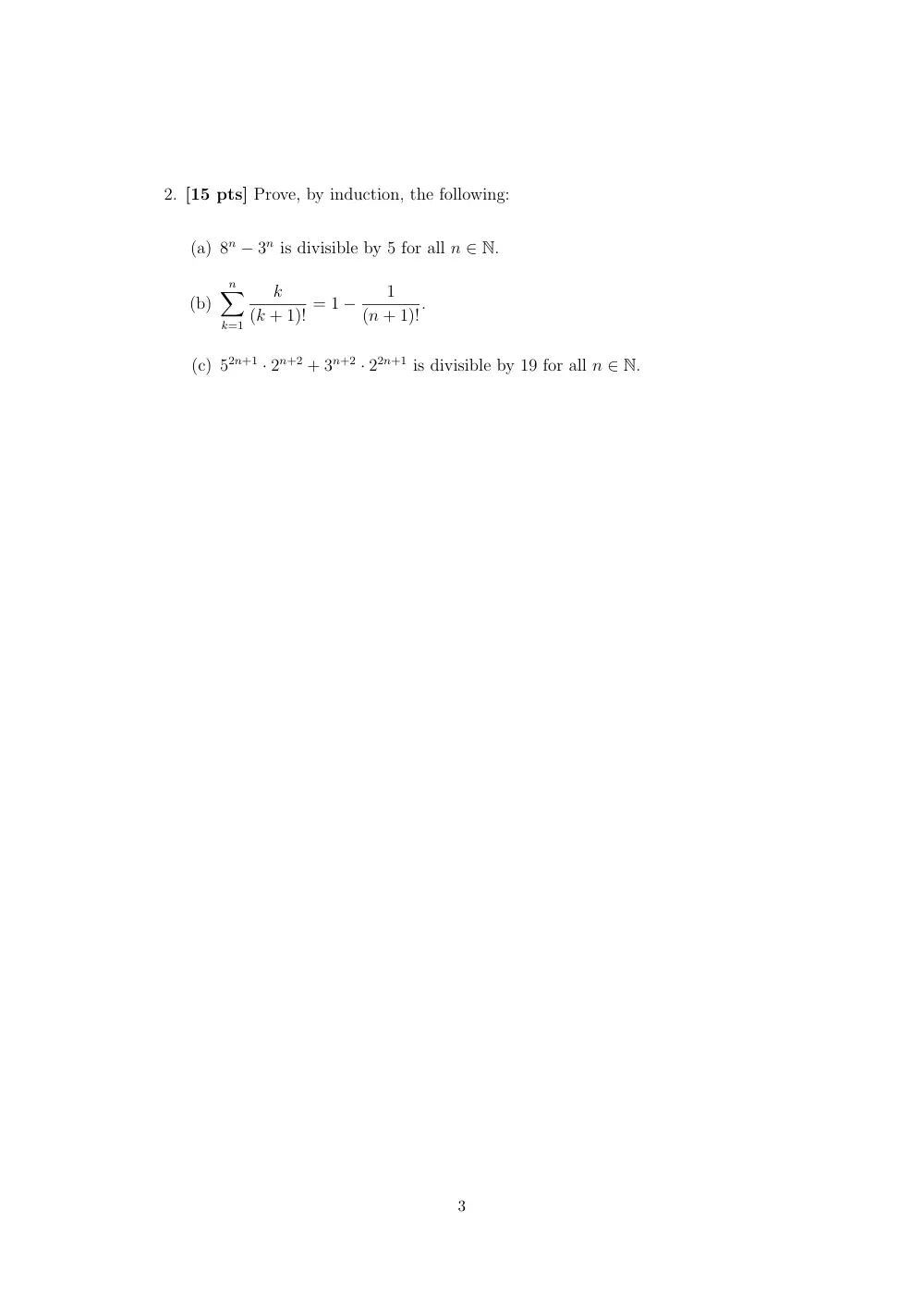
2. [15 pts] Prove, by induction, the following:
(a) 8n − 3n is divisible by 5 for all n 2 N.
(b)
n
X
k=1
k
(k + 1)! = 1 −
1
(n + 1)!.
(c) 52n+1 · 2n+2 + 3n+2 · 22n+1 is divisible by 19 for all n 2 N.
3
4
5
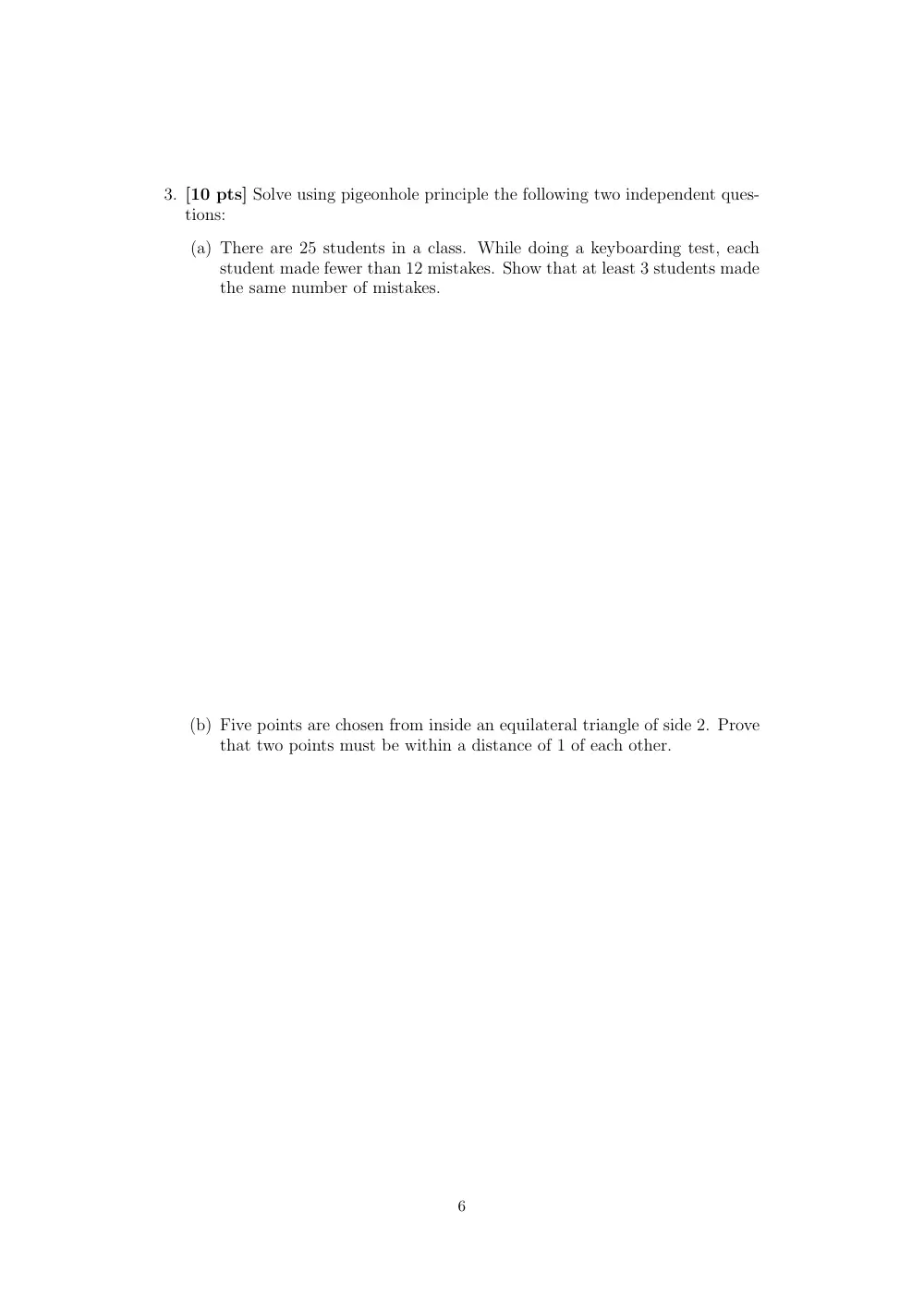
3. [10 pts] Solve using pigeonhole principle the following two independent ques-
tions:
(a) There are 25 students in a class. While doing a keyboarding test, each
student made fewer than 12 mistakes. Show that at least 3 students made
the same number of mistakes.
(b) Five points are chosen from inside an equilateral triangle of side 2. Prove
that two points must be within a distance of 1 of each other.
6
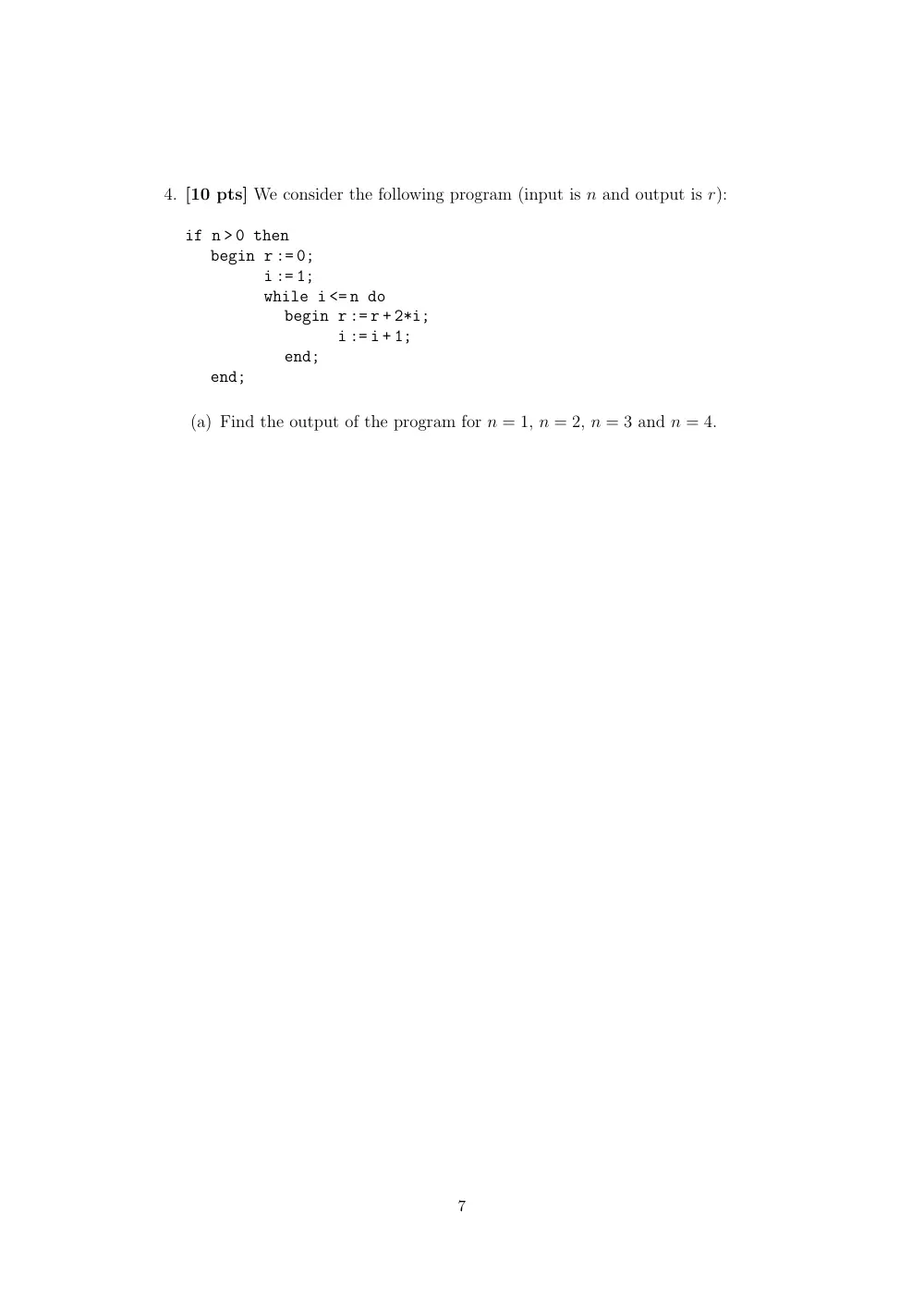
4. [10 pts] We consider the following program (input is n and output is r):
if n > 0 then
begin r := 0;
i := 1;
while i <= n do
begin r := r + 2*i;
i := i + 1;
end;
end;
(a) Find the output of the program for n = 1, n = 2, n = 3 and n = 4.
7
(b) Which function computes the program?
8
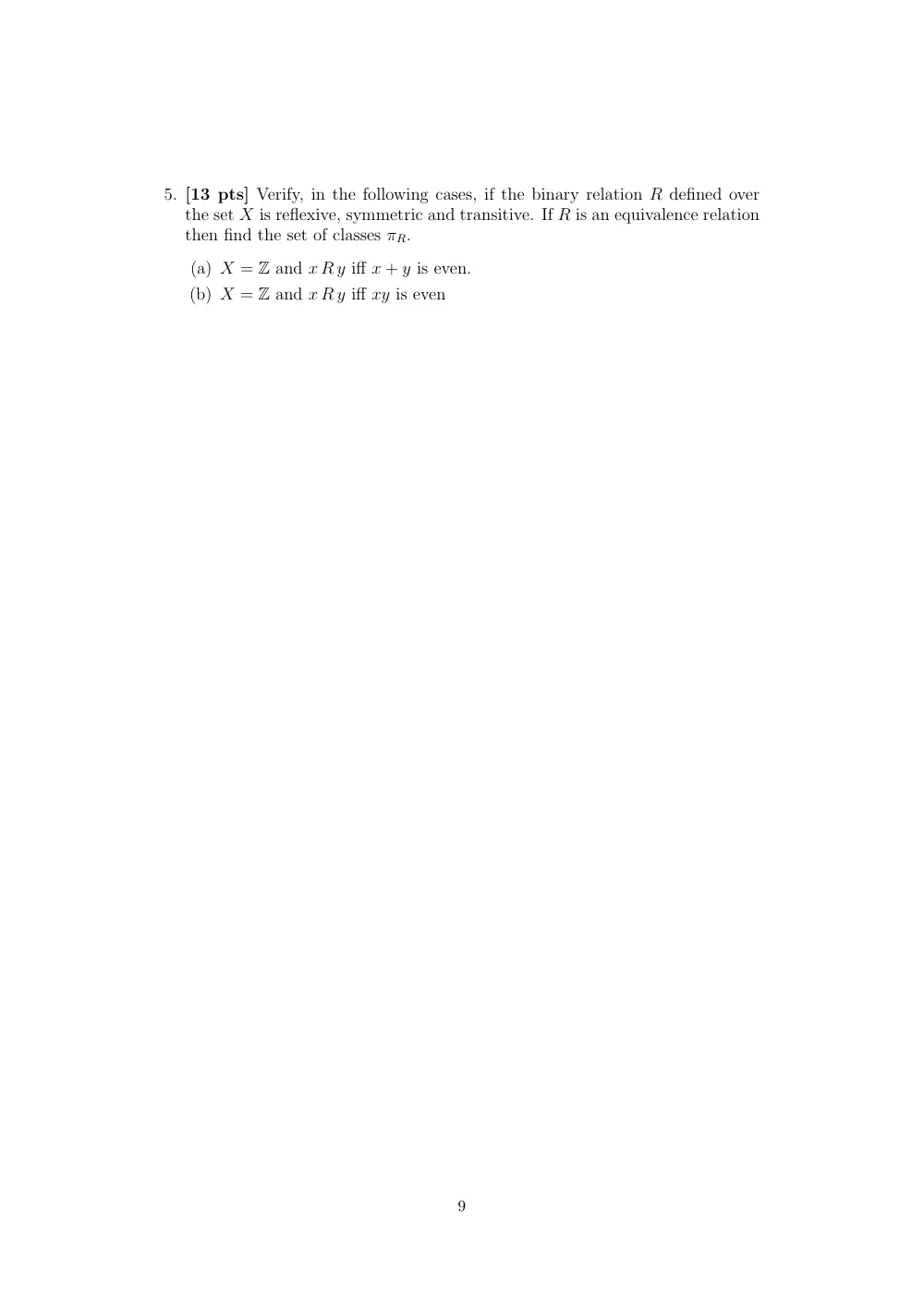
5. [13 pts] Verify, in the following cases, if the binary relation R defined over
the set X is reflexive, symmetric and transitive. If R is an equivalence relation
then find the set of classes ⇡R.
(a) X = Z and x R y i↵ x + y is even.
(b) X = Z and x R y i↵ xy is even
9
10
6. [12 pts] Find for the following two ordered sets the maximal, minimal, greatest
and least elements (if any):
(a) X = {2, 6, 12, 18, 24, 36} and the order is x R y i↵ x divides y.
(b) X = {[0, 1], [−1, 2], [−1, 3], [2, 3], [−1, 5]} and the order is x R y i↵ x ✓ y.
(c) X = {2, 3, 4, 8, 9, 16} and the order is x R y i↵ 9 n 2 N⇤ such that y = xn.
11