
MTH 207 Syllabus
Lebanese American University · Discrete Structures I · 2 pages · Dr. Chadi Nour

More MTH 207 files
Show the text of this lab
Course Number and Name: MTH 207—Discrete Structures I
MTH 207
Course Coordinator: Faisal Abu Khzam
Course Co-coordinator: Chadi Nour
Class Time and Location: MWF 9h-10h SCI 405
Credits and Contact Hours: 3.00
Semester: Fall 2014
Last Revised on: Feb. 2012
INSTRUCTOR
Name: Chadi Nour
Email: cnour@lau.edu.lb
Course Page: On Blackboard
Office: Block A, Room 809b, ext. 2403
Office Hours: MW 10h-12h and TTH 11h-12h
CURRENT CATALOG DESCRIPTION
This course covers the foundations of discrete mathematics as they apply to computer science.
The course is an introduction to propositional logic, logical connectives, truth tables, normal forms,
validity, predicate logic, universal and existential quantification, and the limitations of predicate
logic. In addition, the following topics are covered: the number system, the Euclidean algorithm,
proof techniques, mathematical induction, counting arguments, permutations and combinations,
discrete probability and binomial coefficients, sets, functions, relations, matrices, and Boolean
Algebra.
COURSE PREREQUISITE/CO-REQUISTE
Sophomore Standing
TEXTBOOK AND REFERENCES
Discrete Mathematics and Its Applications, (6th edition), by Kenneth H. Rosen, McGraw-Hill,
ISBN 0072880082
Discrete Mathematics for Computer Scientists (2nd Edition), by J. K. Truss, Pearson,
ISBN 0-201-36061-6
COURSE TYPE
Required
Elective
COURSE LEARNING OUTCOMES
CLO1. Students will be able to work with sets, relations, functions, and matrices.
CLO2. Students will be able to prove the validity of a propositional and predicate logic formula
using different methods including truth table and formal proofs.
CLO3. Students will be able to use different proof techniques including contradiction and induction.
CLO4. Students will be familiar with Boolean algebra.
Students will be familiar with various counting principles.
STUDENT OUTCOMES ADDRESSED IN THIS COURSE
CLO1 contributes to SLO 1
CLO2 contributes to SLO 1
CLO3 contributes to SLO 1
CLO4 contributes to SLO 1
CLO5 contributes to SLO 1 and SLO 3
Page 2 of 2
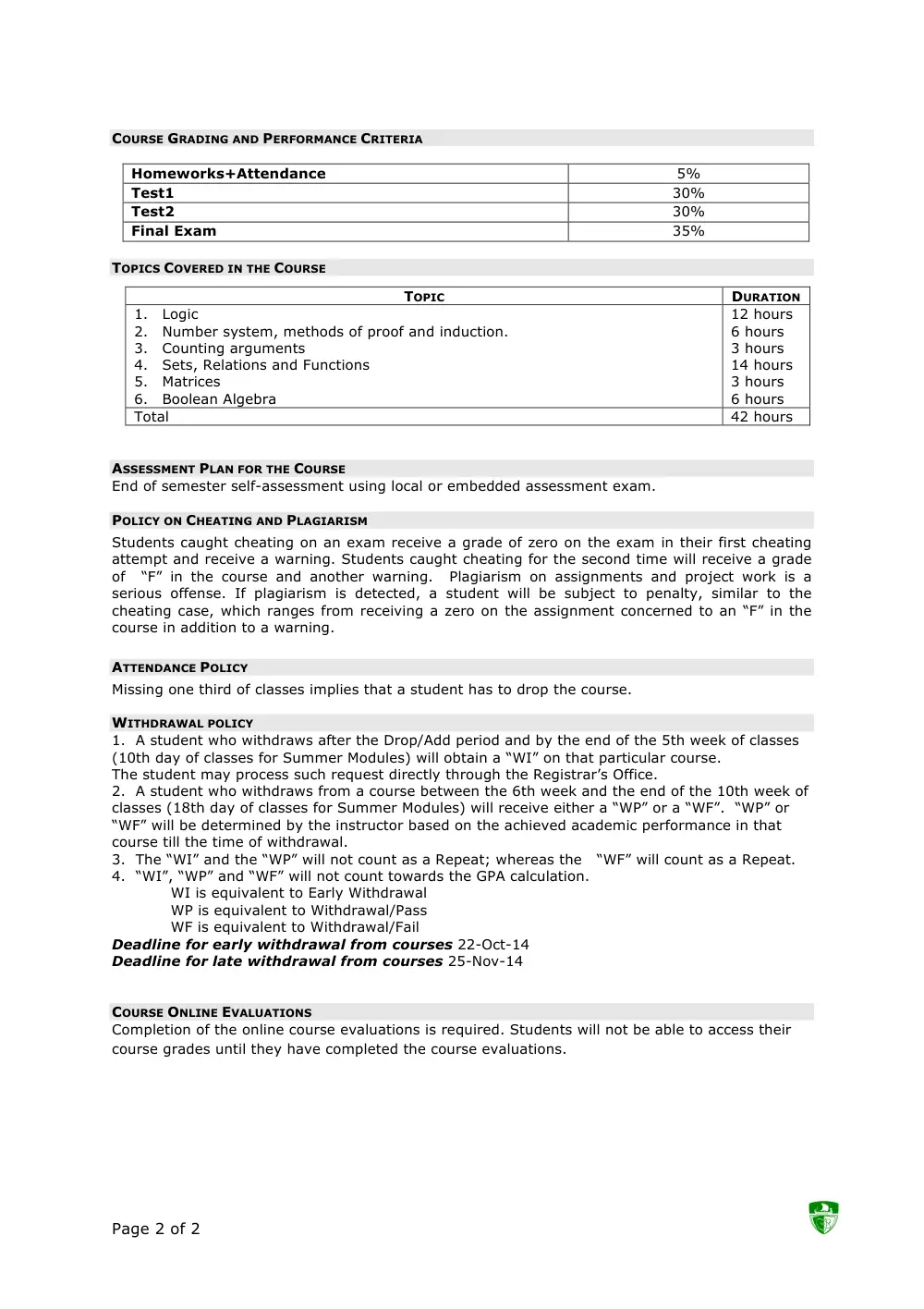
COURSE GRADING AND PERFORMANCE CRITERIA
Homeworks+Attendance
5%
Test1
30%
Test2
30%
Final Exam
35%
TOPICS COVERED IN THE COURSE
ASSESSMENT PLAN FOR THE COURSE
End of semester self-assessment using local or embedded assessment exam.
POLICY ON CHEATING AND PLAGIARISM
Students caught cheating on an exam receive a grade of zero on the exam in their first cheating
attempt and receive a warning. Students caught cheating for the second time will receive a grade
of “F” in the course and another warning. Plagiarism on assignments and project work is a
serious offense. If plagiarism is detected, a student will be subject to penalty, similar to the
cheating case, which ranges from receiving a zero on the assignment concerned to an “F” in the
course in addition to a warning.
ATTENDANCE POLICY
Missing one third of classes implies that a student has to drop the course.
WITHDRAWAL POLICY
1. A student who withdraws after the Drop/Add period and by the end of the 5th week of classes
(10th day of classes for Summer Modules) will obtain a “WI” on that particular course.
The student may process such request directly through the Registrar’s Office.
2. A student who withdraws from a course between the 6th week and the end of the 10th week of
classes (18th day of classes for Summer Modules) will receive either a “WP” or a “WF”. “WP” or
“WF” will be determined by the instructor based on the achieved academic performance in that
course till the time of withdrawal.
3. The “WI” and the “WP” will not count as a Repeat; whereas the “WF” will count as a Repeat.
4. “WI”, “WP” and “WF” will not count towards the GPA calculation.
WI is equivalent to Early Withdrawal
WP is equivalent to Withdrawal/Pass
WF is equivalent to Withdrawal/Fail
Deadline for early withdrawal from courses 22-Oct-14
Deadline for late withdrawal from courses 25-Nov-14
COURSE ONLINE EVALUATIONS
Completion of the online course evaluations is required. Students will not be able to access their
course grades until they have completed the course evaluations.
TOPIC
DURATION
1. Logic
2. Number system, methods of proof and induction.
3. Counting arguments
4. Sets, Relations and Functions
5. Matrices
6. Boolean Algebra
12 hours
6 hours
3 hours
14 hours
3 hours
6 hours
Total
42 hours