
PHY 301 Lecture 2, Fall 2015
Lebanese American University · Classical Physics for Life Science · 21 pages · Dr. Veroughi Bodakian



Showing the first 10 of 21 pages. Download the PDF to see all of it.
More PHY 301 files
Show the text of this lab
9/26/2014
1
Chapter 2 : Motion in One Dimension
2.1 Position and Displacement.
2.2 Velocity and Speed
2.3 Acceleration
2.4 One-Dimensional Motion
with Constant Acceleration.
2.5 Free Fall.
• Dynamics The branch of physics involving the motion of an object
and the relationship between that motion and other physics concepts
• Kinematics is a part of dynamics
– In kinematics, you are interested in the description of motion
– Not concerned with the cause of the motion
• Any motion involves three concepts: displacement,
velocity and acceleration
9/26/2014
2
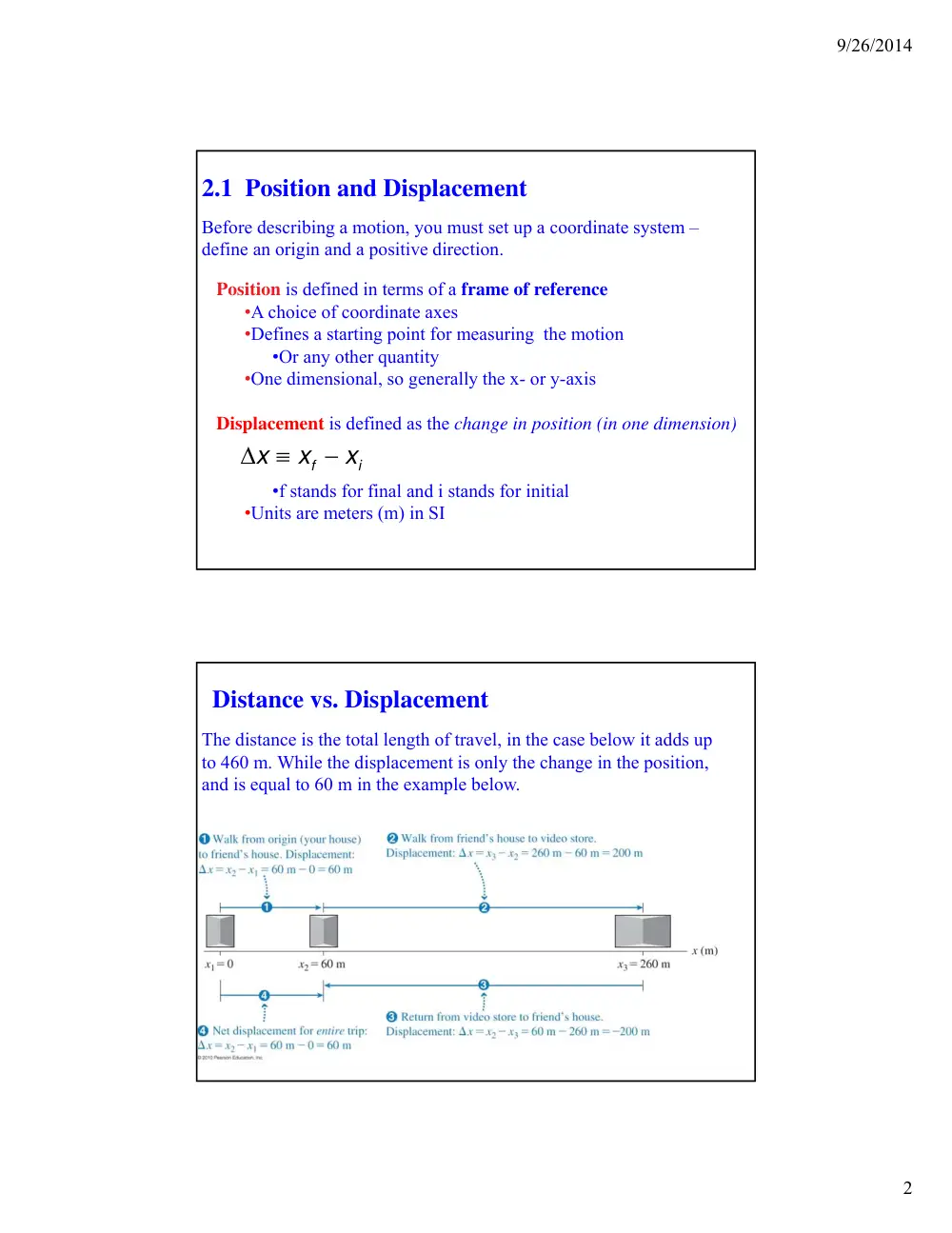
2.1 Position and Displacement
Before describing a motion, you must set up a coordinate system –
define an origin and a positive direction.
Position is defined in terms of a frame of reference
•A choice of coordinate axes
•Defines a starting point for measuring the motion
•Or any other quantity
•One dimensional, so generally the x- or y-axis
Displacement is defined as the change in position (in one dimension)
•f stands for final and i stands for initial
•Units are meters (m) in SI
f
i
x
x
x
Distance vs. Displacement
The distance is the total length of travel, in the case below it adds up
to 460 m. While the displacement is only the change in the position,
and is equal to 60 m in the example below.
9/26/2014
3
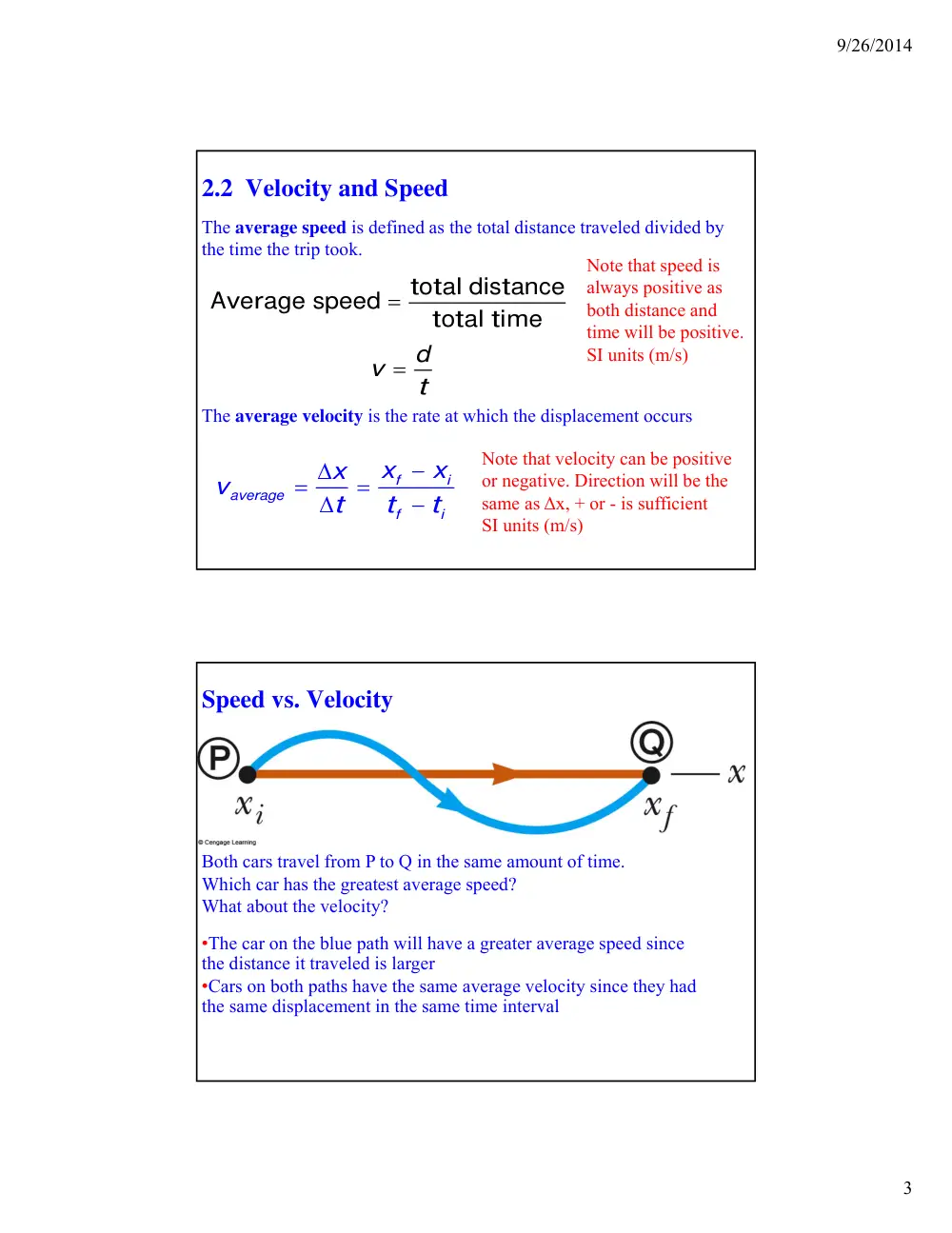
2.2 Velocity and Speed
The average speed is defined as the total distance traveled divided by
the time the trip took.
The average velocity is the rate at which the displacement occurs
total distance
Average speed
total time
d
v
t
Note that speed is
always positive as
both distance and
time will be positive.
SI units (m/s)
f
i
average
f
i
x
x
x
v
t
t
t
Note that velocity can be positive
or negative. Direction will be the
same as Δx, + or - is sufficient
SI units (m/s)
Speed vs. Velocity
Both cars travel from P to Q in the same amount of time.
Which car has the greatest average speed?
What about the velocity?
•The car on the blue path will have a greater average speed since
the distance it traveled is larger
•Cars on both paths have the same average velocity since they had
the same displacement in the same time interval
9/26/2014
4
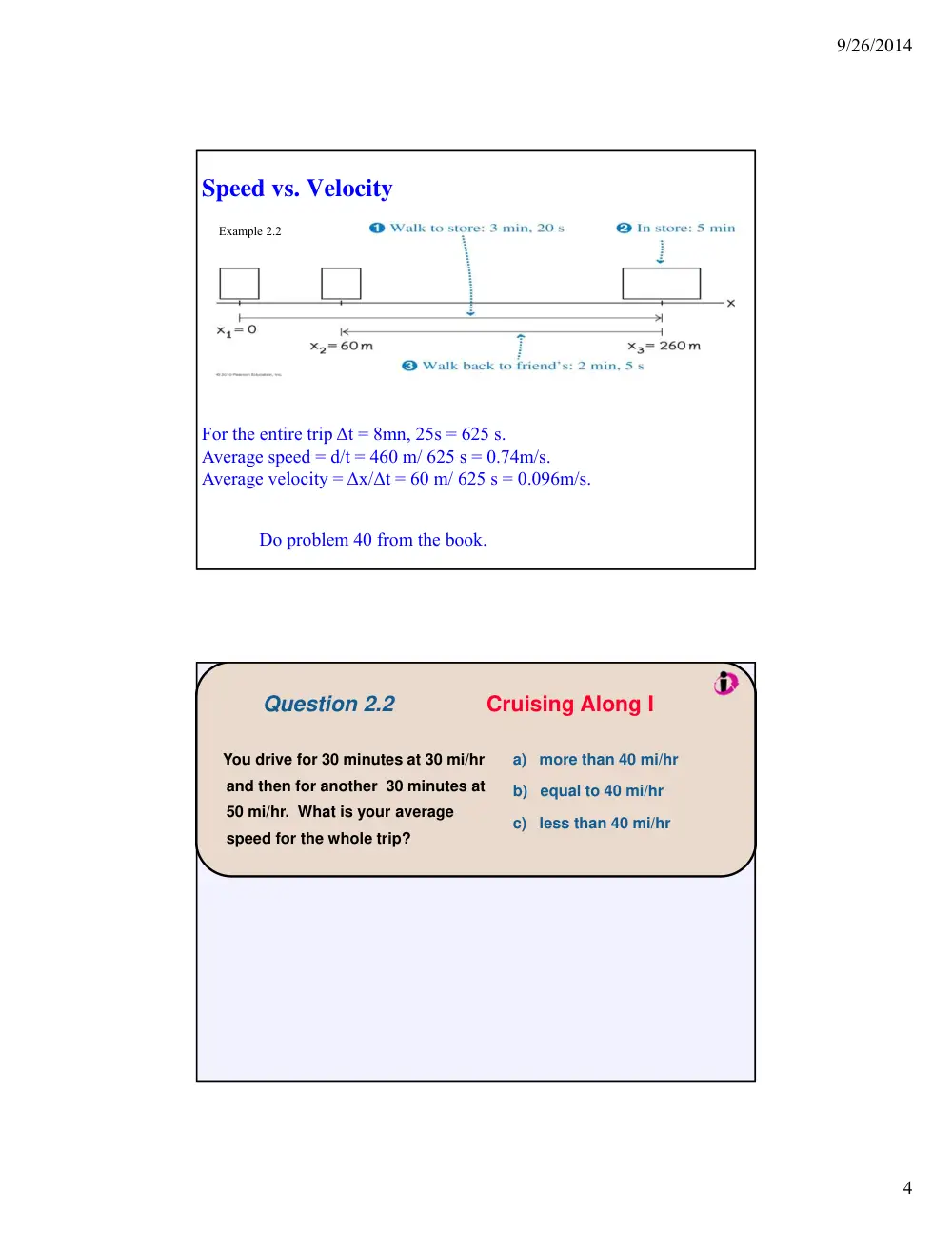
Speed vs. Velocity
For the entire trip Δt = 8mn, 25s = 625 s.
Average speed = d/t = 460 m/ 625 s = 0.74m/s.
Average velocity = Δx/Δt = 60 m/ 625 s = 0.096m/s.
Example 2.2
Do problem 40 from the book.
You drive for 30 minutes at 30 mi/hr
and then for another 30 minutes at
50 mi/hr. What is your average
speed for the whole trip?
a) more than 40 mi/hr
b) equal to 40 mi/hr
c) less than 40 mi/hr
Question 2.2
Cruising Along I
9/26/2014
5
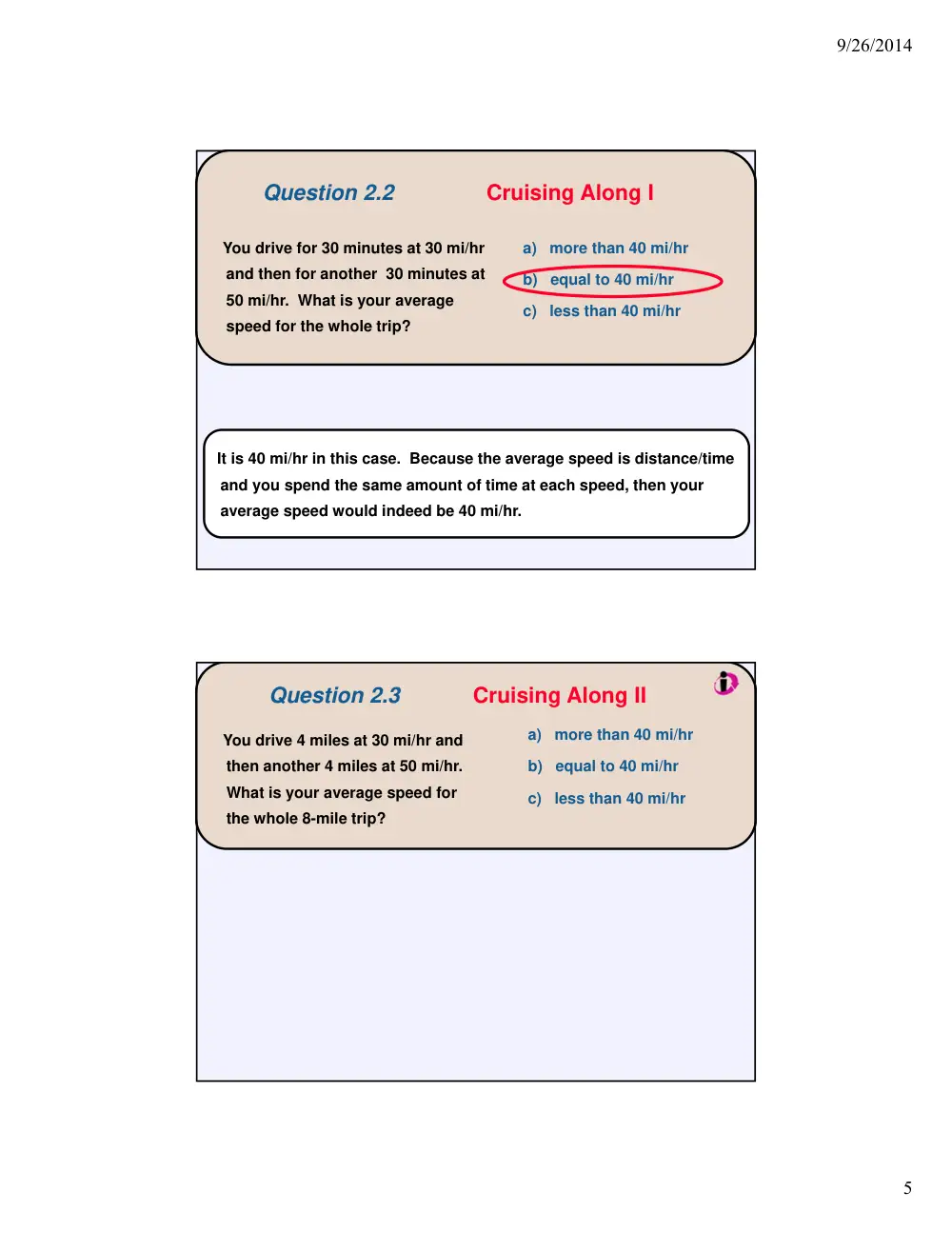
You drive for 30 minutes at 30 mi/hr
and then for another 30 minutes at
50 mi/hr. What is your average
speed for the whole trip?
a) more than 40 mi/hr
b) equal to 40 mi/hr
c) less than 40 mi/hr
It is 40 mi/hr in this case. Because the average speed is distance/time
and you spend the same amount of time at each speed, then your
average speed would indeed be 40 mi/hr.
Question 2.2
Cruising Along I
You drive 4 miles at 30 mi/hr and
then another 4 miles at 50 mi/hr.
What is your average speed for
the whole 8-mile trip?
a) more than 40 mi/hr
b) equal to 40 mi/hr
c) less than 40 mi/hr
Question 2.3
Cruising Along II
9/26/2014
6
You drive 4 miles at 30 mi/hr and
then another 4 miles at 50 mi/hr.
What is your average speed for
the whole 8-mile trip?
a) more than 40 mi/hr
b) equal to 40 mi/hr
c) less than 40 mi/hr
It is not 40 mi/hr! Remember that the average speed is distance/time.
Because it takes longer to cover 4 miles at the slower speed, you are
actually moving at 30 mi/hr for a longer period of time! Therefore, your
average speed is closer to 30 mi/hr than it is to 50 mi/hr.
Question 2.3
Cruising Along II
Question 2.5
Graphing Velocity I
t
x
The graph of position versus
time for a car is given below.
What can you say about the
velocity of the car over time?
a) it speeds up all the time
b) it slows down all the time
c) it moves at constant velocity
d) sometimes it speeds up and
sometimes it slows down
e) not really sure
9/26/2014
7
Question 2.5
Graphing Velocity I
t
x
The graph of position versus
time for a car is given below.
What can you say about the
velocity of the car over time?
The car moves at a constant velocity
because the x vs. t plot shows a straight
line. The slope of a straight line is
constant. Remember that the slope of x
vs. t is the velocity!
a) it speeds up all the time
b) it slows down all the time
c) it moves at constant velocity
d) sometimes it speeds up and
sometimes it slows down
e) not really sure
Graphical Interpretation of Velocity (constant)
The straight line indicates constant
velocity
The slope of the line is the value
of the average velocity
The general equation for the slope
of any line is
change in vertical axis
slope
change in horizontal axis
9/26/2014
8
Graphical Interpretation of Velocity: example
Graphical Interpretation of Velocity: example
9/26/2014
9
Graphical Interpretation of Velocity (non-constant)
The motion is non-constant
velocity
The average velocity is the slope
of the straight line joining the
initial and final points.
The limit of the average velocity as the time
interval becomes infinitesimally short, or as the
time interval approaches zero
The instantaneous velocity indicates what is
happening at every point of time
lim
t 0
x
v
t
Graphical Interpretation of Velocity (non-constant)
Note that a positive slope means a
positive velocity.
The slope of the line tangent to the
position-vs.-time graph is defined
to be the instantaneous velocity at
that time
The instantaneous speed is
defined as the magnitude of
the instantaneous velocity
9/26/2014
10
t
x
a) it speeds up all the time
b) it slows down all the time
c) it moves at constant velocity
d) sometimes it speeds up and
sometimes it slows down
e) not really sure
The graph of position vs.
time for a car is given below.
What can you say about the
velocity of the car over time?
Question 2.6
Graphing Velocity II
a) it speeds up all the time
b) it slows down all the time
c) it moves at constant velocity
d) sometimes it speeds up and
sometimes it slows down
e) not really sure
x
The graph of position vs.
time for a car is given below.
What can you say about the
velocity of the car over time?
The car slows down all the time
because the slope of the x vs. t graph is
diminishing as time goes on.
Remember that the slope of x vs. t is
the velocity! At large t, the value of the
position x does not change, indicating
that the car must be at rest.
t
Question 2.6
Graphing Velocity II
9/26/2014
11
2.3 Acceleration – changing velocity
Changing velocity means an
acceleration is present
Acceleration is the rate of change
of the velocity
Units are m/s² (SI), cm/s² (cgs)
f
i
f
i
v
v
v
a
t
t
t
•Average acceleration is the slope of the line connecting the initial and
final velocities on a velocity-time graph
•Instantaneous acceleration is the slope of the tangent to the curve of the
velocity-time graph
•When the instantaneous accelerations are always the same, the
acceleration will be uniform or constant.
Relationship between Acceleration and Velocity
•Velocity is positive and acceleration is negative
•When the sign of the velocity and the acceleration are in the opposite
directions, the speed is decreasing
•Positive velocity and positive acceleration
•When the sign of the velocity and the acceleration are the same (either
positive or negative), then the speed is increasing
9/26/2014
12
Unnumbered Figure Page 25
Which velocity-versus-time graph goes
with the position-versus-time graph
shown at right?
x
2.4 One-Dimensional Motion with Constant
Acceleration
9/26/2014
13
Consider the line labeled B in
the v vs. t plot. How does the
speed change with time for
line B?
a) decreases
b) increases
c) stays constant
d) increases, then decreases
e) decreases, then increases
Question 2.8
v versus t graphs II
v
t
A
B
Consider the line labeled B in
the v vs. t plot. How does the
speed change with time for
line B?
a) decreases
b) increases
c) stays constant
d) increases, then decreases
e) decreases, then increases
In case B, the initial velocity is positive
but the magnitude of the velocity
decreases toward zero. After this, the
magnitude increases again, but
becomes negative, indicating that the
object has changed direction.
Question 2.8
v versus t graphs II
v
t
A
B
9/26/2014
14
When throwing a ball straight up,
which of the following is true about its
velocity v and its acceleration a at the
highest point in its path?
a) both v = 0 and a = 0
b) v 0, but a = 0
c) v = 0, but a 0
d) both v 0 and a 0
e) not really sure
Question 2.10
Acceleration II
At the top, clearly v = 0 because the ball has
momentarily stopped. But the velocity of the
ball is changing, so its acceleration is definitely
not zero! Otherwise it would remain at rest!!
When throwing a ball straight up,
which of the following is true about its
velocity v and its acceleration a at the
highest point in its path?
a) both v = 0 and a = 0
b) v 0, but a = 0
c) v = 0, but a 0
d) both v 0 and a 0
e) not really sure
Question 2.10
Acceleration II
Follow-up: …and the value of a is…?
y
9/26/2014
15
Kinematic equations
•Gives displacement as a function of
velocity and time
•Use when you don’t know and aren’t
asked for the acceleration
t
2
v
v
t
v
x
f
o
average
o
v
v
at
•Shows velocity as a function of acceleration and time
•Use when you don’t know and aren’t asked to find
the displacement
2
2
2
o
v
v
a x
•Gives velocity as a function of acceleration and
displacement
•Use when you don’t know and aren’t asked for
the time
xf = x0 + vaverage t
2
o
2 at
1
v t
x
•Gives displacement as a function of time, velocity and
acceleration
•Use when you don’t know and aren’t asked to find the
final velocity
xf = x0 + v0t + ½ a t2
• Solve example 2.9 & 2.10 from the book.
9/26/2014
16
2.5 Free Fall
Gravity: a case of constant acceleration
•All objects moving under the influence of gravity only
are said to be in free fall
•Free fall does not depend on the object’s original motion
•All objects falling near the earth’s surface fall with a
constant acceleration
•The acceleration is called the acceleration due to gravity,
and indicated by g
•g is always directed downward, toward the center of the earth
(g = 9.80 m/s²)
•An object falling in air is subject to air resistance (and
therefore is not freely falling).
Free Fall – an object dropped
•Initial velocity is zero
•Up is positive
•In the kinematic equations use y instead
of x since vertical
•Acceleration is g = 9.80 m/s2
vo= 0
a = -g
9/26/2014
17
Example 2.11 Tower of Pisa
The top floor of the Tower of Pisa is 58.4 m
above the ground. You duplicate Galileo’s
experiment by dropping two balls from the
Tower.
a) What’s their velocity when they strike the
ground?
b) How much time does it take them to fall?
Question 2.11
Free Fall I
You throw a ball straight up
into the air. After it leaves
your hand, at what point in
its flight does it have the
maximum value of
acceleration?
a) its acceleration is constant
everywhere
b) at the top of its trajectory
c) halfway to the top of its trajectory
d) just after it leaves your hand
e) just before it returns to your hand
on the way down
9/26/2014
18
The ball is in free fall once it is released. Therefore, it is entirely under
the influence of gravity, and the only acceleration it experiences is g,
which is constant at all points.
Question 2.11
Free Fall I
You throw a ball straight up
into the air. After it leaves
your hand, at what point in
its flight does it have the
maximum value of
acceleration?
a) its acceleration is constant
everywhere
b) at the top of its trajectory
c) halfway to the top of its trajectory
d) just after it leaves your hand
e) just before it returns to your hand
on the way down
Question 2.12
Free Fall II
Alice and Bill are at the top of a
building. Alice throws her ball
downward. Bill simply drops
his ball. Which ball has the
greater acceleration just after
release?
a) Alice’s ball
b) it depends on how hard
the ball was thrown
c) neither—they both have
the same acceleration
d) Bill’s ball
v0
Bill
Alice
vA
vB
9/26/2014
19
Both balls are in free fall once they are
released, therefore they both feel the
acceleration due to gravity (g). This
acceleration is independent of the initial
velocity of the ball.
Question 2.12
Free Fall II
Alice and Bill are at the top of a
building. Alice throws her ball
downward. Bill simply drops
his ball. Which ball has the
greater acceleration just after
release?
a) Alice’s ball
b) it depends on how hard
the ball was thrown
c) neither—they both have
the same acceleration
d) Bill’s ball
v0
Bill
Alice
vA
vB
Follow-up: which one has the greater velocity when they hit the
ground?
v0
v0
Bill
Alice
H
vA
vB
Alice and Bill are at the top of a cliff of height
H. Both throw a ball with initial speed v0, Alice
straight down and Bill straight up. The speeds
of the balls when they hit the ground are vA
and vB. If there is no air resistance, which is
true?
a) vA < vB
b) vA = vB
c) vA > vB
d) impossible to tell
v0
v0
Bill
Alice
H
vA
vB
Question 2.14
Up in the Air II
9/26/2014
20
Bill’s ball goes up and comes back
down to Bill’s level. At that point, it is
moving downward with v0, the same
as Alice’s ball. Thus, it will hit the
ground with the same speed as
Alice’s ball.
a) vA < vB
b) vA = vB
c) vA > vB
d) impossible to tell
v0
v0
Bill
Alice
H
vA
vB
Question 2.14
Up in the Air II
Alice and Bill are at the top of a cliff of
height H. Both throw a ball with initial
speed v0, Alice straight down and Bill
straight up. The speeds of the balls when
they hit the ground are vA and vB. If there
is no air resistance, which is true?
Alice and Bill are at the top of a cliff of height H. Both throw a ball with
initial speed v0, Alice straight down and Bill straight up. There is no air
resistance, which is true?
v0
v0
Bill
Alice
H
vA
vB
Assessment Question
1) Compare the speeds vA and vB
of the balls when they hit the ground.
2) Which ball arrives first? Alice’s or Bill’s ball?
3) Compare the accelerations of both balls.
The result: Out of 20 attendees, 14 had all three questions right.
6 had a combination of wrong 1 or 2 answers. None had them all 3 wrong.
9/26/2014
21
Summary of Chapter 2
• Distance: total length of travel
• Displacement: change in position
• Average speed: distance/time
• Average velocity: displacement/time
• Instantaneous velocity: average velocity measured over an
infinitesimally small time
• Average acceleration: change in velocity divided by change in
time
• Constant acceleration: equation of motion relate position,
velocity, acceleration and time
• Freely falling objects: constant acceleration, g = 9.80m/s2