
BIO 211 Chapter 1, Fall 2018
Notre Dame University–Louaize · General Biology I · 35 pages



Showing the first 10 of 35 pages. Download the PDF to see all of it.
Show the text of this chapter
Chapter 01
Lecture Outline
Copyright © The McGraw-Hill Companies, Inc. Permission required for reproduction or display.
1
See separate PowerPoint slides for all figures and
tables pre-inserted into PowerPoint without notes and
animations.
The Science of Biology
Chapter 1
2
3
The Science of Life
• Biology unifies much of natural science
• Life defies simple definition
– Living systems are the most complex
chemical systems on Earth
– Life is constrained by the properties of
chemistry and physics
• Science is becoming more interdisciplinary
– Combining multiple fields
4
• 7 characteristics of all living organisms
1. Cellular organization
2. Ordered complexity
3. Sensitivity
4. Growth, development, and reproduction
5. Energy utilization
6. Homeostasis
7. Evolutionary adaptation
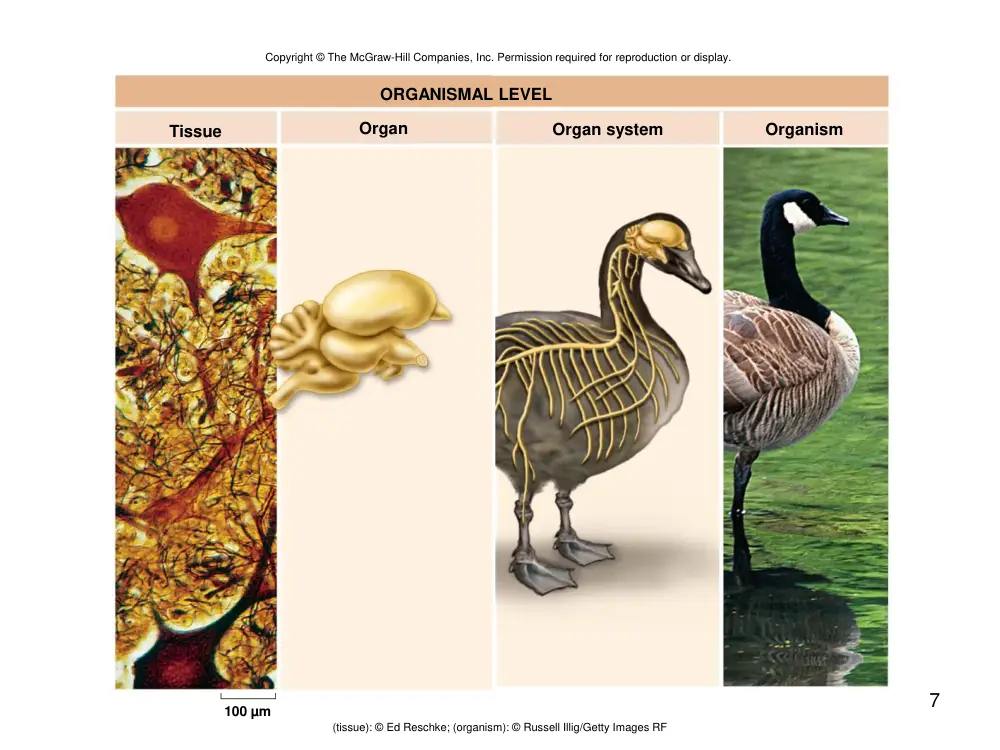
• Living systems show hierarchical
organization
– Cellular level
• Atoms, molecules, organelles, cells
• Cell is the basic unit of life
– Organismal level
• Tissues, organs, organ systems
5
6
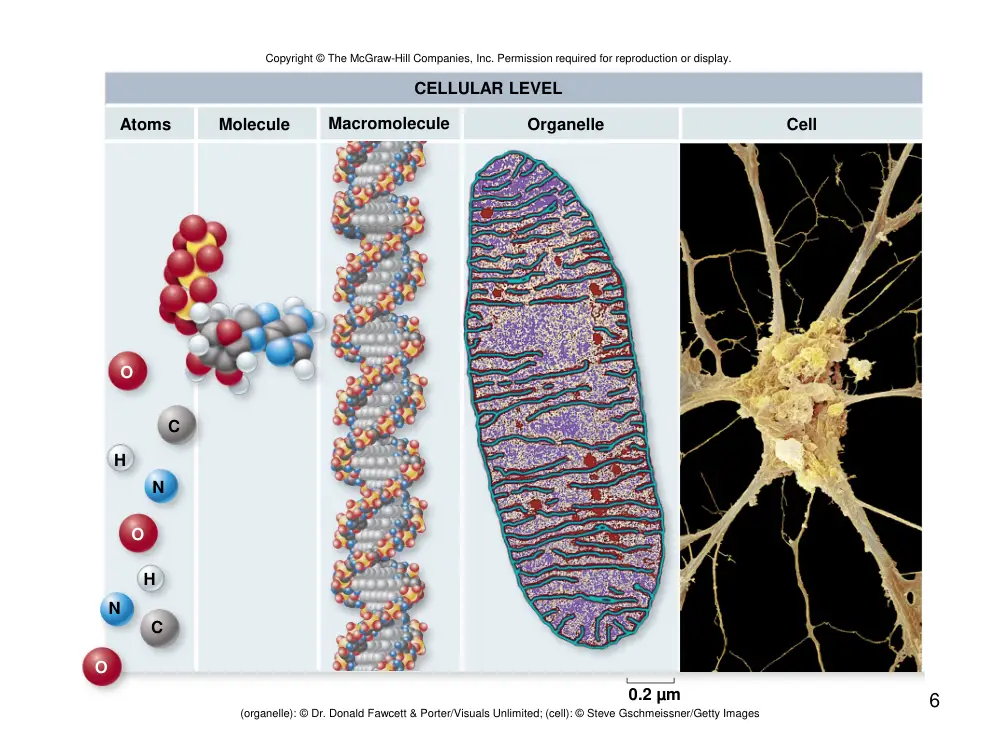
Copyright © The McGraw-Hill Companies, Inc. Permission required for reproduction or display.
Atoms
Molecule
Macromolecule
CELLULAR LEVEL
Organelle
Cell
0.2 µm
O
C
H
N
O
H
N
C
O
(organelle): © Dr. Donald Fawcett & Porter/Visuals Unlimited; (cell): © Steve Gschmeissner/Getty Images
7
Tissue
Organ
100 µm
ORGANISMAL LEVEL
Organ system
Organism
(tissue): © Ed Reschke; (organism): © Russell Illig/Getty Images RF
Copyright © The McGraw-Hill Companies, Inc. Permission required for reproduction or display.
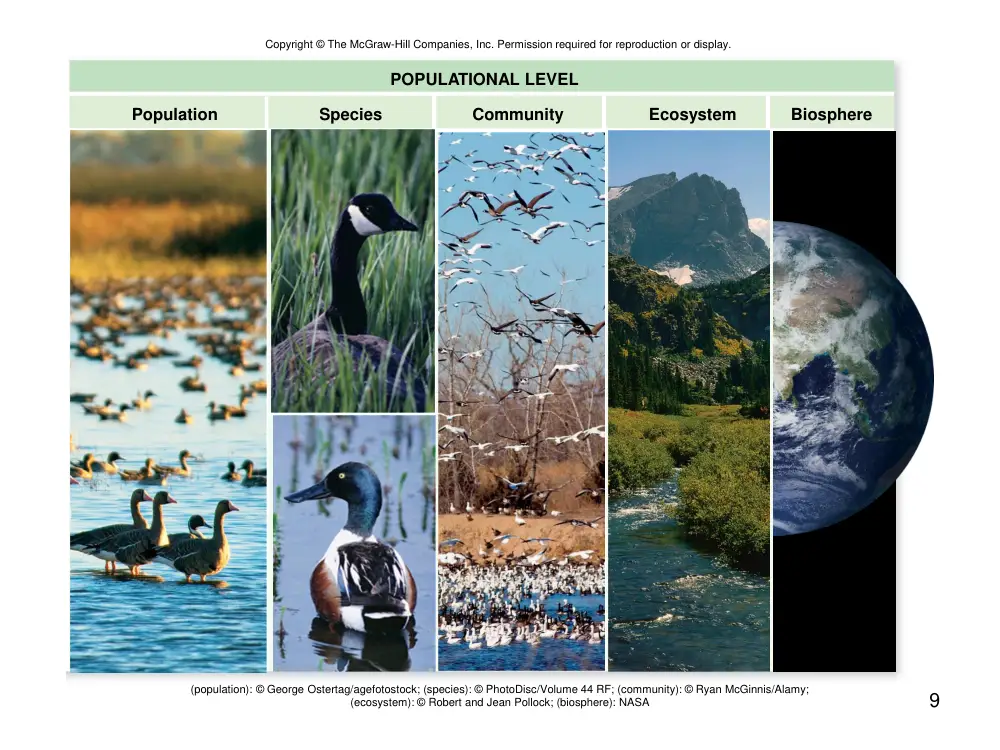
– Populational level
• Population, community
– Ecosystem level
– Biosphere
• Earth is an ecosystem we call the biosphere
• Each level has emergent properties
– Result from interaction of components
– Cannot be deduced by looking at parts
themselves
– “Life” is an emergent property
8
9
Copyright © The McGraw-Hill Companies, Inc. Permission required for reproduction or display.
POPULATIONAL LEVEL
Population
Species
Community
Ecosystem
Biosphere
(population): © George Ostertag/agefotostock; (species): © PhotoDisc/Volume 44 RF; (community): © Ryan McGinnis/Alamy;
(ecosystem): © Robert and Jean Pollock; (biosphere): NASA
10
The Nature of Science
• Science aims to understand the natural
world through observation and reasoning
• Science begins with observations,
therefore, much of science is purely
descriptive
– Classification of all life on Earth
– Human genome sequencing
11
• Science uses both deductive and inductive
reasoning
• Deductive reasoning uses general
principles to make specific predictions
• Inductive reasoning uses specific
observations to develop general
conclusions
12
• Scientists use a systematic approach to
gain understanding of the natural world
– Observation
– Hypothesis formation
– Prediction
– Experimentation
– Conclusion
13
Copyright © The McGraw-Hill Companies, Inc. Permission required for reproduction or display.
Observation
Question
Potential
hypotheses
Remaining
possible
hypotheses
Last remaining
possible
hypothesis
Hypothesis 1
Hypothesis 2
Hypothesis 3
Hypothesis 4
Hypothesis 5
Hypothesis 2
Hypothesis 3
Hypothesis 5
Hypothesis 5
Reject
hypotheses
1 and 4
Experiment
Reject
hypotheses
2 and 3
Experiment
Modify hypothesis
Experiment 4
Experiment 1
Predictions
Experiment 2
Experiment 3
Predictions
confirmed
14
• A hypothesis is a possible explanation for
an observation
• A hypothesis
– Must be tested to determine its validity
– Is often tested in many different ways
– Allows for predictions to be made
• Iterative
– Hypotheses can be changed and refined with
new data
15
• Experiment
– Tests the hypothesis
– Must be carefully designed to test only one
variable at a time
– Consists of a test experiment and a control
experiment
16
• Predictions
– Hypotheses should make predictions
– Predictions provide a way to test the validity of
hypotheses
– Hypothesis must be rejected if the experiment
produces results inconsistent with the
predictions
– The more experimentally supported
predictions a hypothesis makes, the more
valid the hypothesis
17
• Scientific theory
– Is a body of interconnected concepts
– Is supported by much experimental evidence
and scientific reasoning
– Expresses ideas of which we are most certain
• Compare to general meaning of theory
– Implies a lack of knowledge or a guess
18
Darwin and Evolution
• Example of how a scientist develops a
hypothesis and a theory gains acceptance
• Charles Darwin served as naturalist on
mapping expedition around coastal South
America
• 30 years of observation and study before
publishing On the Origin of Species by
Means of Natural Selection
19
Voyage of the HMS Beagle
Copyright © The McGraw-Hill Companies, Inc. Permission required for reproduction or display.
NORTH
PACIFIC
OCEAN
Marquesas
Society
Islands
Straits of Magellan
Cape Horn Tierra del Fuego
SOUTH
ATLANTIC
OCEAN
New
Zealand
Hobart
King George’s
Sound
Mauritius
Bourbon Island
NORTH
PACIFIC
OCEAN
Philippine
Islands
British Isles
Western
Isles
EUROPE
ASIA
Madagascar
Friendly
Islands
Equator
NORTH
AMERICA
Galápagos
Islands
NORTH
ATLANTIC
OCEAN
Cape Verde
Islands
Canary
Islands
AFRICA
Sydney
AUSTRALIA
INDIAN
OCEAN
Cape of
Good Hope
Falkland
Islands
Valparaiso
SOUTH
AMERICA
Port Desire
Buenos Aires
Montevideo
Keeling
Islands
Bahia
Ascension
St. Helena
Rio de Janeiro
• Darwin was not the first to propose
evolution
– Living things have changed over time
• Darwin’s contribution was a mechanism
– Natural selection
20
• On the Beagle, Darwin saw that
characteristics of similar species varied
from place to place
• Galápagos Finches
– 14 related species differ only slightly
– “Descent with modification” or evolution
21
Copyright © The McGraw-Hill Companies, Inc. Permission required for reproduction or display.
Woodpecker Finch (Cactospiza pallida)
Large Ground Finch (Geospiza magnirostris)
Cactus Finch (Geospiza scandens)
22
• Darwin studied Thomas Malthus’s An
Essay on the Principle of Population
– Populations of plants and animals increase
geometrically
– Humans can only increase their food supply
arithmetically
– Populations of species remain constant
because death limits population numbers
• Darwin saw that
although every
organism has
the potential to
produce more
offspring, only a
limited number
do survive and
reproduce
themselves
23
Copyright © The McGraw-Hill Companies, Inc. Permission required for reproduction or display.
2
6
18
54
4
6
8
geometric progression
arithmetic progression
24
• Evidence supporting Darwin’s theory has
only grown
– Fossil record
• Transitional forms have been found at predicted
positions in time
– Earth’s age
• Physicists of Darwin’s time were wrong
• Earth is very old – 4.5 billion years old
– Mechanism for heredity
• Mendel’s laws of inheritance were unknown to
Darwin
– Comparative anatomy
• Vertebrate forelimbs all share the same basic array
of bones
• Homologous – same evolutionary origin but now
differ in structure and function
• Analogous – structures of different origin used for
the same purpose (butterfly and bird wings)
25
26
Copyright © The McGraw-Hill Companies, Inc. Permission required for reproduction or display.
Human
Cat
Porpoise
Horse
Bat
27
– Molecular Evidence
• Compare genomes or
proteins of different
organisms
• Phylogenetic trees –
based on tracing
origin of particular
nucleotide changes to
reconstruct an
evolutionary history
Human
Rhesus
Dog
Frog
Bird
Number of Amino Acid Differences in a Hemoglobin Polypeptide
10
20
30
70
60
0
40
50
Copyright © The McGraw-Hill Companies, Inc. Permission required for reproduction or display.
Unifying Themes in Biology
• Cell theory
– All organisms composed of cells
– Cells are life’s basic units
– All cells come from preexisting cells
28
a.
b.
60 µm
500 µm
Copyright © The McGraw-Hill Companies, Inc. Permission required for reproduction or display.
a: © Dennis Kunkel/Phototake; b: © Karl E. Deckart/Phototake
• Molecular basis of inheritance
– Deoxyribonucleic acid (DNA)
– Sequence of 4 nucleotides encode cell’s
information
– Gene – discrete unit of information
– Genome – entire set of DNA instructions
– Continuity of life depends on faithful copying
of DNA into daughter cells
29
• Structure and function
– Study structure to learn function
– Know a function – look for that structure in
other organisms
– Example
• Receptor on human cell for insulin known
• Find similar molecule in a worm
• Might conclude this molecule functions the same in
the worm
30
• Diversity of life arises by evolution
– Underlying unity of biochemistry and genetics
argues for life from the same origin event
– Diversity due to evolutionary change over
time
– 3 domains
• Bacteria – single-celled prokaryote
• Archaea – single-celled prokaryote
• Eukarya – single-celled or multicellular eukaryote
31
32
Copyright © The McGraw-Hill Companies, Inc. Permission required for reproduction or display.
Eukarya
Plantae
Fungi
Animalia
Protista
(plantae middle): © David M. Dennis/Animals Animals; (plantae right): © Corbis/Volume 46 RF; (fungi left): © Royalty Free/Corbis; (fungi middle):
© Mediscan/Corbis; (fungi right): © PhotoDisc BS/Volume 15 RF; (animalia left): © Royalty-Free/Corbis; (animalia middle): © Tom Brakefield/Corbis;
(animalia right): © PhotoDisc/Volume 44 RF; (protista left): © Corbis/Volume 64 RF; (protista middle): © Tom Adams/Visuals Unlimited;
(protista right): © Douglas P. Wilson/Frank Lane Picture Agency/Corbis
• Evolutionary conservation
– All organisms today descended from a simple
creature 3.5 BYA
– Some characteristics preserved – use of DNA
– Conservation reflects that they have a
fundamental role
33
• Cells are information-processing systems
– Information in DNA used to direct synthesis of
cellular components
• Control of gene expression leads to different cells/
tissue types
– Cells process environmental information
• Glucose levels, presence of hormones
– Cells in multicellular organisms must
coordinate with each other
34
• Nonequilibrium state
– Living systems are open systems
– Constant supply of energy needed
– Self-organizing properties at different levels
– Emergent properties from collections of
molecules, cells, and individuals
35