
CHM 211 Final, Spring 2010
Notre Dame University–Louaize · Principles of Chemistry · 8 pages
More CHM 211 files
- Homework Chapter 1 · Spring 2015ChapterView
- Homework Chapter 2 · Spring 2015ChapterView
- Homework Chapter 3 · Spring 2015ChapterView
- Homework Chapter 4 · Spring 2015ChapterView
- Exam 1 Answers+ Questions · Fall 2013Problems · with solutionView
- Exam 1 with Solution · Spring 2010Exam · with solutionView
Show the text of this final exam
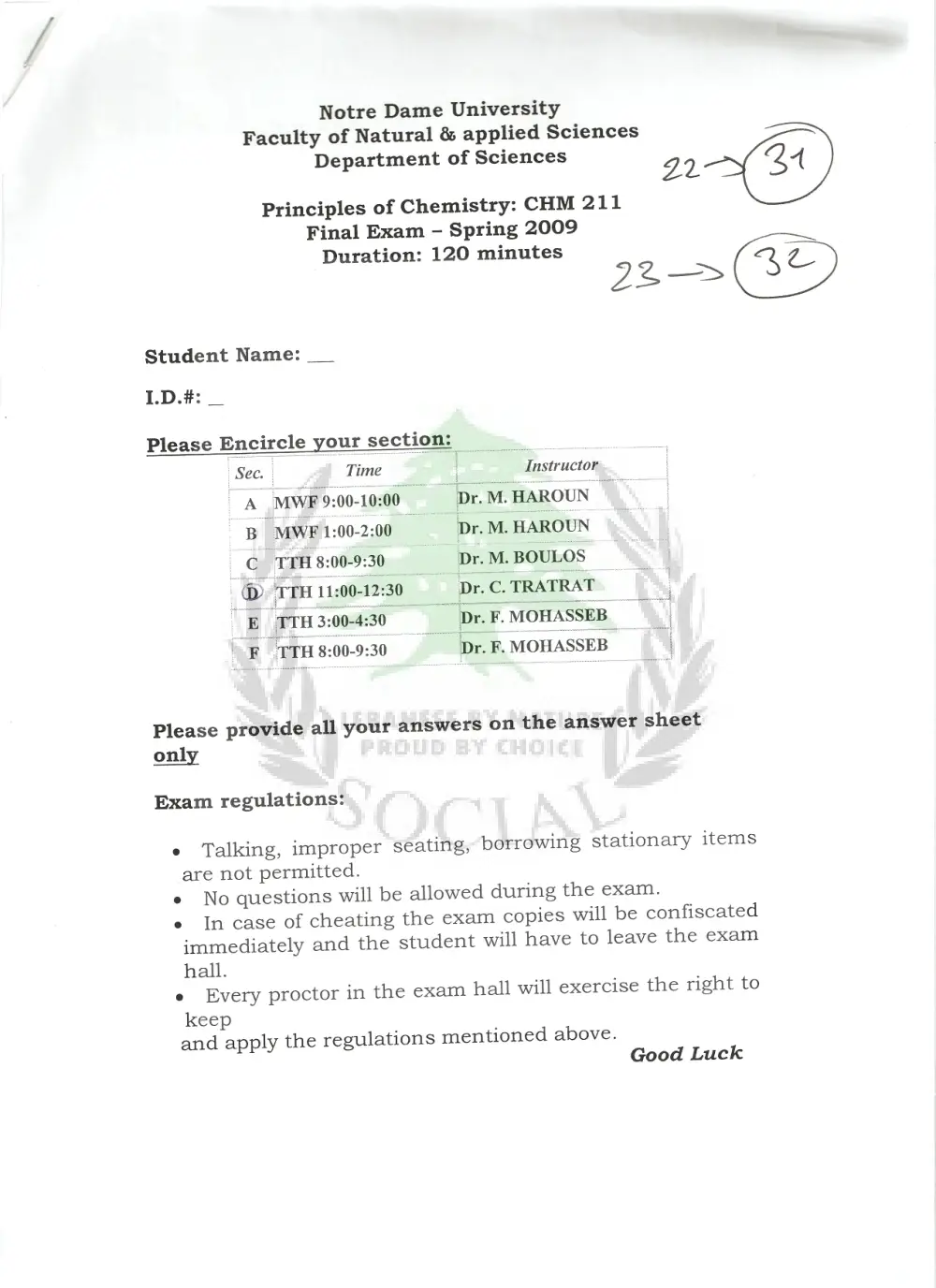
Notre Dame University
Faculty of Natural & applied Sciences
Department of Sciences
ga 31
Principles of Chemistry: CHM 211
Final Exam - Spring 2009
Duration: 120 minutes
22 SOS
Student Name: ____
I.D.#: _
Please Encircle your section:
Sec. Time i Instructor
A MWF9:00-10:00 Dr. M. HAROUN
B MWF 1:00-2:00 Dr. M. HAROUN
C TTH 8:00-9:30 Dr. M. BOULOS
@ rt 11:00-12:30 —dDr. C. TRATRAT
F
> PTH 3:00-4:30 Dr.F.MOHASSEB
TTH 8:00-9:30 Dr. F. MOHASSEB |
Please provide all your answers on the answer sheet
only
Exam regulations:
e Talking, improper seating, borrowing stationary items
are not permitted.
e No questions will be allowed during the exam.
e Incase of cheating the exam copies will be confiscated
immediately and the student will have to leave the exam
hall.
e Every proctor in the exam hall will exercise the right to
keep
and apply the regulations mentioned above.
Good Luck
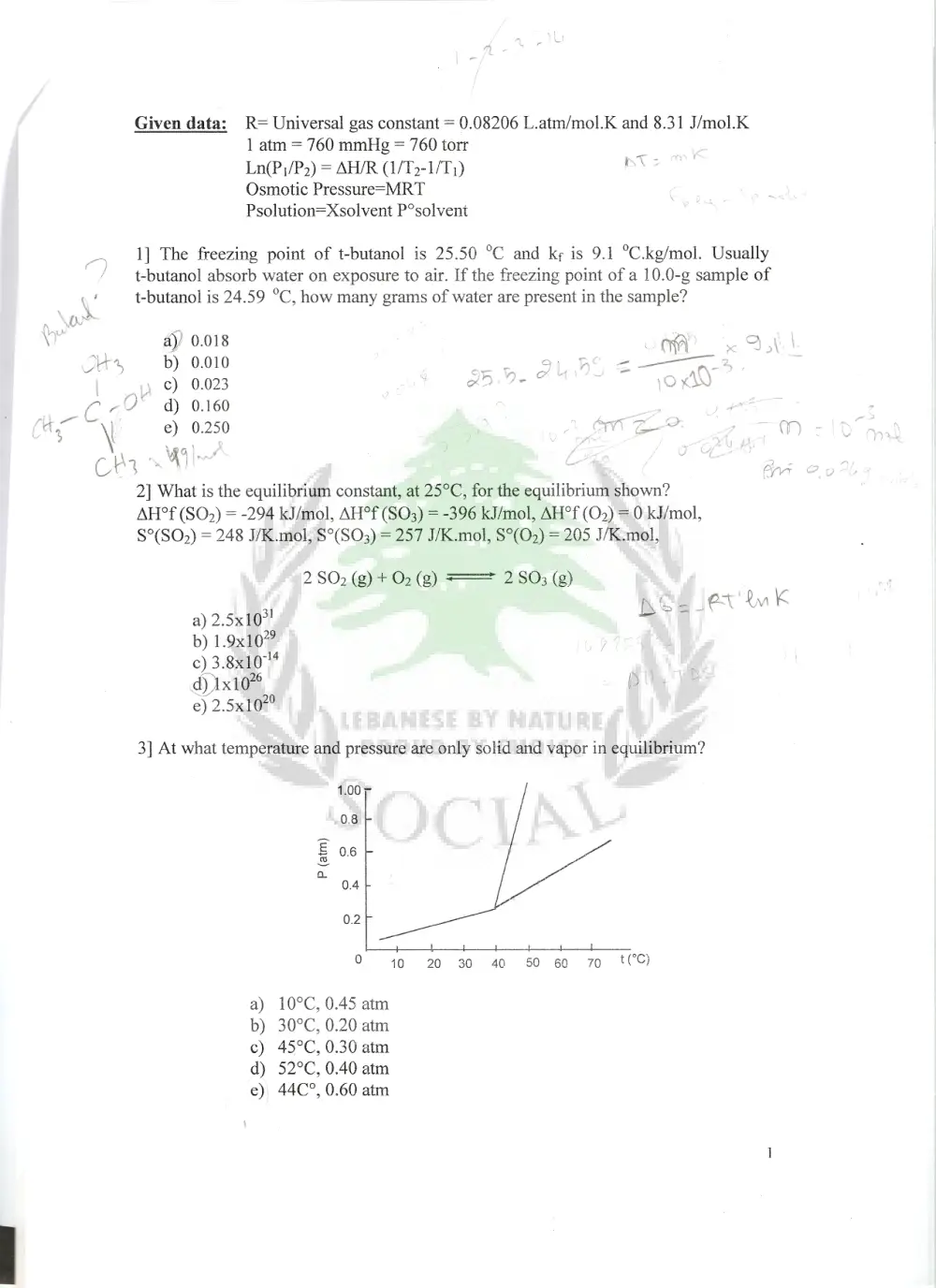
Given data: R= Universal gas constant = 0.08206 L.atm/mol.K and 8.31 J/mol.K
1 atm = 760 mmHg = 760 torr _
Ln(Pj/P2) = AH/R (1/T2-1/T)) BY
Osmotic Pressure-MRT
Psolution=Xsolvent P°solvent
1] The freezing point of t-butanol is 25.50 °C and kg is 9.1 °C.kg/mol. Usually
t-butanol absorb water on exposure to air. If the freezing point of a 10.0-g sample of
t-butanol is 24.59 °C, how many grams of water are present in the sample?
a)) 0.018 ny <9
b) 0.010 oe OLS EO
4) €) 0.023 2D 9- © o x
Yo” d) 0.160 ;
e) 0.250 wT 22 onl
oe ., aX : oe
2] What is the equilibrium constant, at 25°C, for the equilibrium shown?
AH°f (SO2) = -294 kJ/mol, AH°f (SO3) = -396 kJ/mol, AH°f (O2) = 0 kJ/mol,
S°(SQ2) = 248 J/K.mol, S°(SO3) = 257 J/K.mol, S°(O2) = 205 J/K.mol,
2 SO? (g) + O2 (g) ==— 2 SO3 (g) |
a) 2.5x10>) AGE et vk
b) 1.9107
c) 3.8x10°" A
d) 1x10 ai
e) 2.5x10”°
3] At what temperature and pressure are only solid and vapor in equilibrium?
1.007
a) 10°C, 0.45 atm
b) 30°C, 0.20 atm
c) 45°C, 0.30 atm
d) 52°C, 0.40 atm
e) 44C°, 0.60 atm
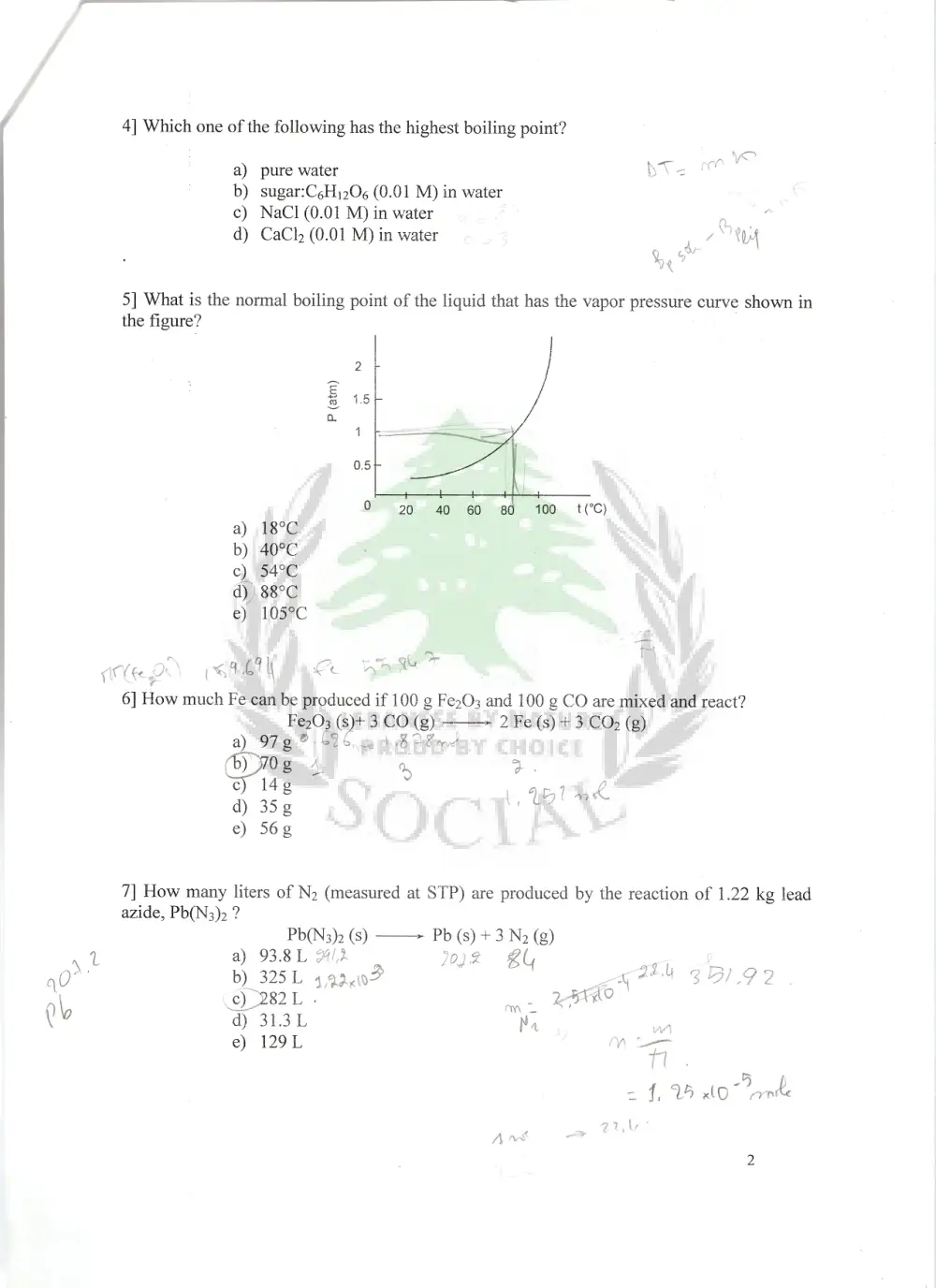
4] Which one of the following has the highest boiling point?
a) pure water bv -
b) sugar:C¢H}20¢ (0.01 M) in water
c) NaCl (0.01 M) in water ;
d) CaCl (0.01 M) in water a7 WA
%ee
5] What is the normal boiling point of the liquid that has the vapor pressure curve shown in
the figure?
2
& 15
oO
1
05
0 5 40 60 8d 100 t(°C)
a) 18°C
b) 40°C
c) 54°C
d) 88°C
(3) IE se
e f A 9) v >, en FS. a
WEL is aGl é
6] How much Fe can be produced if 100 g Fe2O3 and 100 g CO are mixed and react?
Fe203 (s)+ 3 CO (g) ~ 2 Fe (s) + 3 COp (g)
a) 97g? S26. we rh (BAS
(ob) W0g 4 4 ri
Cay . wl , ee
d) 35g
e) 56g
7| How many liters of Np (measured at STP) are produced by the reaction of 1.22 kg lead
azide, Pb(N3)2 ?
Pb(N3)2 (s) ~ Pb (s) +3 No (g)
a) 93.8L M412 D0)R § = oo
40° : b) 325L 4,920 . ako Zi 3B) .92
aly ©) 282L . cm =, KORE
\ d) 31.3L Na 4
e) 129L nT
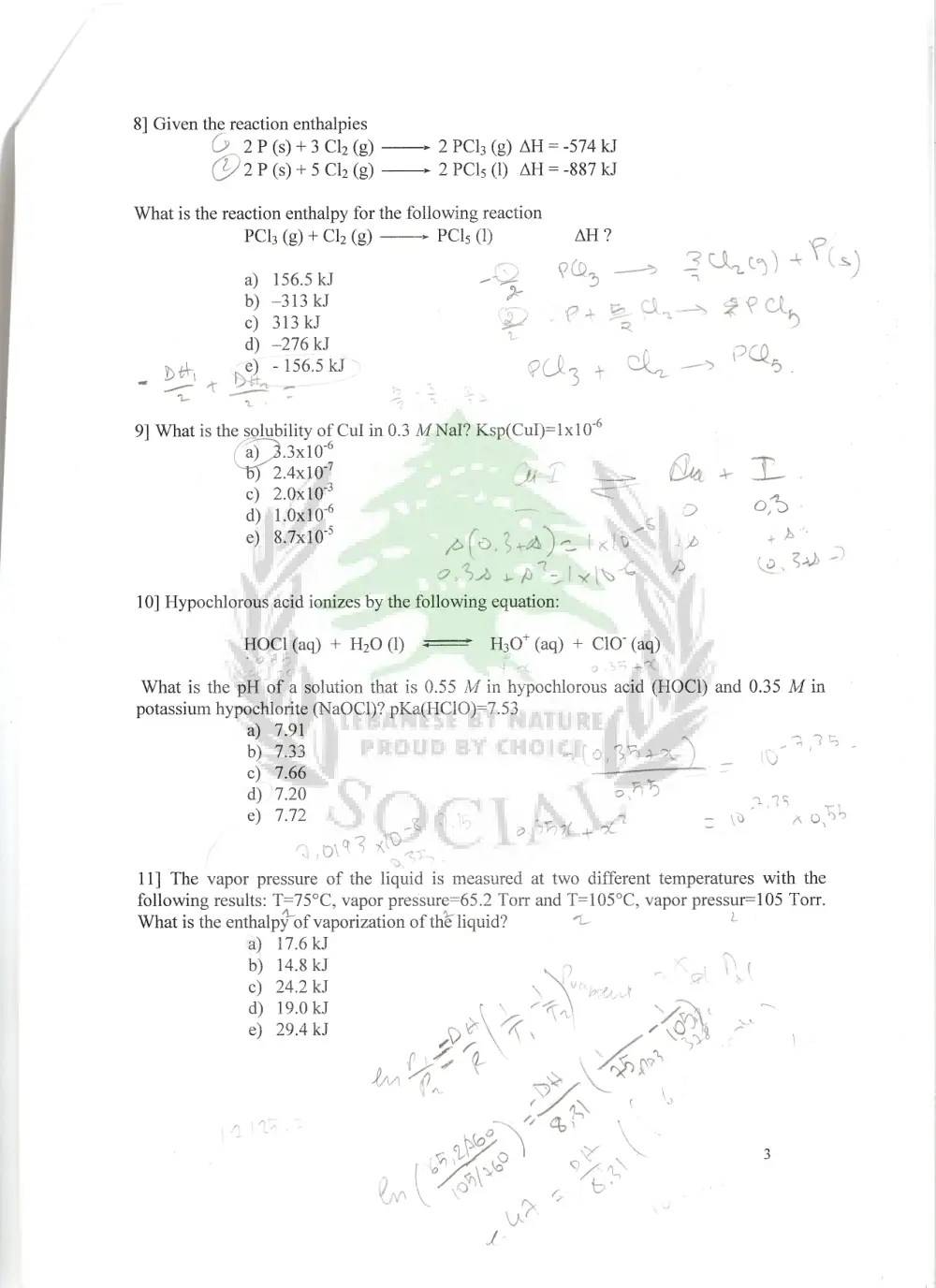
8] Given the reaction enthalpies
©_2P(s)+3Ch(g) > 2 PCl; (g) AH =-574 kI
(Y)2P (s)+5 Ch (g) —— 2PCls (1) AH=-887kI
What is the reaction enthalpy for the following reaction
PChs (g) + Ch (g) > PCls (1) AH? eo
Pre . - Ch ca \ +& \ {
a) 156.5 kJ ase Va = eS)
b) -313 kJ a1 eo hs S? In
c) 313 kJ ge ; 2 : D
d) -276kJ . ar,
pt e) - 156.5 kJ P(de » CR os
= — “ Dey _ 7 3 -
s -
9] What is the solubility of Cul in 0.3 M Nal? Ksp(Cul)=1x10" 6
a) 3.3x10° 4 <=
“by 2.4x10⁷ Wi ~ be+ tL.
c) 2.0x10" =
d) | 1.0x10⁸ - cb? OD
e) 8.7x10" p(o.3+a)~ lip ip r .
229 ep ies omy, © nom
10] Hypochlorous acid ionizes by the following equation:
HOC! (aq) + HO() = 430° (aq) + ClO (aq)
; +X
What is the pH r a solution that is 0.55 M in hypochlorous acid (HOCI) and 0.35 M in
potassium hypochlorite (NaOCl)? pKa(HClO)=7.53
a) 7.91 x ae
b)_ 7.33 pl Of oe ) “i 2
c) 7.66 =a
d) 7.20 ale) ae -
e) 7.72 oe ; > bry! vt - A 0,2?
ol Qs x z
11] The vapor pressure of the liquid is measured at two different temperatures with the
following results: TS 75°C, vapor pressure=65. 2 Torr and T=105°C, vapor peste Torr.
a
What is the enthalpy’ of vaporization of thé liquid? L
a)
b)
c)
d)
e)
17.6 kJ
14.8 kJ
24.2 kJ
19.0 kJ
29.4 kJ
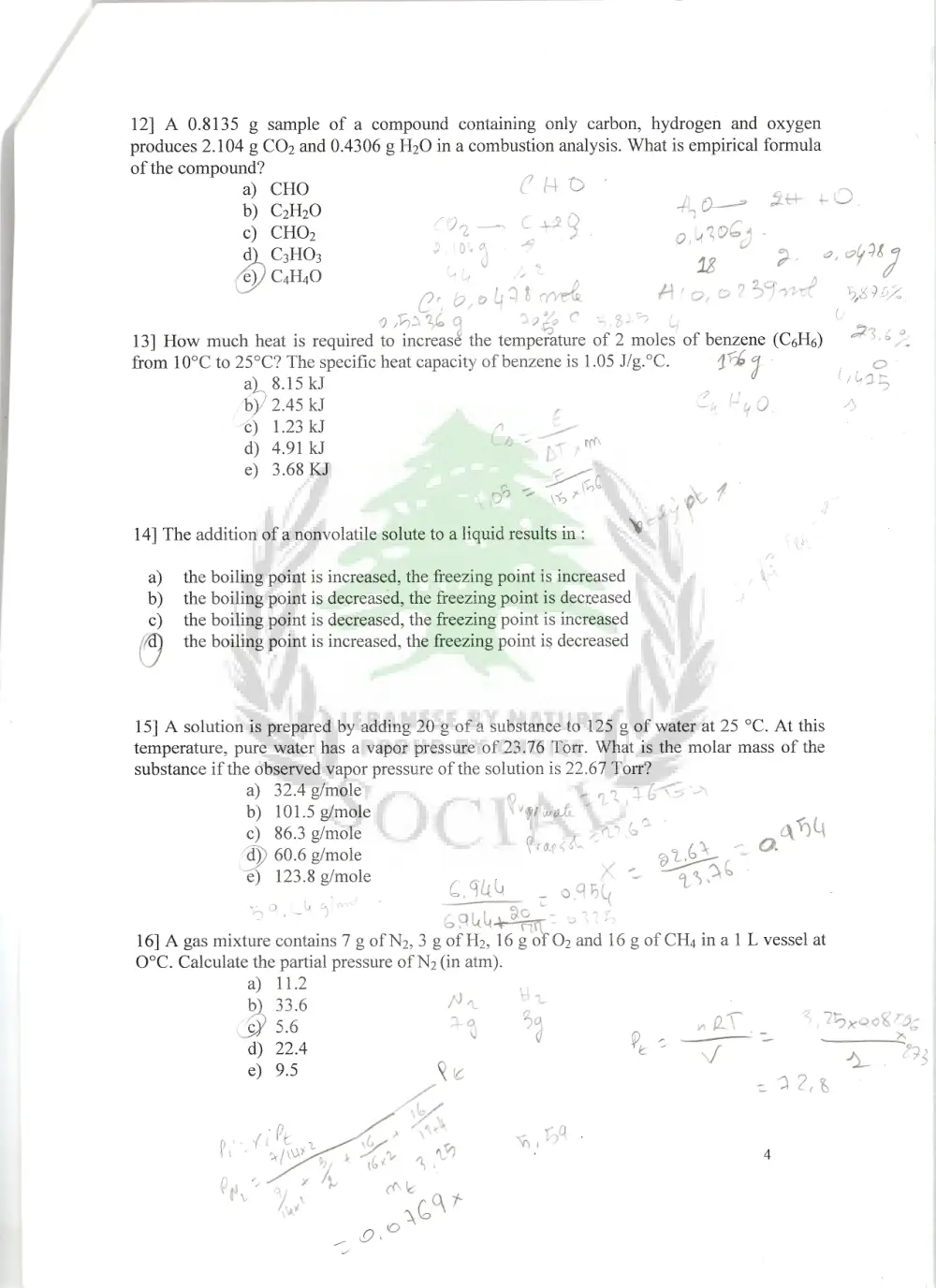
12] A 0.8135 g sample of a compound containing only carbon, hydrogen and oxygen
produces 2.104 g CO» and 0.4306 g H2O in a combustion analysis. What is empirical formula
of the compound?
a) CHO CHO Py '
b) C)H,O 5 tO" ae
c) CHO, 447 ES 9, u20e4
d) C3HO; DL 4 7 . a oa, oy Vb
s) C4H4O tly ub o ) 7
~ - 2,0 re: oto vai > DVS YEISA
0; Dd: \2 b& g a ¢ =>,
13] How much heat is required to increasé the temperature of 2 moles of benzene (CoH)
from 10°C to 25°C? The specific heat capacity of benzene is 1.05 J/g.°C. Wh d Oo
a) 8.15kJ : 425,
by 2.45 kJ ; 0
c) 1.23 kJ A
d) 4.91 kJ a ar pi
e) 3.68 KJ _ cA. 5
aN ie
14] The addition of a nonvolatile solute to a liquid results in : v
a) the boiling point is increased, the freezing point is increased
b) the boiling point is decreased, the freezing point is decreased
c) the boiling point is decreased, the freezing point is increased
@ the boiling point is increased, the freezing point is decreased
15] A solution is prepared by adding 20 g of a substance to 125 g of water at 25 °C. At this
temperature, pure water has a vapor pressure of 23.76 Torr. What is the molar mass of the
substance if the observed vapor pressure of the solution is 22.67 Torr?
a) 32.4 g/mole . a ee ae
b) 101.5 g/mole Vat gt. © ;
c) 86.3 g/mole ee, VG rr 7 aAnk
d)) 60.6 g/mole os 91.6. ~~
5 123.8 g/mole r eht At cite .
&, 1UY ~- of hy
5 9kk ae 2
16] A gas mixture contains 7 g of No, 3 g of Hp, 16 g of O2 and 16 g of CH, ina 1 L vessel at
O°C. Calculate the partial pressure of N2 (in atm).
a) 11.2
b) 33.6 Ny. - oe tis
& 56 q q 6 4 eee one x
Ye 7 ij ar,
oa
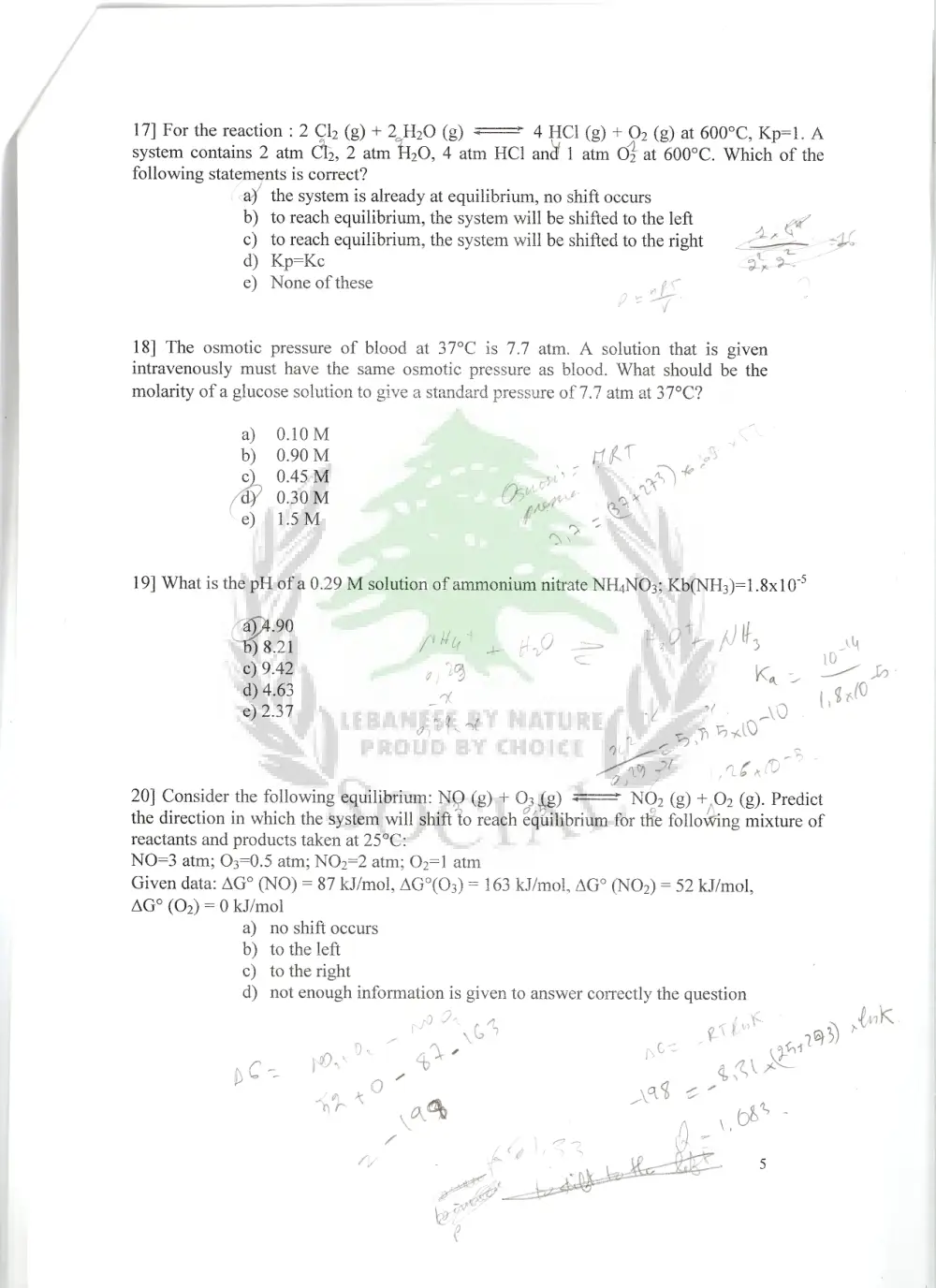
17] For the reaction : 2 Cl (g) + 2,H2O (g) === 4 HCl (g) + Oe (g) at 600°C, Kp=1. A
system contains 2 atm Ch, 2 atm io, 4 atm HCl] and 1 atm of at 600°C. Which of the
following statements is correct?
a) the system is already at equilibrium, no shift occurs
b) to reach equilibrium, the system will be shifted to the left 7
c) to reach equilibrium, the system will be shifted to the right Zeek
d) Kp=Ke a 2
e) None of these p
18] The osmotic pressure of blood at 37°C is 7.7 atm. A solution that is given
intravenously must have the same osmotic pressure as blood. What should be the
molarity of a glucose solution to give a standard pressure of 7.7 atm at 37°C?
a) 0.10M ;
b) 0.90M ak mp
2). 0.45 M py, a ao)”
fay 030M om ae
e) 15M f! aN
90 A Hey / ale Fh A I. ul
) 8.21 Tat / Te > ip
c) 9.42 1,3 Ke —~_b
d) 4.63 - 1 9 x(0
e) 2.37 EGER | V ¢ rE"
Gi le 8
20] Consider the following equilibrium: NO (g) + O3 (g) —— NO) (g) +,O2 nm Predict
the direction in which the system will shift to reach equilibrium for the following mixture of
reactants and products taken at 25°C:
NO=3 atm; O3=0.5 atm; NO2=2 atm; O2=1 atm
Given data: AG° (NO) = 87 kJ/mol, AG°(O3) = 163 kJ/mol, AG° (NO) = 52 kJ/mol,
AG° (O2) = 0 kJ/mol
a) no shift occurs
b) to the left
c) to the right
d) not enough information is given to answer correctly the question
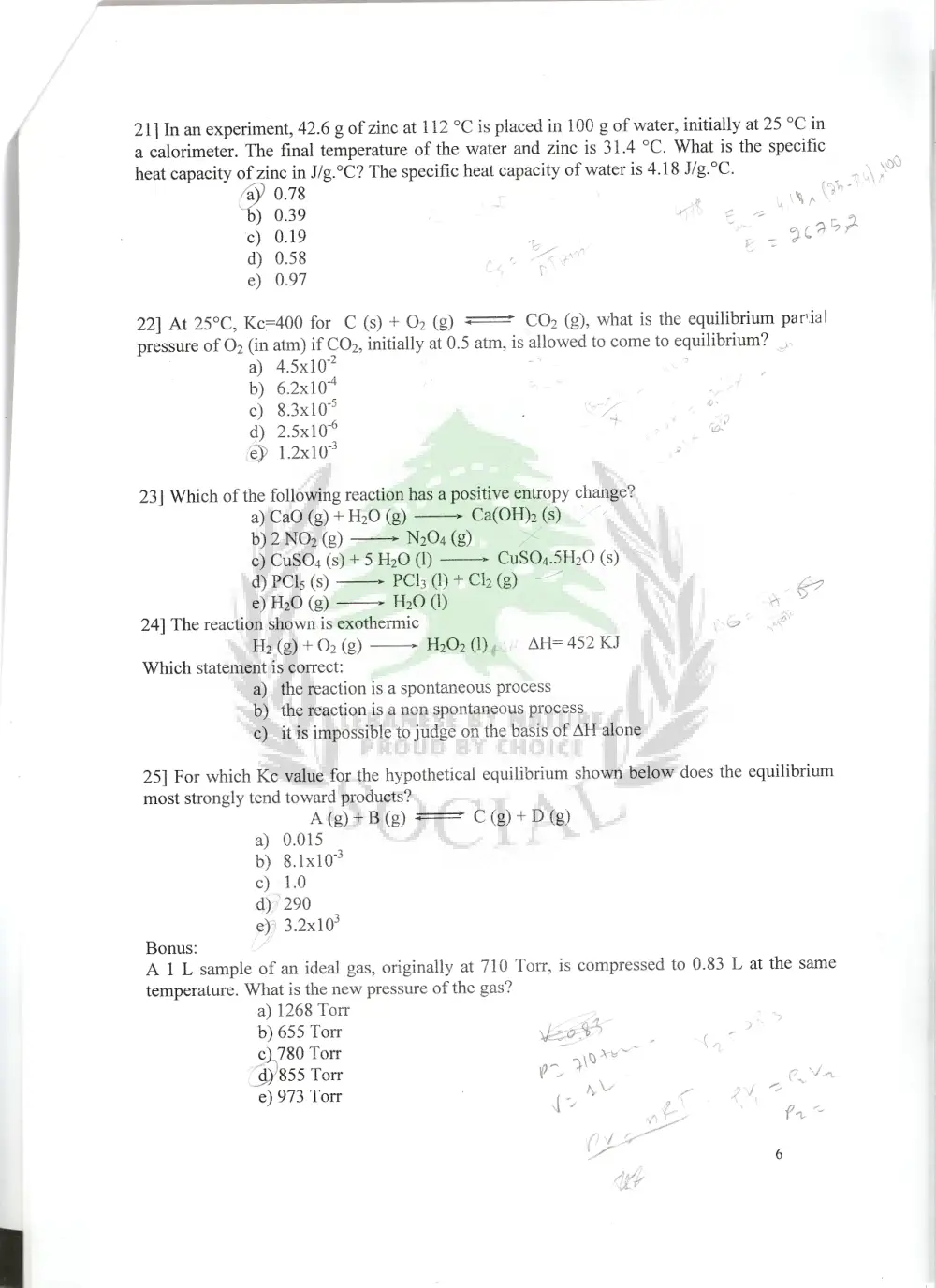
21] In an experiment, 42.6 g of zine at 112 °C is placed in 100 g of water, initially at 25 °C in
a calorimeter. The final temperature of the water and zinc is 31.4 °C. What is the specific
heat capacity of zinc in J/g.°C? The specific heat capacity of water is 4.18 J/g.°C.
a) 0.78
b) 0.39 f gE <a 4
ce) 0.19 * 90777
d) 0.58 oe
e) 0.97
22] At 25°C, Ke=400 for C (s) + OQ (g) === CO2 (g), what is the equilibrium parial
pressure of O> (in atm) if COp, initially at 0.5 atm, is allowed to come to equilibrium?
a) 4.5x10⁷
b) 6.2x10
c) 8.3x10°
d) 2.5x10°
ep 1.2x10°
23] Which of the following reaction has a positive entropy change?
a) CaO (g) + HO (g) ——> Ca(OH), (s)
b) 2 NO> (g) > N2Ozq (g)
c) CuSO, (s) + 5 HxO (1) ——> CuS0Oz.5H20 (s)
d) PCls (s) > PCI; (1) + Ch (g) yo
e) H,0 (g) ——> 20 @) a’
24] The reaction shown is exothermic
Hp (g) + O2 (g) » HO) (I), AH= 452 KJ
Which statement is correct:
a) the reaction is a spontaneous process
b) the reaction is a non spontaneous process
c) it is impossible to judge on the basis of AH alone
25] For which Ke value for the hypothetical equilibrium shown below does the equilibrium
most strongly tend toward products?
A(g)+B(g) === C(g)+Dg)
a) 0.015
b) 8.1x10°
c) 1.0
d) 290
ey) 3.2x10°
Bonus:
A 1L sample of an ideal gas, originally at 710 Torr, is compressed to 0.83 L at the same
temperature. What is the new pressure of the gas?
a) 1268 Torr
b) 655 Torr eo%”
c). 780 Torr 4\0>
dy 855 Torr ~U 7
e) 973 Torr (
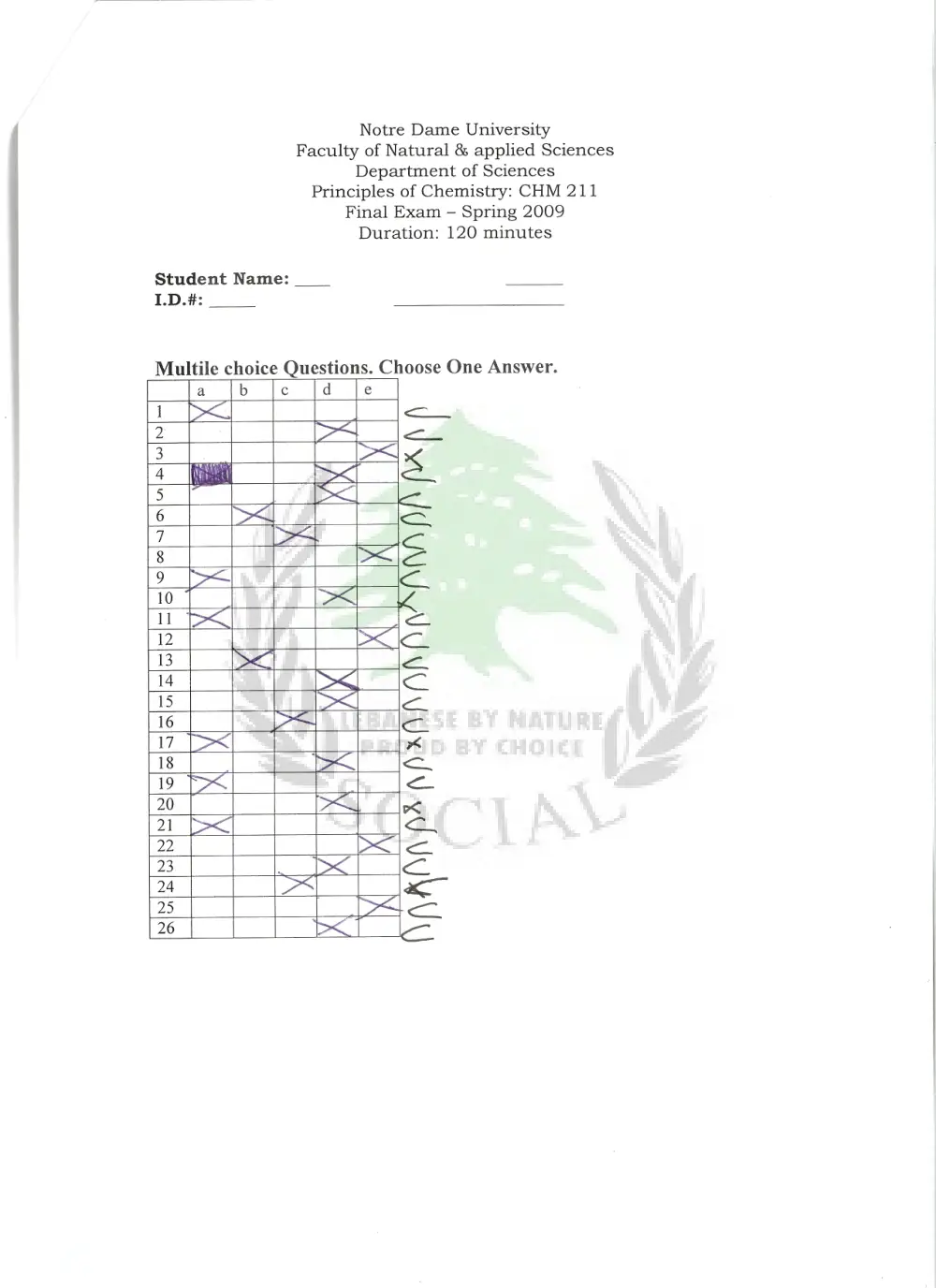
Student Name:
LD.#:
Notre Dame University
Faculty of Natural & applied Sciences
Department of Sciences
Principles of Chemistry: CHM 211
Final Exam — Spring 2009
Duration: 120 minutes
Multile choice Questions. Choose One Answer.
b a
d e
i
K
WOlLONI Di Mn!) Bi] Wl Ny) —
2
a
o
a
WIND
—
&
—
Nn
—
n
—
~
=
—
Co
:
NX
Oo
N
—
N
N
N
we
K
Y
nN
n
N
an
(VARNA AD RR ORD VSISIADI fo fi
X