
CHM 215 Final, Fall 2009
Notre Dame University–Louaize · Quantitative Analysis · 9 pages

More CHM 215 files
Show the text of this final exam
Notre Dame University
Faculty of Natural and Applied Sciences
Department of Sciences
Quantitative Analysis / CHM 215
Final Exam — Duration: 120 minutes
Spring 2009
}
Student Name: ID#:
}
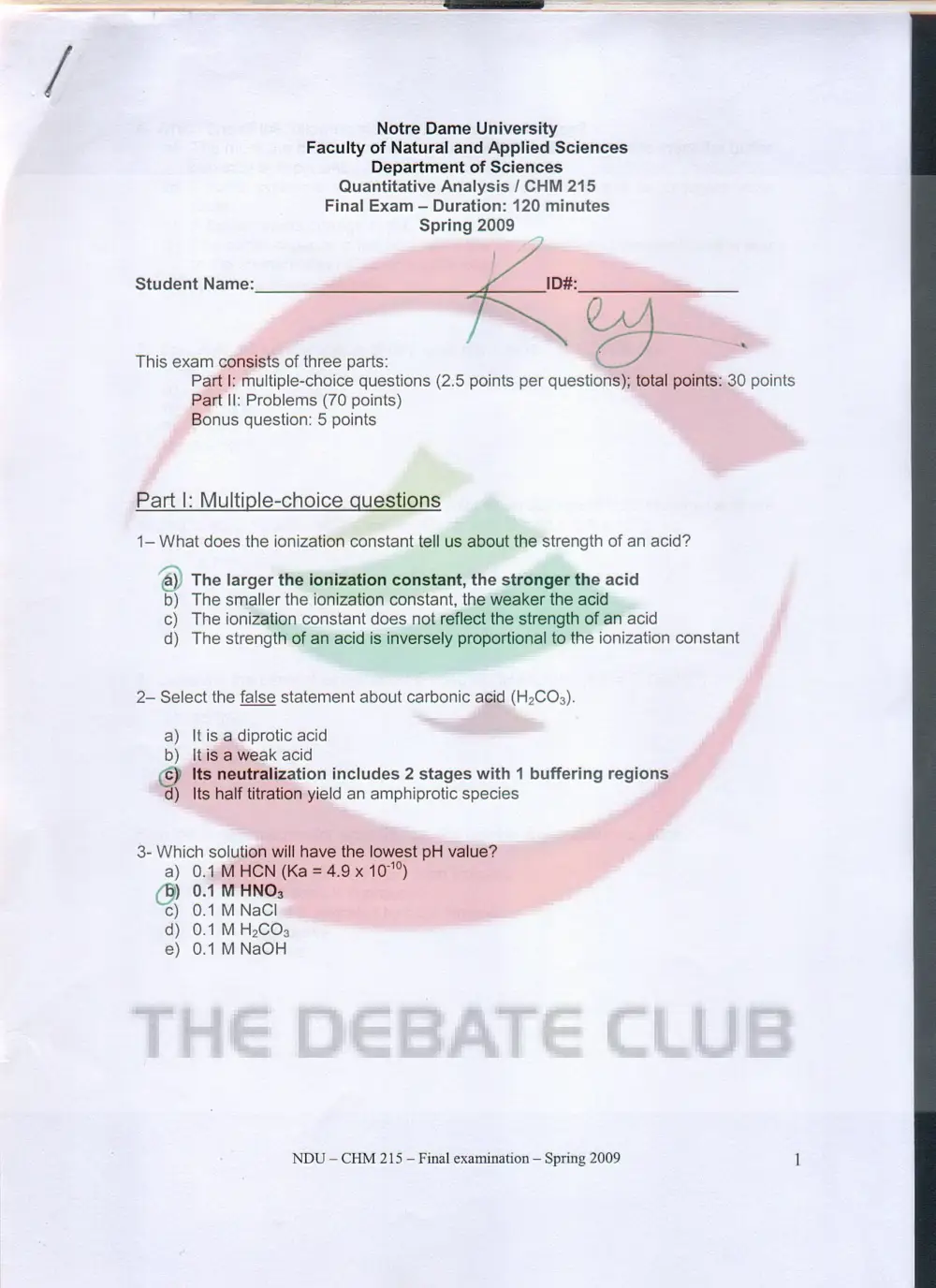
This exam consists of three parts:
Part I: multiple-choice questions (2.5 points per questions); total points: 30 points
Part II: Problems (70 points)
Bonus question: 5 points
Part |: Multiple-choice questions
1— What does the ionization constant tell us about the strength of an acid?
@ The larger the ionization constant, the stronger the acid
b) The smaller the ionization constant, the weaker the acid
c) The ionization constant does not reflect the strength of an acid
d) The strength of an acid is inversely proportional to the ionization constant
2- Select the false statement about carbonic acid (H2COs3).
a) Itis a diprotic acid
b) Itis a weak acid
© Its neutralization includes 2 stages with 1 buffering regions
d) Its half titration yield an amphiprotic species
3- Which solution will have the lowest pH value?
a) 0.1 MHCN (Ka = 4.9 x 10")
(8) 0.1 MHNO,;
“c) 0.1 MNaCl
d) 0.1 MH2CO;
e) 0.1 MNaOH
NDU — CHM 215 — Final examination — Spring 2009 1
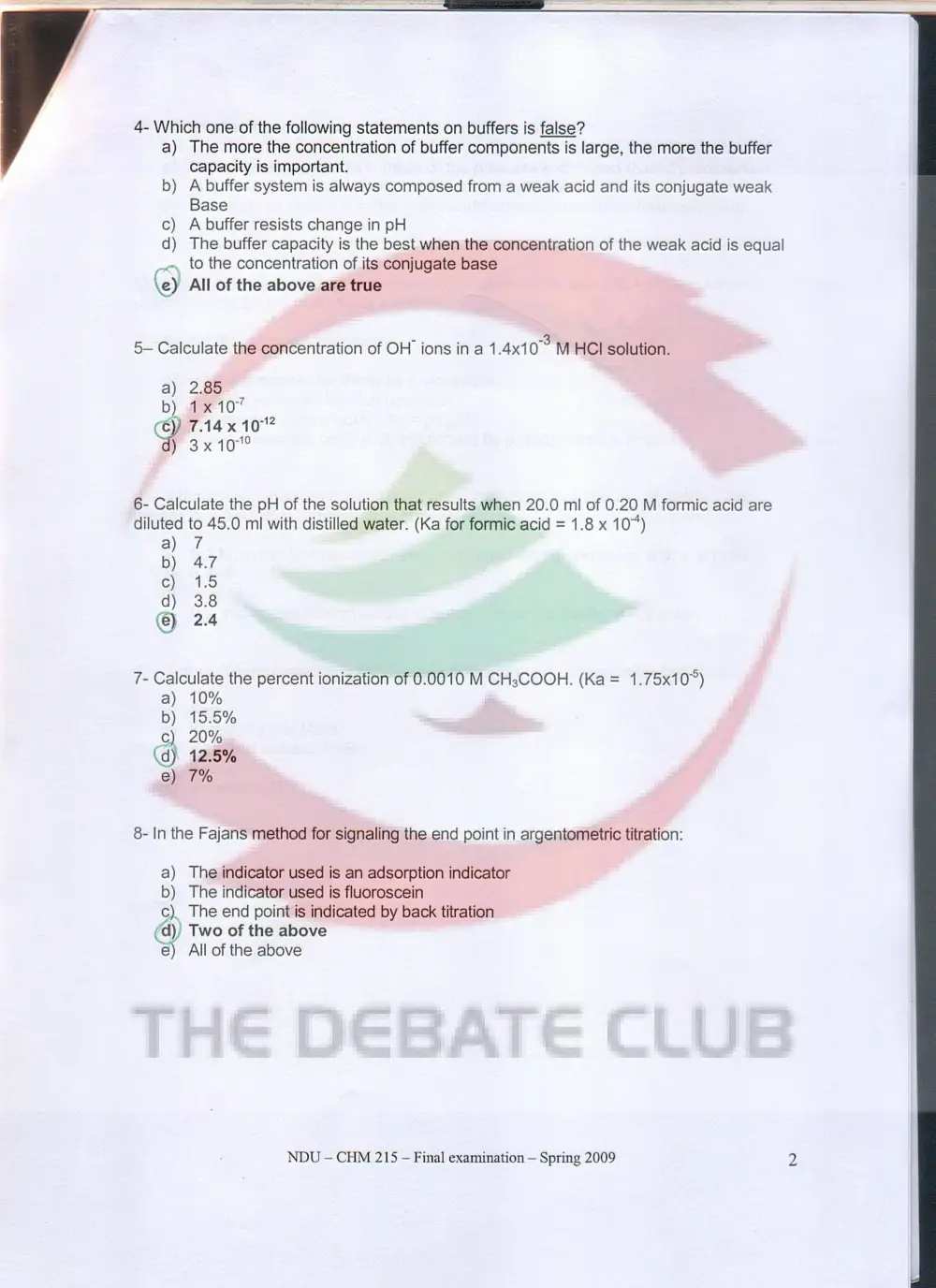
4- Which one of the following statements on buffers is false?
a) The more the concentration of buffer components is large, the more the buffer
capacity is important.
b) A buffer system is always composed from a weak acid and its conjugate weak
Base
) A buffer resists change in pH
) The buffer capacity is the best when the concentration of the weak acid is equal
_-, to the concentration of its conjugate base
(e) All of the above are true
5~ Calculate the concentration of OH’ ions in a 1.4x10° M HCI solution.
a) 2.85
b) 1x10”
(€)) 7.14 x 10⁷
y 3x10°
6- Calculate the pH of the solution that results when 20.0 ml of 0.20 M formic acid are
diluted to 45.0 ml with distilled water. (Ka for formic acid = 1.8 x 10°)
af
b) 4.7
Ce = 1,5)
d) 3.8
@) 2.4
7- Calculate the percent ionization of 0.0010 M CHsCOOH. (Ka = 1.75x10°)
a) 10%
b) 15.5%
c) 20%
@) 12.5%
ey 1%
8- In the Fajans method for signaling the end point in argentometric titration:
a) The indicator used is an adsorption indicator
b) The indicator used is fluoroscein
c). The end point is indicated by back titration
(d)) Two of the above
6) All of the above
NDU — CHM 215 — Final examination — Spring 2009
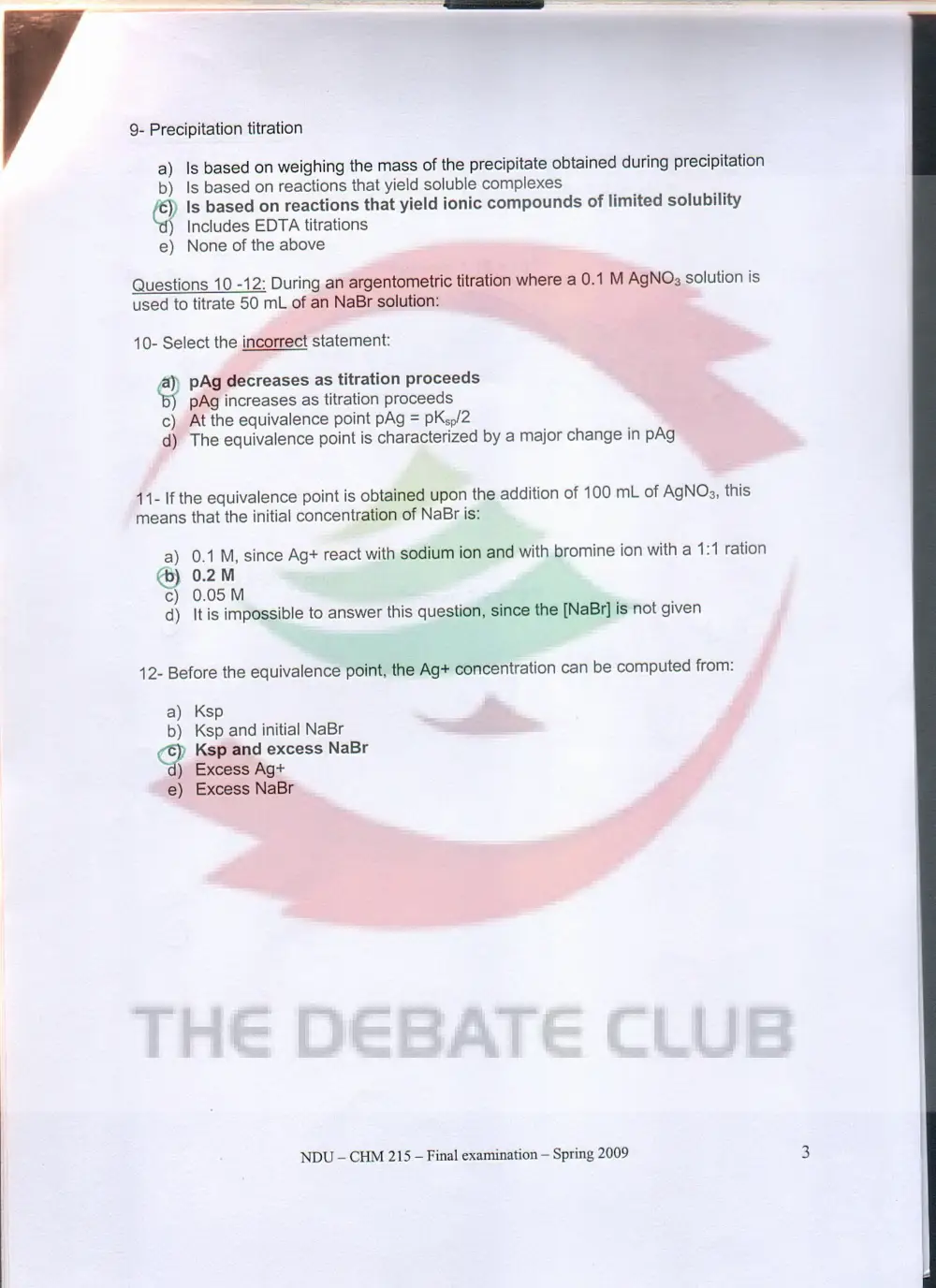
9- Precipitation titration
a) Is based on weighing the mass of the precipitate obtained during precipitation
b) Is based on reactions that yield soluble complexes
@ Is based on reactions that yield ionic compounds of limited solubility
) Includes EDTA titrations
e) None of the above
Questions 10 -12: During an argentometric titration where a 0.1 M AgNO; solution is
used to titrate 50 mL of an NaBr solution:
40- Select the incorrect statement:
4). pAg decreases as titration proceeds
ay) pAg increases as titration proceeds
c) At the equivalence point pAg = pKg,/2
d) The equivalence point is characterized by a major change in pAg
11- If the equivalence point is obtained upon the addition of 100 mL of AgNOs, this
means that the initial concentration of NaBr is:
a
Re
c)
))
) 0.1 M, since Ag+ react with sodium ion and with bromine ion with a 1:1 ration
) 0.2M
0.05 M
It is impossible to answer this question, since the [NaBr] is not given
42- Before the equivalence point, the Ag+ concentration can be computed from:
a) Ksp
b) Ksp and initial NaBr
ct) Ksp and excess NaBr
“d) Excess Ag+
e) Excess NaBr
NDU — CHM 215 — Final examination — Spring 2009
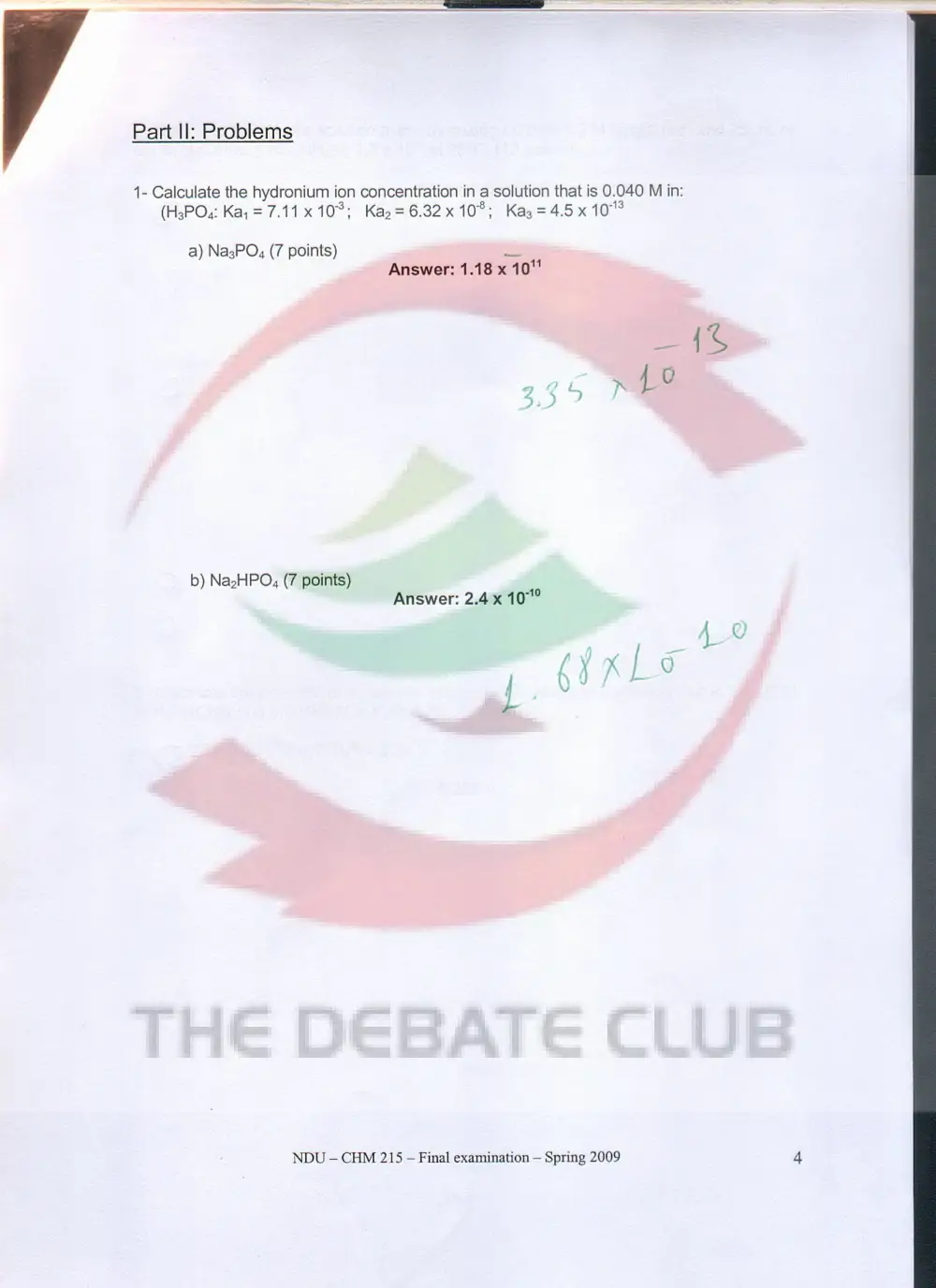
Part Il: Problems
1- Calculate the hydronium ion concentration in a solution that is 0.040 M in:
(HsPOu: Ka; = 7.11 x 10°; Ka, =6.32x 10°; Kas =4.5 x 10°
a) Na3PO, (7 points) es
Answer: 1.18 x 10"
b) NasHPO, (7 points)
Answer: 2.4 x 10⁷°
NDU — CHM 215 - Final examination — Spring 2009
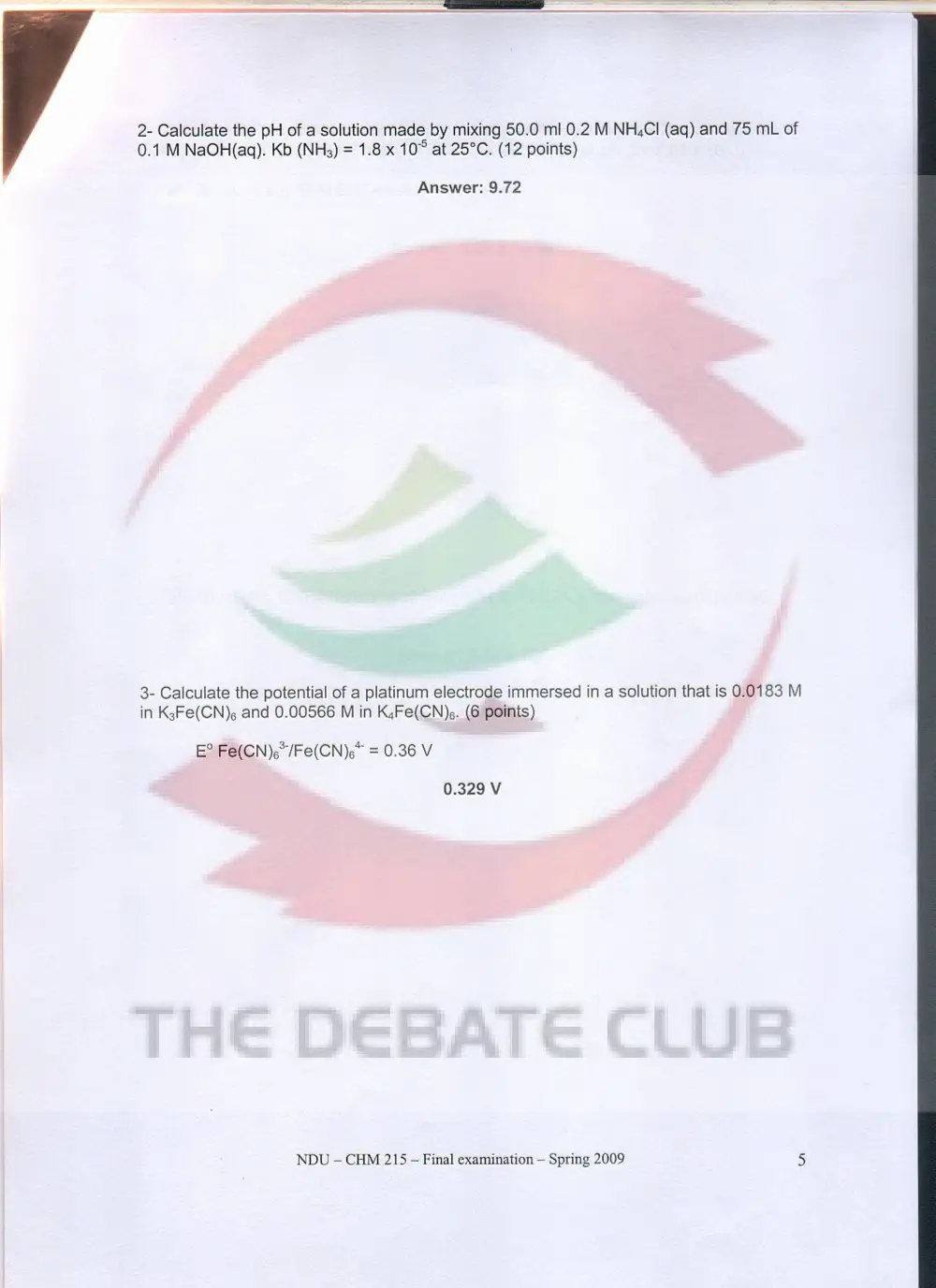
2- Calculate the pH of a solution made by mixing 50.0 ml 0.2 M NH,CI (aq) and 75 mL of
0.1 M NaOH(aq). Kb (NH3) = 1.8 x 10° at 25°C. (12 points)
Answer: 9.72
3- Calculate the potential of a platinum electrode immersed in a solution that is 0.0183 M
in K3Fe(CN)s and 0.00566 M in K,Fe(CN)g. (6 points)
E° Fe(CN).*/Fe(CN).* = 0.36 V
0.329 V
NDU — CHM 215 — Final examination — Spring 2009 5
4- Calculate Ni** concentration in a solution that is buffered to a pH of 3 and prepared by
mixing 50.0 ml of 0.025 M Ni?" with: (Kyiy* = 4.2 x10¹⁸ ; a4 at pH 3 = 2.51 x 10⁷’)
a) 25 mL of a0.05 M EDTA solution (8 points)
Answer: 1.26 x 10°M
b) 50 ml of a 1.86% (m/v or g/100mL) EDTA (372.24 g/mol) solution. (8 points)
Answer: 9.52 x 10°
NDU — CHM 215 — Final examination — Spring 2009 6
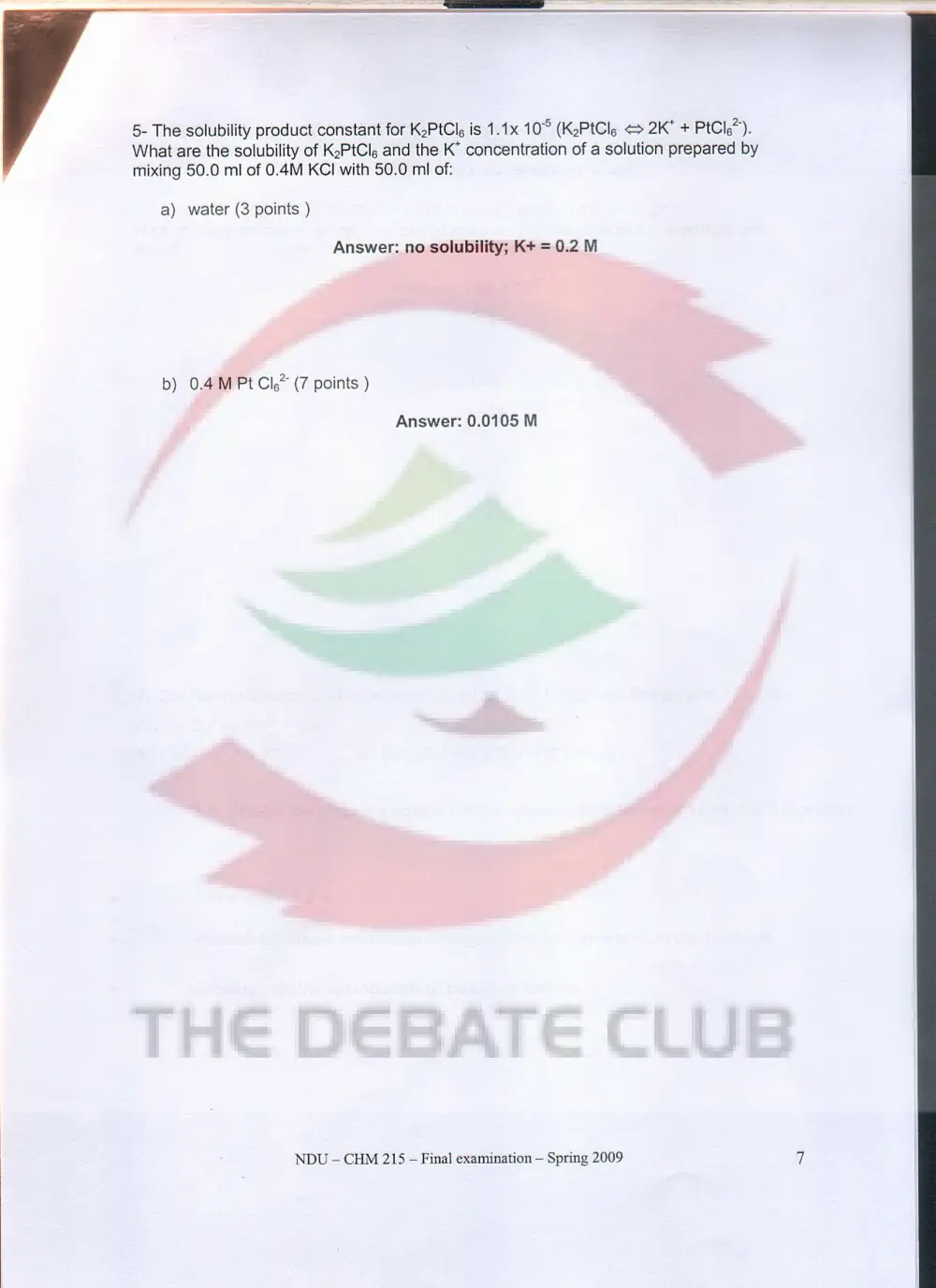
5- The solubility product constant for K2PtCl, is 1.1x 10° (K2PtCle <> 2K" + PtCl,”).
What are the solubility of K,PtCls and the K* concentration of a solution prepared by
mixing 50.0 ml of 0.4M KCl with 50.0 ml of:
a) water (3 points )
Answer: no solubility; K+ = 0.2 M
b) 0.4MPt Cl,* (7 points )
Answer: 0.0105 M
NDU — CHM 215 — Final examination — Spring 2009 i
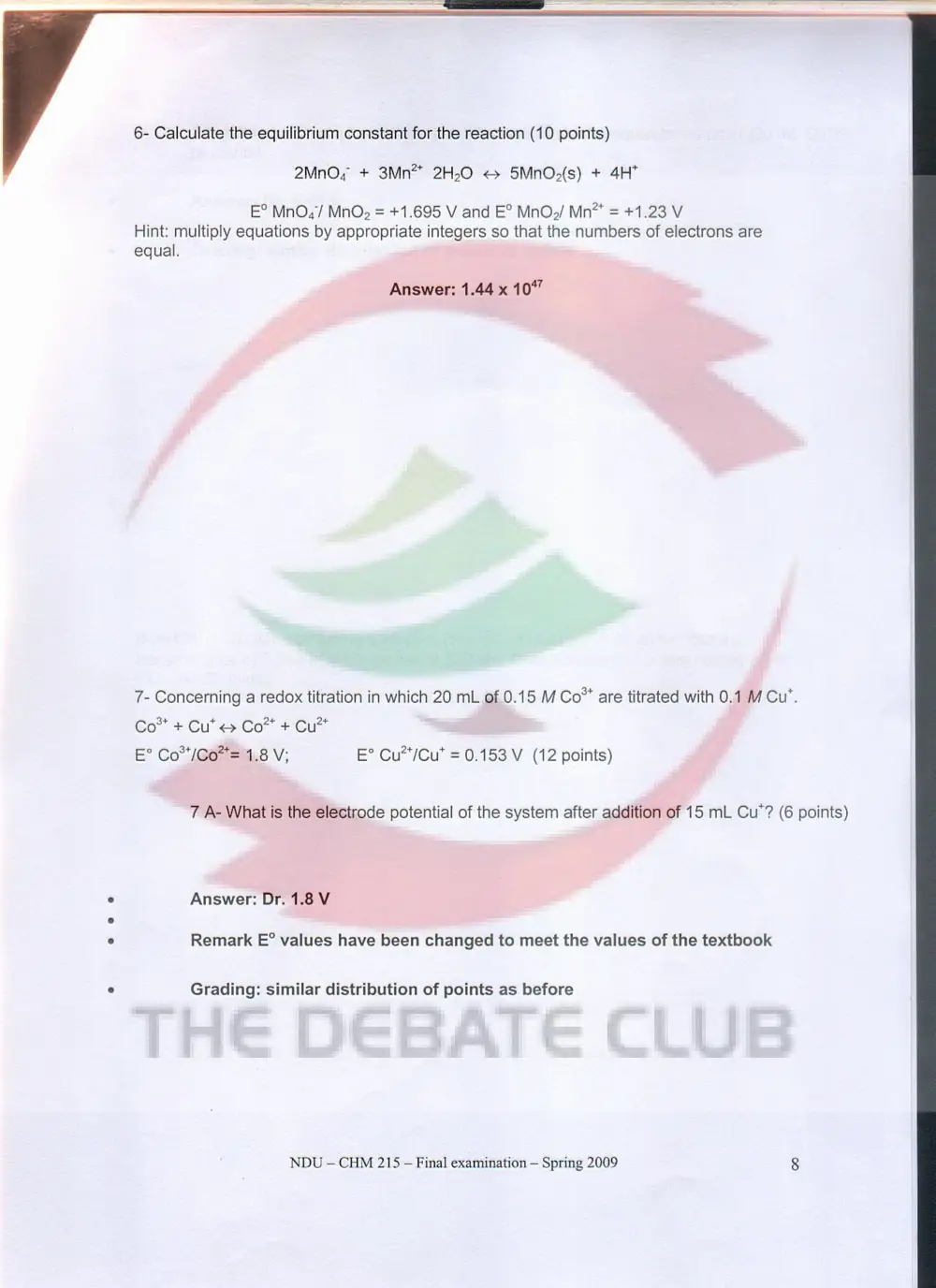
6- Calculate the equilibrium constant for the reaction (10 points)
2MnO, + 3Mn** 2H,0 <> 5MnOz(s) + 4H*
E° MnOz/ MnO> = +1.695 V and E° MnO./ Mn** = +1.23 V
Hint: multiply equations by appropriate integers so that the numbers of electrons are
equal.
Answer: 1.44 x 10°”
7- Concerning a redox titration in which 20 mL of 0.15 M Co” are titrated with 0.1 M Cu’.
Co* + Cu’ <> Co™ + Cu*
E° Co**/G6"=11..8 V; E° Cu**/Cu* = 0.153 V (12 points)
7 A- What is the electrode potential of the system after addition of 15 mL Cu’? (6 points)
° Answer: Dr. 1.8 V
e
e Remark E° values have been changed to meet the values of the textbook
° Grading: similar distribution of points as before
NDU — CHM 215 — Final examination — Spring 2009 8
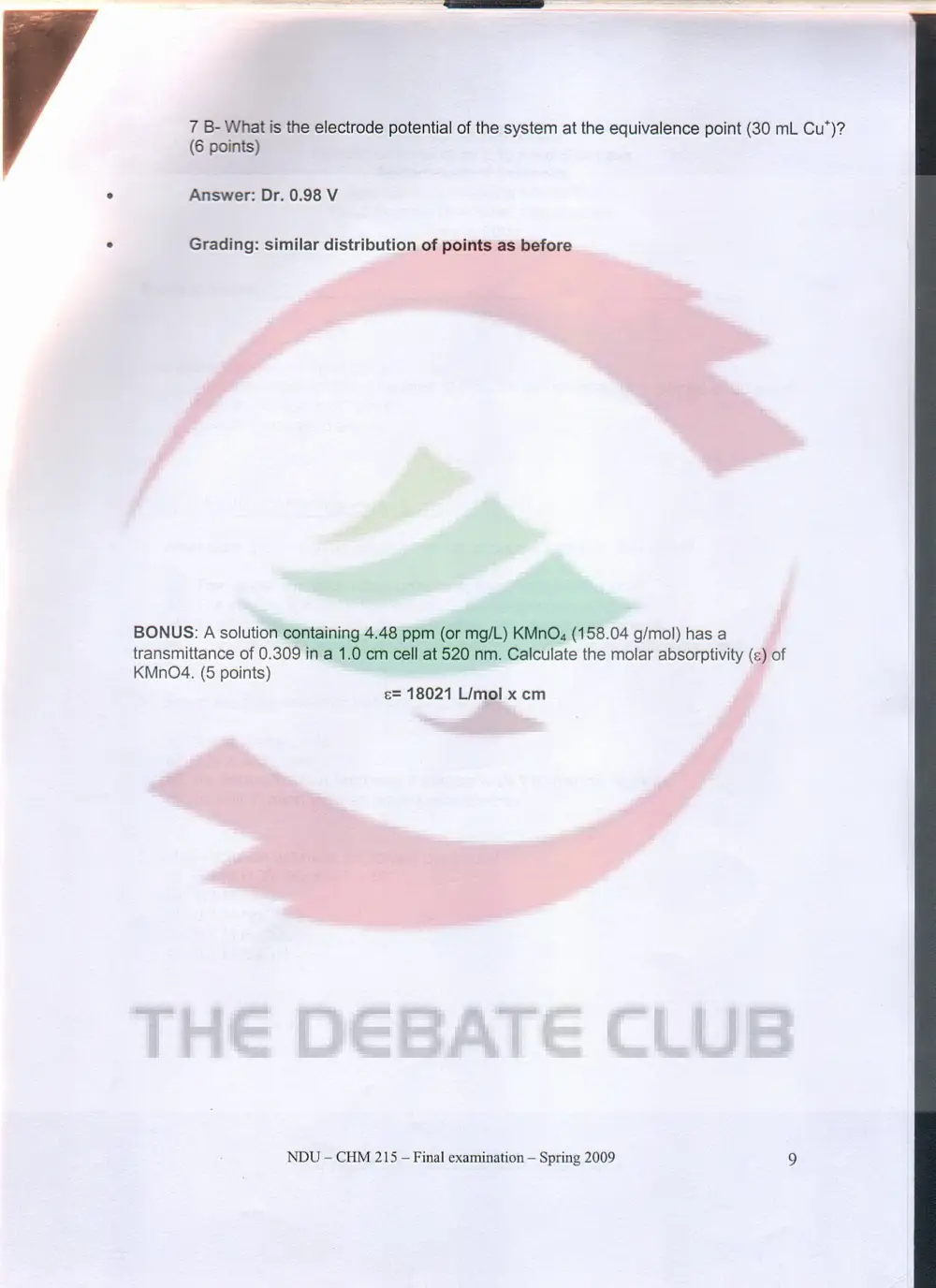
7 B- Whatis the electrode potential of the system at the equivalence point (30 mL Cu’)?
(6 points)
° Answer: Dr. 0.98 V
° Grading: similar distribution of points as before
BONUS: A solution containing 4.48 ppm (or mg/L) KMnO, (158.04 g/mol) has a
transmittance of 0.309 in a 1.0 cm cell at 520 nm. Calculate the molar absorptivity (<) of
KMnO4. (5 points)
e= 18021 L/mol x cm
NDU — CHM 215 - Final examination — Spring 2009 9