
CSC 414 Final, Spring 2009
Notre Dame University–Louaize · Applied Operating Systems · 6 pages

More CSC 414 files
Show the text of this final exam
Notre Dame University
CSC 414 Applied Operating Systems
Final
Fall 2009
Duration: 2 Hours
Name:
ID:
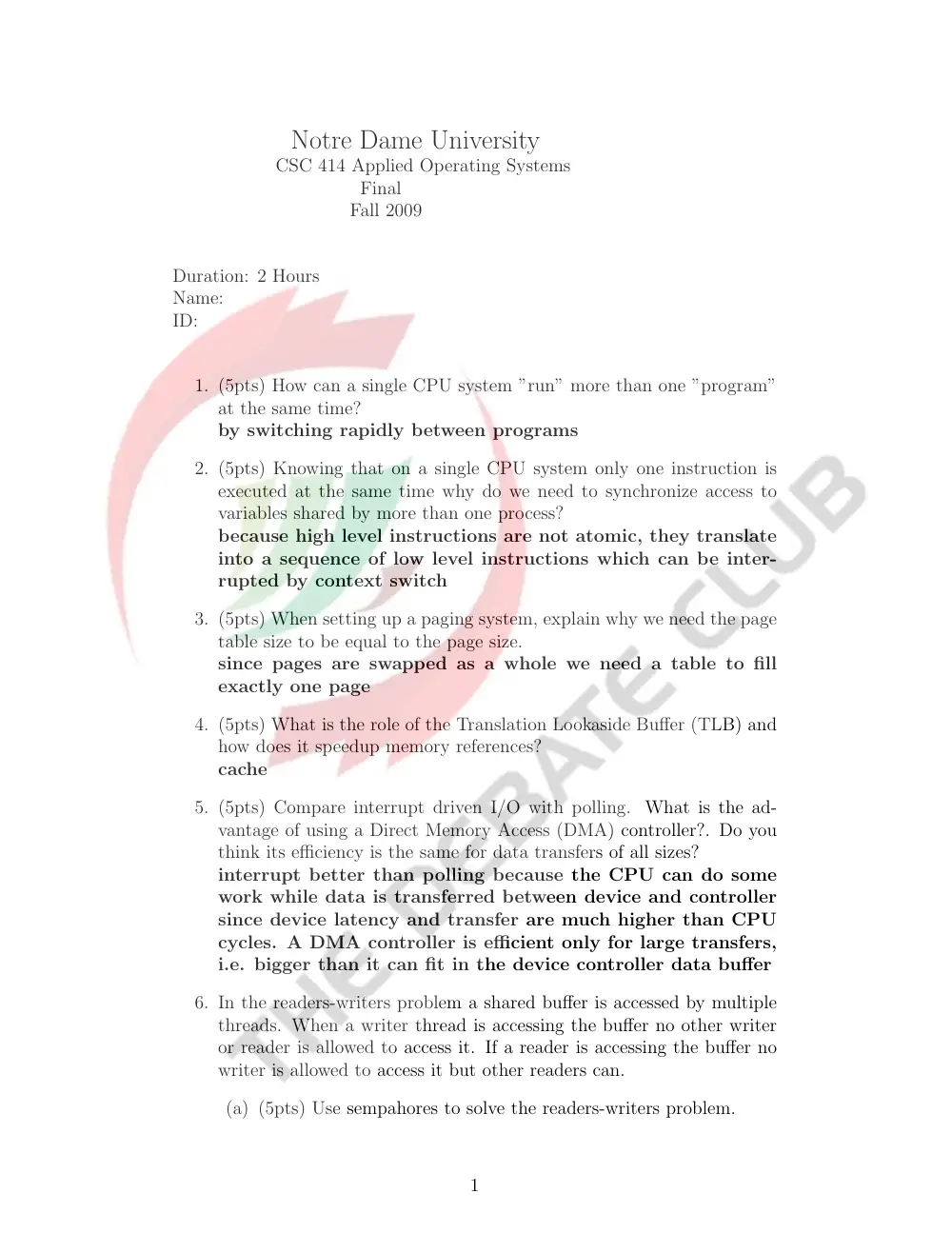
1. (5pts) How can a single CPU system ”run” more than one ”program”
at the same time?
by switching rapidly between programs
2. (5pts) Knowing that on a single CPU system only one instruction is
executed at the same time why do we need to synchronize access to
variables shared by more than one process?
because high level instructions are not atomic, they translate
into a sequence of low level instructions which can be inter-
rupted by context switch
3. (5pts) When setting up a paging system, explain why we need the page
table size to be equal to the page size.
since pages are swapped as a whole we need a table to fill
exactly one page
4. (5pts) What is the role of the Translation Lookaside Buffer (TLB) and
how does it speedup memory references?
cache
5. (5pts) Compare interrupt driven I/O with polling. What is the ad-
vantage of using a Direct Memory Access (DMA) controller?. Do you
think its efficiency is the same for data transfers of all sizes?
interrupt better than polling because the CPU can do some
work while data is transferred between device and controller
since device latency and transfer are much higher than CPU
cycles. A DMA controller is efficient only for large transfers,
i.e. bigger than it can fit in the device controller data buffer
6. In the readers-writers problem a shared buffer is accessed by multiple
threads. When a writer thread is accessing the buffer no other writer
or reader is allowed to access it. If a reader is accessing the buffer no
writer is allowed to access it but other readers can.
(a) (5pts) Use sempahores to solve the readers-writers problem.
1
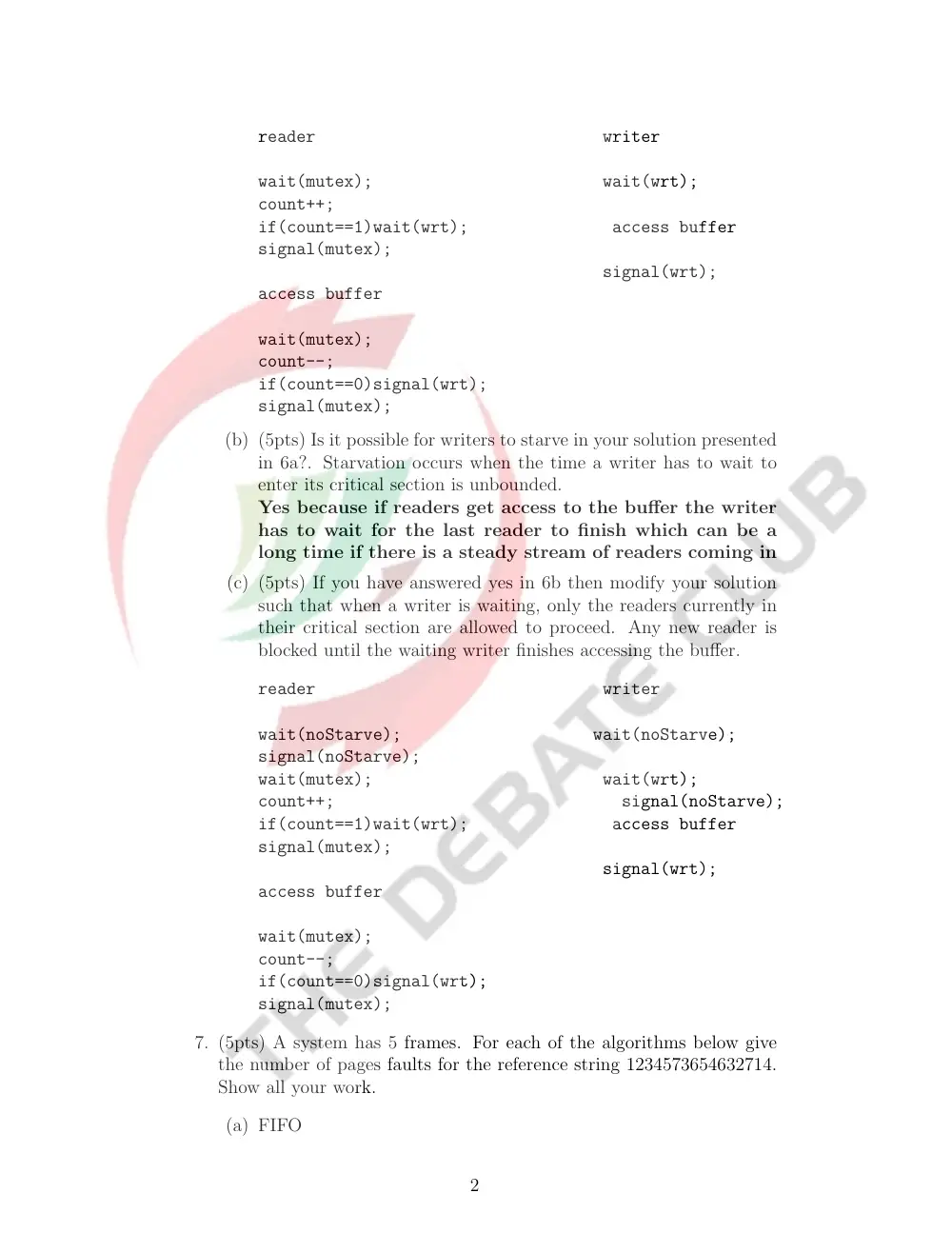
reader
writer
wait(mutex);
wait(wrt);
count++;
if(count==1)wait(wrt);
access buffer
signal(mutex);
signal(wrt);
access buffer
wait(mutex);
count--;
if(count==0)signal(wrt);
signal(mutex);
(b) (5pts) Is it possible for writers to starve in your solution presented
in 6a?. Starvation occurs when the time a writer has to wait to
enter its critical section is unbounded.
Yes because if readers get access to the buffer the writer
has to wait for the last reader to finish which can be a
long time if there is a steady stream of readers coming in
(c) (5pts) If you have answered yes in 6b then modify your solution
such that when a writer is waiting, only the readers currently in
their critical section are allowed to proceed. Any new reader is
blocked until the waiting writer finishes accessing the buffer.
reader
writer
wait(noStarve);
wait(noStarve);
signal(noStarve);
wait(mutex);
wait(wrt);
count++;
signal(noStarve);
if(count==1)wait(wrt);
access buffer
signal(mutex);
signal(wrt);
access buffer
wait(mutex);
count--;
if(count==0)signal(wrt);
signal(mutex);
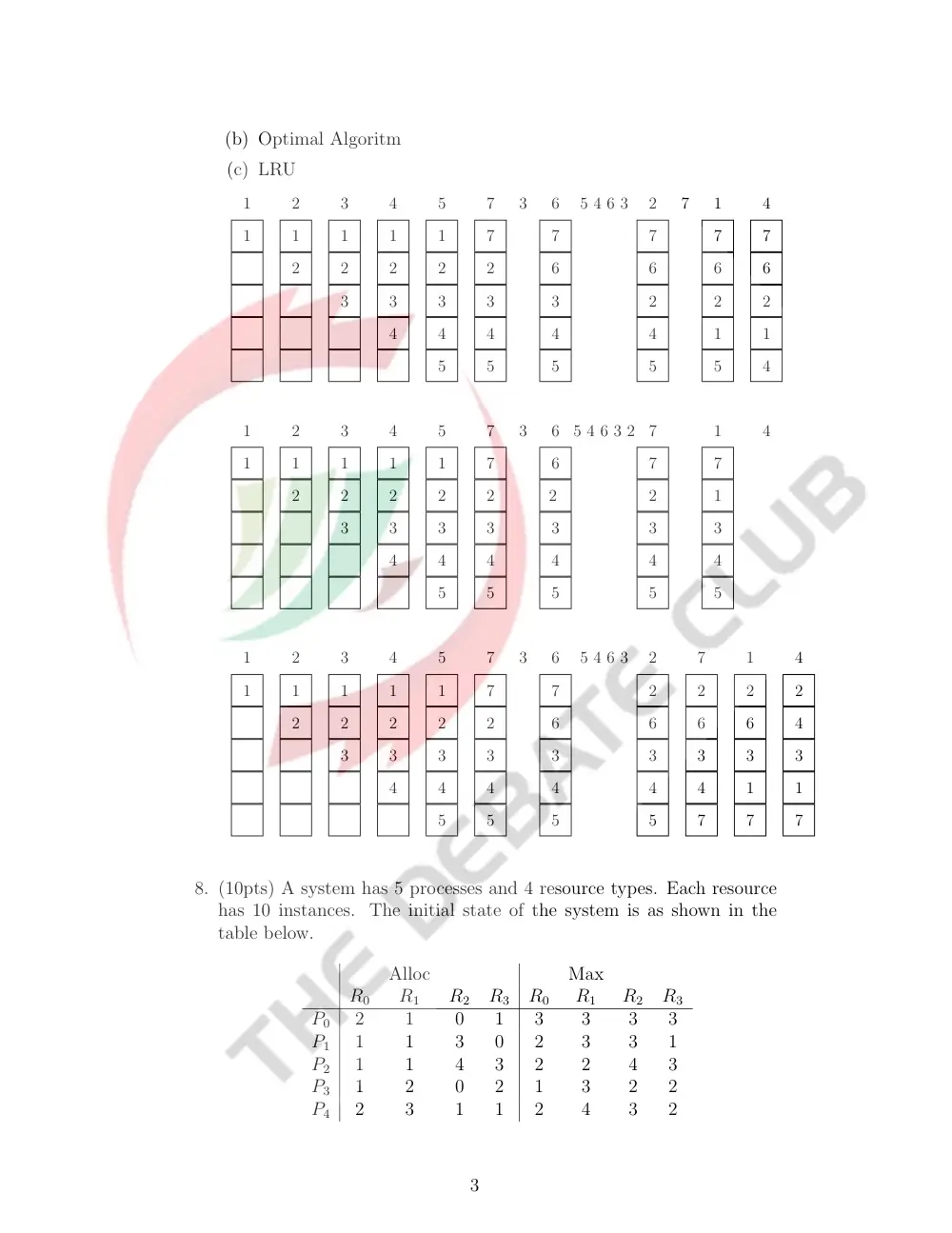
7. (5pts) A system has 5 frames. For each of the algorithms below give
the number of pages faults for the reference string 1234573654632714.
Show all your work.
(a) FIFO
2
(b) Optimal Algoritm
(c) LRU
1
1
2
1
2
3
1
2
3
4
1
2
3
4
5
1
2
3
4
5
7
7
2
3
4
5
3
6
7
6
3
4
5
5 4 6 3
2
7
6
2
4
5
7
1
7
6
2
1
5
4
7
6
2
1
4
1
1
2
1
2
3
1
2
3
4
1
2
3
4
5
1
2
3
4
5
7
7
2
3
4
5
3
6
6
2
3
4
5
5 4 6 3 2
7
7
2
3
4
5
1
7
1
3
4
5
4
1
1
2
1
2
3
1
2
3
4
1
2
3
4
5
1
2
3
4
5
7
7
2
3
4
5
3
6
7
6
3
4
5
5 4 6 3
2
2
6
3
4
5
7
2
6
3
4
7
1
2
6
3
1
7
4
2
4
3
1
7
1
8. (10pts) A system has 5 processes and 4 resource types. Each resource
has 10 instances. The initial state of the system is as shown in the
table below.
Alloc
Max
R0
R1
R2
R3
R0
R1
R2
R3
P0
2
1
0
1
3
3
3
3
P1
1
1
3
0
2
3
3
1
P2
1
1
4
3
2
2
4
3
P3
1
2
0
2
1
3
2
2
P4
2
3
1
1
2
4
3
2
3
Use the Banker’s algorithm to test whether the following requests are
granted or denied, always starting from the initial state given above.
Show all your work.
(a) Request (1,2,1,1) by P0.
no safe sequence
(b) Request (1,1,2,1) by P0.
2,0,1,3,4 is a safe sequence
(c) Request (1,1,1,1) by P2.
request >need, request denied
9. (15pts)An inode in a 32-bit filesystem has 10 direct, 1 indirect, 1 double
indirect, and 1 triple indirect pointers. The filesystem uses 1KB blocks
on a disk that has 4000 tracks and 64 sectors per track. The size of the
sector is 64 bytes and the first two tracks are used to store the inodes.
Show all your work
(a) What is the maximum number of files that can be created.
(b) What is the maximum file size.
(c) If it takes 10 ms to read 1 block, how long does it take to read a
file which has the maximum file size. Assume that the inode of
the file is already cached in memory and that any block read from
disk is cached in memory (i.e no block needs to be read twice from
disk)
(d) How long does it take to read the same file if we use the linked
list method.
Solution
(a) Total size of an inode=4×(10+1+1+1) = 52 bytes. Total size of
the first two tracks=2 × 64 × 64 = 8192 bytes. Maximum number
of inodes=8192
52 = 157 =maximum number of files.
(b) A block stores 256 pointers therefore the maximum file size is:
10 + 256 + 2562 + 2563 = 16843018 blocks≈ 16GB.
(c) In addition to the date blocks we need to read blocks containing
pointers: 1 for indirect+(1+256) for double indirect+(1 + 256 +
2562) for triple indirect. Total blocks containing pointers=66051
blocks we add to that 16843018 data blocks to get a total of
16909069 blocks. Time to read the max file is 169090 seconds
(d) For the link list method each block contains 1024-4=1020 bytes of
data therefore the total number of blocks to be read is 16843018×1024
1020
4
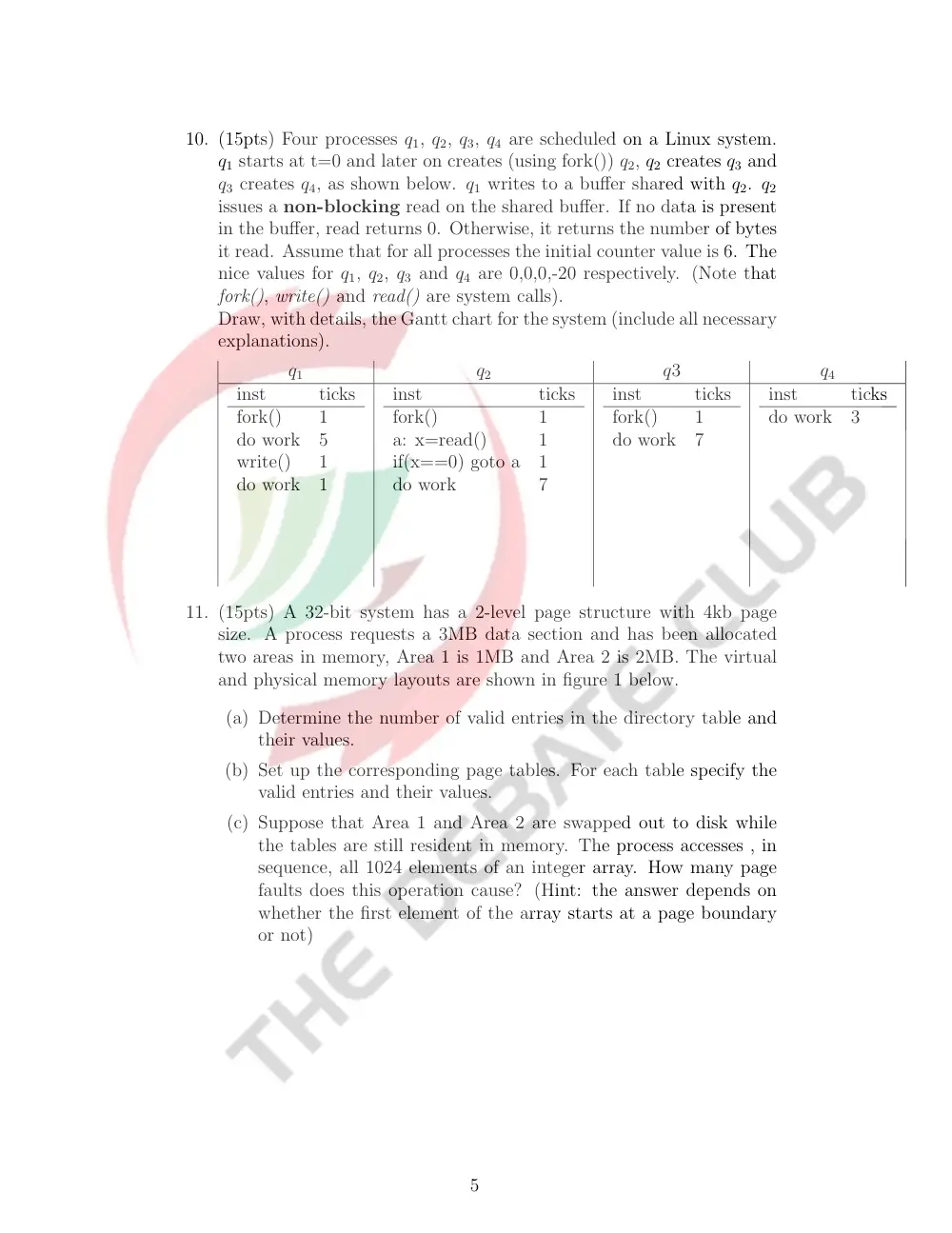
10. (15pts) Four processes q1, q2, q3, q4 are scheduled on a Linux system.
q1 starts at t=0 and later on creates (using fork()) q2, q2 creates q3 and
q3 creates q4, as shown below. q1 writes to a buffer shared with q2. q2
issues a non-blocking read on the shared buffer. If no data is present
in the buffer, read returns 0. Otherwise, it returns the number of bytes
it read. Assume that for all processes the initial counter value is 6. The
nice values for q1, q2, q3 and q4 are 0,0,0,-20 respectively. (Note that
fork(), write() and read() are system calls).
Draw, with details, the Gantt chart for the system (include all necessary
explanations).
q1
q2
q3
q4
inst
ticks
fork()
1
do work
5
write()
1
do work
1
inst
ticks
fork()
1
a: x=read()
1
if(x==0) goto a
1
do work
7
inst
ticks
fork()
1
do work
7
inst
ticks
do work
3
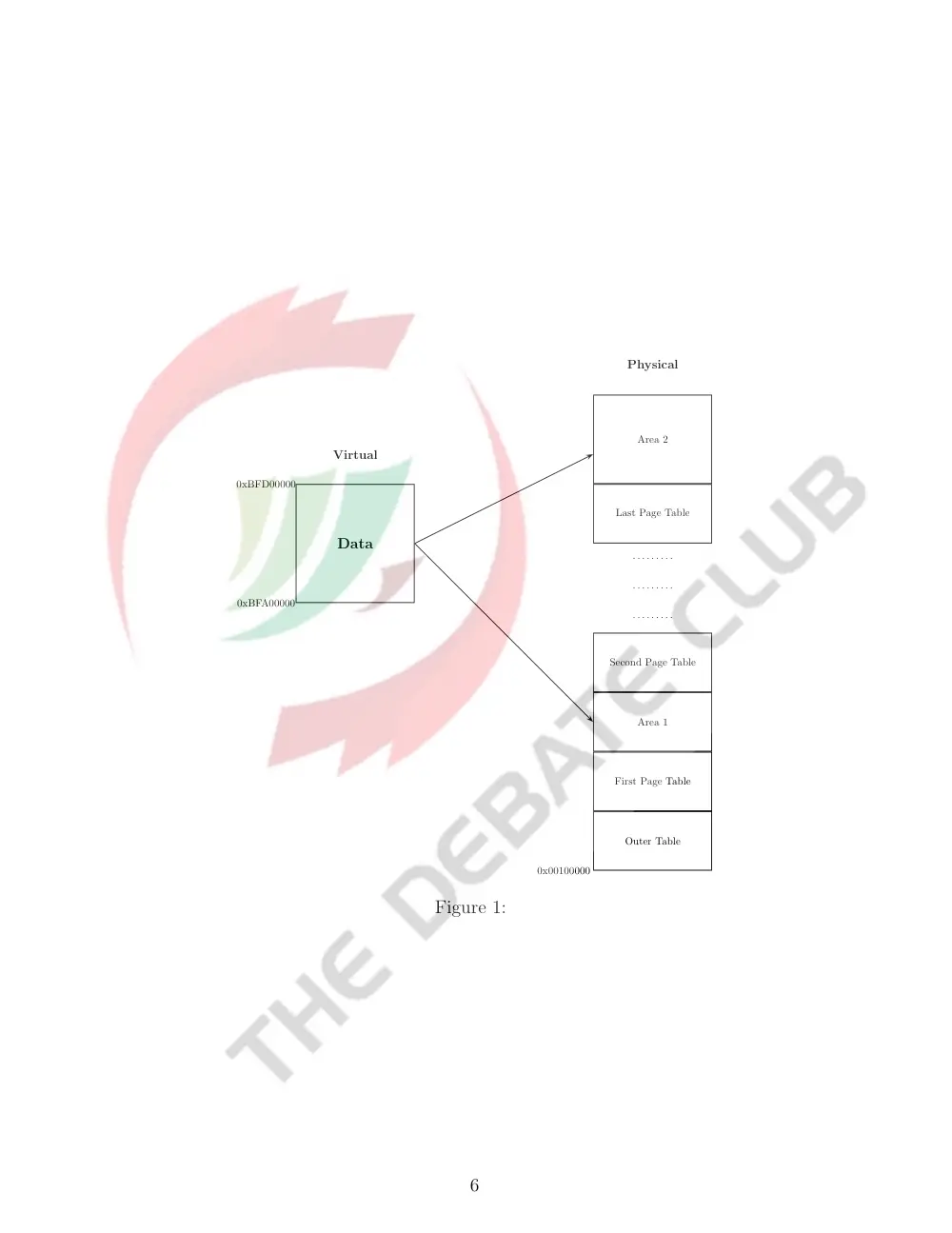
11. (15pts) A 32-bit system has a 2-level page structure with 4kb page
size. A process requests a 3MB data section and has been allocated
two areas in memory, Area 1 is 1MB and Area 2 is 2MB. The virtual
and physical memory layouts are shown in figure 1 below.
(a) Determine the number of valid entries in the directory table and
their values.
(b) Set up the corresponding page tables. For each table specify the
valid entries and their values.
(c) Suppose that Area 1 and Area 2 are swapped out to disk while
the tables are still resident in memory. The process accesses , in
sequence, all 1024 elements of an integer array. How many page
faults does this operation cause? (Hint: the answer depends on
whether the first element of the array starts at a page boundary
or not)
5
Virtual
Data
0xBFA00000
0xBFD00000
Physical
Area 2
Area 1
Last Page Table
. . . . . . . . .
. . . . . . . . .
. . . . . . . . .
Second Page Table
First Page Table
Outer Table
0x00100000
Figure 1:
6