
CSC 414 Notes, Spring 2007
Notre Dame University–Louaize · Applied Operating Systems · 12 pages · Dr. Khaldoun El-Khaldi



Showing the first 10 of 12 pages. Download the PDF to see all of it.
More CSC 414 files
Show the text of this notes
CSC 414 Final
Chapter 10
Memory Management
- The memory management portion of the Operating System is responsible for the
efficient usage of main memory, especially in a multiprogramming environment
where processes contend for memory.
- It must also offer protection of one process address space from another (including
protection of system address space from user processes).
- The memory subsystem should also provide programmers with a convenient logical
or virtual address space, in which the low-level details of memory management are
hidden.
Sharing of Memory
Issues
Allocation schemes
Protection from each other
Protecting OS code
Translating logical addresses to physical
Swapping programs
What if physical memory is small: Virtual memory
Memory Management Strategies
1
Fetch Strategy:
Determine when to load and how much to load at a time. E.g., demand fetching,
anticipated fetching (pre-fetching).
2
Placement (or allocation) Strategy:
Determine where information is to be placed.
E.g., Best-Fit, First-Fit, Buddy-System.
3
Replacement Strategy:
Determine which memory area is to be removed under contention conditions.
E.g., LRU, FIFO.
Memory Management Evolution
- Variations
1
Fixed Partitions
1
Variable Partitions
1
Segmentation
Page 1 of 12
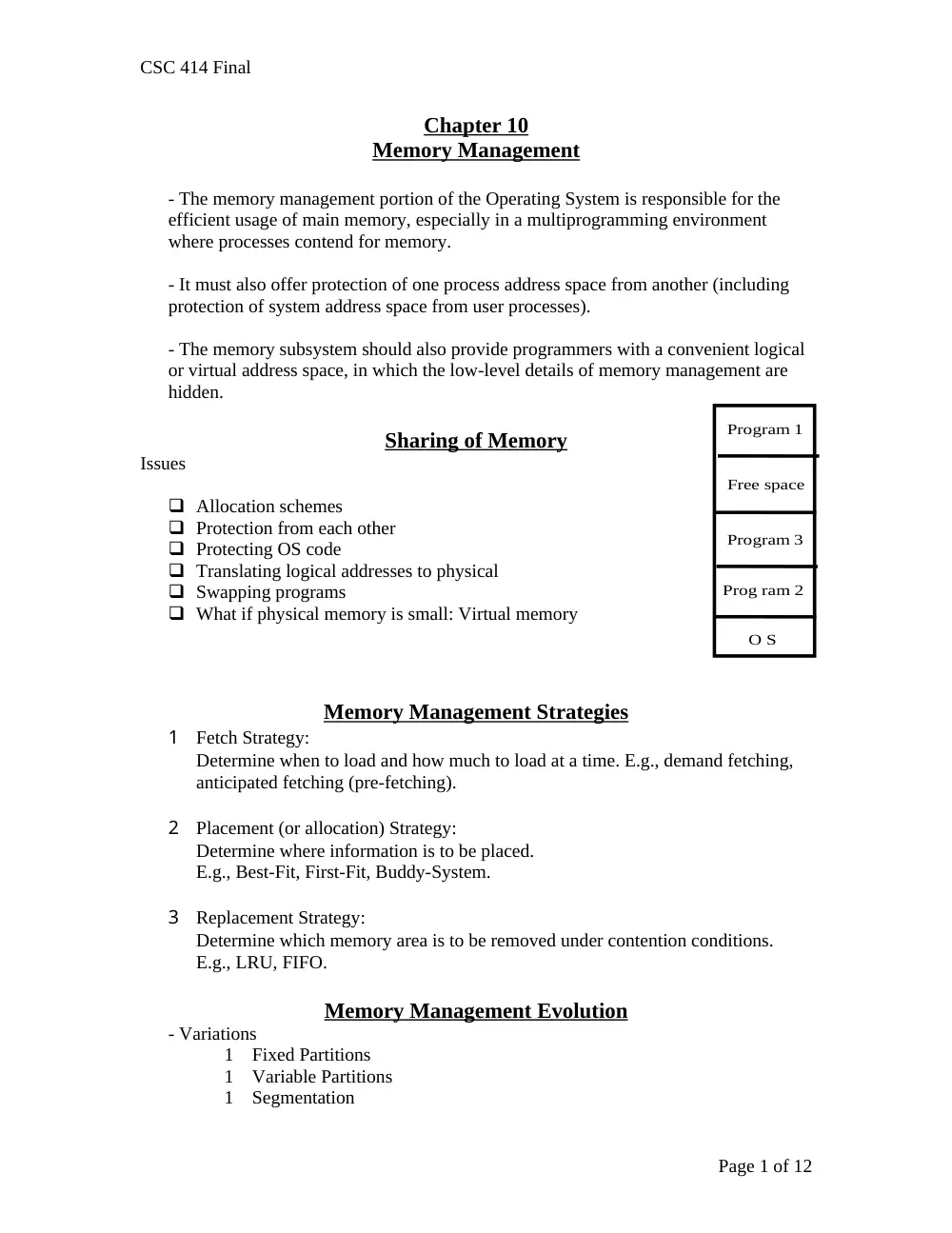
Prog ram 2
O S
Program 3
Free space
Program 1
CSC 414 Final
1
Paging
- Criteria
1
How efficiently can it be implemented?
1
How effectively can the physical memory be utilized?
Fixed Partitions
1
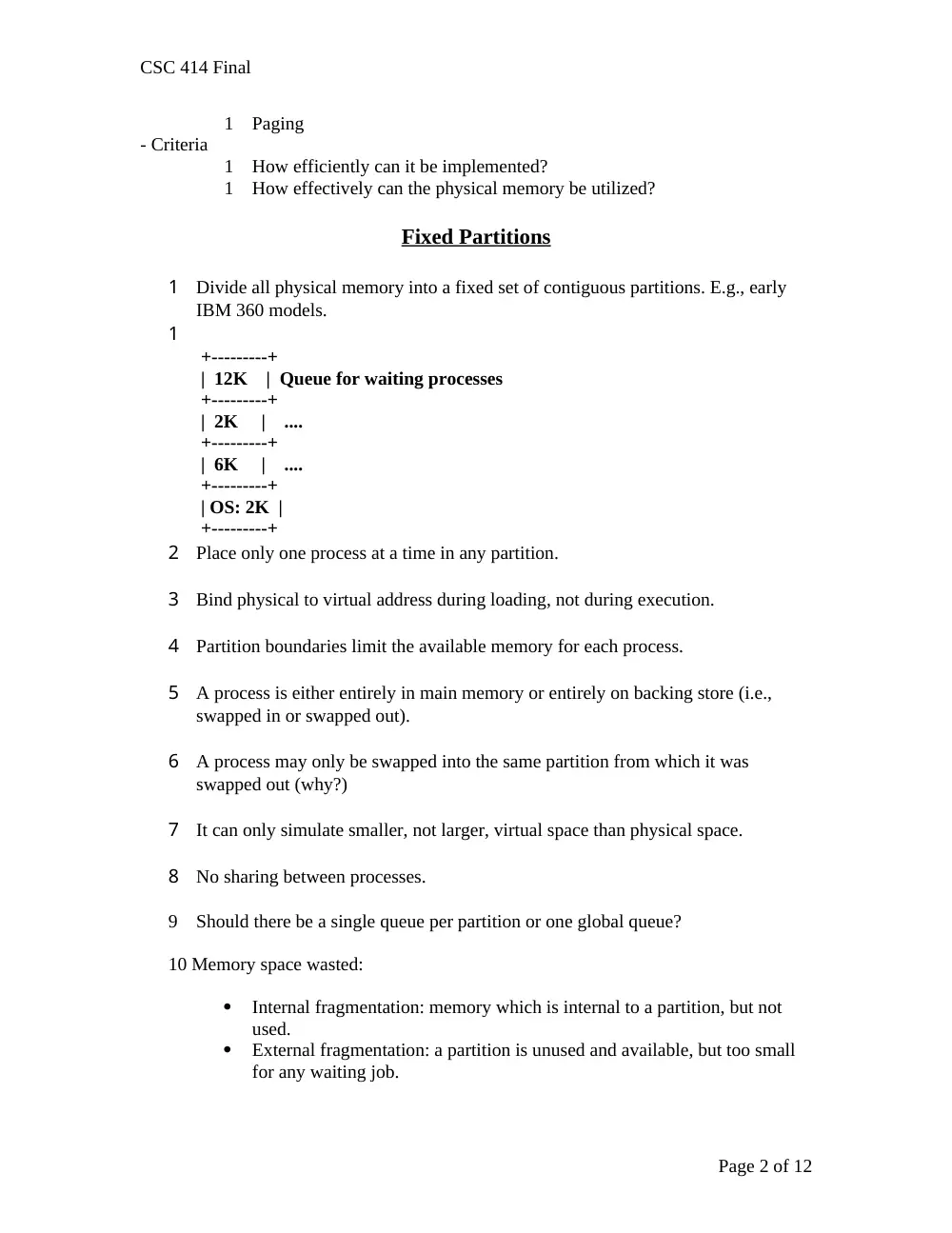
Divide all physical memory into a fixed set of contiguous partitions. E.g., early
IBM 360 models.
1
+---------+
| 12K | Queue for waiting processes
+---------+
| 2K | ....
+---------+
| 6K | ....
+---------+
| OS: 2K |
+---------+
2
Place only one process at a time in any partition.
3
Bind physical to virtual address during loading, not during execution.
4
Partition boundaries limit the available memory for each process.
5
A process is either entirely in main memory or entirely on backing store (i.e.,
swapped in or swapped out).
6
A process may only be swapped into the same partition from which it was
swapped out (why?)
7
It can only simulate smaller, not larger, virtual space than physical space.
8
No sharing between processes.
9
Should there be a single queue per partition or one global queue?
10 Memory space wasted:
Internal fragmentation: memory which is internal to a partition, but not
used.
External fragmentation: a partition is unused and available, but too small
for any waiting job.
Page 2 of 12
CSC 414 Final
Managing Free Space: Linked Lists
- Each record has
Process ID/ Free (H: hole)
Start location
Size
Pointer to Next record
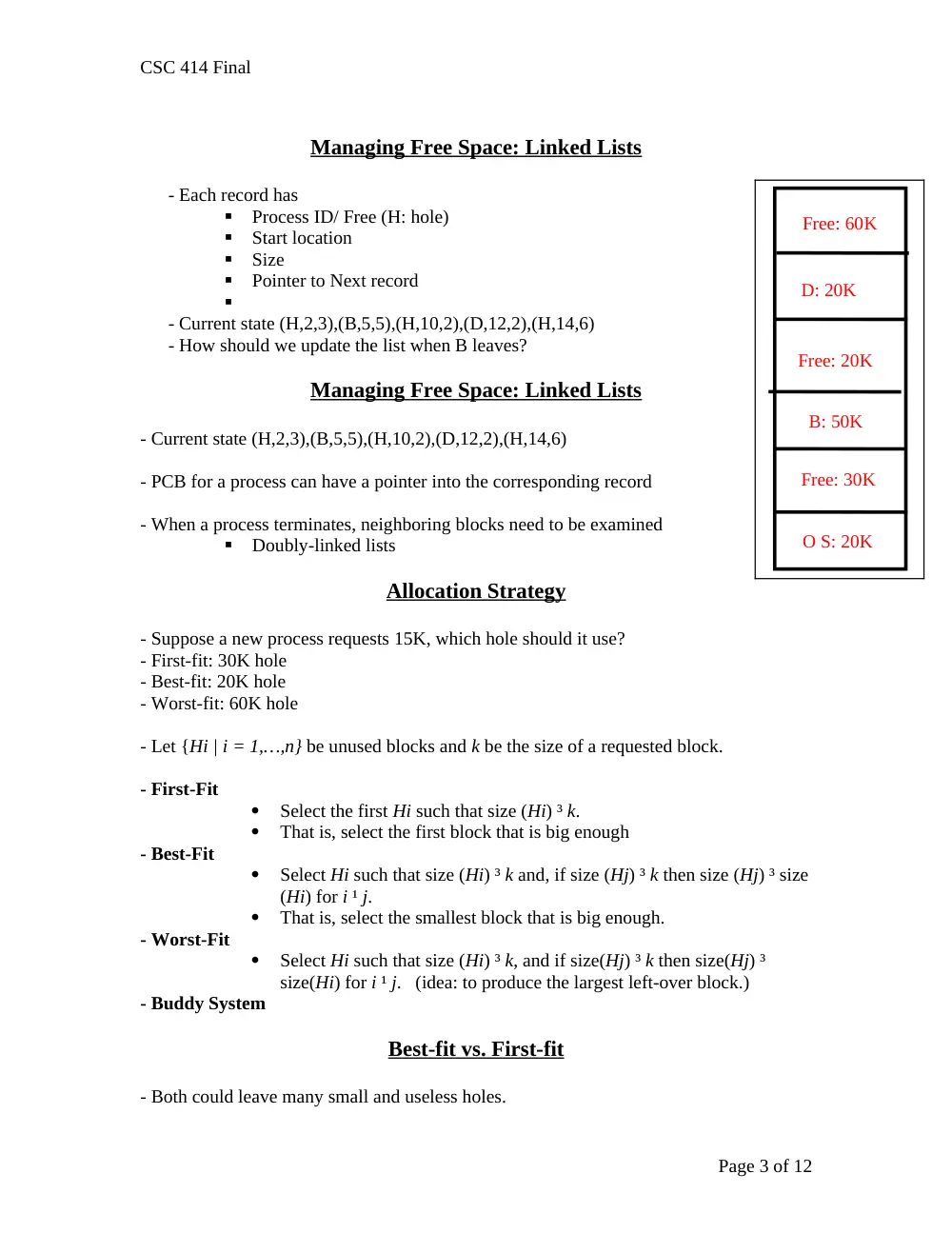
- Current state (H,2,3),(B,5,5),(H,10,2),(D,12,2),(H,14,6)
- How should we update the list when B leaves?
Managing Free Space: Linked Lists
- Current state (H,2,3),(B,5,5),(H,10,2),(D,12,2),(H,14,6)
- PCB for a process can have a pointer into the corresponding record
- When a process terminates, neighboring blocks need to be examined
Doubly-linked lists
Allocation Strategy
- Suppose a new process requests 15K, which hole should it use?
- First-fit: 30K hole
- Best-fit: 20K hole
- Worst-fit: 60K hole
- Let {Hi | i = 1,…,n} be unused blocks and k be the size of a requested block.
- First-Fit
Select the first Hi such that size (Hi) ³ k.
That is, select the first block that is big enough
- Best-Fit
Select Hi such that size (Hi) ³ k and, if size (Hj) ³ k then size (Hj) ³ size
(Hi) for i ¹ j.
That is, select the smallest block that is big enough.
- Worst-Fit
Select Hi such that size (Hi) ³ k, and if size(Hj) ³ k then size(Hj) ³
size(Hi) for i ¹ j. (idea: to produce the largest left-over block.)
- Buddy System
Best-fit vs. First-fit
- Both could leave many small and useless holes.
Page 3 of 12
Free: 30K
O S: 20K
Free: 20K
B: 50K
Free: 60K
D: 20K
CSC 414 Final
- To shorten search time for First-Fit, start the next search at the next hole following the
previously selected hole.
- Best-Fit performs better: Assume holes of 20K and 15K, requests for 12K followed by
16K can be satisfied only by best-fit
- First-Fit performs better: Assume holes of 20K and 15K, requests for 12K, followed by
14K, and 7K, can be satisfied only by first-fit
- In practice, F-F is usually better than B-F, and F-F and B-F are better than W-F.
-Allocation algorithm that forms basis of Linux memory management
- Suppose we have 128 units (128 pages or 128K)
- Each request is rounded up to powers of 2
- Initially a single hole of size 128
- Suppose, A needs 6 units, request rounded up to 8
- Smallest hole available: 128. Successively halved till hole of size 8 is created
- At this point, holes of sizes 8, 16, 32, 64
- Next request by B for 5 units: hole of size 8 allocated
-Next request by C for 24 units: hole of size 32 allocated
Chapter 11
Lecture Note: Virtual Memory
- Recall: memory allocation with variable partitions requires mapping logical addresses
to physical addresses
- Virtual memory achieves a complete separation of logical and physical address-spaces
Page 4 of 12
64H
32C
16H
8A
8B
64H
32C
8A
8B
8H
4
H4
D
D requests 3
64H
32C
16H
8H
4
H4
D
B exits
64H
32C
8H
8B
8H
4
H4
D
A exits
CSC 414 Final
Today, typically a virtual address is 32 bits, this allows a process to have 4GB of virtual
memory
Physical memory is much smaller than this, and varies from machine to
machine
Virtual address spaces of different processes are distinct
- Structuring of virtual memory
Paging: Divide the address space into fixed-size pages
Segmentation: Divide the address space into variable-size segments
(corresponding to logical units)
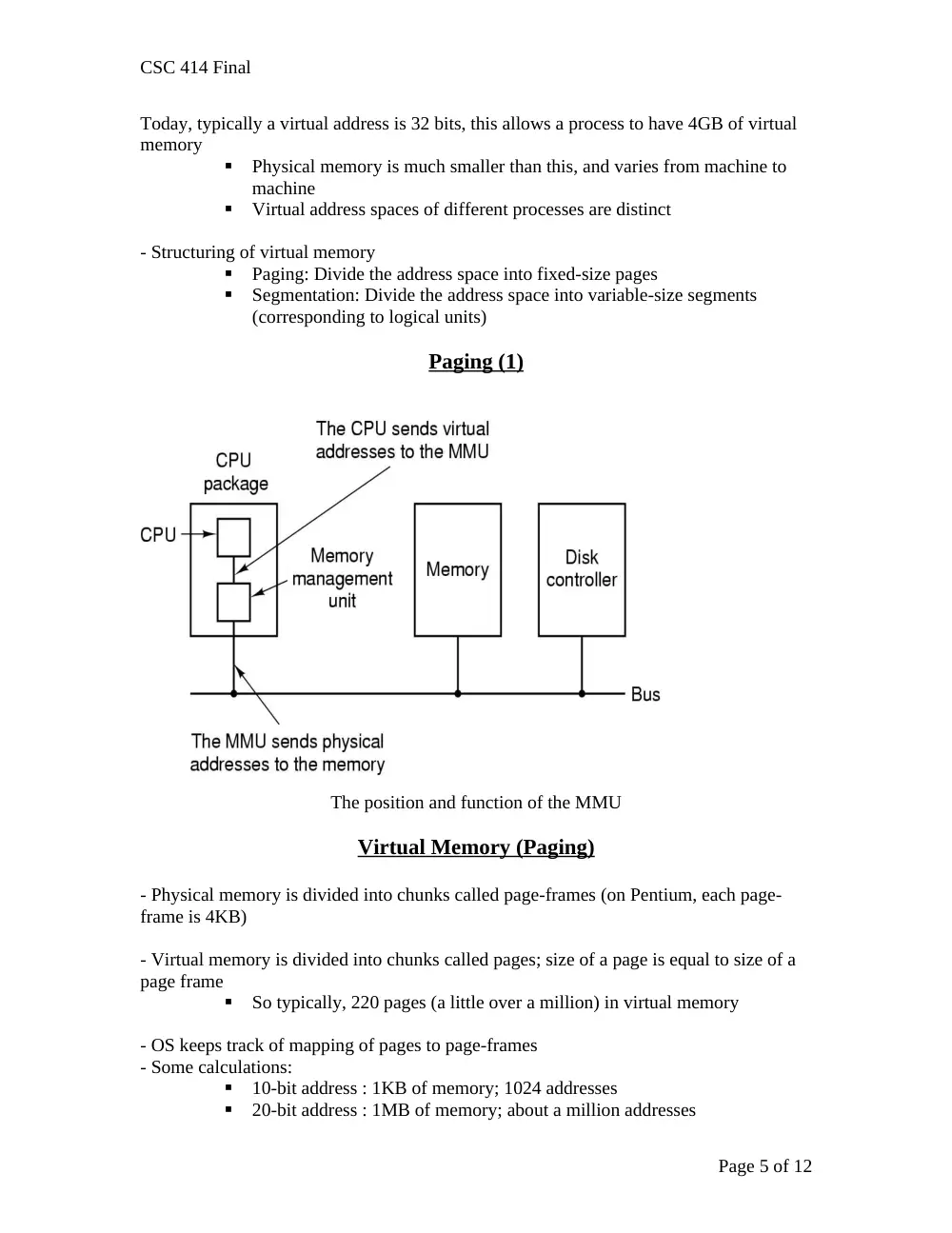
Paging (1)
The position and function of the MMU
Virtual Memory (Paging)
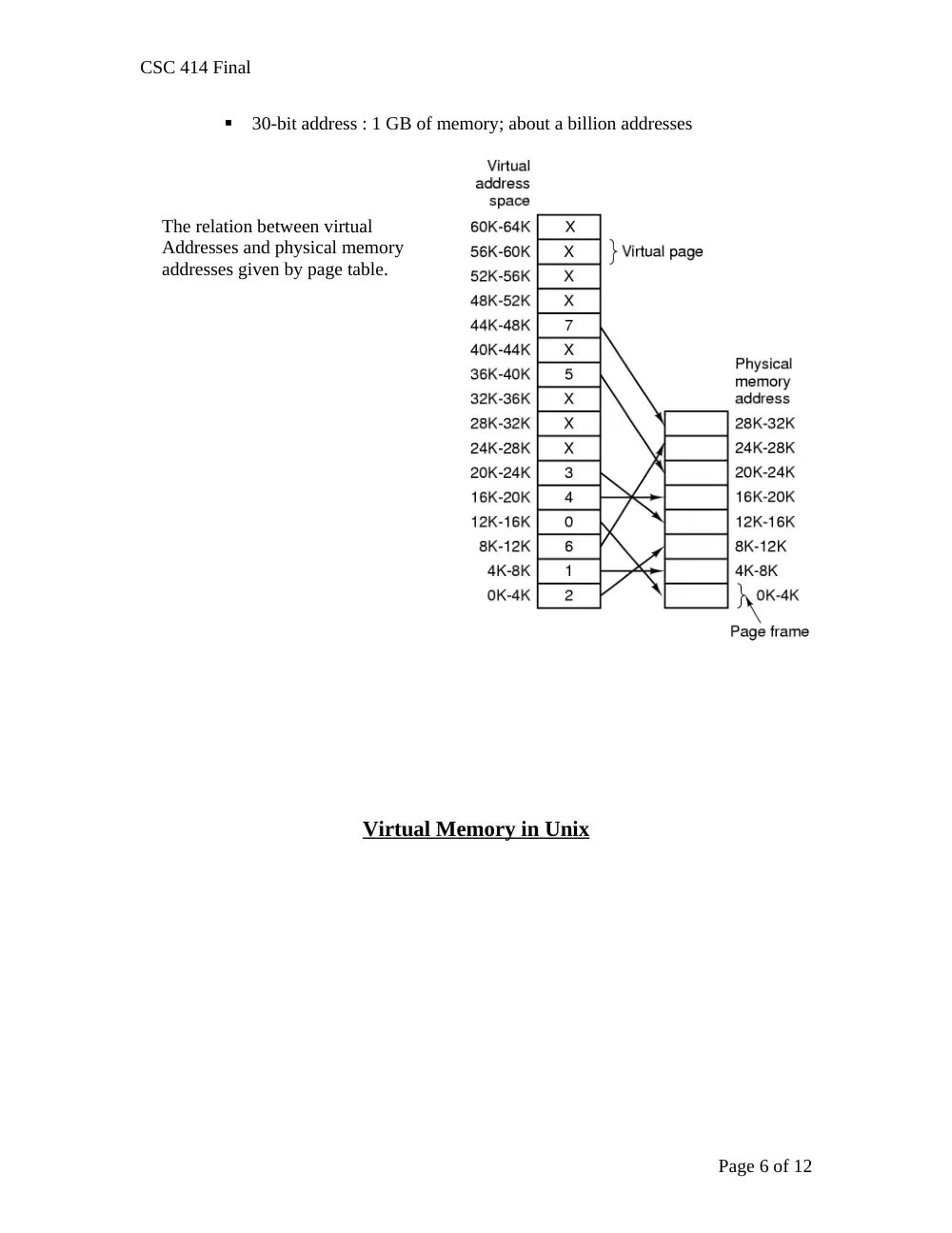
- Physical memory is divided into chunks called page-frames (on Pentium, each page-
frame is 4KB)
- Virtual memory is divided into chunks called pages; size of a page is equal to size of a
page frame
So typically, 220 pages (a little over a million) in virtual memory
- OS keeps track of mapping of pages to page-frames
- Some calculations:
10-bit address : 1KB of memory; 1024 addresses
20-bit address : 1MB of memory; about a million addresses
Page 5 of 12
CSC 414 Final
30-bit address : 1 GB of memory; about a billion addresses
Virtual Memory in Unix
Page 6 of 12
The relation between virtual
Addresses and physical memory
addresses given by page table.
CSC 414 Final
Paging
- A virtual address is considered as a pair (p,o)
Low-order bits give an offset o within the page
High-order bits specify the page p
- E.g. If each page is 1KB and virtual address is 16 bits, then low-order 10 bits give the
offset and high-order 6 bits give the page number
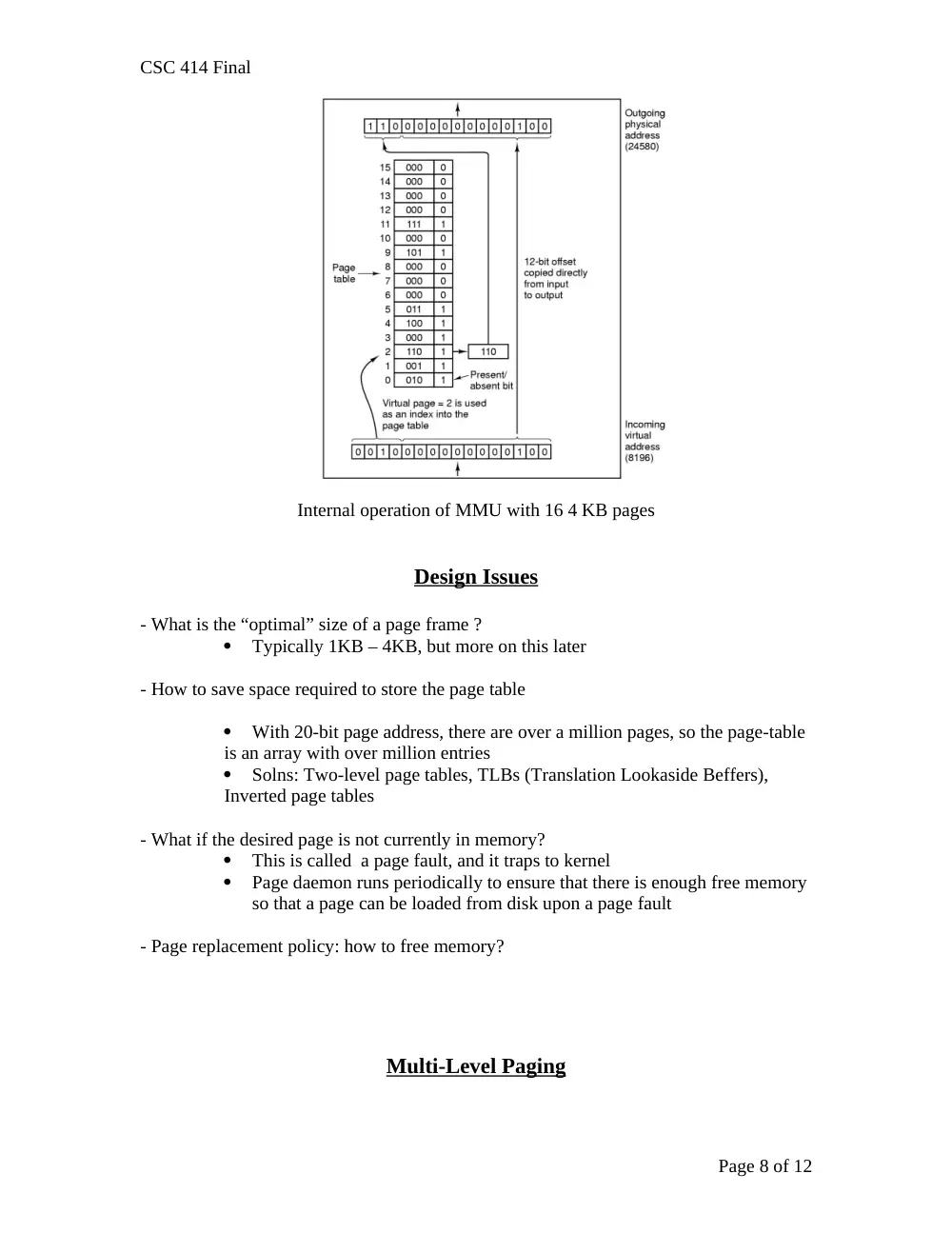
- The job of the Memory Management Unit (MMU) is to translate the page number p to a
frame number f
The physical address is then (f,o), and this is what goes on the memory bus
- For every process, there is a page-table (basically, an array), and page-number p is used
as an index into this array for the translation
Page Table Entry
- Validity bit: Set to 0 if the corresponding page is not in memory
- Frame number
Number of bits required depends on size of physical memory
- Protection bits:
Read, write, execute accesses
- Referenced bit is set to 1 by hardware when the page is accessed: used by page
replacement policy
- Modified bit (dirty bit) set to 1 by hardware on write-access: used to avoid writing when
swapped out
Page Tables (1)
Page 7 of 12
CSC 414 Final
Internal operation of MMU with 16 4 KB pages
Design Issues
- What is the “optimal” size of a page frame ?
Typically 1KB – 4KB, but more on this later
- How to save space required to store the page table
With 20-bit page address, there are over a million pages, so the page-table
is an array with over million entries
Solns: Two-level page tables, TLBs (Translation Lookaside Beffers),
Inverted page tables
- What if the desired page is not currently in memory?
This is called a page fault, and it traps to kernel
Page daemon runs periodically to ensure that there is enough free memory
so that a page can be loaded from disk upon a page fault
- Page replacement policy: how to free memory?
Multi-Level Paging
Page 8 of 12
CSC 414 Final
- Keeping a page-table with 220 entries in memory is not viable
- Solution: Make the page table hierarchical
Pentium supports two-level paging
- Suppose first 10-bits index into a top-level page-entry table T1 (1024 or 1K entries)
- Each entry in T1 points to another, second-level, page table with 1K entries (4 MB of
memory since each page is 4KB)
- Next 10-bits of physical address index into the second-level page-table selected by the
first 10-bits
- Total of 1K potential second-level tables, but many are likely to be unused
- If a process uses 16 MB virtual memory then it will have only 4 entries in top-level
table (rest will be marked unused) and only 4 second-level tables
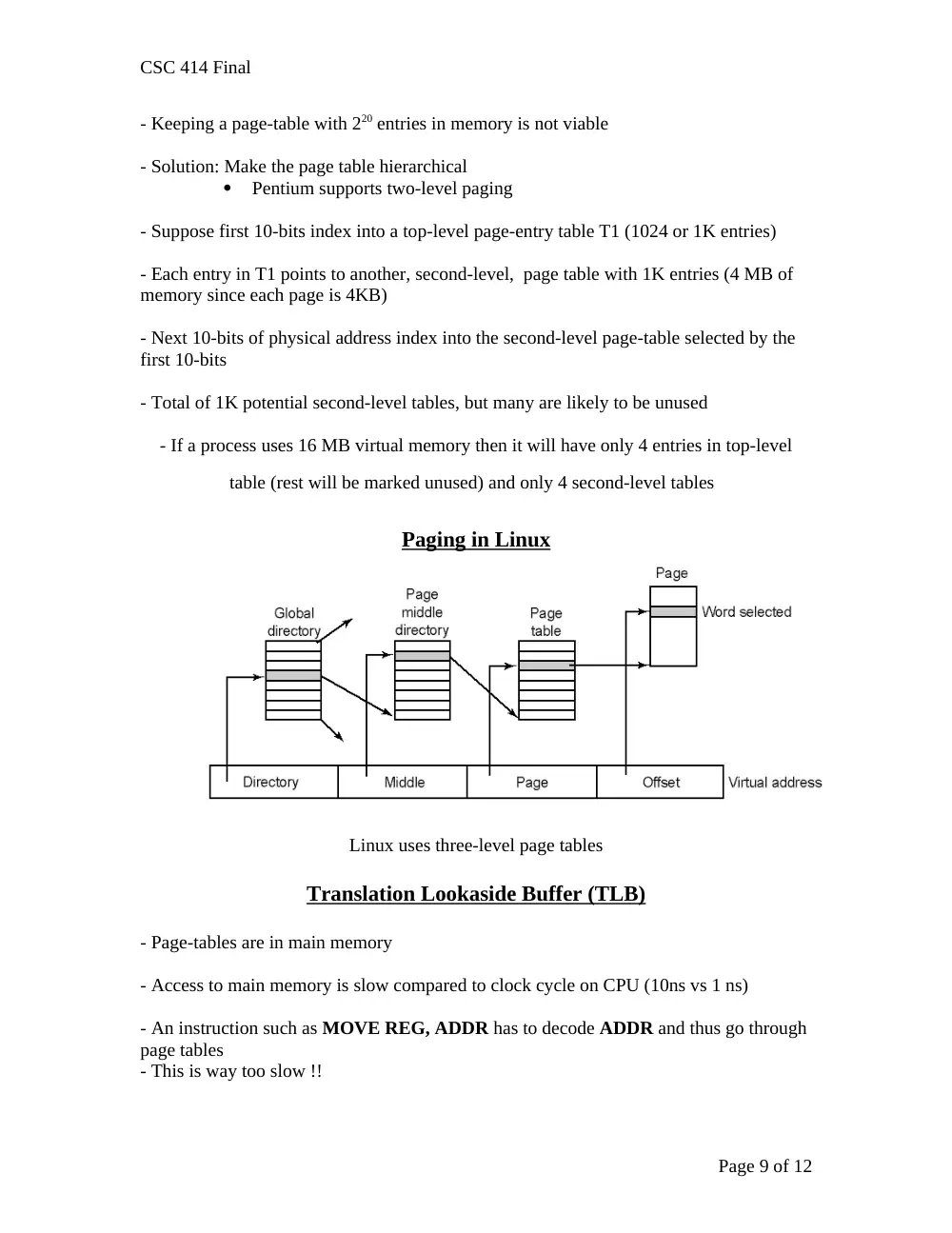
Paging in Linux
Linux uses three-level page tables
Translation Lookaside Buffer (TLB)
- Page-tables are in main memory
- Access to main memory is slow compared to clock cycle on CPU (10ns vs 1 ns)
- An instruction such as MOVE REG, ADDR has to decode ADDR and thus go through
page tables
- This is way too slow !!
Page 9 of 12
CSC 414 Final
- Standard practice: Use TLB stored on CPU to map pages to page-frames
- TLB stores small number (say, 64) of page-table entries to avoid the usual page-table
lookup
- TLB is associative memory and contains, basically, pairs of the form (page-no, page-
frame)
- Special hardware compares incoming page-no in parallel with all entries in TLB to
retrieve page-frame
- If no match found in TLB, standard look-up invoked
More on TLB
- Key design issue: how to improve hit rate for TLB?
Which pages should be in TLB: most recently accessed
- Who should update TLB?
Modern architectures provide sophisticated hardware support to do this
Alternative: TLB miss generates a fault and invokes OS, which then
decides how to use the TLB entries effectively.
Inverted Page Tables
- When virtual memory is much larger than physical memory, overhead of storing page-
table is high
- For example, in 64-bit machine with 4KB per page and 256 MB memory, there are 64K
page-frames but 252 pages !
- Solution: Inverted page tables that store entries of the form (page-frame, process-id,
page-no)
- At most 64K entries required!
Page 10 of 12
Page number
Frame number
Modified bit
Protection bits
CSC 414 Final
- Given a page p of process x, how to find the corresponding page frame?
- Linear search is too slow, so use hashing
- Note: issues like hash-collisions must be handled
- Used in some IBM and HP workstations; will be used more with 64-bit machines
Hashed Page Tables
Steps in Paging
- Today’s typical systems use TLBs and multi-level paging
- Paging requires special hardware support
- Overview of steps
Input to MMU: virtual address = (page p, offset o)
Check if there is a frame f with (p,f) in TLB
If so, physical address is (f,o)
If not, lookup page-table in main memory ( a couple of accesses due to multi-level paging)
If page is present, compute physical address
If not, trap to kernel to process page-fault
Page 11 of 12
Page number
Offset
Hash
Page #
Frame #
Hash table
Number of entries: Number of page frames
PID
PID
CSC 414 Final
Update TLB/page-table entries (e.g. Modified bit)
Page 12 of 12