
MAT 224 Final, Fall 2015
Notre Dame University–Louaize · Calculus IV · 9 pages



More MAT 224 files
Show the text of this final exam
NDU
MAT 224
Calculus IV
Final Exam
Thursday, June 16, 2016
Duration: 2 hours
Name
Section
Instructor
Cell phones are forbidden
You have®exercises an@ $ pages.
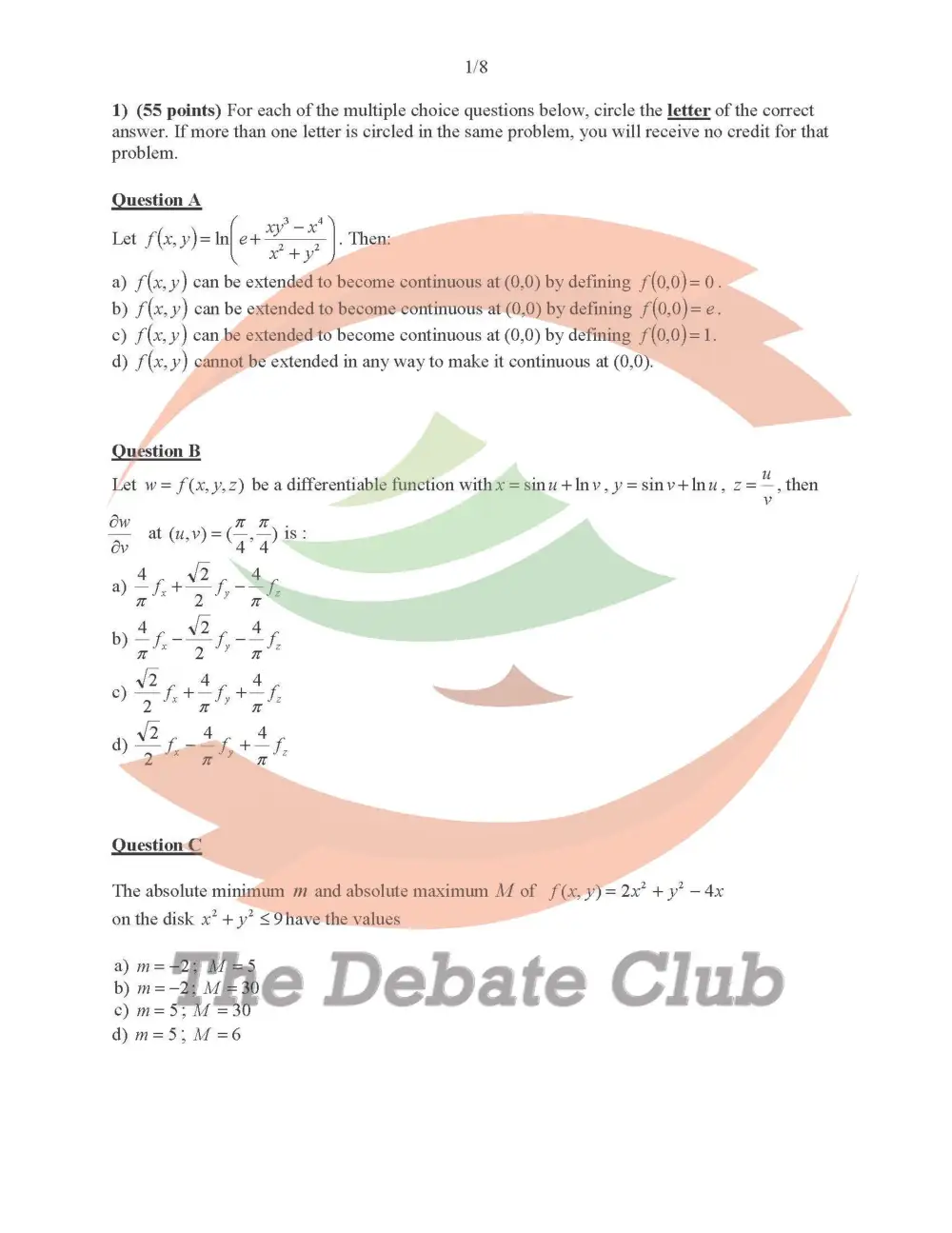
1/8
1) 65 points) For each of the multiple choice questions below, circle the letter of the correct
answer. If more than one letter is circled in the same problem, you will receive no credit for that
problem.
Question A
3 4.4
Let flxy)= {es = a } Then:
x+y
a) f(xy) can be extended to become continuous at (0,0) by defining f (0.0) =0
b) f(x,3) can be extended to become continuous at (0,0) by defining f(0,0) =e.
c) f(x¥) can be extended to become continuous at (0,0) by defining f(0,0) =]
d) f' (x, y) cannot be extended in any way to make it continuous at (0,0).
Question B
Let w= f(x, y,Z) be a differentiable function withy =sinu+Inv,y=sinv+Inu, z= a , then
v
ow
hm.
at (u,v) =(—,—) 18:
(ay) “Cap
Vv
an Ane2y Neg
vi 2 Fi
pln lly +e
a 2 a
bp Baty
a) 2 pte Ay
2 ca a
Question-C
The absolute minimum mm and absolute maximum Af of f(x, y)= 2x? + y? —4x
on the disk x* + y? <9 have the values
a) m= 72, M55
b) m=-2; ME 30
c) m=5; M =30
d) m=5; M=6
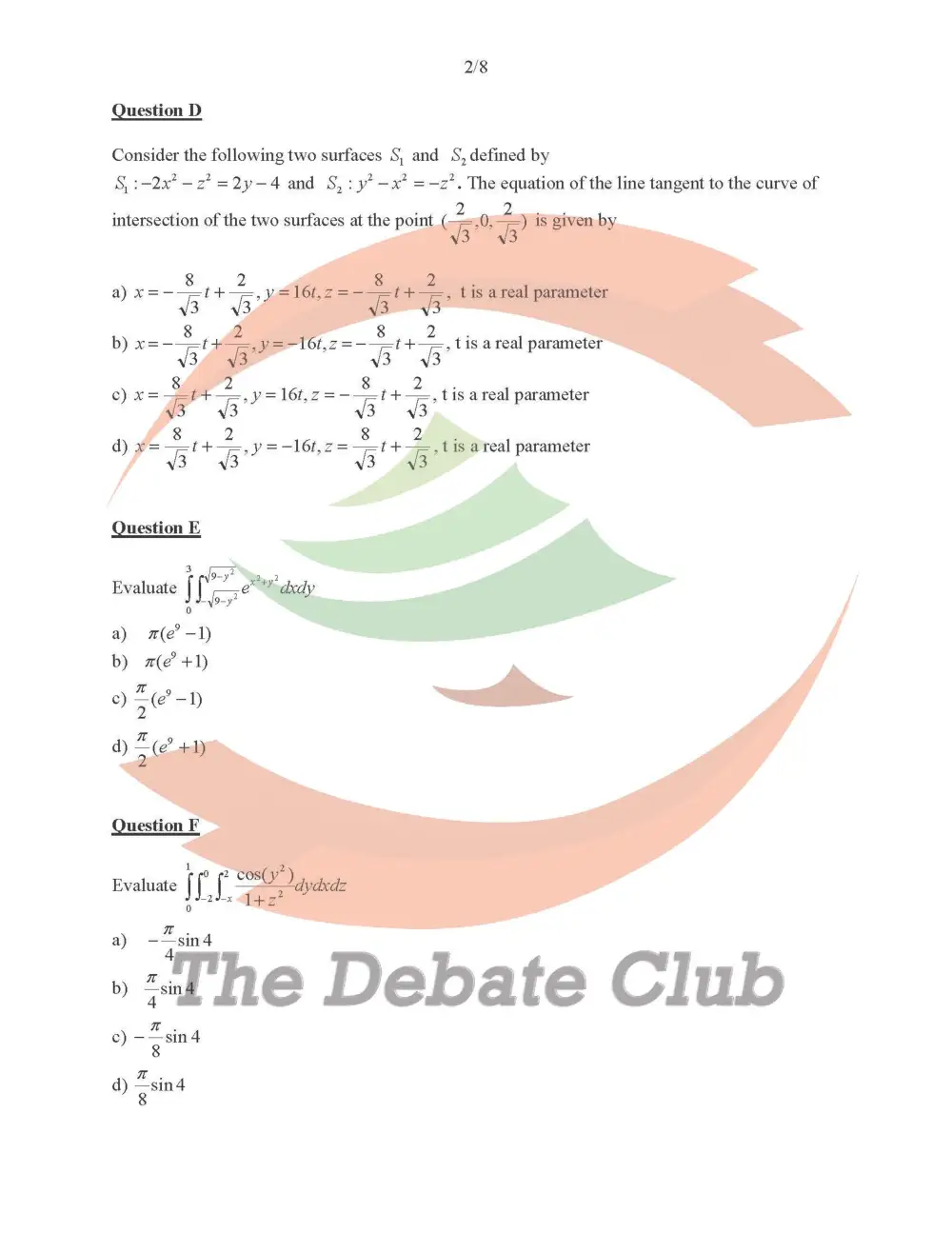
2/8
Question D
Consider the following two surfaces S, and S, defined by
S,:-2x?-2? =2y—4 and S,: y? =x? =-z". The equation of the line tangent to the curve of
2
intersection of the two surfaces at the poin
8 Q ai
——=t+-——, tis areal parameter
3 V3
——, tis areal parameter
a) a(e?-l)
b) a(e? +1)
a
2) Fed
Evaluate i ty
—* sin
» The Debate Club
d) “sin4
8
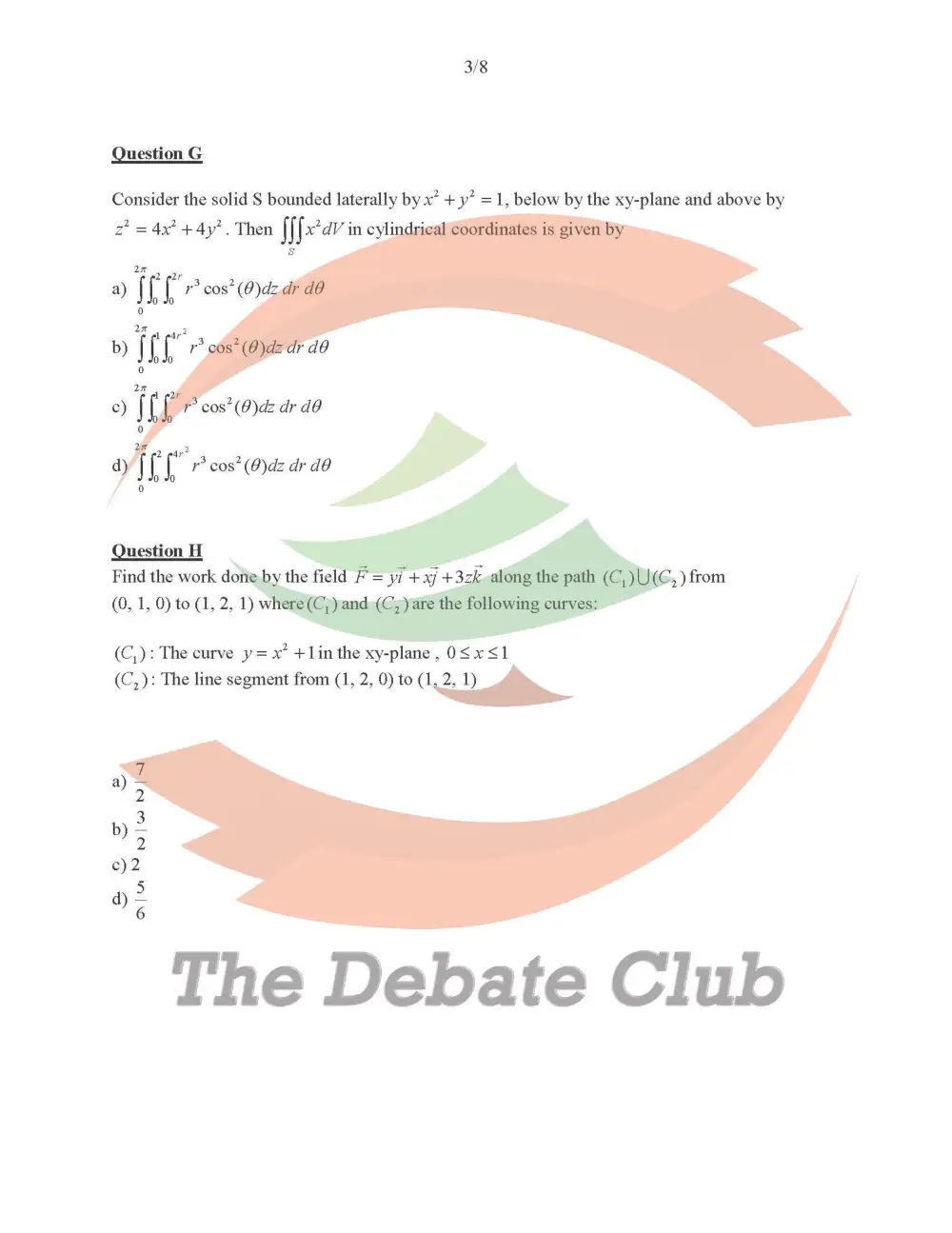
3/8
Question G
Consider the solid $ bounded laterally by x’ + y’ = 1, below by the xy-plane and above by
2 = 4x? +4y*. Then [[fx"d¥’ in cylindri
5
Find the work do:
/ =yi tay+3
(0, 1, 0) to (1, 2, 1) w
(C,): The curve y= x° +1in the xy-plane , 0S x <1
(C,): The line segment from (1, 2, 0) to (1, 2, 1) _*
2
a
or
ala Mwliwnr
oO
The Debate Club
4/8
Question I
Apply Green’s theorem to evaluate fe — yjde+(2Qxy+ y’)dy, where C is the boundary of the
CG
region in the first quadrant enclosed by the x-axis, the line x =1, and the curve y=x’.
8
15
Question J Consider the integral ff +y)cos(3y—x)dydx, where R is the triangular region in
R
the xj-plane bounded by the lines y = 0, =—x, and 3y—x=4. Let G be the region in the uy-
plane which is the image of R under the transformation u=3y—x and. v=x+y. Then
Part 1 ffie+ cosBy—x)dydx =
a) — [[ 4vcosududv
G
b) {f-rcosudtuay
G
fe) Way cos ududy
d) ff 4y cos ududy
G
Part 2: The region G in the uv -plane is bounded by the lines:
a)u=4,u>—-y, v=0
b) 3v-#34° 4 Sy = 0
c)u=4,u=9, p33
d)u=3, u=3v, y=0
5/8
2) (24 points)
a)(12points) Let D be the region that is bounded from below by z = 1 and from above by
x? + jy +z’ =4. Sketch D and set up triple integrals in spherical coordinates representing
its volume according to the order of integrationdp dé dé.
b) (12 points) Set up triple integrals in — its volume ac
to the order of integrationdd dp d@
The Debate Club
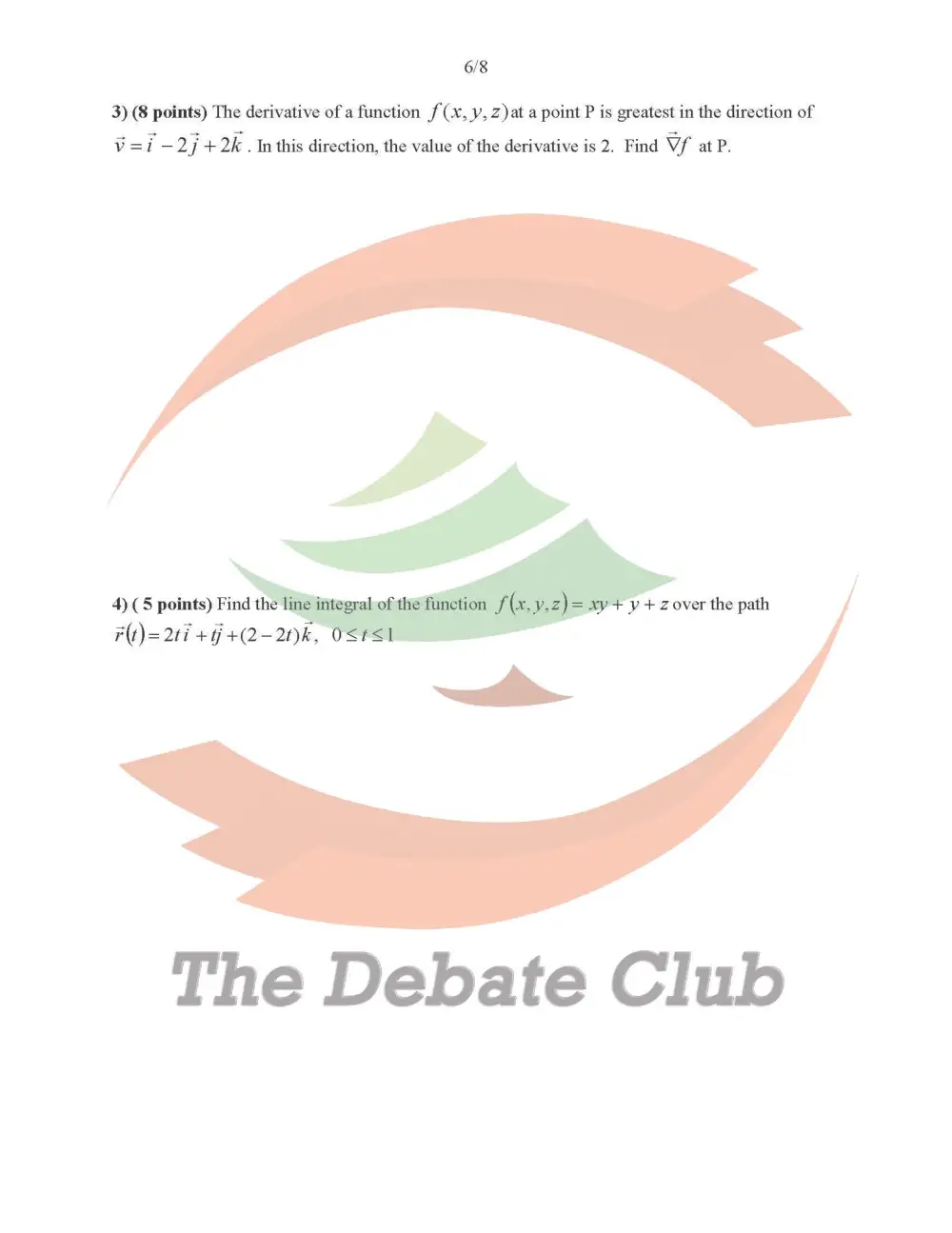
3) (8 points) The derivative of a function f(x, y,Z)at a point P is greatest in the direction of
vai ~2} +2k In this direction, the value of the derivative is 2. Find Vf “at P.
4) (5 points) Find th t y+ zover the path
#(t)= 207 +9 +(2-20k,
The Debate Club
78
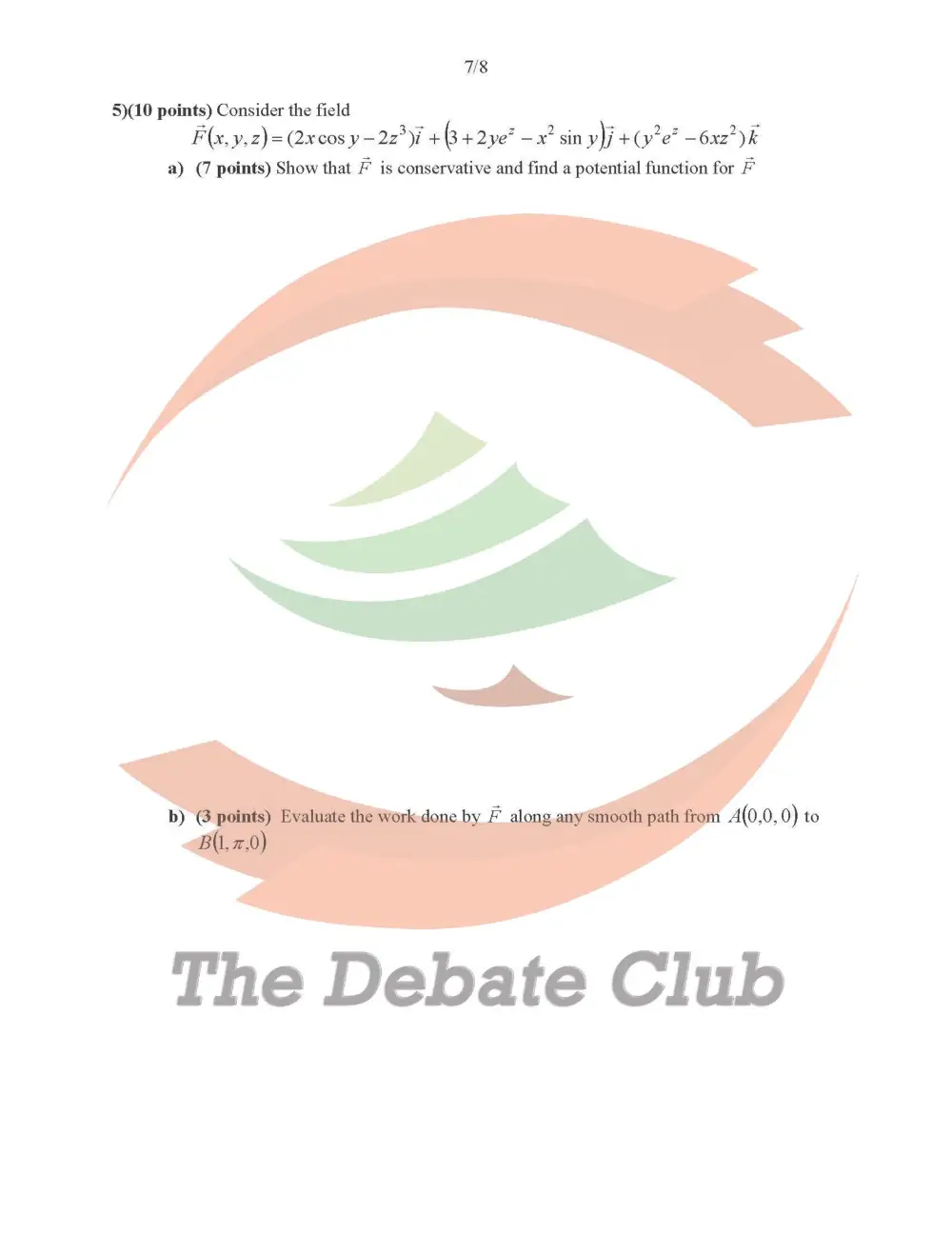
5)(10 points) Consider the field :
F (x.y. z)=(2xcos y 22°) +6 +2ye? — x" sin yy +(e? -6x2")k
a) (7 points) Show that F’ is conservative and find a potential function for F
The Debate Club
8/8
6) (8 points) Use Green’ s theorem to find the outward flux for the field
B= 2Qxy? b+x 2 2g across the curve (C): the boundary of the triangular region bounded by the
lines y=x, y=—x and p=1
—s
=—
The Debate Club