
MAT 335 Final, Spring 2002
Notre Dame University–Louaize · Partial Differential Equations · 2 pages
More MAT 335 files
Show the text of this final exam
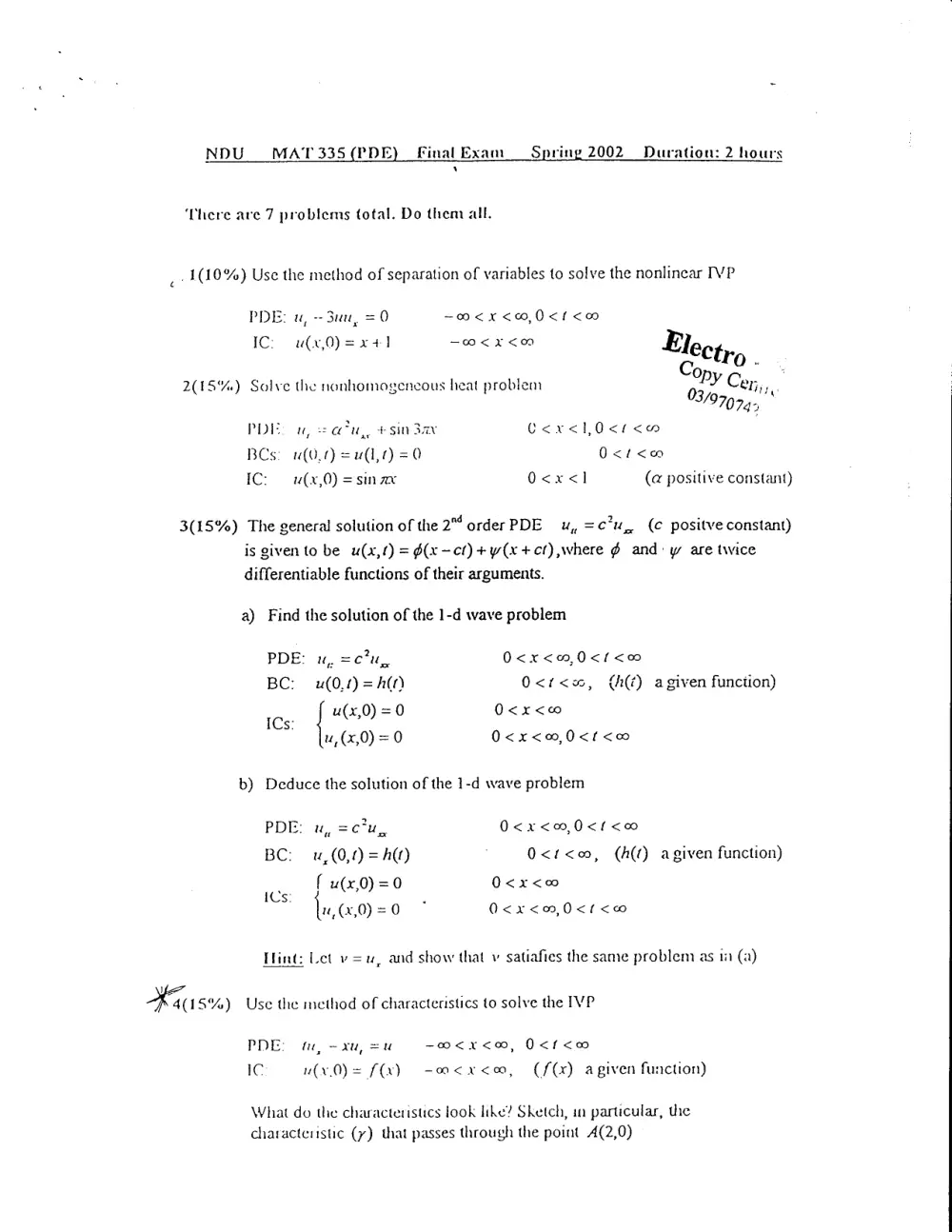
NDU MAT 335 (PDE) Final Exam Spring 2002 Duration: 2 hours
Ny
‘There ave 7 problems total. Do them all.
_ 110%) Use the method of separation of variables to solve the nonlinear IVP
PDE: u, -3uu, = 0 -am<x<w,0<1<o
IC: u(x,0)= x4) -o<x<o Elec
To
Co "
2(15%) Solve the nonhomogeneous heat problem Onn, Cer,
97074,
PDE. uw, = aru, + sin 3av C<x<lO0<i<m
BCs: u(0,9) =u(l,O =0 O<t<a
IC: u(x,0) = sin ax O0<x<l (a positive constant)
3(15%) The general solution of the 2" order PDE u, =c7u,, (c¢ positve constant)
is given to be u(x,1) = 6(x-cl)+y(x+cr),where ¢ and: y are twice
differentiable functions of their arguments.
a) Find the solution of the 1-d wave problem
PDE: u, =c7u,, 0<x<0,0</<a
BC: u(0,.)=h( O0<1<a«, (A(?) agiven function)
u(x,0) =0 0<xr<0
ICs:
u,(x,0) = 0 0<x<0,0<t<a@
b) Deduce the solution of the 1-d wave problem
PDE: u, =c7u,, 0<x<0,0<1<a
BC: u,(0,0 =hO . 0<s<oo, (A(t) agiven function)
fF ulx,0) =0 0<x <0
ICs: .
u,(x,0) = 0 Q<x<0,0<1<w
Hint Let v =u, and show that v satiafies the same problem as 10 (a)
Uz
Xs) Use the method of characteristics to solve the IVP
PDE: te ~ xu, =u -~a<x<wo, 0O<1<oa
IC u(v.0)= f(x) -a<x<m, (f(x) agiven function)
What do the characteristics look like? Sketch, in particular, the
characteristic (y) that passes through the point A(2,0)
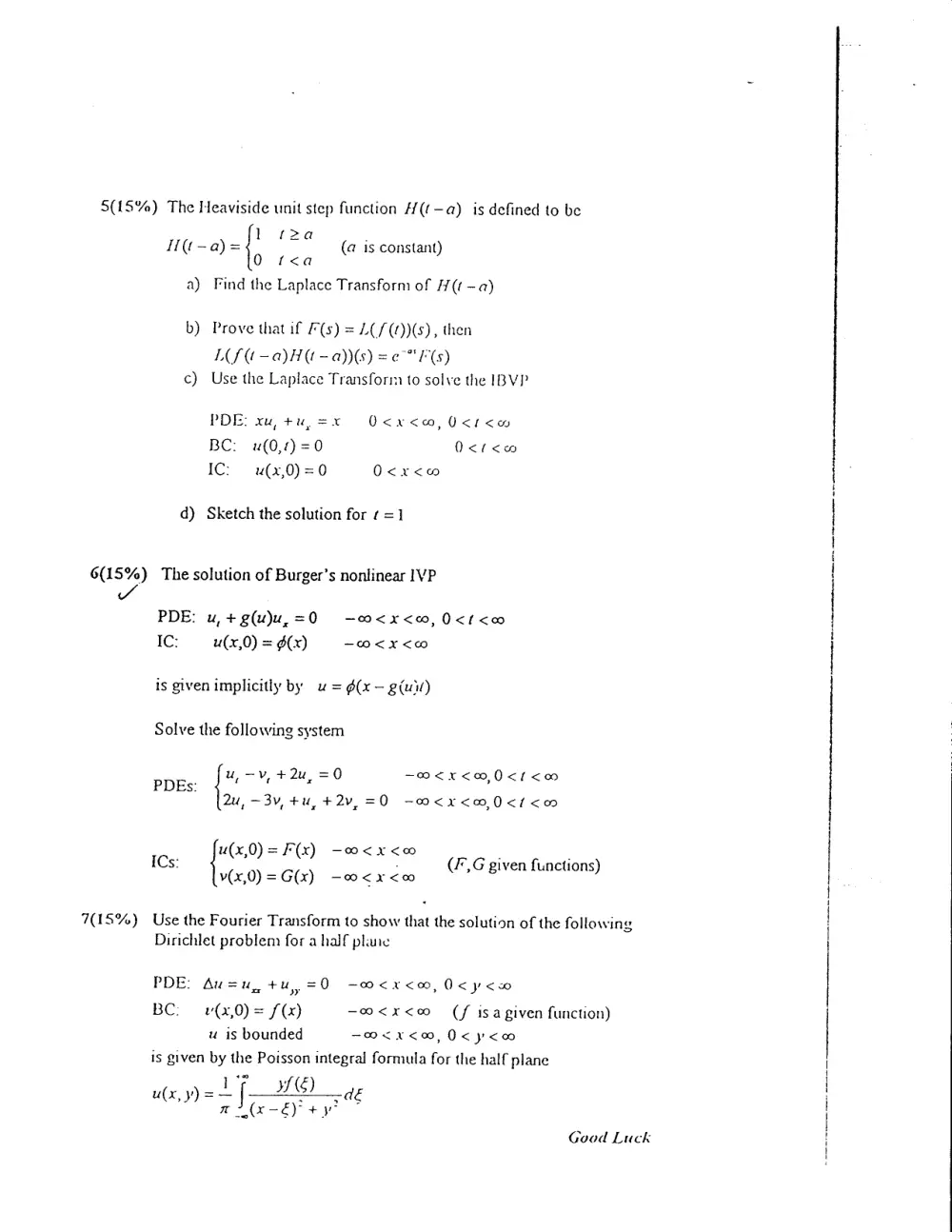
S(IS%) The Heaviside unit step function Af(¢—a) is defined to be
1 f2a
W(t-a)= { (a is constant)
0 {<a
a) Find the Laplace Transform of H(r-a)
b) Prove thatif F(s) = L(/())(s), then
Lf -a)H(t-a)f(s) =e" F'(s)
c) Use the Laplace Transform to solve the IBVP
PDE: xu,tu,=x O<x<w, 0<1<w
BC: u(0,1) =0 O<l<w
IC: u(x,0) =0 O<x<w
d) Sketch the solution for ¢=1
6(1S%) The solution of Burger’s nonlinear IVP
Y
PDE: u,+g(uju,=0 -ao<x<w, 0<t<o
Ic: u(x,0) = d(x) -oO<x<w
is given implicitly by u = ¢(x - g(ui/)
Solve the following system
u,—v,+2u, =0 ~a<x<0,0<1<a
PDEs:
2u,—3v,+u,+2v,=0 -w<x<m,0<1<m
=F -O<xX<H
ICs: {i =F) s (FG given functions)
v(x,0) =G(x) -a<x<0
715%) Use the Fourier Transform to show that the solution of the following
Dirichlet problem for a half pluie
PDE: Au=u, tu, =0 -w<x<mo, O<y<w
BC: u(x,0) = f(x) -a<x<o (/ isa given function)
u is bounded —-OM<X<O, O<j<w
is given by the Poisson integral formula for the half plane
i? /
us) = | LO a
ni(x-ép +"
Good Luck